







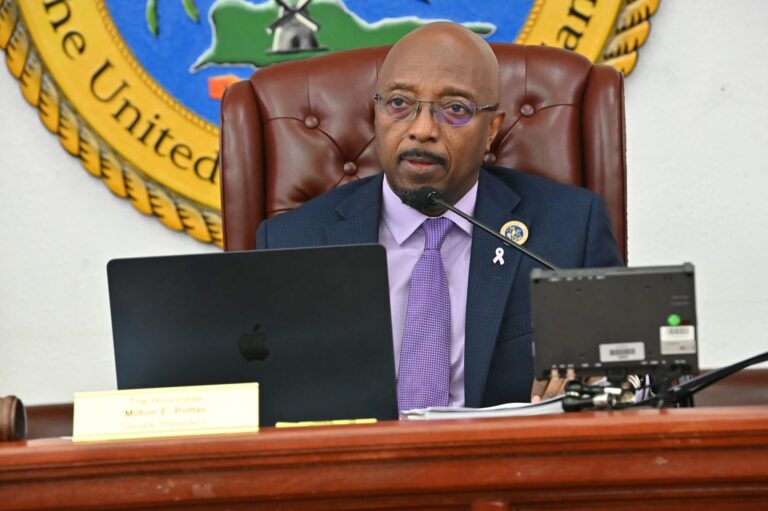
On Thursday, the Virgin Islands Senate advanced major bills covering health care, tax relief, infrastructure, public safety, and constitutional reform, while also addressing senior protections and cultural recognitions amid ongoing federal uncertainty.
The Senate unanimously approved Bill No. 36-0203, a resolution urging Congress to allow the territory full participation in the Affordable Care Act.
Lawmakers spoke candidly about the long-standing gap in access to federal health care benefits, noting that thousands of residents remain excluded from protections available to other U.S. citizens.
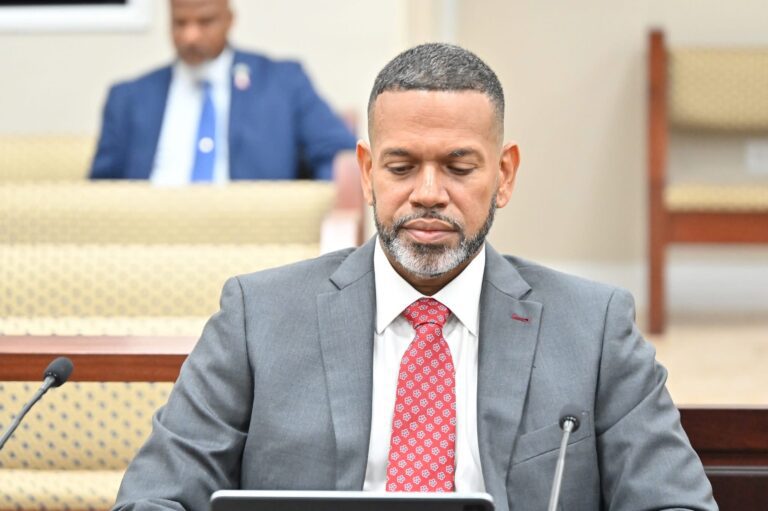
“There’s no access,” said Sen. Kurt A. Vialet, sponsor of the measure. “So this resolution is asking the government of the United States of America, Congress, the White House, the Senate, that while you argue … Americans in the Virgin Islands do not have that access. So we’re asking to be included.”
Vialet continued, “The irony is that Virgin Islanders have no access to the Affordable Care Act, not even the chance to decide whether they could afford it.”
The resolution passed by roll-call vote and now heads to Gov. Albert Bryan Jr. for transmittal to Congress.
The fate of the Randall “Doc” James Racetrack on St. Croix once again commanded the Senate’s attention. At the center of the debate, Bill No. 36-0119 seeks to reprogram $5 million to push forward improvements to the Racetrack, a sum lawmakers emphasized must remain fully dedicated to the project.
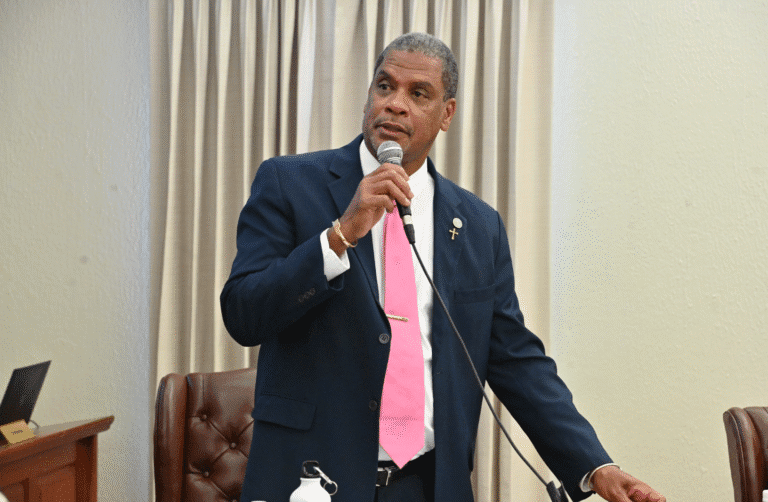
“Not a dime moving from this $5 million … not one penny,” declared Sen. Franklin D. Johnson, reflecting the chamber’s commitment to finally seeing the delayed improvements completed.
The bill also reinforced a $100 million contingency fund, serving as a fiscal safety net for critical infrastructure, including the racetrack. The funds would be released only if a federal government shutdown extends beyond Dec. 1, and could be used for operating or disaster-related expenses in the event of disrupted federal funding.
While some senators voiced exasperation over the project’s long delays, others expressed renewed cautious optimism, “We will just build little by little, right, and we’ll get it to where it should be,” said Sen. Marise C. James.
Ultimately, Bill No. 36-0119 passed by roll-call vote, accompanied by related amendments addressing appropriations and youth development programs.
Lawmakers also unanimously approved Bill No. 36-0083, initiating a 90-day amnesty period that waives penalties on overdue property, income, and gross-receipts taxes for all tax years.
Senators described the measure as a critical step for both residents facing economic hardship and the government itself, which has seen diminished tax collections in the wake of hurricanes Irma and Maria and ongoing fiscal challenges.
Advocates said the temporary amnesty would provide breathing room for families and businesses still struggling to recover, while also helping the government collect overdue taxes that might otherwise go unpaid.
“This is going to give us a little cushion, especially at a point in time where we’re not generating and bringing in revenues,” said Johnson.
In the same session, lawmakers advanced Bill No. 36-0201, which extends deadlines and provides additional funding to the Sixth Constitutional Convention. Senators commended the diverse group tasked with crafting a foundational document for the territory, expressing optimism that this effort could succeed where previous attempts have failed.
“We need to get it done. It’s been a lengthy process,” said Vialet. “We need to give them the opportunity to complete the job.”
The Elder and Dependent Adult Abuse Prevention Act was expanded to establish new multidisciplinary teams and grant broader authority to detect, intervene, and prevent abuse, a reform described by legislators as long overdue.
A bill lowering the legal blood alcohol limit for commercial drivers to 0.04% and prohibiting operation by anyone under the age of 21 with any detectable alcohol was also approved.
Another measure now also requires security personnel and investigators to complete lethal weapon training, a step aimed at strengthening public safety across the territory. Additional legislation rezoned land at Lindbergh Bay for affordable housing, updated technical structures for government boards and commissions, and enacted a series of honorific resolutions recognizing cultural and civic leaders.
All bills passed by roll-call vote and have been sent to Bryan for further action.


Senior Judge Jed Rakoff of the Southern District of New York ordered the unsealing after The New York Times and Dow Jones, The Wall Street Journal’s parent company, requested access to 158 exhibits that the territory submitted in 2023, believed to contain, among other things, financial statements for accounts belonging to Epstein or his victims.
In an August letter to the court, New York Times reporter Matthew Goldstein argued that “records documenting the flow of money into Epstein’s account from persons who may have been involved in his sexual abuse of minors and the flow of money to victims are of particular public interest at this time in light of allegations that the federal government has not been forthcoming in providing records from the Epstein investigation, despite promises to do so.”
Attorneys both for the territory and for JPMorgan agreed with the idea of unsealing the bulk of the documents except those containing identifying information about Epstein’s victims or financial information supposedly protected by the Bank Secrecy Act. In an opinion signed last week, Rakoff specified that JPMorgan objected to unsealing one batch of documents because they “contain personal and financial information related to JPMC customers or other third parties that are irrelevant” to the case.
“For instance,” Rakoff wrote, “several exhibits contain internal JPMC correspondence concerning individuals and entities whose activities could pose various forms of financial and/or reputational risk to JPMC. Such individuals and entities, whose conduct was not at all at issue in this litigation, have substantial privacy interests that, as the Second Circuit has directed, ‘should weigh heavily’ in a court’s assessment of countervailing factors to the right of public access.”
Rakoff ordered that those documents remain sealed or redacted but lifted redactions from a pair of deposition transcript excerpts which included the name and email address of someone “unaffiliated with JPMC.”
“Although the individual has a substantial privacy interest in his or her email address … he or she does not have such an interest in the fact that he or she corresponded with a JPMC executive about Epstein,” he wrote.
Rakoff also considered several exhibits, including two versions of a photograph showing “two individuals of minor age” and an email conversation between Epstein and a JPMorgan executive about the picture.
“The privacy interests of these minors clearly warrant continued protection, but the same is not true of either the bulk of the email exchange … or the bulk of the description of that email exchange,” he wrote before directing JPMorgan to provide the court with proposed redactions.
Of the bank’s claim that another 18 documents were protected under the Bank Secrecy Act, Rakoff wrote that the court “is unpersuaded.”
“As the Times and the Journal argue, the confidentiality obligations that the Bank Secrecy Act imposes on regulated financial institutions are distinct from the right of access to judicial documents,” he wrote.
Rakoff gave JPMorgan and the territory until Oct. 30 to supply the unsealed documents to the Times and the Journal and ordered them to file the documents on the public docket by Friday.
The territory sued JPMorgan Chase shortly after settling with Epstein’s estate for $105 million in late 2022, alleging that the financial giant ignored or enabled Epstein’s years of sex trafficking and abuse of multiple minors. JPMorgan called the lawsuit a “masterclass in deflection” in a blistering motion to dismiss the case and argued that the territory had as much knowledge of Epstein’s crimes as anyone.
“USVI did nothing to stop Epstein during this period, notwithstanding the fact that he registered with the USVI as a Tier 1 sex offender,” attorneys for the bank wrote. “To the contrary, during the same period, USVI granted Epstein and his businesses lucrative privileges and massive tax incentives.”
The parties ultimately settled for $75 million in 2023 — less than half of the $190 million sought by the Virgin Islands government.
Rakoff’s order comes one month after a V.I. Superior Court judge denied the Times’s request to unseal reports compiled by the court-appointed special master overseeing Epstein’s estate. Magistrate Judge Simone Van Holton-Turnbull wrote that the records were already deemed confidential in 2020 and that unsealing them could “jeopardize innocent third parties.”
“The facts have not changed over the last five years,” she wrote. “This case is still of immense public interest. Considering recent news media events, the case is at the most intense public interest since Mr. Epstein’s passing. The need to protect third parties from undue harassment, in particular the need to protect victims that were minors at the time, is thereby even greater than when the Estate’s motion was originally granted.”

Retirement Day has arrived at the end of October for Dr. Elizabeth Barot, a public health physician who spent the past 40 years serving residents and visitors on the island of St. John. A few days before her last day at work, Barot looked back on the years of service rendered to residents and visitors alike.
Her retirement comes at a time when thousands of rural health facilities in the U.S. provide urgent care without an attending physician. And unlike St. Thomas and St. Croix, St. John has no hospital. For those suffering medical emergencies, the first stop is the Myrah Keating-Smith Clinic.
But for much of her time, Barot and Dr. Joseph DeJames have answered the call anytime, day or night; DeJames, a family medicine practitioner, has 25 years to his credit on St. John so far. Most often, the first person to see a patient in immediate need is a nurse or a nurse practitioner.
“You just have to wake up and be nice to the phone so the nurses, wouldn’t be nervous when they call you. So, I’d say, ‘Okay, I’ll be there,’” she said, “and then they would ask for some order before I came.”
And by the time she arrived at the clinic, the first step in treatment was already taking place; except, Barot said, if the emergency involved a woman in labor. “If they call me for a pregnant woman I don’t wait for their explanation. I just go to the clinic because I don’t want them to deliver on St. John — although there are some people who would love to deliver there because they want a St. Johnian,” she said.
That’s how it was in the days of the clinic’s namesake — Myrah Keating-Smith. A midwife and herbalist, tales of Keating-Smith pictured her riding her horse across the island at any time — day or night — delivering close to 500 babies over the course of her career.
“I had the chance, the honor to meet her,” Barot said with a laugh, “She was so tall, and I was about as high as her waistline.”
Born in the Philippines, Elizabeth Barot came to California with her then-husband and child, working as a respiratory therapist. Around the mid-1980s, she said a friend told her that St. John in the U.S. Virgin Islands needed a physician. Equipped with the results of her U.S. Medical Licensing Exam, Barot said she called St. Thomas hospital administrators to ask about a job.
“I called St. Thomas, and they said, ‘Oh, no, we don’t have vacancies,’ so I called them again — still the same. After then … they called me and said, ‘We need you right away — in three days. So, I said Okay, I’ll think about it. So, here we go.”
Barot took the trip and took up her duties on island Oct. 18, 1985, confident that she would serve and be a good doctor. The years found her on duty through hurricanes Hugo (1989), Marilyn (1995), Irma and Maria (2017).
“With Irma and Maria we were there with Dr. DeJames; the roof gave up and so we were there all night sweeping and mopping. That was an experience — it was fun,” she said. “For all the people who worked there, they all came together; even the husbands and wives. They all helped out.”
Now, almost 40 years to the day, she steps away from her service but not from St. John. “It’s nice not to have a call at night,” she said.
The social media page run by Schneider Regional Medical Center profiled their longtime St. John doc recently with these words: “As she approaches retirement, Dr. Barot reflects on the values that have guided her throughout her career: compassion, honesty and attention to every detail.”
Travel to Singapore and Saudi Arabia, and to see family in California, are on the agenda, then she said the plan is to complete the move into a new home on St. John.
To those well-wishers who asked if she would return to her native Philippines, Barot said no.
“This is my land. I am a St. Johnian by choice,” she said.

During the Miss Universe USVI pageant in September, one contestant’s costume stood out and created a buzz throughout the community, ultimately tying for best costume and highlighting a taboo part of Virgin Islands culture.

As Halloween, one of the most spooky times of the year, approaches, Kyandra Smith expressed her eerie portrayal of the Cowfoot Woman and the Senepol Cattle for her costume. Spirited about conveying the meaning behind her costume, Smith shared her costume’s background.
“A couple things went into the inspiration for the costume,” she said. “Even though I wasn’t born in St. Thomas, I always came down for Christmas and take my summers there.”
She added that she used to participate in troupes for the Carnival parade, which allowed her to incorporate the backpiece aspect of her costume that was adorned in leaves.
“I want my Carnival theme, for the backpack or the wings, I would like them to be made out of the leaves,” she said, when deciding what would make up the details of her costume. She added that the leaves were symbolic of both the cattle and Cowfoot Woman.
Covered in red and white fabric and holding a chain with child dolls, Smith moved across the stage representing the Cowfoot Woman.
When asked what inspired her to showcase the Cowfoot Woman as part of her costume, “I remember my grandparents always telling me these scary stories and stuff,” she recalled. “The Cowfoot Woman is a fictitious person. Everyone has their own depiction of what they look like. In St. Croix they call it the Goatfoot Woman.” Smith further shared that the Cowfoot Woman is said to appear to discipline youths by taunting or capturing them.
Though she wanted to incorporate a mysterious part of the territory’s culture, Smith said she wanted a dual representation of her costume. Not only representing the Cowfoot Woman, she represented the Senepol Cattle of St. Croix. Smith’s maternal side is from St. Croix and her great-great-grandfather was a farmer. This led to the incorporation of the Senepol Cattle in her costume. She described the Senepol Cattle as having a reddish brown coat and recalled having to go with a swatch of fabric to the fabric store to get a specific color.
“Now found around the world and nicknamed the ‘Crucian breed,’ it reflects centuries of dedicated husbandry and highlights St. Croix’s profound contribution to the Virgin Islands farming scene,” said Smith.
Though Smith’s costume was a floor-length dress with a back piece that appeared to stretch about two feet long in each direction, one of the most standout pieces she was outfitted with was her cowfoot. On her right foot, Smith represented the hoof of a Cowfoot Woman, who has one human foot and one cow foot. The cowfoot was a heeled cast that was brown and black in color. A statement piece that left viewers gawking! Smith said she was also adorned in Crucian gold bracelets and a Gucci necklace to show unity among the larger islands in the territory.
When asked what was the hardest part of bringing her costume to life, Smith described the finishing touches.
“I think the sleepless nights of putting on the crystals or bedazzling,” she said. “It took three of us to put on all the crystals on the dress,” and added that the “easiest part was coming up with the design, sketch, brainstorming.”
In designing her costume, Smith said, “It was a family thing. It was mainly my mom, me, and my sister. My little sister really helped me with the cowfoot.”
Additionally, Smith captured the title of best evening wear. Her gown was symbolic of a conch shell, another item found in the territory.
“Evening wear, I did a reveal. For the reveal that I did I was wrapped in an iridescent cloth material. I did it that way because I wanted to represent a conch shell,” said Smith. “The inside of it, my gown was actually pink.”
For her, the segment symbolized her becoming more confident.
“This would be synonymous with coming out of your shell,” she said. She even shared a memory of collecting conchshells from Coki Point Beach and taking them by her grandmother in Paul M. Pearson Gardens when she was younger.
For Smith, this was her first time competing in a pageant, and she said she had always wanted to participate in one. She added that she gained two types of experiences.
“The experience for me was a beautiful experience because it allowed me to grow. I always wanted to do it but my mom never let me do it. Being able to do it on my own accord allowed me to grow,” said Smith. “Looking on the outside you don’t think these girls have all this training. Now I feel like I’m more confident when I’m speaking. I can look in someone’s eyes when they’re speaking,” and added, “I’ve been coming to St. Thomas for so long but only now I’m really knowing people.”
Smith, who usually spent most of her time around her family while in the territory, said she got to network more while participating in the pageant.
Smith competed this year against Britanny Robinson and Orelia Thomas. Robinson took first place in the competition and tied with Smith for best costume.

Since 1999 the Virgin Islands Source – the only online newspaper of general circulation in the U.S. Virgin Islands – has been providing the community with reliable, accurate and balanced local journalism.
Contact us: visource@gmail.com
© 1999-2025 Virgin Islands Source