Fresh produce harvested from local farms reflects the growing emphasis on strengthening food security and supporting sustainable agriculture throughout the Virgin Islands. (Photo courtesy Virgin Islands Good Food)
Two U.S. Virgin Islands agricultural leaders were featured Friday in a regional discussion on food security, climate resilience and sustainable innovation during the Caribbean POSHgirl Power Brunch in the British Virgin Islands, a press release announced.
Shelli Brin, a Caribbean farming entrepreneur and advocate for sustainable agriculture, and Sommer Sibilly Brown, founder of the Virgin Islands Good Food Coalition, participated as panelists during the event, which was held at Ocean 7 on Peter Island as part of Caribbean POSH Weekend, according to the press release.
The panel, titled “The Future of the Caribbean: Food Security, Climate Resilience & Sustainable Innovation,” brought together agricultural and sustainability leaders from across the region to discuss strengthening local food systems, improving climate resilience and developing innovative solutions for Caribbean communities, the press release stated.
According to the press release, the participation of Brin and Sibilly Brown reflects increased recognition of U.S. Virgin Islands agricultural professionals in regional discussions focused on food production, sustainability and public policy.
“The U.S. Virgin Islands has a unique and valuable perspective to offer the region,” Brin said. “As we continue building stronger local food systems, it’s important that our experiences, challenges, and successes are represented in conversations taking place across the Caribbean.”
The event was hosted by Caribbean POSH Magazine, which organizes Caribbean POSH Weekend and programs highlighting Caribbean entrepreneurs, business leaders and changemakers, the release stated.
Regional discussions on food security have grown in importance as Caribbean islands continue addressing climate-related challenges and supply chain disruptions. Organizers said the event provided an opportunity for collaboration and knowledge sharing among leaders working to strengthen sustainable agriculture throughout the region, it stated.
A licensed firearm owner has been arrested and charged in connection with the fatal shooting of a man Friday evening at a Sion Farm gas station, according to the Virgin Islands Police Department.
Police identified the suspect as Brian Schooler, who was arrested after officers responded to reports of gunfire at approximately 7:07 p.m. at the WMJR Service Gas Station near Sion Farm, according to a VIPD police report.
The 911 Emergency Call Center received a ShotSpotter notification along with several calls reporting shots fired and a gunshot victim, police said.
Responding officers found Pedro Melendez Sanes suffering from multiple gunshot wounds. Medical personnel pronounced him dead at the scene, according to the report.
Police said Schooler was identified at the scene and transported to the Criminal Investigation Bureau, where he was arrested and processed.
According to the police report, Schooler was charged with first-degree murder, first-degree assault, reckless endangerment and discharging a firearm.
Police said bail was set at $1 million. Unable to post bail, Schooler was remanded to the John A. Bell Adult Correctional Facility pending his advice of rights hearing in Superior Court on Monday.
The public is invited to attend a hearing to discuss proposed updates to the Virgin Islands Port Authority’s (VIPA) aviation tariff rates and charges for aeronautical users at Cyril E. King International Airport (STT) and Henry E. Rohlsen Airport (STX).
Virgin Islands Port Authority — St. Croix, St. Thomas, St. John
VIPA is required by law to conduct this hearing to inform the public of any changes to its tariffs and to provide interested parties with the opportunity to discuss these changes with VIPA officials (Act 2375, § 505(8)).
The hearings will be held in person and will be accessible via Zoom and VIPA’s YouTube channel at www.youtube.com/@VirginIslandsPortAuthority. They are scheduled to take place on the following dates:
The tariff rates that VIPA proposes to update include:
(A) Airfield Tariff – Airline Rate: VIPA’s Board of Governors has authorized the Interim Executive Director to revise the methodology used to determine the tariff rate charged to airfield users at STT and STX to comply with Federal Aviation Administration policy requirements. The proposed methodology will use cost-recovery formulas similar to those utilized at other U.S. airports. Annual costs associated with the airfields will be estimated before the beginning of each fiscal year, along with a forecast for aircraft landings for that year. The total annual airfield costs will then be divided by the forecasted activity to establish a Landing Fee for all passenger, cargo, and private aircraft operators, based on the size of their aircraft. At the end of each year, VIPA will reconcile actual costs and landings against budgets and forecasts, issuing invoices or credits to each aeronautical user based on the final reconciled Landing Fee and their respective activity.
(B) Terminal Tariff – Passenger Airline Rates: VIPA’s Board of Governors has also authorized the Interim Executive Director to update the methodology for determining the terminal tariff rates charged to passenger airlines at STT and STX. These terminal rates apply to specific terminal facilities and related infrastructure that facilitate passenger arrivals and departures. Similar to the airfield rate, the annual terminal costs—including financing and construction of terminal improvements, operations, maintenance, safety, security, and administration—will be estimated before the fiscal year begins, alongside forecasts of passenger arrivals and departures. The total terminal costs will be allocated to passenger airline areas and retail concession areas. Costs attributed to passenger airline areas will be divided by the forecasted passenger activity to establish the terminal rates. Terminal rates will be collected from the passenger airlines using the terminals at STT and STX. After each fiscal year, VIPA will reconcile actual terminal costs and passenger activity against budgets and forecasts and will invoice or credit each airline based on the final reconciled terminal rates and their passenger activity. Retail concession costs will not be charged to airlines; these costs will be attributed to VIPA and funded through rents collected from retail concession operators and other non-airline revenues.
(C) Airfield and Terminal Tariff Rates for Airlines Operating at STT and STX: VIPA will establish updated airfield and terminal tariff rates based on the aforementioned methodologies for airlines operating at STT and STX to become effective November 1, 2026. Detailed rates and related calculations can be reviewed athttps://www.viport.com/rates-statistics (attached).
Tariff rates will be updated annually and are an essential part of VIPA’s commitment to improving the operations and standards of STT and STX for the residents of the United States Virgin Islands and the traveling public.
For questions about the upcoming public hearing, please contact the VIPA Public Relations Office at (340) 774-1629 ext. 6640 or via email at info@viport.com.
Ruff Start STX, Inc., the St. Croix-based dog rescue organization, has partnered with the U.S. Virgin Islands Board of Elections to host a Voter Education and Registration Drive on Tuesday, June 30, from 5 to 8 p.m. at Ruff Night Hair of the Dog Bar, Victoria House Courtyard, 7 Strand St., Frederiksted, St. Croix.
Ruff Start STX Dog Rescue
The free event invites residents of all backgrounds to learn about the voter registration process in the USVI and register on the spot with Elections System officials. The evening begins with a cocktail hour from 5 to 6 p.m., featuring drink specials, complimentary hors d’oeuvres courtesy of Sion Farm Distillery, and a free drink for anyone who completes a USVI voter registration. Formal voter registration with Board of Elections staff runs from 6 to 8 p.m.
Anyone who will be 18 years old by Nov. 3 is eligible to register. The deadline to vote for the Aug. 1 Primary Election is July 2.
“I believe in this event as a first step to turning passion into action,” said Katie Nelson, founder of Ruff Start STX. “We have many people who care deeply about many missions that focus on the betterment of our community. But if those people aren’t voting come election time, we are dead in the water. Without putting the right people in place who support these various missions, they will never flourish.”
Nelson said the partnership was a natural fit. “Ruff Night and Ruff Start STX have a wonderfully diverse and passionate following, so this event was a natural fit,” she said.
Attendees must bring original documents to register. Acceptable forms of identification include a birth certificate, U.S. passport, military discharge form (DD214), or naturalization certificate. Copies will not be accepted.
For questions about the registration process, contact the Elections System Office on St. Croix at 340-773-1021 or visit vivote.gov.
Remember: Your voice is your vote, and your vote is your voice.
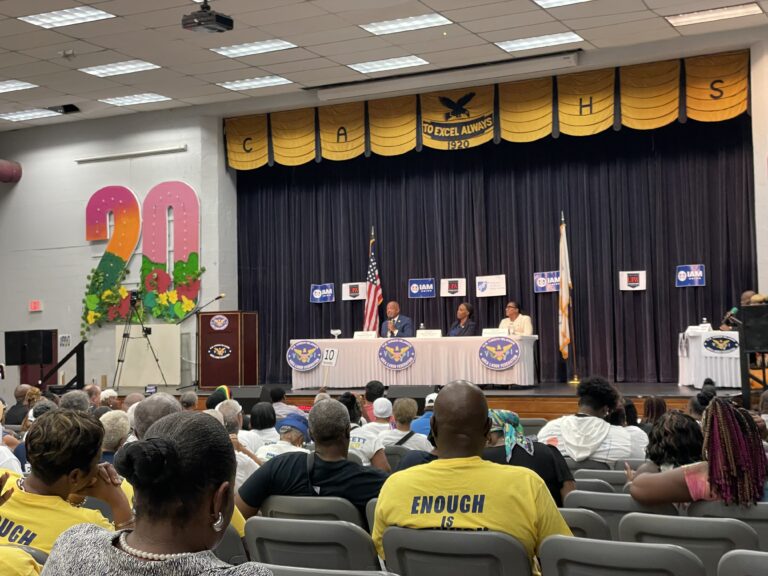
Democratic candidates for governor engage in spirited debate at the Charlotte Amalie High School auditorium Friday. Form left, Lt. Gov Tregenza Roach, Delegate to Congress Stacey Plaskett and former Sen. Donna Frett-Gregory. (Source photo by Grayton Goldsmith)
The U.S. Virgin Islands Area Labor Federation hosted the first gubernatorial debate of the 2026 election cycle Friday at the Charlotte Amalie High School auditorium. The debate featured Lt. Gov. Tregenza Roach, Delegate to Congress Stacey Plaskett and former Sen. Donna Frett-Gregory, who are seeking the Democratic nomination for governor in the Aug. 1 primary.
The debate was moderated by Moleto Smith Jr., director of the V.I. Law Enforcement Planning Commission, and Emily Carter, a career educator at the Education Department. Candidates took turns answering questions and were given 90 seconds each. When it was not a candidate’s turn to answer, they were given 45 seconds to rebut.
Over the course of two hours, candidates answered prepared questions on collective bargaining, health care, government accountability, and economic development. Smith began the debate with a question for Roach.
“In your first 100 days [as governor], name one concrete, measurable commitment you will make to public school administrators and organized labor, something we can hold you to,” he said.
Roach committed to staffing the Office of Collective Bargaining and supporting union contract negotiations.
“I would staff up the office of collective bargaining, because I believe that is a tremendous need. They need more attorneys … I will also seek, in the first 100 days, legislative support for funding to pay negotiated raises, so that when people sit at the bargaining table, they’re not bargaining in a vacuum,” he said.
In a short rebuttal, Frett-Gregory touched on what would become a recurring theme of the night’s discussion: Roach’s connection to the outgoing administration.
“What prevents you from ensuring that we get back to the table and move forward these union negotiations now?” she asked.
Roach responded by stressing that the chief negotiator “serves at the pleasure of the governor and follows his directives.”
While all three candidates agreed that the Virgin Islands Water and Power Authority is in dire need of reform, they disagreed on the immediate path forward. Frett-Gregory proposed seeking a public-private partnership within her first 100 days.
“Until WAPA is regenerated with the 4.7 billion [dollars] that I was able to receive for the Virgin Islands, how are you going to attract a private sector company to come in and do a generation program?” Plaskett questioned.
Citing complaints from residents about government responsiveness, Carter posed the following question to Frett-Gregory:
“What specific measures would you put in place to hold your appointees accountable, ensuring that the basic problems faced by residents and their neighborhoods are addressed in a timely manner?”
Frett-Gregory proposed an accountability system within the Office of the Governor, as well as a mobile application that would allow residents to report grievances like potholes and flickery street lights.
“If you are on the road, and you run into a streetlight issue, you are able to make a text on that app to ensure that you are able to get your streetlight fixed,” she said. “Accountability matters, and transparency matters, and that’s the direction that we need to move in this territory at this time,” she continued.
While Plaskett appreciated the idea, she argued that “an app is not going to solve the problem.”
“I think an app is a good first step. We all know that we’ve been able to tell various offices when there have been issues and nothing is done. I think the real issue is, do we have the personnel, do we have the support, do we have the funding to be able to actually put on the ground to get things done in a timely fashion,” she said.
On the issue of economic development, all three candidates agreed that more transparency is necessary with respect to EDC benefits, which are tax incentives granted to businesses that meet certain requirements for contribution to the territorial economy.
“I agree with Senator Frett-Gregory that a dashboard is eminently necessary for Virgin Islanders to be able to see what they are getting from the companies that are here,” Plaskett said.
Roach criticized EDC rules that allow companies to hire workers from elsewhere and count them as V.I. residents after one year.
“That does not grow resident employment. That is a thing that I would change,” he said.
Roach also proposed reopening the Limetree Bay Refinery and encouraging development on St. Croix’s South Shore as strategies to diversify the V.I. economy.
The final two questions were posed to all three candidates, with each given a full 90 seconds to answer. The first focused on ensuring that labor standards and union regulations are upheld, while the second focused on health care.
“I think there needs to be an open door to the governor, and in my administration, one of the things that I would first institute is a biannual meeting of the Labor Council with the office of the governor, where they are sitting at the table and expressing issues that they have across labor unions with the governor herself … That should be done with nonprofits, with our faith-based community, with youth, [there should be] regularly scheduled meetings so that the governor can hear directly from the people that are affected,” Plaskett said.
After each candidate answered the final questions, they were given three minutes to make a closing statement. Frett-Gregory emphasized the role of young Virgin islanders in building the territory’s future.
“I’m running for governor because it’s time for results for our people, not for a select few here in this territory. We talked about workforce development, and we talked about young people. It is time that we put our young people first in this territory,” Frett-Gregory said.
Plaskett addressed comments about being born outside of the territory, and stressed her political record.
“I was raised by fighting people on St. Croix who believed that [these islands] can be better, but more than a fighter, I’m a worker, and I will stand by my record. I’m not going to take just the good and not take the bad. I’m willing to say that I’ve been a part of work that has been transformational, but my issue is that you have not, and I have not seen and felt it on the ground, and I want to be a part of ensuring that that’s what’s happening,” Plaskett said.
With his final three minutes, Roach again aimed to distance himself from Gov. Albert Bryan Jr. and questioned Plaskett’s experience.
“You’re ready to run the government of the Virgin Islands when the most you probably run is an office of maybe 10 persons,” he said to Plaskett. “Four thousand, at the Department of Justice,” she quipped back.
“There’s only one governor at a time. The Organic Act of the Virgin Islands, as you both know, gives the governor a superior power to any governor in the United States. In fact every appointment document, every paper document, every contract that has to be signed is signed by the governor. So it is, it is improper for us to be in this forum, and focused on the failures of [this] government,” Roach continued.
The full debate is available for online playback via YouTube at this link
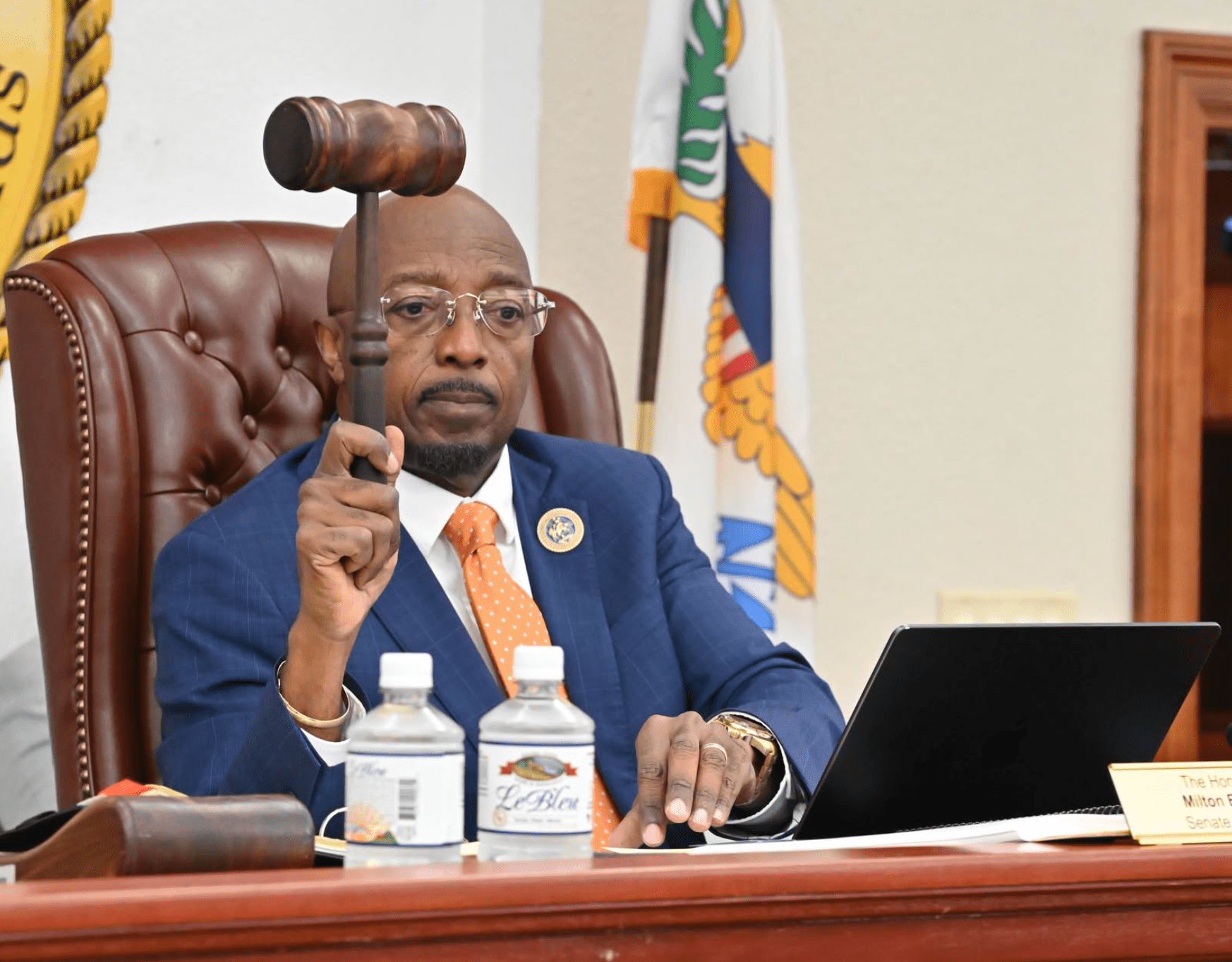
Senate President Milton E. Potter presides over a Committee of the Whole hearing Friday about a proposed Water Island resort lease. Lawmakers heard divided testimony on a plan to lease about 180 acres of public land for an 88-room hotel, marina, residences and workforce housing. (Photo courtesy V.I. Legislature)
On Friday, lawmakers heard divided testimony on a proposed Water Island resort that would lease about 180 acres of public land for a development requiring at least $300 million in private investment.
Meeting as a Committee of the Whole, the 36th Legislature considered whether to amend and reinstate a 2014 ground lease for a hotel, marina and mixed-use project. The proposal would keep Water Island Development Company LLC as the lessee while bringing in Blue Water Global Advisors LLC as the lead developer.
Supporters said the project would bring hundreds of millions of dollars in private investment, while residents and several senators questioned its scale, provisions allowing public land to be sold for luxury housing, the adequacy of protections for infrastructure and the environment, and legal issues involving legislative authority and federal land restrictions.
“No conclusions have been made, no votes will be taken here today,” Senate President Milton E. Potter said, calling the hearing “an opportunity for both sides to share their perspectives.”
Under the proposal, the government would lease more than 180 acres of publicly owned land on Water Island for a 99-year term beginning May 1. Plans call for an 88-room luxury hotel, a marina at Flamingo Bay, about 90 residences, workforce housing, a retail village and new police, fire and emergency medical facilities on the leased land. Honeymoon Beach and the adjacent catchment area would remain under government control.
Developer representatives Steven Miller, Daniel Knoll and attorney Alex Moskowitz said the agreement requires at least $300 million in private investment, though updated estimates place total project costs between $400 million and $440 million. They projected about 200 permanent jobs with average salaries of roughly $75,000, millions of dollars annually in hotel occupancy and property tax revenue, and said they would fund significant infrastructure improvements, including roads, drainage, water, wastewater and utility systems.
The developers also said the resort would operate largely on self-contained infrastructure, including desalination, centralized wastewater treatment, waste-to-energy generation, solar power and battery storage, while allowing Water Island residents to voluntarily connect to the new utility systems.
Residents who testified said they support rebuilding a hotel and marina on Water Island but oppose the scale and land footprint now proposed. Water Island Civic Association President Chuck Nestrud told senators residents “support a replacement of the hotel” destroyed by Hurricane Hugo in 1989 at the Flamingo Bay site but expected redevelopment to remain near the former resort’s roughly 48-acre footprint. Instead, he said, the amended lease would expand the project to about 180 acres, placing “over one-third of the entire island” under long-term lease.
Opponents said the agreement goes beyond a hotel and marina to a mixed resort and residential project with about 90 private residences and workforce housing on land originally transferred from the federal government for public purposes, including portions that critics say would now be carved out for private ownership. They warned that allowing luxury homes to be sold in fee simple, meaning as full private ownership, combined with what Nestrud called a “totally inadequate” $3 million performance bond backing a project projected to cost up to $440 million, would leave the territory exposed if the development fails.
Residents, including WICA Treasurer Rachael Ackley and marine scientist Stephan Bitterwolf, also questioned whether the lease provides sufficient guarantees for roads, emergency services, and environmental protections on an island already facing deteriorating infrastructure, a limited solid waste facility, and an aging WAPA undersea cable.
Bitterwolf urged senators to scrutinize impacts on reefs and wildlife, warning that construction in and around Flamingo Pond, a mangrove lagoon and snorkeling area, and a deep-water marina would affect mangroves, sea grass and already-stressed coral reefs. He added that the lease does not require the developer to partner with reef-restoration programs or commit to specific mitigation measures.
Several senators echoed those concerns and said they could not support the agreement without changes and more information. Lawmakers questioned the scale of the lease, the adequacy of the $3 million bond and the decision to place a large share of Water Island’s public land under a 99‑year lease to a private developer, including provisions that could allow portions to be converted into privately owned residential parcels.
Senators also requested detailed mapping showing veteran-designated and conservation lands within the proposed lease area, saying they need to know exactly what parcels are legally reserved before deciding how much land can be leased.
Although the administration and developer held a virtual meeting with Water Island residents earlier this year, lawmakers and testifiers said it was limited and not publicly noticed, and urged the Bryan-Roach administration and Property and Procurement officials to hold a formal, open town hall so Water Island residents and other Virgin Islanders can be heard directly.
The Legislature’s chief counsel, Amos Carty, told senators the proposal raises legal questions that should be resolved before final approval. He said the original 2014 lease was terminated in 2025 for nonperformance and later rescinded during negotiations, and that no evidence has been presented to lawmakers that the breach was cured before the lease was brought back.
Carty also said the amendment could keep the lease in place for more than a century and reminded senators that federal deeds restrict parts of Water Island to public purposes and require sale proceeds to go to the U.S. government unless otherwise agreed.
He also warned that provisions allowing the commissioner of Property and Procurement to approve additional site leases and convey residential lots without further legislative approval may conflict with Virgin Islands law requiring legislative approval for most long-term leases and government land sales, which many senators said would effectively usurp the Legislature’s authority.
A man was shot and killed Friday evening at the WMJR Service Station in Sion Farm on St. Croix, and the suspected shooter was taken into custody at the scene, according to the Virgin Islands Police Department.
Police said the St. Croix 911 Emergency Call Center received a ShotSpotter notification along with multiple reports of gunfire in the area at approximately 7:07 p.m. Friday. Officers, Emergency Medical Services personnel and other first responders were dispatched to the service station, where they found an unresponsive adult male. He was pronounced dead at the scene.
The deceased was identified by next of kin as 50-year-old Pedro Melendez Sanes, according to the VIPD.
Police said the suspect was apprehended at the scene.
Melendez Sanes’ death marks the 12th homicide for St. Croix and the 25th for the territory, according to the Source Homicide List.*
The shooting remains under investigation. Anyone with information is asked to contact the Criminal Investigation Bureau at 340-778-2211, Crime Stoppers VI at 800-222-TIPS (8477), or 911.
*The Source Homicide List is a chronological log of the homicides recorded in 2026 in the U.S. Virgin Islands, as reported by the VIPD. Cases are broken down by island. While this listing is based on VIPD reports, the Source does not include suicides or vehicular homicides in its listing, which the police and some other media do. This can lead to a discrepancy in the number of incidents reported.
The front of the U.S. Supreme Court building in Washington, D.C., with the words “Equal Justice Under Law.” (Shutterstock image)
Congressional Delegate Stacey Plaskett on Friday condemned the U.S. Supreme Court’s ruling Thursday allowing the Trump Administration to deport people from Haiti and Syria legally sheltering in the United States because it was unsafe to return to their country. The ruling could ultimately disrupt the lives of thousands of Virgin Islanders.
Del. Stacey Plaskett
Plaskett, like her predecessor Donna M. Christensen, was a longtime advocate for people fleeing war zones and natural disasters. She said the 6-3 ruling failed to take into account the Trump Administration’s overt racist animus in seeking to strip 350,000 Haitians and roughly 6,000 Syrians of their Temporary Protected Status.
“Congress created TPS over 35 years ago, on a bipartisan basis, because we agreed that we should not send people back to war, disaster, and death — particularly individuals within our own hemisphere who, by working in the United States, create some level of economic support for neighboring countries that, without the support of those TPS holders, may utterly collapse,” Plaskett said in a written statement. “Federal judges found that the administration’s actions were likely motivated by documented hostility toward Black and Haitian immigrants. Justice [Elena] Kagan said plainly in dissent that there is no dispute these individuals will suffer irreparable harm. She is right.”
A 2025 congressional report counted 3,110 people with Temporary Protective Status in the Virgin Islands.
The economic impact of removing those people was not clear.
“Haitian TPS holders contribute nearly $6 billion to the U.S. economy each year and pay $1.56 billion in taxes — funding programs they cannot even access. More than 20 percent work in healthcare, including as nursing assistants and caregivers. Sending them back to a country the State Department warns Americans not to visit due to gang violence, kidnapping, and instability is not policy. It is cruelty and short-sighted,” she said.
“This decision, while deeply disappointing, is ultimately unsurprising from a court that has repeatedly placed a regressive-activist-conservative agenda above the rule of law. The Supreme Court has handed the Trump Administration unchecked authority to remove legal protections from hundreds of thousands of people who came here lawfully, registered with the government, passed background checks, paid taxes, and built lives in this country,” Plaskett said.
According to the State Department, Haiti was initially designated for Temporary Protected Status in January 2010 when extraordinary conditions in that country prevented Haitians from returning safely. As conditions worsened, the protected status was renewed several times. Syria first received TPS designation in 2012 amid a devastating civil war.
Noem moved to revoke both designations in 2025, contending conditions had improved — a conclusion at odds with the State Department’s own travel warnings, which continue to advise against travel to both countries due to extreme danger.
“The Supreme Court’s ruling means those terminations may now proceed without further judicial review,” Plaskett said.
A new era of roadside signage could soon pop up around the Virgin Islands as what constitutes a temporary and noncommercial sign remains relatively undefined. (Photo illustration by Mat Probasco)
Virgin Islanders answered a call for comment on a giant digital billboard proposed to sit along the Weymouth Rhymer Highway — sending the Public Works Department more than 300 messages against the plan, said Commissioner Derek Gabriel, who has denied the permit.
Gabriel had said he was personally against the billboard proposed by a private company as it would dramatically change the nature of the landscape but wanted to gauge community sentiment as well. He sent out a request for public comment the first week of May, with a May 26 deadline.
The public poll results were overwhelmingly against the 10-foot-by-30-foot light-up billboard atop an enormous pillar near the Edith L. Williams Academy High School, roughly halfway between the turnouts for Cost U. Less and PriceSmart in central St. Thomas.
Some commenters were concerned that billboards can be legally tricky and certainly costly to remove once erected.
“Most really were concerned about aesthetics,” he said Thursday. “The last thing I want is for it to be an adversarial situation,” he had said earlier.
The denial did not prohibit the would-be billboard builders from revising and resubmitting their proposal, Gabriel said. Each permit application is considered on its own merit and Public Works officials plan to meet with the billboard company in coming days.
Gabriel did not say which company was behind the digital billboard proposal but one company, St. Thomas-based RockVision Media, sells advertising on digital billboards in Mandela Circle, at the Red Hook Terminal, and at the Tortola Dock in Charlotte Amalie.
The company boasts “seamless” relationships with the Division of Festivals, the University of the Virgin Islands, and marketers associated with the Virgin Islands Police Department and other organizations. The company’s website lists planned expansions.
RockVision’s website was also overt in leveraging the Virgin Islands’ natural beauty as a contrast to its signage. The website features prominent images of Fort Christian, Yacht Haven, the Virgin Islands Legislature, Charlotte Amalie Harbor, Main Street, the WICO dock, and other St. Thomas landmarks.
According to the website, RockVision is the “ … premier destination for cutting-edge billboard solutions in the captivating landscapes of the U.S. Virgin Islands. As the forefront leader in innovative outdoor advertising, we blend technology with creativity to bring your brand to life against the backdrop of our stunning island vistas.”
The proposed billboard was not the only signage issue up for debate in the territory.
Recent changes to laws governing public signs complicate the issue, Gabriel said, and opened the door to an era of free-for-all roadside signage.
Two weeks ago, the 36th Legislature overrode Gov. Albert Bryan Jr.’s veto of a bill from Sen. Marvin Blyden that lifted many restrictions on roadside signs.
The new law exempts temporary noncommercial signs, defined as “concerning an election, candidate, political committee, ballot question, referendum, public question, civic matter, religious message, ideological message, charitable message, community event, or other noncommercial expression.”
Blyden’s measure was not a bill of its own but an amendment tacked on to an unrelated proposal, meaning debate and public comment were limited.
Gabriel said the language of the new law was somewhat ambiguous. For example, would it apply to a for-profit company selling sign space for a noncommercial message.
The law also does not define temporary, only saying it must be taken down within 14 days of the event advertised. If the sign is permanent — like a large digital sign — but the message on it is temporary, is it permanent or temporary? Or what if a large digital sign is on a truck or trailer that can move? And if the event never arrives — like the ever popular message “Repent, the end is near” — what is to keep the territory from being littered with such signage?
Public Works officials were trying to discern the new law’s implications.
“We are still analyzing the overall impact but it essentially gives people the authority to erect signage wherever they want with our fees or approvals once it isn’t a for-profit cause. That’s going to cause real issues,” he said.
When vetoing the amendment, Bryan had said, “road signs can be an ugly impediment to our territory’s natural beauty and fines or fees are necessary to maintain order for the erection and removal of such signs in a timely manner.”
The most recent digital billboard proposal came just as a two-year moratorium on such signage was ending.
Laws about what signs are allowed and public opinion about them are not new issues.
In 2017, a private company proposed floating billboards in Charlotte Amalie Harbor. In 2018, then-Gov. Kenneth Mapp signed a law strictly limiting digital signs.
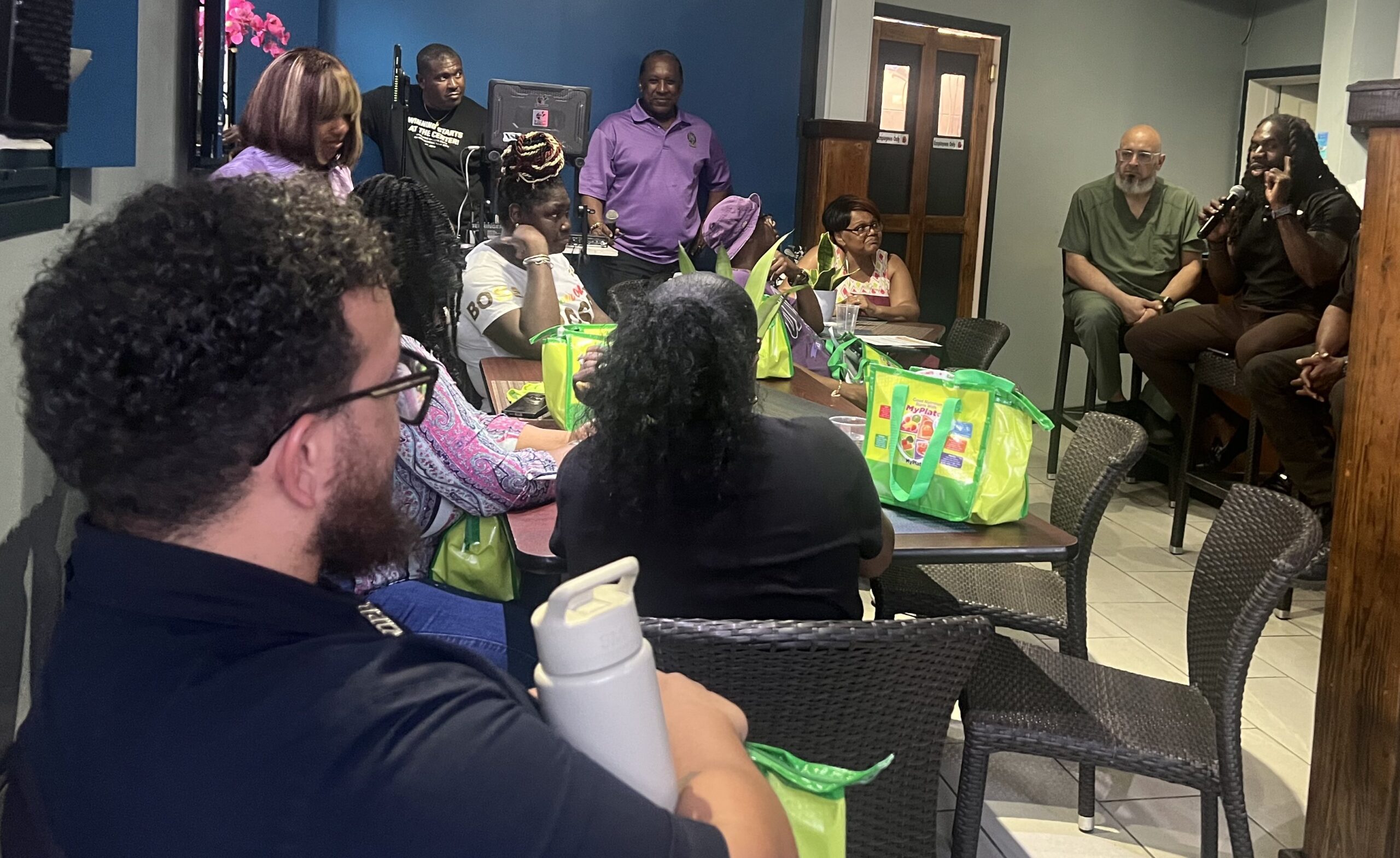
An attentive audience listens to panel of experts discuss diabetes at the Coal Pot. (Source photo by Judi Shimel)
A week of events promoting health awareness on St. John capped off with a forum on diabetes — a chronic illness — contributing factors and ways the average person can fend off negative outcomes. A panel discussion featuring a doctor, a fitness coach, an agronomist, a specialist on tobacco abuse and a psychologist led their audience through their different points of view.
The forum — sponsored by the Health Department Division of Chronic Disease and Prevention — took place late Friday afternoon at the Coal Pot in Cruz Bay. Normally a setting suitable for end-of-the-work-week happy hours, the proprietor laid out a buffet of lean cold cuts, crudités, fruit, and lemon water.
A similar event hosted by Omega Psi Phi Fraternity took place May 16 on St. Thomas. Organizers chose the venue to create a relaxed setting to frame the health talk amid socializing and an after-talk bingo game.
Dr. Joseph DeJames led off the talks with thoughts about the link between diet and diabetes. Fitness trainer Bernard Douglas, Jr. spoke about the challenges of incorporating exercise into a health regimen. James Henderson, director of Agro-Development, encouraged listeners to avoid processed foods.
A tobacco training specialist explained how the stress of managing ailments like diabetes can lead to formation of harmful habits like smoking. The forum wrapped up with words from social psychologist Melinda McCarthy, who emphasized the link between tobacco use and chronic illness.
Friday’s forum followed Thursday’s Dinner with a Doctor, which took place at the St. John Legislature building and was hosted by Schneider Regional Medical Center. From Monday through Wednesday, residents and visitors on St. John were welcomed to free medical screenings in Franklin Powell, Sr. Park, courtesy of the Health Department.