


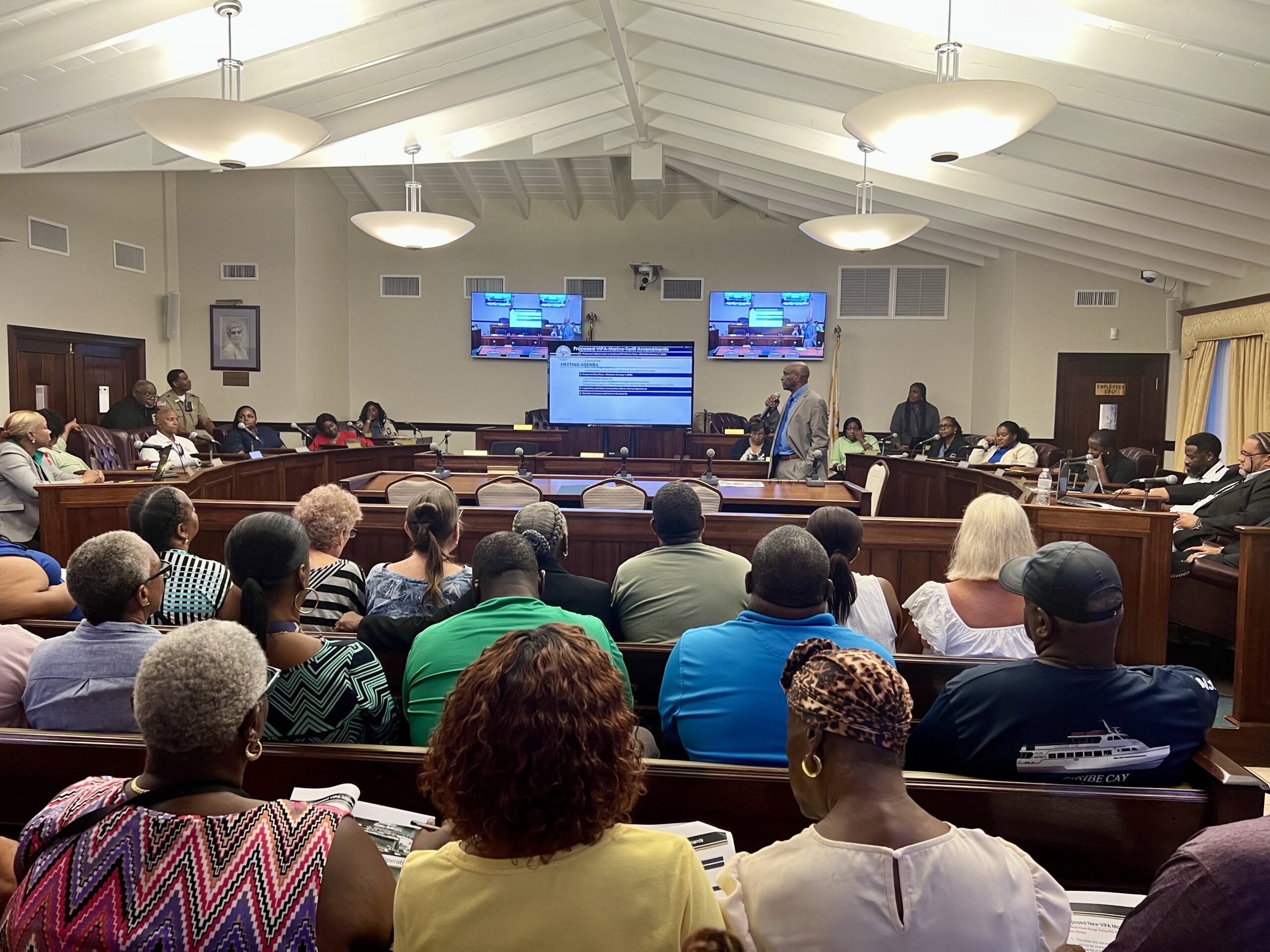
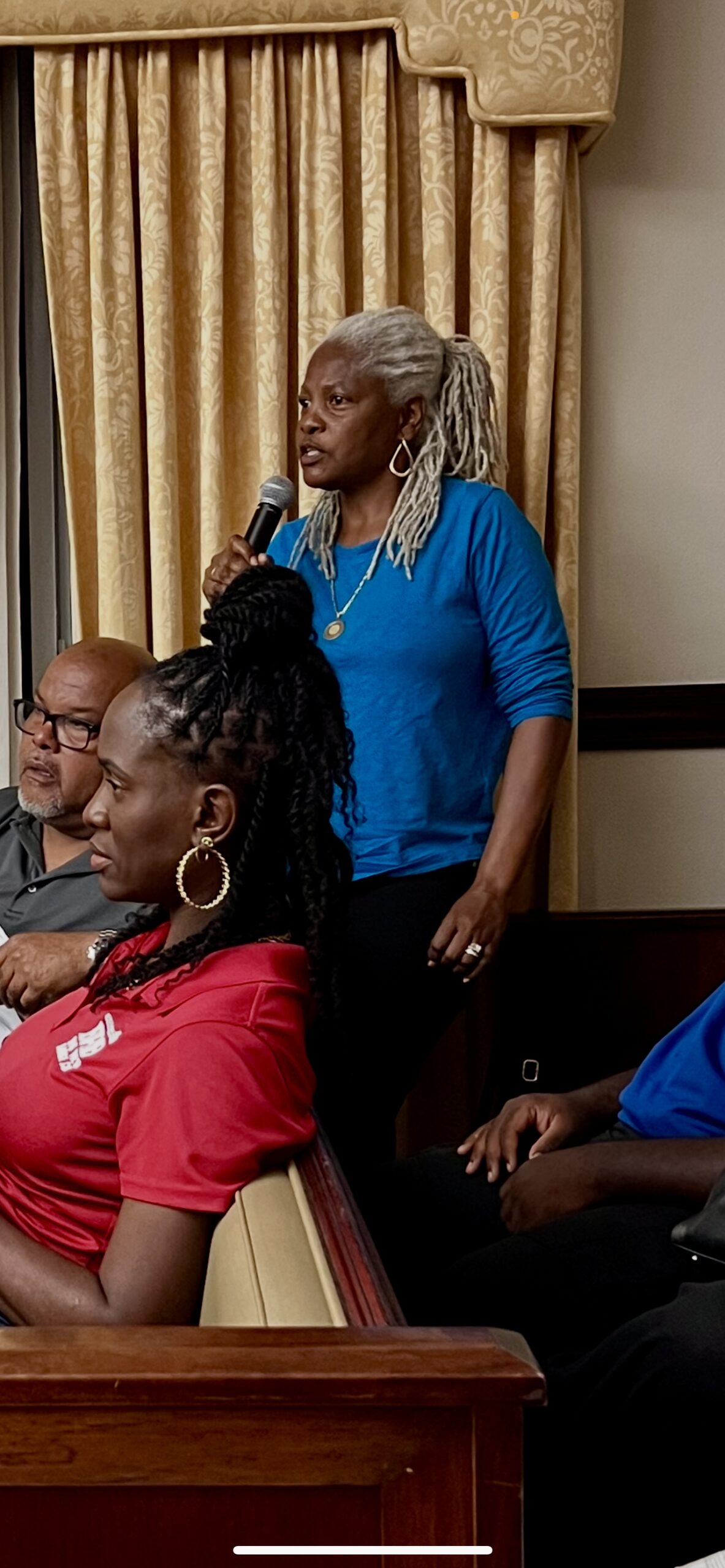
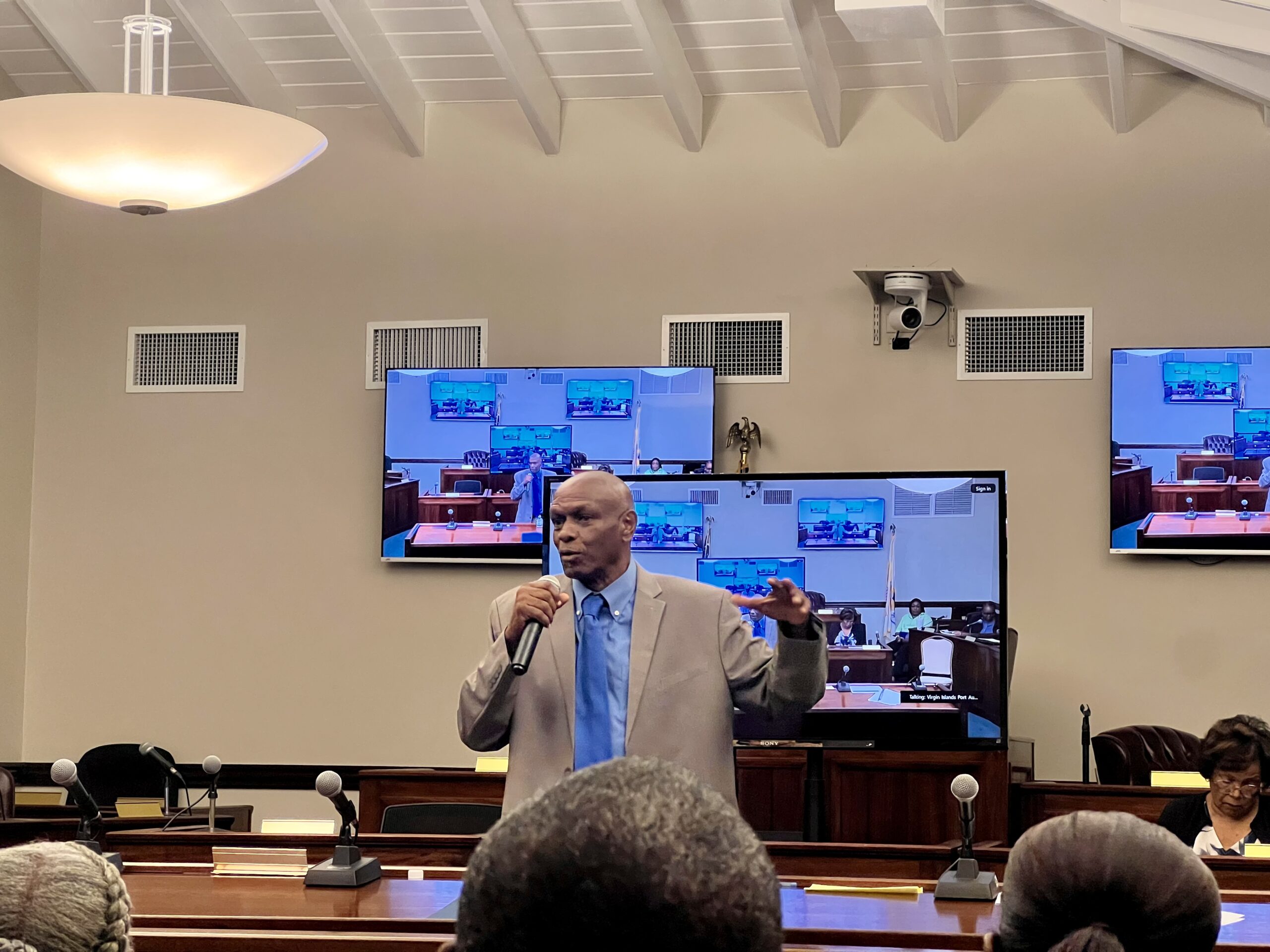
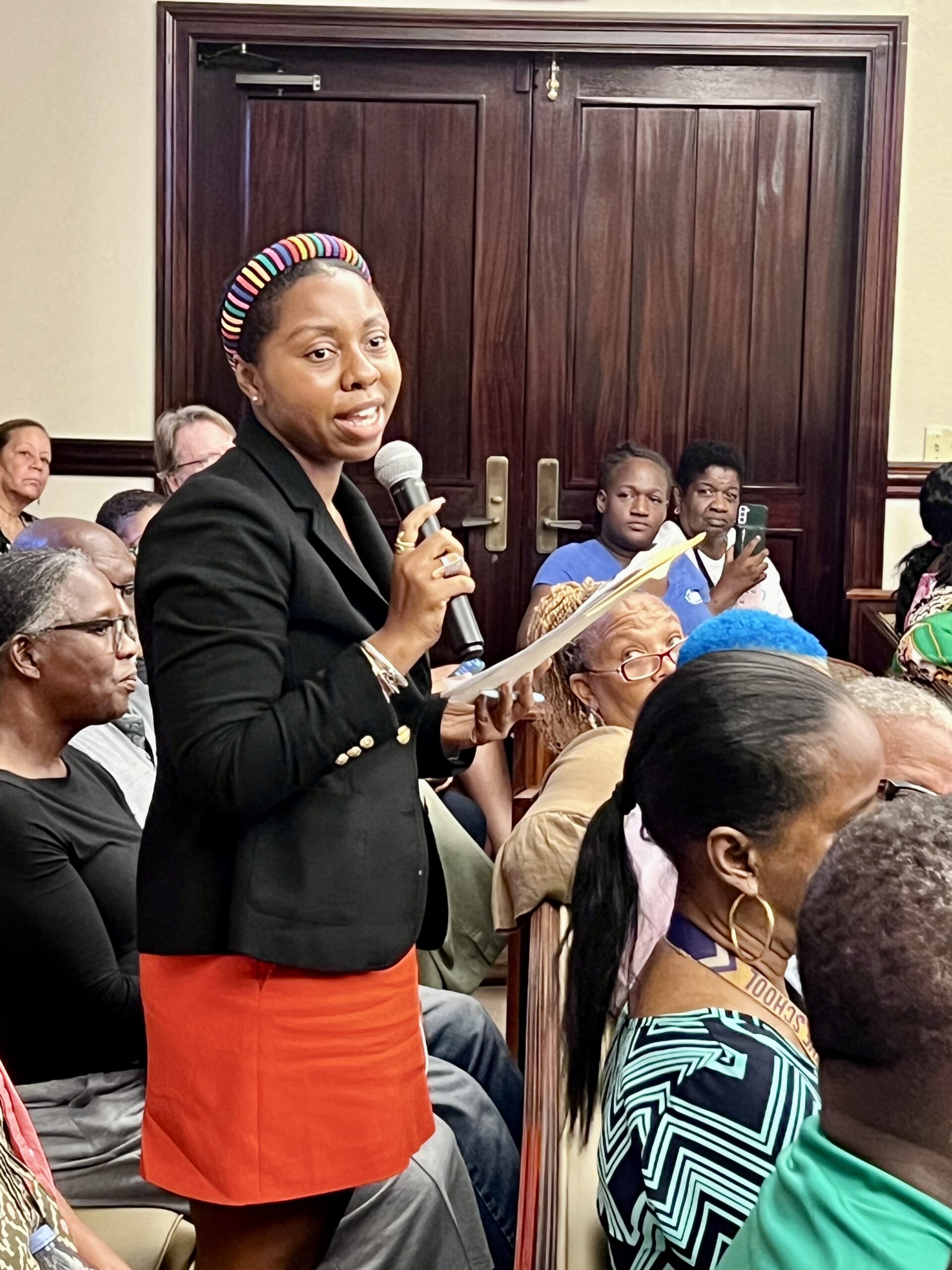
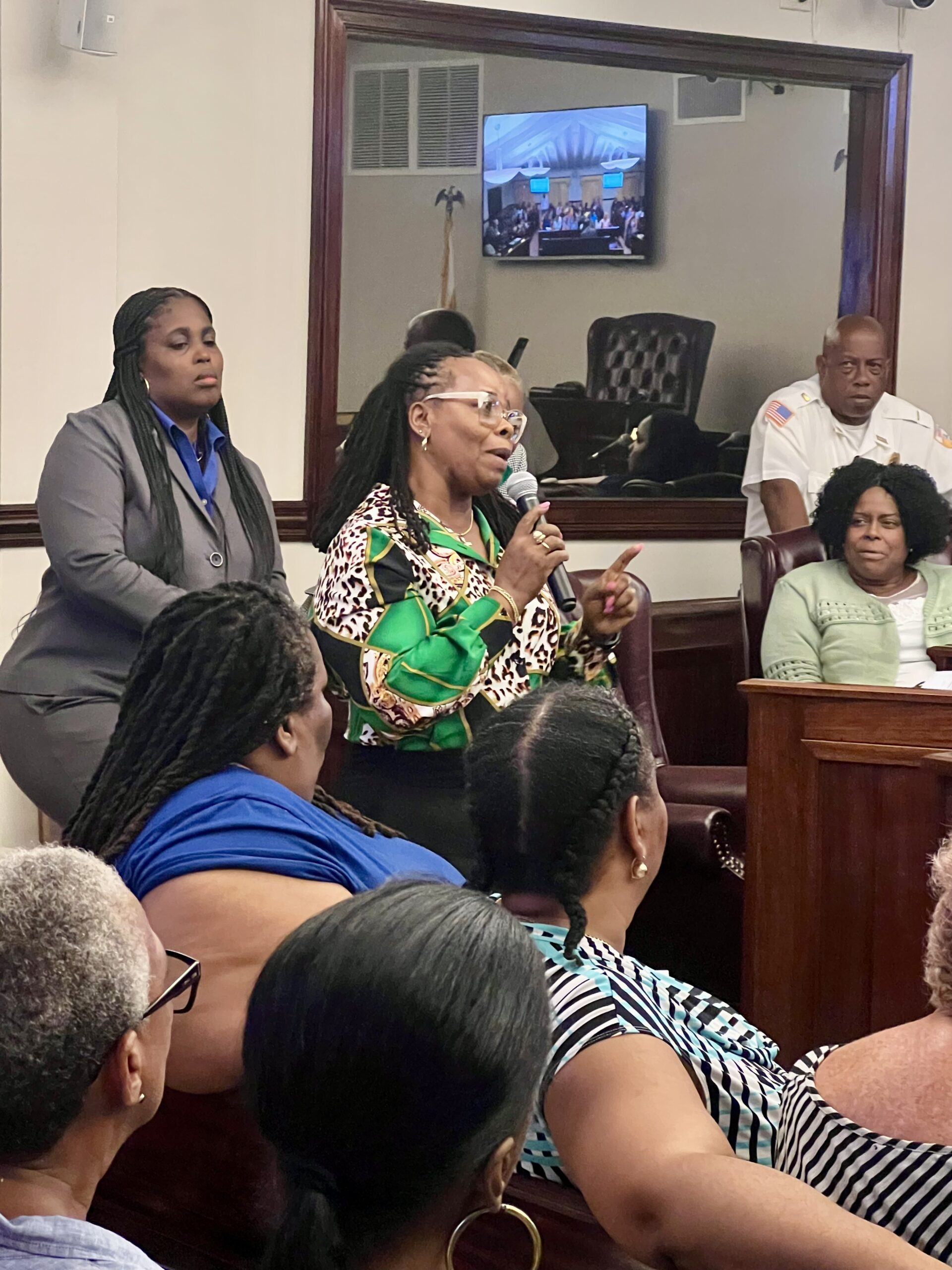
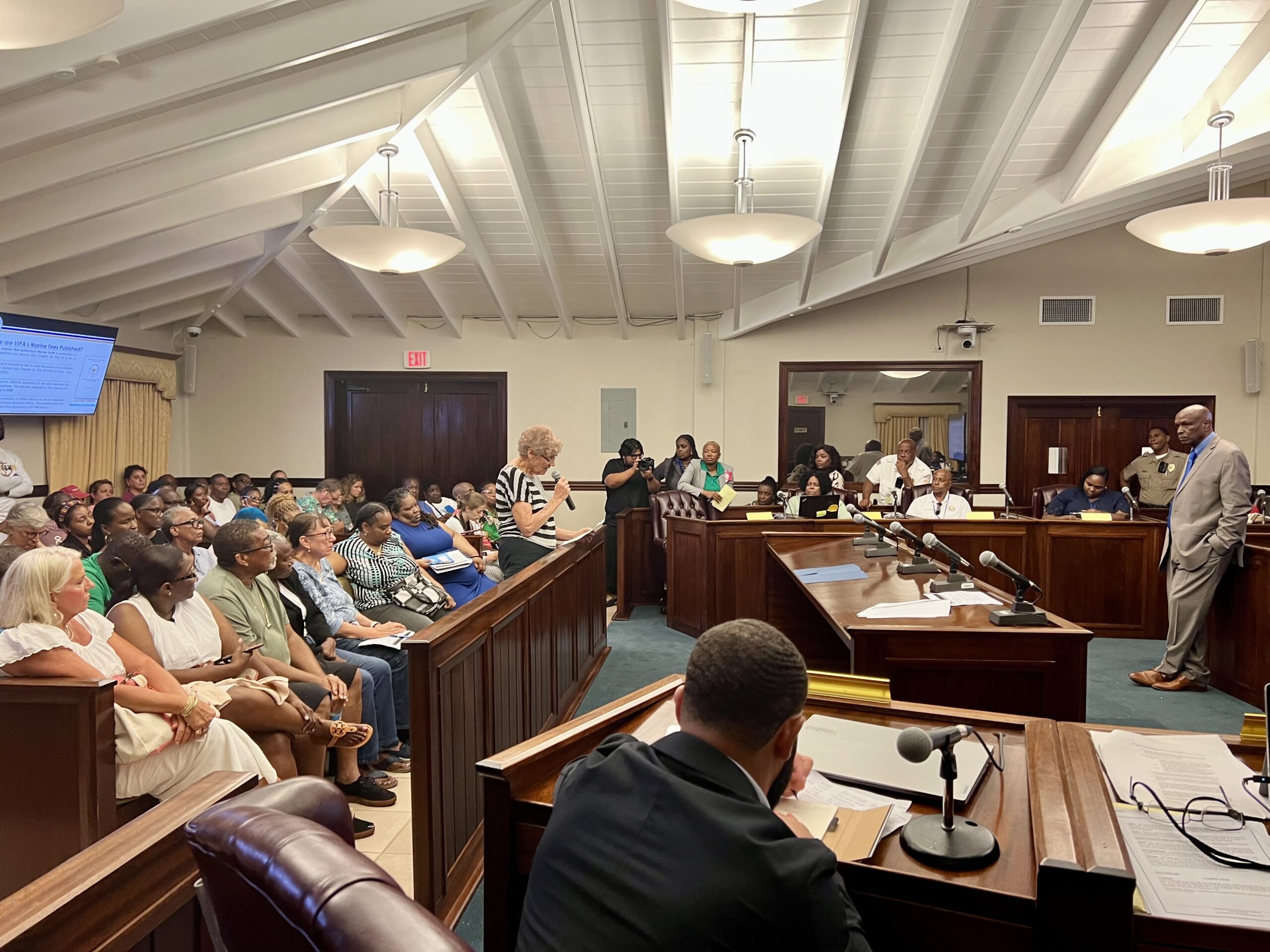
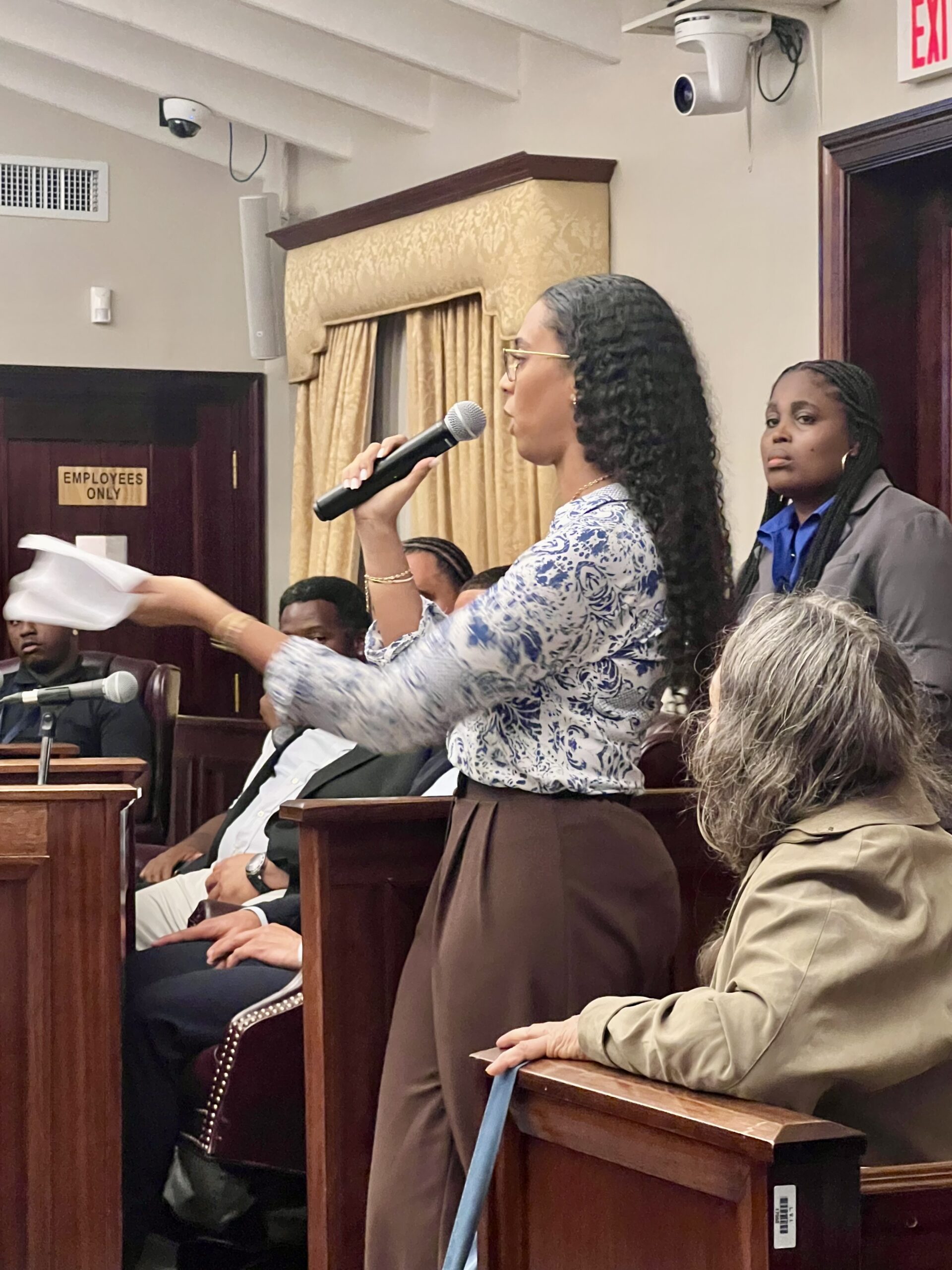
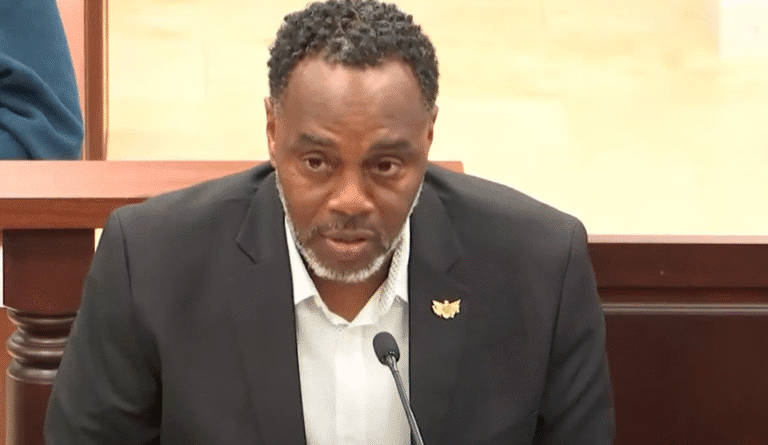
Emotions ran high Tuesday as the Senate Budget, Appropriations, and Finance Committee met on St. Croix to debate Bill 36-0119, which would reprogram $5 million to the Sports, Parks and Recreation Department to complete long-delayed renovations at the Randall “Doc” James Racetrack — a project stalled for years amid funding and oversight disputes.
The session, marked by passionate testimony and heated exchanges, exposed deep divisions within the community and among lawmakers. Supporters of the measure, including Sen. Avery L. Lewis, called the racetrack “a cultural landmark, a community gathering place, and a cornerstone of St. Croix heritage for generations.”
Lewis, who sponsored the bill, described it as “cultural preservation, economic revitalization, and community pride. It is a promise to every horseman, every small business owner and every young person who looks to the track as a place of opportunity … that this legislature will not allow their future to remain on hold.”
The meeting quickly revealed deep divisions and lingering anger over years of stalled progress and unmet promises, much of it stemming from the racetrack’s troubled development history. “The IGL did not live up to its end of the deal, and the people of St. Croix have been denied their racetrack far too long,” Lewis said, referencing the failed agreement with the previous developer.
Lawmakers continually revisited the legal and contractual setbacks that have long plagued the project. As Sen. Kurt A. Vialet explained, “A breach of contract lawsuit was filed by the executive branch. It was settled back in January … As a part of the breach of contract lawsuit, all of the plans are turned over to Government House,” marking a new chapter of government control and responsibility.
Elroy Bates Jr., president of the Flamboyant Park Horsemen Association, warned that “some owners are running horses in Saint Thomas and training them on Saint Croix, often in open fields and roadsides, and some are even training on the highway, which is unsafe for drivers, riders and the horses involved.”
Despite broad support for moving the project forward, many participants questioned whether the proposed $5 million appropriation would be enough to restore the racetrack to modern standards. Vincent Roberts, commissioner of the Sports, Parks and Recreation Department, testified that while the funding is a “critical step forward,” it falls short of what is truly needed. “The total estimated cost for the completed construction and modernization of the facility is approximately $12 to $14 million,” Roberts said, noting that the current appropriation would only cover initial phases of the work.
Roberts added that the funding would still allow the project to begin important preparatory work.
“The $5 million appropriation, although not sufficient to complete the racetrack, will enable us to proceed with crucial design management and site preparation work that makes this project possible,” Roberts said.
Roberts outlined how the funds would be prioritized, emphasizing that “the most important thing is the safety of the jockeys and the horses.” He explained that the first phase would focus on repairing the running surface and stables, with additional improvements — such as perimeter fencing, clearing overgrown vegetation and renovating the paddock area —dependent on securing further funding.
Lawmakers and community members expressed concern that the project could stall again without a clear plan for bridging the funding gap. “Is it $5 million enough? No, but I know one thing, it’s a start [toward] moving in the right direction,” Lewis said, urging colleagues to support the measure as an essential first step.
While questions about funding dominated much of the discussion, an equally contentious issue emerged over who should ultimately operate the racetrack. As lawmakers weighed the best path forward, the debate shifted to whether the government should retain control or seek out a private promoter to manage the facility. The general consensus was that a public-private partnership would be the ideal long-term solution, but in the meantime, most agreed that government oversight was necessary to move the project forward in its current status.
Roberts acknowledged the long-term goal of finding a private partner but emphasized the need for public oversight in the immediate future. “The plan is to secure the first $5 million to get the project started … After that, we will see whether we have any interested investors. If not, we most likely will probably end up back in the legislature,” Roberts said.
“We do not want the government running the racetrack. No way, no way,” said Roberts, reflecting a widely shared sentiment among industry stakeholders.
Jay Watson, a horse racing advocate, echoed these concerns, urging lawmakers that “in an environment where our hospitals, schools, GERS and other critical government functions severely lack funding to operate. Horse racing needs to be looked at from a venue revenue-generating perspective, and not as a cost to the government.”
The committee’s deliberations culminated in a pivotal amendment to the bill, shifting oversight of the $5 million appropriation from a private company to the Sports, Parks and Recreation Department. “I move amendment number 36-579, an amendment in the nature of a substitute to bill number 36-0119,” said Sen. Marise C. James, as the committee unanimously adopted the change.
Transparency and process remained flashpoints throughout the meeting, with lawmakers pressing officials on the lack of a new request for proposals for a private promoter. “The RFP did not receive a response,” said Hugo Hodge, a member of the horse race commission. “Discussions have started to get another one prepared.”
Amid the debate over funding and management, lawmakers also raised pointed questions about the fate of materials and equipment previously located at the racetrack. Sen. Angel L. Bolques Jr. pressed officials for answers, asking, “We have things that have been removed from the track. I’m talking about the footings, the foundation, the elements, the truss, the steel, the seating, the staging area, where they gone, where they gone?”
Roberts acknowledged the concern but admitted he did not know what had happened to the missing items. “They are no longer on the property,” Roberts said.
Bolques expressed frustration that government-owned materials could disappear without clear documentation or compensation, noting, “I don’t understand how it is a contract that could just remove these items that belong to the government of the Virgin Islands without having to pay for them if they wanted to use them, or if we sold them to them. I don’t know what the situation is, but they’re gone now.”
When the roll was called, the committee approved the amended bill by a vote of 5-1, with one senator absent.
Vialet cast the lone “no” vote on the amended bill, delivering a pointed critique of both the process and the substance of the proposal. He warned that the $5 million appropriation could lead the territory to repeat a cycle of incomplete or stalled projects.
“There’s no clear plan, none,” Vialet said, expressing frustration with what he described as a lack of coordination and transparency.
With the committee’s approval, the bill now advances to the Rules and Judiciary Committee for further consideration. As the meeting adjourned, a sense of cautious optimism prevailed. “Slow motion is better than no motion,” Roberts said.
The fate of the Randall “Doc” James Racetrack and the future of horse racing on St. Croix now rest with the next round of legislative review.



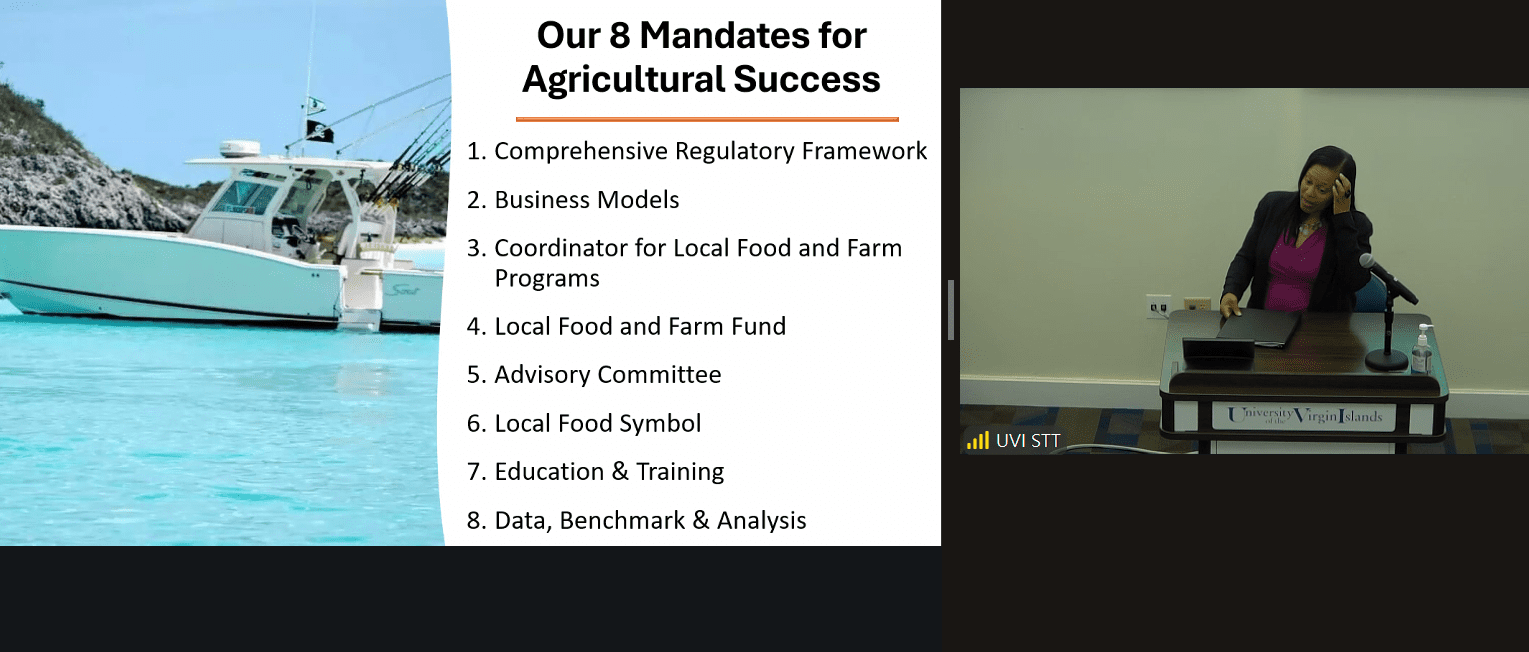
1. Regulatory Framework (Status: Not Started)
The first mandate of the Local Food and Farm Council remains “not started,” focusing on establishing a comprehensive agricultural regulatory framework for the Virgin Islands for the purpose of establishing clear, updated laws and definitions.
Preliminary work exists from previous councils, but the current body lacks the personnel to advance comprehensive legal reviews.
“When the Food and Farm Council coordinator comes on and that position is hired, that body of work will be passed to the coordinator as they can take it to the next step. So the prework has been done, but within the council, it’s not started yet,” Sommer Sibilly-Brown said, a local food systems advocate and the founder and executive director of Virgin Islands Good Food.
2. Business Development (Status: Active)
Commissioner Louis E. Petersen Jr. highlighted the Public-Private Partnership Investment Fund as a landmark achievement: “The program awarded over half a million dollars to grantees on St. Croix, St. Thomas and St. John, something we are very proud of. And we’re looking forward at this point to expanding this initiative.”
Shay Roberts, director of the VI Agriculture Business Center, reinforced the program’s impact: “Our centers operate across all three islands, and this year we’re actively assisting 23 clients while reaching out to over 80 participants in workshops and training. We focused this year on practical topics like organics, soil management, planting and pruning, livestock management, the types of skills that help strengthen production and sustainability.”
3. Coordinator for Local Food and Farm Programs (Status: In Transition)
The Local Food and Farm Council’s third mandate, establishing a dedicated coordinator for local food and farm programs, remains in a state of transition, with the position yet to be fully funded. The role has been identified as Sibilly-Brown.
For the past year and a half, Sibilly-Brown has filled the role on a volunteer basis.
“I have been serving in a voluntary manner for a year and a half,” Sibilly-Brown said. “We are building a full job description and seeking allocated funding.”
The coordinator is intended to serve as a link between the council, farmers, and fishers, ensuring the agricultural plan is implemented and that communication flows across all stakeholders.
4. Council Establishment and Oversight (Status: Active)
The fourth mandate of the agricultural plan centers on the formal establishment and ongoing operation of the Local Food and Farm Council, a body designed to guide and oversee the territory’s agricultural transformation.
The council brings together leaders from government agencies, educational institutions, and the farming and fishing communities.
“Our council represents a number of people with expertise across a number of different sectors,” said Safiya George, council co-chair and president of the University of the Virgin Islands.
Members include commissioners from the Agriculture Department, Economic Development Authority, and Department of Planning and Natural Resources, as well as representatives from the farming and fishing sectors.
The council meets every two weeks, providing a consistent forum for advancing the agricultural plan, sharing updates, and coordinating initiatives.
“We are committed to working with our local farmers, fishers, and community members. Prioritizing agriculture and creating the next generation,” George added.
5. Advisory Committee and Community Engagement (Status: Developing)
The fifth mandate of the Local Food and Farm Council centers on establishing a robust advisory committee and strengthening community engagement. This initiative aims to ensure that farmers, fishers, and residents have a direct voice in shaping agricultural policy and programs.
The council’s advisory committee’s structure and outreach mechanisms are still being developed.
6. Branding and Marketing (Status: Initiated)
The sixth mandate of the Local Food and Farm Council focuses on branding and marketing local agricultural products through the creation of a distinctive food and farm symbol. The symbol is designed to help consumers easily identify and trust products that are grown, raised, or processed in the Virgin Islands, supporting both local producers and the broader goal of food sovereignty.
Initial batches of stickers featuring the symbol have been distributed at community events, and the council is working to expand its visibility across the territory. Council members say the symbol is a key step in building pride in local agriculture and encouraging residents to buy Virgin Islands-grown products.
However, the council acknowledges that more work is needed to ensure the symbol’s credibility. Efforts are underway to develop a transparent distribution and monitoring system so that only qualifying products carry the mark. Leaders believe maintaining the integrity of the symbol, along with strong branding, marketing, and public awareness campaigns, will be essential for building consumer trust.

7. Education and Training (Status: Active)
The seventh mandate of the Local Food and Farm Council centers on expanding education and training opportunities in agriculture across the Virgin Islands. This year, the council reported significant progress, including the development of a comprehensive, 360-degree curriculum that integrates agricultural concepts into core subjects like math, science, and English. The new curriculum is designed to prepare students for careers in agriculture and related fields, while also promoting sustainability and food security.
Student engagement has also seen dramatic growth. “We’ve increased our FFA roster from 25 to 150 students,” reported Cydney Meadows, director of Sustainability and Agricultural Education. The council has partnered with local schools and organizations to offer hands-on training, capstone projects, and outreach events that connect students with real-world agricultural experiences.
Despite these advances, the council continues to face challenges, particularly in retaining qualified agricultural educators. Council leaders say that addressing this issue will be critical to sustaining the momentum of their education and training initiatives and ensuring that the next generation of Virgin Islands farmers and food leaders is well-prepared.
8. Data Collection and Benchmarking (Status: Active)
The eighth mandate of the Local Food and Farm Council focuses on comprehensive data collection and benchmarking to guide the territory’s agricultural development.
Council leaders have partnered with the Eastern Caribbean Center to gather critical information on arable land, food costs, and other key metrics across the Virgin Islands.
By using accurate data and establishing clear baselines, the council aims to measure the effectiveness of its programs and track progress toward the ambitious Vision 2040 goal of producing 35% of the territory’s food locally.

Infrastructure alone is not enough. The future depends on whether Virgin Islanders are prepared to seize the jobs and opportunities of tomorrow.
In the first two installments of this series, Virgin Islands at a Crossroads, I argued that the territory must act boldly to diversify its economy. Part I focused on the urgency of aligning with global shifts. Part II highlighted the extraordinary opportunity in St. Croix’s undersea cables, dark fiber, and energy potential to position the Virgin Islands as a digital hub. But infrastructure alone is not enough. Cables, data centers, and power plants may create potential — yet the true measure of success will be whether Virgin Islanders are prepared to seize the jobs, lead the businesses, and build the innovations that flow from these investments. The next phase of our transformation must be about people. Lessons from Our Past Our history offers clear lessons. When Cuba closed to U.S. tourists in the 1950s, the Virgin Islands became a tourism hotspot, creating thousands of jobs. But managerial and technical expertise often came from abroad, limiting how much wealth stayed in Virgin Islanders’ hands. In the 1960s and ’70s, the arrival of Harvey Alumina and Hess Oil ushered in an industrial boom. Thousands of Virgin Islanders found work, but again, many of the specialized and higher-paying technical roles were filled by imported labor. The lesson is unmistakable: unless we deliberately build homegrown talent pipelines, we risk watching outside expertise capture much of the value created here. This time, we must ensure Virgin Islanders — both at home and in the diaspora — are at the center of the opportunity. The Skills of the Future The AI and diversified clean energy revolutions are reshaping global labor markets. The Virgin Islands must align with the skills that will power these industries:These are not abstract skills. They are the practical tools that will decide whether our people fill the jobs created by data centers, energy infrastructure, and new industries — or whether those jobs go to outsiders.
Building the Pipeline To prepare, the territory must commit to a comprehensive talent strategy:Policy Enablers
The government must also create the conditions for success. That means:
With smart policy, we can ensure that every major investment in infrastructure also builds human capital.
A Call to Action
Without talent, cables and power plants are just steel and fiber. With talent, they become the foundation of a new economy.
This is why the most important investment we can make is not only in megawatts or terabits, but in our people. If we fail to prepare, we risk repeating the patterns of the past — jobs created here, but wealth and expertise flowing elsewhere. If we succeed, we can create a future where Virgin Islanders lead the companies, invent the technologies, and build the prosperity of the next generation.
The AI and diversified clean energy revolutions will create thousands of new jobs worldwide. The only question is whether Virgin Islanders will be the ones to fill them.
This piece is part of the “Virgin Islands at a Crossroads” series, which invites Virgin Islanders at home and abroad to join the conversation on building a resilient, diversified future.
— Bernard Dyer is a Virgin Islander in the diaspora, technologist, and strategist with more than 25 years of public-sector experience, including 16 years with Booz Allen Hamilton supporting digital transformation at the U.S. Food and Drug Administration. He is also a monthly co-host on WSTX 970 radio’s Community Digest, where he highlights new ideas and best practices to help build a more diversified and sustainable Virgin Islands economy.
Editor’s Note: Opinion articles do not represent the views of the Virgin Islands Source newsroom and are the sole expressed opinion of the writer. Submissions can be made to visource@gmail.com.

When the law bends to political power, public confidence in justice breaks. It’s time to strengthen the Virgin Islands’ system of checks and balances by making the Attorney General accountable to the people of the Virgin Islands — not just the governor.
There’s not a week that goes by without me thinking about the fact that Gov. Albert Bryan Jr. fired the previous Attorney General, Denise George, just days after she filed a major federal civil lawsuit against JPMorgan Chase for allegedly enabling Jeffrey Epstein’s sex-trafficking operation in the Virgin Islands. The suit, filed on behalf of the Government of the Virgin Islands, fell squarely within her jurisdiction as Attorney General — the chief legal officer charged with protecting the public interest.

This week, that history came to mind again after the governor’s public relations officer announced at an Oct. 6, 2025 press briefing that the current Attorney General, Gordon Rhea, had issued a legal opinion concluding that The Summer’s End Group (SEG) Coastal Zone Management (CZM) permit “has not expired” and remains valid until all required federal approvals are obtained.
In essence, the opinion contends that because the SEG permit was contingent on receiving federal approvals, the 12-month clock for beginning construction under 12 V.I.C. § 910(d)(7) never began. But that reading stretches the statute. The law says development must start “within twelve months from the date [the] permit is issued.” The contingency language in §910(g) bars construction before federal permits arrive — it doesn’t appear to suspend or erase the one-year deadline. Under §910(d)(7), a permit that sits idle for a year without an extension automatically lapses by operation of law. Once it does, the only legal path forward is a new application and review by the CZM Committee.
As community advocate and Save Coral Bay founder David Silverman noted, the governor’s earlier request that the Legislature “extend” the permit effectively acknowledges that it expired — an admission that contradicts the AG’s new interpretation.
This is more than a technical dispute. It is a reminder of how fragile our checks and balances are. The Attorney General should be empowered to act in the people’s interest and must not be vulnerable to retaliation from the executive branch when their work implicates government officials. An AG who serves primarily at the governor’s pleasure runs the risk of eroding public confidence in the integrity of law enforcement.
In fact, in most jurisdictions across the United States, the Attorney General is elected by the people, not appointed by the governor — a structure designed to safeguard independence and uphold the rule of law. In two other U.S. territories, Guam and the Northern Mariana Islands, appointed AGs were replaced with elected ones, thereby creating a level of accountability that can curb corruption and abuse of power. With the Sixth Constitutional Convention of the Virgin Islands underway, Virgin Islanders should ask whether it is time to follow suit.
An elected Attorney General could be directly accountable to the public, free to issue opinions and pursue enforcement actions without fear of dismissal. Such a shift would begin to build stronger systems of accountability and trust in government.
Restoring confidence in our institutions begins with ensuring that justice serves the people — and not just those in power.
— Dr. Hadiya Sewer is a strategist, philosopher, and President and Co-Founder of St. JanCo: the St. John Heritage Collective, a founding member of the Virgin Islands Studies Collective, and an Environment and Democracy Cross-Territorial Fellow at Right to Democracy. She was a Research Fellow in African and African American Studies at Stanford University and a Visiting Scholar at Brown University’s Center for the Study of Slavery and Justice. A longtime advocate for decolonization, environmental justice and equitable development, she writes on governance, transparency, and the intersection of culture and public policy.
Editor’s Note: Opinion articles do not represent the views of the Virgin Islands Source newsroom and are the sole expressed opinion of the writer. Submissions can be made to visource@gmail.com.





Since 1999 the Virgin Islands Source – the only online newspaper of general circulation in the U.S. Virgin Islands – has been providing the community with reliable, accurate and balanced local journalism.
Contact us: visource@gmail.com
© 1999-2025 Virgin Islands Source

