In preparation for the new school year, Nana Baby Children’s Home and The Salvation Army are teaming up to host a Free School Uniform Swap onSaturday, Aug. 2, from 9 a.m. to 3 p.m. at the Salvation Army on Main Street, next to the Market Square.
Families are invited to drop off and/or pick up gently used school uniform items including pants, shirts, belts, ties, and skirts. All donated items should be in good condition — no stains, holes, or heavy wear. This community-driven event offers an easy way for families to share resources, save money, and ensure children start the school year off right.
“This event is about more than clothing — it’s about connection and support,” said a representative from Nana Baby Children’s Home. “We want to ease the back-to-school burden for families while promoting a spirit of giving and sustainability.”
The event is made possible with support from local business owners Lowayna L. Durant of Grazing the Bar and Rasha Harris of Beans, Bites & Bubbles, who are committed to helping our community thrive.
***Early uniform drop off at Beans Bites & Bubbles at Al Cohen’s through July 27***
Event Details:
Salvation Army, Main Street (across from Market Square)
Saturday, Aug. 2
9 a.m. – 3 p.m.
Free to all – no registration required
For more information or to volunteer, please contact Nana Baby Children’s Home at 340-775-0044 or email nanababyhome@gmail.com.
Together, we can make sure every child starts school feeling confident and cared for.
The Virgin Islands Department of Justice announces the retirement of Amie Simpson, Chief of the Criminal Division for the St. Croix District, after 28 years of dedicated service. Simpson’s final day with the Department will be August 8, 2025, marking the end of a distinguished career in public service.
During her tenure, Chief Simpson led her team in managing hundreds of criminal cases, created and implemented innovative diversion and mental health initiatives, streamlined internal juvenile justice procedures, and significantly reduced the Department’s case backlog. She maintained close working relationships with law enforcement and community partners, while providing extensive training and mentoring to attorneys and officers alike.
The DOJ has faced many challenges over the last several years, not the least of which involved the years-long pause as the VI Justice system dealt with the effects of the COVID-19 pandemic. Despite these challenges, Attorney General Gordon Rhea commended Simpson for remaining steadfast in her responsibilities—trying cases, managing a full docket, and supervising her team with determination and professionalism until her final days of service.
Attorney General Rhea issued the following statement:
“It is with profound respect and deep appreciation that I acknowledge the retirement of Amie Simpson, St. Croix Criminal Division Chief. She has served the Department with dedication and integrity,” continued Attorney General Rhea. “Her leadership and commitment to justice have been deeply valued, and we thank her for her contributions as she moves on to the next chapter.”
The Virgin Islands Police Department advises the community of the parking restrictions that will be enforced on Saturday, July 26, for the USVI Cultural Extravaganza with Mocko Jumbie, Fine Art Show and Fashion Show that will take place in Christiansted Town.
NO PARKING is allowed on Company Street from 2 p.m. until 10 p.m. from the intersection of Church Street and Company Street (Sonya’s Jewelry) to the intersection of Company Street and Queen Cross Street (Hamilton’s).
NO PARKING signs will be posted and any vehicles parked in the restricted area will be towed at the owner’s expense.
The Virgin Islands Police Department thanks everyone for their cooperation.
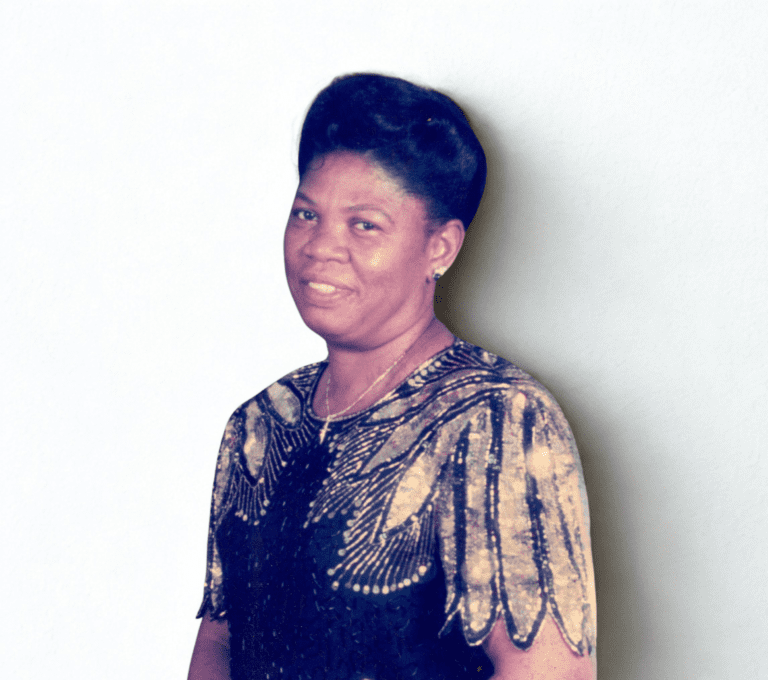
The Smith Family regrets to announce the passing of Mariel Elodia Smith of Cane Garden Bay, Tortola, who transitioned peacefully on Monday, June 30, in North Carolina.
Mariel Elodia Smith
She was preceded in death by her beloved parents, Richard and Rosita Hodge, her brother Cromwell Hodge, and her sister Moel Dawson.
She is lovingly remembered by her husband Lloyd Smith; her sons Allen Smith, Jermyn Smith, and Jerry Smith; her daughters-in-law Diane Smith, Akima Smith, and Sharifa Smith; and her cherished sisters Muriel Callwood, Mabel Dublin, Merle Carey, Marilyn Moore, Mona Jones, Millicent Stevens, and Melberita Hodge.
She is also survived by numerous nieces, nephews, and cousins—too many to name—who will all cherish her memory.
Two funeral services will be held in her honor:
-The first service will take place on Thursday, August 7th at Wesley Methodist Church, St. Thomas. Viewing will be held from 9:30 AM to 10:30 AM, followed by the service at 10:30 a.m.
-The second service will take place on Saturday, August 9th, 2025, at Zion Hill Methodist Church, Tortola BVI. Viewing will be held from 9:30 AM to 10:30 AM, with the funeral service beginning at 10:30 AM.
She will be laid to rest at the Cane Garden Bay Cemetery, followed by a repast at the Cane Garden Bay Baptist Church Fellowship Hall.
Tributes to be included in the memorial booklet may be emailed to marielsmithlpn@gmail.com no later than July 30.
The family kindly asks for your thoughts and prayers during this time of bereavement.Funeral arrangements are under the care of Dan Hurley Home for Funerals and Cremation centers of St. Thomas, St. John, and St. Croix and Majestic Life Funeral Home and Crematory Services.
Virgin Islands Sports Ambassador Michelle Smith etched her name into the history books at the 2025 FISU World University Games in Rhine-Ruhr, Germany, by winning a silver medal in the Women’s 400m Hurdles — the first-ever medal earned by a female athlete from the Virgin Islands at these prestigious Games.
Michelle Smith (Submitted photo)
Smith’s journey to the podium was marked by consistency, grit, and world-class execution. After advancing through the preliminary rounds with the 9th fastest time, she surged to 2nd place in her semi-final, clocking 56.37 seconds to secure the 4th best time overall heading into the final.
In the championship race, held on Thursday, July 24, Smith ran from Lane 8, delivering a spectacular performance that earned her the silver medal in a time of 55.65 and a place among the elite university athletes from around the globe.
Her achievement not only highlights her individual excellence but also marks a watershed moment for Virgin Islands athletics. Smith’s medal is a symbol of progress, inspiration, and the growing impact of female athletes from the territory on the international stage.
As she continues her ascent in the sport, Michelle Smith’s silver shines as a beacon for future generations — proving that with talent, determination, and heart, the Virgin Islands can stand tall among the world’s best.
Smith’s next competition will be the Junior Panam Games in Asuncion, Paraguay from Aug. 15 to Aug. 25.
A 19-year-old man was arrested Wednesday evening after officers with the Virgin Islands Police Department’s Special Operations Bureau discovered an unlicensed firearm and ammunition during a traffic stop on Norre Gade on St. Thomas, the V.I. Police Department announced.
At approximately 6:47 p.m., officers observed a black Infiniti traveling westbound without a front license plate and obstructing traffic. When they attempted to pull the vehicle over, the driver reversed into traffic, turned onto Kirke Strade, then stopped and exited the car, according to the police report.
The driver, identified as Cai Jonte Andrew, told officers he was “going to get lunch” and attempted to walk away. Officers detected the smell of marijuana from the vehicle, which led to a search, the police report stated.
Inside, they found marijuana along with a Ruger 5.7x28mm firearm loaded with armor-piercing ammunition. The weapon’s serial number had been obliterated, the report said.
Andrew admitted he was underage and did not have a license to carry a firearm in the U.S. Virgin Islands. He was arrested, processed, and transported to the Alexander Farrelly Justice Complex. He faces charges of possession of an unlicensed firearm and possession of ammunition, it said.
Andrew was unable to post bail, which was set at $75,000, and was remanded to the Bureau of Corrections pending his advice of rights hearing, it said.
Displaced Palestinians in Al-Mawasi crowd to get rice meals due to the lack of flour and also the lack of entry of aid, in the southern Gaza Strip on Nov. 29. The situation has only grown more dire, with the United Nations reporting this week that nearly 1 in 3 people in Gaza are now going multiple days without eating, and hospitals are reporting rising deaths from malnutrition and starvation. (Shutterstock photo by Anas-Mohammed)
“Take my kidney, just feed my children,” said a father in Gaza.
Nour Suid (Photo by Digna Blash)
Children in Gaza went from dying from airstrikes, limbs amputated with no medication, displaced from their homes, burned alive, and now, now they are dying from hunger. This is not just a war zone, it has become a humanitarian catastrophe.
For those who remain silent or question who is right and who is wrong, I must ask, since when did starving thousands of children become self-defense? Since when did blocking food and aid while babies are dying of hunger become justified? Since when did the cries of innocent children become so easy to ignore?
This is a manufactured famine. Deliberate and, if you believe otherwise, it’s only because you haven’t looked closely enough, done your research, or chosen to confront the truth.
If you are a parent, just imagine for a moment watching your child die from hunger. Imagine watching and hearing your child crying, not from illness, but from being hungry. Now, imagine holding them in your arms and their cries turn into complete silence, their breath slowly and painfully fades away, feeling so helpless as there is nothing you can do.
This is a forced famine, engineered through blockades, bombings, and the deliberate withholding of aid, designed to break the spirit of an already wounded people. By definition, a famine is “the widespread scarcity of food leading to extreme hunger and death, often caused by conflict, displacement, or political obstruction.” What is happening in Gaza not only meets but exceeds this definition.
Again, this is a genocide. There is simply no other word for it.
The traumas Palestinians are experiencing are unbearable.
Hospitals barely have supplies. Injured children scream in pain with no anesthesia. Newborns lie in incubators with no electricity. Classrooms are turned into morgues, and schools, the ones that are still standing, are no longer places of education but shelters. A whole generation is being robbed of their education, their future and their very childhood.
Now ask yourself: What if this were your child lying in a hospital bed with no pain relief? What if it were your newborn struggling to survive without electricity? What if your child’s school was turned into a graveyard? Could you sleep at night knowing your child, daughter or son, has not eaten in days? Would you still call this “self-defense”? Would you still scroll past in silence?
Because if it were your child, your home, your life, your heart would already be breaking. How can it not?
Gaza has been bombed. Gaza has been burned. Gaza has been amputated. Gaza has been displaced and so much worse, but now, now Gaza is starving!
What more do they have to experience and endure for the world to open its eyes? What justification can possibly explain this level of suffering? What argument can ever validate the slow deliberate starvation of children?
There is nothing anyone can say to justify what is happening in Gaza. Not one thing.
To say you are or want to be “neutral” is mind-blowing to me. Neutrality in the face of injustice is not peacekeeping, it’s complicity. When children are starving, when hospitals are bombed, when families are buried under rubble, there is no such thing as a neutral stance. If you choose silence amid such inhumanity, then you are standing with the oppressor.
This is not a conflict of opinions, it’s a crisis of conscience.
Humanity is crying out and your silence echoes louder than you think.
We are not asking for sides. We are asking for basic human decency.
To see suffering and say nothing is to forget your own humanity.
If you’ve ever said you care about humanity, this is your moment to prove it.
This is not about politics. This is about lives and human decency. This is about not turning your back on human suffering.
Speak up. Use your voice. Because if it were your child, your home, your people, you’d pray the world wouldn’t stay silent, so why would you?
— Dr. Nour Suid is a Licensed Professional Counselor, mental health advocate, and founder of Serenity Wellness & Counseling in the U.S. Virgin Islands. She uses her voice to amplify stories of trauma, resilience and healing, and is a passionate advocate for Palestinian human rights.
Editor’s Note: Opinion articles do not represent the views of the Virgin Islands Source newsroom and are the sole expressed opinion of the writer. Submissions can be made to visource@gmail.com.
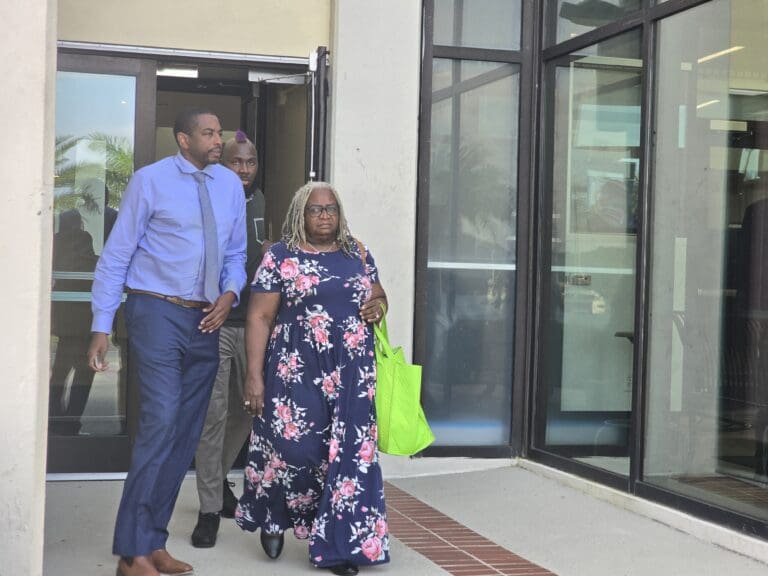
Benjamin Hendricks, left, and his attorney, Darren John-Baptiste, right, exit the federal courthouse Thursday. (Source photo by Kit MacAvoy)
Twelve Virgin Islanders are deciding whether to convict Calvert White, the former Sports, Parks and Recreation commissioner, and Benjamin Hendricks, his alleged accomplice, on charges of wire fraud and bribery.
The jury began deliberating at approximately 1:37 p.m. Thursday after hearing closing arguments from the U.S. Justice Department and from White and Hendricks’s respective attorneys, Clive Rivers and Darren John-Baptiste. Deliberations will resume Friday.
Over the course of a week, Assistant U.S. Attorney Michael Conley said during closing, jurors had “delved deep” into the world of greed, corruption and backroom deals. Conley said White had a duty to the people of the Virgin Islands but that, unfortunately, it wasn’t worth much, “as his loyalty could be bought for $16,000.”
Conley rehashed the timeline of events that led White and Hendricks to be indicted by a federal grand jury in January for allegedly soliciting a bribe equal to one percent of a federally funded $1.6 million contract to install surveillance equipment at DSPR facilities across the territory.
The government cited a Dec. 28, 2023, phone call recorded by its cooperating witness, David Whitaker, who owned the cybersurveillance company Mon Ethos Pro Support at the time. During the call, White asked Whitaker if he’d had a chance to talk to “Benji.” Whitaker said he hadn’t yet.
“OK you gonna need to have that conversation and you need to do it sooner than later OK,” White said.
“That call is how the scheme unfolded,” Conley told jurors Thursday, with Hendricks as the “middleman, helper, aider and abettor.”
Whitaker claimed Hendricks approached him on St. Croix later that day and told him to pay White $16,000 to ensure that the DSPR surveillance camera contract went to Mon Ethos. During a recorded call later that night, Whitaker told Hendricks, “I just want to make sure I heard you right. He only wants one percent? 16,000?”
“I told him 16,” Hendricks replied. “He say ‘Benji I easier.’”
John-Baptiste argued that there had clearly been conversations between Whitaker, White and Hendricks prior to that first call in December, declaring that “something is missing” from the government’s timeline of alleged criminality. On the stand earlier this week, Whitaker acknowledged having known White and Hendricks prior to alerting the Federal Bureau of Investigation to their scheme, and Whitaker was already working with the FBI as a cooperating witness in the agency’s investigation into former Police Commissioner Ray Martinez and Management and Budget Director Jenifer O’Neal.
Conley also reminded jurors of a Jan. 2, 2024, conversation between the trio at the VIPD’s mobile command center during the Crucian Christmas Festival, during which White was heard showing Whitaker confidential bid documents from rival bidders and telling them not to take pictures.
Calvert White leaves the federal courthouse Thursday afternoon on St. Thomas after a jury began deliberations in the government’s wire fraud and bribery case against White and his alleged accomplice, Benjamin Hendricks. (Source photo by Kit MacAvoy)
“I have seen people lose a job, seen people gone to jail over something like this,” White said. “I’ve been doing this a while, and I know the less evidence you have, the better you’ll be. So I hope you all got a photographic memory because I want you to take a look at this document.”
The meeting continued in the parking lot outside the mobile command center, where Whitaker asked White to “just let me know how you want me to get you the sixteen that we talked about.”
“Yeah, no it can’t be a check or nothing like that,” White replied.
After that meeting, prosecutors said, Hendricks told Whitaker to “get him four going into the meeting,” an apparent reference to an upcoming meeting of the V.I. Property and Procurement Department’s evaluation committee. Later, Hendricks messaged Whitaker: “5k for C.”
“Not 4,” Whitaker confirmed. The two discussed how the payment should be made in a call recorded on Jan. 3, 2024, after which Whitaker wired $5,000 from his FirstBank account to an account belonging to Hendricks’s company, A Clean Environment. He labeled the payment “Partial payment for contract.”
“Wire sent for Cal,” he texted Hendricks.
“Does this sound like someone who is ‘duped’ to you?” Conley asked the jury Thursday, anticipating renewed claims from the defendants that Whitaker — a convicted felon whom Rivers repeatedly called a “con man of the highest class” — had entrapped them.
John-Baptiste pointed to Whitaker’s own testimony this week in which he admitted to planting listening devices in government offices, claiming it was at then-Commissioner Martinez’s behest, which he then “discovered” after being hired by the VIPD to sweep the buildings.
“That’s what his modus operandi is,” John-Baptiste said. “That’s what he does.”
Throughout the trial, the prosecution made no secret of Whitaker’s extensive criminal history, which included working with law enforcement in exchange for a dramatically reduced sentence in a sting operation against search giant Google. John-Baptiste noted that Whitaker “has felled greater people than who we have here in the courtroom.”
“He’s a criminal. He’s a felon several times over,” Conley acknowledged, adding that he was presented to jurors “warts and all.” Conley told jurors that they didn’t have to like Whitaker to accept his testimony, and he and trial attorney Alexandre Dempsey noted that Whitaker’s checkered past was precisely why the government “flooded” the courtroom with audio recordings, text messages and bank statements in making their case against White and Hendricks.
“He’s still not likable,” Conley said of Whitaker, “but his testimony fits with the other evidence.”
In arguing that White steered the contract award to Mon Ethos, the government attempted to show that he colluded with Whitaker to make the latter’s bid more competitive across multiple DPP meetings without the knowledge of the department’s evaluation committee. During one Jan. 8 conversation, White was recorded as saying he had “no doubt in my mind, had I not get into this evaluation, SmartNet would have got this contract.”
During one Jan. 19 meeting, White texted Whitaker, “Letting you know I’m watching” and “Make sure you reiterate that cost can be decrease [sic] by reducing the number of drops/cameras.”
On Feb. 5, Whitaker called White while he was in a meeting with the evaluation committee that did not include bidders and coached him on how to make Mon Ethos’s bid submission more attractive. One of the committee’s members was Kim Spencer, an evaluation supervisor at Property and Procurement, who the government called to the witness stand Wednesday. Spencer told the court that it was “absolutely not” usual for a bidder to be on the line while committee members discussed contract negotiations with representatives from a user agency — in this case, DSPR.
“Ms. Spencer is by the book and she would have shut this down” had she known, Conley said Thursday.
Speaking to Hendricks after the Feb. 5 meeting, Whitaker said they just had to figure out how to bring the cost down.
“Yeah, I made a phone call to … an individual. Actually, one of … the Senators,” Hendricks said. “And he said ‘Benji, don’t worry about it …. He said ‘They’ll get it.”
On the stand this week, Whitaker said he did not know the identity of that senator.
White eventually emailed the evaluation committee to let them know that DSPR had accepted Mon Ethos’s revised cost of $1.43 million, and the committee recommended that the contract be awarded to Whitaker’s company on March 12, though it was never executed. The federal investigation into Martinez and O’Neal, in which Whitaker played a similarly central role, came to light the following June. Both subsequently resigned.
Ninety days after Whitaker wired the $5,000 installment to Hendricks, the same amount was deposited into one of White’s bank accounts. Asked about the three-month time difference Wednesday, FBI Special Agent Kiernan Whitworth began to say that their investigation revealed there is “a belief” in the U.S. Virgin Islands, but the defense objected and jurors did not hear the rest of his statement. On Thursday, Rivers rhetorically asked jurors who would hold on to $5,000 in cash for three months without spending any of it and claimed that the FBI essentially cherry-picked from White’s bank statements.
Whitworth said Hendricks made a statement to the FBI in June 2024 and admitted to receiving $5,000 from Whitaker. He then agreed to call White to ask if Whitaker still owed him money.
“You had said something about sixteen thousand or whatever,” Hendricks prodded.
“Yeah, yeah. Uh – uh – uh – uh – I’ll talk to you in person on that,” White replied.
Rivers framed this exchange as a denial during Thursday’s closing arguments. Dempsey said White never denied anything on that call.
“He said, ‘come talk to me in person,’” he said.
After the parties presented their arguments, U.S. District Judge Mark Kearney gave jurors their instructions. After they were discharged to begin deliberations, Kearney denied the defendants’ request to dismiss the case on the grounds that the prosecution had not met the burden of proof. Though some pieces of evidence could be open to interpretation, Kearney said, a jury could reasonably decide to convict White and Hendricks.
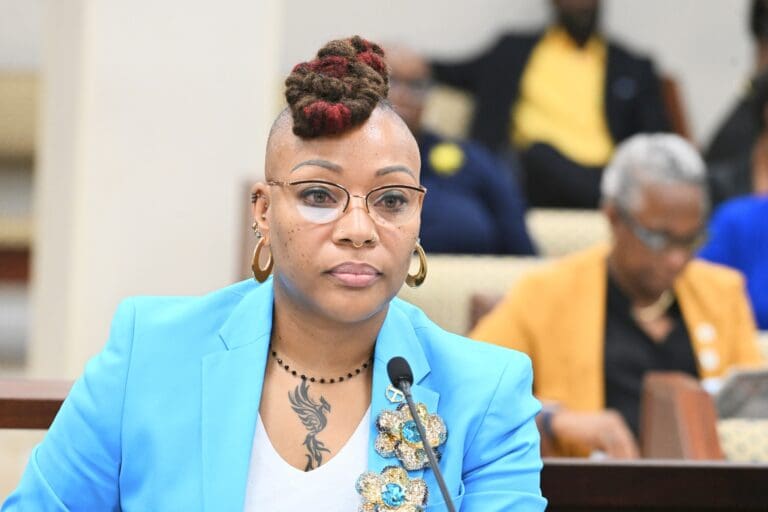
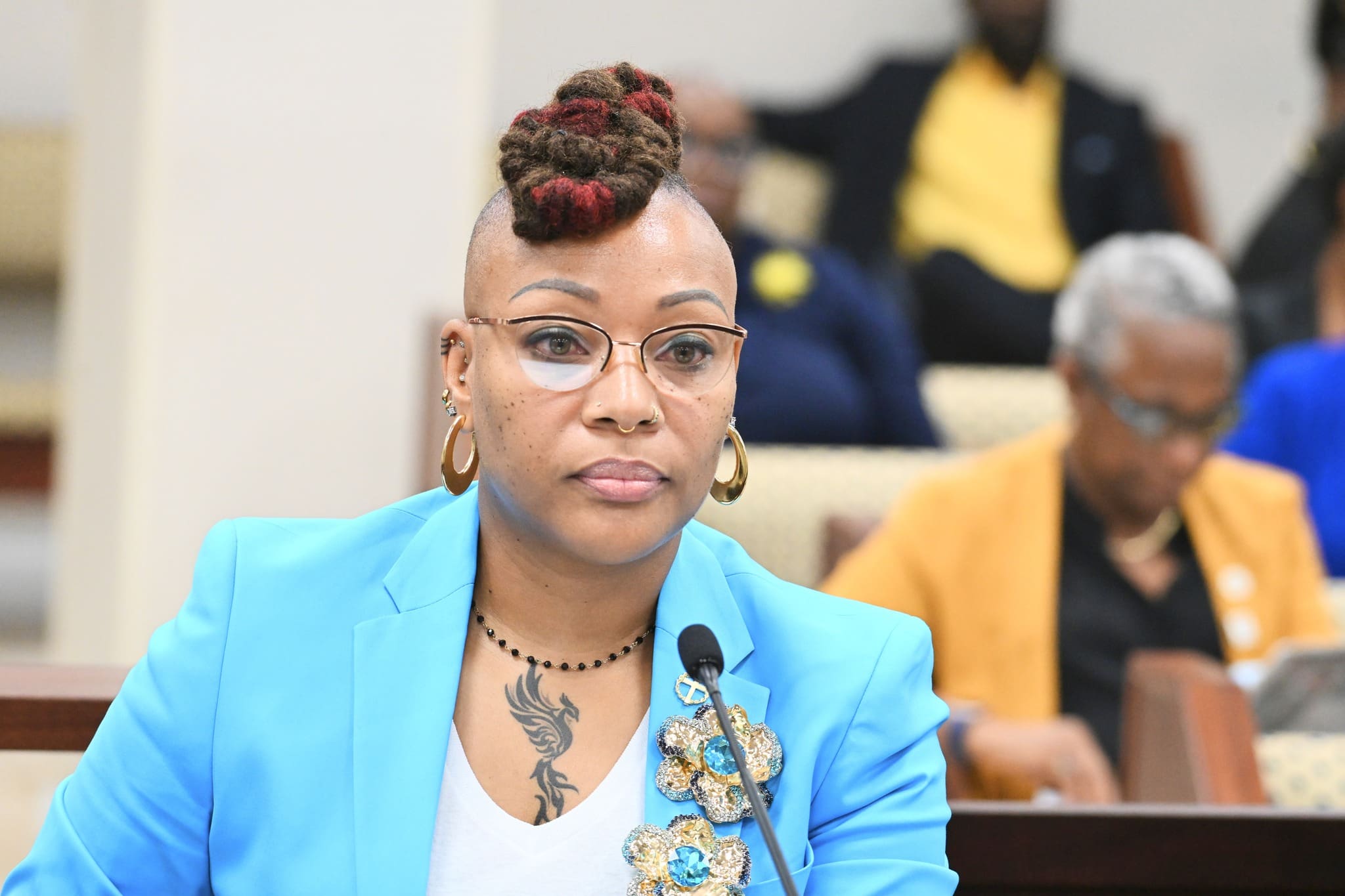
Assistant Health Commissioner Nicole Craigwell-Syms testifies at the Senate Budget, Appropriations and Finance Committee hearing Thursday. (Photo courtesy V.I. Legislature)
The Virgin Islands Health Department presented lawmakers with an overview of its financial and operational priorities Thursday during a Senate Budget, Appropriations and Finance Committee hearing, highlighting the strain of missing vendor payments, rising off-island care costs, and behavioral health needs.
The department’s proposed financial plan for fiscal year 2025 includes $29.8 million from the General Fund, $27.2 million in federal funds, $1.5 million from the Health Revolving Fund, and $1.6 million in non-appropriated funds. Personnel services remain a central expense, with $11.8 million coming from the General Fund and $10.8 million from federal sources. Fringe benefits, supplies, and other operational costs make up the remainder.
VIDOH employs 332 full-time equivalents, nearly evenly divided between the St. Thomas-St. John and St. Croix districts. Of those, 176 positions are funded by the General Fund, and 156 by federal grants. The department currently faces 40 vacancies and has launched structured onboarding efforts and volunteer initiatives to close staffing gaps.
The department’s federal grants portfolio totals nearly $98 million, supporting 34 core projects and 93 single-account budgets. The Office of Federal Grants continues to manage a diverse funding stream while pursuing additional resources to support mental health services and technology upgrades.
As part of its modernization efforts, the department launched a universal data warehouse in April 2024 using $2 million in ARPA funds. The $6.75 million project aims to create a secure, unified system for real-time disease tracking, emergency response, and streamlined federal reporting. Currently paused due to exhausted ARPA funding, the department is seeking $4.75 million to complete it, calling the system key to breaking down data silos, improving coordination, and enabling evidence-based decisions.
Off-island care — the practice of sending patients to mainland facilities for specialized treatment when it’s unavailable locally. The department now spends $9.4 million annually on these placements, a number that has steadily increased over the past two decades.
Beyond the financial burden, off-island care strains staff resources, limits investment in local solutions, and places added stress on families who must navigate treatment far from home, Health officials said. Lawmakers and health leaders have called for greater local capacity, improved budgeting practices, and a long-term strategy to reduce reliance on out-of-territory placements.
In FY2024, 38 patients received off-island care. That year, the department was allocated $6.4 million, but actual costs totaled $7.8 million, resulting in a $1.45 million shortfall. For FY2025, 48 patients are in off-island care, and as of June 30, the outstanding balance reached $4.6 million. The department also faces $7.5 million in unpaid vendor bills — $5.5 million of that tied to off-island services — prompting threats from some facilities to stop accepting patients.
“It’s clear that, in terms of meeting our obligations for vendor payments, that is woefully inadequate,” said Sen. Kurt Vialet. He also pointed out that the Health Department operates 30 offices across 19 different locations, resulting in $967,000 in rent costs, and questioned whether consolidating operations could reduce expenses and improve efficiency.
In response, Assistant Health Commissioner Nicole Craigwell-Syms said, “Our goal is really to have an area like a one-stop shop for services. So, we are working to identify an area that could be large enough, but at the same time, we want to be fiscally responsible in terms of finding a location. And once we’re able to do that, we should be able to consolidate a lot of the divisions into one area.”
Meanwhile, the Behavioral Health Division continues to see a rise in both demand and complexity of care. Over the past year, the division served 676 patients, primarily diagnosed with schizophrenia, bipolar disorder, or other psychoses. Sixty-one percent of the patients were male, and most patients fell within the age range of 24 to 64. The territory currently lacks a dedicated crisis mental health facility.
“Overall, the data indicates a growing and evolving patient population with increasing clinical complexity and sustained demographic diversity. These trends reinforce the need for targeted services, planning culturally sensitive responses and expanded support for populations experiencing serious mental illness,” said Craigwell-Syms.
Efforts to expand care have been hindered by the loss of $3.1 million in federal ARPA grants, which previously funded 16 staff positions, including four in behavioral health. While some personnel were reassigned, officials acknowledged that service expansion has slowed due to the funding gap. Despite these challenges, the Elder Shelter Branch remains fully operational, housing 32 residents at an annual cost of nearly $1.5 million.
Community outreach programs remain a priority. School-based initiatives reached over 6,000 students and 575 educators across the territory through workshops on mental health, substance use, and emotional well-being. Homeless outreach teams connected with 52 individuals on St. Thomas and St. John, many of whom were referred to outpatient or transitional services. DOH is currently working to establish a mobile crisis response team, as mandated by Act 8957, but this is pending funding and implementation.
“We owe it to this community to really address this particular issue,” Sen. Novelle Francis told officials. “We will keep pushing at every opportunity to make this happen.”
WAPA CEO Karl Knight, right, leaves a marathon governing board meeting Thursday that lasted more than 4.5 hours. (Screenshot from Microsoft Teams)
The Water and Power Authority’s governing board voted Thursday to approve a new liquefied petroleum gas provider.
In a narrow 3-2 vote, the board chose to sign a contract with San Juan-based Empire Gas Company, replacing the territory’s previous fuel supplier, Switzerland-based Vitol.
WAPA said several companies responding to the request for proposals to be the new provider did not fully meet the utility’s needs, so it began direct negotiations with companies to get a fuel supplier by Sept. 1.
Empire Gas Company is Puerto Rico’s largest propane provider and the 10th largest in the United States, WAPA CEO Karl Knight said at the board meeting. The company currently provides propane to Diageo’s St. Croix operations. The contract making Empire WAPA’s propane provider would be for two years with a potential one-year extension.
Board members Hubert Turnbull, Juanita Young, and Cheryl Boynes-Jackson voted for the contract.
New Board Chair Maurice Muia asked that a vote on the contract be delayed while the board gathered more information. That motion failed 3-2, with only Muia and V.I. Energy Office Director Kyle Fleming voting to delay.
Exact details of the contract had not yet been released by press time.
Muia, unanimously voted the new WAPA board chair in June, opened Thursday’s meeting by advocating for greater efficiency, accountability, and reliability. He said he hoped the board could launch a new era where Virgin Islanders could depend on the territory’s primary utility.
“I want the governing board to be the conduit to re-instill faith in the authority, its people, our products, and services,” Muia said. “The governing board and I understand the challenges that you face when it comes to the costs of living in the Virgin Islands. The governing board’s intent is to strategically envision a new WAPA with the management team, one which wholly benefits the people of the Virgin Islands.”
Muia outlined several key issues for the board to address.
“We must get our fuel right. This is our largest expense at the authority and the biggest burden to our customers,” he said.
He also alluded to personnel changes, without elaborating.
“We need to take a serious look at persons in the workforce at the authority. Optimal resource allocation, plant and substation operations, safety, customer service, vegetation management and other critical teams must strategically meet the needs of where we are today. In return, WAPA’s electric and water services must become consistent, affordable and beneficial to the Virgin Islands community,” Muia said. “We must tackle the outstanding obligations to vendors and others in the community.”
Starting late, the governing board was already 18 minutes behind schedule when Muia spoke. Board members quickly voted to go to executive session to discuss legal matters. Muia estimated the private conference would last until 11:15 a.m. At 11:30, the authority sent an email saying the executive session was ending soon. It went far longer. More than 20 remote participants stood by in the Microsoft Teams waiting room for nearly another two hours before the meeting resumed.
“I sincerely apologize for the length of time that it took but it was a good discussion that benefited the authority,” Muia said when the meeting resumed. The meeting would eventually last longer than 4.5 hours.
Lorraine Kelly, WAPA’s chief financial officer, presented an electric and water budget for fiscal year 2026. Water revenue was estimated at just more than $38 million, with roughly $4 million left over. The electrical revenue was estimated at $287.2 million, with no profit.
“The fiscal year 2026 budget has increases in revenues for both the water and the electric divisions. In so doing, and the achievements of those additional revenue targets will give us the ability to invest further in some of the repairs and maintenance that has be deferred. Not all, but some,” Kelly said.
Some of those additional revenues would be the result of new power and water meters.
“We are acquiring several thousand more,” Kelly said. “That gives us the ability to have greater accuracy in billing, reduction in estimated billings that have plagued us in the past.”
She said there were a dozen other smaller measures that could help increase efficiency by roughly three percent.