












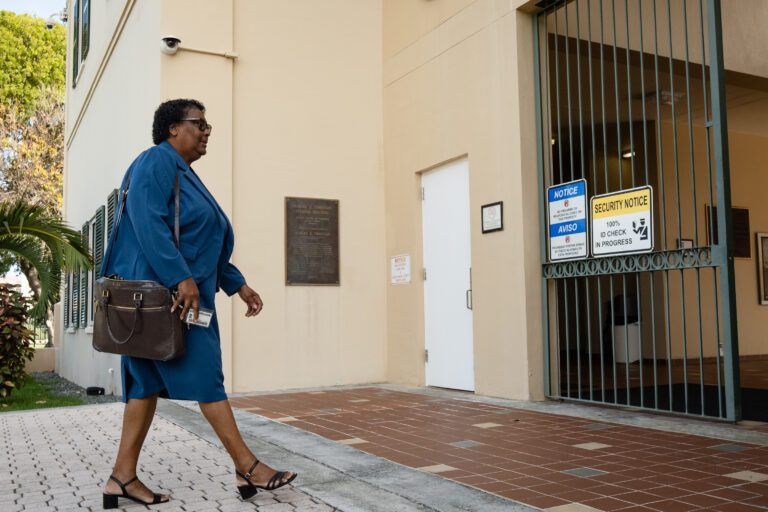

A federal lawsuit filed in District Court is widening the legal battle over how candidates qualify for the ballot in the Virgin Islands — challenging not only the Elections System’s treatment of independent candidates, but also a recent agreement that gave political parties a direct role in determining who advances to the primary ballot.
The case, filed by Delegate to Congress candidate Shelley Moorhead, along with legislative candidates Collister Fahie and Lorelei Monsanto, argues that the territory’s current election framework now operates under multiple sets of rules depending on who a candidate is, what party they belong to, and even which voters sign their nomination papers.
At stake is something larger than a dispute over paperwork deadlines or technical election procedures. The lawsuit goes directly at the mechanics of ballot access — who gets on the ballot, who helps put them there, and whether the government can enforce rules that plaintiffs argue treat similarly situated candidates differently.
For independent candidates, the complaint argues, the process has become especially burdensome.
Under Virgin Islands law, an independent candidate for Delegate to Congress must collect at least 200 valid signatures from voters in at least two districts. But the lawsuit says the actual hurdle is much higher because election officials are rejecting signatures from voters labeled “inactive,” even though those same voters can still cast ballots in the election after confirming their identity and residency.
That distinction matters because candidates gathering signatures often have no practical way of knowing, in real time, which registered voters may later be flagged during verification. The result, according to the filing, is that independent candidates are forced to over-collect signatures simply to survive the review process — spending more time, money, and organizational effort than party-backed candidates competing for the same office.
The lawsuit repeatedly frames that imbalance as a constitutional issue, arguing that ballot access in the territory now depends less on uniform election law and more on which political lane a candidate occupies.
The complaint also takes aim at a March clarification notice issued by Supervisor of Elections Caroline Fawkes stating that signatures submitted by inactive voters “are invalid and will be rejected.”
Plaintiffs argue the policy effectively excludes a category of otherwise eligible voters from participating in the nomination process, even while allowing them to vote in the same election months later.
But the filing’s most politically significant challenge may involve a mediated settlement reached last month between the Democratic Party of the Virgin Islands and election officials. That agreement, signed April 23, created a process in which the Elections System would first determine whether Democratic candidates met statutory requirements, after which the Democratic Party would separately certify which candidates move forward to the primary ballot.
Monsanto — who is running as a Democrat — argues in the lawsuit that she was never part of the mediation that produced the agreement, yet is now subject to a certification process controlled by a private political organization.
The complaint argues that distinction is critical because political parties, while free to manage their internal affairs, do not have unrestricted authority over access to a public ballot administered by the government. To support that argument, the plaintiffs point to legal opinions issued earlier this year by Attorney General Gordon Rhea following the federal court’s 2024 ruling striking down portions of Virgin Islands election law dealing with party nominations and political committees.
Those opinions concluded that while parties may choose their officers and govern internal operations, the actual process of determining who qualifies for public office remains controlled by Virgin Islands law and election officials.
The lawsuit argues the recent settlement blurred that line by effectively allowing a private organization to participate in deciding ballot access under government enforcement.
The case arrives at a moment when the territory’s election system is already facing mounting legal pressure ahead of the 2026 cycle.
What started earlier this year as a dispute over party certification procedures has steadily expanded into a broader courtroom fight over constitutional protections, voter participation, and whether Virgin Islands election law is being applied consistently across candidates and parties.
The plaintiffs are asking the court to block enforcement of the inactive-voter signature policy, halt implementation of the April 23 settlement agreement, and declare portions of the current ballot access framework unconstitutional.


Editor’s Note: Opinion articles do not represent the views of the Virgin Islands Source newsroom and are the sole expressed opinion of the writer. Submissions can be made to visource@gmail.com.
________________________________________________________________________ National Mental Health Resources National Suicide & Crisis Lifeline
The government is appealing a federal judge’s recent order requiring them to bear the majority of costs associated with court-mandated monitoring of the St. Thomas jail, which has been under some form of consent decree for more than 30 years.
Inmates and people in the custody of the V.I. Corrections Bureau on St. Thomas initially filed the lawsuit in 1994 amid unconstitutional conditions in the island’s corrections facilities, which, U.S. District Court Judge Curtis Gomez wrote in 2020, “ largely have remained unresolved for over twenty-five years.” Gomez noted that the court had found the Virgin Islands in contempt of the original consent decree four times. The settlement was amended in 2013 and 2015, leading to quarterly hearings on jail conditions that included testimony from court-appointed experts.
Gomez wrote in a 2020 enforcement order that the “totality of evidence has consistently demonstrated” that the territory remained out of compliance with the consent decree and that in “the wake of multiple decades of a glacial pace towards compliance, many have continued to suffer injury.” Gomez cited evidence of prison cell arson, attacks on inmates — both by other inmates and by corrections officers — rape, suicide, officers sleeping on shift, falsified log records and other failings.
Conditions have little improved, according to plaintiffs who asked Chief Judge Robert Molloy last year to issue a second enforcement order and sanctions against the territory. They noted that in 2024 — when “a full complement of Court Experts assessed Defendants’ compliance for the first time” since the consent decree was amended in 2013 — monitors found the jail to be compliant with just two percent of the provisions outlined in the settlement agreement.
“The time for Defendants to be held to account for their repeated and flagrant failures to comply with either the Consent Decree or this Court’s prior orders has come,” they argued. In a status report filed last week, they said violations of the consent decree persist.
One inmate who was booked in August 2025 was unable to go to the recreation area for six months because the route did not accommodate a wheelchair, they claimed. He was later transferred to St. Croix.
The report also highlighted a Feb. 11 assault, which was discovered “only after a maintenance worker who happened to be in the area heard it and called for help.” The plaintiffs claim that the victim was left in the same cluster as the detainee who assaulted him for an hour and a half afterward, allowing the assailant to enter the victim’s cell and spit in his face.
Other claims include examples of incarcerated people being confined in cells for more than 12 hours a day, lack of air conditioning, insufficient recreation, poor record-keeping, lack of a sprinkler system and inadequate staffing.
Molloy denied the request for an enforcement order in March, but only because monitoring was suspended amid a payment dispute between the plaintiffs and the government. In the same order, Molloy wrote that the consent decree is clear and unambiguous: the defendants are solely responsible for paying monitors’ fees up to $100,000. Any amount beyond that is apportioned by the court. Molloy said he looked at a number of factors in deciding how to break down the costs, including the parties’ ability to pay.
“As Plaintiffs are pretrial detainees and inmates, their ability to pay is limited,” he wrote, while the defendants operate a budget of more than one billion dollars on an annual basis and have “a much greater ability to pay, as amply demonstrated by their retention of numerous outside counsel.”
He ultimately ordered that the territory would bear 95% of any costs in excess of $100,000.
The notice of appeal, submitted last week by V.I. Attorney General Gordon Rhea and signed by attorney William Lunsford of the law firm Butler Snow and V.I. Assistant Attorney General Sheena Conway, indicated that the government intends to challenge Molloy’s recent order as well as “all underlying orders and opinions,” including Gomez’s 2020 enforcement order.




Since 1999 the Virgin Islands Source – the only online newspaper of general circulation in the U.S. Virgin Islands – has been providing the community with reliable, accurate and balanced local journalism.
Contact us: visource@gmail.com
© 1999-2025 Virgin Islands Source


DPVI Calls for Timely Funding of Primary Election, Urges Intentional Leadership