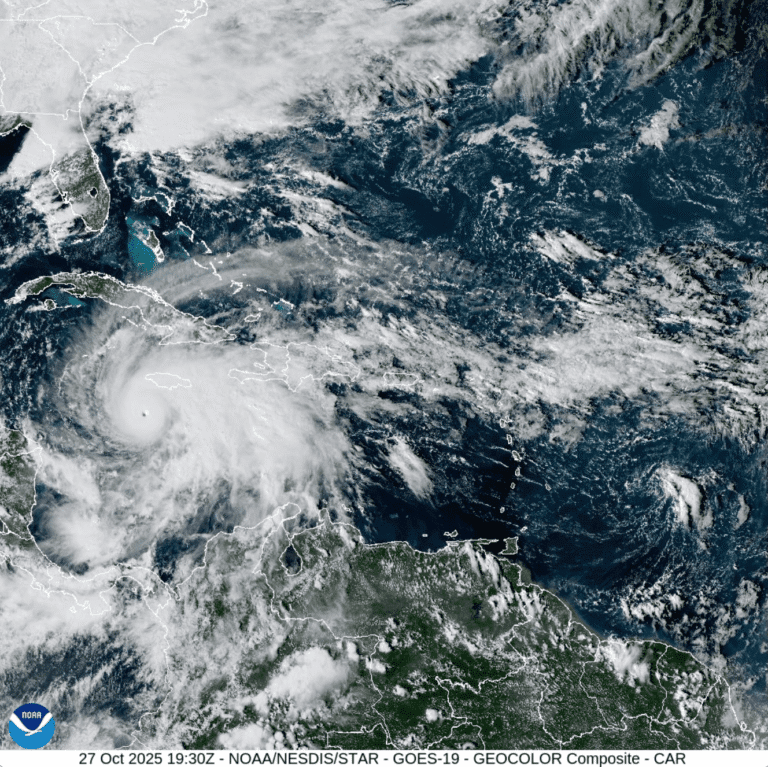
Lt. Gov. Tregenza A. Roach, Esq., who also serves as the territory’s Commissioner of Insurance, reminds Virgin Islands residents to be prepared for the 2026 Atlantic hurricane season, which begins June 1 and ends on Nov. 30.
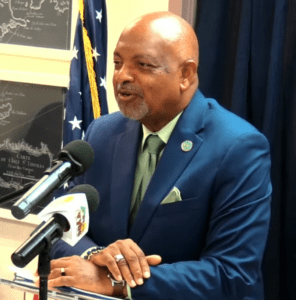
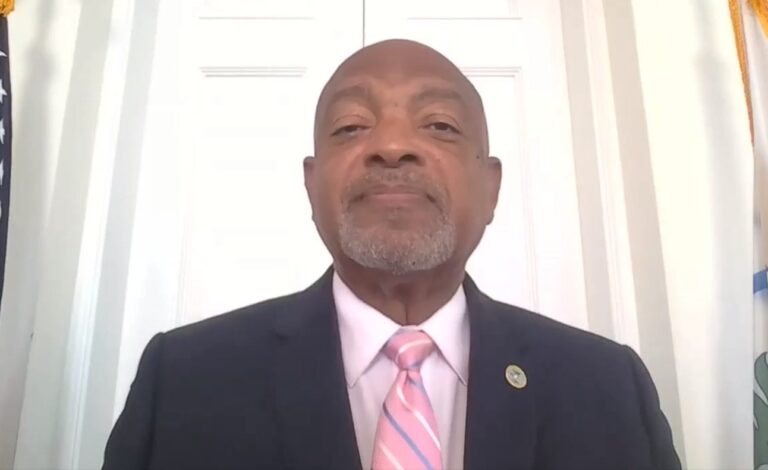
Lt. Gov. Tregenza Roach. (Screenshot from the Office of the Lieutenant Governor Facebook livestream)
The National Oceanic and Atmospheric Administration National Weather Service predicts a below-average 2026 Atlantic hurricane season, with eight to 14 named storms, three to six are forecasted to become hurricanes and one to three of which will reach Category 3 status or stronger. Tropical storm winds are from 39-73 MPH; Category 1 Hurricane winds 74-95 MPH; Category 2 Hurricane winds 96-110 MPH; Category 3 Hurricane winds 111-130 MPH; Category 4 Hurricane winds 131-155 MPH; Category 5 Hurricane winds 156 MPH and greater.
Lieutenant Governor Roach advises property owners to review their insurance policies annually and contact their agent directly to discuss any need for additional or revision in coverage, or if they have questions. Property owners may contact the Division if additional assistance is required after speaking with an agent. Lieutenant Governor Roach further advises residents of the following as they prepare for the hurricane season:
You cannot buy a homeowners insurance policy once a storm has been declared
Know what is covered and what will not be covered in your homeowner’s insurance policy.
Avoid being underinsured by purchasing at least 80% of the replacement cost value of your residential property. To determine replacement cost value, hire an appraiser and make sure the appraisal includes Replacement Cost Value, which is the cost of replacing your property without a reduction for depreciation.
Avoid being force-placed, which may cover only the mortgage balance. If you have a mortgage, purchase your own homeowner’s insurance policy. You can have the insurance premium escrowed along with your property tax payment, or you can use premium financing.
To lower the cost of your property insurance, take advantage of all available Discounts offered by your insurance company. Remember, once you file a claim you may lose your “No Claim Discount”, meaning that your premium will then increase but only by the amount you saved through the No Claim Discount.
Purchase homeowners’ insurance even if you own your home outright and don’t have a mortgage! Your home is your biggest investment; be sure to protect it by insuring it.
Do NOT exclude windstorm. We live in a hurricane-prone area.
Make sure you have a homeowner’s insurance policy and a separate flood insurance policy. A homeowner’s insurance policy does not provide flood protection.
If you rent, buy renter’s insurance to cover your contents in the building.
Understand that you do not have a separate policy if you own a condominium. The policy belongs to the condominium association as a whole and is subject to the decision by its Board of Directors. You can purchase a separate contents insurance policy as a condominium owner.
Keep your insurance policy and other important documents in safe, dry waterproof and fireproof containers.
Know what is insured: inventory personal property and take photographs of your home.
Visit ltg.gov.vi and download the “Home Inventory Checklist”. Complete the checklist and take photos of your contents BEFORE a storm occurs! Know what is insured.Have disaster supplies on hand and secure important documents (insurance policies, birth certificates, deeds, will and testaments, power of attorneys, Government -issued photo identifications, etc.)
Protect your property by putting up shutters, cutting back tree limbs and clearing debris.
After the disaster, it is important that you have a contingency plan in place:
Take photos and make a list of your damages; file a claim as soon as possible; get an estimate of your damages; be ready to have your claim adjusted to receive a claim settlement.
Secure your property and make temporary repairs if needed. Your homeowner’s policy allows you to make minor temporary repairs to prevent further damage.
Avoid disaster fraud. Avoid scam artists. Request a copy of the business license and identification from anyone who will perform disaster related services on your property. Never pay in full for a disaster related service provided for you before the service is completed. Additionally, do not participate in disaster related fraud by misrepresenting damage amounts and submitting inflated and unreasonable estimates to your insurer. Such activities can drive up the future costs of insurance for all policyholders.
Public adjusters are also licensed by the Commissioner of Insurance. A property owner does not need to hire an attorney to contract services of a public adjuster.
Per Bulletin No. 2017-06 issued by the Commissioner of Insurance on September 29, 2017, a public adjuster may not charge a fee that exceeds 5% of the insurance proceeds recovered on behalf of the homeowner or residential insured.
“Virgin Islands residents are reminded also to pay special attention to national and local weather advisories and VITEMA alerts during the hurricane season to keep informed of impending weather conditions.” stated Lieutenant Governor Roach.
For more information on disaster preparedness and the responsibilities of the Office of the Lieutenant Governor, visit ltg.gov.vi., or contact Division of Banking, Insurance & Financial Regulation on St. Thomas at 340-774-2991 and on St. Croix and 340-773-6449.
The Virgin Islands Waste Management Authority is strengthening enforcement efforts at bin sites across the territory as part of its ongoing commitment to improving accountability, protecting public resources, and maintaining clean and safe communities.
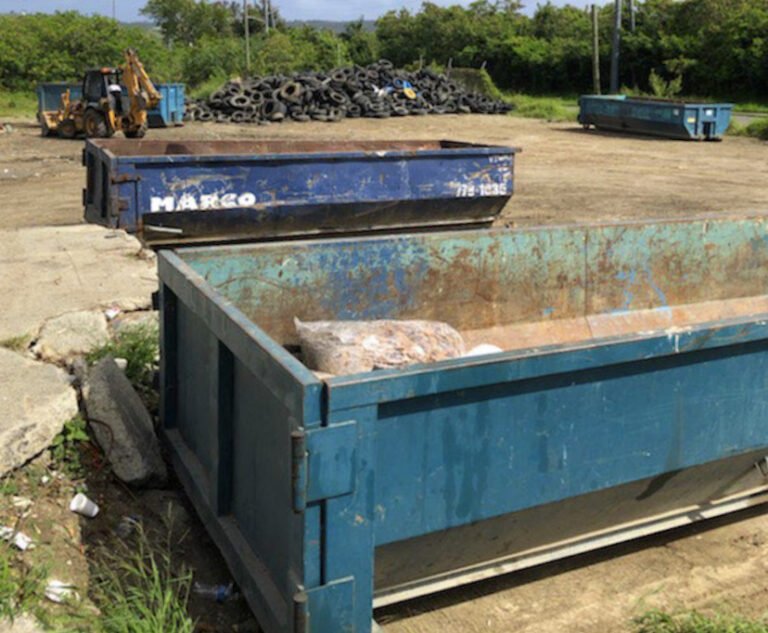
The Waste Management Authority is upping enforcement efforts at trash bins. (Screenshot from WMA presentation)
This initiative reflects VIWMA’s broader focus on operational integrity and responsible waste management. Through enhanced enforcement strategies, the Authority is improving its ability to identify violations, respond to concerns efficiently, and ensure that public waste disposal areas are used appropriately.
Illegal dumping and misuse of public bin sites remain a serious environmental, operational, and public health concern throughout the Territory. Improper disposal practices contribute to overflowing sites, infrastructure damage, increased cleanup costs, pest activity, and environmental degradation. Individuals caught engaging in illegal dumping or misuse of bin sites may be subject to fines of up to $1,000, penalties, or additional enforcement actions in accordance with Virgin Islands law.
To help maintain safe and accessible bin sites, VIWMA reminds residents and businesses of the following disposal guidelines:
DO:
Dispose of household waste in designated bins only
Break down cardboard boxes and bulky materials before disposal
Secure trash bags properly to reduce litter and pest activity
Follow all posted signage and disposal instructions at each location
Report overflowing bins, illegal dumping, or maintenance concerns promptly
DO NOT:
Dispose of hazardous materials, including chemicals, batteries, paints, oils, or medical waste
Leave trash outside of bins or on the ground
Dump construction debris, appliances, furniture, tires, or bulk waste
Use residential bin sites for commercial disposal purposes
Engage in illegal dumping or vandalism at any VIWMA facility or bin site
To further support proper disposal practices, VIWMA will coordinate the collection of white goods/scrap metal and bulk waste at the Anguilla Landfill and the Cotton Valley bin site on St. Croix, the Nazareth and Cancryn bin sites on St. Thomas, and at the Pine Peace and Coral Bay bin sites on St. John on the second weekend of each month beginning July 2026. The scheduled time is from 8 a.m. to 3 p.m., but it is subject to change due to weather conditions.
As part of its commitment to strengthening community partnerships and enhancing waste management services throughout the Territory, VIWMA has coordinated and will continue to coordinate quarterly bulk waste collections at designated bin sites. Residents are encouraged to follow posted schedules and placement guidelines to ensure safe and efficient collection.
Both convenience centers will accept residential white goods and scrap metal, including refrigerators, stoves, and other household appliances, during the first and third weeks of each month. Bulk waste items, such as mattresses, tables, and couches, will be accepted during the second and fourth weeks of each month. Mandahl Convenience Center will continue operating on its regular schedule, Monday through Saturday from 6 a.m. to 6 p.m., and on Sundays from 6 a.m. to 4 p.m. Peter’s Rest Convenience Center will operate Monday through Friday from 6:00 a.m. to 7 p.m., and on Saturdays and Sundays from 6 a.m. to 5 p.m.
On holidays, the convenience centers are open from 6 a.m. to 2 p.m. and closed on Thanksgiving Day, Christmas Day, and New Year’s Day. Residents are encouraged to follow posted schedules and placement guidelines to ensure safe and efficient collection.
VIWMA would like to take this opportunity to remind the business community that tire dealers are responsible for contracting and arranging the proper removal and off-island disposal of used tires. Tires are not permitted at residential bin sites, and improper disposal will result in enforcement action. Maintaining clean and functional bin sites is a shared community responsibility and a partnership between the Authority, residents, businesses, and waste haulers. By working together, we can improve service delivery, protect the environment, and preserve the natural beauty of the Territory.
The Authority encourages everyone to take an active role in keeping bin sites clean and compliant. Let us work collectively to keep our islands clean, safe, and sustainable.
For more information, contact us at customer_care@viwma.org or communications@viwma.org, or call 340‑715‑9100 for St. Thomas or 340‑712‑4962 for St. Croix. Stay connected with VIWMA on Facebook, X, and LinkedIn for updates.
The Bryan-Roach Administration, through the Virgin Islands Department of Public Works, has begun initial mobilization and preparation work for the milling, reconstruction and paving of King Street, Queen Street, Strand Street and portions of Fisher Street in Frederiksted town.
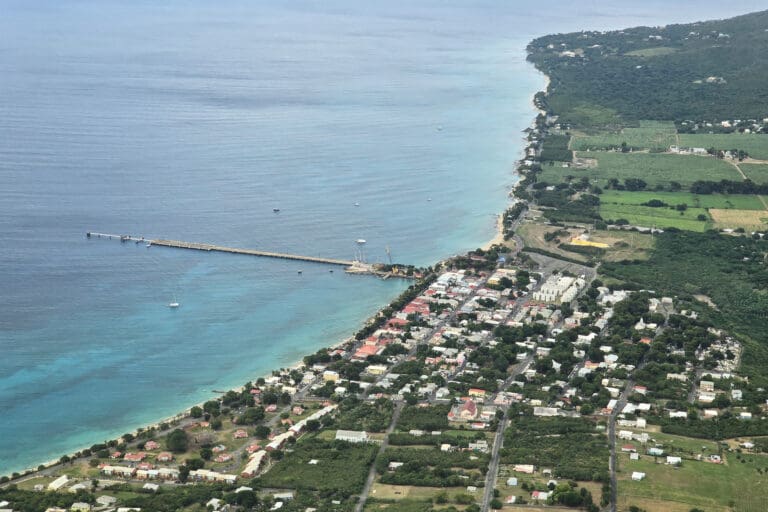
Frederiksted, St. Croix. (Photo courtesy OTF Facebook)
The work is being carried out by DPW contractor Marco St. Croix Inc. and marks another important step in the administration’s continued effort to improve road conditions, strengthen public infrastructure and support the ongoing revitalization of Frederiksted.
Crews have begun preparatory activities, including staging equipment, assessing work areas and preparing traffic control measures ahead of active roadwork. Once construction begins, the project will include milling deteriorated roadway surfaces, rebuilding and preparing road sections as needed, and paving the streets to provide a safer, smoother and more reliable driving surface for residents, businesses and visitors.
The project will also address the temporary bridge on King Street, located just north of the Midre Cummings Recreational and Youth Facility. That portion of the work is especially important for traffic circulation in the area and for residents and families who regularly travel near the park, the waterfront and surrounding neighborhoods.
Governor Albert Bryan Jr. said the project is part of a broader vision to strengthen the Territory’s historic towns by making targeted infrastructure investments that support housing, commerce, public activity and long-term economic development.
“Our administration’s investments in roads, utilities, public spaces and community infrastructure are about more than fixing what is broken. They are part of a larger effort to bring new life and new opportunity into our historic towns,” Governor Bryan said. “In Frederiksted, as in Charlotte Amalie, Christiansted and Cruz Bay, we are working to create the conditions for more housing, more business activity, more foot traffic and more confidence from residents and investors.”
The paving of King Street, Queen Street, Strand Street and portions of Fisher Street represents a significant milestone for Frederiksted. Once completed, these streets will bring to completion the repaving of Frederiksted town streets advanced under the Bryan-Roach Administration, following years of coordinated work to address road conditions throughout the town.
Commissioner of Public Works Derek Gabriel said the project reflects DPW’s continued focus on moving infrastructure work from planning to construction while coordinating with residents, businesses and motorists to minimize disruption.
“We understand how important these streets are to the daily movement of Frederiksted,” Commissioner Gabriel said. “Our team is working with the contractor to move carefully and efficiently, particularly in areas where traffic, drainage, utilities and pedestrian activity must all be considered. We are asking the public to remain patient and attentive as this work gets underway.”
During construction, motorists should expect temporary traffic changes, equipment movement, lane restrictions and possible delays in and around the affected streets. DPW will provide additional traffic advisories as work progresses.
The department is urging motorists to follow posted signs, observe traffic control measures, obey flaggers and use caution when traveling through active work zones.
Governor Bryan noted that he is excited to see the final phase of the road reconstruction and repaving project to fully complete to road restoration in the historic town of Frederiksted
For updates on roadwork and traffic advisories, residents are encouraged to follow the Virgin Islands Department of Public Works and Government House official communications channels at dpw.vi.gov and vi.gov.
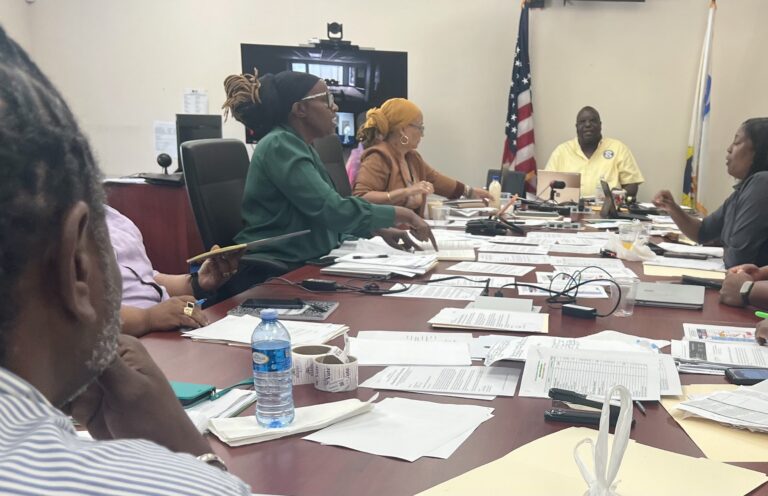
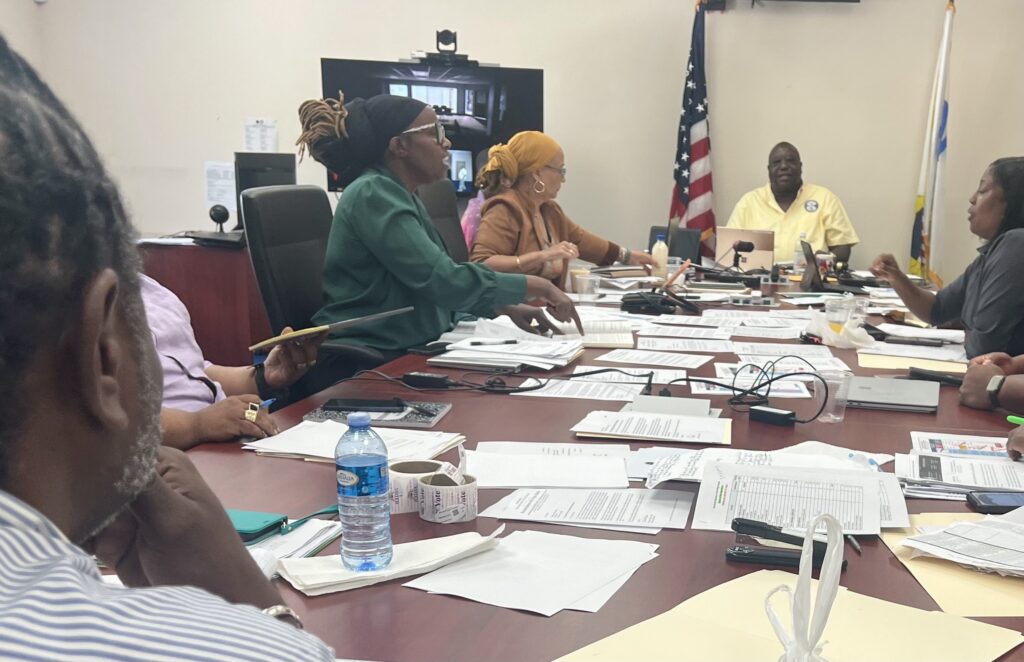
Elections Board members Cleopatra Peters and Atanya Springette debate procedural rules during Wednesday’s meeting on St. Thomas. (Source photo by Judi Shimel)
The Virgin Islands Board of Elections voted Wednesday to continue using a single ballot for federal and territorial races, while spending much of a lengthy meeting debating candidate eligibility, residency disputes, and a failed effort to remove Elections Supervisor Caroline Fawkes.
The decision came after board members emerged from an hourlong executive session, where representatives of Election Systems & Software confirmed the Elections System has the capability to produce separate paper ballots for federal and territorial contests and still meet the June 17 deadline for military and overseas voters. Board Chair Raymond Williams said no action was taken during the closed-door session, which also included updates from the Office of the Attorney General on pending election-related litigation.
Despite confirmation that separate ballots could be produced, the board voted 6-3 to continue using a combined ballot for the 2026 election cycle.
The issue stems from a long-standing debate over whether federal and territorial races should appear on separate ballots. While board members were advised Wednesday that separate ballots could still be produced in time for military and overseas voters, a majority ultimately chose not to alter the format for the current election cycle, arguing that broader compliance questions could be addressed after the 2026 election.
Board member Kareem Francis, who introduced the motion, argued the board could move forward with the current ballot format while continuing discussions about future compliance with election laws.
“We can ensure future elections follow the law to the letter,” Francis said.
Board members Cleopatra Peter and Barbara LaRonde disagreed, arguing that election officials have had ample time to prepare for separate ballots and that voter education efforts could address concerns surrounding the transition.
“We’ve had two years to figure it out,” Peter said.
“It was already identified that it can be done,” LaRonde added.
The ballot issue served as a backdrop for broader concerns raised throughout the meeting about election administration, candidate qualifications, and compliance with election law.
Much of the discussion centered on a complaint filed by Delegate to Congress candidate Ida Smith, who accused Fawkes of improperly requiring documentation related to a St. John address listed on her nomination papers.
Smith contends the request exceeds the supervisor’s authority and effectively imposes additional qualifications beyond those required under federal law for candidates seeking the office of Delegate to Congress.
The dispute mirrors a similar controversy during the 2024 election cycle, when Fawkes moved to disqualify Smith’s congressional candidacy and the Board of Elections later voted to place her on the ballot after receiving an opinion from Attorney General Gordon Rhea concluding that Delegate to Congress candidates are governed by federal qualification requirements.
Fawkes defended the latest request, telling board members the issue differs from questions raised during the 2024 election cycle.
According to Fawkes, the previous dispute focused on Smith’s residency within the Virgin Islands, while the current matter concerns the residence listed on Smith’s nomination papers and whether the structure identified on St. John is, in fact, her place of residence.
Fawkes cited a 2025 ruling by Chief District Judge Robert Molloy in explaining why additional documentation was requested.
Board member Harriet Mercer later introduced a motion directing Fawkes to withdraw the request. The motion failed on a 3-5 vote.
The board also revisited recurring concerns about candidate notification procedures and due process protections.
Several members questioned whether candidates whose nomination papers are found defective are being notified in accordance with Virgin Islands law, which references notification by “special messenger.” Members debated whether modern communication methods such as email and telephone calls satisfy that requirement.
Fawkes said her office typically contacts candidates through multiple channels, including telephone calls and email, and emphasized that the Elections System does not publicly announce candidate disqualifications.
Questions about candidate filings extended to challenges involving congressional candidates James Weber and Jed JohnHope, whose appeals are expected to be addressed when the board reconvenes Friday.
Williams said Weber’s disqualification stemmed from filing nomination papers in the wrong district.
“The law is clear,” Williams said.
According to Williams, Weber’s filing error leaves little room for interpretation under election law, though the matter is expected to be revisited when the board takes up candidate appeals later this week.
The board also reviewed a complaint involving JohnHope, who was disqualified on May 26 by the Elections System. Under 18 V.I.C. § 381(b), candidates for offices elected territorywide must submit nomination papers signed by at least 100 qualified electors from each of at least two election districts and at the time, Fawkes said JohnHope did not meet that requirement, noting that his filing fell short of the district-based signature threshold.
Responding to questions about petition signatures, Fawkes displayed color-coded filing forms and said additional signatures submitted by JohnHope were provided on white paper rather than the official petition forms. She described the color coding as a quality-control measure used by the Elections System.
In other business, board members approved the Elections System’s proposed Fiscal Year 2027 budget request, which Fawkes and her staff are expected to present before the Senate Finance Committee later this summer.
Fawkes also discussed funding allocated for the current election cycle, telling members that $275,000 has been designated for the primary election and approximately $400,000 for the general election, though supplemental funding may ultimately be required.
The board approved the supervisor’s report after making several amendments and corrections during public discussion.
Members also addressed the status of board member Lawrence Boschulte, whose May 27 resignation letter was read into the record. Boschulte recently filed to run for a seat in the 37th Legislature and was previously determined, and ultimately disqualified about a week ago, by Elections officials to be ineligible to remain on the Board of Elections while seeking another public office. During the casting of the lots on May 29 for the Democratic Primary, Fawkes told members of the media that Boschulte would be replaced by former Elections board member Lydia Hendricks.
Under Virgin Islands law, Board of Elections members may not be candidates for another public office during the term for which they were elected and must resign from the board as a condition of seeking office.
Williams declined to accept Boschulte’s resignation Wednesday, noting that the letter submitted to the board was unsigned.
Tensions escalated near the end of the meeting when LaRonde introduced a motion seeking Fawkes’ removal, citing what she described as “numerous violations of law.”
Williams immediately ruled the motion out of order.
LaRonde challenged the ruling, but a majority of board members sided with the chairman, effectively preventing debate on the proposal and stopping the motion from advancing.
With several St. Croix board members needing to return home, the meeting adjourned shortly after 2 p.m. Members agreed to reconvene Friday to continue reviewing appeals and correspondence from candidates challenging their disqualification from the 2026 ballot.
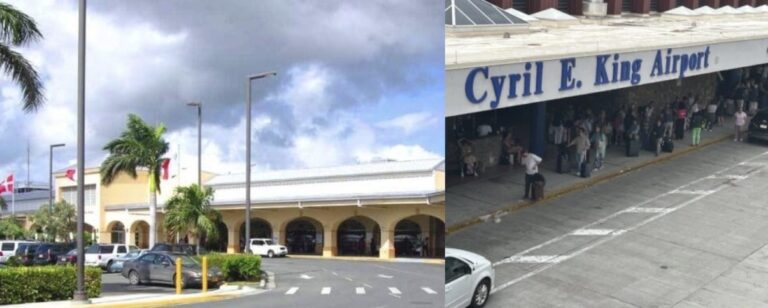
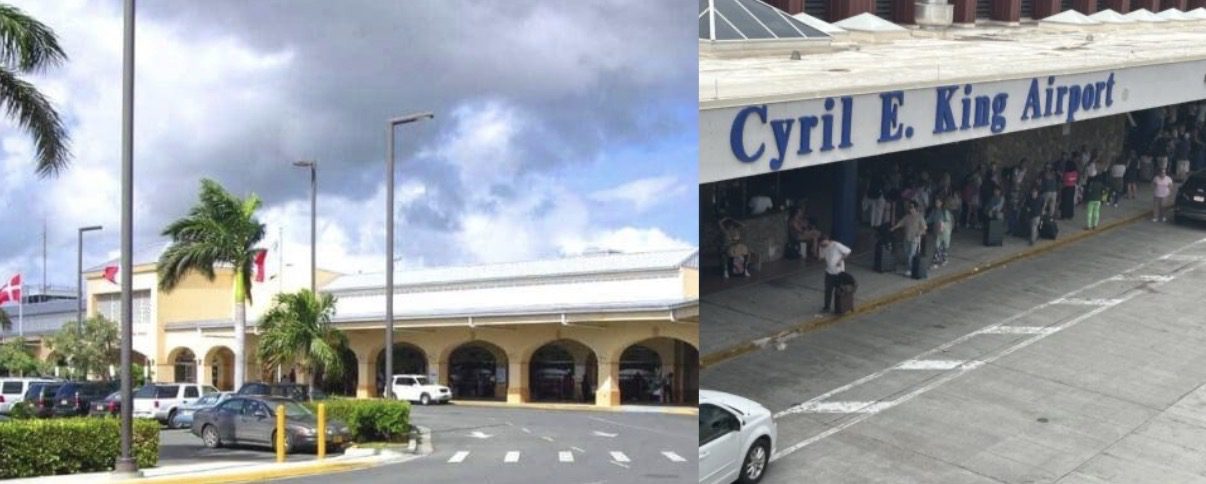
Representatives from major airlines servicing St. Thomas and St. Croix signed a letter to V.I. Port Authority leadership and Gov. Albert Bryan Jr. calling for changes to the territory’s airport redevelopment plans. (Source file photo)
In a letter to V.I. Port Authority leadership and Gov. Albert Bryan Jr. Wednesday, major airlines decried the lack of transparency around plans to redevelop the St. Thomas and St. Croix airports and said they would not sign leases or operating agreements under the current structure.
“As you are aware, the AAAC members are essential to the economic vitality and connectivity of the USVI, supporting tourism, commerce, and access for residents and visitors alike,” they wrote. “Despite paying VIPA-imposed fees that should be used to operate and improve USVI airports, AAAC members have been disappointed that, unlike surrounding airports in the region, there has been no transparency in the use of funds as it relates to the improvement of facilities.”
The letter was sent by the U.S. Virgin Islands Airlines Airport Affairs Committee and signed by representatives from American Airlines, Delta, United Airlines, JetBlue Airways, Cape Air, Sun Country Airlines, Southwest Airlines and the trade association Airlines for America. The Virgin Islands government announced its selection of VIports Partners — a consortium of firms comprising Aecon, Tikehau Star Infra, AvPorts, Corgan Associates, Consigli Construction, J. Benton Construction and the law firms Orrick, Herrington and Sutcliffe LLP and Dudley Rich LLP — to rebuild the territory’s two major airports during a press conference in April 2024. The group later formed a special purpose company dubbed “SkyCity.”
On Wednesday, airlines said they were shut out of opportunities to consult on “program operability, affordability or constructability.”
“At no point during the RFP or solicitation process were the airlines consulted or brought in to discuss program scope or P3 selection,” according to the letter. The airlines further claimed that VIPA dismissed an alternative proposal of phased, $300 million “capital core program developed over the last year in favor of the P3 proposal that well exceeds” $1 billion. They called VIPA’s plan to move forward with the public-private partnership an “unacceptable” proposition that was “not economically supportable” for AAAC members and stated that they will not enter into a lease, operating agreement, or rates and charges arrangement under the current model.
“In serving USVI airports through the years, AAAC members share VIPA’s goals of improved facilities, but we cannot ignore the need to ensure operational and economic sustainability for a program of this magnitude in the USVI,” they wrote.
Neither the V.I. Port Authority’s spokesperson nor its governing board chair, Willard John, responded to the Source’s requests for comment. Gov. Albert Bryan Jr. told the Source that former VIPA Executive Director Carlton Dowe had been speaking to the airlines about these issues for years and that “were offered a chance to move forward” with the Port Authority “and that never materialized.”
“We are moving forward with our plan and will work with the airlines to get it done,” Bryan said, adding that it was nonnegotiable that the territory needs new airports. “I don’t know anyone that would disagree with the need for one in St. Thomas, especially the people standing in line to sit in our hot, crowded departure lounge. Equally, improving our infrastructure in St. Croix is just as important.”
The threat to future airlift to the Virgin Islands came just two days after Lt. Gov. Tregenza Roach announced forthcoming United Airlines flights connecting Newark and St. Croix. On the same day, Bryan delivered opening remarks for the Caribbean Tourism Organization’s Caribbean Week in New York.
Acting Gov. Tregenza A. Roach has signed legislation appropriating $2.1 million for repairs and assessments intended to improve power reliability in the St. Thomas-St. John district and $2.3 million to continue the University of the Virgin Islands’ tuition-free scholarship program, according to a Government House press release.
The measures, approved Tuesday, provide funding for repair or replacement of the damaged submarine electrical transmission cable serving St. John, assessments and repairs to Unit 15 at the Randolph Harley Power Plant on St. Thomas, and continued support for the Virgin Islands Higher Education Scholarship Program, the press release stated.
According to the release, Roach signed Bill No. 36-0292, which appropriates $2.1 million to the Virgin Islands Water and Power Authority for work on the submarine transmission cable and Unit 15. Government House said the projects are expected to improve grid stability in the St. Thomas-St. John district.
The submarine cable serves as the electrical connection between St. Thomas and St. John, while Unit 15 is part of the generating capacity at the Randolph Harley Power Plant, the release stated.
“Reliable electricity is essential to daily life, public safety, health care, business operations and the overall quality of life of our people,” Roach said. “This funding supports work that is intended to have a direct and practical impact on grid stability in the St. Thomas-St. John District, including repair or replacement of the submarine cable serving St. John and critical assessments and repairs to Unit 15 at the Randolph Harley Power Plant. These are necessary steps as we continue the broader work of strengthening the Territory’s energy system.”
Roach also signed Bill No. 36-0296, which appropriates $2.3 million to the University of the Virgin Islands Scholarship Revolving Fund and shifts the program’s funding source from the Internal Revenue Matching Fund to the General Fund, according to Government House.
The measure supports the Virgin Islands Higher Education Scholarship Program, commonly known as the Free Tuition Program, which allows eligible Virgin Islands students to attend UVI without paying tuition costs, the release stated.
Government House noted that Roach introduced the legislation establishing tuition-free education at UVI while serving in the 32nd Legislature.
“This measure is about more than appropriating funds. It is about keeping a promise to Virgin Islands students and families,” Roach said. “When I introduced the legislation to make tuition-free education at UVI possible, it was rooted in a simple belief that the ability to pursue a college degree should not be limited by a family’s ability to pay. Today, by shifting the funding source to the General Fund and providing this appropriation, we are helping to sustain that promise and ensure that more Virgin Islanders have a fair opportunity to prepare themselves for the future.”
According to the release, the program is intended to support workforce development and expand access to higher education by helping eligible students earn undergraduate degrees at UVI.
Richard Allan Lockhart passed on May 20. He was 76 years old.
Richard Allan Lockhart
He is survived by wife, Alda Fabio Lockhart; children, Dr. TanyaM. Lockhart, Tisha M. Lockhart, Tricia M. Lockhart, Tremain M. Lockhart; adopted daughters, Ja’Nae A. Curry, Amira Russell, Aretha Reviere; grandchildren, T’Moi M. Lockhart, T’Anna C.M. Lockhart Edney, T’Mari M. Lockhart, Luis S. Llanos III, Triana M. E. Llanos; brother, Raymond Lockhart; sisters, Violet Delville, Ju-Ana Lockhart-Brown, Suni Lockhart, Merilyn Lockhart; sisters-in-law, Morlene Lockhart, Patricia Petersen, Carolie Fabio; brothers-in-law, Alfredo Petersen, Dudley Fabio Jr.; nieces and nephews, Raymond Lockhart III, Resa Lockhart, Olive and Patrice Petersen, Dudley “3rd” Fabio III, Calvin Fabio, David Fabio, Austin Fabio, Anthony Fabio, Rissa Fabio-Parrilla, Dean Scarbriel, Jr, Yma Su-ling Scarbriel, Pia Henry, Omar Brown III, Raymond Brown, Suni Lydia Lima, Antoine Magras, and Gregory Magras, Louise Aurora Scott, Yvanis Romeo Lockhart, Edan Feige-Scott; extended family, Christian, Grigg, Lockhart, Elskoe, Fabio, Petersen, Schuster, Phillips, Merle Derricks Finley, Peter William, Sr and Cleon Llanos; special friends, Carol St. John, Luther Edwards, Christiansted High School Class of 1967, Coakley Bay Campers, Albert and Marie Schuster, Adelbert Bryan, Gerard Luz James II, Elroy Bauman, Chester Benjamin, Kevin Hendricks, Hugo Moorehead, Daryl Lynch, O’Reilly Construction, Frankie Pollara; special thanks, Keva Muller, Aunty Pat and Family, Uncle Raymond and Family, Cousin Rose Marie S. Gonzalez, Shanda and Noah Cebedo, The Bryan Sisters, The Hansen Sisters, Wilma Pinela, Alvin Milligan, O’Reilly Construction, VIDE Division of Special Education STX District, Governor Juan F. Luis Hospital and Staff, Broward Youth Treatment Center Florida, Alpha Kappa Alpha Sorority, Inc. Mu Gamma Omega Chapter and the Delta Sigma Theta Sorority, Inc. Other relatives and friends too numerous to mention.
Funeral service will be held on June 8 at Friedensthal Moravian Church. Viewing at 9 a.m. and service begins at 10 a.m. Interment will be held at Kingshill Cemetery.
Funeral arrangements are entrusted to James Memorial Funeral Home, Inc.
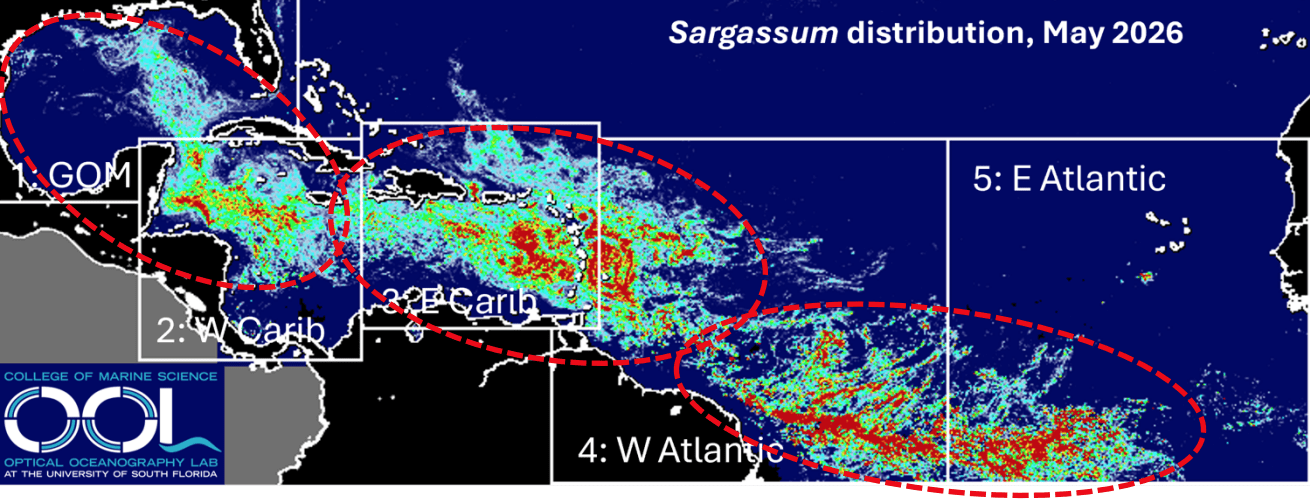
A May 2026 satellite map from the University of South Florida’s Optical Oceanography Lab shows sargassum distribution across the Caribbean, Atlantic, and Gulf regions, with several large areas of accumulation outlined. (Photo courtesy USF)
Sargassum continued to rise across much of the Atlantic basin during May, and the latest regional outlook from the University of South Florida’s Optical Oceanography Lab indicates that beaching events around the Caribbean and Florida may continue to increase in June.
The lab at USF monitors the presence of sargassum across the Atlantic, Caribbean, and Gulf regions using satellite imagery. In its May 31 bulletin, USF showed another active month for sargassum, with amounts continuing to rise across most monitored regions.
“As predicted in April, total sargassum amount in most regions continued to increase in May. Every area except the West Atlantic region continued to show record-high sargassum amount for the month of May,” according to the USF report.
The bulletin included a chart that depicts an estimated 28.9 million metric tons of sargassum across all monitored regions during May. USF also said that three separate, large masses of sargassum continued to expand across the Atlantic basin. Additionally, the USF lab reported that sargassum transport into the Gulf continued, and that seaweed beaching events have occurred.
“The transport of sargassum to the Gulf also continued, resulting in record-high amount at this time of year,” USF reported. “Major beaching events have been reported around the Caribbean and Lesser Antilles islands as well as along the Florida Keys and east coast of Florida.”
Local Sargassum Effects
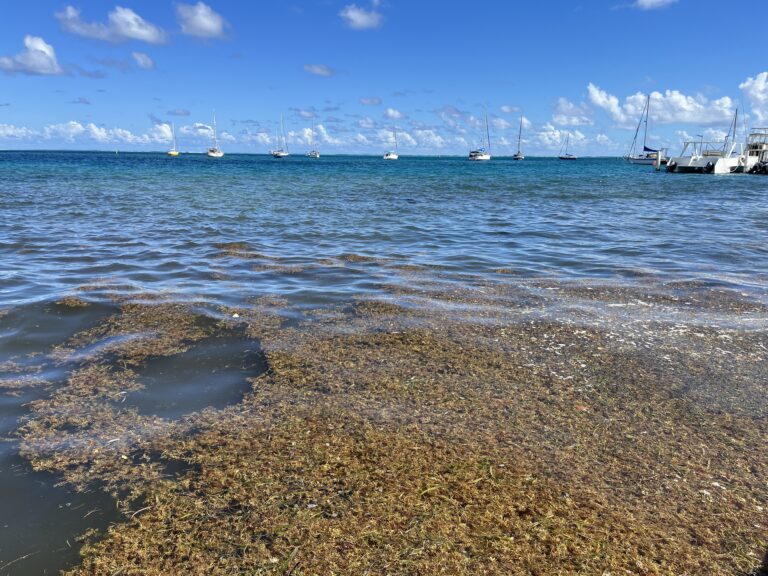
For the U.S. Virgin Islands and Puerto Rico, impacts from the seaweed will continue to depend on winds, currents, tides, swell direction, and nearshore conditions. Even when the broader region is active, conditions can change quickly from one beach to another and from one day to the next.
Because both U.S. territories sit within the eastern Caribbean and Lesser Antilles region, additional sargassum arrivals remain likely in the weeks ahead. Residents and visitors are encouraged to monitor local beach conditions, particularly during periods of changing winds or currents.
“Sargassum amount in most regions is likely to increase in June,” USF said.
The USF lab added that shoreline inundation events are also predicted to continue.
“Beaching events around the Caribbean and southeast coast of Florida will continue and likely increase,” USF stated. “Some beaching events may also occur around Louisiana and Texas coasts. The year of 2026 is set to be another major sargassum year, meaning that sargassum amount exceeds 75% of the historical values, and possibly will be a record year by summer 2026,” USF added.
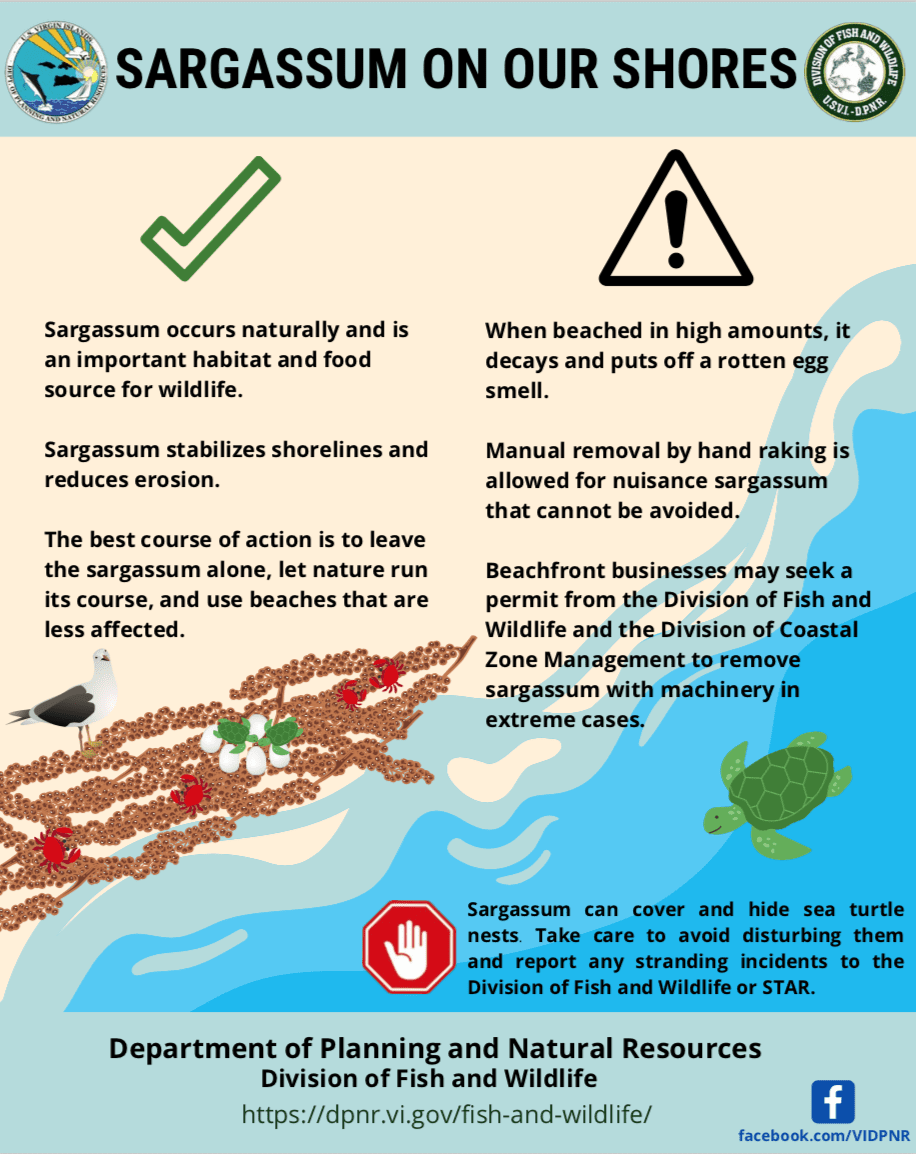
Sargassum ExplainedAs the Source previously reported, sargassum seaweed plays an important role offshore as habitat for marine life, but it can also create problems when winds and currents carry large mats ashore, according to the National Oceanic and Atmospheric Administration.
Virgin Islands Department of Planning and Natural Resources graphic explains how sargassum can benefit shorelines and wildlife, while also warning that large amounts of decaying sargassum can create odor and other coastal concerns. (Photo courtesy DPNR Division of Fish and Wildlife)
“Sargassum is a type of floating brown algae that provides food, protection, and habitat for many marine species. While sargassum plays an important role in the health and biodiversity of open ocean ecosystems, it can also be harmful in certain situations when rafts of this brown algae are carried to shore by winds and currents,” NOAA said.
Sargassum Research and Possible Uses
While sargassum remains a major challenge for Caribbean communities, researchers continue to study ways the seaweed may be used as a resource.
A recent Barbados TODAY report highlighted work by Bidyut Mohapatra, Ph.D., a University of the West Indies Cave Hill Campus scientist, who discovered three new species of microorganisms in decomposing sargassum. The report said the microbes may help break down the structural components of sargassum and could have potential uses involving enzymes, antibiotics, biofuels, and agricultural chemicals.
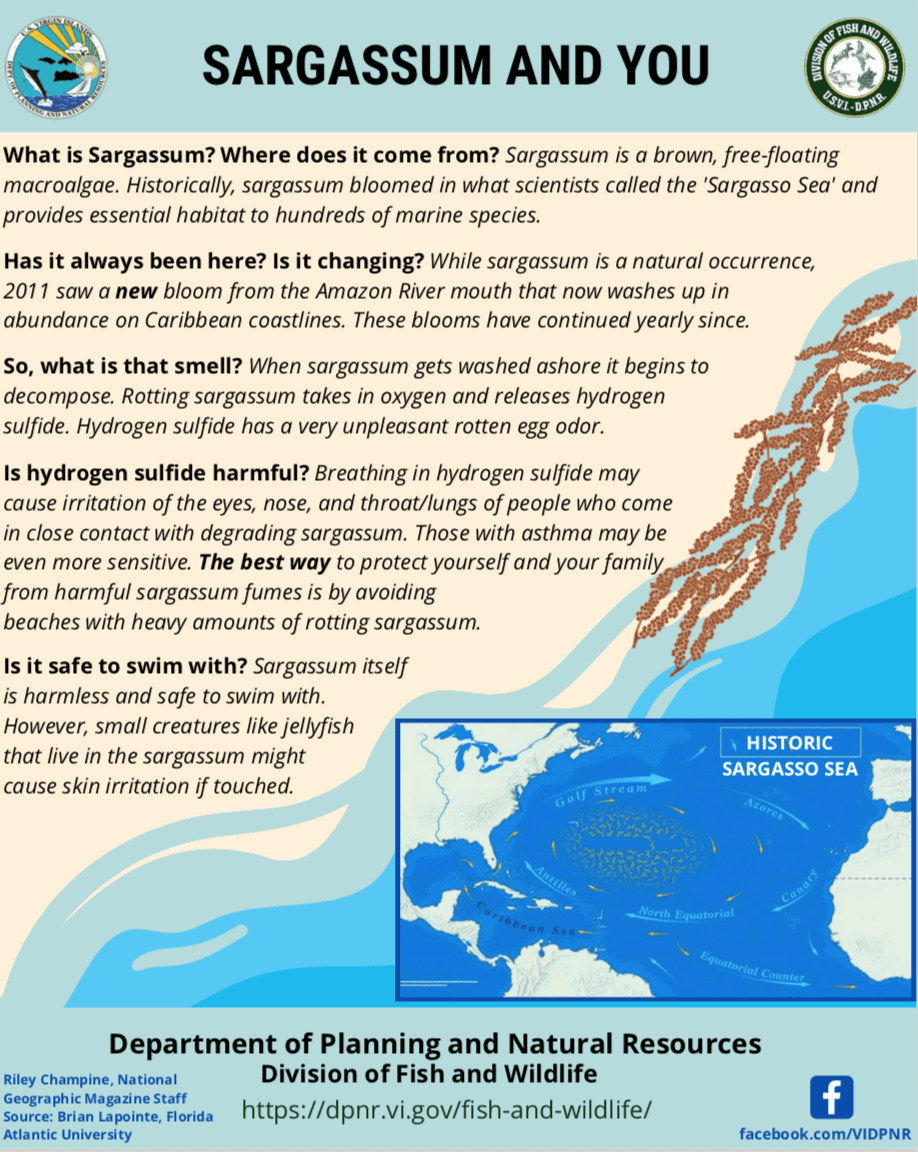
DPNR graphic provides general information about sargassum, including where it comes from, why it smells when it decomposes, and how heavy accumulations can affect people near impacted beaches. (Photo courtesy DPNR Division of Fish and Wildlife)
One of the newly identified microbes, “Streptomyces sargassi,” was described in the Barbados paper as especially significant because of its possible medical and industrial uses.
Additionally, a recent report from Earth.com, based on a Nature Communications study, noted that scientists are increasingly viewing the Great Atlantic Sargassum Belt as a persistent and self-sustaining feature of the ocean, rather than a short-term seasonal problem. The study found that nutrient recycling within older sargassum mats and the organisms living in them may now be helping to sustain the blooms.
“Floating mats now host communities of marine organisms that recycle nutrients such as nitrogen inside the seaweed itself,” the Earth.com report explained. “Decaying algae release those nutrients back into the surrounding water.”
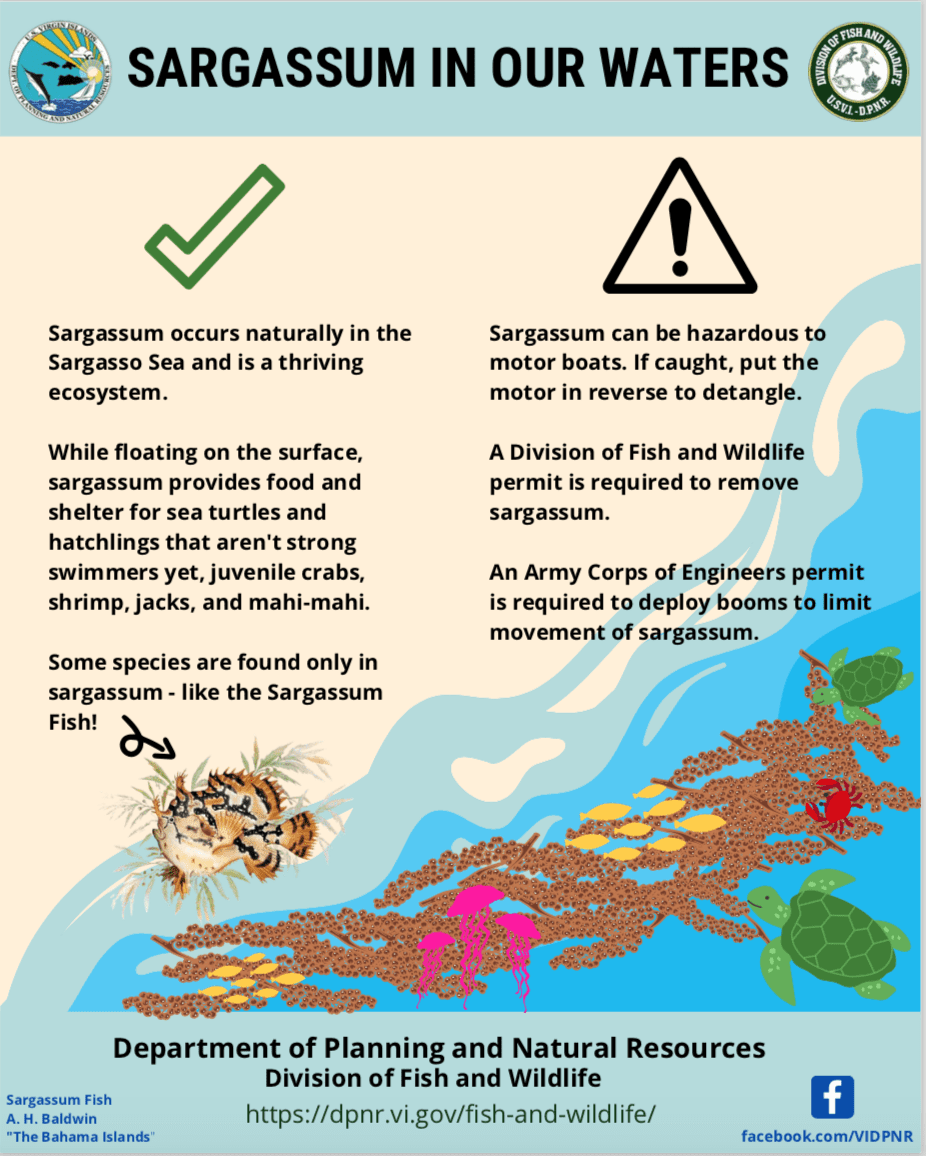
A graphic from DPNR explains the benefits of sargassum in the water, including its role as habitat and food for marine life, while also noting possible boating hazards and permit requirements for removal. (Photo courtesy DPNR Division of Fish and Wildlife)
“The system has learned, in a biological sense, to feed itself. Wind events still influence it, but they no longer drive it. The belt generates its own conditions for growth, season after season, regardless of what the weather does,” the article continued.
Monitoring Local Conditions
Individuals can follow the progression of the current sargassum bloom and stay up to date each month on where the algae may be headed.
Finally, in addition to monitoring sargassum, residents and visitors across the U.S. Virgin Islands are encouraged to follow the local weather forecast. Weather information is available from the NWS and NOAA. The local weather forecast for the U.S. Virgin Islands is regularly updated on the Source Weather Page, and individuals can also find helpful weather information and alerts from the Virgin Islands Territorial Emergency Management Agency.
For the second year in a row, Cancer Support VI is proud to recognize Men’s Health Month this June, through a territory-wide digital awareness campaign focused on education, prevention, connection, and support for men and families across the U.S. Virgin Islands.
Every Dollar raised is Doubled through June 30. (Submitted photo)
Men in the U.S. Virgin Islands are dying from cancers that are treatable when caught early. This June, Cancer Support VI is asking our community to help change that and thanks to two extraordinary local partners, every dollar you give will go twice as far.
Heavy Materials and J. Benton Construction, Bliss Properties, Fun Hog Charters, Renaissance Marine, Seaview Management and Sonic Charters have committed to matching every donation made to Cancer Support VI up to $20,000 during the month of June. Every dollar counts, and right now, every dollar is doubled.
This year’s Men’s Health Awareness campaign, “Partners in Care,” launches Cancer Support VI’s territory-wide June effort to reach men across St. Thomas, St. John, and St. Croix with education, resources, and meaningful connections to care. Centered on the importance of collaboration in improving health outcomes for men at every stage of life, the campaign brings together local healthcare providers, community organizations, businesses, and advocates to encourage open conversations, early detection, and proactive healthcare decisions throughout our territory.
Throughout the month, the campaign will feature local physician spotlights, warrior stories, screening information, community health fairs, and recognition of Wear Blue Day on June 19.
“Men in our community are dying from cancers that are treatable when caught early. When men get the support they need, whole families are stronger. This campaign, and the generosity of our matching partners, gives us a real opportunity to change that. Every dollar donated before June 30th goes twice as far for the men and families we serve.” — Barb Michaud, Director, Cancer Support VI
Men continue to experience higher rates of preventable illness and premature death, often due to delayed screenings and limited engagement in preventive healthcare. Cancer Support VI hopes this campaign will help break stigmas surrounding men’s health conversations and encourage earlier intervention and healthier outcomes.
These matching contributions not only amplify donations but also demonstrate a shared investment in improving men’s health awareness, access to care, education, and support services throughout the U.S. Virgin Islands. Together, we are creating stronger outcomes for the men, families, and communities we serve.
Community members are encouraged to follow Cancer Support VI throughout June for educational resources, warrior stories, physician spotlights, health fair information, and opportunities to support men’s health initiatives across the Virgin Islands.
For more information, to become a Matching Partner in Care, or to access patient support services, please visit cancersupportvi.org or call Barb Michaud 207-624-2422.
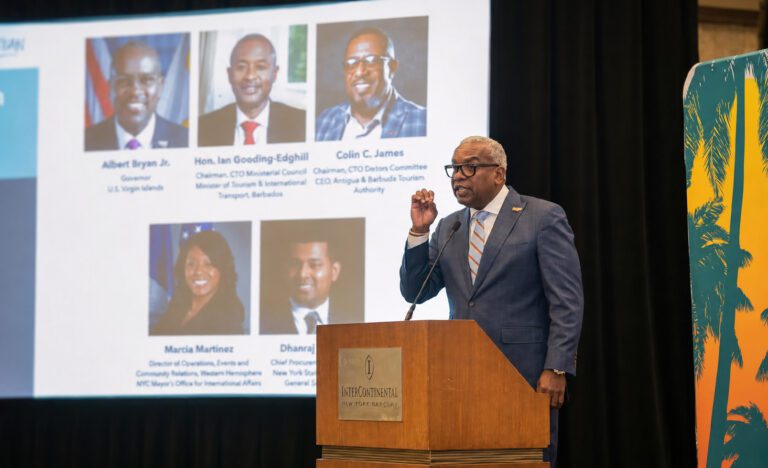
Gov. Albert Bryan Jr. delivered opening remarks Monday during the Caribbean Tourism Organization’s Caribbean Week in New York, calling on regional leaders to strengthen cooperation across the Caribbean and position tourism not only as a driver of visitor arrivals, but also as a catalyst for long-term investment, economic development and shared regional prosperity.
Gov. Albert Bryan Jr in New York. (Submitted photo)
Speaking before tourism officials, industry leaders and government representatives from across the Caribbean, Gov. Bryan urged destinations to see one another as partners in a larger regional strategy rather than competitors for the same visitors.
“There are more than enough visitors in the United States and around the world for all of us,” Bryan said. “The Caribbean’s success is not dependent on one island winning at the expense of another. Our collective strength lies in working together to market our region, improve connectivity and elevate the Caribbean brand globally.”
Bryan said that while the Caribbean’s natural beauty remains one of its greatest assets, the region must continue evolving beyond traditional tourism promotion and use its global appeal to attract broader investment and opportunity.
“We will always use our smiles, our sand, our surf, our culture and our hospitality to attract visitors,” Bryan said. “But our responsibility does not end when tourists arrive. We must leverage our talent, our innovation and our resources to transform visitors into investors, partners and advocates for the future of the Caribbean.”
The governor emphasized the importance of converting tourism relationships into opportunities for entrepreneurship, real estate development, technology investment, trade partnerships and workforce development throughout the region.
He also pointed to renewed interest by the United States in the Caribbean as a significant opportunity that regional governments should seize together.
“The Caribbean stands at a pivotal moment,” Bryan said. “The United States has renewed its focus on the region because it recognizes our strategic importance. We must work collectively to ensure that this renewed engagement translates into meaningful investments in resilience, energy security, climate adaptation, infrastructure modernization and expanded trade opportunities.”
Bryan said Caribbean nations and territories have a unique opportunity to collaborate on energy efficiency, disaster preparedness, supply chain development, maritime commerce and emerging industries that can help diversify regional economies beyond tourism alone.
He noted that improving air access remains central to the region’s ability to compete, grow and convert interest in the Caribbean into lasting economic activity. In the U.S. Virgin Islands, that strategy has recently produced significant new airlift, including Southwest Airlines’ new nonstop service to St. Thomas from Orlando and Baltimore/Washington, and United Airlines’ announced nonstop service between Newark/New York and St. Croix, which is scheduled to begin Oct. 31.
Bryan said those additions reflect the kind of connectivity Caribbean destinations must continue pursuing together to make travel easier, expand visitor access, strengthen local economies and create new investment opportunities.
Drawing from the experience of the U.S. Virgin Islands, Bryan highlighted ongoing investments in renewable energy, infrastructure reconstruction, broadband expansion and economic diversification initiatives designed to create sustainable growth and strengthen resilience against future challenges.
“As Caribbean leaders, we must think beyond the next tourism season and focus on building economies that create opportunity for future generations,” Bryan said. “Together, we can build a stronger, more resilient Caribbean that attracts visitors, welcomes investment, expands trade and creates prosperity for our people.”
Caribbean Week is the Caribbean Tourism Organization’s premier annual tourism event, bringing together government officials, tourism stakeholders, media representatives and private-sector leaders to discuss the future of Caribbean tourism and economic development.