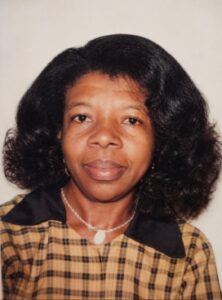
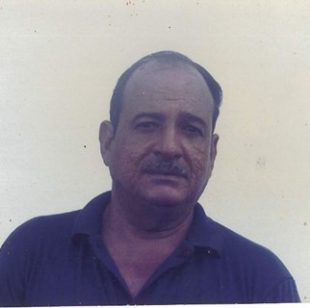
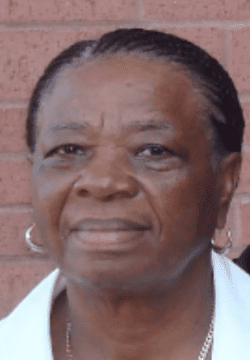
Laurina Mary Dalsan, born on October 28, 1951, passed away peacefully on April 21, 2026. She was a beloved daughter, sister, aunt, and friend whose presence will be deeply missed by all who knew and loved her.
Laurina Mary Dalsan
Laurina’s life was one marked by quiet strength, warmth, and devotion to her family. She shared meaningful connections with those around her and will be remembered for her kindness, resilience, and the love she extended to others throughout her life.
She leaves to cherish her memory her brothers, John Dalsan and George Herman; and her sisters, Carola Charlery, Agnes Dalsan, and Celestina Fenelon-Ishmael. She is also remembered fondly by her many nieces and nephews, who are too numerous to mention but held a special place in her heart.
Laurina was preceded in death by her mother, Rosanna Herman-Dalsan; her father, Antoine Dalsan; and brothers, Felix Antoine Herman, Harris Dalsan, and Lucien Herman.
She also leaves behind the extended Herman, Dalsan, and Fenelon families in St. Croix, St. Lucia, and abroad, along with many other relatives and friends whose lives she touched in meaningful ways.
A funeral service in celebration of her life will be held on April 30, at St. Ann’s Catholic Church, #42 Barrenspot, Christiansted, St. Croix, Virgin Islands. Viewing will begin at 9 a.m., followed by the service at 10 a.m. The family kindly requests that no flowers be sent for the funeral service. In celebration of Laurina’s life, attendees are encouraged to wear bright and cheerful colors rather than customary black attire.
Laurina Mary Dalsan’s memory will live on in the hearts of all who knew her. May she rest in eternal peace.
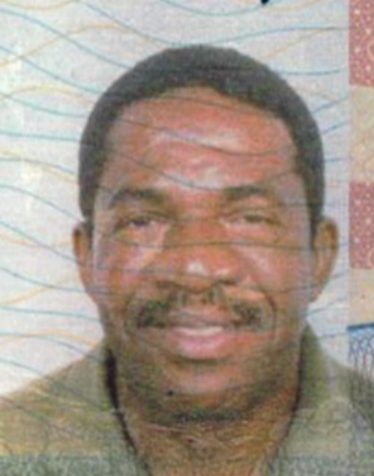
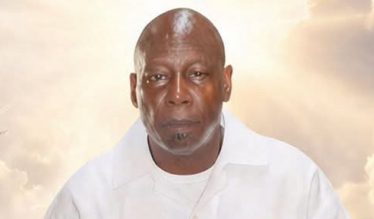
Lindsay Thomas, of Bugby Hole, C’sted, passed away on April 8. He was 68 years old.
Lindsay Thomas
He was preceded by his parents, Eulda Thomas and Peter Thomas.
He is survived by his wife, Debbie Colbourne- Thomas; daughter, Cayce Thomas; son, Larry Thomas; stepsons, Javon Knighton, Javier Hitlall; grandchildren, Amira Thomas, McKenzie & Amir Knighton; sisters, Megan Bernadette Frair, Roselia Durand, Nerica Allen, Nelister Thomas; brothers, Hayson Thomas, Peter Thomas; nieces, Nardia Pierre, Nandine Frair, Claysia Thomas, Amanda Thomas, Nickendra Thomas, Darnel Durand, Tardel Durand; nephews, Anderson Pierre, Jed Fifi, Ziah Thomas, Adowa Thomas, Calvin Durand, Nick Durand, Greg Jno Baptist; great nieces, Nikita & Adaria Pierre, O’Niyah Selkridge, O’nika Jn Louis, Nailah & Abigail Adrien; great nephews, Thomas, Ethan, Evan Jno Baptist; aunts, Salome Williams, Magdaline Zodia; brothers-in-law, Auribe Frair, Pascal Durand, Carron & Derrol Colbourne, Taj Malik Tafari; sisters-in-law, Elmarie Stemn, Lucinda Joseph, Gwen Steele; special friends, Amos King, Leroy Hamilton, Paul Alexander, Sherlinda Guadalupe, DPNR Permits Division, Peters Rest SDA Family; cousins and other relatives, Anita Jackline, Lisa Gerwin Pierre, Terry, Tracy, Tesa Sterns, Lerry Roberts, Derrick Serrant, Derrison Common, Marlene & Claude Mowlon, Royette Charles, Kenrick John, Daphne Edwards, Glenora Nicholas, Garvin & Diana Williams, The Children of the Late Monea Toutsant in Chockram, Dominica, Travis Pierre, The Scotland and Xavier in Dominica; precious friends and other relatives too numerous to mention.
Funeral service will be held on April 30 at Central Seventh Day Adventist Church. Viewing begins at 9 am, with service at 10 am. Interment will be held at Kingshill Cemetery.
Funeral arrangements are entrusted to James Memorial Funeral Home, Inc.
Clinton Lang Sr., aka “Clinty”, of Sally’s Fancy, passed away on March 18, 2026. He was 86 years old.
Clinton Lang Sr.
He was preceded by his mother, Eulalia Briscoe, and father, Charles Lang.
He is survived by his wife, Roselyn Lang;son, Clinton Lang Jr.; sisters, Ann Marie Gibbs, Gerarda Gibbs, Geraldine T. Gibbs, Claudette Coleman, Lynette Lang; brothers, Lauritz E. Gibbs, James Gibbs; nieces, Arienne Lang, Ezra Carrasquille, Duerka Carrasquille, Lynette; nephew, Robert Lang; brother-in-law, George Coleman; precious friends and other relatives too numerous to mention.
The memorial service will be held on April 29 at James Memorial Chapel, starting at 10 am. Interment of the cremains will be at the Kingshill Cemetery.
Funeral arrangements are entrusted to James Memorial Funeral Home, Inc.
Scams are everywhere today—from fake texts and emails to nonstop phone calls—and the damage is devastating. According to the Federal Trade Commission, Americans lost as much as $196 billion to financial fraud in 2024, with older adults losing as much as $81.5 billion.
(Submitted photo)
This April, AARP is mounting a nationwide Fraud Prevention Month, through which volunteers across the country will host hundreds of free local events that offer practical ways to stay informed, safe, and connected. Many sites will also offer free, safe document shredding to help prevent identity theft.
You can also join us from the comfort of your home on April 15 for a special fraud prevention broadcast on RFD‑TV and online, or pick up the phone for a nationwide Tele‑Town Hall with AARP fraud experts on April 30. Learn more at aarp.org/fraudsafety.
Fraud affects every generation, and AARP Fraud Watch Network is helping people fight back—one community at a time. By learning together and sharing information, we can better protect one another.
Learn how to spot and avoid scams with AARP Fraud Watch Network™. Suspect a scam? Call our free helpline at 877-908-3360 and talk to one of our fraud specialists about what to do next.
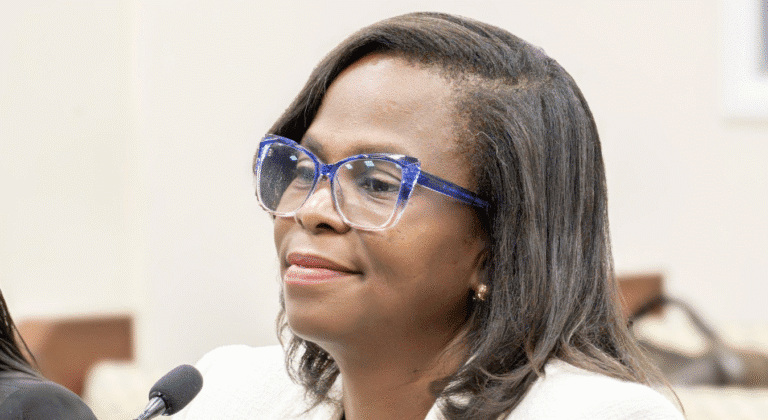
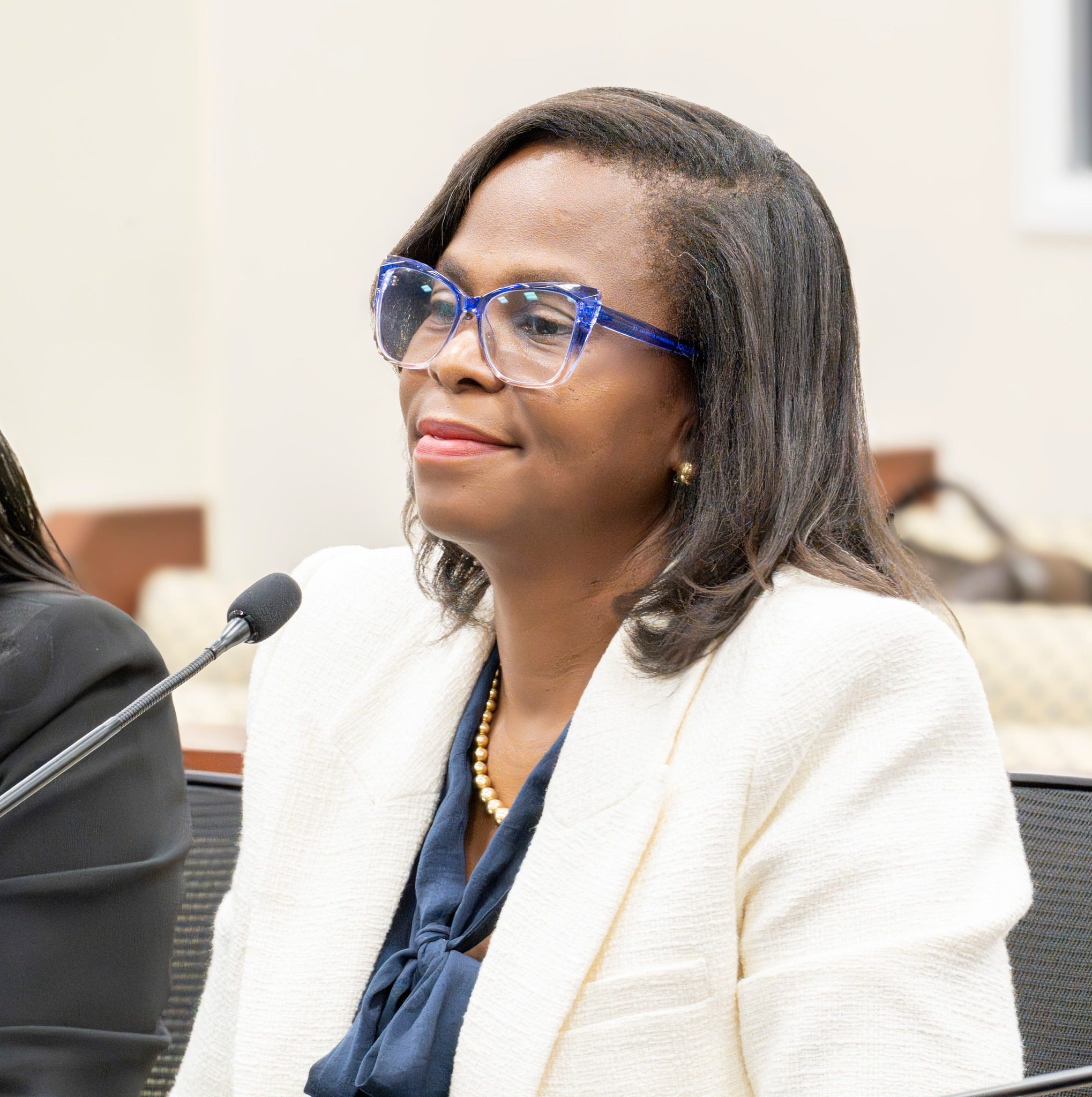
Adrianne L. Williams-Octalien, director of the Office of Disaster Recovery, at the Friday meeting of the Senate Disaster Recovery, Infrastructure and Planning Committee on disaster recovery in the territory. (Photo courtesy V.I. Legislature)
The Senate Disaster Recovery, Infrastructure and Planning Committee convened an oversight hearing Friday on a $24 billion reconstruction effort, reviewing project progress and the territory’s labor and housing capacity.
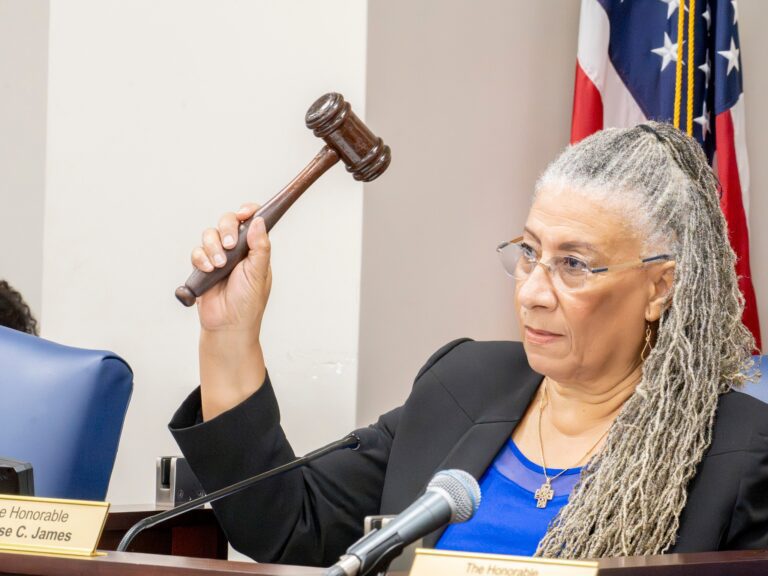
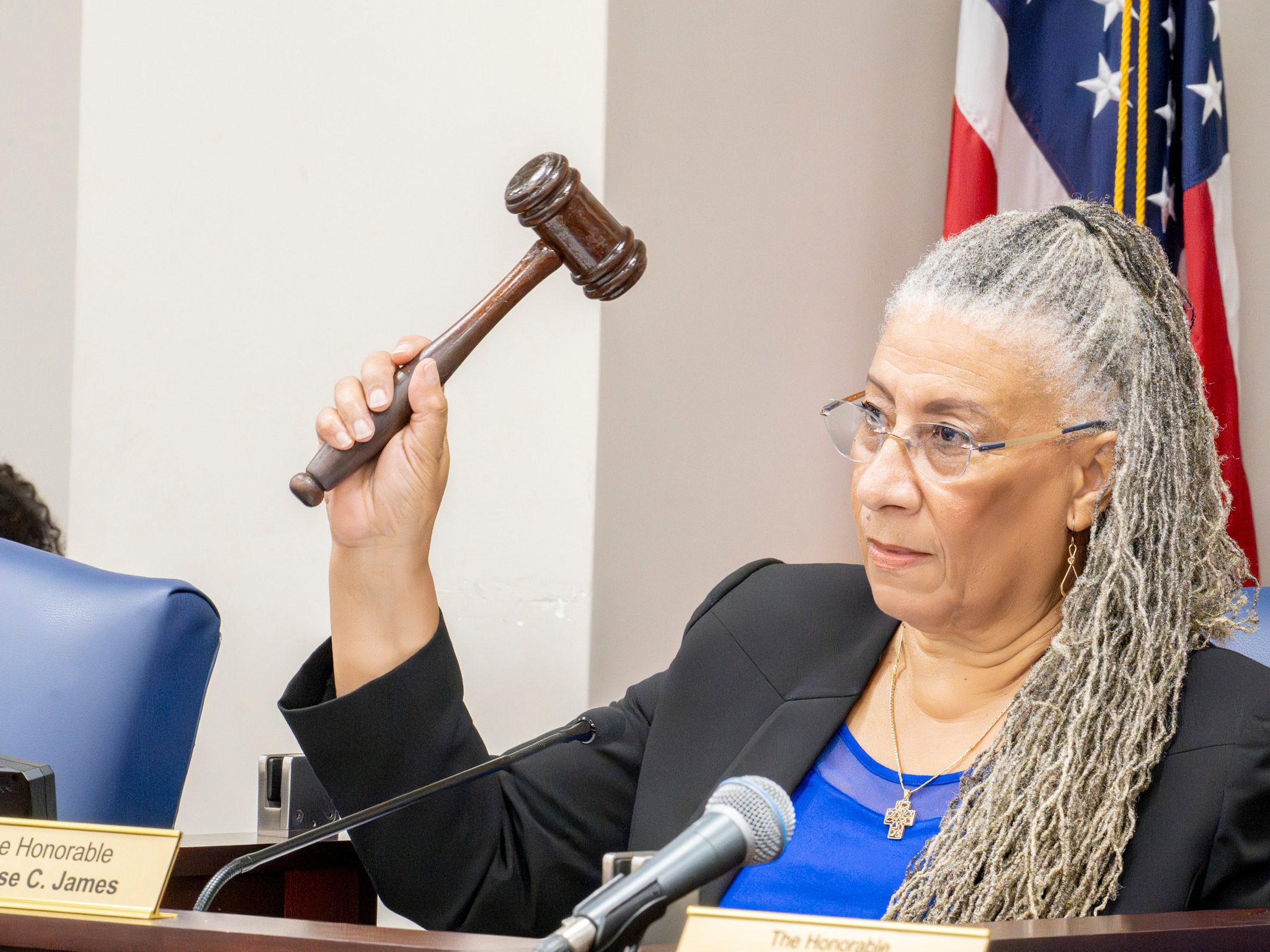
Chaired by Sen. Marise C. James, the committee heard detailed testimony from the Office of Disaster Recovery, the Labor Department and private construction executives on how federal recovery funds are being translated into new schools, hospitals, utilities and housing.
Lawmakers focused on three themes: whether major projects are on schedule, whether the Virgin Islands has enough workers to complete them, and where thousands of additional off-island laborers would live.
Officials described a recovery now in full construction mode, with dozens of major projects under contract and more nearing rollout. At the same time, they warned that a tight labor market, permitting delays, inflation and limited housing stock could slow progress, even as FEMA has set 2035 as the deadline to complete fixed‑cost projects while maintaining the current cost share.
Office of Disaster Recovery officials said the scale of the effort has expanded sharply, with projected federal funding growing from about $8 billion to roughly $24 billion as additional projects were approved and funding rules changed.
“The Office of Disaster Recovery has been laser focused on executing contracts for our critical facilities and moving projects into construction,” Director Adrienne L. Williams‑Octalien testified. “The recovery is in full throttle.”
To manage the workload, ODR created a “Super Project Management Office” overseeing 38 large, complex projects, including hospitals, schools and major power and water system bundles. Officials said 34 are under contract or in procurement, and across the broader portfolio, ODR is tracking 87 projects in construction and 33 that are shovel‑ready.
Major work includes hospital rebuilds on St. Croix, including the Gov. Juan F. Luis Hospital and a new Donna M. Christian, M.D. Health Center at the former Charles Harwood site, as well as school projects such as Arthur Richards PreK – 8 and bundled education and mixed‑use projects on St. Thomas, St. Croix and St. John.
ODR is also overseeing territorywide infrastructure upgrades, including power plant replacements and underground utility, water and wastewater improvements. Officials said more than 10,000 composite utility poles have already been installed as part of grid modernization efforts.
With dozens of major projects moving or poised to start, senators turned to whether the territory has the people to build them. Labor Commissioner Gary A. Molloy told the committee the Virgin Islands is entering peak construction years with a tight labor market and limited interest in construction among job seekers.
As of Thursday, he said, the Virgin Islands Electronic Workforce System listed 40 construction vacancies from 12 employers, while “there are currently 712 active job seekers in the labor market, with 114 individuals expressing interest in or pursuing opportunities within the construction industry.”
To push more of the $24 billion rebuild toward local workers, Molloy said the department now requires contractors to post jobs in the VIEWS system, fund training programs, use registered apprentices and comply with labor standards written into recovery contracts. He said failure to follow those provisions “may constitute a material breach of contract.”
“We come in peace,” he said, “but if we have to come with enforcement, we are coming.”
Some contractors said they expect to rely primarily on existing local labor and subcontractors, at least in the early phases of construction. P.J Platt, project manager for Persons Services Corporation’s bundled fire station projects, said starting early and at a smaller scale allows firms like his to avoid the worst of the coming crunch. “We anticipate most of our needs through existing contractor relationships and local subcontractors,” he testified.
Even so, ODR officials said local labor alone will not meet projected demand. Drawing on prior workforce analysis, they estimate the territory will need roughly 5,500 additional workers at peak construction levels around 2028, even after all available local labor is employed. That projection raised a second issue at the hearing: where those workers will live.
Williams‑Octalien called workforce housing a “persistent and structural challenge,” citing limited land and already tight rental markets. She said the agency is exploring several options with contractors, including refurbishing existing worker camps, renovating vacant hotels and using marine‑based housing, with eligible costs billed to project budgets.
Several senators said existing options, including the St. Croix refinery man camp and shuttered public schools that could be converted to dormitory space, should be used before any new facilities are built. They warned that new worker housing must not strain neighborhoods or displace residents.
Lawmakers also raised concerns about how much the government is spending on outside consulting firms. James pointed to Public Finance Authority contracts worth up to $25.6 million a year for Ernst & Young and $21.2 million a year for Witt O’Brien, and said that money could instead be used to hire and train Virgin Islanders to do more of the work in‑house.
Williams‑Octalien said the firms are important to handling the surge of federal disaster funds. Witt O’Brien’s, she said, helps the territory secure money by preparing and defending complex FEMA funding requests, while Ernst & Young helps ensure the money is managed and spent in line with federal requirements. She added that she attributes a significant part of the increase from roughly $8 billion to about $24 billion in obligated funding to Witt O’Brien’s support.
As the hearing ended, officials and lawmakers acknowledged visible progress in the recovery but warned of continued pressure from inflation and housing costs as construction accelerates across the territory.
Sen. Marise C. James, chair of the Senate Disaster Recovery, Infrastructure and Planning Committee, during the Friday meeting on a bill that would establish a Commercial Property Assessed Clean Energy program (Photo courtesy V.I. Legislature)
The Senate Disaster Recovery, Infrastructure and Planning Committee on Friday advanced a bill that would allow commercial property owners in the Virgin Islands to pay for energy upgrades and storm protection using private capital rather than taxpayer funds.
The measure, Bill 36‑0248, would establish a Commercial Property Assessed Clean Energy program, or C‑PACE. The program would allow businesses to finance improvements such as solar panels, more efficient air‑conditioning, stronger roofs and water systems, then repay the cost over time through a charge tied to the property. If the building is sold, the remaining payments would transfer to the new owner.
The committee voted 5–2 to approve the bill, sending it to the Rules and Judiciary Committee for further consideration.
Sen. Avery L. Lewis, the bill’s sponsor, said the proposal is meant to give businesses another way to finance building upgrades in a territory facing high energy costs and frequent hurricanes.
The legislation “gives our commercial property owners another tool to invest in their properties, strengthen their buildings and reduce long-term operating costs,” Lewis said.
He emphasized that the program would be voluntary, limited to commercial properties and funded entirely by private lenders.
“The government is not writing a check. We are opening the door,” he said.
Supporters from the business and lending community told senators the program could unlock projects that have stalled because developers cannot meet traditional banks’ upfront equity requirements.
Several testifiers described a common problem: even when projects are planned, permitted and partially financed, high construction costs and strict lending standards leave owners unable to close the final funding gap.
John Hebert, a St. Croix developer working on a planned 120-bed nursing facility, said projects like his often require “a substantial, often prohibitive” level of upfront capital before lenders will commit, leaving many developments unrealized.
Angel Torres Sr., a retired deputy fire chief, described a similar struggle. He said he has spent 15 years trying to build a commercial center at Estate Hartman and owns the land, permits and an approved loan, but rising costs have left him short of the equity needed to move forward.
“No local funding sources have been willing to provide any financial assistance,” Torres said, calling the program “a game changer.”
Lenders said C-PACE could help bridge that gap by allowing certain project costs tied to energy and resilience upgrades to count toward equity. Michael Sammartino of Alba Capital Corporation said a $20 million project that might typically require $4 million in cash could need closer to $2 million with C-PACE.
But key government officials cautioned that the program could create challenges if it is not tailored to local conditions.
Kyle Fleming, director of the Virgin Islands Energy Office, said he supports the goal of lowering energy costs and improving resilience but warned that the bill’s structure, particularly creating a lien ahead of mortgages and tying repayment to the property tax system, could make lenders more cautious in an already limited market.
“In a market like the Virgin Islands where access to capital is already limited and heavily dependent on a small group of regional lenders, introducing a financing instrument that effectively supersedes existing mortgages could further restrict lending activity and place additional pressure on property owners,” Fleming testified.
He also raised concerns about the territory’s once‑a‑year property tax billing, noting that large annual payments could be difficult for borrowers and that “a single missed payment could result in a full year delinquency.”
Officials from the Office of the Lieutenant Governor echoed those concerns. Tax Assessor Ludence Romney said his office is not equipped to administer the program as written and would need costly system upgrades, while Tax Collector Brent Leerdam warned it could blur the division’s role as a neutral administrator.
“We do not help any other borrowing facility … We stay away from that because we have to have fair and equitable treatment to everyone,” Leerdam said.
Some senators pressed similar issues, questioning whether the government should act as a collection agent for private lenders and whether large annual payments could create hardships for businesses.
Supporters responded that the bill allows billing and collection to be handled by private lenders or third-party administrators instead of the tax office, and stressed that existing mortgage lenders would have to consent before a C-PACE assessment is placed ahead of their loans. They also noted that similar programs are already in use across dozens of U.S. states.
The measure now heads to the Rules and Judiciary Committee, where lawmakers are expected to consider amendments as they weigh how to expand financing options for businesses while addressing concerns raised by lenders and government officials.
U.S. District Court Judge Mark Kearney did not unseal the pretrial diversion agreement of a key witness in the federal case against Davidson and Sasha Charlemagne but will allow their attorneys to review it. (Shutterstock image)
A federal judge on Friday granted a request by Davidson and Sasha Charlemagne to review the pretrial diversion agreement of Morris Anselmi, a key witness in the disaster recovery fraud case against the husband and wife.
Anselmi, who was separately charged with stealing half a million dollars in COVID-19 relief funds, signed the pretrial diversion agreement in his own case earlier this month. The Charlemagnes’ attorneys, Pamela Colon and David Cattie, filed an emergency motion to unseal the agreement ahead of Anselmi’s deposition, which is set to resume next week after a yearlong delay. In an order filed in U.S. District Court Friday, Judge Mark Kearney stopped short of unsealing the agreement but directed that it be shared with the Charlemagnes’ attorneys — with several redactions.
The redacted agreement may be used “solely for exculpatory or impeachment purposes in connection with or in response to the witness’s testimony in this case” unless Kearney orders otherwise. According to the order, the redacted sections include five provisions listed under a “General Conditions” section and two provisions listed under “Special Conditions” as well as a separate paragraph and attachment.
Anselmi and his co-defendant, Kimberly McCollum, were first indicted two years ago and charged with stealing $500,000 in federal Paycheck Protection Program funds. The case languished in court because of health issues, which prevented Anselmi’s return to the territory, and he wasn’t formally arrested and arraigned until U.S. Marshals visited him abroad in March. The delay also held up proceedings in the Charlemagnes’ case because attorneys were unable to finish Anselmi’s deposition last year until they resolved questions about his immunity from prosecution.
Darin Richardson, the former V.I. Housing Finance Authority executive who was arrested and charged alongside Davidson and Sasha Charlemagne but whose case was severed shortly afterward, has already gone to trial and been convicted. He was sentenced to three years in prison last month.
Anselmi’s deposition is scheduled to resume on Monday. The Charlemagnes’ trial is scheduled to begin on July 13.
Educators and environmental scientists joined hundreds of school children this week for a celebration of Earth Day — a day to celebrate the wonders of nature since 1970. Earth Day 2026 came to St. John on a mild spring morning just outside the doors of the National Park Visitors Center.
Some advocates for the environment describe Earth Day as part of an ongoing campaign to educate, promote cleanup activities and plant trees. Adults stationed at displays in the National Park Ballfield enticed the students to do just that.
Hands-on learning under the tents for Earth Day – St. John (Source photo by Judi Shimel)
At the Island Green Living tent, visitors were invited to take paper seedling pots from a box. Seated next to an open bag of soil, Kheyanna David described how the paper pots work. “When the kids come around they add the soil to newspaper pot, take a seed of their choice — basil, okra or one of these fun little flowers — and when they get home the remove that little tape at the bottom and put it in a pot of soil, or even the soil at home,” David said.
And by the number of students marching with a seedling in their hand, the activity seemed to have caught on.
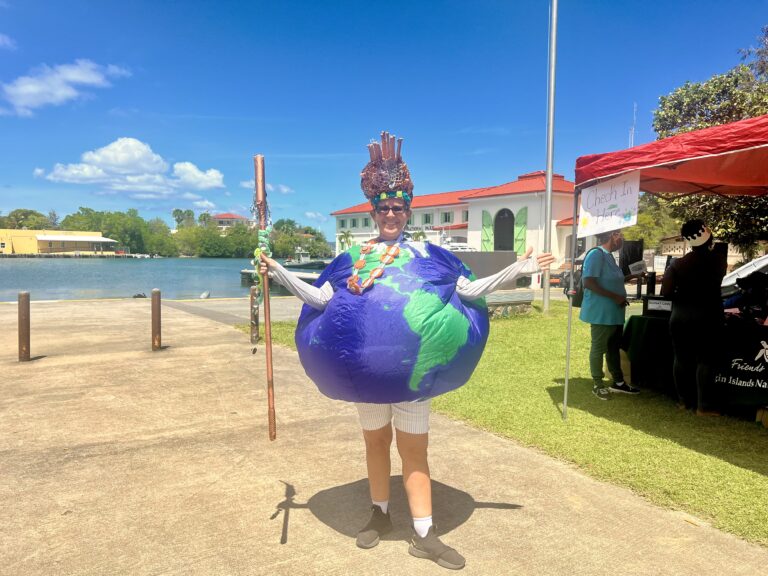
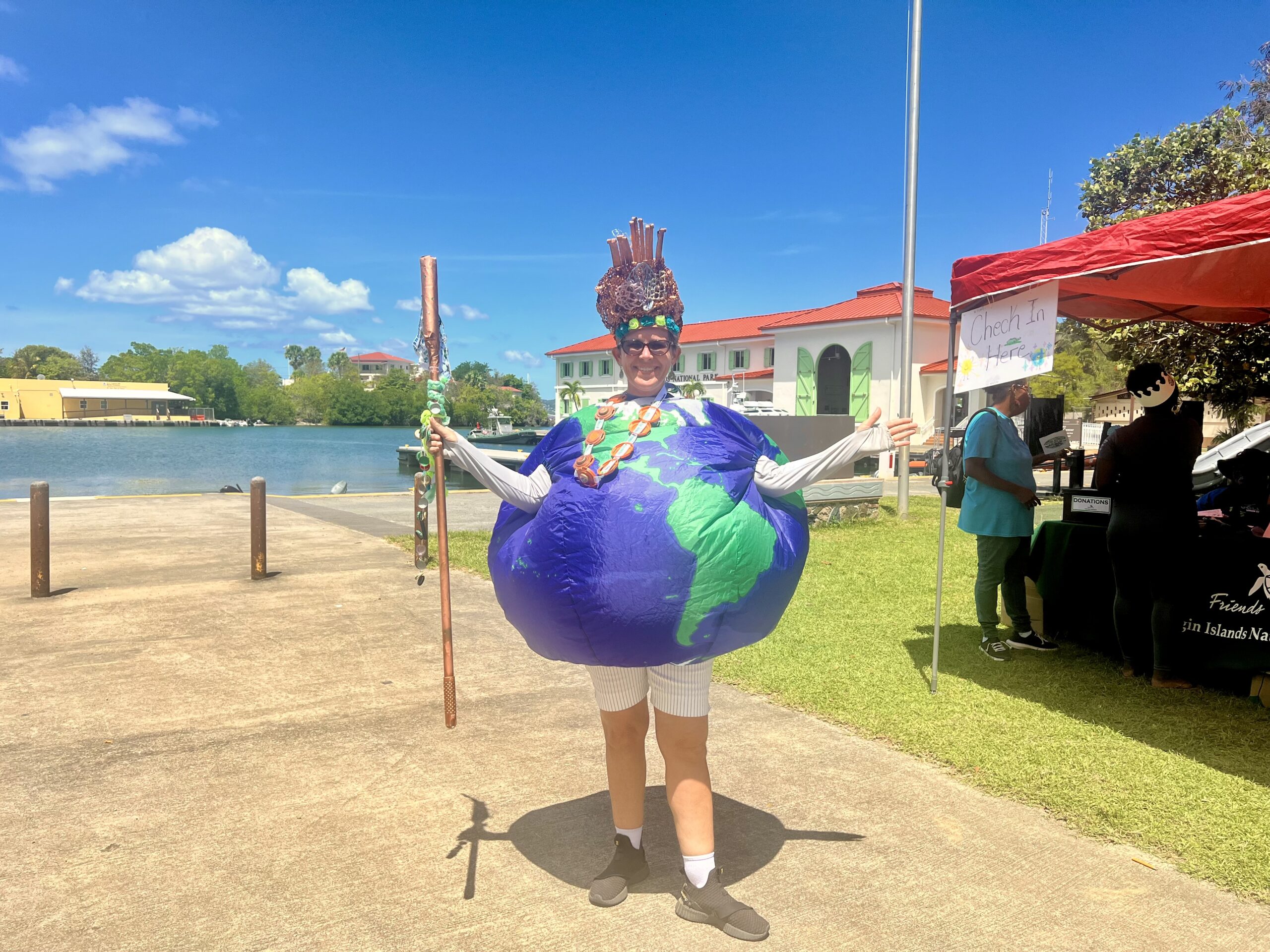
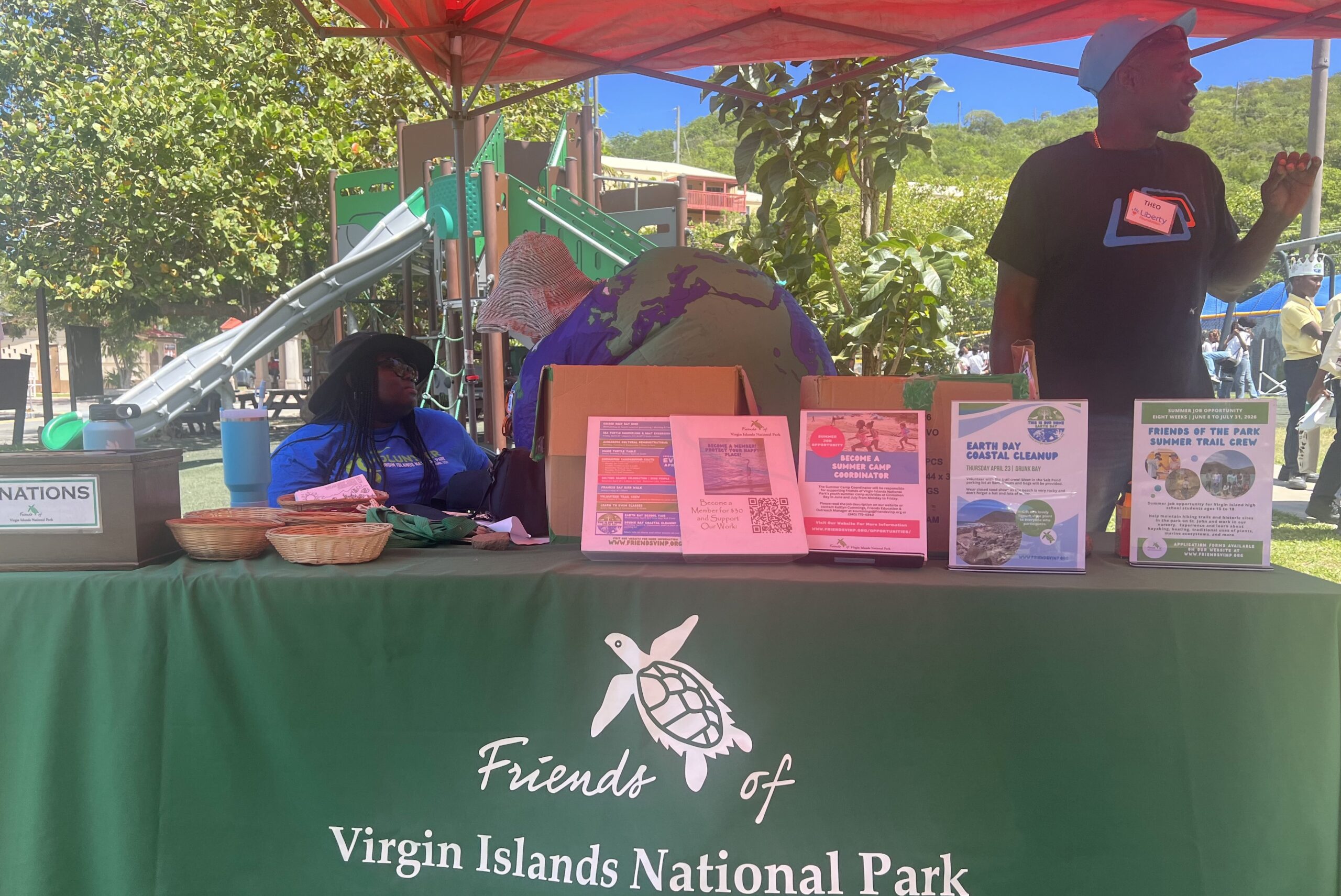
Then there was the Earth Day Trash Stomp: a parade of children led by costumed lobsters, the Waste Management Authority Litter Critter, and — of course — Mother Earth, played by Friends of the Virgin Islands National Park Finance Manager Stephanie George.
Students take part in the Earth Day Trash Stomp outside the National Park Visitors Center on St. John, led by costumed characters including Mother Earth, during Earth Day 2026 celebrations. (Source photo by Judi Shimel)
“My costume is Earth to celebrate Earth, but the staff and the crown and the necklace are made out of trash. We’ve got cardboard, bottle caps, some old lanyards from the (Beach 2 Beach) Power Swim, and my crown is made out of packaging material,” George said.
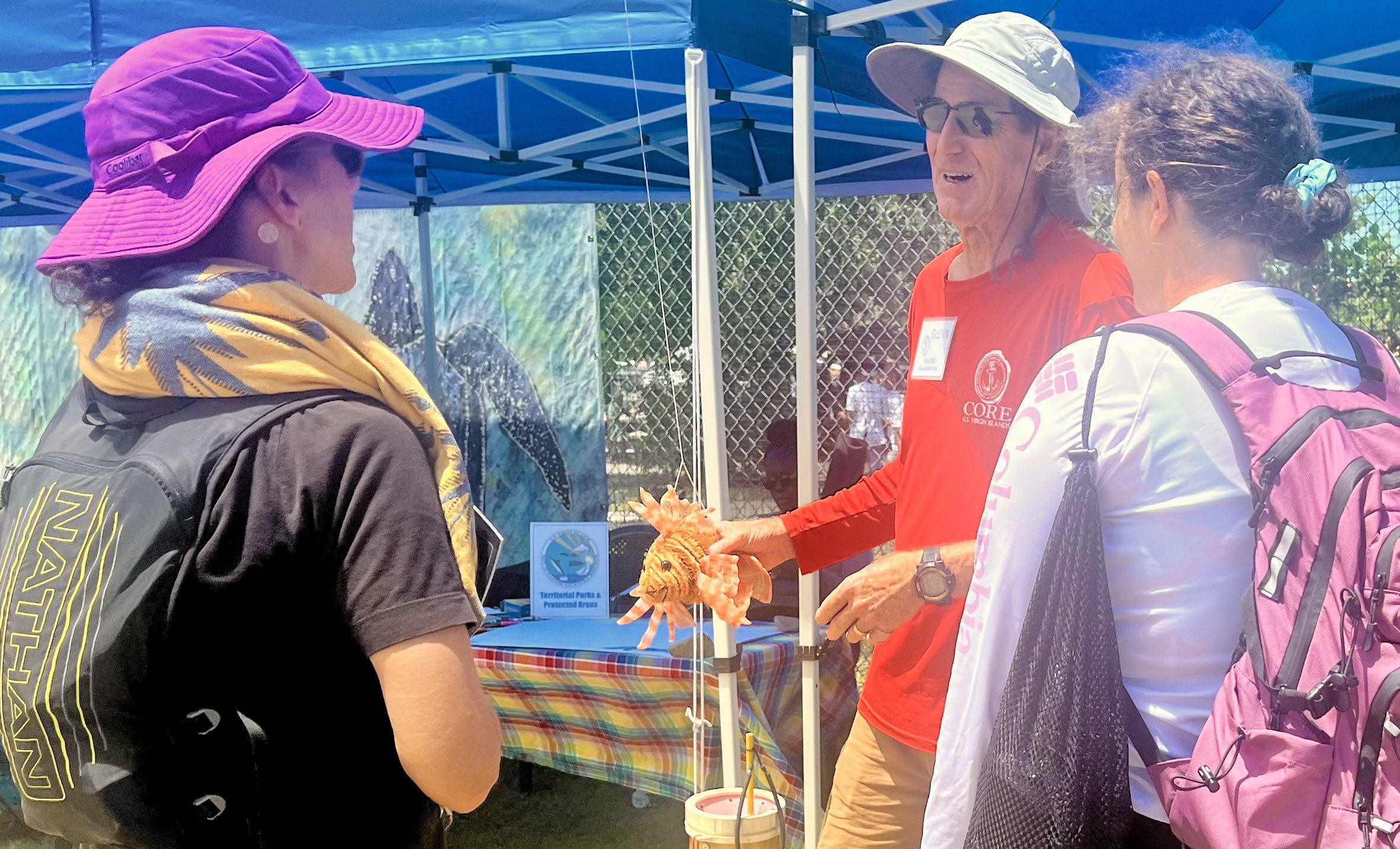
Many displays held coloring pages and piles of crayons for students who wanted to illustrate local sea life. Glenn Harmon inspired students to think about invasive lionfish and their impact on the fish they prey on.
A lionfish on a string becomes a conversation piece for Glen Harmon from the CORE Foundation VI, while back at the Island Green table, Recycling Manager Akeino Williams talks about new ways to get the community involved in recycling. (Source photo by Judi Shimel)
“Now, we are expanding into sustainable living. Now we’re conserving water and education, saving electricity and education, and now we’re expanding into the planting program,” Williams said.
Newly appointed Island Green Director Dawn Henry said she was impressed to see how students interacted with exhibits at the ball field, and how much they already knew about St. John’s environmental concerns.
“We here in the Virgin Islands need to continue to have more activities like what the National Park is doing to continue to educate our children about the things we do every day to impact this planet – whether it’s in a positive way or a negative way,” Henry said.
Friends of the Virgin Islands National Park served as the main organizers for Earth Day 2026. (Source photo by Judi Shimel)
Blessed are those who mourn, for they will be comforted. Matthew 5:4. The family of Sheila Yvonne Thomas are saddened to announce her passing on March 21.
Sheila Yvonne Thomas
Kitty, as she was affectionately known, was born on September 16, 1944, in Green Bay, Antigua, to Robert and Amelia Byrd. As a middle child, she naturally developed independence, empathy, and a gift for being a peacemaker. Above all else, Kitty was deeply devoted to her family, whom she loved fiercely and cared for with unwavering dedication throughout her life.
On February 15, 1971, she married the love of her life, Ran. Together, they built a home rooted in faith, love, and perseverance, raising their children to embody kindness, respect, integrity, and compassion for others. Through her example, Kitty taught the importance of putting family first, serving others selflessly, and living a life guided by purpose and grace. Though her absence has left her loved ones heartbroken, they cherish the love shared, the memories created, and the lessons learned from her life. Forever loved. Forever remembered. Forever in our hearts.
She was preceded in death by her, spouse, Randolph Thomas; siblings, Thomas Merchant, Hyacinth Browne; child, Sean Thomas, nephew, Trevor Byrd.
She is survived by her, siblings, Conrad Byrd, Jean Byrd, and Eunice Ambrose; children, Randolph (Steve) Thomas, Ermin Smith, Rudell, Karen, Stacy, and Shauna Thomas, along with Shanna Stevenson (daughter-in-love); grandchildren, Omari Benjamin, Jinelle Banks, Tiffney Bailey, Tremanye Thomas, Caliph Wall, Khaleel Thomas, O’Nesha Hansen, Dohnysha Holland, Tariq Wall, Tariq Thomas, Raheem Thomas, Thalia Murray, Alyrica Winslow, Jahyra Thomas; great- grandchildren, Omani, O’Shea and Tamia Benjamin, Maasai and Maalani Banks, and Camron Thomas; nieces & nephews, Yvonne Greenaway, Arthur Cummings, Deborah Sherman, Sharon Weekes, Sharon Charles, Denise Phillp, Terrance Browne, Novella Phillip, Michelle Mizrahi, Colette Christian, Alison Browne, Stacy Roberts, Sean Roberts, Lucinda Browne, Kelly Byrd, Natalie Mulholland, Conrad Byrd, Alicia Ambrose, and Allison Ambrose; special nephews, Dwight Spencer and Jamil Thomas; godchildren, Dawne Simon and Leslie Maduro; in-laws, Miriam Merchant, Rubert Thomas, Genevive Winter, Judith Barnes, Alcott Ambrose, JoAnn Thomas, Tamara Benjamin, Deshauna Thomas, Antoinette Thomas, Daniel Banks, Loriann Thomas, and Gabriel Murray; special friends, Christina Bastian, Tennyson and Irene Joseph, Cavelle Dickenson, Christobelle Heskey, Veron Isaac, Heather Aska, Pet Simon, Melba Williams, Melrose Herrington, Rose Williams, Sylvia Henry, Violet Nero, Elvina McIntosh, Edris Weekes, Dawn Martin, Emelda Isaac, Agatha Phillip, Camella Nesbitt, Arnold Jarvis, Pamela Richards, Devon Phillip and Family, Esther Williams, Tyrone Lake, Vernon Thomas, and Antonio Rivera and Family; extended family and friends, Dawn and Ezra Tonge, Emanuel Barnes, Rodrigo, William, Israel, and Isaac Gonzales, Bernard Shaw, Ivan Hansen, Chimwala McIntosh, Kyra Lynch, Suzan Hopkins, Carla Ragguette-Cascen, Shelbourne Simeon, John K. Kennedy Family, Ronald Inglis, Anthony St. Louis, Steve Funderburk, Jose Estela, Tyrone Joseph, Marcia Johnson, Clarice Krieger, Marisa Samuel, Alfred Moore, Dalsia Parrilla, Anna Hall, Mount Pleasant Villas Friends, along with Jerry and Diedre Carver; precious friends and other relatives too numerous to mention.
A viewing will be held on April 29, from 5:30 – 7:30 p.m. at James Memorial Funeral Home, Inc. 4040 Estate La Grande Princesse, Christiansted, VI 00820.
Funeral services for Sheila “Kitty” will be held on Thursday, April 30 at 10 a.m., with viewing beginning at 9 a.m. Services will take place at Friedensberg Moravian Church, 1–6 Hospital Street, Frederiksted, U.S. Virgin Islands. Interment will be held at Kingshill Cemetery.
Professional arrangements are entrusted to James Memorial Funeral Home.
Vernon Renford Drew of Estate Rattan passed away on April 4 at the age of 68 years old.
Vernon Renford Drew
He was preceded in death by his mother, Irene Dore Drew, and father, Zephaniah Drew.
He is survived by his loving wife, Andrea V. Francis-Drew; daughters, Tamika “Sandrene” and Natasha “Tasha” Drew, Evastus “Vas” Drew Williams, Renata “Rena” and Shinikua “Nikki” Drew; adopted daughter, Nelcia St. Jean; sons, Renford “Junior” Drew, Glenn “Junior” Thomas and Gerard “Kona” Thomas; grandchildren, Naema, Malachi, Malena, Ezekiel, Maliek and Malkom, Drew and Ki’Zaiah Richardson Thomas; brothers, Eugene Pemberton (Nevis), Irwyn Ottley (New York) and Doval Drew; niece, Nordia Drew; nephews, Ebal, Doval Jr. and Dion Drew; daughters-in-law, Deirdra Drew and Koyeshia Richardson; son-in-law, Troy Williams; adopted mother, Winifred Violenus; mother and father-in-law, Yvonne and Charles “Bumpy” Isles Sr.; sisters-in-law, Christine Drew, Karlene Henry and Okesiha Beaupierre; brothers-in-law, Kenneth “Abumba” and Stephen “Kuff” Francis, Charles Jr., Sheldon, Randall and Dexter Isles; uncle and Aunt-In-Law, Everton “Ike” and Verna Blackman; great nieces and great nephews, too numerous to mention; godchildren, James Swanston, Kyle and Caleb Freeman and DeAndra Brewley; precious cousins and other relatives too numerous to mention; special Friends, Roal “Coke” Caesar and Family, Yolanda Robles and Family, Weldon Maxwell, Winifred Dawson, Tony James and Family, Arnold “Beverage” and Perclyn Richardson and Family, Cherry-Ann “Nessa” Elliott and Cuthbert Cyril and Family, George Lake and Family, Dominoe Crew and Family, Mitchell Sr. and Lorraine Benjamin-Matthew, Nathaniel Challenger and Family, Kleon, Karema, Carl, and Donna Gaskin and Family, The Phillip Family, Raphael “Raphy” Corneiro, Eustace Roach, Denise Bell, David and Cecile Rossington and Family, Lynette Johannes and Norton Williams and Family, Rev. Dr. Dion and Eulencine Christopher and Family, Rev. Dr. Jeremy B. and Rena Warner-Francis and Family, Friedensberg Moravian Church Congregation and Family, Brenda Stevens, Shamoni and Alvin Ogarro and Family, Murphy and Corine, Shermaine Samuel, Hobson Family and Eugene Phipps, The Jones and Grouby Family; other Extended Family and Friends, Dr. Charles Perez and Family and Staff of ProHealth Urgent Care, Dr. Walter Gardner and Staff of Haemodialysis Caribbean Kidney Center, The staff and special ladies and gentlemen of Internal Revenue Bureau, Lynette “Ms. Patrick” Ramon and Family, The Johannes Family, Ohmar Adams and Family, Esau Brooks and Family, Corine Messer, Mario Richardson, Dorothy Joseph, Emile A. Henderson III and Marlene Henderson, Senators Kurt Vialet and Family, Kenneth “Kenny” Gittens and Novel Francis Jr. and Family, Donald “Budah” Francis, Estate Rattan and Neighbour’s and Family, Carol and Andrea Williams and Family, Family and friends in the BVI and Tortola; many precious friends and other relatives too numerous to mention.
Funeral service will be held on April 29 at Friedensberg Moravian Church (Frederiksted). Viewing begins at 9 a.m., with service at 10 a.m. Interment will be held at Kingshill Cemetery. A love offering will be collected during the service. Guests are asked to please wear shades of light blue, beige, and cream.
Funeral arrangements are entrusted to James Memorial Funeral Home, Inc.