Satellite imagery from the University of South Florida’s Optical Oceanography Lab shows sargassum distribution across the Atlantic, Caribbean, and Gulf in March 2026, including patches near Puerto Rico and the Virgin Islands. Darker red areas indicate higher concentrations. (Photo courtesy University of South Florida Optical Oceanography Lab)
Sargassum continued to expand across the Atlantic basin during April, with the latest bulletin from the University of South Florida’s Optical Oceanography Lab showing increasing amounts of seaweed across the regions monitored by USF.
“The trend in the last few months has continued, resulting in increased sargassum amount in every region shown in the map,” USF said. “Nearly every region also continued to see record-high sargassum amount for the month of April.”
USF noted that the growth of seaweed during April led to sargassum inundation events across the monitored region, including the Caribbean islands.
Map illustrating the Sargasso Sea, the Great Atlantic Sargassum Belt and major ocean currents that can influence the movement of sargassum across the Atlantic, Caribbean, and Gulf. (Photo and details courtesy EPA and López Miranda et al. 2021.)
“By mid-April, sargassum expanded to the entire Caribbean Sea, with substantial amounts transported to the Gulf. Major beaching events have likely occurred around the Caribbean and Lesser Antilles islands. Moderate beaching events have also occurred along the southeast coast of Florida,” USF reported.
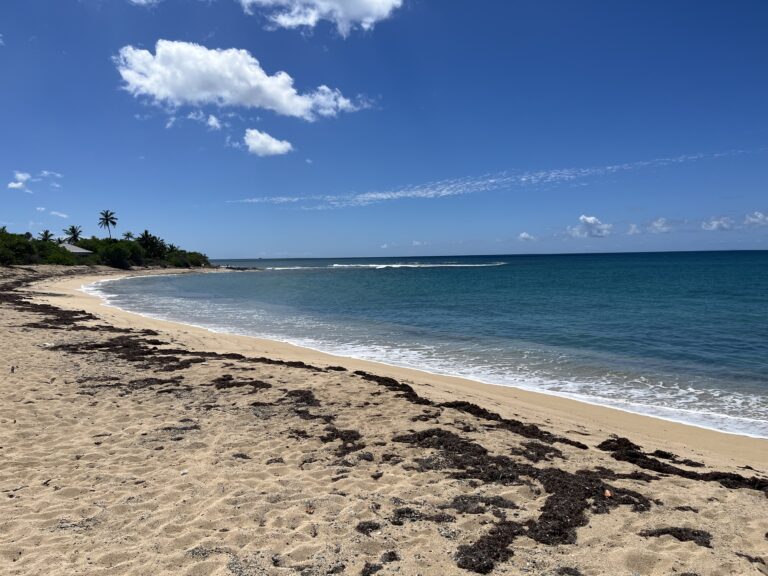
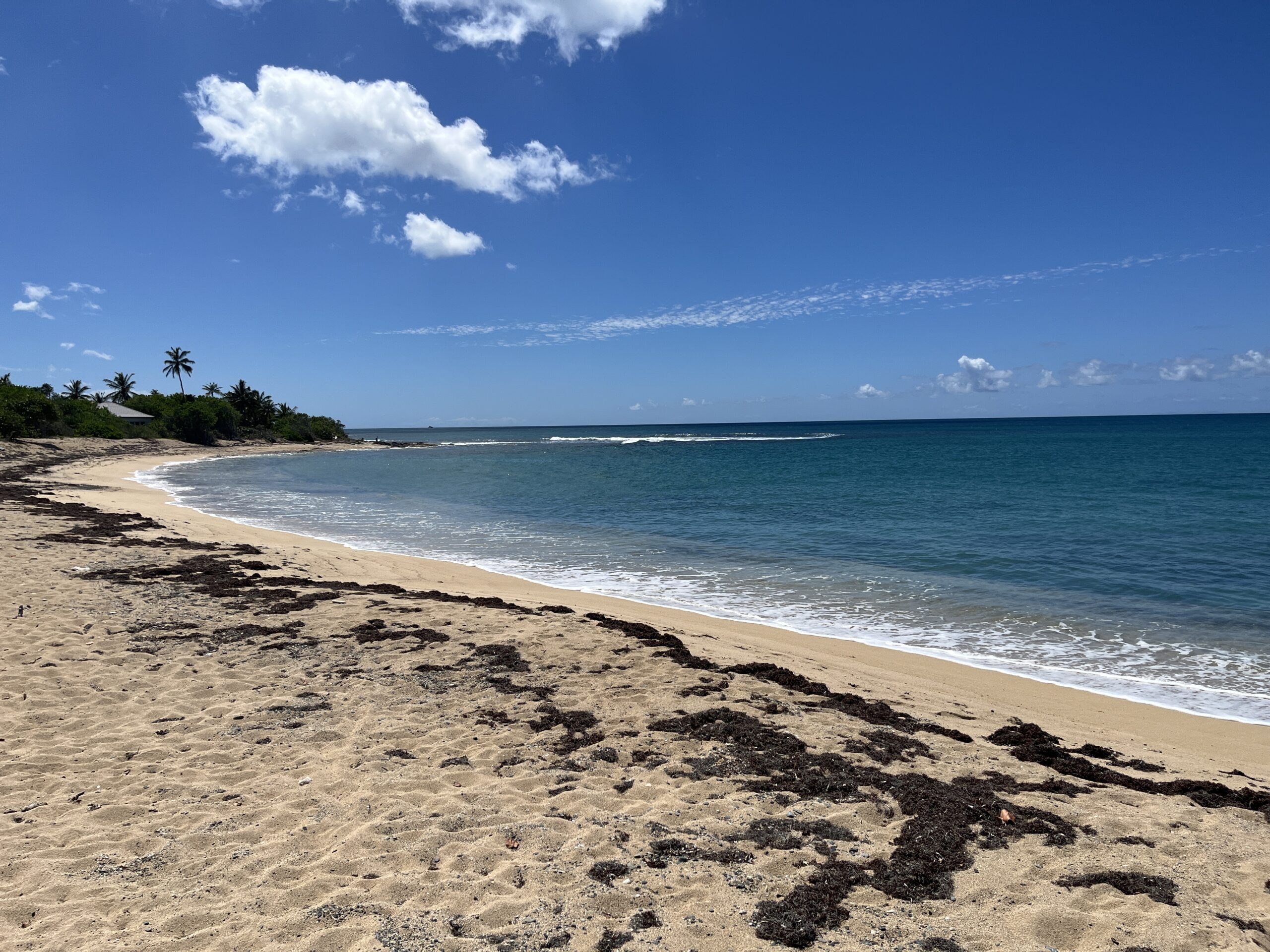
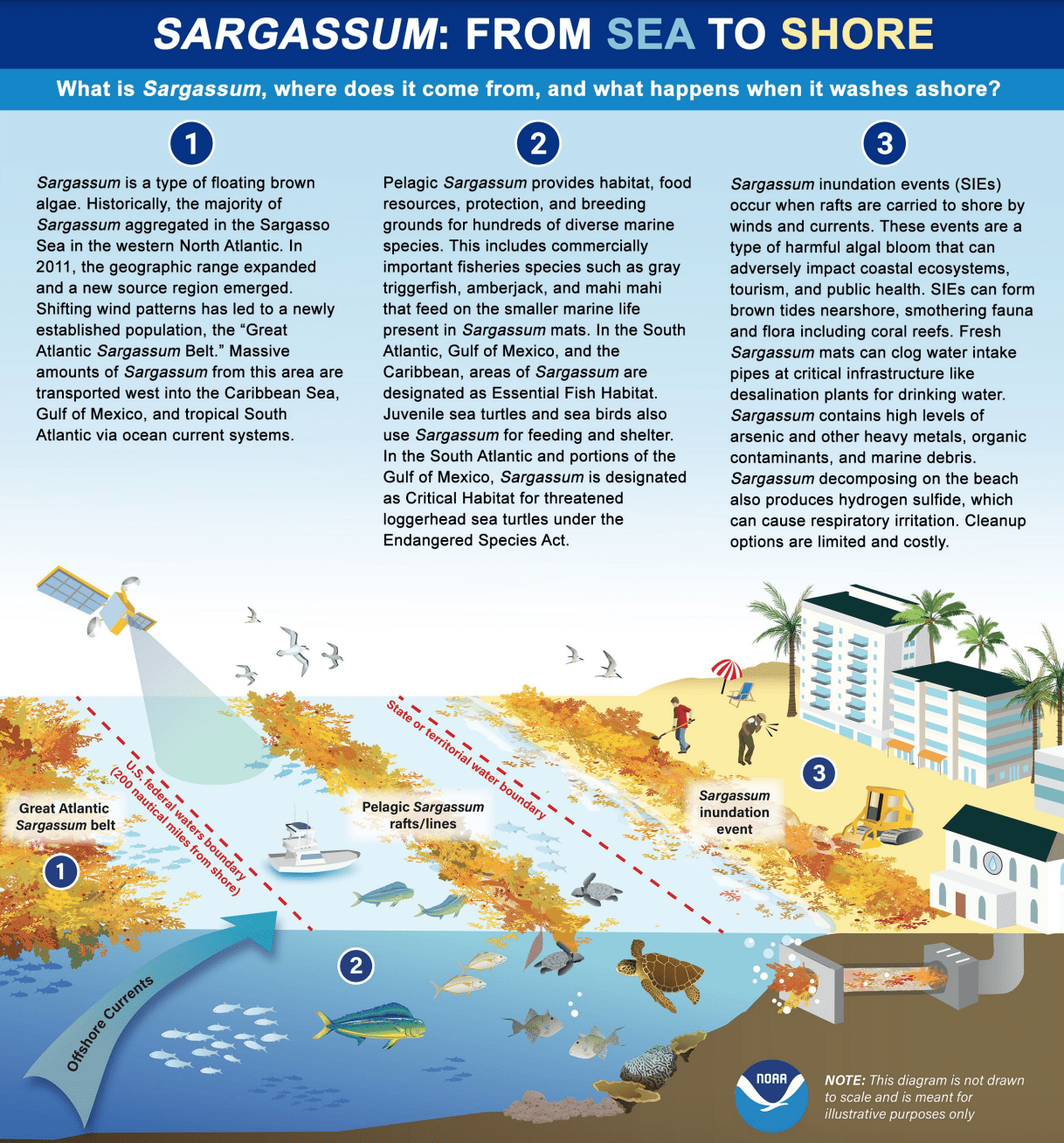
Patches of sargassum were visible along the shoreline at Shoys Beach on St. Croix on May 2. (Source photo by Jesse Daley)A National Oceanic and Atmospheric Administration graphic illustrating sargassum and seaweed inundation events, also called beaching events. (Photo courtesy NOAA)
“Sargassum is a type of floating brown algae that provides food, protection, and habitat for many marine species. While sargassum plays an important role in the health and biodiversity of open ocean ecosystems, it can also be harmful in certain situations when rafts of this brown algae are carried to shore by winds and currents,” NOAA said.
What This Means for the USVI
For the U.S. Virgin Islands, local impacts will continue to depend on winds, currents, tides, and nearshore conditions. Even during an active regional sargassum pattern, beach conditions can vary widely from one shoreline to another and from day to day.
However, because the USVI sits within the broader eastern Caribbean and Lesser Antilles region, additional sargassum arrivals remain possible in the weeks and months ahead.
USF researchers said sargassum amounts in most regions are expected to continue to rise in the coming months.
“Sargassum amount in most regions will continue to increase in the coming months,” USF explained. “Beaching events around the Caribbean and southeast coast of Florida will continue and likely increase. Some beaching events may also occur around Louisiana and Texas coasts. The year of 2026 is set to be another major sargassum year, meaning sargassum amounts are expected to exceed 75% of historical values, and the year is likely to become a record year by summer 2026.”
Monitoring Local Conditions
The USF monthly bulletins provide a broad regional outlook and are not meant to predict exact conditions at a specific beach or shoreline. Residents and visitors should continue to monitor local beach conditions, especially during periods of shifting winds or currents.
Previous monthly reports and daily imagery are available through USF’s Sargassum Watch System. High-resolution sargassum maps for selected coastal regions are also available through the Optical Oceanography Lab’s satellite data products.
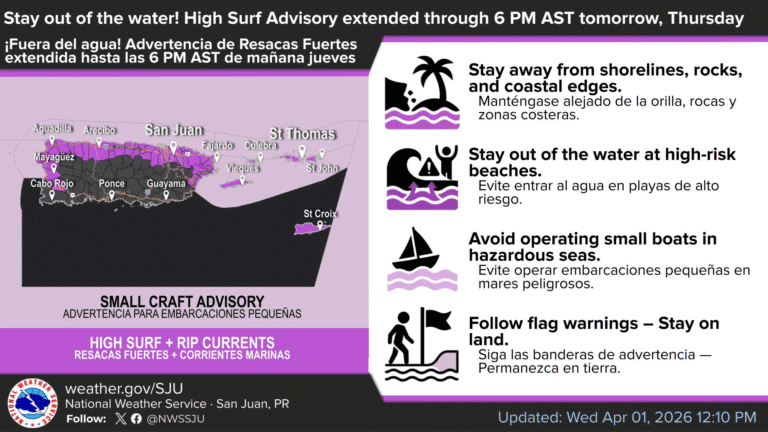
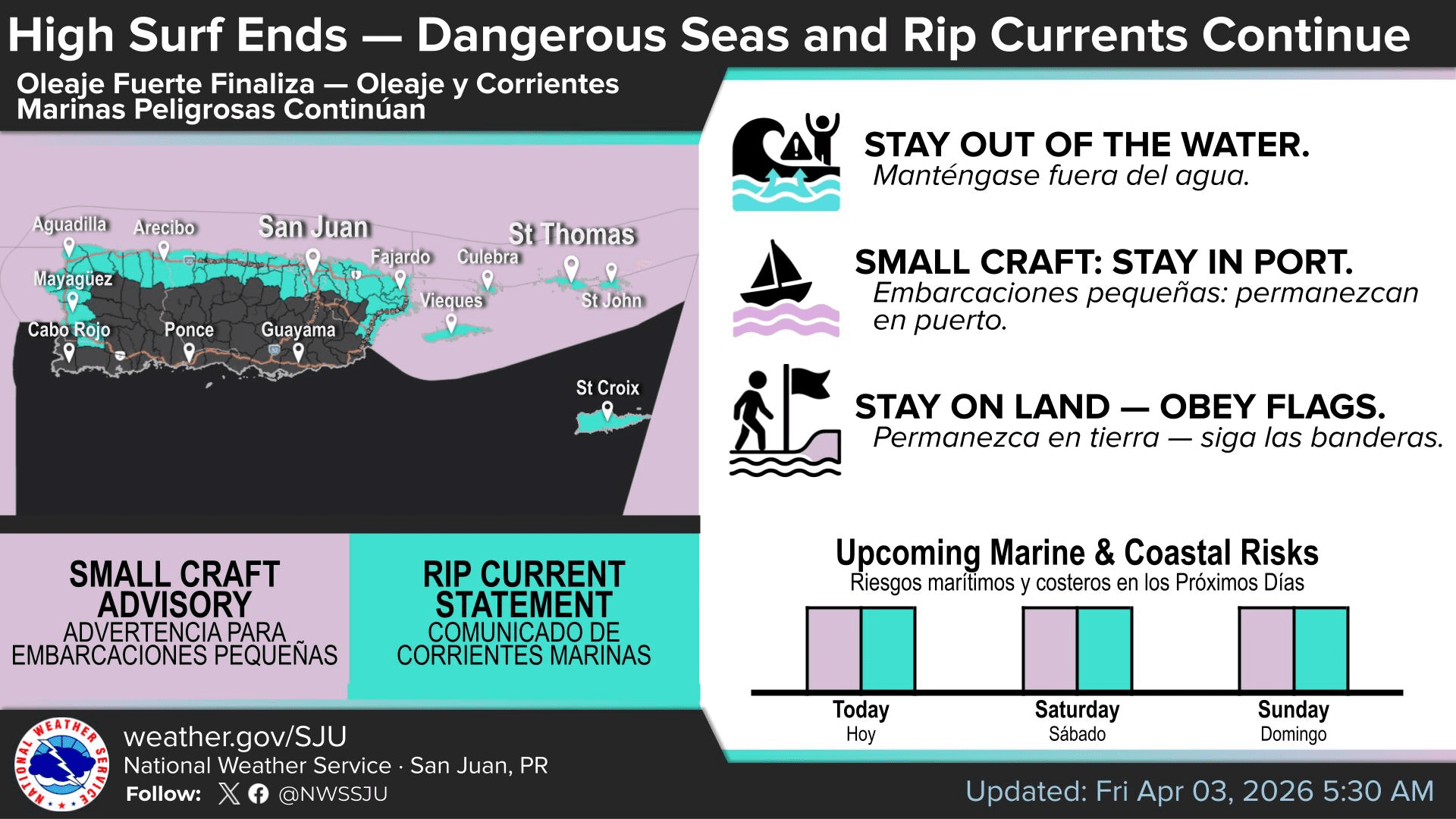
Finally, in addition to monitoring sargassum, residents and visitors across the U.S. Virgin Islands are encouraged to follow the local weather forecast. Weather information is available from the NWS and NOAA. The local weather forecast for the U.S. Virgin Islands is regularly updated on the Source Weather Page, and individuals can also find helpful weather information and alerts from the Virgin Islands Territorial Emergency Management Agency.
National Hurricane Preparedness Week highlights the importance of taking action before storms by understanding risks and knowing what to do before, during, and after a storm. (Photo courtesy NOAA)
National Hurricane Preparedness Week will take place from May 3 through May 9. The event urges residents across hurricane-prone areas, including the U.S. Virgin Islands and Puerto Rico, to review emergency plans before the Atlantic hurricane season officially begins on June 1.
The annual campaign, led by the National Oceanic and Atmospheric Administration and the National Weather Service, is designed to help communities prepare before, during, and after a tropical cyclone threatens.
Each day throughout Hurricane Preparedness Week, there is a daily theme that focuses on key preparedness topics. The precaution tools include knowing your risk from wind and water, preparing before hurricane season, understanding forecast information, knowing what to do when a storm threatens, staying protected during storms, avoiding danger after storms, and taking action today.
Storms Can Bring Multiple Hazards
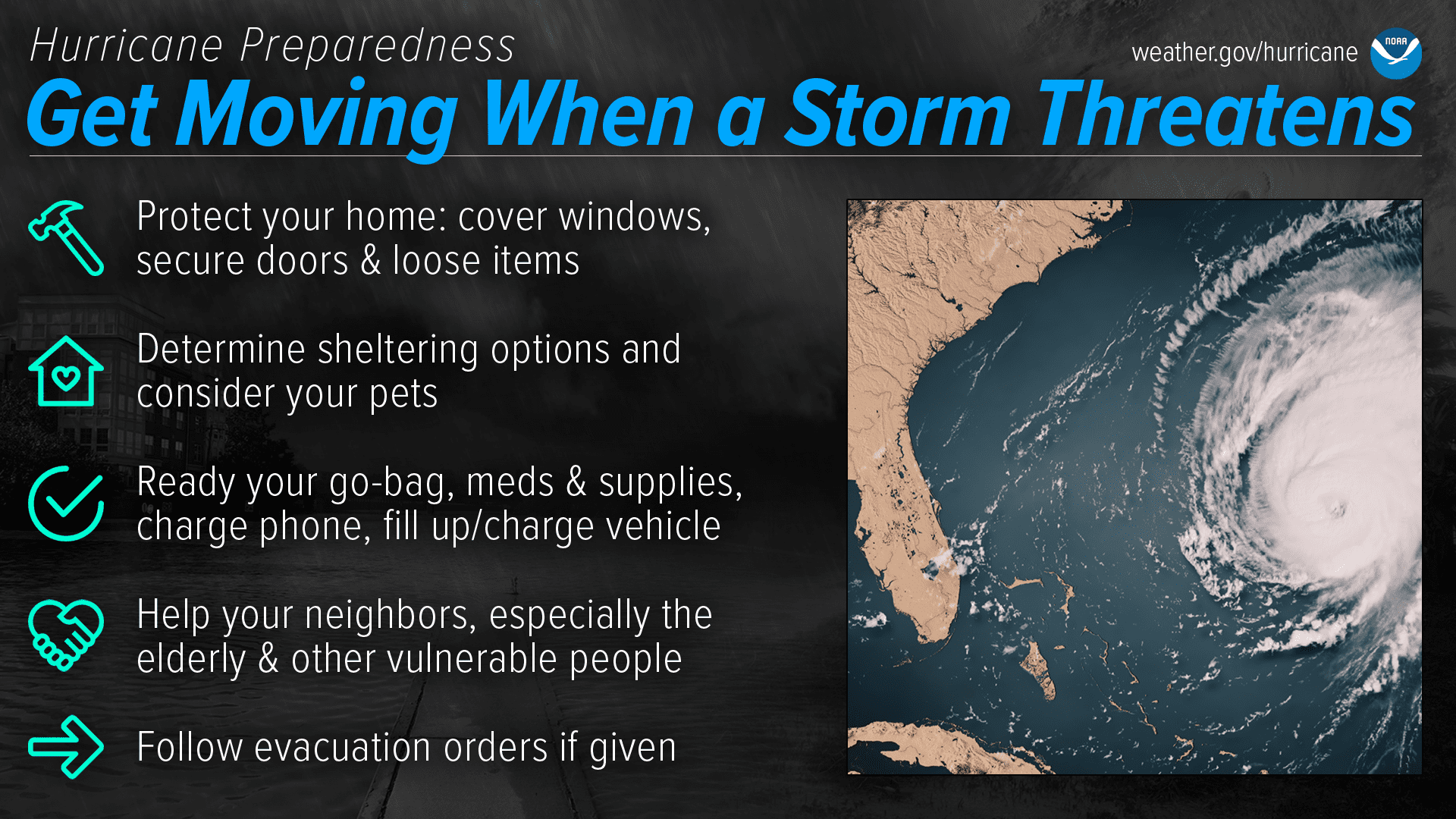
When a storm threatens, residents should secure their homes, prepare supplies, charge devices, and follow evacuation orders if issued. (Photo courtesy NOAA)
Residents of the U.S. Virgin Islands are all too familiar with the critical challenges associated with cyclones. Preparedness is especially important, because tropical systems can bring multiple hazards, including damaging winds, heavy rainfall, flooding, storm surge, rip currents, and hazardous marine conditions.
Additionally, serious perils can occur after a storm has passed, such as threats involving downed power lines, disruption of communications, loss of electricity and water, and limited access to basic necessities like food or healthcare.
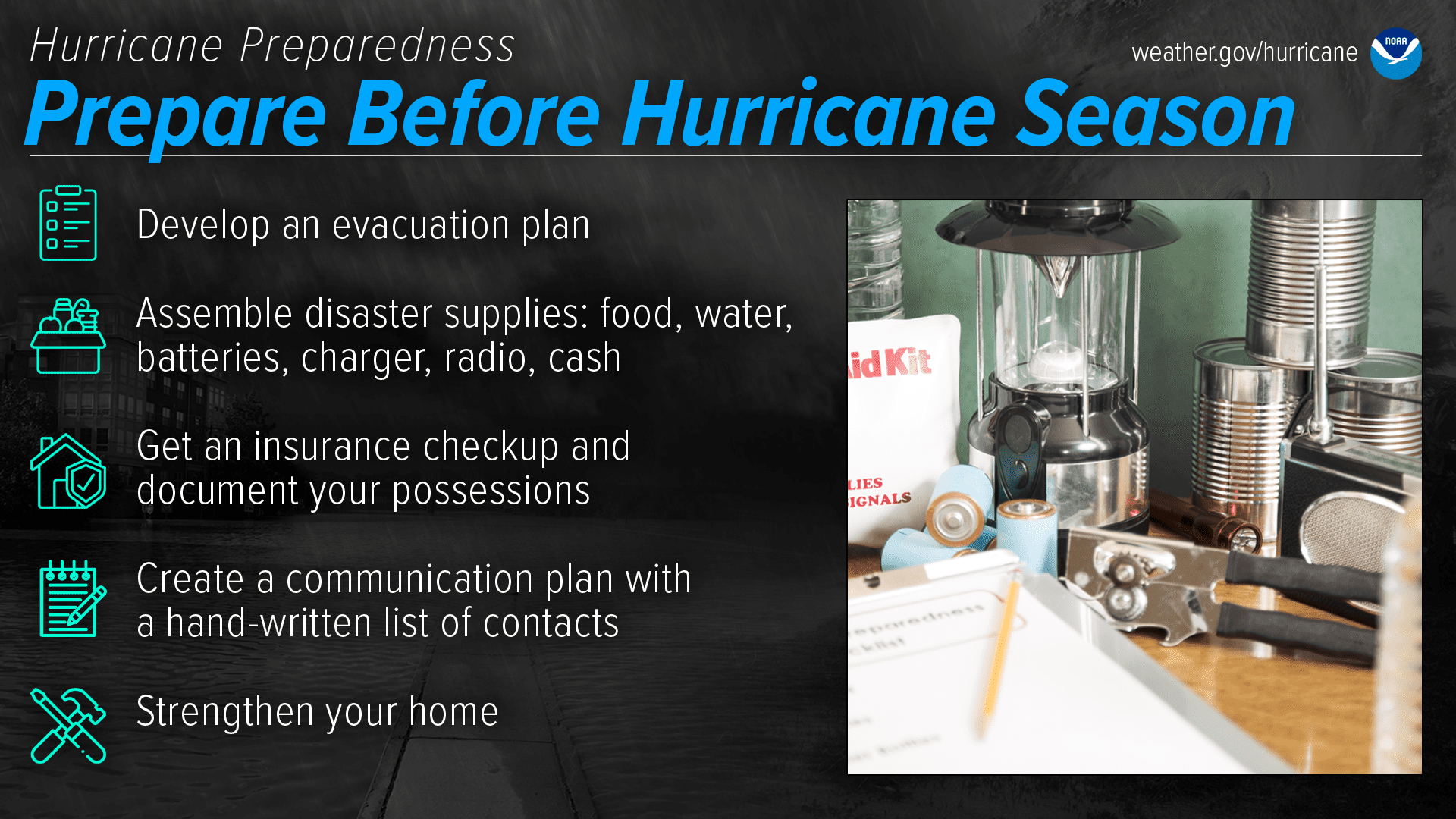
Preparing before hurricane season includes developing an evacuation plan, assembling disaster supplies, reviewing insurance, and strengthening homes where possible. (Photo courtesy NOAA)
“The best time to prepare for hurricanes is before hurricane season begins,” NOAA said. “Avoid having to rush through potentially life-saving preparations by waiting until it’s too late. Get your disaster supplies while the shelves are still stocked, and get that insurance checkup early, as flood insurance requires a 30-day waiting period,” NOAA stated.
Tips to consider prior to a storm include:
Compile a disaster kit, including flashlights, batteries, a first-aid kit, medications, food, and water.
Create an evacuation plan. This can include flights off-island as well as verifying emergency shelter locations.
Review insurance documents and ask questions to an insurance agent. Remember that “flood insurance” and “hurricane/wind insurance” policies can be very different.
Assess your home and evaluate areas in need of reinforcement or repair.
Become familiar with hurricane/tropical storm alerts and updates. Remember that emergency services may not be available during a storm.
During a Hurricane
Staying protected during a storm includes remaining in safe areas, monitoring official alerts, and avoiding travel unless directed by local officials. (Photo courtesy NOAA)
“Be prepared for hurricane season by knowing what to do during a storm,” NOAA noted. “Whether you’ve evacuated or are sheltering in place, know what to expect from the hazards you may face. Remain vigilant, stay up-to-date with the latest forecasts and alerts, and continue to listen to local officials,” NOAA continued.
The following are tips to stay safe during a hurricane:
Stay away from windows.
Keep a radio and communication devices charged up and have extra batteries available.
Be on guard against rising water. Flood waters can rise very quickly.
Remain in a sheltered location such as an interior bathroom until the storm completely passes.
Remember that if the eye of the storm passes over, the weather will temporarily improve. However, since the eye of the storm is at the center of the cyclone, it is just a matter of time before the other side of the hurricane moves over the area, the weather again deteriorates, and high winds return.
After a Hurricane
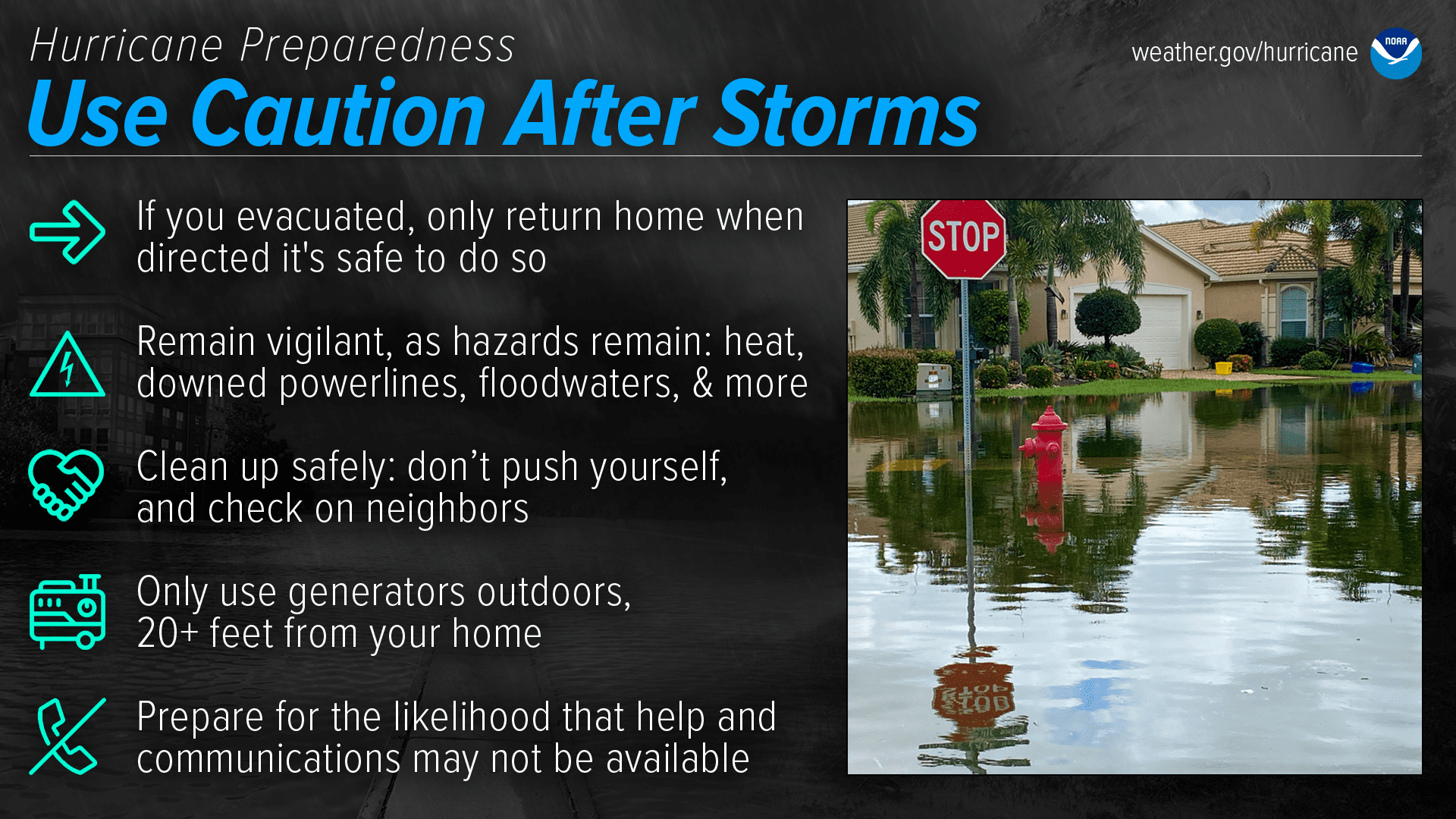
Hazards can continue after a storm, including floodwaters, downed power lines, extreme heat, and communication outages. (Photo courtesy NOAA)
“A key part of hurricane preparedness is understanding the dangers that remain well after a storm, [and] this is not the time to put your guard down,” NOAA explained. “Nearly half of hurricane fatalities occur after the storm,” NOAA warned.
Safety reminders after a hurricane include:
Be alert for hazards such as downed power lines or damaged structures.
Ensure that generators are placed away from interior areas or spaces where toxic fumes could be inhaled.
Only drink water if it is deemed safe to do so. Contamination is possible during storms.
Connect with neighbors and fellow islanders and assess any needs for medical treatment. (Don’t forget about pets and animals, too!)
Stay updated on the weather and news and monitor for future developments about severe weather or additional cyclone development in the region.
Early Outlooks Point to a Possibly Quieter Season, But Risk Remains
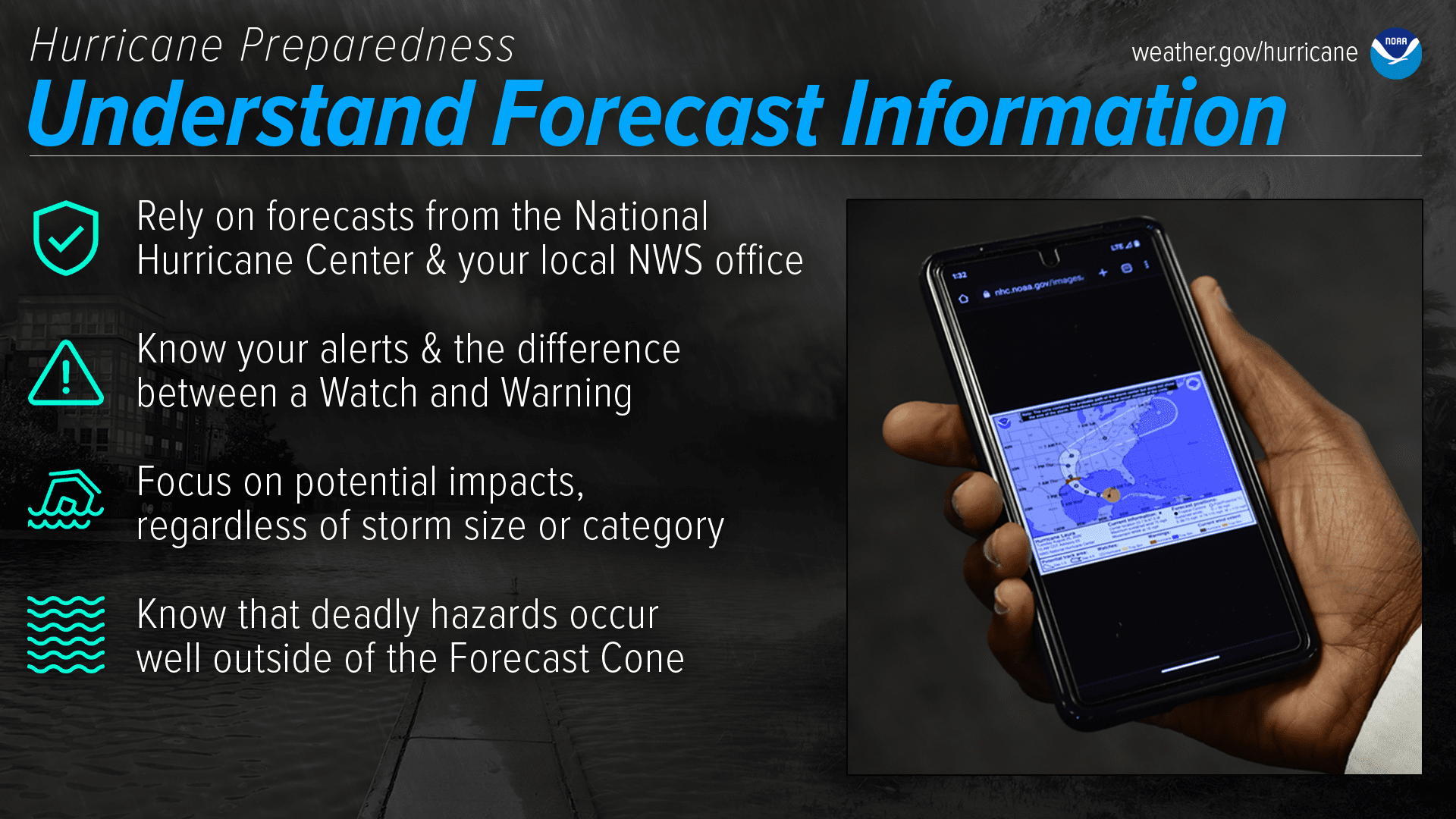
Official forecasts from the National Hurricane Center and local National Weather Service offices can help residents understand watches, warnings, and forecast cone information. (Photo courtesy NOAA)
National Hurricane Preparedness Week comes as several early outlooks suggest the 2026 Atlantic hurricane season may be near or below average overall, due in large part to an expected developing El Niño weather pattern.
El Niño, which involves a warming of the equatorial Pacific Ocean, usually helps to increase wind shear—a change in wind direction and velocity with height in the atmosphere. In the Atlantic Ocean the increase in wind shear from El Niño helps to rip apart storms and prevent hurricane formation and intensification. This is the opposite of a La Niña cycle, when the ocean waters across the equatorial Pacific cool significantly. During La Niña, wind shear typically decreases in the Atlantic, and a reduction in wind shear can favor cyclone development.
As the Source previously reported, Colorado State University forecasts 13 named storms, including six hurricanes and two major hurricanes, and the Source also reported that AccuWeather has forecast a near-to below-historical average season, with 11 to 16 named storms, four to seven hurricanes, and two to four major hurricanes. However, forecasters noted that warm waters near the northeastern Caribbean could still support rapid intensification if storms pass close to the region.
Importantly, while an El Niño pattern can help to suppress overall activity in the Atlantic basin due to increased wind shear, an outcome of fewer storms is certainly not guaranteed. As is the case every season, it only takes one storm passing near a region to create serious impacts.
USVI Weather Updates
NOAA encourages residents to understand their risk from hurricane-related hazards, including storm surge, flooding from heavy rain, strong winds, tornadoes, and rip currents. (Photo courtesy NOAA)
For the U.S. Virgin Islands and Puerto Rico, National Hurricane Preparedness Week is a reminder that preparation begins well before the first storm threatens the region. Even if the 2026 season is less active overall, residents are encouraged to review their plans now and remain prepared throughout the season.
NOAA is expected to release this year’s hurricane season predictions soon, and individuals will be able to locate the forecast on the administration’s official website. The NHC is also set to resume regular tropical updates for the Atlantic Basin starting on May 15.
In addition to weather information from the NWS and VITEMA, a daily weather forecast is also published on the Source Weather Page.
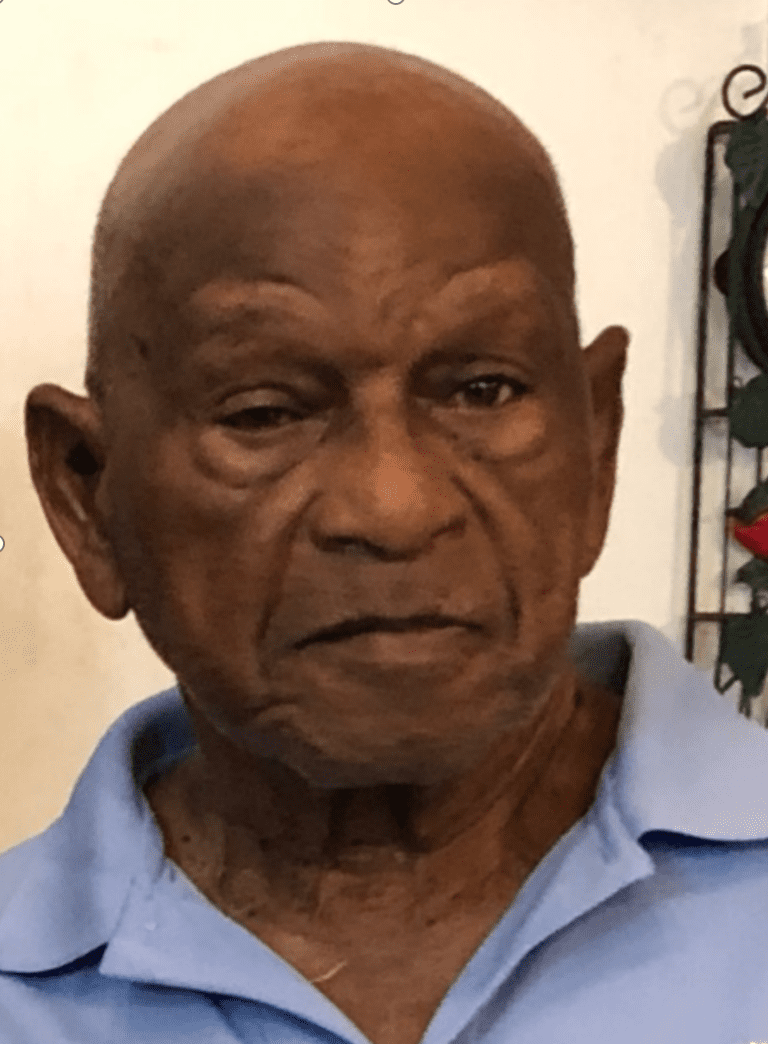
John Alphonso Bell Sr., a dedicated public servant, respected lawmaker, and esteemed Army veteran, passed away peacefully at the age of 94 on April 20, 2026.
John Alphonso Bell Sr.
He was preceded in death by his parents Isabella Christopher and Sydney Alphonso Bell; Wife, Gloria Bell; Daughter, Gina Bell; Grandson, Jesse Martinez: Adopted Father, Ullmont L. James Sr.
He is survived by his Daughters, Jurene Bell, Alesis Boddie-Morris; Sons, John Bell Jr., Jason Bell, Cirgie A. Bell, John M. Bell; Grandchildren, Jaheem Lawrence, Yshu Bell, Desiree Bell, Cirgie P. Bell, Shamoi Bell, Shatoya Bell, Denae Bell, Rishon Bell, Jahnoah Bell, Kasheema Miller, Akeella Bell, Khalil Bell, Brandon Bell, Talisha Griffith Simmonds; Great Grandchildren, Janiece Lawrence, Jordyn Lawrence, Jahnoah Bell Jr., Alaunis Bell, Noah Miller, Roselyn Ross, Kaleah Belardo, Kaon Durand, Bernhardt, Tahir & Talia Simmonds, Aniya, Zymir, Tasean, Dontre, Tayden, Marriah, Amauriana, Umani & Xaviel Bell; Daughter-In-Law, Denise Bell, Felicia Tyson, Jen Combe, Eslyn John-Parrilla; Caregivers, Zahlasha Chinnery, Cecilia George, Rheanna LaPlace, Cattianna Glasgow, Teanna Browne, Asanté Wenceslas, Tashana George, Be’Anca Joseph, Avonice Martin, Geraldine Willocks, Staff at The Turning Point, Gisel Benjamin, Shakira Jose, Akelina Jeffrey; Special Friends, Bobby James, King Derby, Mr. & Mrs. Lawrence Nelson, Ruth Cruz, Wanda Belardo, Laverne Bailey, Kenneth Hermon, Ullmont L. James Jr., Luz James, Donna Green, Olaf Hendricks, Marilyn Bartlett, James Family, Tyson Family, Herman Family, Charlo Christian, Hansen Family, Watergut Posse, Canton Family, Milagros Johnson. Other relatives and friends too numerous to mention.
A viewing for John A. Bell Sr. will be held at the Legislature of the Virgin Islands on Tuesday, May 12, from 11 a.m. to 3 p.m..
Funeral service will be held on Wednesday, May 13 at Island Center for the Performing Arts. Viewing will begin at 9:00 AM with service at 10 a.m. Interment will follow at Kingshill Cemetery. Family, friends, and community members are invited to pay their respects and celebrate his remarkable life.
Professional Arrangements are entrusted to James Memorial Funeral Home, Inc.
A Spirit Airlines airplane at the Cyril E King Airport on St. Thomas. (Source photo by Mat Probasco)
The V.I. Tourism Department announced Saturday afternoon that it has launched a “Stranded Passenger Program” for travelers left in the lurch after Spirit Airlines announced a few hours after midnight that its customers should not go to the airport as it is winding down operations, effective immediately, after a White House rescue deal fell through.
Affected travelers should visit www.visitusvi.com/spirit-airlines-cancellations/ for information. They should also monitor Spirit communications for updates. In the U.S./Canada call 855-952-6606 and 971-715-2831 for international.
Spirit Airlines, which filed for bankruptcy protection in August, said in a statement on its website early Saturday that while it cannot rebook passengers on other airlines, it would “automatically process refunds for any flights purchased through Spirit with a credit or debit card to the original form of payment.” Guests who booked flights via a travel agent should contact the travel agent directly to request a refund, it said. Compensation for those who booked flights using any other methods, including a voucher, credit or Free Spirit points, will be determined later through the bankruptcy court process, it said.
The announcement comes after “extensive and comprehensive efforts to restructure the business,” including a proposal by President Donald Trump in recent weeks for the federal government to buy the beleaguered budget carrier. That plan fell through when key creditors reportedly opposed the deal, according to reports.
Until Saturday, the airline had routes connecting St. Thomas to Orlando and Fort Lauderdale, the latter of which also had flights to and from St. Croix.
Multiple media outlets reporting on Saturday’s announcement also cited the U.S. war against Iran as a contributing factor as it has led to soaring jet fuel prices, and said the decision has put some 17,000 workers out of a job, including 14,000 employees and thousands of contractors.
“We are proud of the impact of our ultra-low-cost model on the industry over the last 34 years and had hoped to serve our Guests for many years to come,” Spirit said in its statement that was posted at 2 a.m. Saturday.
Customers are directed to visit the website for more information on the wind-down process, and to contact Spirit’s claims agent, Epiq, by emailing SpiritAirlinesInfo@epiqglobal.com or calling (855) 952-6606 (for toll-free U.S. and Canada calls) or (971) 715-2831 (for international calls).
CNN reported that several U.S. carriers have said they would support affected passengers, including American Airlines, which the news outlet said had “immediately implemented fare caps on Main Cabin tickets for Spirit routes where we also offer nonstop service.” It said United, Allegiant and Frontier also said they would try to help affected passengers, and that Southwest said it would offer special fares for Spirit customers on eligible routes through Wednesday.
The U.S. Department of Transportation also has guidance for passengers on its website, including checking with other airlines to see if they will honor Spirit tickets, or offer a discount on a new ticket.
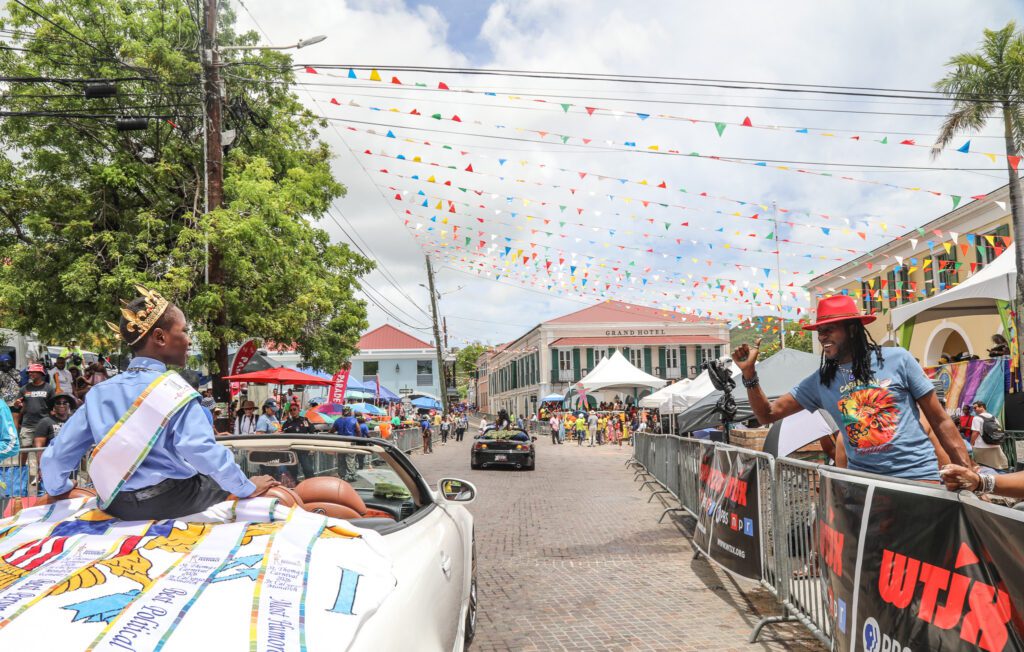
Junior Calypso Monarch Prince Kahleel – who said he credits his mom for his stage name – gets a thumbs-up from fan-in-the-stands Patrickson Thomas. (Photo by Ananta Pancham)
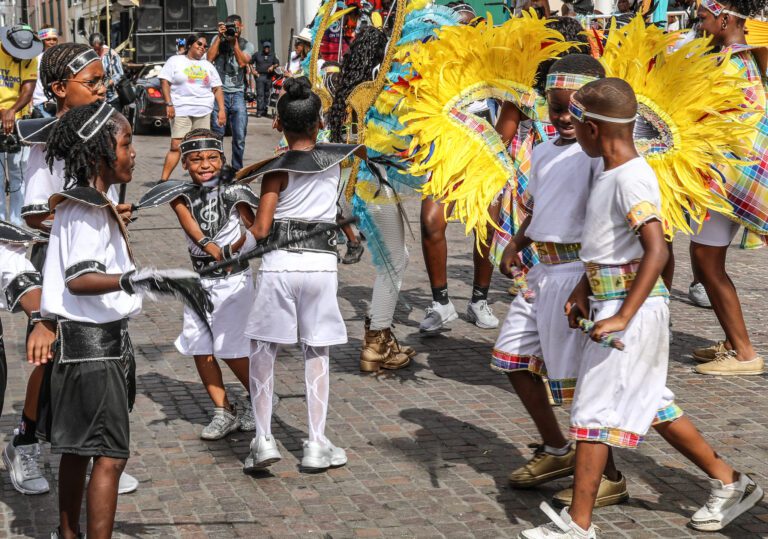
The boundless energy of the territory’s youngest culture bearers was on full display as the 2026 St. Thomas Children’s Parade brought vibrant life to the streets on Friday.
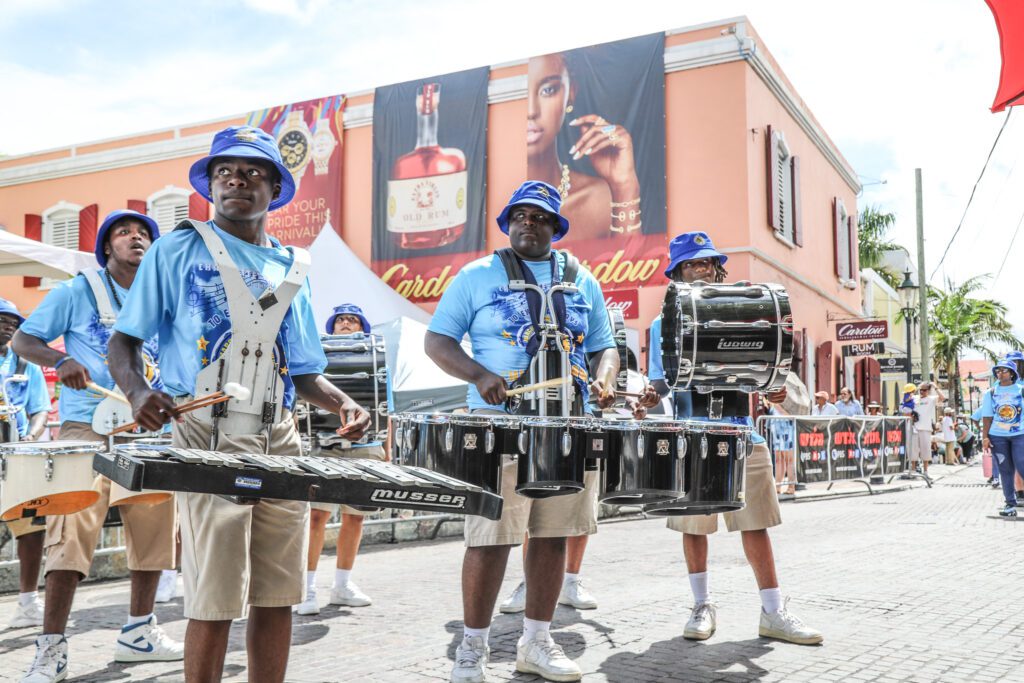
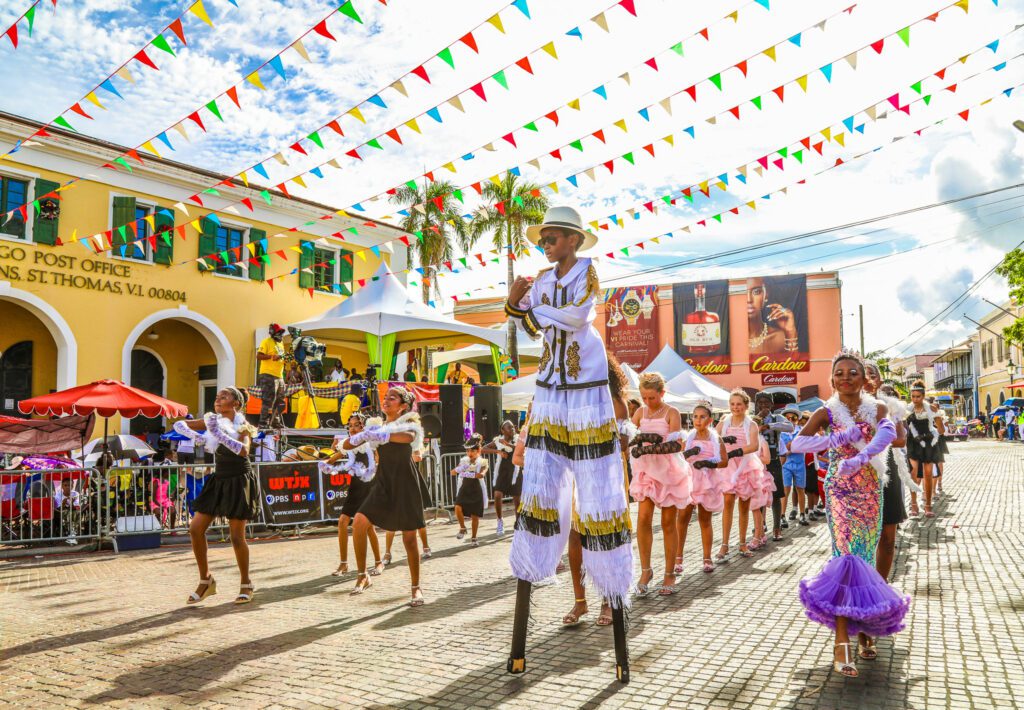
Beneath a canopy of colorful Carnival flags and to the pulsating rhythms of the season, young revelers moved with confidence and joy, delivering creative, well-choreographed routines that complemented their striking, meticulously styled costumes.
Each of the 28 entries was met with enthusiastic applause from a deeply supportive crowd. Proud parents, gushing grandparents, parade-goers, and community members lined the route, gathering at key vantage points including Market Square and the main judging area at Post Office Square, while others filled Main Street, all eager to celebrate the talent and spirit of the territory’s youth.
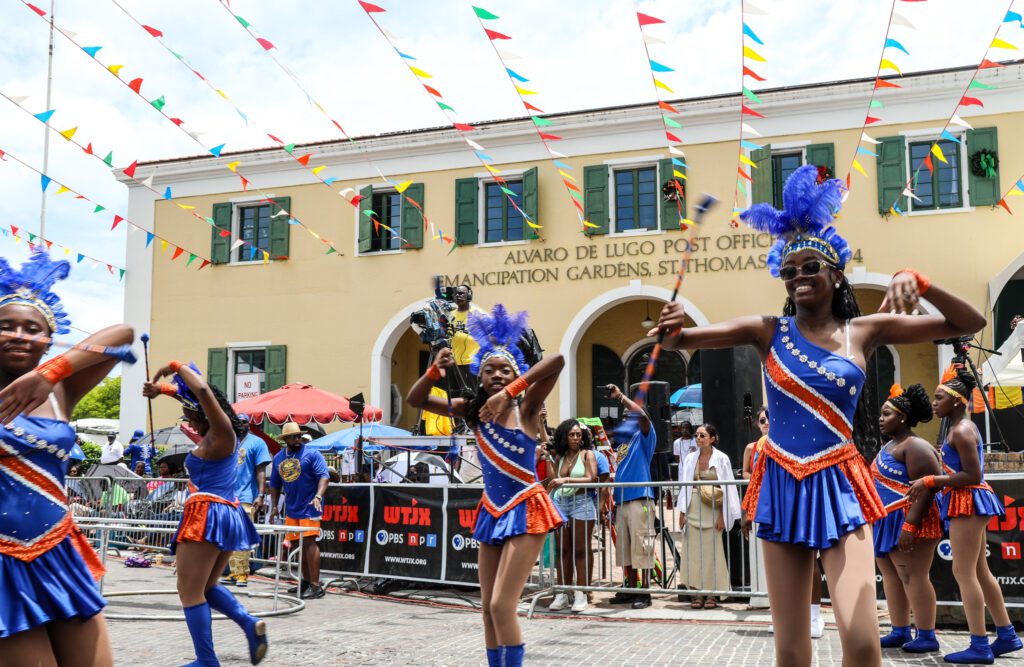
The 2026 Children’s Parade Grand Marshals, the Charming Twirlers Majorettes are celebrating 41 years on the road. (Photo by Ananta Pancham)
Leading the parade as the 2026 Grand Marshals, the Charming Twirlers Majorettes delivered an electrifying opening performance that energized the crowd and set the tone for the vibrant showcase to follow. With precision twirling, synchronized formations, and commanding presence, the group moved in perfect rhythm, drawing loud applause from spectators as they advanced along the route.
Dressed in striking blue-and-orange ensembles, complemented by feathered headpieces that swayed with each movement, the group embodied royalty while paying homage to the vibrant spirit of Carnival. Divided into toddler, junior, and intermediate groups, the performers demonstrated a dynamic range of ability. Even the youngest participants stepped confidently into the rhythm of the parade, with each age group contributing its own level of skill, discipline, and stage presence, collectively showcasing a seamless continuum of talent that reflected both growth and promise.
Carnival Princess Kaysa Freeman said her favorite event each Carnival is Food Fair. (Photo by Ananta Pancham)
Carnival royalty from St. Thomas, including Petite Princess – Skai Lewis, Princess – Kaysa Freeman, and Jr. Miss Jada-Marie Donovan, executed their royal duties and paid tribute to Jeavon “Uncle Mehn” Sasso, donning camouflage outfits and proudly wearing their crowns and tiaras in honor of the beloved musical icon. Known for delivering hit after hit, Sasso’s music has long served as a defining soundtrack of the Carnival season, resonating across generations.
The presence of youth was also on full display as a cadre of young calypsonians appeared along the parade route as part of the royal entourage, adding to the pageantry of the procession. Among them was Intermediate Monarch Prince Khaleel, Khaleel Mills, whose performance reflected both confidence and command of the art form. Also representing the next generation of calypso talent were Junior Calypso Secondary Monarch Queen Malene, Alauna Petersen, and Junior Calypso Intermediate First Runner-Up Prince Rainy, Sa’ Moore Weekes.
Further enriching this year’s parade was the active participation of groups from across the Virgin Islands and neighboring territories. First up were the various celebration royalties, whose poise and elegance added a ceremonial dimension to the procession. Delegations included St. Croix Prince – Noah Cebedo, Princess – Jaelyn Rodriques and Dutchess – Talia Simmonds. St. John was represented by St. John Festival Princess – Tichelle Walters and Tortola BVI Prince – Ojonte Ellis & Princess – Surayya Stevens were also present.
Their presence was further amplified by groups that brought their own distinctive flair to the roadway, enriching the overall showcase with diverse expressions of Carnival.
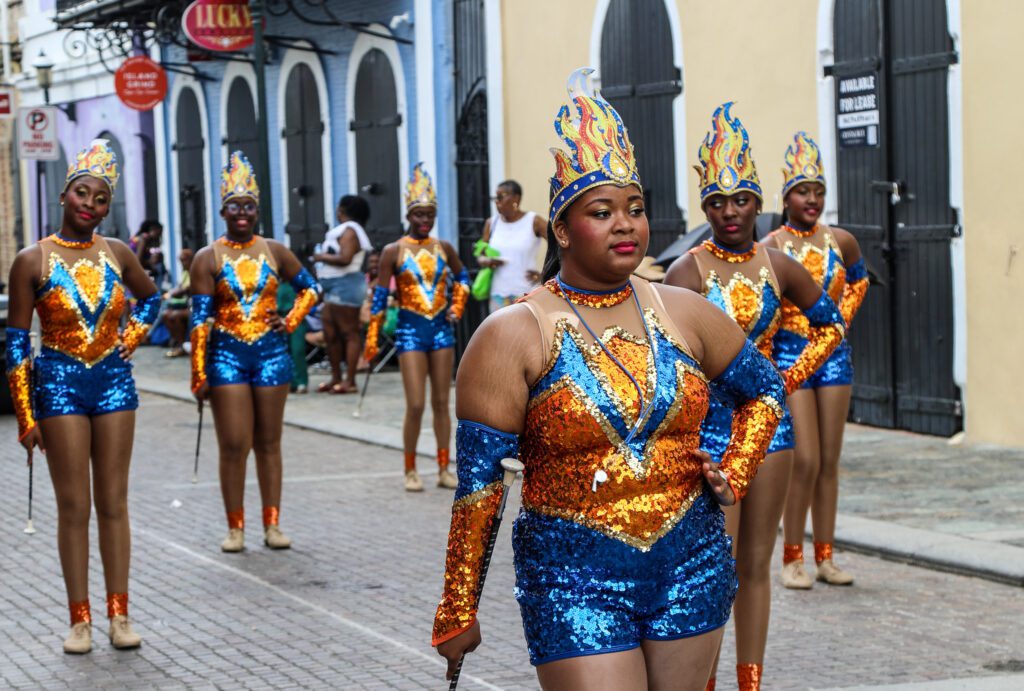
SLT Legacy Majorettes, clad in the orange and blue of the Logan Cruz Miracle Foundation, pays tribute to young cancer-warrior during Friday’s performance (Photo by Ananta Pancham)
Representing St. Croix, the Sparkle Lite Twirlers, Inc., the St. Croix Majorettes, Inc., and SLT Legacy Majorettes delivered high-energy performances that drew enthusiastic applause. Clad in orange and blue, the SLT Legacy Majorettes’ presentation carried a deeper significance, as it highlighted the Logan Cruz Miracle Foundation and paid tribute to Logan Cruz — adding a meaningful and heartfelt layer to their performance while underscoring the community-centered spirit of Carnival.
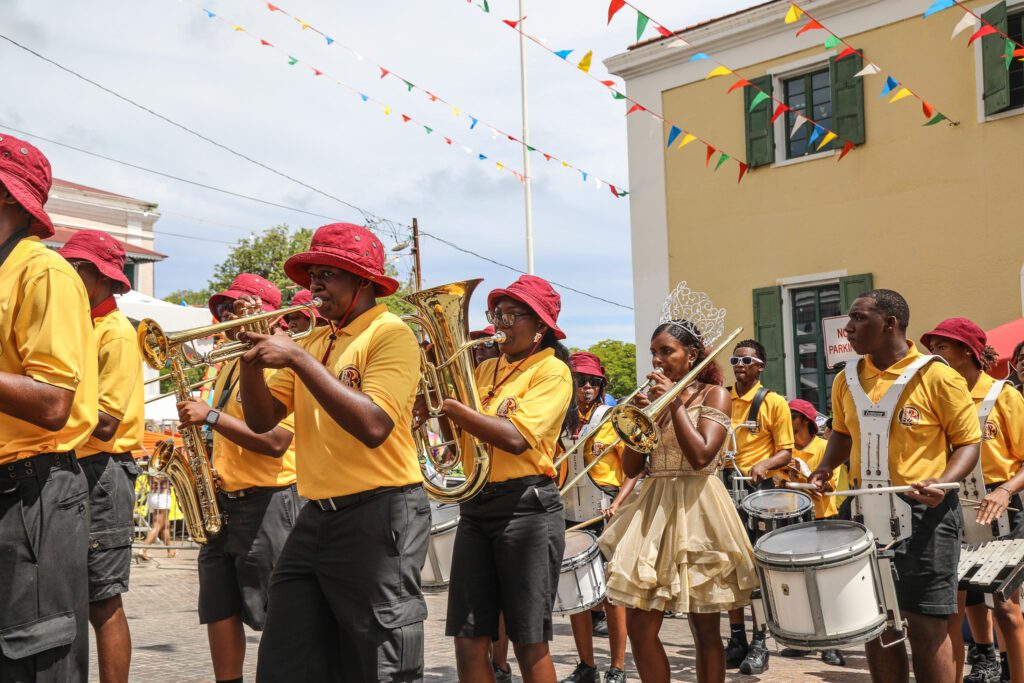
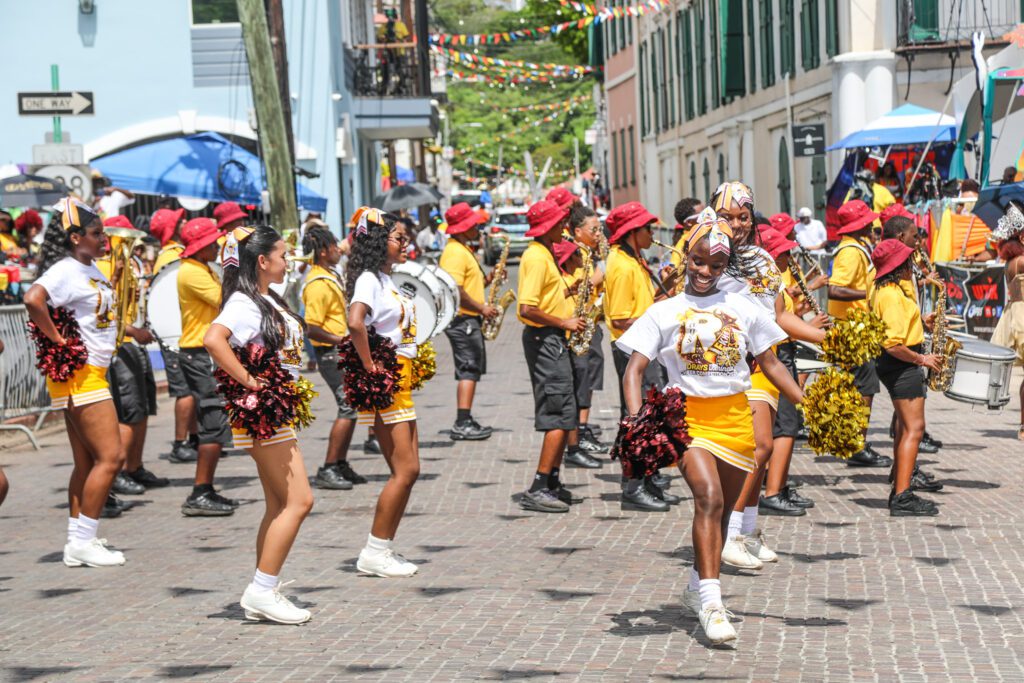
The Dynamite Rays, guided by instructor Monet Davis, brought its band and cheer squad to the road (Photo by Ananta Pancham)
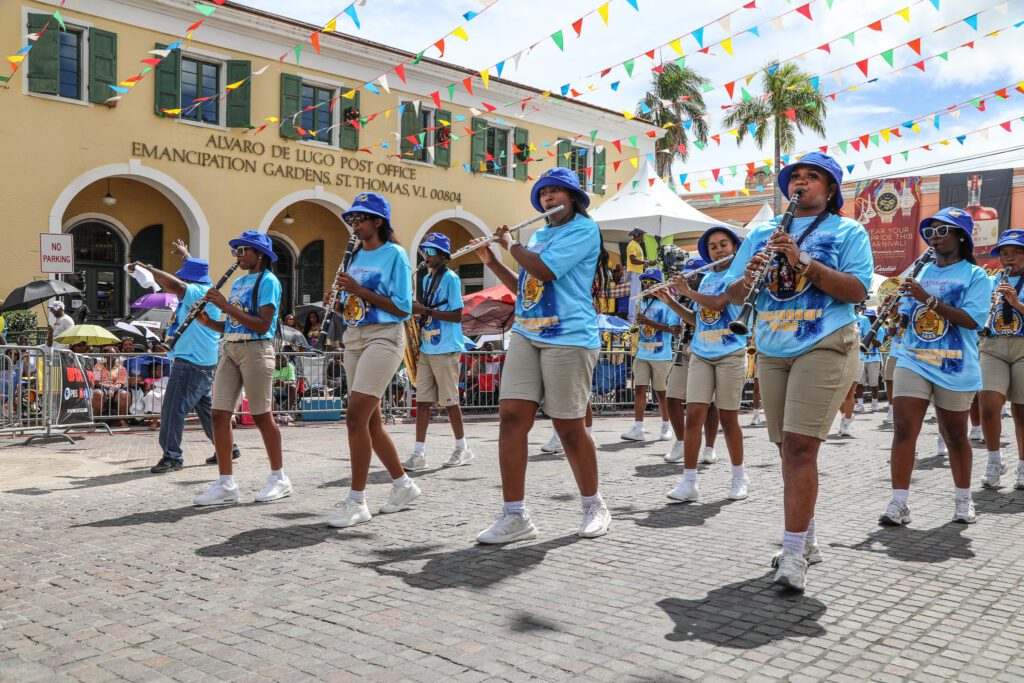
School-based entries also played a significant role in this year’s parade, showcasing the talent, discipline, and pride cultivated within the territory’s educational institutions. Public schools were well represented, with standout appearances from Ivanna Eudora Kean High School, whose Mr. & Miss JROTC and Dynamite Rays Marching Band delivered a spirited and commanding presence along the route.
Charlotte Amalie High School’s multi-layered performance, with marching band, color guard, and steel pan, also paid tribute to its anniversary classes. (Photos by Ananta Pancham)
Charlotte Amalie High School was equally prominent, with Miss Charlotte Amalie High School, Ana Tejeda Eduardo, making a poised and elegant appearance, complemented by the high-energy performance of the Marching Hawks and an engaging float that captured the attention of spectators.
At the elementary level, Jane E. Tuitt Elementary School brought youthful enthusiasm to the parade through its “Jets In Motion” group, whose performance reflected both creativity and coordinated effort.
Yvonne E. Milliner Bowsky Elementary School delivered a standout entry, with participants dressed in black-and-white ensembles accented by colorful madras, blending classic contrast with traditional Caribbean vibrancy.
Antilles School celebrated 75 years in style, with an old-Hollywood style set that supported their “Lights. Camera. Action” theme. (Photo by Ananta Pancham)
Representing the private school community, Antilles School added to the diversity of the showcase as it marked its milestone 75th anniversary. With a presentation themed “Lights, Legacy, Action,” the school embraced an Old Hollywood style, bringing a sense of elegance and theatrical flair to the parade route.
Together, these school-based entries reflected the important role of education in nurturing talent, fostering discipline, and sustaining the cultural traditions of Carnival.
Amid the excitement of the parade, a powerful message on literacy also took center stage. In today’s fast-paced, distraction-filled world, fostering a love for reading among children remains essential. Whatever your individual interests or abilities may be, finding time to read reaps short and long-term benefits. Reading develops a strong knowledge of self, improves communication skills and fosters creativity to explore, create, and problem solve.
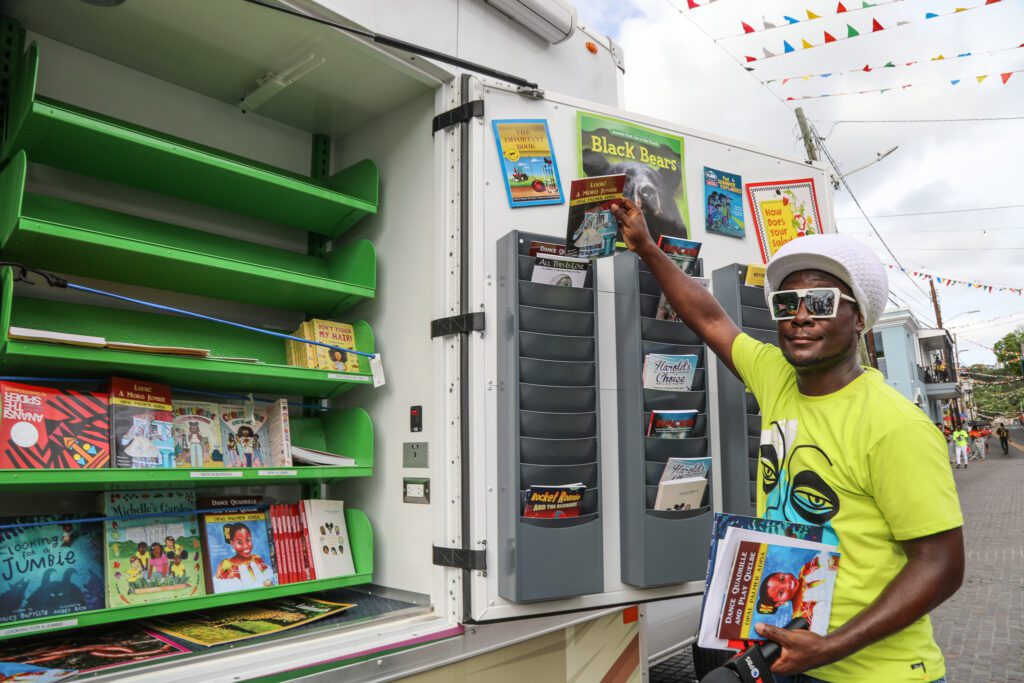
George Silcott Jr. browses the book mobile’s books – and the helped distribute them to the crowd. (Photo by Ananta Pancham)
To that end, the Virgin Islands Department of Education’s St. Thomas–St. John Office of the Insular Superintendent made a meaningful contribution to the parade through a special presentation and book distribution, highlighted by the unveiling of its literacy van. The effort served as a reminder that, alongside the vibrant expressions of culture, fostering literacy remains a critical pillar in strengthening the community.
Insular Superintendent Dr. Stefan Jürgen noted that he was especially pleased to introduce children to local authors, people from this community who share similar stories that children can relate to, identify with, or recognize.
Jürgen shared that he was extremely pleased with the level of participation from our schools this year. Carnival is the biggest celebration of our heritage and it is so critical that we engage children from an early age so that they grow to appreciate Carnival to the point that it develops a stronger sense of community that compels them to give back. The children were vibrant and energetic today and the public seemed to enjoy the entries. I look forward to the day when every school participates in carnival and recognizes the benefits of engaging children in such meaningful activities.
Two government agencies also utilized the parade as a platform to promote key public initiatives. The Virgin Islands Health Department advanced its “Before You Fete, Get Checked” campaign, encouraging residents to prioritize their health during the Carnival season, while the Office of the Lieutenant Governor of the Virgin Islands shared information on its Street Addressing Initiative, aimed at improving location identification and emergency response across the territory.
Delivering one of the most dynamic performances of the parade, St. Thomas Majorettes, Inc. captivated spectators with a multifaceted routine that pushed the boundaries of traditional presentation. Celebrating 20 years of participation in the Children’s Parade, the group incorporated a trampoline and an elevated prop into their choreography, seamlessly blending athleticism with artistry, creating a visually engaging and high-energy showcase that stood out among the day’s performances.
With precision, creativity, and confidence, the performers executed their routines to enthusiastic applause, twirling their way into the hearts of many and leaving a lasting impression along the parade route.
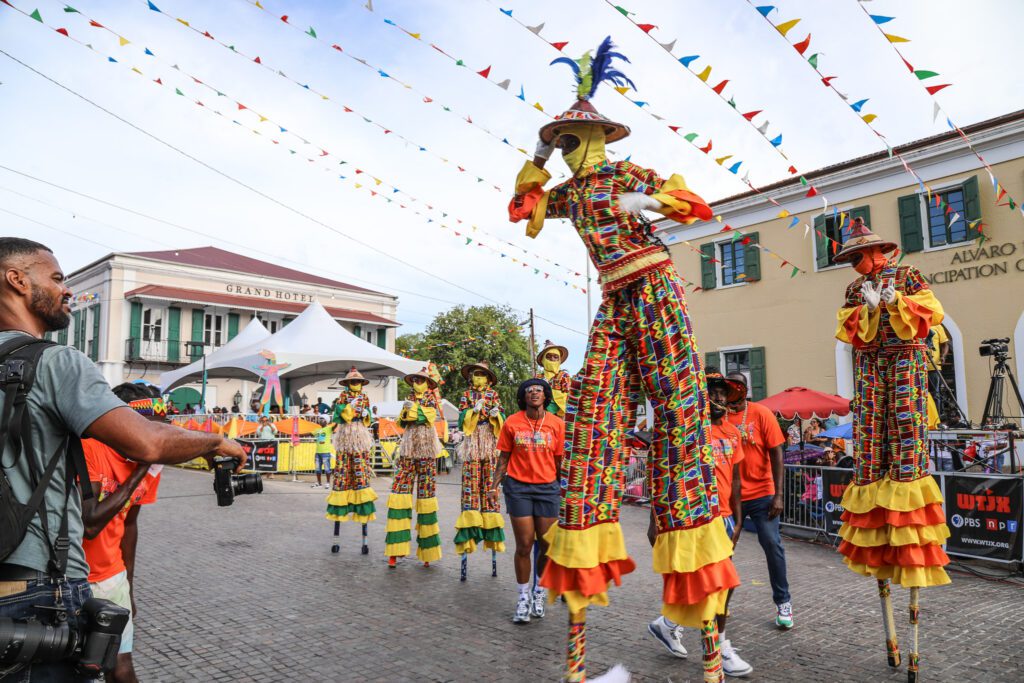
Eccentric Mocko Jumbies had no shortage of tricks Friday, as each one of their students spent time performing for the judges. (Photo by Ananta Pancham)
A crowd favorite throughout the parade was the series of performances by Mocko Jumbie troupes, whose towering presence and fluid, rhythmic movements captivated spectators along the route. Groups such as the Eccentric Mocko Jumbies and Yisrael’s Ambassadors of Culture Moko Jumbies drew loud applause, adding both spectacle and cultural depth to the day’s festivities.
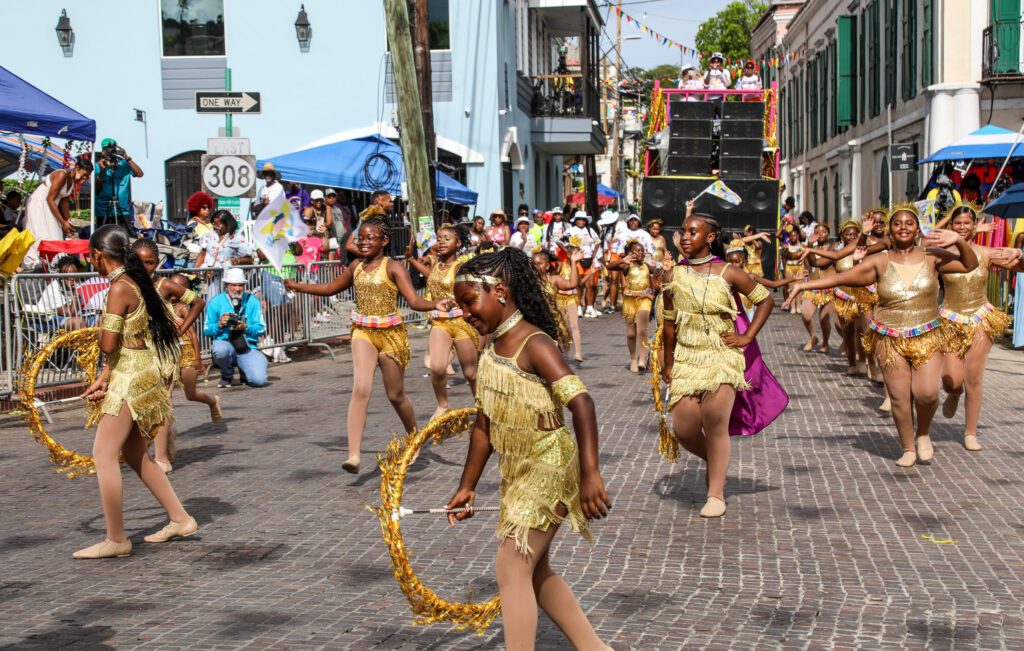
The smiles on the faces of the Elite Dynasty performers were just as dazzling as their gold-sequined costumes Friday. (Photo by Ananta Pancham)
Several troupes brought distinct themes and visual storytelling to the parade route, each offering a unique interpretation of Carnival through costume and performance. Elite Dynasty commanded attention in radiant gold, exuding confidence and regal flair as they made their way along the roadway.
Fete Massterz Cultural School also made a high-energy appearance.
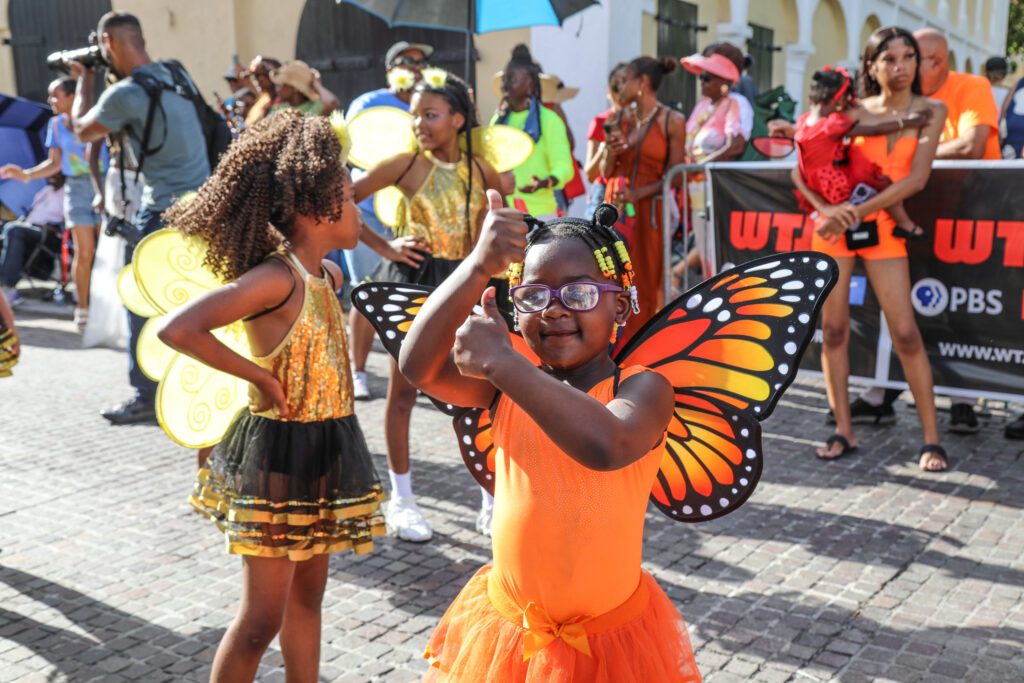
Equally captivating was Sun Children: Tanti Melda’s Garden, whose presentation transformed the street into a vibrant garden scene. Through imaginative costuming and coordinated movement, the group illustrated a lively, nature-inspired theme that added color and creativity to the day’s festivities.
From beautiful butterflies to busy bees, the Sun Children brought light to Tante Melda’s Garden. (Photo by Ananta Pancham)
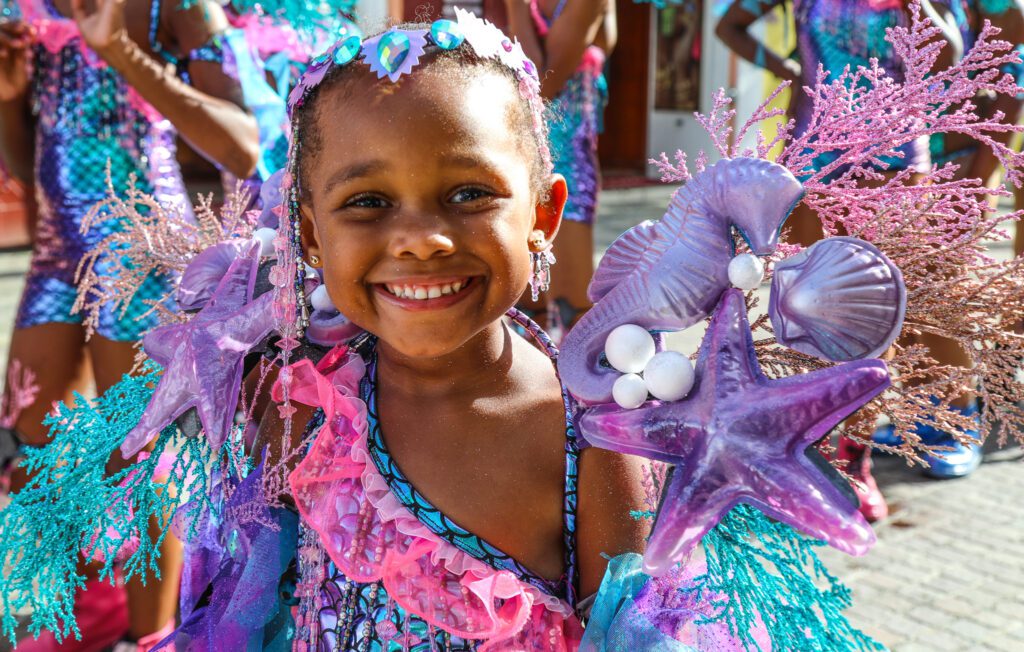
Rounding out the showcase, Exotic Royalties Carnival Troupe delivered a mystical, ocean-inspired performance. Their fluid movements and thematic design evoked the depth and beauty of the sea, offering a visually immersive experience that resonated with spectators.
Matching the Exotic Royalties Carnival Troupe’s undersea theme was music from “The Little Mermaid” – and a bit of soca, too. (Pho
Together, these presentations highlighted the creativity and imaginative storytelling that continue to define the Children’s Parade experience.
Each entry was introduced through descriptive storytelling that established a clear backdrop and set the tone for the performance that followed, reinforcing Carnival as both a visual spectacle and a living narrative of culture and identity.
As the parade gradually made its way toward a close, it did so on a high note, underscored by the rhythmic melodies of steelpan. The St. Thomas All Stars Steelband, Genfusion Steel Orchestra, and the Superior Court Rising Stars Youth Steel Orchestra delivered captivating performances that echoed through the streets, sustaining the excitement and closing the procession with vibrant musical flair.
As is customary, the Traditional Indians emerged as the final act, bringing the parade to a close with a striking and culturally rich display that honored long-standing heritage.
As the curtains fell on the 2026 St. Thomas Children’s Parade, the lasting impression was one of promise and continuity. From toddlers to teens, the day’s showcase reflected the depth of talent, pride, and cultural awareness being cultivated among the territory’s youth. In every step, spin, and smile, they carried forward the traditions of Carnival, offering a powerful reminder that the future of the Virgin Islands’ cultural heritage is not only secure but thriving.
“Wait for me I’m coming
In my garters and pearls
With what melody did you
barter me from the
wicked underworld?”
—Anaïs Mitchell
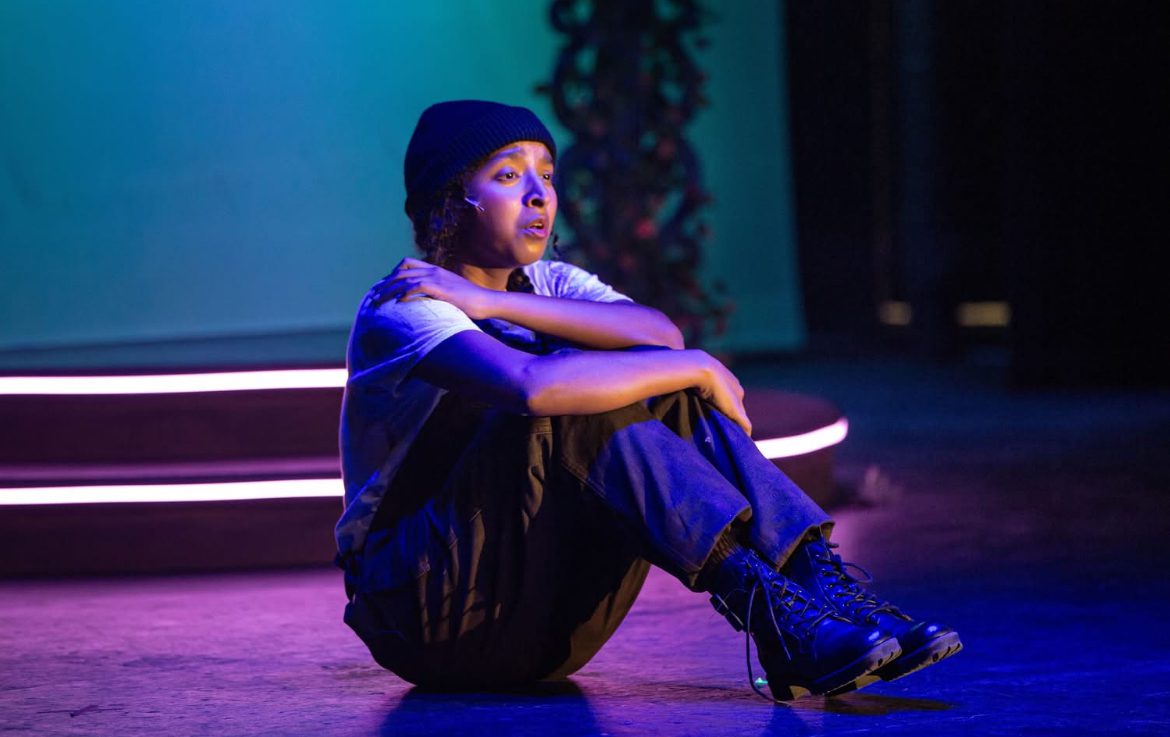
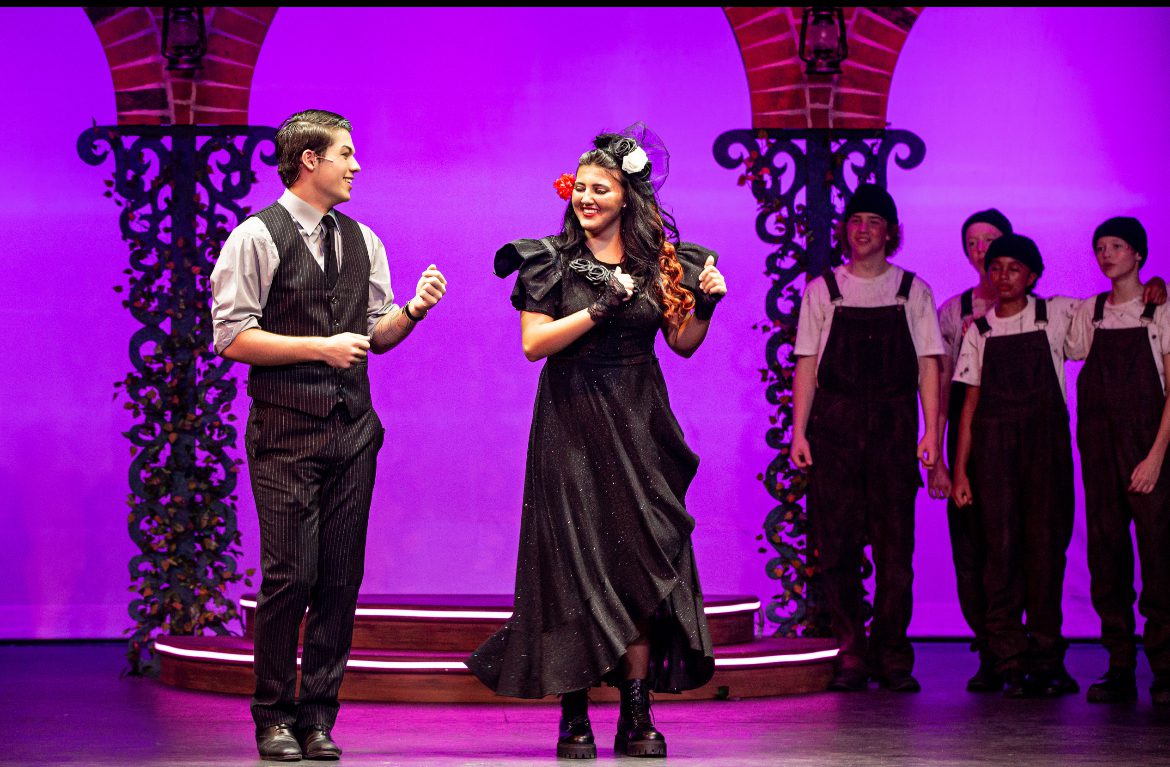
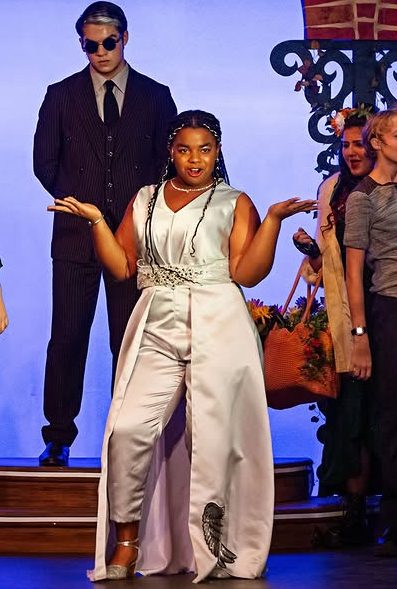
Young, destitute and tragically romantic, the penniless poet Orpheus is tasked with composing a melody so beautiful it will both induce the arrival of spring and persuade Hades to release Eurydice from the fiery clutches of the Underworld.The Three Fates play on Eurydice’s vulnerabilities, mocking and cajoling her as personifications of her own inner dialogue (Photo by Lindsay Kammerzelt Photography)The chips are down in the mortal world above, where the climate is unstable, poverty is rife, and economic recession spreads like a plague over the land. Falling prey to a Faustian bargain in which Hades promises her relief from poverty and hardship, Eurydice is lured into forsaking her love for Orpheus and joining Hades in his underground lair, which takes the form of a postapocalyptic walled factory in which faceless workers toil tirelessly like automaton cogs in a profit-churning industrial nightmare. Welcome to Hadestown! When Orpheus learns that Eurydice has been abducted by Hades and lured into the underworld, he sets out upon an epic journey on the road to hell, determined to rescue his young lover with a song. The show opens with the messenger god Hermes, whose vocal narration of “Road to Hell” helps set the stage for all to come by introducing the musical’s cast of Gods and mortals and reminding the audience that what they are about to witness is an “old song, an old tale from way back when.” But who knew Hermes was Crucian? In the hands of 11th grader Kimaya Jackson, who plays the role marvelously, this myth becomes fact and her Crucian-inflected portrayal of the messenger god shines a bright light on the inherent music, color and poetry of the local dialect. In “Road to Hell,” the cast promptly breaches the 4th wall with a hypnotic opening refrain, a bluesy minor pentatonic riff set to the rhythmic pulse of the railroad to the underworld, which draws the audience into a call and response, setting up a repetitive incantatory hum that seems to signal a spell is being cast. Caught up in the rhythmic hypnosis, players and audience alike enter the timeless dimension of myth, a spell that lasts for the duration of the show.Eurydice fretful in the Underworld (Photo by Lindsay Kammerzelt Photography)Sitting in the darkened theater watching the unfolding spectacle of Orpheus’ epic journey into the underworld propelled by an electrifying Gumbo of jazz, blues, Dixieland and folk, I found myself thinking of the great mythologist Joseph Campbell, whose approach to myth and story has had a shaping impact on my own teaching of literature in high school. Answering the clarion call to adventure by his love for Eurydice and his determination to save her, Orpheus casts aside his own safety and comfort and willingly faces the perils and challenges of a harrowing descent into the Underworld. His story contains all of the elements of that universal, cyclical narrative template that Campbell referred to as “The Hero’s Journey.” Campbell believed that the role of the contemporary artist is to reimagine the universal mythic archetypes of the past and to reinterpret them in terms of the modern moment. In his novel Ulysses, for example, James Joyce famously retells Homer’s Odyssey, but distills that decade-long saga into a single day in the life of a character named Leopold Bloom and sets it on the stage of the streets in Dublin in 1904. Vermont-based singer-songwriter turned playwright AnaïsMitchell seemed to be doing something similar with Hadestown. Utilizing the tropes of ancient Greek myth to comment on the contemporary moment, she playfully intertwines the myths of Orpheus, Eurydice, Hades, Persephone, Hermes, and the Fates, inviting those mythic characters into the present to renew an old song, an ancient tale about trust, faith, love, doubt and the transcendent power of the creative act to restore order to the world.Orpheus in the Underworld of Hadestown (Photo by Lindsay Kammerzelt Photography)Living in a preindustrial world, the ancient Greeks were blissfully untroubled by the specter of global climate change, which today has become an existential threat that is increasingly in the foreground of our social and political discourse. In Hadestown, drastic shifts and unpredictable patterns in the weather stem from the turbulent and troubled marriage between Hades and Persephone. In the original story, Hades abducts Persephone, absconding with her into the Underworld, which causes winter in the mortal world, but he allows her a reunion with her mother, Demeter, every spring. Upon her return, the temperature warms, flowers blossom and renewal spreads over the landscape. It was a myth that provided an explanation for seasonal change in the ancient Greek world.11th graders Tristan Samuels and Peyton Schindler dazzle the spellbound, sold-out audience with their portrayals of Hades & Persephone (Photo by Lindsay Kammerzelt Photography)In “Any Way the Wind Blows,” young, hungry and on the run, Eurydice mourns that “the weather ain’t the way it was before,” and obliquely describes a world transfigured by climate change: “ain’t no spring or fall at all any more. It’s either blazing hot or freezing cold.” In the universe of the musical, these drastic shifts in the weather are a result of marital strife and Hades’s insistence on keeping Persephone in the Underworld for longer and longer periods of time, leading to more death and decay in the living world. Lady Persephone, goddess of the seasons, the “cycle of the seed and the sickle,” is cast as an irrepressible force of nature: sassy, saucy and spirited (as well as something of a conspicuous boozehound!) The part is played pitch-perfectly by 11th-grader Peyton Schindler, whose performance provides the perfect counterpoint to the fiery, toxic masculinity of Hades, a role that 11th-grader Tristan Samuel delivers with gusto in a starched suit, dark glasses, and perfect hair. In classical Greek mythology, the Three Fates or “Morai” personify destiny and control the proverbial thread of life for all mortals. In Hadestown, the three sisters function as the embodiment or personification of characters’ internal dialogue, that voice in the back of one’s mind, specifically as whispers of fear, self-doubt, and bitter recrimination in the minds of Orpheus and Eurydice. Performing in these roles, 10th grader Lena Kammerzelt and 12th graders Amalie-Laeah Figueroa and Allegra Ferreras provide the show with some of its best moments and the seamless three-part harmony they manage as they mock, cajole and sow doubt in the minds of the young lovers is especially impressive. Having survived the descent into the underworld, Orpheus arrives in Hadestown and is reunited with Persephone. In confronting Hades, Orpheus appeals to the humanity he senses beneath that sinister exterior and finds common ground by drawing parallels between Hades’ love of Persephone and his own love for Eurydice. Orpheus then sings his song, presenting a melody that has developed and evolved as a subtle motif woven into the background of the musical over the course of the show before rising to center stage as a crescendo in this performance before Hades.12th grader Maya Prasad as Eurydice and 9th grader Avery Adams as Orpheus (Photo illustration created using AI tools)Orpheus’ performance is so moving, his melody so full of beauty and pathos, that it convinces Hades to allow Eurydice to return with him to the living world. As in the original myth, however, Hades tests Orpheus’ faith with a single condition: on their ascent back to the living world, Eurydice must trail behind Orpheus and not be at his side until they emerge into the sunlight of the world above. During the journey, Orpheus is never to look back to ensure that Eurydice is following him, or else …During their ascent, the Fates play upon Orpheus’ insecurities and pester him with persistent whispers of self-doubt. As the young lovers near the surface, suddenly overcome with doubt, Orpheus cannot resist the impulse to look back at Eurydice, who is then abruptly drawn back into the fiery depths of the Underworld, lost to Orpheus forever. Despite recalling Hermes’ reminder in the show opener that “It’s an old tale and we all know how it ends,” the moment seems to come as a shock. It reveals that doubt itself is, in fact, the tragic tale’s true villain, not Hades after all. In the omniscient wisdom that is Hermes’ hallmark, we are told:The dog you really go to dread
Is that one that howls inside your head
It’s him whose howling drives men mad
And a mind to its undoingBut the last we see of Orpheus, who is played with astonishing skill and charisma by 9th grader Avery Adams, and Eurydice, played with equal grace and talent by 12th grader Maya Prasad, returns the young couple to the moment of their first meeting in the mortal world when she is taking shelter from the cold and he is working on a song to bring back spring. The musical has come full circle and like the arrival of spring in the cycle of the seasons that Persephone represents, the stage is set for another go around! And once again, whether ill-fated or not, hope stubbornly springs eternal anew!But who knew Hermes was Crucian? In the hands of 11th grader Kimaya Jackson, who plays the role marvelously, this myth becomes fact and her Crucian-inflected portrayal of the messenger god shines a bright light on the inherent music, color and poetry of the local dialect. (Photo courtesy GHCDS)GHCDS’s long-standing dedication to the theatrical arts and its commitment to excellence in drama shone through every aspect of the performance. Sitting in the darkened theater and beaming with pride while watching so many of my former students bring the mythic past alive in the present through the vehicle of Anais Mitchell’s musical Hadestown was actually a familiar experience. As an English teacher in the high school at GHCDS for over a decade, I always relished seeing my students perform in the fall dramas and spring musicals. It was thrilling to watch them thriving in a context outside the classroom and to witness their latent talents come to fruition in the convivial, community setting of shared performance. I came to believe that the drama program’s performances presented a kind of distillation of everything the school and the community do well, and these performances offered an opportunity to celebrate together and, in the parlance of Hadestown, to “live it up on top!”Just when you thought the GHCDS theater program had outdone itself, at the moment I’m recalling The Drowsy Chaperone (2017), and Mama Mia (2019), they come forward with an astonishment like Hadestown (2026). What a gift to the larger community of the Virgin Islands these vibrant performances are. And it should be noted that the new incoming head of school, a proud native Crucian and graduate of Good Hope School, Mr. Ali Morgan, is himself a student of the theater arts and shares this commitment to excellence in drama and so I’m guessing we can look forward to more tastes of “Broadway on St. Croix” in the years to come. I appreciate whatever mysterious force precipitated the arrival upon our shores of those mythic figures from the deep past and induced the likes of Orpheus and Eurydice, Persephone and Hades, Hermes and the Fates to wash up on St. Croix, take the stage at Good Hope Country Day School and breathe new life into an “old song” for spellbound audiences. I remain in awe of the cast and crew that produced the astonishment that transpired on the stage the night I saw the show. While the musical was entirely student-driven and student-executed, from cast to crew, from start to end, those who helped the students shepherd the production into existence also should come forward, take a bow and receive a standing ovation: Kiomie Pedrini and Carolyn Forno codirected Hadestown, Yoav Hayut was its Musical Director, Joseph Barnwell was its Technical Director and alumna Cereyna Bougouneau (GHCDS class of 2016) was its Choreographer. As I suspect was true of everyone in attendance, I walked out of the theater after the performance that night feeling as though I had been touched by the Gods.
Editor’s Note: Opinion articles do not represent the views of the Virgin Islands Source newsroom and are the sole expressed opinion of the writer. Submissions can be made to visource@gmail.com.
In recognition of Mental Health Awareness Month this May, the Virgin Islands Department of Health’s Behavioral Health Division is launching a series of initiatives aimed at supporting vulnerable populations and strengthening community awareness around mental health.
(Source photo by Michele L Weichman)
Central to this year’s observance is a community-wide effort to support individuals experiencing homelessness. Throughout the month of May, the Department’s Behavioral Health Division will collect donations of non-perishable food items and personal hygiene products at its Behavioral Health offices at:
St. Croix – VITRACO Mall, Golden Rock
St. Thomas – Barbel Plaza, Estate Thomas
St. John- Morris F. DeCastro Clinic, Cruz Bay
Donations will be accepted Monday through Friday, from 9:00 a.m. to 3:00 p.m. Collected items will be distributed directly to individuals experiencing homelessness in both districts during the final week of May.
“We have always been committed to meeting people where they are, with compassion, dignity, and respect,” said VI Health Commissioner Justa Encarnacion. “This initiative is us reaching out and providing meaningful support to those who need it most.”
Commissioner Encarnacion notes that the Territory’s homeless population is gradually increasing, driven by a combination of economic pressures, mental health conditions, and other social factors. The Behavioral Health Division is continuing to partner with the VI Department of Human Services and community organizations to engage this population by providing care and connection while respecting individual rights and autonomy.
In addition to outreach efforts, the Behavioral Health Division will officially launch its first major GenZ-focused suicide prevention campaign during the month of May. The campaign is designed to raise awareness, reduce stigma, and encourage young people to seek help and support when facing mental health challenges.
“Young people across our Territory are navigating stress, uncertainty, and real-life pressures every day and have a difficult time expressing how they really feel,” said Renan Steele, Deputy Commissioner of the divisions of Behavioral Health and Environmental Health. “Through this campaign, we are working to turn silence into connection, creating safe spaces for conversation, helping young people recognize when they need support, and ensuring they know they are not alone.”
As part of its continued focus on youth and young adults, the Department will also roll out Season 2 of “Bush Tea & Gen Z – Real Talk in the Morning,” in partnership with ROE FM 101.3 WEVI. The new season will expand its focus to address the adult Gen Z population, offering real conversations around mental health, relationships, stress, and self-worth through a culturally relevant and engaging format.
Residents are encouraged to support Mental Health Awareness Month by donating items, participating in community conversations, and reaching out to those who may need support.
Individuals in need of immediate support can call or text 988, the Suicide & Crisis Lifeline, or visit 988lifeline.org for confidential, 24/7 assistance.
Carla Denise Beharry was born on Oct. 10, 1979, and passed away on April 20, 2026. She will be remembered with love and cherished in the hearts of all who knew her.
Carla Denise Beharry
Carla was preceded in death by her beloved parents, Catherine Thomas Beharry and Emanuel Beharry.
She leaves to mourn her passing her devoted brothers, Wendell Beharry and Eric Beharry, and her loving sister, Gail Beharry, along with other relatives and close friends who will deeply miss her presence.
Carla’s life, though not long enough, was filled with moments that touched those around her. Her memory will continue to live on through the lives she impacted.
The Caribbean Sea, with its currents and deep offshore trenches is one of the world’s premier destinations for landing one of sport fishing’s most elusive prizes: the swordfish. Known for their strength, speed, and mysterious deep water habits, these powerful predators offer anglers both a physical challenge and a story worth telling.
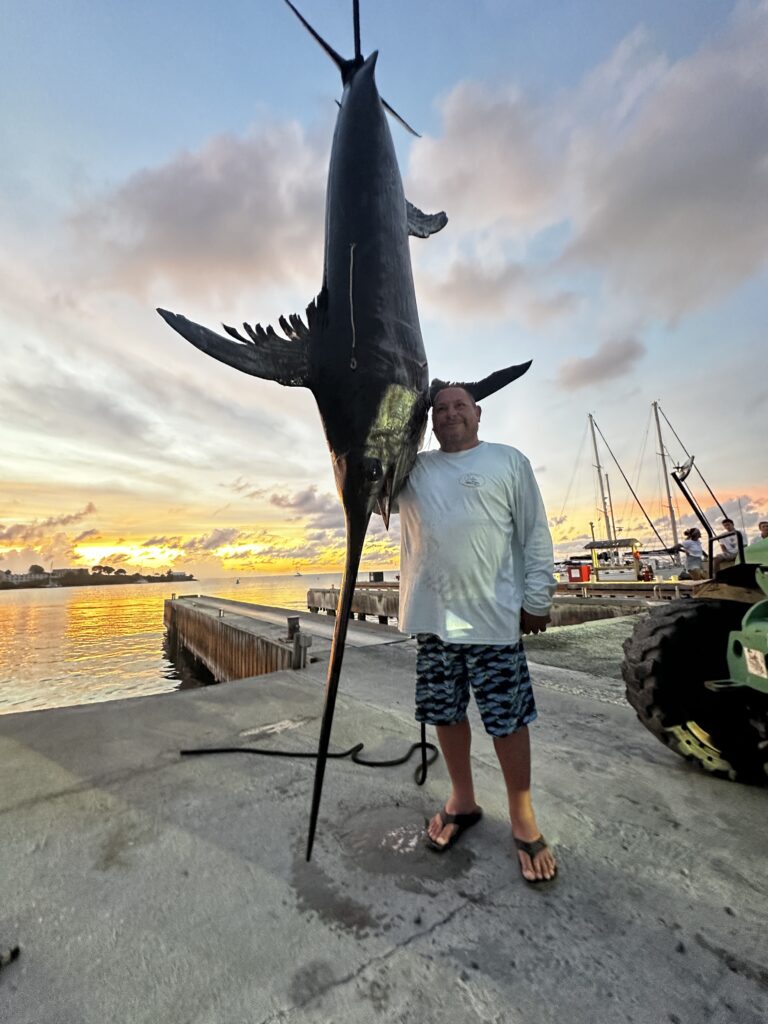
Crew of the boat Wicked Wench and their haul. (Submitted photo)
Swordfish are unlike many other game fish found in the Caribbean; by day they typically inhabit depths ranging from 1,500 to over 2,000 feet, rising closer to the surface only at night to feed.This behavior has shaped the specialized techniques used to catch them. Modern anglers often rely on deep-drop fishing during daylight hours, using electric reels , heavy weights, and illuminated bait rigs designed to attract attention in the dark, pressurized depths.
The experience of hooking a large swordfish is unforgettable.After hours of patience, carefully monitoring lines and equipment, the strike can be surprisingly subtle-a slight twitch or hesitation in the line.But once hooked, the fish reveals its true power.
Swordfish are known for their low, stubborn fights, often diving deep and forcing anglers into a test of endurance that can last several hours.The swordfish’s iconic bill and muscular bodies make them formidable opponents, capable of sudden bursts of strength even after prolonged struggle.
The Caribbean offers several ideal locations for targeting swordfish, particularly along steep drop-offs where the ocean floor plunges dramatically.Areas near Puerto Rico, the Dominican Republic, and the Virgin Islands are especially productive due to their proximity to deep water just offshore. These conditions allow anglers to reach prime swordfish habitat without traveling extreme distances.
Beyond the thrill of the catch, pursuing swordfish in the Caribbean is also about the environment itself.The open ocean, the shifting hues of blue water, and the sense of isolation far from land all contribute to the experience.Encounters with other marine life such as dolphins, flying fish, and even whales, add to the sense of adventure.
Responsible fishing practices are essential, however.
Swordfish populations, once heavily overfished, have shown signs of recovery thanks to conservation efforts. Many anglers now practice selective harvesting, releasing smaller catch and adhering to sustainability guidelines to ensure that future generations can experience the same thrill and excitement we feel today.
For Billy Desmond, vice president of the Golden Hook Fishing Club it was even more special: It was his first day back on the water after his loss of a close family member.
“Wicked Wench” with 2200 hp of Suzuki engines on the back took off on a beautiful day in the Caribbean on the island of St. Croix.
Heading off shore more than 3 miles the first fish that he caught was a big bull dolphin hooked up on a spin caster. Then they raised a white marlin, but couldn’t get it to bite.Around noon they decided to start deep dropping for Swordfish.
While rigging the cockpit they discoveredthey had no strobe lights and where they had thought they’d like to try deep dropping was over 2000 feet deep, so they went back to shoreto get some strobe lights.
They finally got set up and their first drop was at about 12:45 in the afternoon.
They pulled that up around 2 o’clock and made another drop deciding that they were going to fish until 3 o’clock and then call it a day.
They were using all their patience, deep dropping can seem a little slow, then all of a sudden at 2:59 in the afternoon they saw the little tap on the rod and then they saw another little tap again, then the line tightened up theand he fight was on!
Hooked UP!!
This is a BIGfish.
It fought hard, it ran at least four times to over 1000 feet each time!
It was incredible.
They finally got the fish to the boat at around 6:05 to end over a three hour fight.
“Wicked Wench”with Captain Billy Desmond and his crew boated a 469 pound swordfish!Now they needed to get the fish on board: they opened the transom door and it would not go through the door due to its massive size. They turned the fish around and tied it up with the transom lines, only 1/3 of the fish would go through the door. The fish came in fast, as they were trying toevade the sharks. It took 4 gaffs to get the swordfish to the boat.For Billy Desmond and his crew, it was more than just a fishing trip, it was the catch of a lifetime,off the coast of St. Croix, in the deep blue waters Billy Desmond and his crew landed a 469 pound Swordfish in the Caribbean and they had battled and landed one of the ocean’s most formidable creatures .It all came down to one final drop… and one last minute of patience.
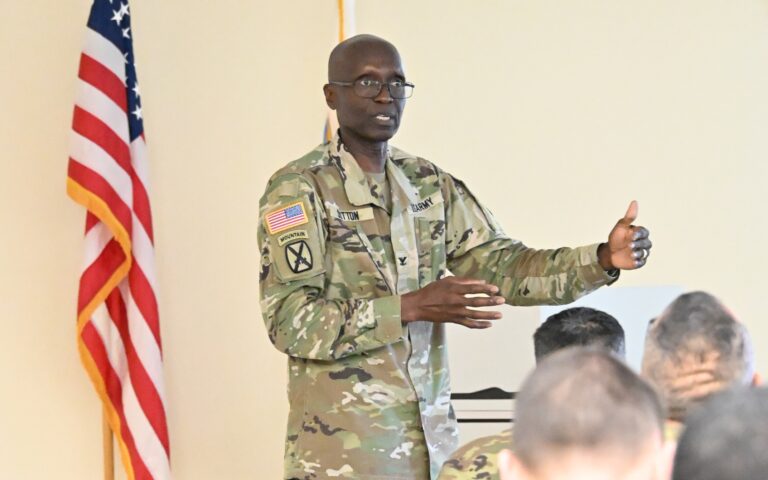
Col. Clayton Sutton, Deputy Chief of Staff for Operations, led the workshop’s opening session, welcoming executives, directors, and senior leaders from local government agencies, emergency management organizations, and partner entities.U.S. Army Col Clayton Sutton opens the All-Hazards Workshop. (Photo by 1st Lt. Latoya John)
Sutton emphasized the importance of unified planning and collaboration as the territory continues to refine its readiness posture for hurricanes, infrastructure disruptions, and emerging threats.
“This workshop brings together the people who make disaster response more manageable,” Sutton said. “Our goal is to ensure every agency understands not only its own responsibilities, but how we integrate as a team when the Virgin Islands needs us most.”
The All-Hazards Workshop provided a structured environment for leaders to review current plans, identify capability gaps, and support communication pathways across agencies. Over the three days, participants engaged in scenario-based discussions, operational planning sessions, and capability assessments focused on improving coordinated
response during complex emergencies.
Key focus areas for the 2026 workshop include:
• Interagency communication and information sharing
• Emergency operations center coordination
• Logistics and resource management during large-scale incidents
• Continuity of operations planning
• Integration of National Guard capabilities with territorial response frameworks
The workshop also supports ongoing efforts to enhance the Virgin Islands’ resilience by aligning local plans with federal and regional emergency management standards.
The Virgin Islands National Guard continues to serve as a critical partner in disaster preparedness and response, working year-round with territorial agencies to ensure the Virgin Islands remains ready for any hazard.