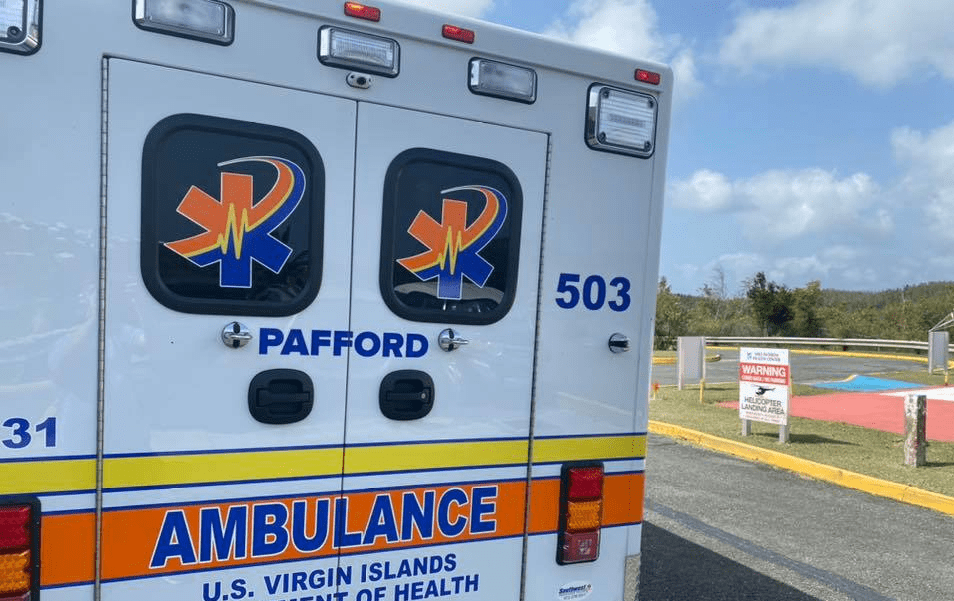
Pafford Medical Services will receive an initial payment from the Virgin Islands government, officials said. (Source file photo)
The Government of the Virgin Islands has made an initial $2.5 million payment to Pafford Medical Services in an attempt toward tackling the nearly $10 million debt that recently caused the company to suspend its operations in the territory.
This payment, which was appropriated by the V.I. Legislature at the request of Gov. Albert Bryan Jr., covers services provided to the Caribbean Kidney Center from October 2023 through September 2024, with an additional $500,000 expected from the General Fund, according to a Government House release Friday.
The payment comes after Pafford, a key provider of emergency medical services in the territory since hurricanes Irma and Maria, abruptly withdrew its staff earlier this month due to unpaid bills, leaving a critical gap in the territory’s healthcare system. In an interview with the Source Friday afternoon, Health Commissioner Justa Encarnacion confirmed that the government is committed to making monthly payments until the debt is fully satisfied. “They haven’t specified a fixed amount for each payment, but we’re dedicated to continuing these payments until the debt is cleared,” Encarnacion said.
The substantial debt is part of a broader financial struggle faced by the Virgin Islands government, with many vendors awaiting payment. “It shouldn’t be a surprise,” Encarnacion said, noting the government’s ongoing cash crisis when asked how the debt continued to accumulate without payment. “We’ve been managing payments on a month-to-month basis, especially for critical services like those provided at the Caribbean Kidney Center.”
Though it was reported last week that the Caribbean Kidney Center was closing due to non-payment, Encarnacion said this is not currently the case. “The Kidney Center remains operational, with nurses and technicians showing up daily. We’ve had ongoing communication with Pafford, and while the situation is challenging, the center is not closing,” she said.
Pafford was initially contracted under emergency circumstances to provide essential medical services after the hurricanes and throughout the COVID-19 pandemic. However, as federal funds that supported these services have been exhausted, the financial burden has shifted entirely to the local government, making it difficult to sustain Pafford’s services. In his release Friday, Bryan emphasized the administration’s commitment to healthcare in the territory, stating, “Our administration has been steadfast in expanding and improving access to critical medical services over the past five years, including the enhancement of diabetes and dialysis care. We recognize the essential role that Pafford Medical Services has played in providing emergency care during our most challenging times, and we are grateful for their partnership.”
Speaking to the Source, Encarnacion also highlighted the Health Department’s efforts to fill the gaps left by Pafford’s exit by recruiting local and off-island medical staff. Three nurses from Pafford have already been hired to work at Eldra Schulterbrandt Mental Health Facility on St. Thomas, with further recruitment efforts underway. “We’re working to find more sustainable, locally managed solutions,” Encarnacion noted, acknowledging the financial strain of maintaining clinical staff, particularly after federal support ended.
In addition to addressing the immediate debt to Pafford, the Virgin Islands Legislature has allocated $1 million each to the Governor Juan F. Luis Hospital and Schneider Regional Medical Center to enhance staffing and infrastructure, particularly for dialysis services. These investments are part of a broader strategy to ensure that critical healthcare services remain available to the territory’s residents, according to Government House.
Meanwhile, Health is also working on preventive measures, including continuing to support the Mobile Integrated Health Team managed by Pafford, which is aimed at reducing hospitalizations for chronic conditions like diabetes. Encarnacion mentioned that they have requested $400,000 annually to sustain these services as part of the broader budget.
Encarnacion added the department continues to keep a handle on the situation, particularly at facilities like Eldra Schulterbrandt, where staffing has been stabilized through overtime and reassigning nurses from other areas. “When something like this happens, there’s naturally a level of panic and concern, but we’re focused on balancing immediate needs with long-term solutions,” she emphasized.
In the event of a health emergency, the Health Department will take the lead in coordinating care across all healthcare agencies in the territory, ensuring that critical services like those at the Caribbean Kidney Center continue uninterrupted, Encarnacion said.
In her bi-weekly column, “State of the Territory,” former Sen. Janelle K. Sarauw delves deeper into issues of concern for V.I. residents.
The Government of the Virgin Islands has put forward its proposed budget for Fiscal Year 2025, promoting it as a model of fiscal responsibility and conservative budgeting. While the intent to manage finances prudently is commendable, a deeper analysis of the budget raises significant concerns. The administration’s projections, spending strategies, and reliance on federal funds suggest that the budget may be more about maintaining appearances than addressing the territory’s long-term financial health.
Overly Optimistic Revenue Projections
One of the most troubling aspects of the Bryan FY25 budget is its optimistic revenue projections. Despite actual data from the Department of Finance showing a decrease in FY2024 collections compared to FY2023 across all tax categories, the FY25 budget forecasts an increase in all tax revenue categories except Property Tax. This stark contrast between reality and the administration’s projections raises serious concerns about the accuracy and reliability of the budget.
There is a significant risk that locally sourced revenues in the Bryan FY25 budget may be overestimated by as much as $100 million. This kind of overestimation is not just overly optimistic—it’s irresponsible. The consequences of such a miscalculation could be severe, leading to substantial budget shortfalls that would strain public services, undermine financial stability, and necessitate mid-year adjustments that could have been avoided with more realistic forecasting.
Spending Cuts and Broken Promises
The proposed budget also reflects a $77 million decrease in General Fund expenditures for FY25. While reducing spending can be a necessary part of fiscal management, the methods used to achieve this reduction are concerning. The budget eliminates $25 million in retroactive pay that was promised to public sector employees and removes funding for wage increases in contracts still under negotiation. These decisions represent broken promises to workers and a failure to honor commitments made in previous budgets.
The $25 million in retroactive pay, which was diverted last year to bolster the General Fund, is now entirely absent from the FY25 budget. This not only undermines trust but also disregards the financial rights of employees who were counting on these payments. Similarly, not funding wage increases for contracts yet to be negotiated is a short-sighted move that could lead to labor disputes and decreased morale among public sector workers, ultimately impacting the quality of public services.
Unsustainable Reliance on Federal Funds
Another significant issue is the sharp increase in federal budget support, which rises from $248 million in FY24 to $417 million in FY25—a 69% increase. This growing dependence on federal funds is unsustainable and positions the Virgin Islands as increasingly reliant on external support. Under the Bryan administration, federal support now accounts for 29% of the total budget, compared to just 16% in the last Mapp administration budget.
This level of dependence on federal funds is not only unsustainable but also risky. Should federal support diminish, the territory could face severe financial challenges, forcing cuts to essential services or leading to increased local taxes. The reliance on federal aid to this extent could turn the Virgin Islands into a welfare state, dependent on external sources rather than building a resilient local economy.
The Need for a Hiring Freeze and Increased Efficiency
Staffing levels within the Government of the Virgin Islands (GVI) have increased significantly during the Bryan administration, rising from 6,955 employees in FY18 to 7,814 in FY25, inclusive of vacancies—a 12% increase. Despite this rise in staffing, there has been no corresponding improvement in the quality of services provided by GVI departments. In fact, many argue that service quality has declined.
Rather than continuing to expand the workforce, the government should consider implementing a hiring freeze across all departments. The focus should shift to increasing efficiency and productivity among existing staff, ensuring that public services are delivered effectively without the need for additional hires. This approach would not only control costs but also address the perception that the government is bloated and inefficient.
The Need for Progress in Disaster Recovery
The budget highlights a substantial increase in federal disaster recovery funds, with $8.2 billion now available to the territory. This funding is crucial for rebuilding and strengthening infrastructure after the 2017 hurricanes. However, the pace of disaster recovery has been slow, and this budget presents an opportunity to accelerate these efforts. The Office of Disaster Recovery anticipates spending $474 million of these funds in FY2025, which will generate additional revenue through taxes associated with construction activities.
Timely and effective use of these funds is essential not only for recovery but also for stimulating the local economy by creating jobs and boosting related industries. The government must prioritize the swift implementation of recovery projects to ensure the territory is better prepared for future challenges and to prevent the territory from becoming overly reliant on federal support.
Addressing Outstanding Financial Obligations
We must acknowledge the territory’s outstanding debt, including the $90 million owed to vendors. This debt represents a significant financial obligation that must be managed carefully to avoid further straining the territory’s finances. Small businesses, which often comprise a large portion of these vendors, are the backbone of the local economy. They create jobs, drive economic growth, and contribute to the vibrancy of our communities.
Timely payments to these businesses are crucial for maintaining cash flow, enabling them to pay employees, invest in growth, and continue providing goods and services. When payments are delayed, it can lead to financial strain, reduced economic activity, and, in some cases, business closures. The government’s strategy for addressing this debt should be transparent, with a clear plan to repay vendors promptly. Ensuring that these obligations are met is essential for fiscal responsibility and maintaining trust and stability within the local economy.
The Retirement System’s Precarious Situation
Another pressing issue is the financial health of the Government Employees’ Retirement System (GERS). The budget notes the impact of the rum cover-over program on the retirement system, particularly the fact that the rate was not increased. This situation places additional pressure on an already strained system. The government needs to consider long-term solutions to ensure the retirement system’s viability for future retirees. Without careful management, the retirement system could face significant challenges, affecting the financial security of many residents.
Conclusion: A Need for Transparent and Sustainable Budgeting
The FY25 budget presented by the Bryan administration raises several red flags. From overly optimistic revenue projections and broken promises on spending to an unsustainable increase in federal support and unchecked growth in government staffing, the budget lacks the transparency and prudence needed to ensure the long-term financial health of the Virgin Islands.
The Legislature of the Virgin Islands must revamp and vote on a budget grounded in reality, respects prior commitments, and works towards reducing dependency on external support. Moving forward, it is crucial for the government to adopt a more cautious and responsible approach to budgeting, one that prioritizes efficiency, sustainability, and the well-being of all residents. By addressing these issues, the Virgin Islands can build a stronger, more resilient economy that is better equipped to face future challenges.
Editor’s Note: Opinion articles do not represent the views of the Virgin Islands Source newsroom and are the sole expressed opinion of the writer. Submissions can be made to visource@gmail.com.
From left – GERS’ COO Asiah Clendinen Gumbs, Administrator Angel Dawson, and Havensight Property Manager Jahmed Mills share plans for the historic property on St. Thomas. (Source photo by Ananta Pancham)
A recent survey released to the public in June has supplied the Government Employees Retirement System (GERS) with much-needed feedback that will inform the revitalization efforts of Havensight Shopping Mall.
On June 30, 1993, GERS acquired the Havensight Shopping Mall, a 14-acre investment, from the West Indian Company (WICO) for $32 million. After the acquisition, WICO continued to manage the property until 2020, when GERS assumed full control of operations.
After news broke in 2023 that Haven Developments, in partnership with Hilton, would be establishing a Hampton by Hilton Hotel in Havensight, the GERS team saw an opportunity to completely revamp the Havensight product and reimagine the Havensight experience for both locals and visitors alike.
“We have discovered through time that tourists are more interested in experiential destinations. We offer retail which is great, and some dining and entertainment opportunities, but we really want to expand our experiential offerings at Havensight,” said Angel Dawson, administrator of GERS.
“This is why we sent the survey out. We wanted to get input from visitors and locals so we could understand what they would like to glean from the Havensight experience. We had a few concepts that we were able to test with the survey and the responses have really guided us in the new direction of the mall. One of the questions had to do with possible new names for the mall. We don’t find that the term “mall” is a fitting name for Havensight. We believe we can use something more organic and authentic for the location. We expect a renaming in our very near future,” Dawson added.
With over 1600 responses to the survey, the GERS team believes they have a clear picture of what the public desires for the space. “In the survey we sent out we shared a few ideas of some of the experiences we were considering including a rum tasting and pirate themed splash pad, but one thing we can say for sure that is gonna be happening is the creation of a public park that will also host our visitor center. This space is intended to be inviting for both visitors and residents. It’ll be our prime entertainment venue, similar to Central Park in New York City,” Dawson said.
“We are planning to dedicate the park to the Coal Women who were responsible for supplying coal to the steamships that were docking in our port. They are commemorated annually with the Dollar fo’ Dollar History Tour which celebrates the Coal Women’s efforts in staging a labor strike that ultimately led to higher wages for the workers. They are our ancestors and we felt it appropriate to honor them at that site. In addition, we will also be erecting a monument in their honor that will be placed in the park for the public to enjoy,” Dawson said.
In addition to the development of a public park, other ideas for experiential opportunities abound including an artisan market where vendors have an opportunity to display their handmade products and live demonstrations of traditional skills including woodturning and basket making.
“I think a big part of the experiences we want to cultivate are those that are connected to our culture and heritage, whether it’s with a show kitchen with someone demonstrating how to make johnny cake or Sweet Bread or even a walkthrough of the park where visitors can learn about the story of the Coal Women. We want to make it a place that people always want to visit because there will always be something new to see, said Asiah Clendinen Gumbs, chief operating officer of GERS.
“We want people to feel that they are in a place with a people who have a culture of their own. We want to differentiate ourselves from all the other places who promote sun, sand, and sea. Its about showcasing our local culture organically and giving people an experience of a lifetime,” Dawson concluded.
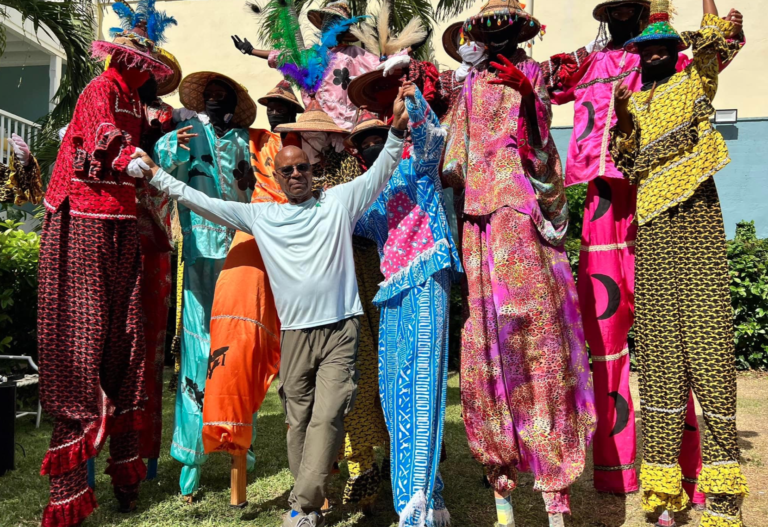
Willard John with the Guardians of Culture Moko Jumbies (Photo by Wendy Wynter)
This month, cultural icon Willard John was named one of the 25 Taproot Fellows by the national funder, the Alliance for California Traditional Arts (ACTA). This fellowship, supported by the Mellon Foundation, recognizes his work in educating youth about the importance of moko jumbies in Virgin Islands culture.
John was among the 25 fellows chosen from across the United States out of 100 applicants. Receiving this prestigious honor means that John will receive $50,000 in unrestricted funding and an additional $10,000, which must be used for community-focused projects.
John, known hugely for his group, Guardians of Culture Moko Jumbies, headquartered on St. Croix, has lived on the big island for over 30 years. Originally from St. Thomas, John moved to St. Croix in 1979.
John said that during his time at an HBCU international university, there were students from all over the world, specifically from Africa. In the evenings, they would sit and discuss their culture, where they came from, and other topics.
“In those discussions, I felt bad because I didn’t think I knew enough about my culture and my history,” said John. He attended a Catholic school in his primary school days and at that time they didn’t teach anything about Virgin Islands culture or history. “What I knew about my culture was how I lived,” said John.
He told himself when he graduated and returned home, he would immerse himself in some aspect of Virgin Islands culture and become an expert. “I didn’t know what it was at that time,” said John. He came home and he was living and working until one day his cousin approached him to learn moko jumbie. “My immediate answer was no. I am not going up in them thing,” John said with a laugh.
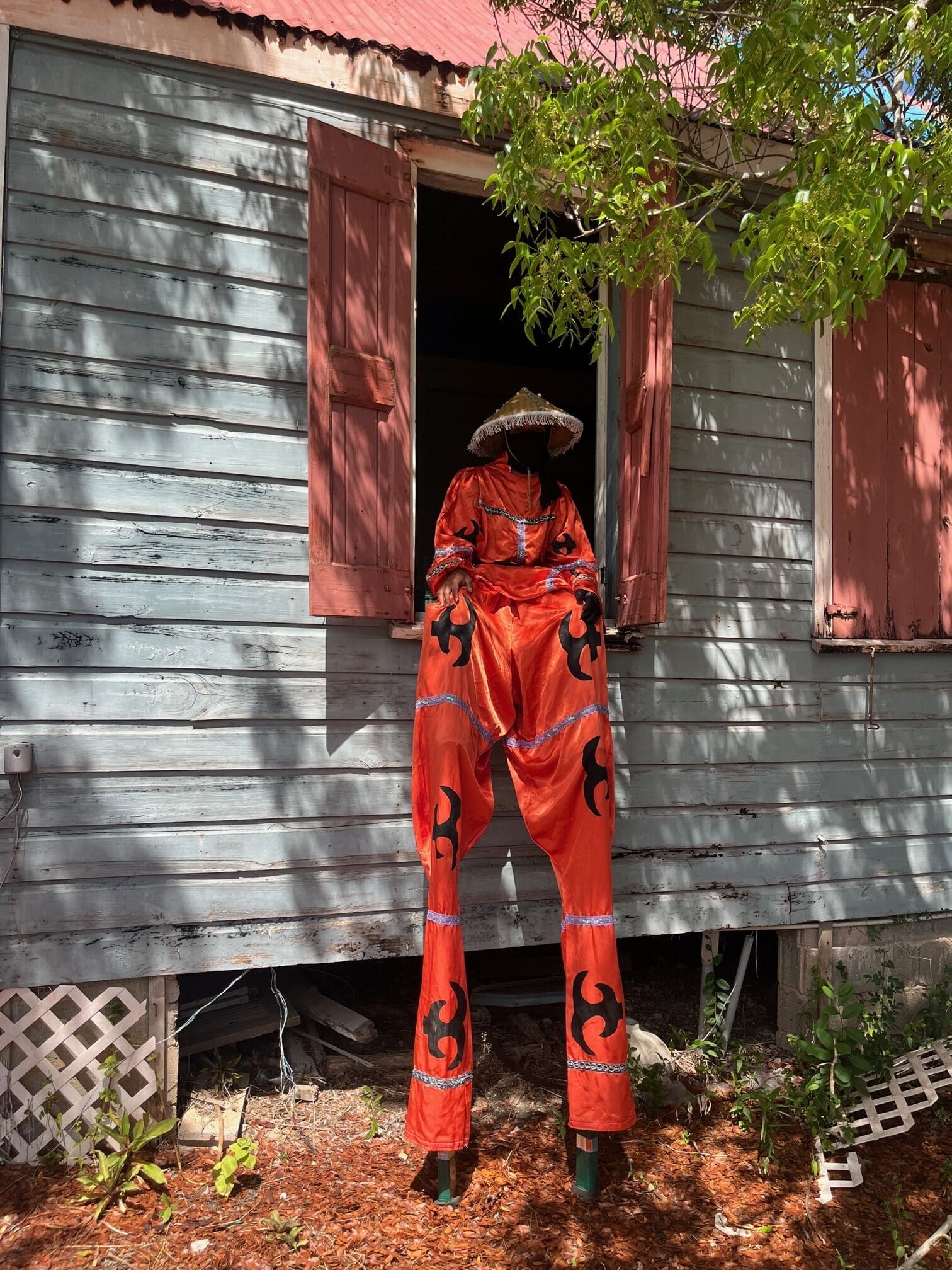
A moko jumbie at the exhibit “Granny’s House” at the Folklife Festival. (Source photo by Diana Dias)
His cousin repeatedly asked him, and he finally gave up in 1974. John made his debut in the St. Thomas Carnival in April 1975. “The rest was history,” John said. In 1979, he moved to St. Croix, and at that time there were no active moko jumbies. He started teaching people and went through several groups, but it wasn’t until 1993 a counselor at the Ricardo Richards School asked, “Why don’t you start a group at our school,” and after much persistence, they established the “Guardians of Culture Moko Jumbies.”
John said the mission of the Guardians of Culture Moko Jumbies is to promote, preserve, and educate about this unique art form, to which John said he has dedicated his life doing. “We currently have 40 members in their academy and the youngest eight years old,” said John.
Over those 31 years, John has taught 400 young people the art form that is seen at carnivals, festivals, agricultural fairs, and many more local events.
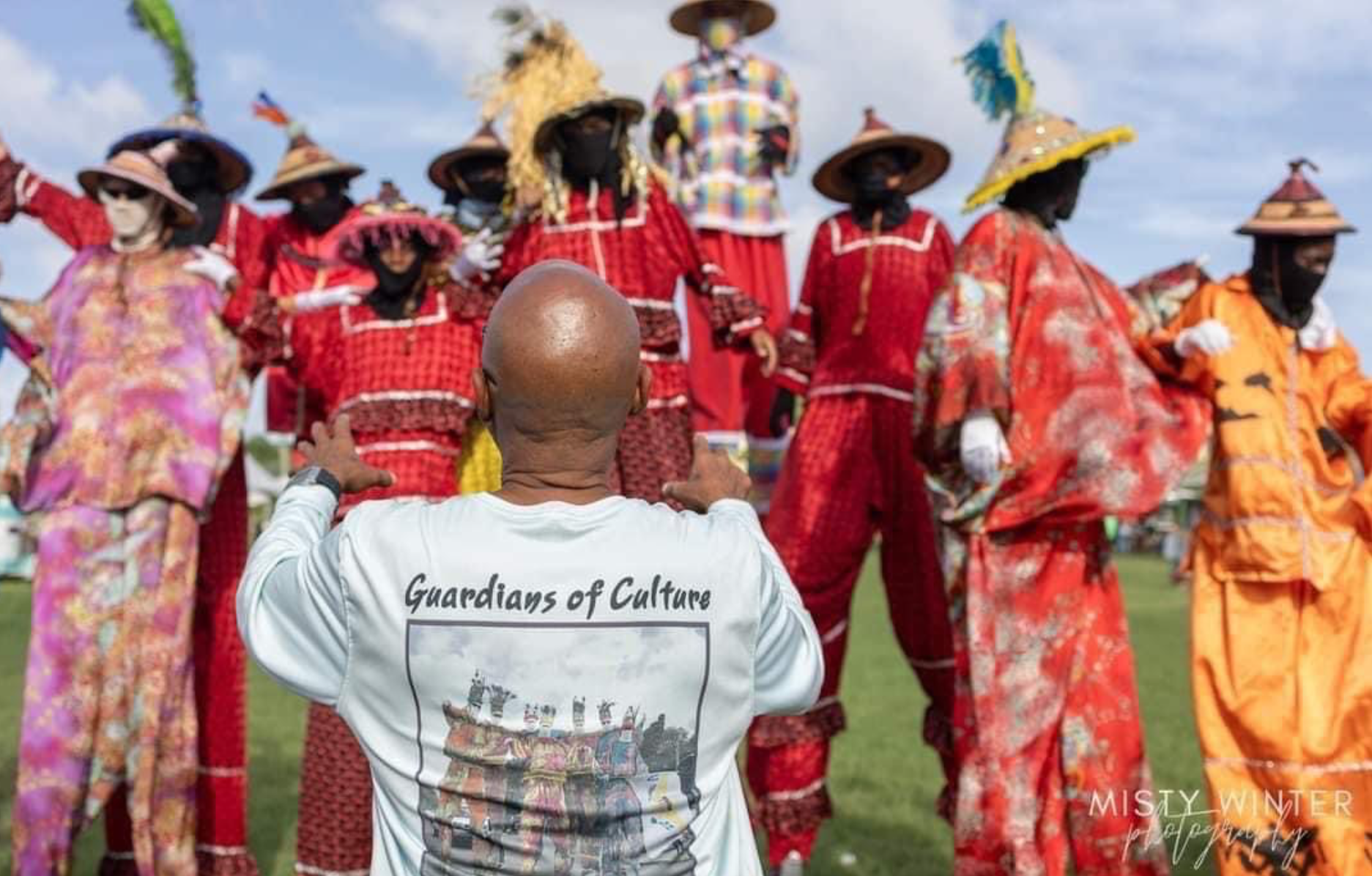
Willard John and the Guardians of Culture Moko Jumbie Academy (Photo by Misty Winter)
“I think that one unique thing about the Guardians of Culture is that we are focused on history and education. We are traditional moko jumbies so at all times I do things to remind people from where we come. That this art form originated from Africa. We dress a certain way, and we move a certain way. For example, we are one of the few moko jumbies that will always wear a mask,” said John. These are some of the things that John tries to maintain.
“It is important to me that we show that we are a group, that we practice and do things together,” said John.
John mentioned that he was selected after being nominated by someone at the Virgin Islands Council on the Arts. After being contacted, he was asked to apply for the fellowship. Out of hundreds of applicants, he was one of the 25 selected. John explained that the application process involved submitting pictures, videos, and other requested information.
John was recently honored with the 2023-2024 Crucian Christmas Festival Village being named after him for his accomplishments in the Legislature. “That helped them in choosing me,” said John.
John’s “Mokolution the evolution of the Moko Jumbies” presentation breaks down the history into three timelines. “There is the African timeline, the old time West Indian timeline and there is the modern timeline and each timeline I demonstrate how they dressed, danced, what music they used and the history behind it,” John said.
His mission, with the additional funds from his award, will be to spread this education to St. John, St. Thomas, and Tortola.
“Cultural preservation is important. Culture is dynamic not static and that is something you cannot stop, that process. I look at my leadership as making sure people know from where we come. Know that this art form originated in Africa, know the context in which it originated and know how it developed into what it is today,” said John.
The other winning artists’ profiles can be viewed here.
Joshua Barry in group photo with the whole crew from short film “The Therapist.” (Submitted photo)Three St. Thomians are about to take the stage, bringing their passion for filmmaking abroad to South Africa.Joshua Crawford Barry, the director of the documentary “Footsteps to Tomorrow,” along with Kitania Weston and Keano Brin, will make up the team of creatives using their talents to share untold stories.Barry, a junior at Howard University, majoring in TV and film with a minor in photography, has taken up the responsibility of directing a South African documentary. Barry first fell in love with film as an eighth grader at Antilles School. His photography skills helped him better understand lighting in film. During his senior year of high school, Barry started working for a local newspaper, combining his passion for art and storytelling. As Barry went on to Howard University, he started his own photography business, taking photos on Howard’s campus and in the D.C., Maryland, and Virginia area.By his sophomore year at Howard, Barry’s growing portfolio had garnered the attention of Kenrick Isaac, who proposed the idea of creating a documentary “for the students, by the students.” Enthralled by the concept, Barry didn’t waste any time in rising to the challenge and did not at finding talent scouting. Through collaboration a team of three creative minds from the U.S. Virgin Islands was born: Weston, Brin and Barry..Barry recruited Weston as the first member of his team. Her interest in the arts has followed her up through her life to present day. The theatrics of the storytelling in the shows and movies she watched as a young girl, along with the beauty of the island surroundings, set her on the track towards following a career in photography. “The ability to bring something from your imagination into a real thing is something I admire and strive for in my photography,” Weston shared.Kitanina Weston dressed to the nines awaiting for film she codirected with Keano Brin. (Source photo by Joshua Crawford Barry)It was not until her senior year in high school that Weston’s path became clear: this was her calling—to be a photographer. Her journey in photography began by capturing the natural beauty of her island home and her friends. This career decision has been the drive to push her into diverse creative spaces, such as a news internship and film sets. Her most recent venture into the world of filmmaking is her involvement with the Paradise 48 Film Festival, where Weston worked as a still photographer, assistant director, and producer. Through Weston, Barry met another talented artist, from St. Thomas, Brin. He came into arts early through his natural disposition towards drawing, painting, and other kinds of creative projects. Starting college with a declared major in computer science helped show him an early interest in technology but by his sophomore year he felt unfulfilled.This led Brin into the field of multi-platform production, where technological abilities interlaced with artistic passions. After Brin changed majors, he bought his first camera, which catapulted him into the learning process of how to be great at videography and photography. Upon graduating from college, he returned to the USVI, working on different commercial projects, interviews, and live events to build his skills. His role in building out a media company’s private studio further solidified his expertise and confidence.Keano Brin with a friend as they wait for the exhibition of films at film festival. (Source photo by Joshua Crawford Barry)After two years of professional growth, Brin decided to further his career by working for an independent brand, Key Visuals. He eventually relocated to Los Angeles in pursuit of his final goal: cinematography. Now working on various film productions, Brin’s journey in film has just begun.Together, Barry, Weston, and Brin make up an impactful proof of artistic collaboration grounded in their shared heritage. They are making history as storytellers of the Virgin Islands. To support these storytellers and their upcoming venture, click here to donate to their GoFundMe.
Cadwell Turnbull, with CFVI members as people visit the booth. (Source photo by Joshua Crawford Barry)Books, books, and more books. At the bustling Walter E. Washington Convention Center in Washington D.C., teeming with book lovers from across the nation, a vibrant booth representing the U.S. Virgin Islands showcased cultural pride and literary achievements to a broad audience at the annual book festival, the National Book Convention.For Cadwell Turnbull, a native of St. Thomas and author of the novel “The Lesson,” the festival was not just an opportunity to promote his work but a platform to represent the unique narratives emerging from the Virgin Islands. His novel, a first contact story set against the backdrop of the islands, explores themes of power, colonialism, and the complex relationship between the U.S. Virgin Islands and the United States. Inspired by a vivid dream and shaped by years of reflection on the islands’ history and culture, “The Lesson”delves into how a community grapples with the arrival of mysterious extraterrestrial beings and the resulting conflicts.“I think the alien stuff in the book is a metaphor for that feeling of being a small territory trying to navigate relationships with world powers,” Turnbull shared. “It’s about the tensions that arise and the cycles of violence and power that we see in our history.” His passion for storytelling is evident in his work and in his conversations with festival-goers, where he frequently emphasizes the importance of recognizing the Virgin Islands’ rich cultural and literary heritage.Turnbull signs his last available copy to eager fan. (Source photo by Joshua Crawford Barry)Turnbull’s experience at the festival has been deeply rewarding, particularly in his interactions with fellow islanders and those unfamiliar with the territory. “There’s something special about being able to talk about home and share our stories in this space,” he reflected. For many attendees, discovering that the Virgin Islands is not just a tropical destination but a place with a thriving literary community was an eye-opener. Turnbull noted the impact of these conversations, especially with visitors who were previously unaware of the territory’s existence or its place on the map.The booth also featured other Virgin Islands authors, highlighting the diversity and talent within this small community. The Community Foundation of the Virgin Islands serves as the Library of Congress’ Center for the Book, U.S. Virgin Islands. For the past three years, the foundation has showcased local authors at the festival, providing them with a platform to share their work and connect with a global audience.One such author, Chanell Rohan, who preferred to focus on children’s literature, spoke passionately about the need for representation in books. Inspired by her young nephew’s charisma and desire to create relatable stories for children growing up in the Virgin Islands, she penned a series of books celebrating its culture and identity. “I wanted to create something that they could look at and relate to where they’re from,” she explained, noting the scarcity of such books when she first began her search. Her goal now is to bring these stories to a wider audience, ensuring that the voices of the Virgin Islands are heard and cherished beyond the islands’ shores.Chanell Rohan poses with her children’s book inspired by her nephew. (Source photo by Joshua Crawford Barry)The festival’s theme, “Books Build Us Up,” resonated deeply with these authors, who see literature as a powerful tool for education and cultural preservation. For Turnbull and Rohan, the convention’s theme resonated as this festival was more than just a chance to promote their work. It was an opportunity to ensure that the stories of their U.S. Virgin Islands continue to be told.“We’re a growing community, and we’re very supportive of each other,” Turnbull emphasized. “I think any opportunity to talk about home is really important and valuable.”
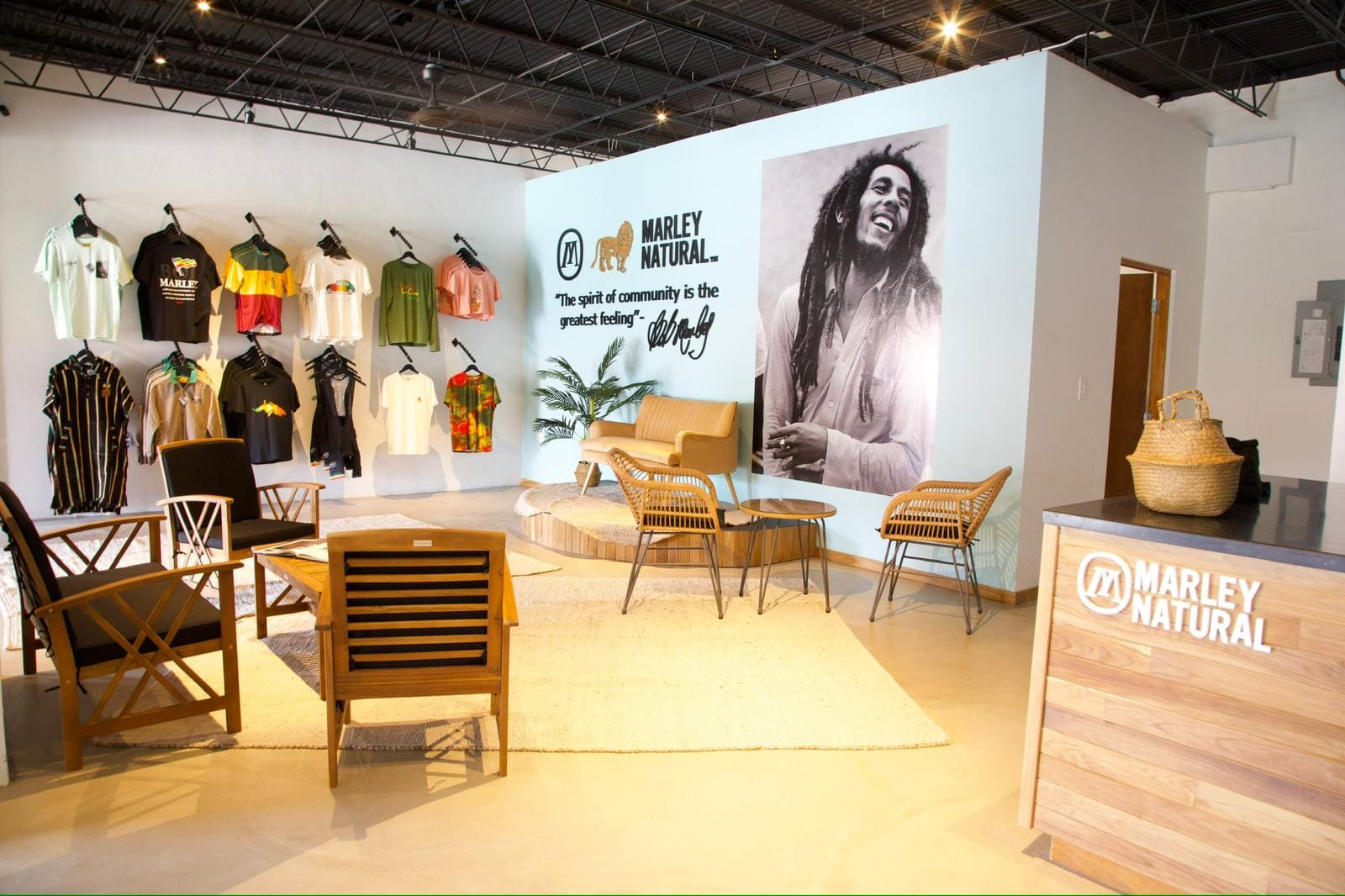
Marley Natural, a renowned cannabis brand founded in collaboration with the Marley family, has recently expanded its presence in the U.S. Virgin Islands with the opening of a new store on St. Thomas. This addition follows the successful launch of its first location on St. Croix in October 2022.
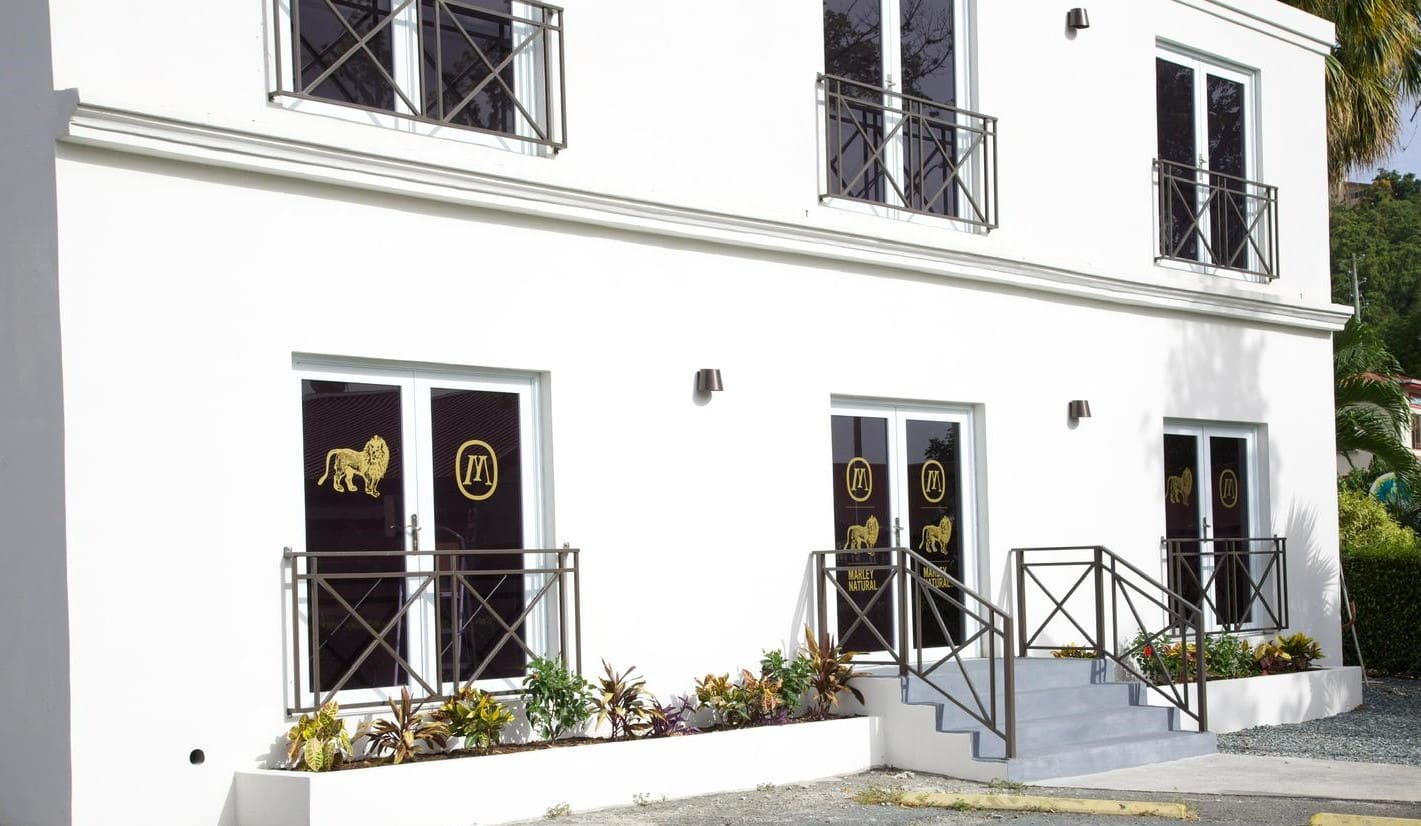
Storefront of the St. Thomas Marley Natural location. (Photo courtesy Marley Natural)
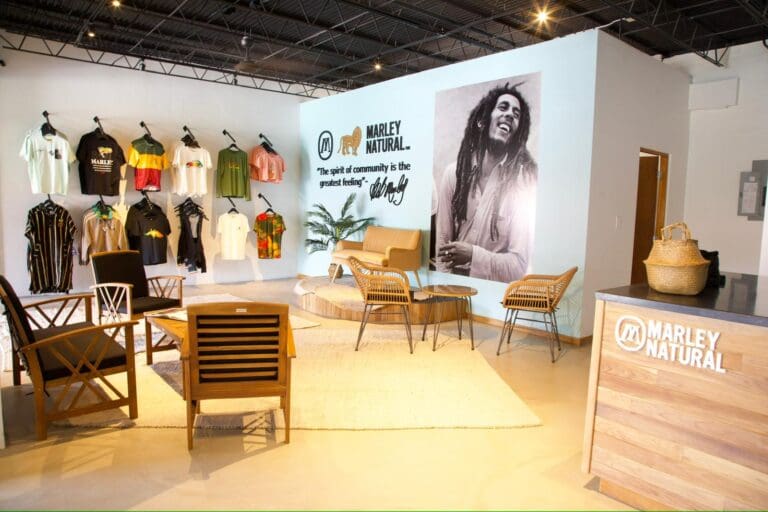
The St. Thomas store, which opened in July 2024, marks the second Marley Natural location in the USVI and only the third globally, with the original store located in Kingston, Jamaica. The new store is situated across from Havensight, an area known for its high tourist traffic, and aims to cater to both locals and visitors by offering a diverse range of products and a unique reggae-themed experience.
Brian Blaschka, the owner of Marley Natural, expressed his enthusiasm about the expansion. “I am very proud,” he said, reflecting on his long-standing connection with the Marley family and his appreciation for the opportunity to work with them. Blaschka first met Damian and Julian Marley as a fan when they were teenagers and has since built a career intertwined with the Marley brand. “I live in St. Croix — I love the V.I. and Marley brand. It’s a perfect combination,” he added.
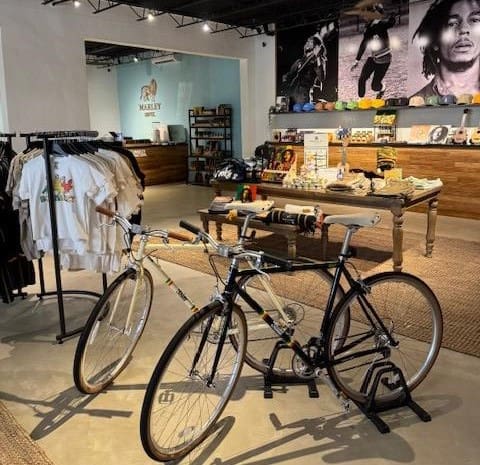
Marley Natural initially began as a cannabis brand, offering various products including accessories, clothing, and CBD items. The USVI stores feature a broad array of products, including bicycles, tea, coffee, and other Marley-branded merchandise. Despite the presence of CBD and cannabis products in their inventory, Marley Natural operates as a lifestyle store not as a dispensary.
Bicycles and other Marley accessories sold at the St. Thomas location. (Photo courtesy Marley Natural)
Cannabis regulations in the U.S. Virgin Islands are evolving. Blaschka noted that while the USVI is still developing its regulatory framework, Marley Natural is working closely with the Licensing and Consumer Affairs Department to ensure compliance and foster a positive relationship with the Virgin Islands government. “We want to be good partners and stewards with the government,” he said. Blaschka also voiced support for full cannabis legalization, citing the potential medical benefits and economic opportunities such as taxation and funding for local schools.
The history of cannabis in the United States is marked by significant legal and social shifts. The plant was first criminalized in the 1930s, partly influenced by efforts to undermine its competition with alcohol. Despite its controversial past, cannabis legalization has gained momentum over recent decades, driven by both medical research and shifting public attitudes.
Marley Natural emphasizes community engagement and cultural integration. On St. Thomas, the store will feature a “puff in paint” event space designed for private parties, meetings, and social events, including opportunities for local artists to showcase their work. Blaschka mentioned the aim to involve local artists and vendors, reflecting a commitment to community involvement similar to that established on St. Croix.
Marley Natural envisions a social space for a variety of local events. (Photo courtesy Marley Natural)
Marley Natural also supports local initiatives, including a partnership with Ruff Start and the St. Croix Animal Welfare Center to provide CBD products for pets. This aligns with the brand’s broader goal of integrating into the local community.
Blaschka encourages feedback from the community and invites local artists and vendors to contribute to the store’s offerings. He also highlighted the store’s involvement in local media through their radio show, “Mystic Hour,” and their sponsorship of the “Monday Marley” show on Tropics radio.
As Marley Natural continues to expand and adapt, the brand remains focused on its core values of community involvement and cultural celebration while navigating the evolving landscape of cannabis regulation and public perception.
Virtue of the Week – Confidence
Virtue of the Week focuses on building peaceful and caring communities through understanding and fostering the practice of virtues. The Source supports the Virtues Project and will publish one virtue developed by the project each week.
Confidence
Confidence is having faith in ourselves and in life. We feel capable and competent. We trust that we have the strength to cope with whatever happens. Confidence helps us to be free of worry. When confident in others, we believe in them. We build self-confidence as we learn from our mistakes and we improve. Confidence brings the strength to try new things, to gain mastery through practice. With confidence, we cast off self-limiting beliefs and doubts. When opportunity comes, we step up to it. We just say “yes.”
Quote: “Confidence thrives on honesty, on honor, on the sacredness of obligation, on faithful protection and on unselfish performance. Without them it cannot live.” -Franklin D. Roosevelt
The Practice of Confidence
I have the strength to face what life brings me.
I act with self-assurance.
I treat others as trustworthy.
I learn from my mistakes.
I patiently practice until I master something.
I maintain a positive attitude.
Questions for Discussion
What are some limiting beliefs that may impact our social justice efforts?
As a community, what do we need in order to fully express our talents and ideas?
How do we maintain a positive attitude when unpacking the impact of social injustices?
As a community, what do we need in order to feel capable and confident in our social justice work.
Sign up to receive the Virtue of the Week by email!
Visit https://cfvi.net/Virtues-Project and scroll to the end of the page to fill out the form.
Virtue of the Week is provided by the Community Foundation of the Virgin Islands (CFVI) in partnership with the VI Source and Virtues Matter.About the Community Foundation of the Virgin Islands Since 1990, CFVI has been a catalyst for positive change in the territory through initiatives committed to youth, learning, family support and the environment. With a professional staff and a volunteer Board of Directors composed of community leaders, CFVI is a trusted advocate and supporter of programs that ensure opportunity and sustainability for current and future generations. CFVI is a registered non-profit organization entirely supported by individual donors, grants, trusts, corporate donations and estate planning. For more information, visit www.cfvi.net.
About Virtues Matter Virtues Matter was started by a passionate wife-husband team of social entrepreneurs seeking to positively uplift as many lives as possible. We aim to inspire and empower, to build capacity, strengthen relationships, and help everyone lead lives of passion and purpose.
Virtues Matter believes in a world where people are committed to kindness and respect, strive to be their best, and live with hope, courage and in unity. We built the Virtues Cards mobile app, an interactive personal and team development tool, to help people identify and develop key virtue skills. We also offer dynamic workshops, online training, and customized programs to help people cultivate these positive qualities of character. To learn more, visit virtuesmatter.com.
To learn more about the Virtues Project, visit www.virtuesproject.com.
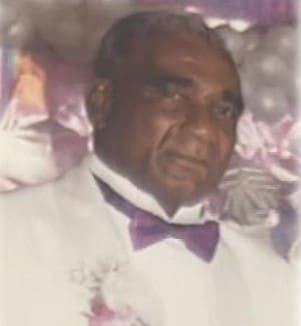
James Leonard Archibald
James Leonard Archibald died on Aug. 11.
He was preceded in death by his wife, Ena Archibald; father and mother: James and Wilhelmina Liburd; brother, Keith Liburd; and sisters: Violet Phillips and Mary Callwood.
He is survived by his sons: Jerome “Junie” Archibald and Bryan Boland; daughters: Naomi “Na” Benjamin, Leona “Lee” Claxton, Ideitha “Deita” Archibald, Averil “Minnie” Tomlinson, Avalyn “Lyn” Warner, Eulalie “Eulie” Archibald and Belinda “Bebe” Archibald; sons-in-law: Frankie Claxton, Ian Tomlinson and Andre Simon; and daughters-in-law: Corrine Archibald and Ann Marie Boland.
He is also survived by grandchildren: Shinika Crooke-Dyall, Vernon Crooke, Bjorn Claxton, Shimon Claxton, D-shon Claxton, Zavion Claxton, Geran Archibald, Gevion Archibald, Pedro Archibald, Akil Tomlinson, Jameel Tomlinson, Lakysha Archibald-Rodriguez, Telani Archibald, Justin Archibald, Jo’Neil Warner, Jorome Warner, Joel Warner, Darnell Boland, Dashea Boland, Dejane Boland, Jayveon Boland, Jahmari Joseph, Jahnae Milsap, Lenysha Hodge, Kiara Simon and Jalen Simon.
More survivors are great-grandchildren: Nickolon Liburd, Joekyah Allen, Shi’Kenya Greaves, Asia Crooke, T-Mari Claxton, Taliah Claxton, Da’mani Claxton, Ezra Tomlinson, Manuel Rodriguez, Samuel Rodriguez, Daniel Rodriguez, Kailyn Archibald, Kai Archibald, Kali Archibald and Isaiah Rolle; great-great-grandchildren: Amire Crooke, Benjie Liburd, Pastor Elroy Liburd, Mortern Liburd and Aubrey “Rakey” Liburd; sisters: Heather Ward, Caroline Brumant, Dr. Louvina Liburd and Denise “Anna” Liburd;
Other survivors include his aunt, Mary Maynard (UK); nieces, nephews, and cousins to include: Sandra Ward, Angela Henry, Vancelyn “Vancey” Brumant-Aaron, Trevor Liburd, Sharon Liburd, Tony “Preach” Archibald, Wilhelmina Berry and the Pinney family; special friends: Pastor Fernando Leonard, William Ottley, Charles and Verna Caines, Cynthia Parrot and Ruby Woodley; caretaker, Danney Joseph; and many other relatives and friends too numerous to mention.
The first viewing will be held from 4-6 p.m., Tuesday, Sept. 3, at Blyden Memorial Chapel.
A second viewing will be held at 9 a.m. followed by a funeral service at 10 a.m., Wednesday, Sept. 4, at Faith Christian Fellowship Alive in Christ. Interment will take place at Western Cemetery No. 3.
Funeral arrangements are by Turnbull’s Funeral Home and Crematory Services.
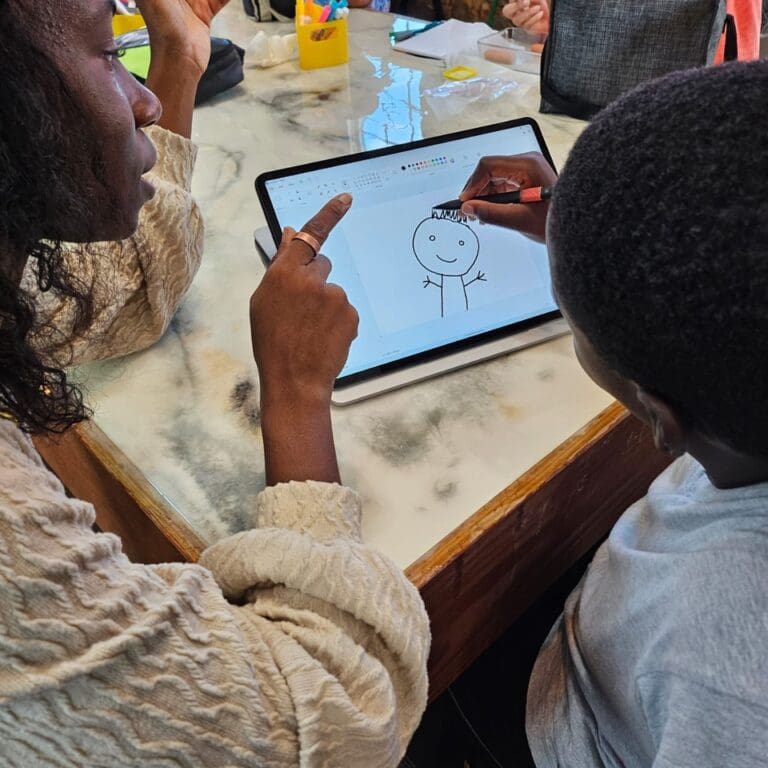
81C introduces the new after-school program DigiLocal. (Submitted photo)
81C is honored to introduce the new after-school program DigiLocal launching at 81C Studio in the famed Camille Pissarro Building on Main Street in historic Charlotte Amalie.
DigiLocal is a new art and education program spearheaded by UVI alumna and local artist Jenique Jolly in collaboration with 81C Arts. The after-school program, for ages 12-18, will run throughout the school year Monday through Thursday, 3:30 p.m. – 6:30 p.m. Online registration and program purchase is currently available in single-week and monthly session packages.
DigiLocal focuses on learning digital illustration, animation, and design using state-of-the-art equipment, while also mastering essential computer skills like operating systems, internet DigiLocal focuses on learning digital illustration, animation, and design using state-of-the-art equipment, while also mastering essential computer skills like operating systems, internet safety, and office software. Instructor Jenique Jolly provides hands-on training and studio access for budding artists and techies ages 12-18. Ms. Jolly is a seasoned digital artist with a certification in digital media specialization from the College of Westchester. She is on a quest to ignite a passion for digital art mediums throughout the US Virgin Islands. Jenique’s teaching approach is all about customized instruction crafted to match each student’s unique interests and challenges.
DigiLocal is sponsored in part by 81C Arts’ community partners Alpine Securities USVI, IPB & ICMC, Viya, and AROC Foundation.
Endorsements:
“We are excited to provide young people in the Virgin Islands with access to fun programs in the arts and technology,” said Vernon Araujo, Director of Philanthropy & Community Relations of Alpine Securities USVI. “Initiatives like DigiLocal, allow our children to stay engaged and competitive in this fast-paced environment.”
“We are proud to support the DigiLocal after-school program, giving the talented youth of our community a chance to express their passion for the arts, sharpen their computer skills, and showcase their creativity. In partnership with 81C Arts, we are excited to help continue to provide these new and unique opportunities that invest in the future of our students,” said Scott Ozarski and Jennifer Matarangas-King of Viya.
Allison Flanders of IPB & ICMC contributes her thoughts as a co-sponsor of the program: “IPB and ICMC are proud to support 81C Studio in its launch of Digi Local. The intersection of art and technology is an exciting space to explore and we are thrilled about the enriching opportunities 81C Studio is bringing to arts education in St. Thomas.”
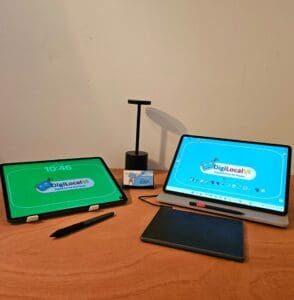
AROC foundation, who launched a Mac lab at UVI came on board to sponsor the DigiLocal program with a donation of Ipads for student use after AROC founder Cora Richardson and Jenique Jolly met at the TBR USVI summit (TechBeach Retreat) held at the Westin on St Thomas in June of this year. An in-depth conversation on community, art and education, and tech between AROC and 81C Arts on St. Thomas in June of this year. An in-depth conversation on community, art and education, and tech between AROC and 81C Arts evolved into a collaborative community partnership, bolstering the program’s community impact goals.
DigiLocal is sponsored in part by 81C Arts’ community partners Alpine Securities USVI, IPB & ICMC, Viya, and AROC Foundation. (Submitted photo)
“By investing in the education of students in the Virgin Islands, we are investing in the future of our community. Empowering our youth with digital skills and knowledge will not only benefit the individuals themselves but also contribute to the overall growth and prosperity of our society.” Cora Richardson – Founder of AROC
Program Details
DigiLocal Afterschool
Ages: 12-18
Schedule: Mon-Thurs, 3:30 p.m.– 6:30 p.m.
Instructor: Jenique Jolly
Location: 81C Studio, 14 Dronningens Gade
Visit https://linktr.ee/81CVI or 81CVI.ORG for program purchase
Course Description:
Unleash your child’s creativity and future-proof their skills with DigiLocal, 81C Arts’ digital arts after-school program.
Learn digital illustration, animation, and design using state-of-the-art equipment, while also mastering essential computer skills like operating systems, internet safety, and office software. Our expert instructor provides daily hands-on training and studio access for budding artists and techies ages 12-18. Showcase your child’s talent at our events! Limited spots available.




 In her bi-weekly column, “State of the Territory,” former Sen. Janelle K. Sarauw delves deeper into issues of concern for V.I. residents.
The Government of the Virgin Islands has put forward its proposed budget for Fiscal Year 2025, promoting it as a model of fiscal responsibility and conservative budgeting. While the intent to manage finances prudently is commendable, a deeper analysis of the budget raises significant concerns. The administration’s projections, spending strategies, and reliance on federal funds suggest that the budget may be more about maintaining appearances than addressing the territory’s long-term financial health.
Overly Optimistic Revenue Projections
One of the most troubling aspects of the Bryan FY25 budget is its optimistic revenue projections. Despite actual data from the Department of Finance showing a decrease in FY2024 collections compared to FY2023 across all tax categories, the FY25 budget forecasts an increase in all tax revenue categories except Property Tax. This stark contrast between reality and the administration’s projections raises serious concerns about the accuracy and reliability of the budget.
There is a significant risk that locally sourced revenues in the Bryan FY25 budget may be overestimated by as much as $100 million. This kind of overestimation is not just overly optimistic—it’s irresponsible. The consequences of such a miscalculation could be severe, leading to substantial budget shortfalls that would strain public services, undermine financial stability, and necessitate mid-year adjustments that could have been avoided with more realistic forecasting.
Spending Cuts and Broken Promises
The proposed budget also reflects a $77 million decrease in General Fund expenditures for FY25. While reducing spending can be a necessary part of fiscal management, the methods used to achieve this reduction are concerning. The budget eliminates $25 million in retroactive pay that was promised to public sector employees and removes funding for wage increases in contracts still under negotiation. These decisions represent broken promises to workers and a failure to honor commitments made in previous budgets.
The $25 million in retroactive pay, which was diverted last year to bolster the General Fund, is now entirely absent from the FY25 budget. This not only undermines trust but also disregards the financial rights of employees who were counting on these payments. Similarly, not funding wage increases for contracts yet to be negotiated is a short-sighted move that could lead to labor disputes and decreased morale among public sector workers, ultimately impacting the quality of public services.
Unsustainable Reliance on Federal Funds
Another significant issue is the sharp increase in federal budget support, which rises from $248 million in FY24 to $417 million in FY25—a 69% increase. This growing dependence on federal funds is unsustainable and positions the Virgin Islands as increasingly reliant on external support. Under the Bryan administration, federal support now accounts for 29% of the total budget, compared to just 16% in the last Mapp administration budget.
This level of dependence on federal funds is not only unsustainable but also risky. Should federal support diminish, the territory could face severe financial challenges, forcing cuts to essential services or leading to increased local taxes. The reliance on federal aid to this extent could turn the Virgin Islands into a welfare state, dependent on external sources rather than building a resilient local economy.
The Need for a Hiring Freeze and Increased Efficiency
Staffing levels within the Government of the Virgin Islands (GVI) have increased significantly during the Bryan administration, rising from 6,955 employees in FY18 to 7,814 in FY25, inclusive of vacancies—a 12% increase. Despite this rise in staffing, there has been no corresponding improvement in the quality of services provided by GVI departments. In fact, many argue that service quality has declined.
Rather than continuing to expand the workforce, the government should consider implementing a hiring freeze across all departments. The focus should shift to increasing efficiency and productivity among existing staff, ensuring that public services are delivered effectively without the need for additional hires. This approach would not only control costs but also address the perception that the government is bloated and inefficient.
The Need for Progress in Disaster Recovery
The budget highlights a substantial increase in federal disaster recovery funds, with $8.2 billion now available to the territory. This funding is crucial for rebuilding and strengthening infrastructure after the 2017 hurricanes. However, the pace of disaster recovery has been slow, and this budget presents an opportunity to accelerate these efforts. The Office of Disaster Recovery anticipates spending $474 million of these funds in FY2025, which will generate additional revenue through taxes associated with construction activities.
Timely and effective use of these funds is essential not only for recovery but also for stimulating the local economy by creating jobs and boosting related industries. The government must prioritize the swift implementation of recovery projects to ensure the territory is better prepared for future challenges and to prevent the territory from becoming overly reliant on federal support.
Addressing Outstanding Financial Obligations
We must acknowledge the territory’s outstanding debt, including the $90 million owed to vendors. This debt represents a significant financial obligation that must be managed carefully to avoid further straining the territory’s finances. Small businesses, which often comprise a large portion of these vendors, are the backbone of the local economy. They create jobs, drive economic growth, and contribute to the vibrancy of our communities.
Timely payments to these businesses are crucial for maintaining cash flow, enabling them to pay employees, invest in growth, and continue providing goods and services. When payments are delayed, it can lead to financial strain, reduced economic activity, and, in some cases, business closures. The government’s strategy for addressing this debt should be transparent, with a clear plan to repay vendors promptly. Ensuring that these obligations are met is essential for fiscal responsibility and maintaining trust and stability within the local economy.
The Retirement System’s Precarious Situation
Another pressing issue is the financial health of the Government Employees’ Retirement System (GERS). The budget notes the impact of the rum cover-over program on the retirement system, particularly the fact that the rate was not increased. This situation places additional pressure on an already strained system. The government needs to consider long-term solutions to ensure the retirement system’s viability for future retirees. Without careful management, the retirement system could face significant challenges, affecting the financial security of many residents.
Conclusion: A Need for Transparent and Sustainable Budgeting
The FY25 budget presented by the Bryan administration raises several red flags. From overly optimistic revenue projections and broken promises on spending to an unsustainable increase in federal support and unchecked growth in government staffing, the budget lacks the transparency and prudence needed to ensure the long-term financial health of the Virgin Islands.
The Legislature of the Virgin Islands must revamp and vote on a budget grounded in reality, respects prior commitments, and works towards reducing dependency on external support. Moving forward, it is crucial for the government to adopt a more cautious and responsible approach to budgeting, one that prioritizes efficiency, sustainability, and the well-being of all residents. By addressing these issues, the Virgin Islands can build a stronger, more resilient economy that is better equipped to face future challenges.
Editor’s Note: Opinion articles do not represent the views of the Virgin Islands Source newsroom and are the sole expressed opinion of the writer. Submissions can be made to visource@gmail.com.
In her bi-weekly column, “State of the Territory,” former Sen. Janelle K. Sarauw delves deeper into issues of concern for V.I. residents.
The Government of the Virgin Islands has put forward its proposed budget for Fiscal Year 2025, promoting it as a model of fiscal responsibility and conservative budgeting. While the intent to manage finances prudently is commendable, a deeper analysis of the budget raises significant concerns. The administration’s projections, spending strategies, and reliance on federal funds suggest that the budget may be more about maintaining appearances than addressing the territory’s long-term financial health.
Overly Optimistic Revenue Projections
One of the most troubling aspects of the Bryan FY25 budget is its optimistic revenue projections. Despite actual data from the Department of Finance showing a decrease in FY2024 collections compared to FY2023 across all tax categories, the FY25 budget forecasts an increase in all tax revenue categories except Property Tax. This stark contrast between reality and the administration’s projections raises serious concerns about the accuracy and reliability of the budget.
There is a significant risk that locally sourced revenues in the Bryan FY25 budget may be overestimated by as much as $100 million. This kind of overestimation is not just overly optimistic—it’s irresponsible. The consequences of such a miscalculation could be severe, leading to substantial budget shortfalls that would strain public services, undermine financial stability, and necessitate mid-year adjustments that could have been avoided with more realistic forecasting.
Spending Cuts and Broken Promises
The proposed budget also reflects a $77 million decrease in General Fund expenditures for FY25. While reducing spending can be a necessary part of fiscal management, the methods used to achieve this reduction are concerning. The budget eliminates $25 million in retroactive pay that was promised to public sector employees and removes funding for wage increases in contracts still under negotiation. These decisions represent broken promises to workers and a failure to honor commitments made in previous budgets.
The $25 million in retroactive pay, which was diverted last year to bolster the General Fund, is now entirely absent from the FY25 budget. This not only undermines trust but also disregards the financial rights of employees who were counting on these payments. Similarly, not funding wage increases for contracts yet to be negotiated is a short-sighted move that could lead to labor disputes and decreased morale among public sector workers, ultimately impacting the quality of public services.
Unsustainable Reliance on Federal Funds
Another significant issue is the sharp increase in federal budget support, which rises from $248 million in FY24 to $417 million in FY25—a 69% increase. This growing dependence on federal funds is unsustainable and positions the Virgin Islands as increasingly reliant on external support. Under the Bryan administration, federal support now accounts for 29% of the total budget, compared to just 16% in the last Mapp administration budget.
This level of dependence on federal funds is not only unsustainable but also risky. Should federal support diminish, the territory could face severe financial challenges, forcing cuts to essential services or leading to increased local taxes. The reliance on federal aid to this extent could turn the Virgin Islands into a welfare state, dependent on external sources rather than building a resilient local economy.
The Need for a Hiring Freeze and Increased Efficiency
Staffing levels within the Government of the Virgin Islands (GVI) have increased significantly during the Bryan administration, rising from 6,955 employees in FY18 to 7,814 in FY25, inclusive of vacancies—a 12% increase. Despite this rise in staffing, there has been no corresponding improvement in the quality of services provided by GVI departments. In fact, many argue that service quality has declined.
Rather than continuing to expand the workforce, the government should consider implementing a hiring freeze across all departments. The focus should shift to increasing efficiency and productivity among existing staff, ensuring that public services are delivered effectively without the need for additional hires. This approach would not only control costs but also address the perception that the government is bloated and inefficient.
The Need for Progress in Disaster Recovery
The budget highlights a substantial increase in federal disaster recovery funds, with $8.2 billion now available to the territory. This funding is crucial for rebuilding and strengthening infrastructure after the 2017 hurricanes. However, the pace of disaster recovery has been slow, and this budget presents an opportunity to accelerate these efforts. The Office of Disaster Recovery anticipates spending $474 million of these funds in FY2025, which will generate additional revenue through taxes associated with construction activities.
Timely and effective use of these funds is essential not only for recovery but also for stimulating the local economy by creating jobs and boosting related industries. The government must prioritize the swift implementation of recovery projects to ensure the territory is better prepared for future challenges and to prevent the territory from becoming overly reliant on federal support.
Addressing Outstanding Financial Obligations
We must acknowledge the territory’s outstanding debt, including the $90 million owed to vendors. This debt represents a significant financial obligation that must be managed carefully to avoid further straining the territory’s finances. Small businesses, which often comprise a large portion of these vendors, are the backbone of the local economy. They create jobs, drive economic growth, and contribute to the vibrancy of our communities.
Timely payments to these businesses are crucial for maintaining cash flow, enabling them to pay employees, invest in growth, and continue providing goods and services. When payments are delayed, it can lead to financial strain, reduced economic activity, and, in some cases, business closures. The government’s strategy for addressing this debt should be transparent, with a clear plan to repay vendors promptly. Ensuring that these obligations are met is essential for fiscal responsibility and maintaining trust and stability within the local economy.
The Retirement System’s Precarious Situation
Another pressing issue is the financial health of the Government Employees’ Retirement System (GERS). The budget notes the impact of the rum cover-over program on the retirement system, particularly the fact that the rate was not increased. This situation places additional pressure on an already strained system. The government needs to consider long-term solutions to ensure the retirement system’s viability for future retirees. Without careful management, the retirement system could face significant challenges, affecting the financial security of many residents.
Conclusion: A Need for Transparent and Sustainable Budgeting
The FY25 budget presented by the Bryan administration raises several red flags. From overly optimistic revenue projections and broken promises on spending to an unsustainable increase in federal support and unchecked growth in government staffing, the budget lacks the transparency and prudence needed to ensure the long-term financial health of the Virgin Islands.
The Legislature of the Virgin Islands must revamp and vote on a budget grounded in reality, respects prior commitments, and works towards reducing dependency on external support. Moving forward, it is crucial for the government to adopt a more cautious and responsible approach to budgeting, one that prioritizes efficiency, sustainability, and the well-being of all residents. By addressing these issues, the Virgin Islands can build a stronger, more resilient economy that is better equipped to face future challenges.
Editor’s Note: Opinion articles do not represent the views of the Virgin Islands Source newsroom and are the sole expressed opinion of the writer. Submissions can be made to visource@gmail.com. 





 Virtue of the Week – Confidence
Virtue of the Week focuses on building peaceful and caring communities through understanding and fostering the practice of virtues. The Source supports the Virtues Project and will publish one virtue developed by the project each week.
Confidence
Confidence is having faith in ourselves and in life. We feel capable and competent. We trust that we have the strength to cope with whatever happens. Confidence helps us to be free of worry. When confident in others, we believe in them. We build self-confidence as we learn from our mistakes and we improve. Confidence brings the strength to try new things, to gain mastery through practice. With confidence, we cast off self-limiting beliefs and doubts. When opportunity comes, we step up to it. We just say “yes.”
Quote: “Confidence thrives on honesty, on honor, on the sacredness of obligation, on faithful protection and on unselfish performance. Without them it cannot live.” -Franklin D. Roosevelt
The Practice of Confidence
I have the strength to face what life brings me.
I act with self-assurance.
I treat others as trustworthy.
I learn from my mistakes.
I patiently practice until I master something.
I maintain a positive attitude.
Questions for Discussion
Virtue of the Week – Confidence
Virtue of the Week focuses on building peaceful and caring communities through understanding and fostering the practice of virtues. The Source supports the Virtues Project and will publish one virtue developed by the project each week.
Confidence
Confidence is having faith in ourselves and in life. We feel capable and competent. We trust that we have the strength to cope with whatever happens. Confidence helps us to be free of worry. When confident in others, we believe in them. We build self-confidence as we learn from our mistakes and we improve. Confidence brings the strength to try new things, to gain mastery through practice. With confidence, we cast off self-limiting beliefs and doubts. When opportunity comes, we step up to it. We just say “yes.”
Quote: “Confidence thrives on honesty, on honor, on the sacredness of obligation, on faithful protection and on unselfish performance. Without them it cannot live.” -Franklin D. Roosevelt
The Practice of Confidence
I have the strength to face what life brings me.
I act with self-assurance.
I treat others as trustworthy.
I learn from my mistakes.
I patiently practice until I master something.
I maintain a positive attitude.
Questions for Discussion
 About the Community Foundation of the Virgin Islands Since 1990, CFVI has been a catalyst for positive change in the territory through initiatives committed to youth, learning, family support and the environment. With a professional staff and a volunteer Board of Directors composed of community leaders, CFVI is a trusted advocate and supporter of programs that ensure opportunity and sustainability for current and future generations. CFVI is a registered non-profit organization entirely supported by individual donors, grants, trusts, corporate donations and estate planning. For more information, visit www.cfvi.net.
 About Virtues Matter Virtues Matter was started by a passionate wife-husband team of social entrepreneurs seeking to positively uplift as many lives as possible. We aim to inspire and empower, to build capacity, strengthen relationships, and help everyone lead lives of passion and purpose.
Virtues Matter believes in a world where people are committed to kindness and respect, strive to be their best, and live with hope, courage and in unity. We built the Virtues Cards mobile app, an interactive personal and team development tool, to help people identify and develop key virtue skills. We also offer dynamic workshops, online training, and customized programs to help people cultivate these positive qualities of character. To learn more, visit virtuesmatter.com.
To learn more about the Virtues Project, visit www.virtuesproject.com.
About Virtues Matter Virtues Matter was started by a passionate wife-husband team of social entrepreneurs seeking to positively uplift as many lives as possible. We aim to inspire and empower, to build capacity, strengthen relationships, and help everyone lead lives of passion and purpose.
Virtues Matter believes in a world where people are committed to kindness and respect, strive to be their best, and live with hope, courage and in unity. We built the Virtues Cards mobile app, an interactive personal and team development tool, to help people identify and develop key virtue skills. We also offer dynamic workshops, online training, and customized programs to help people cultivate these positive qualities of character. To learn more, visit virtuesmatter.com.
To learn more about the Virtues Project, visit www.virtuesproject.com.