The Virgin Islands Track & Field Federation proudly celebrates Sofia Swindell, freshman at the University of Pennsylvania, for delivering another milestone performance during the 2026 Hurricane Collegiate Invitational, hosted by the University of Miami on March 27 and 28 at Cobb Stadium in Coral Gables, Florida.
Sofia Swindell broke the USVI under-20 100 meter hurdle record. (Submitted photo)
Competing in the 100m hurdles, Swindell produced a standout performance, clocking an impressive 13.70 seconds. This time not only marked a new Virgin Islands U20 record, but also placed her among the top six performers in University of Pennsylvania program history, an extraordinary achievement for an athlete in her first collegiate season.
The Virgin Islands Track & Field Federation congratulates Sofia on her outstanding performance and looks forward to her representing the Virgin Islands at the CARIFTA Games, which will be held in Grenada from April 4–6.
Portions of customers on the following feeders have restored power:
5A
Portion of 6A
Portion of 7A
8A
6B
Portion of 10B
8B
9B
7B
WAPA Plant Personnel continue to slowly restore power to customers to reduce fluctuations and maintain grid stability.
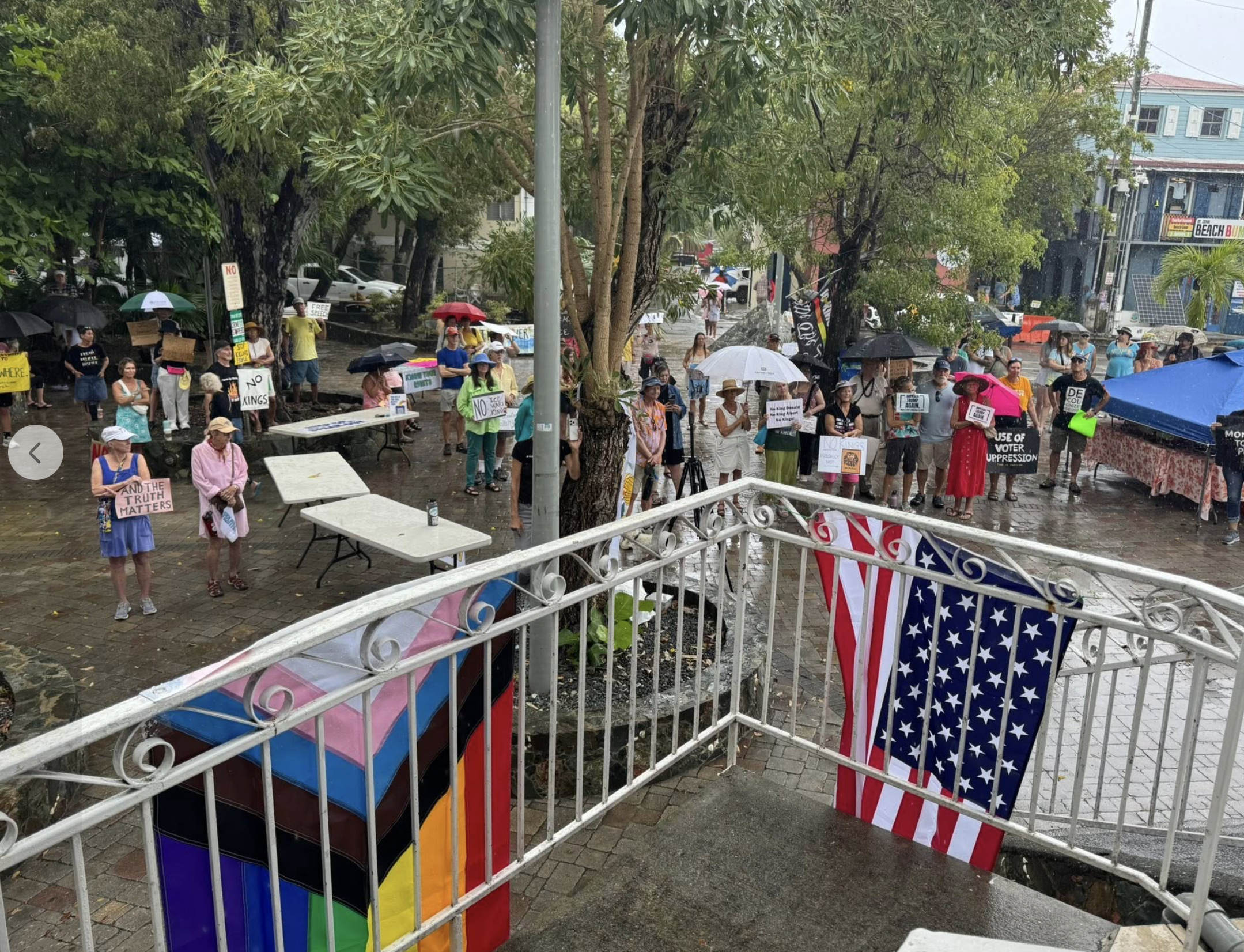
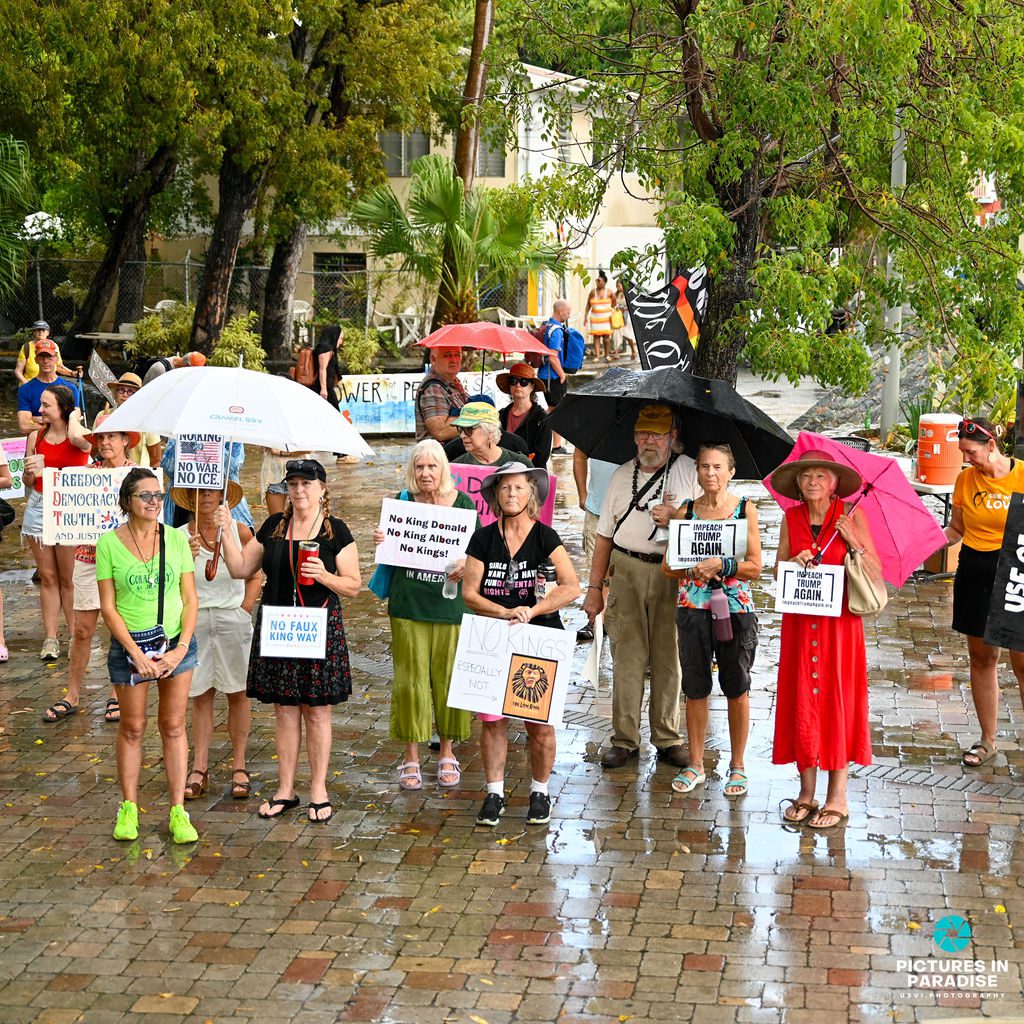
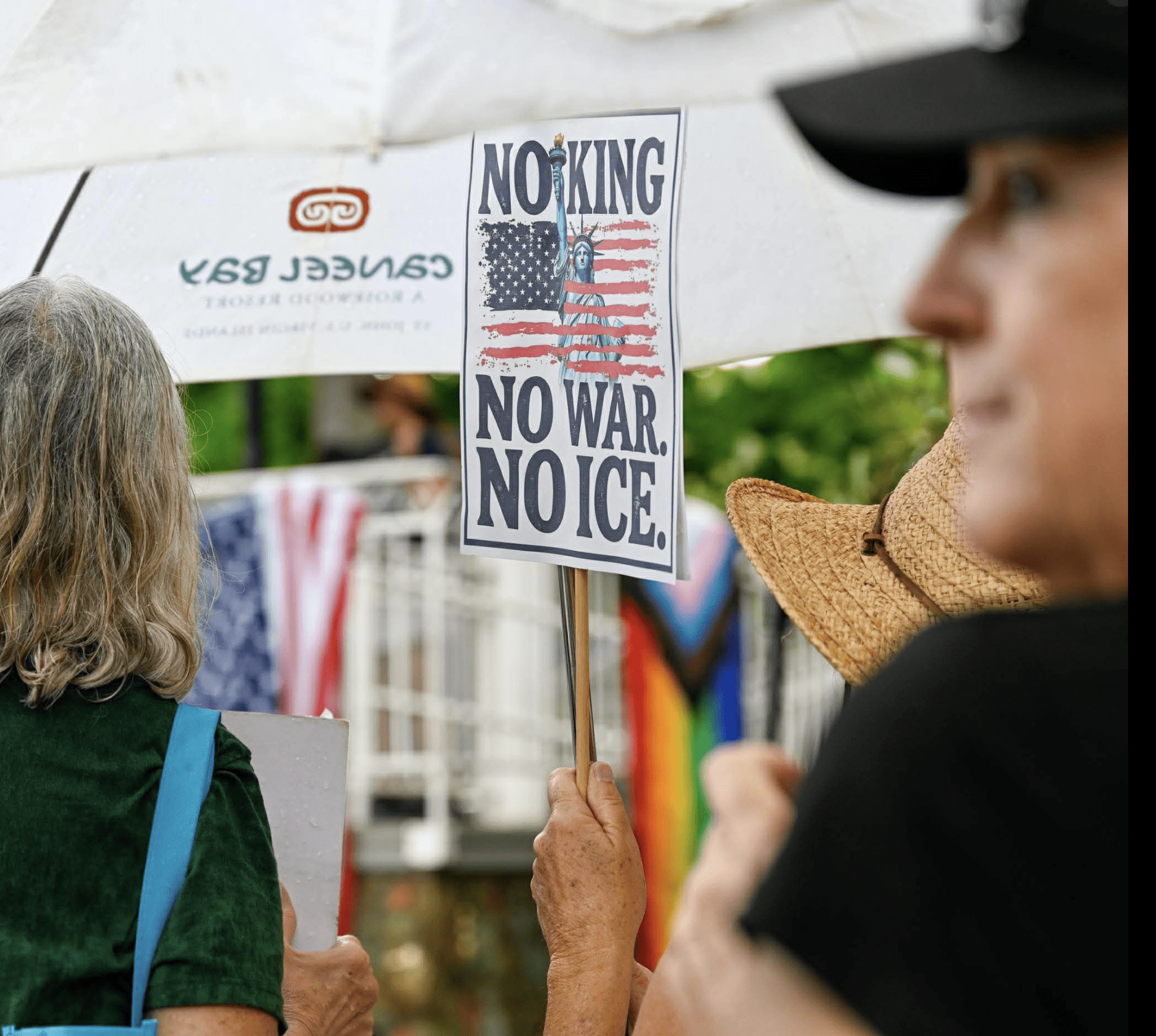
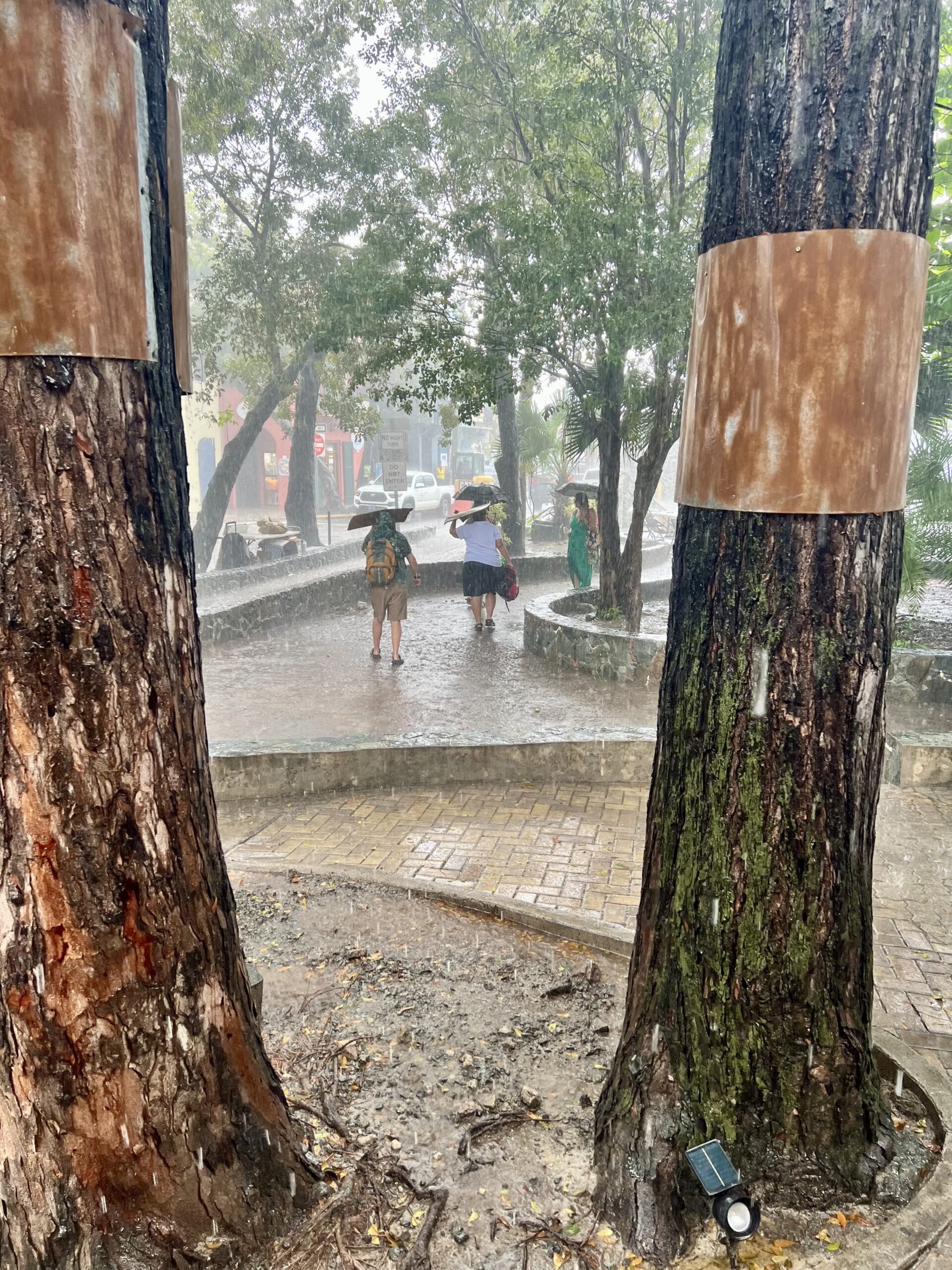
Nearly 150 people gathered in Cruz Bay Saturday morning for the St. John No Kings rally when the skies opened up and the rain poured down.
Rally-goers endure the rain. (Submitted photo)
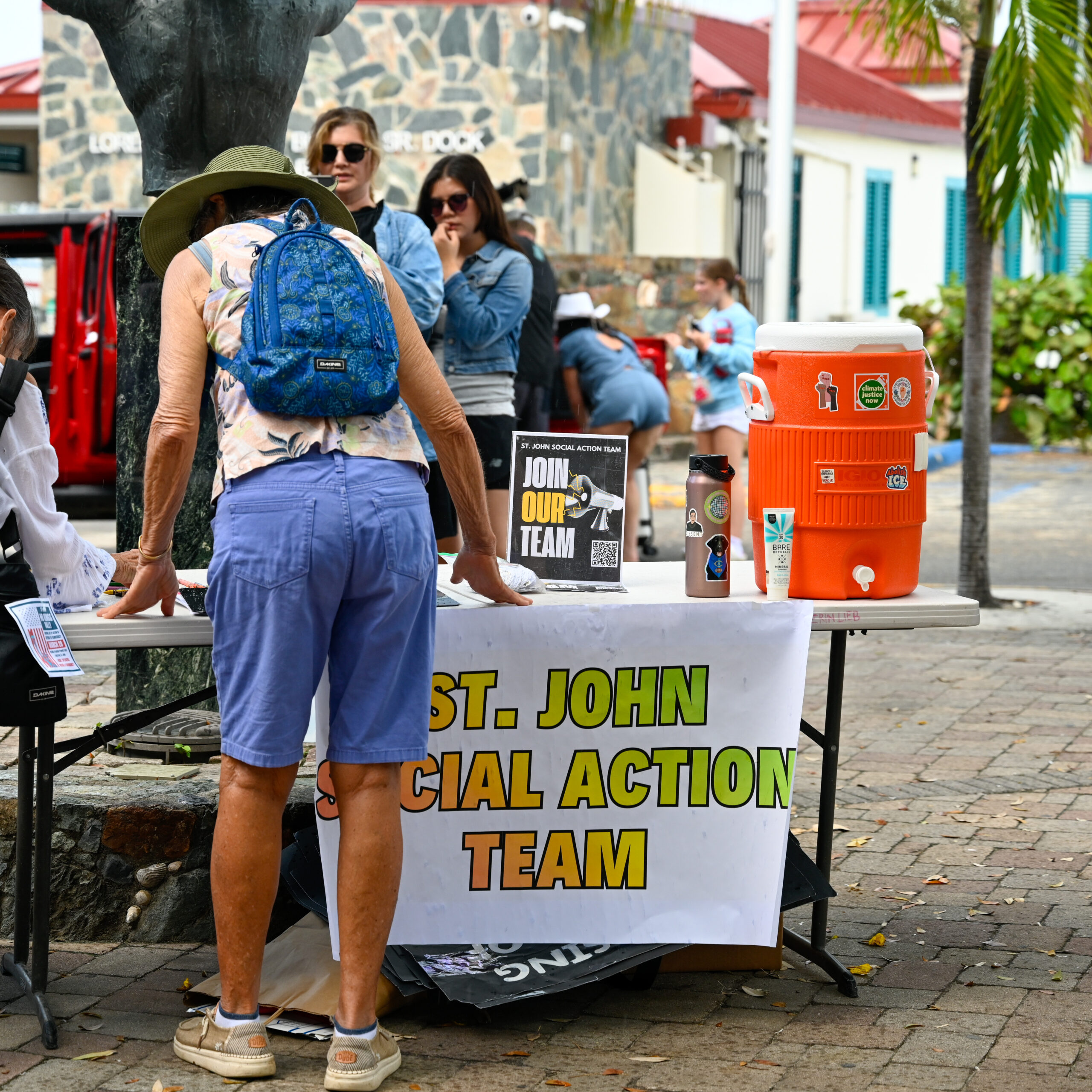
Members of the St. John Social Action Team had just completed setting up tables with information on voter registration, immigration rights and other matters when the deluge began. The rain gauge at Mongoose Junction recorded three inches of rain, most of it falling exactly during the two hours designated for the event.
For a few minutes before the rain hit, information was available at tables. (Submitted photo)
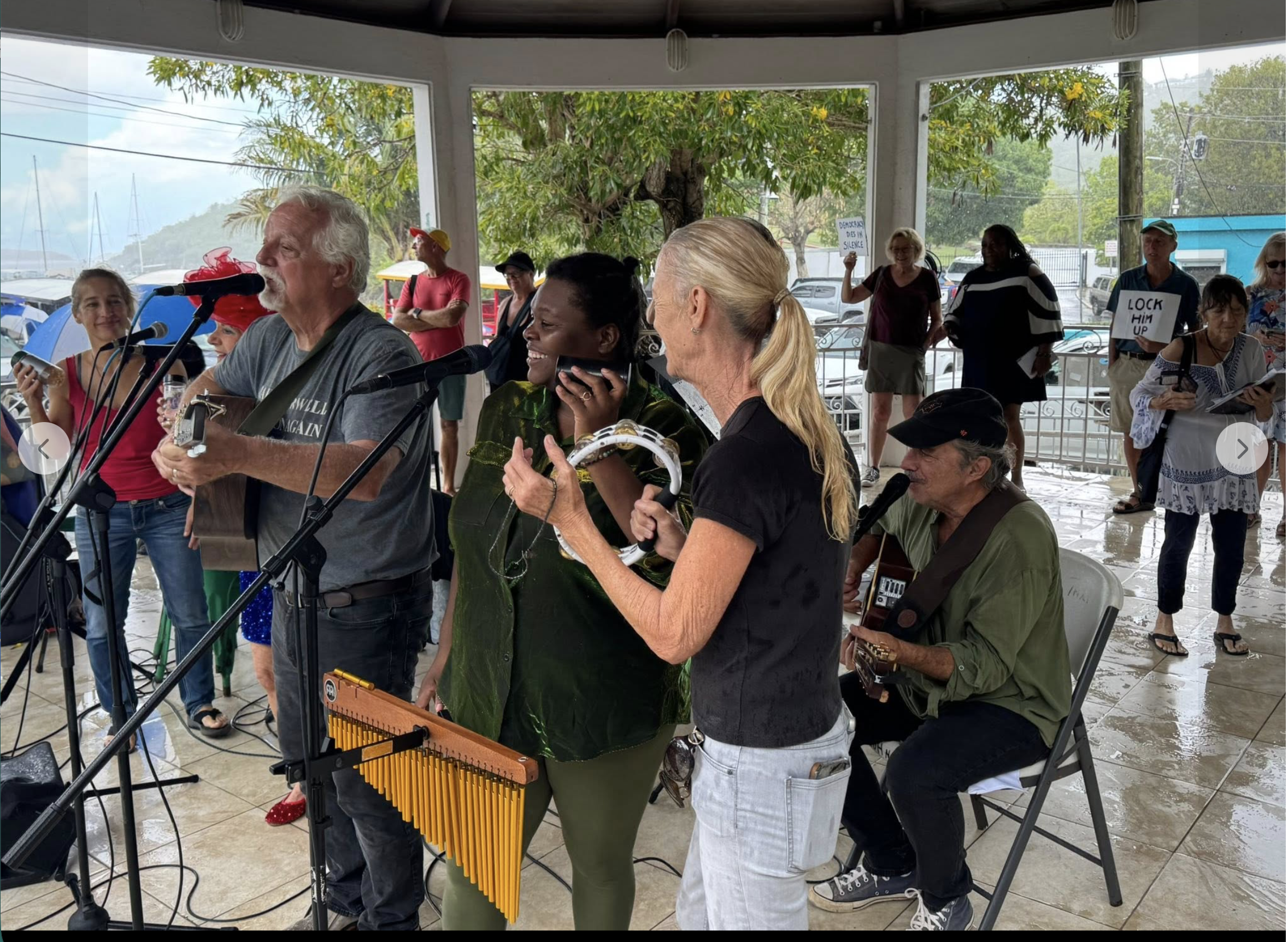
But the program continued as planned, with inspiring music by Lauren Magnie, Eva Chinnery, Mark Wallace, Michael Barry, Barbie Barry, Mark “Bucky” Buchalter, and Nancy Liburd.
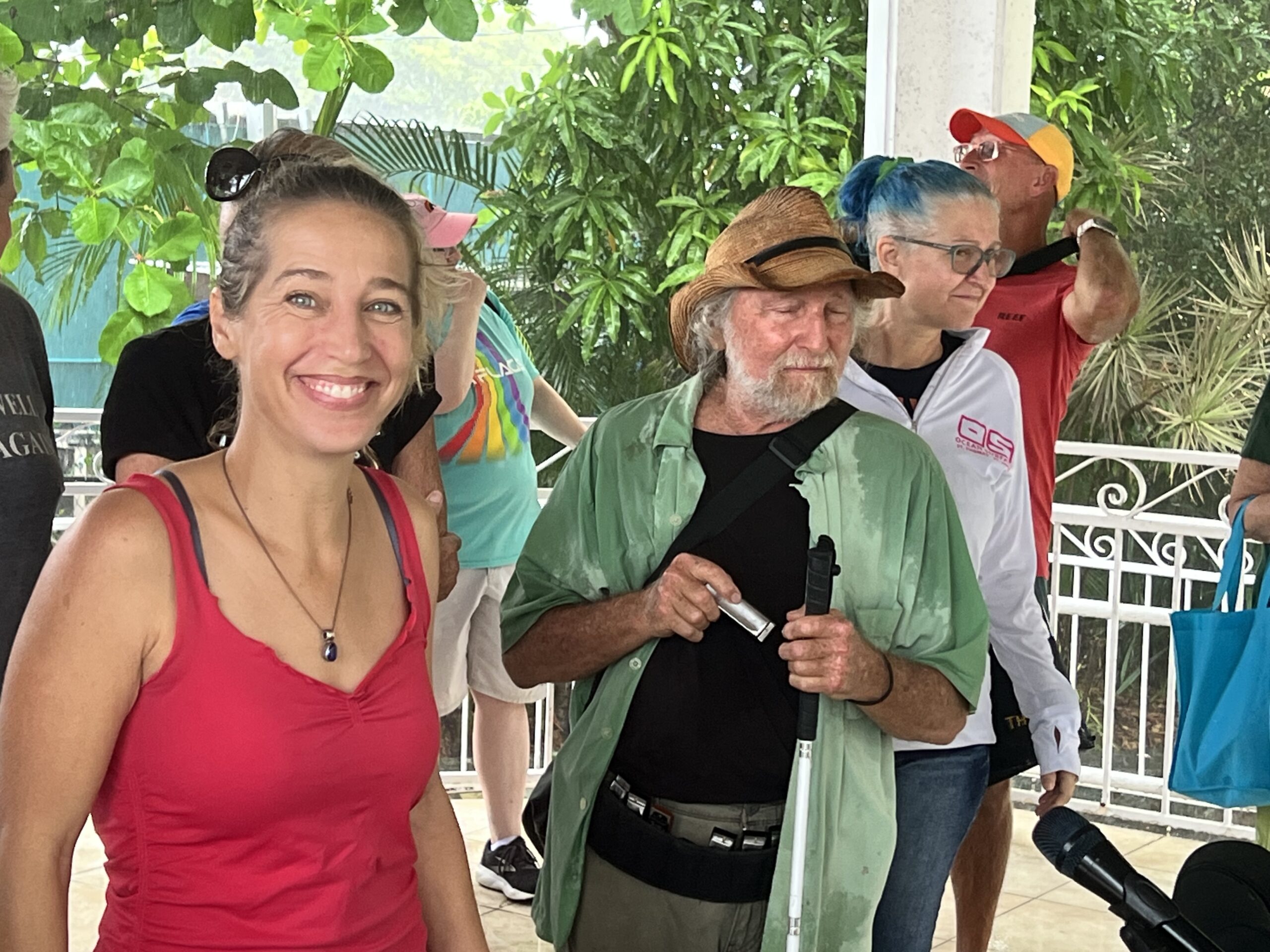
Musicians at the St. John No Kings Rally included, from left, Lauren Magnie, Nancy Liburd, Michael Barry, Eva Chinnery, Barbie Barry, and Mark Wallace, seated. (Submitted photo)Singer Lauren Magnie’s smile lights up a stormy morning. (Source photo by Amy H. Roberts)
Erin Lieb, who heads up the St. John Social Action Team, welcomed the audience, reminding them, “We are here to collectively rededicate ourselves to love, joy, and justice. We gather to stoke that fierce love and rekindle our collective hope for a more perfect union …. We will sing. We will chant. We will listen to members of our community. And we take action.”
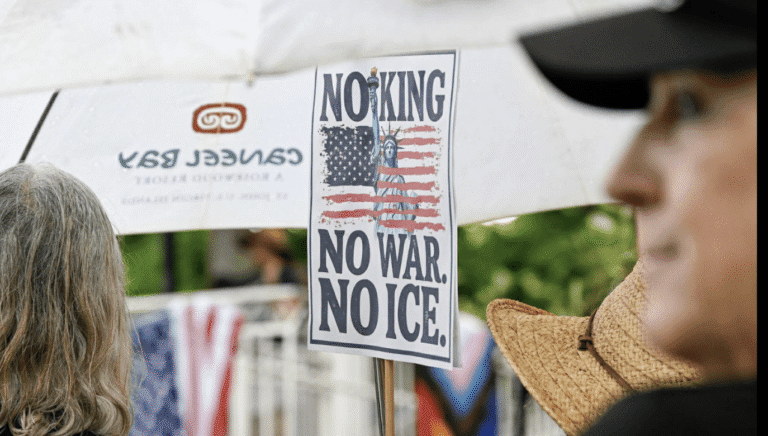
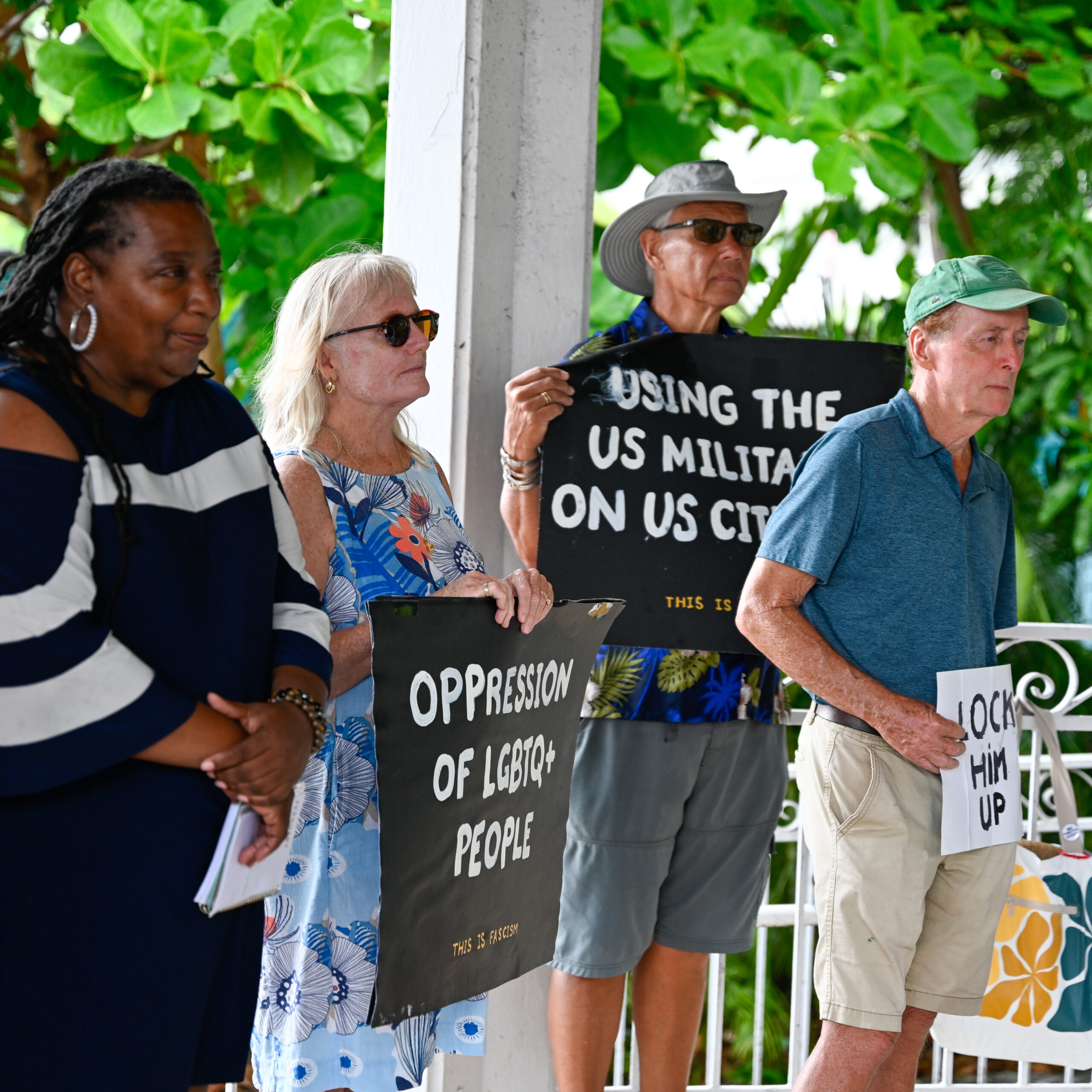
Erin Lieb has headed up the St. John Social Action Team which hosted the Cruz Bay No Kings Rally. (Submitted photo)Signs express community concerns. (Submitted photo)
Three St. John residents gave speeches during the rally.
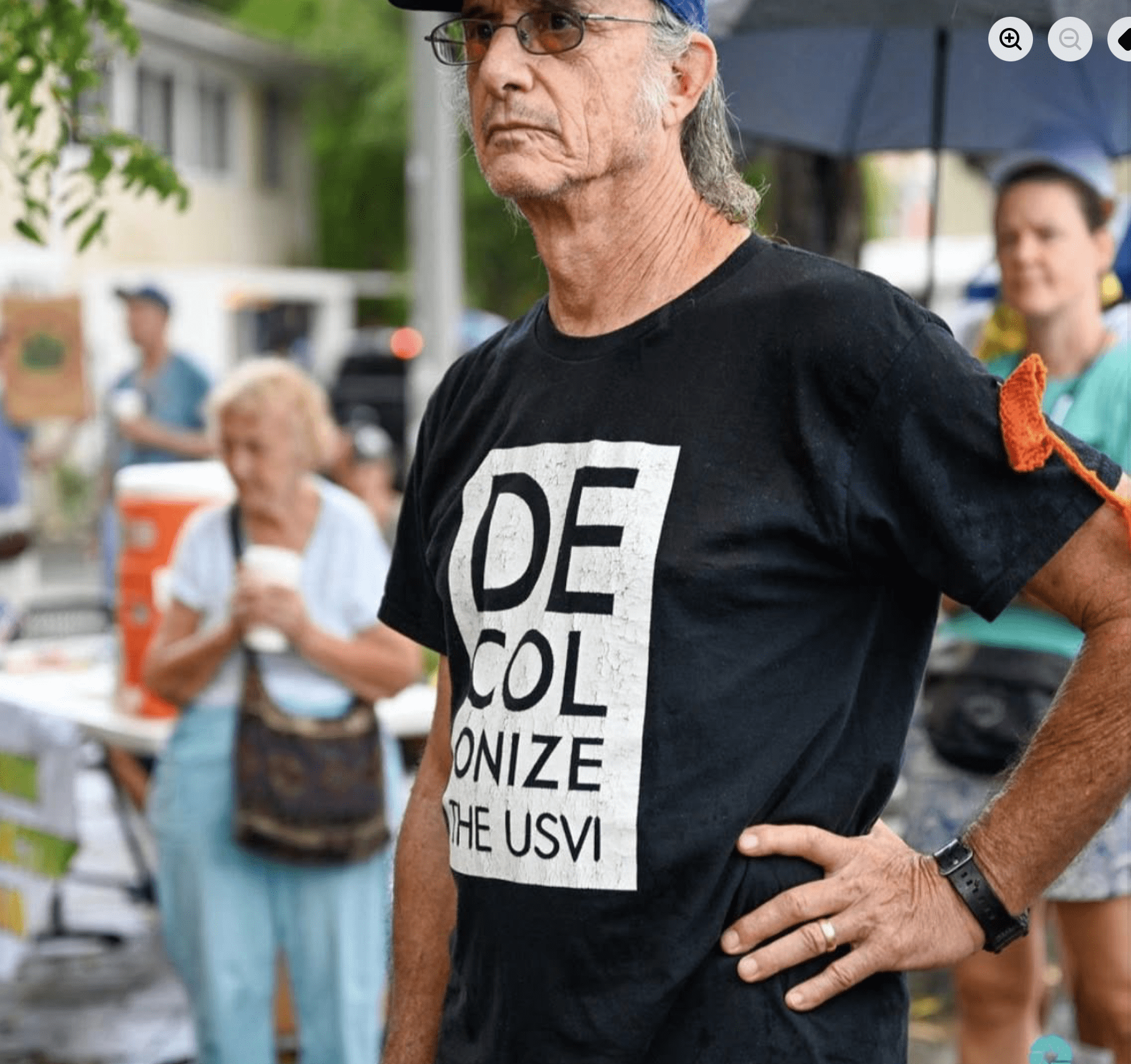
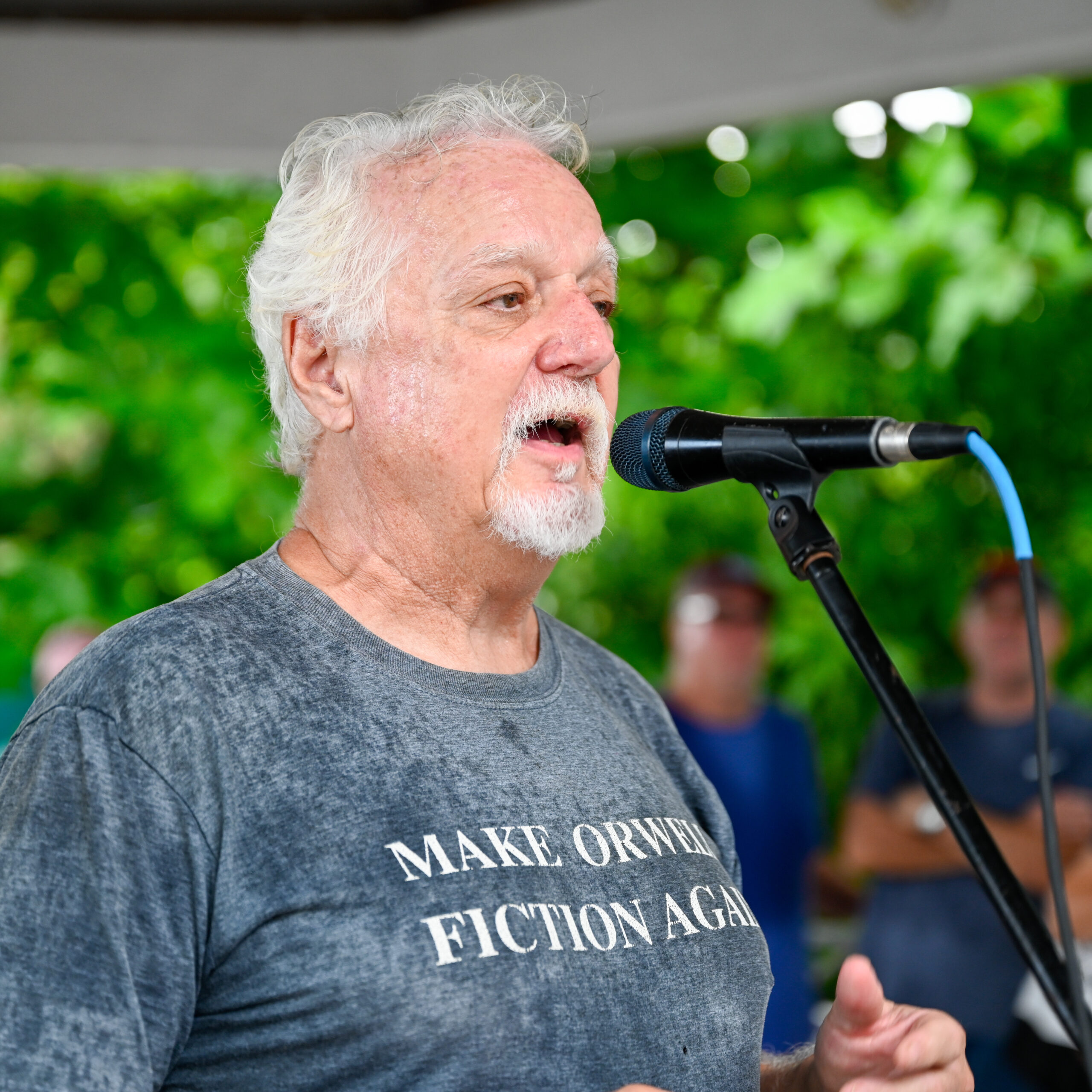
David Silverman, a member of the committee charged with drafting a new constitution for the territory, spoke about the provisional document’s importance and the dangers of a “king” governor.
David Silverman’s shirt proclaims the importance of decolonizing. (Submitted photo)One sign says it all. (Submitted photo)
Abigail Hendricks, an activist who works with seniors on St. John, reminded listeners that in spite of our differences, all members of the community need each other. She also urged listeners to seize their power of the vote.
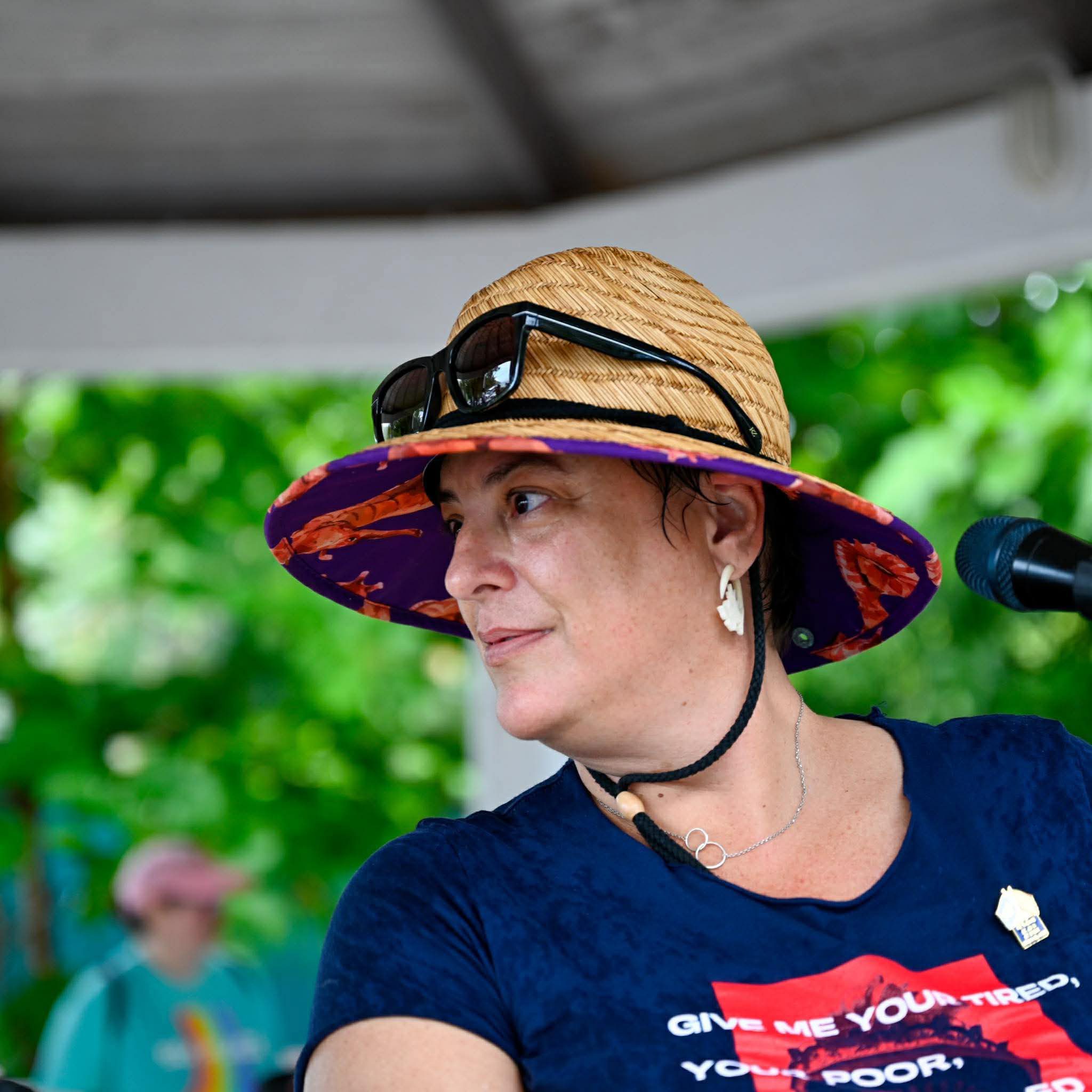
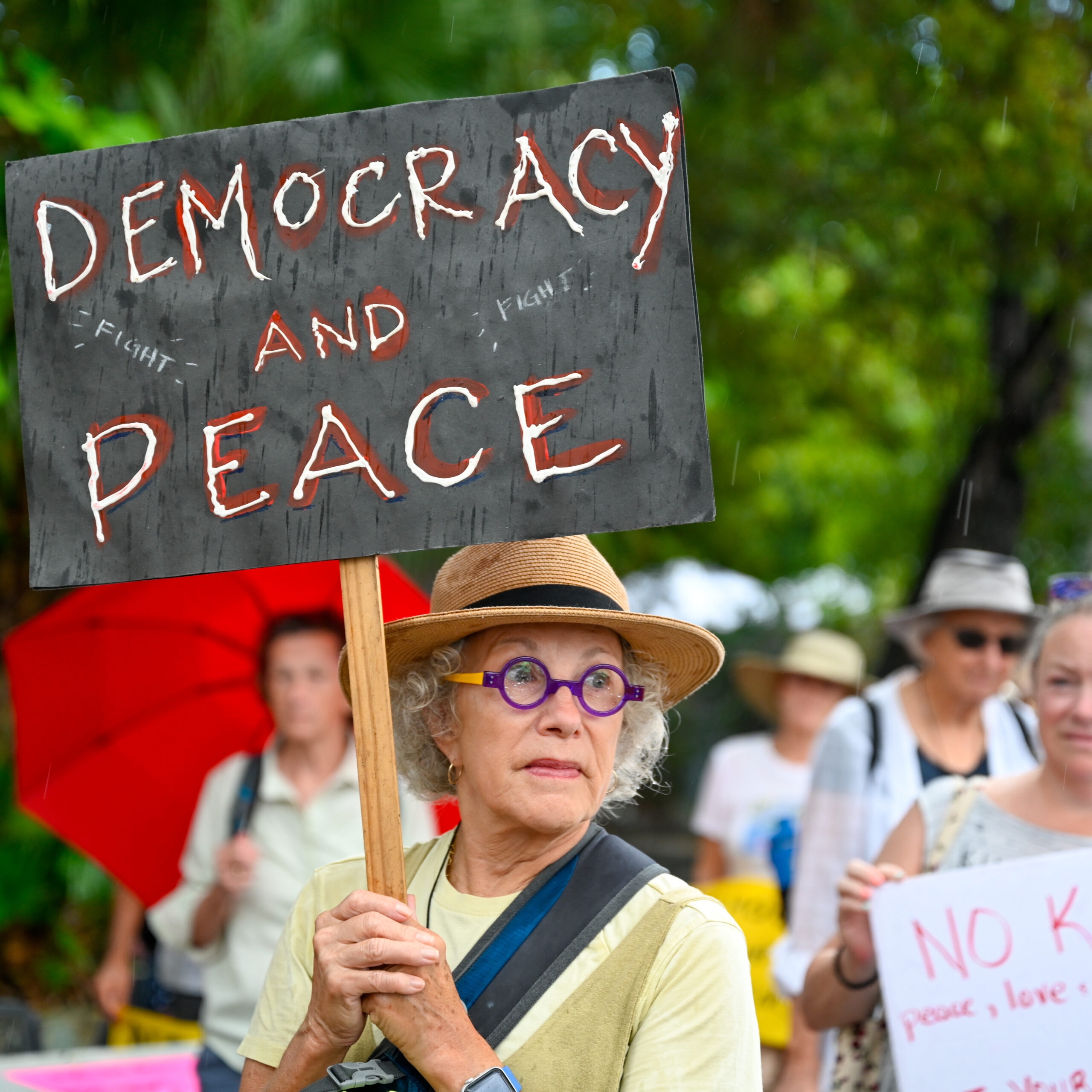
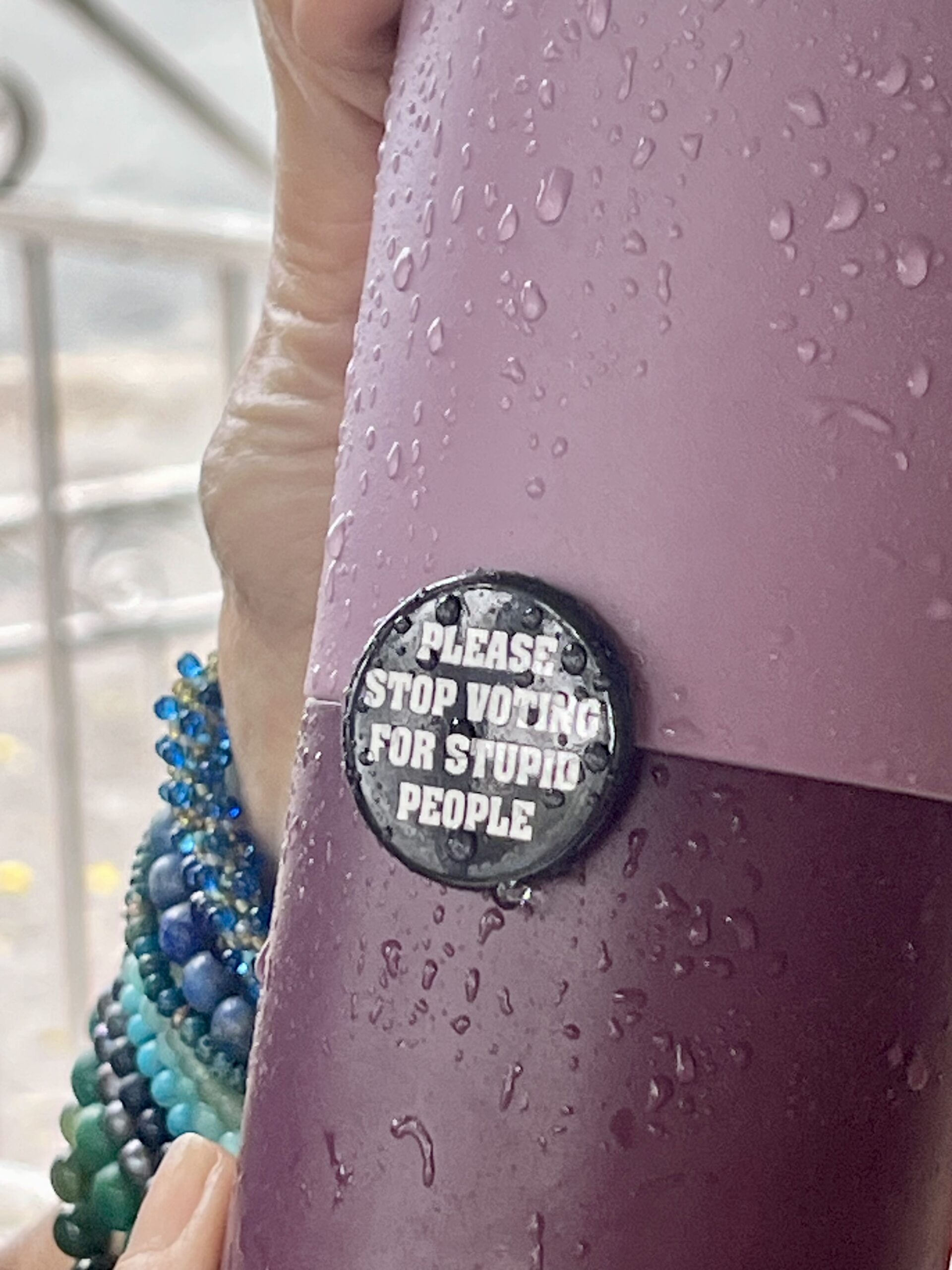
Abigail Hendricks, left, gets ready to speak about the importance of voting and community unity. (Submitted photo)Democracy and peace are at the heart of the No Kings movement. (Submitted photo)A button on a water bottle expresses this voter’s sentiments. (Source photo by Amy H. Roberts)
In his speech, Michael Barry addressed the importance of increasing literacy and education so that individuals can understand and resist the growing power of those who encourage divisiveness. His remarks are posted on Facebook and can be seen here.
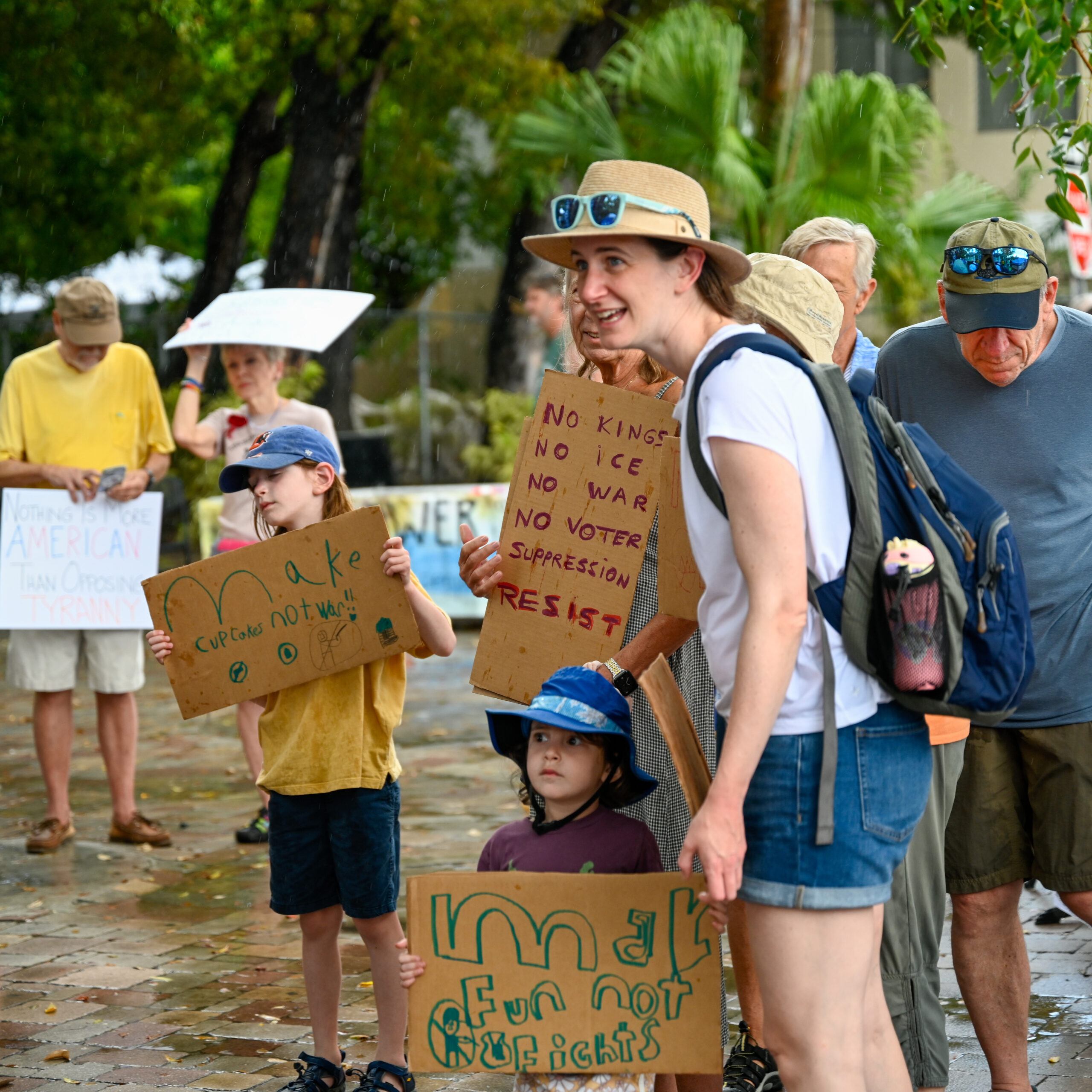
Michael Barry said in his speech, “When people have hate in their hearts, they are easier to manipulate.” (Source photo by Amy H. Roberts)Children’s signs proclaim their priorities. (Submitted photo)
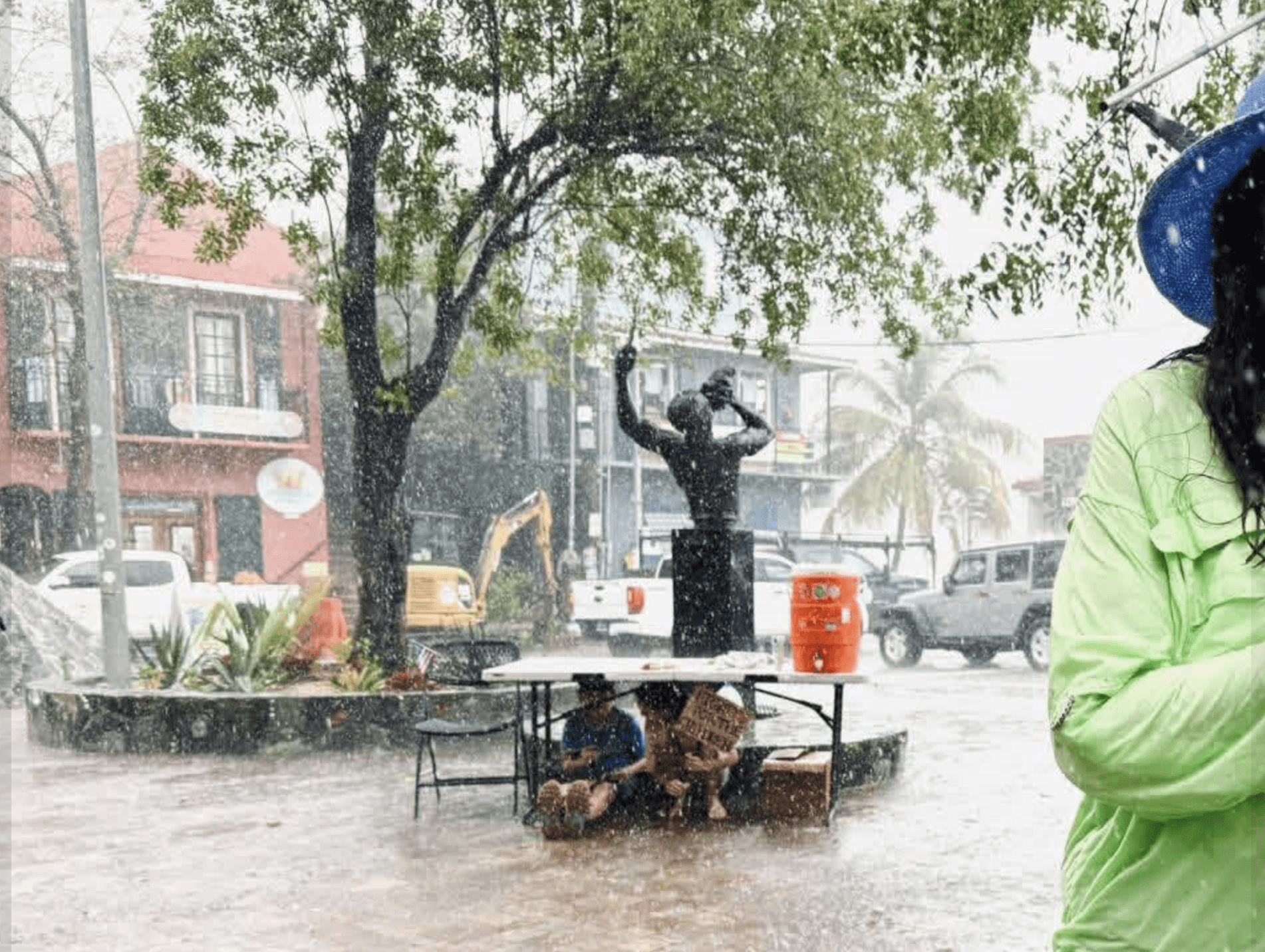
As the rain continued to pour down, listeners sought shelter under umbrellas, tables, nearby awnings, and the signs they carried.
As the rain continues to pour down, rally-goers seek shelter under a table. (Submitted photo)
Rain eventually covered the floor of the gazebo where the speakers and musicians gathered, and rally organizers decided to pull the plug on the sound system rather than put participants at risk of electrical shock.
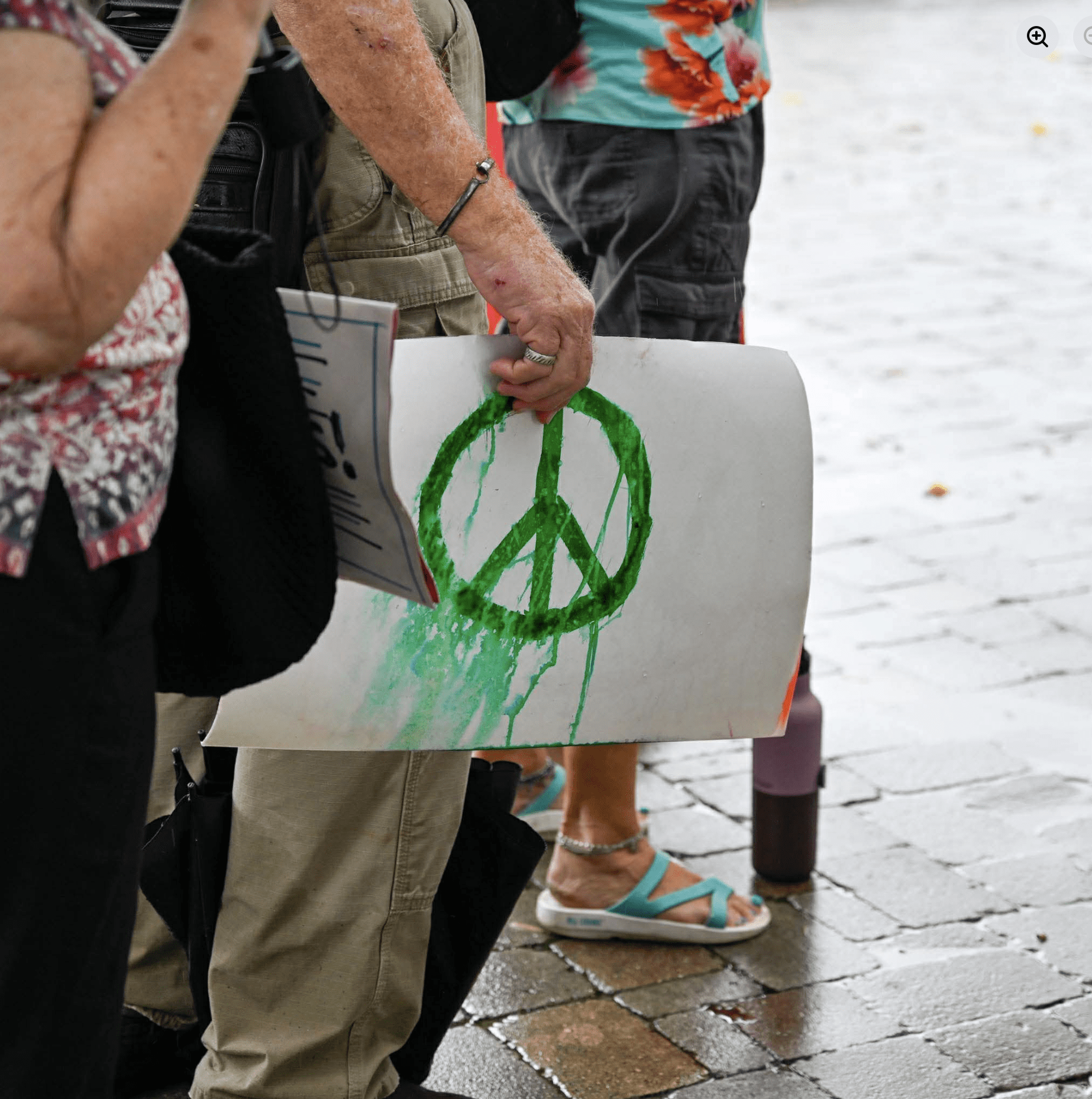
A peace sign fades away in the rain, but rally-goers stay the course. (Submitted photo)
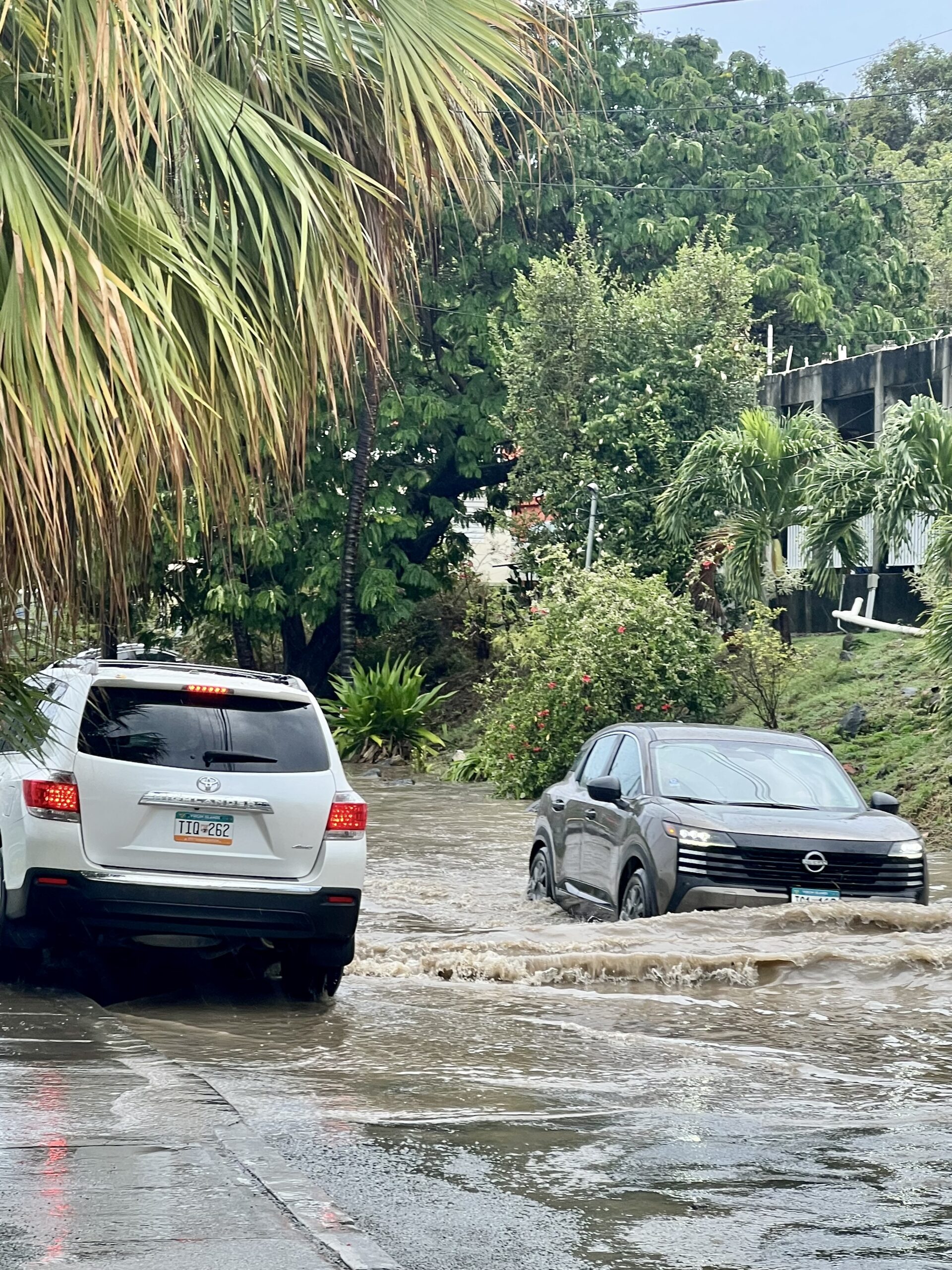
As rally-goers went home, many found themselves facing flooded streets, particularly along Fish Fry Road near the gravel lot. By midafternoon, most of the puddles had dissipated.
Rally-goers head home using their signs for rain protection. (Source photo by Amy H. Roberts)Cars send bow waves through flooded streets in Cruz Bay on Saturday morning. (Source photo by Amy H. Roberts)
The skies cleared, allowing other organizers to set up for the second community event scheduled for the day – the St. John Cancer Fund’s annual Light Up the Night fundraiser.
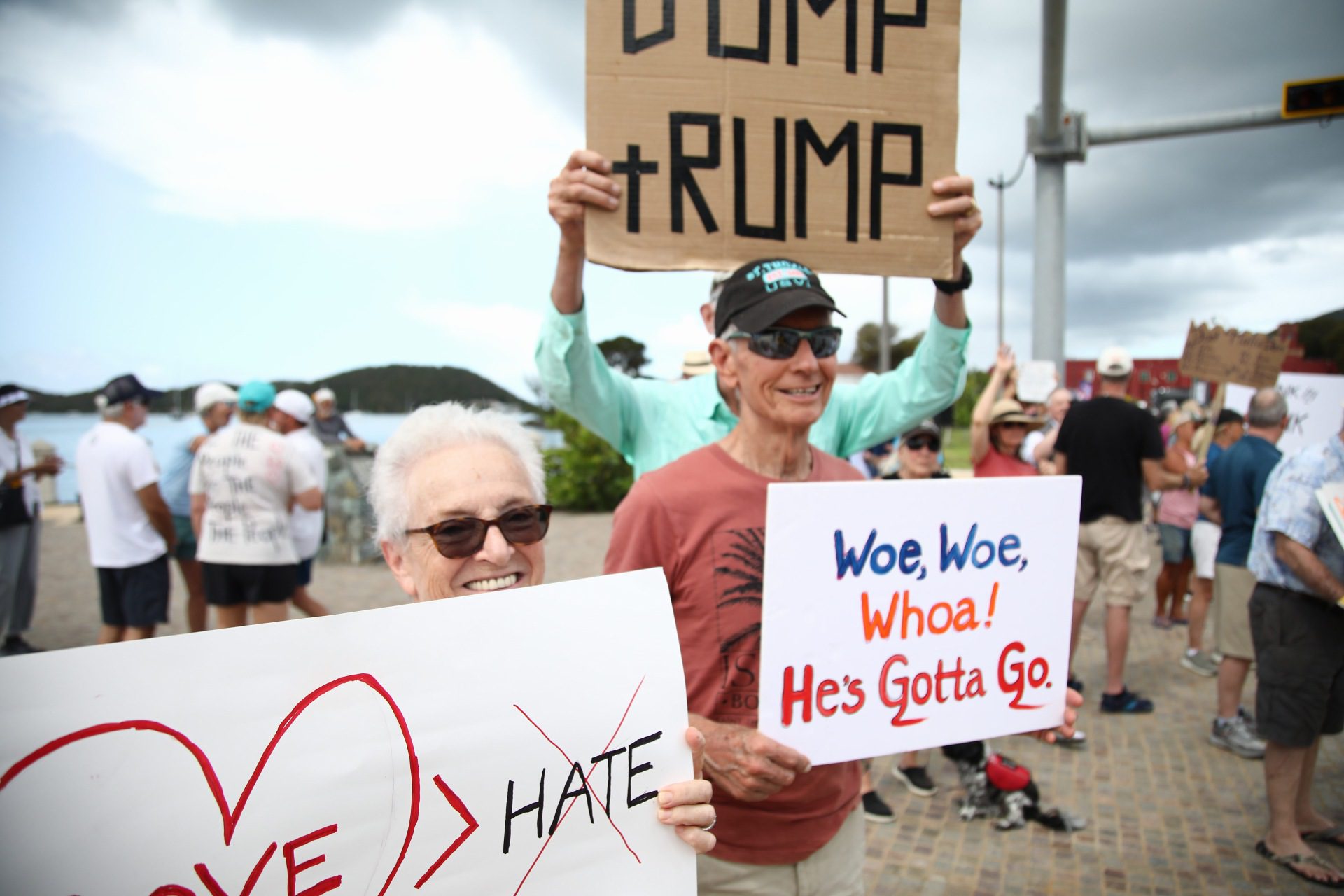
St. Thomas also held a No Kings Rally on Saturday.
On Saturday, peaceful protesters rallied across the street from the V.I. Courts. (Photo by Brian Everett Francis)
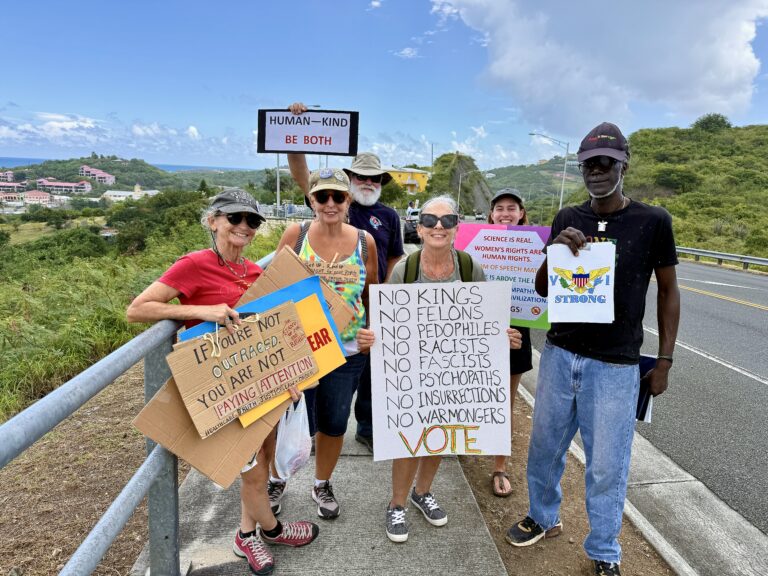
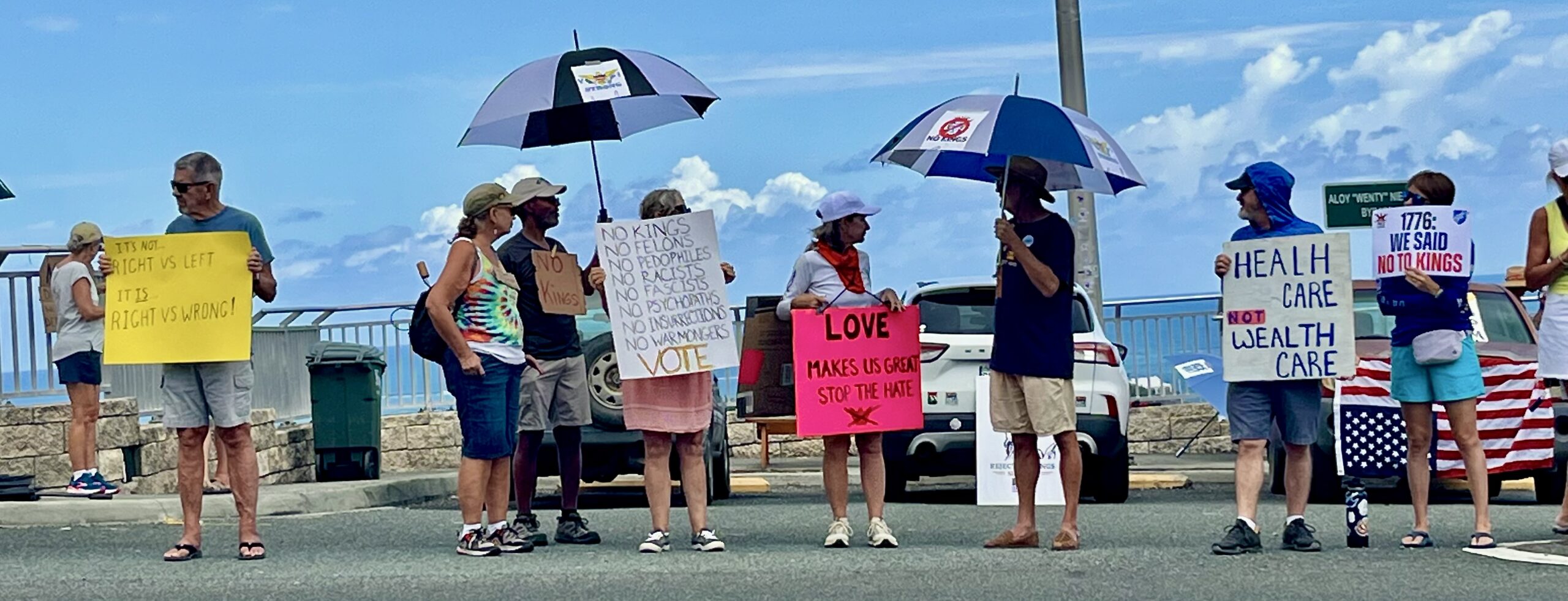
No Kings Day demonstrators on the St. Croix bypass hold signs and umbrellas as they stand on the side of the road. (Photo submitted by Ryan Flegal)
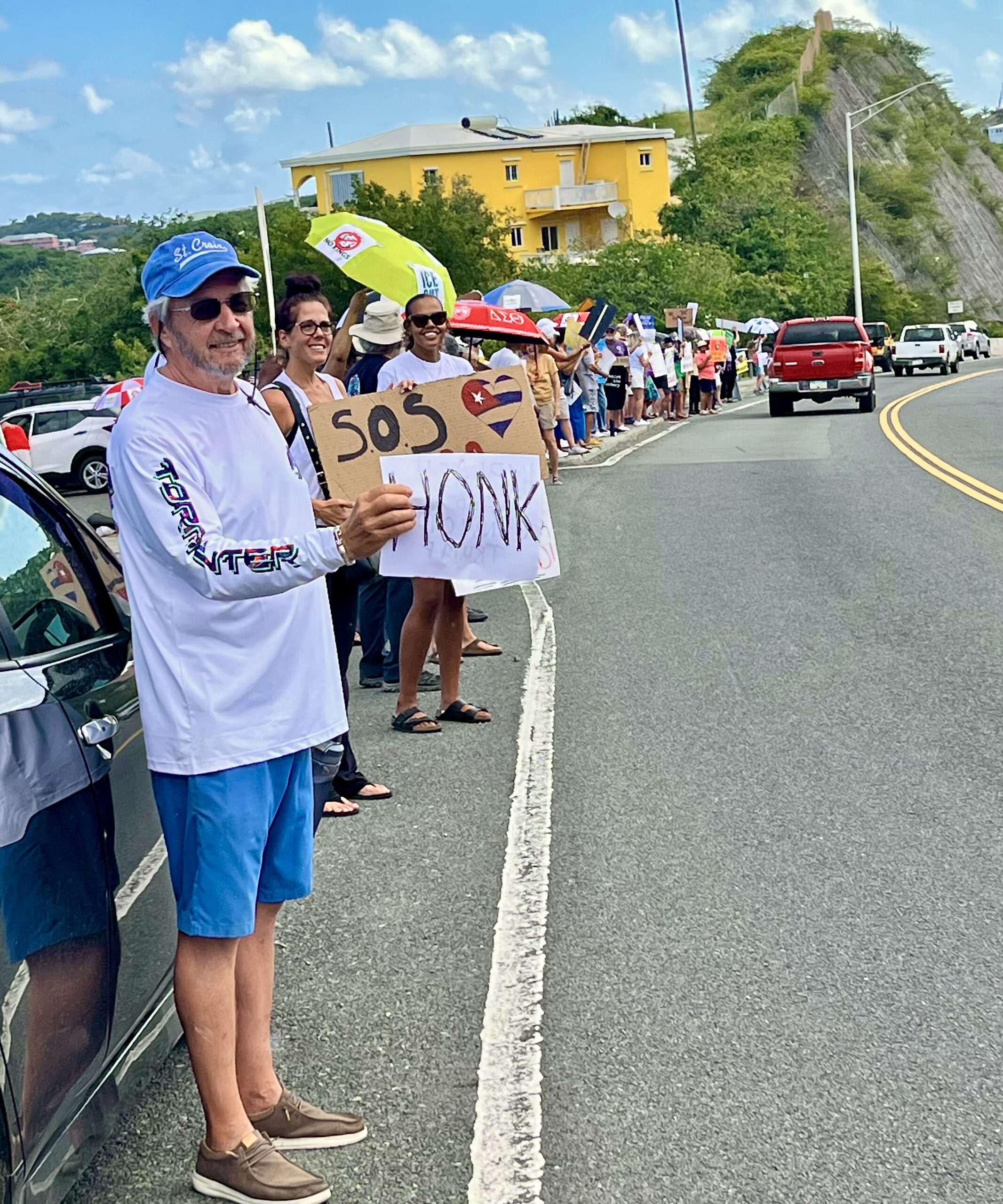
Uncertain weather did not deter over 100 people who joined the No Kings protest along the bypass on St. Croix on Saturday.
Over 100 No Kings Day protesters participated along the St. Croix bypass. (Photo submitted by Ryan Flegal)
Holding handmade signs of all colors and types, the protesters stood in sunshine and rain to emphasize their feelings the desire for change. Passing cars honked in unity with those actively involved. Even pets displayed signs marking the day.
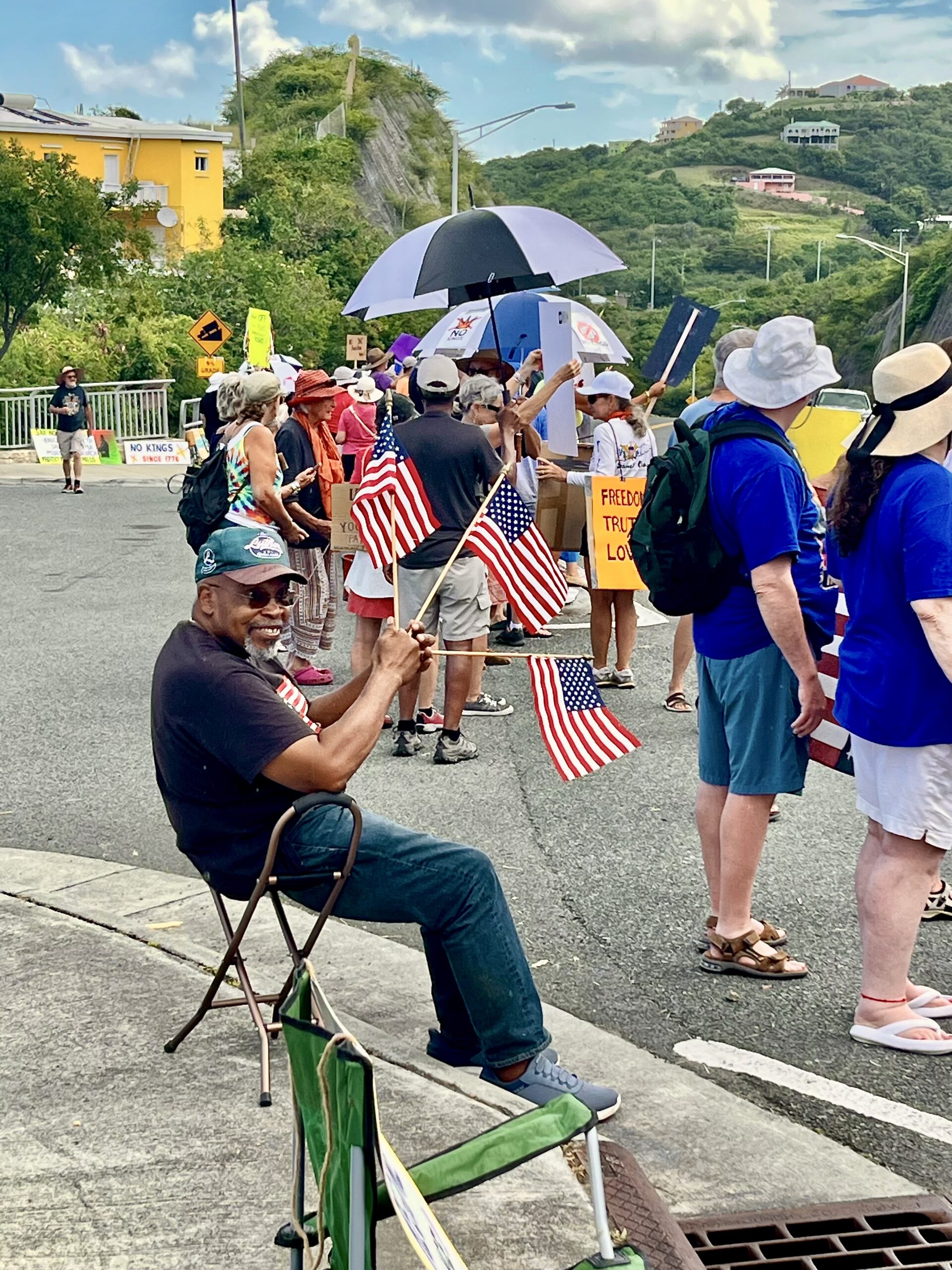
Luther Edwards holds the American flag as he joins in the No Kings Protest on St. Croix along the bypass. (Photo submitted by Ryan Flegal)
Ryan Flegal, one of the organizers of the event, said, “What an outpouring of support we saw here in St. Croix and across the nation and across the world for No Kings. Hundreds of thousands if not millions of people stood up for democracy today. And this message is especially important here in the Virgin Islands, where we’re excluded from the national democratic process. It is especially important when policies made by an unpopular president in Washington come to our shores and affect the lives of people in our community. From health care to ICE raids, from wars we didn’t vote for to the defunding of our health care system, our community and our country are saying loudly: No Kings.”
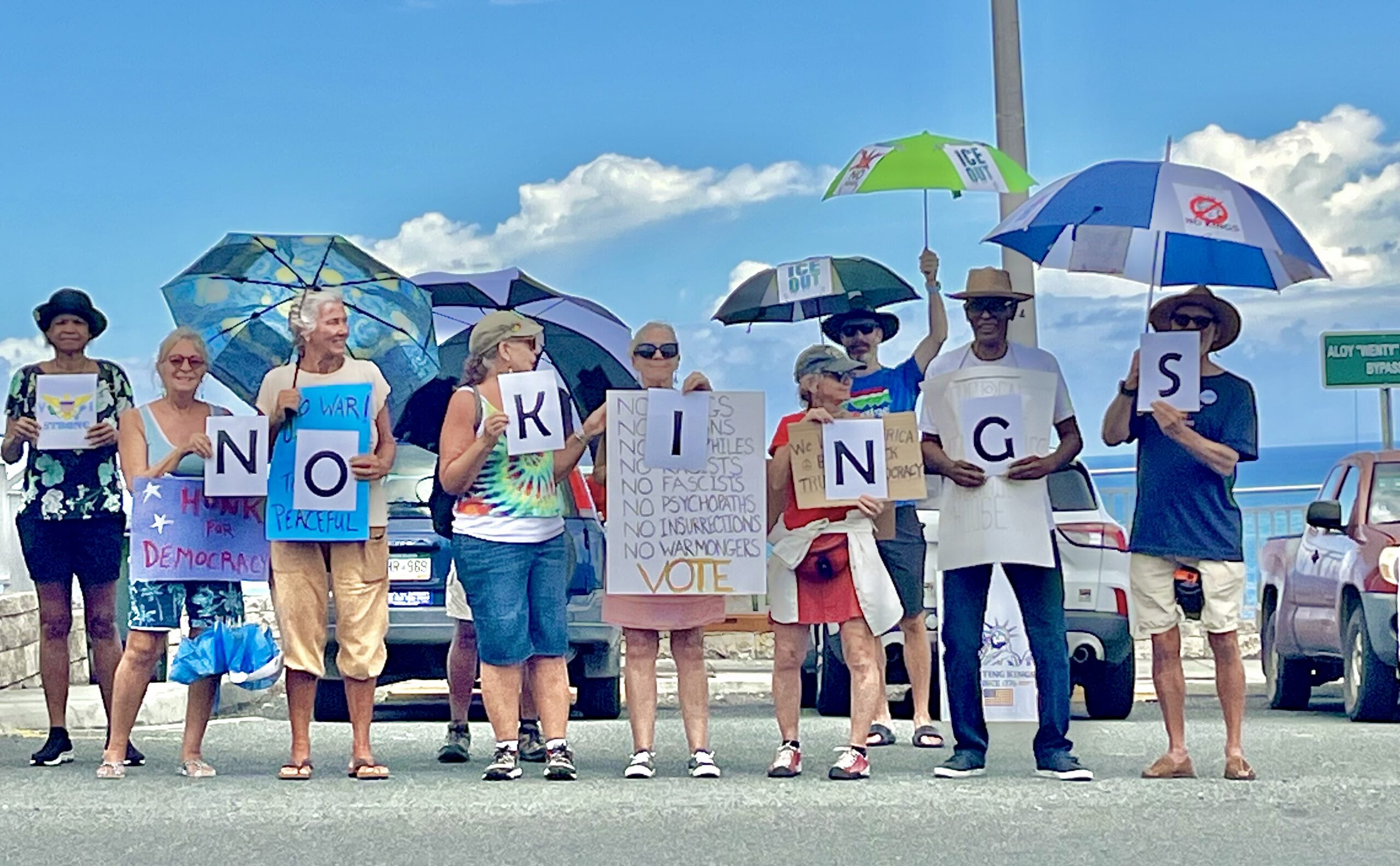
NO KINGS is clearly spelled out by demonstrators on St. Croix. (Photo submitted by Ryan Flegal)
“Well over 100 people gathered Saturday morning at the Christiansted Bypass Overlook for the St. Croix No Kings Day protest, joining protesters in St. Thomas, St. John, and more than 3000 other No Kings demonstrations held across the United States and internationally in opposition to authoritarianism and in defense of democracy.
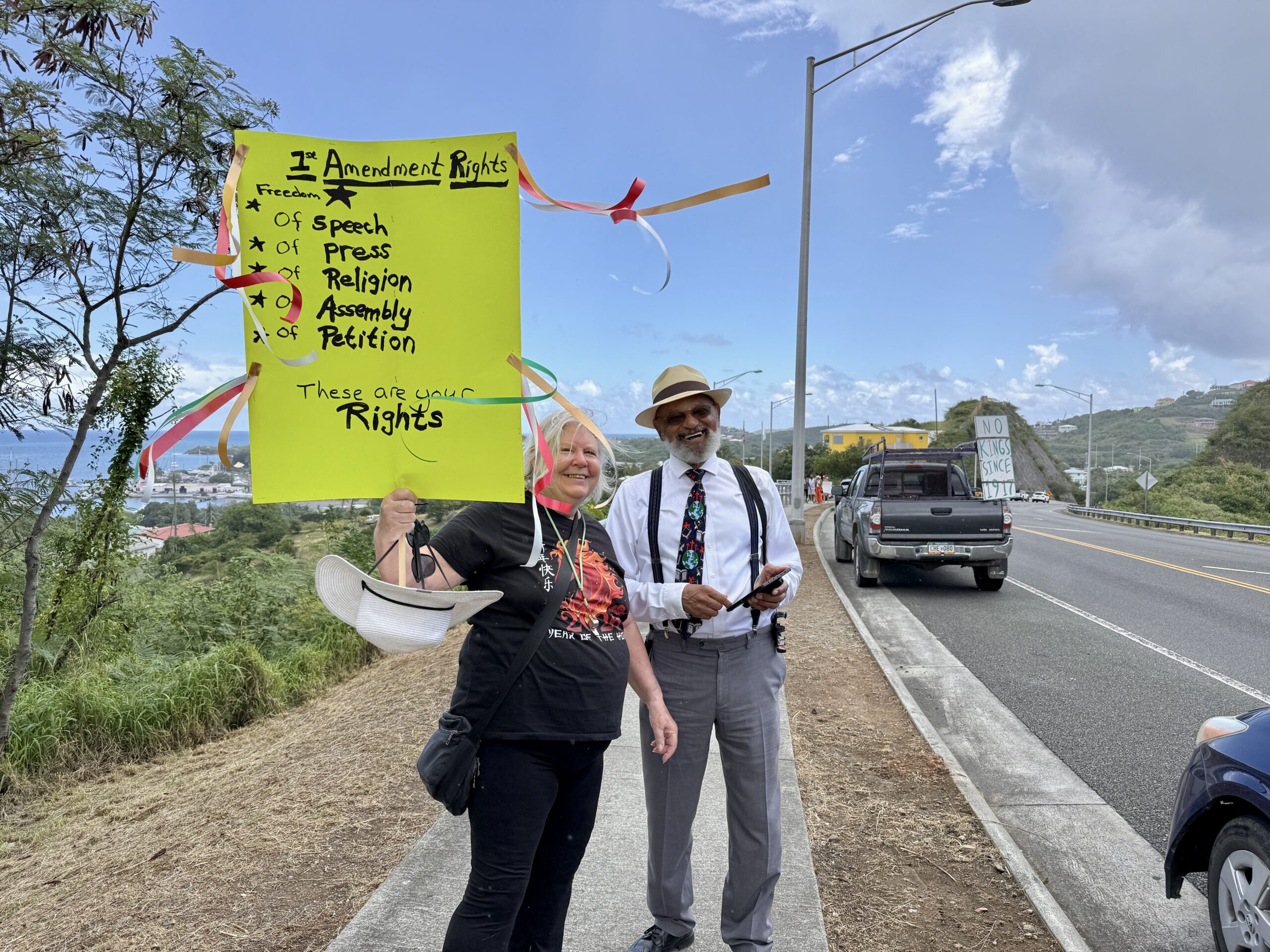
Kris Vandenberg hold a placard enumerating First Amendment rights during the No Kings Day protest along the bypass on St. Croix. (Source photo by Linda Morland)
The event was peaceful and reflected strong community concern about the impact of federal policies on the Virgin Islands were residents are affected by national decisions without full representation in Washington.
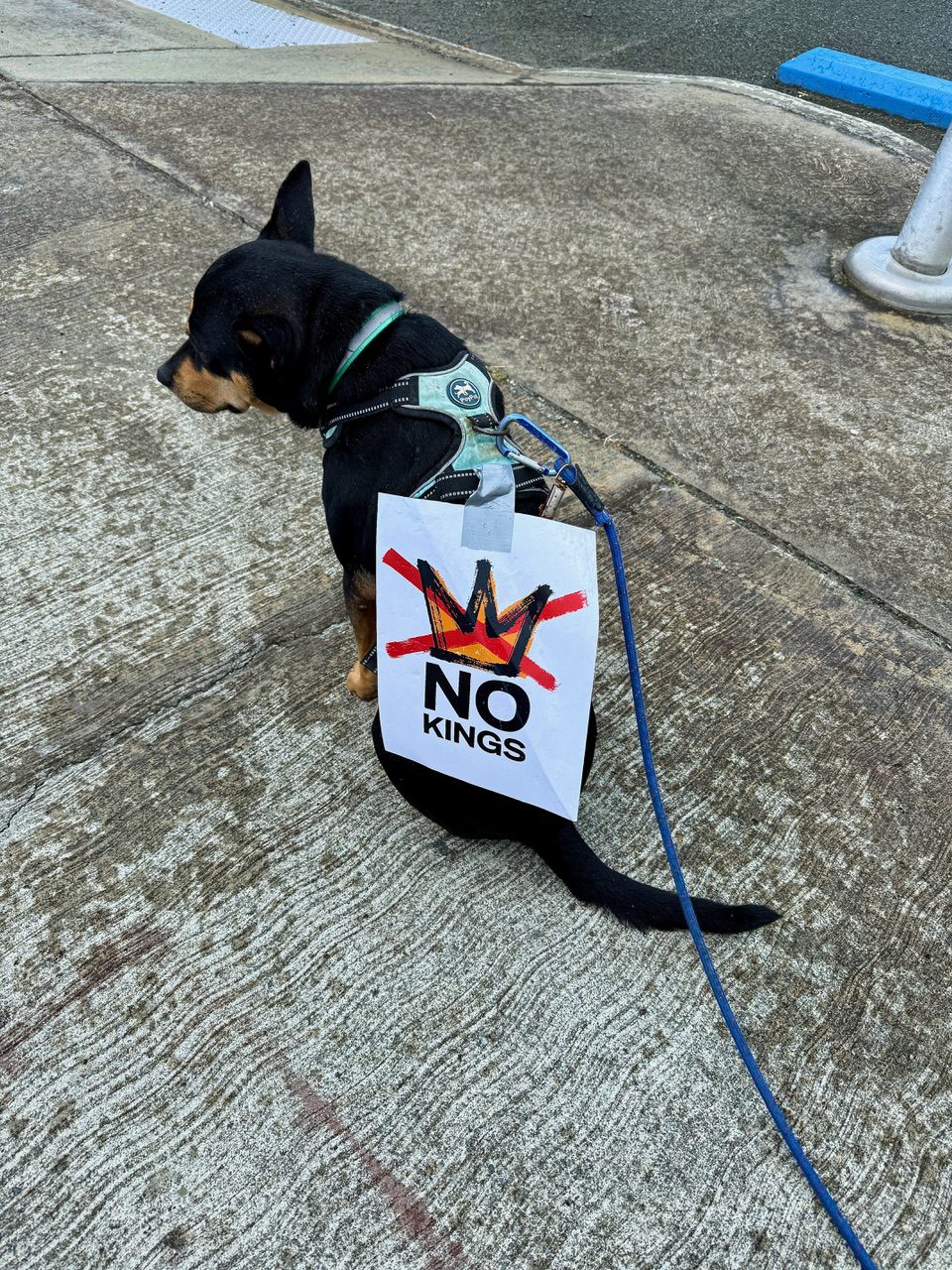
No Kings was displayed by a friendly dog during the protest. (Source photo by Linda Morland)
The St. Croix protest was part of a growing movement rejecting rule by fear, cruelty and concentrated power, and affirming that no president is above the law or beyond accountability.” Ryan Flegal said.
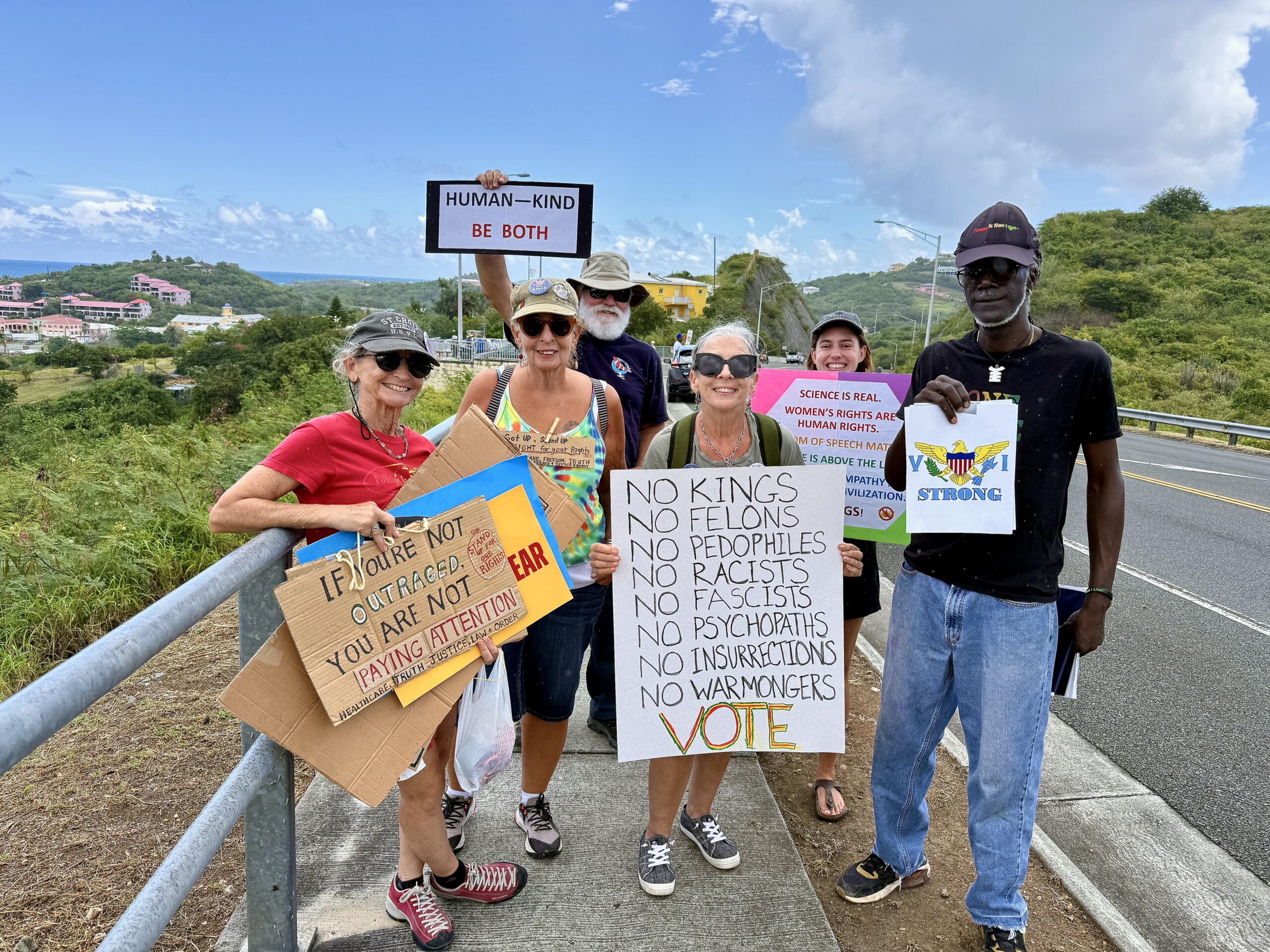
A group of protesters stand on the sidewalk along the St. Croix bypass holding a variety of signs they created for the No Kings Day protest. (Source photo by Linda Morland)
Outside of the U.S., rallies took place in Rome, London, Paris and more than a dozen other countries from Europe to Latin America and Australia.
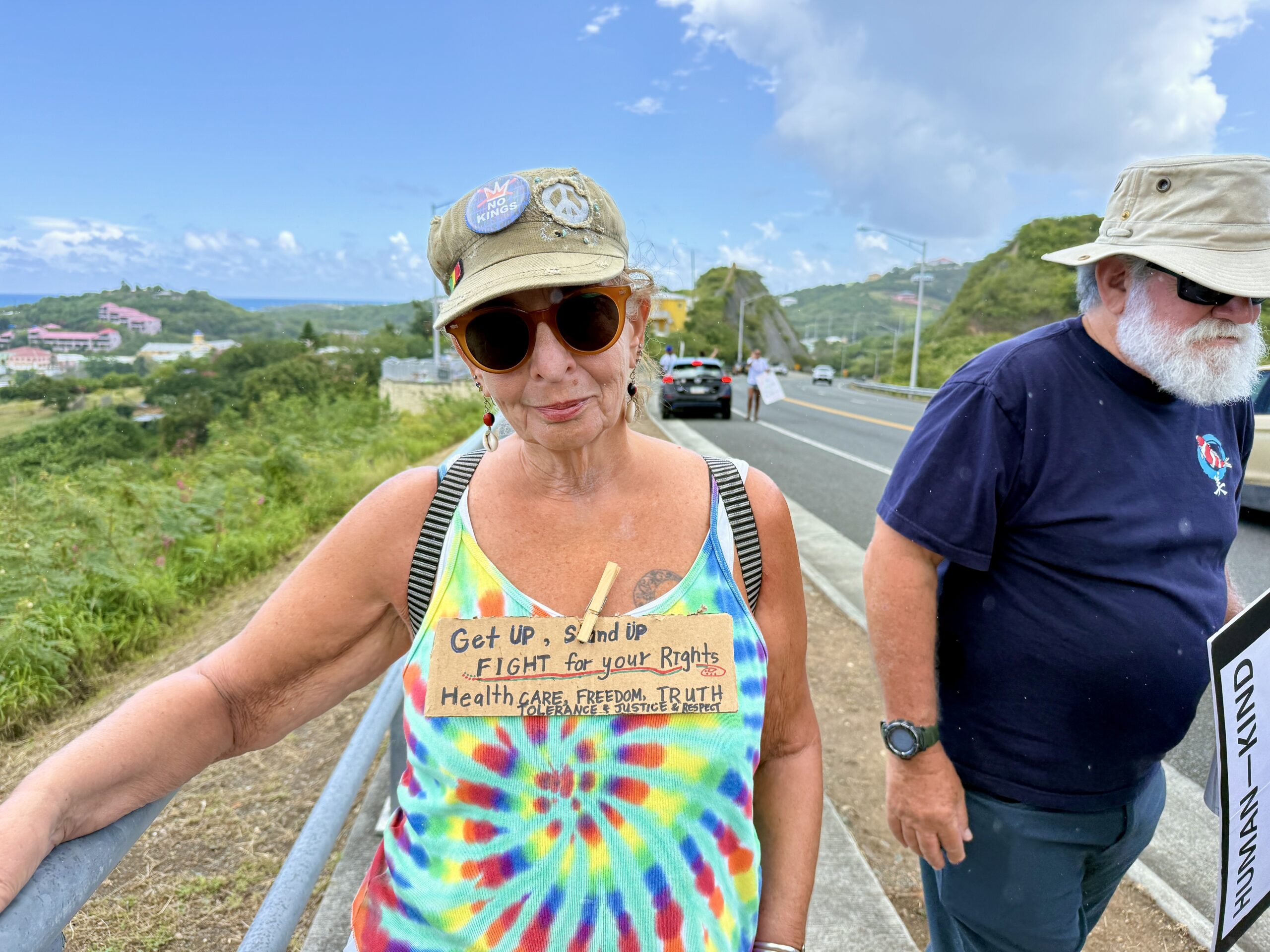
Get Up, Stand Up and Fight for your rights adorned the front of a protester’s shirt as part of the No Kings event along the St. Croix bypass. (Source photo by Linda Morland)
According to PBS News, organizers were expecting 9 million participants. As of Sunday, no actual number has been reported.
Associated Press reported 5 million people in the June 2025 and 7 million in the October 2025 No Kings rallies with 3100 events, 500 more than October registered in all 50 states.
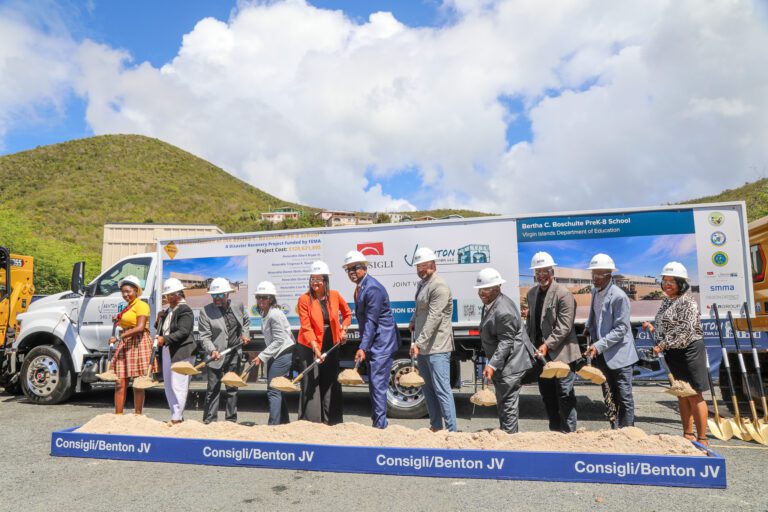
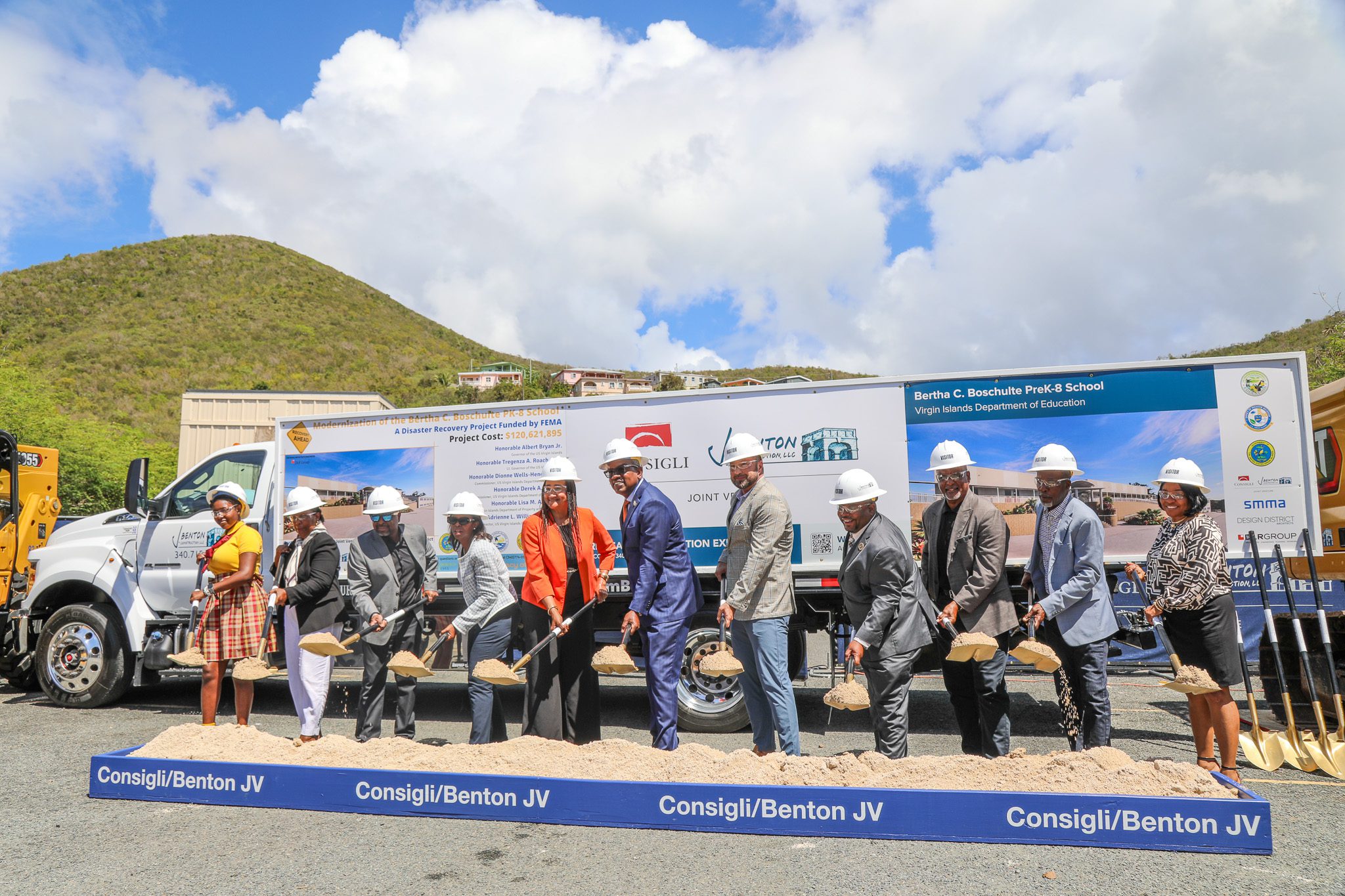
Officials, project partners, and students take part in a ceremonial groundbreaking at Bertha C. Boschulte Middle School, marking the start of a $120.6 million modernization project as work begins on a long-planned campus rebuild. (Submitted photo)
The government of the Virgin Islands has broken ground on a $120.6 million modernization project at Bertha C. Boschulte Middle School — a long-awaited step forward for a campus that, until recently, had become a clear example of how strained school conditions have been across the territory.
Those conditions have been well documented. In October, teachers did not report for duty, forcing an early dismissal over concerns about mold, heat, leaks, and failing air conditioning systems. Weeks later, during a walk-through of the campus, Senate President Milton Potter described classrooms where buckets caught water dripping from ceiling vents, with doors and windows propped open just to keep air circulating. “We definitely can’t function like this,” Potter said at the time, calling for urgent action and greater accountability between agencies responsible for school maintenance.
By January, the school shifted to a shortened schedule, with classes ending at midday as conditions persisted. Principal Terrence Corbett said at the groundbreaking ceremony that it’s only within the past two weeks that BCB has returned to a full day, following targeted repairs by the Bureau of School Construction and Maintenance and J. Benton Construction, working in partnership with Consigli. In the interim, classroom and building doors remained open throughout the day to help circulate air, even as crews began replacing aging units and stabilizing conditions across campus.
Now, that stopgap work is transitioning into a broader rebuild. The project, led by the Education Department in partnership with the Consigli/Benton Joint Venture and the Office of Disaster Recovery, will overhaul the existing 14-building campus — replacing aging systems, upgrading ventilation and chilled-water infrastructure, and reworking classroom and shared spaces to meet current building standards. Plans also include improved circulation across campus and more durable materials aimed at reducing the kind of maintenance issues that have plagued the school for years.
Contractor James Benton said crews have already begun early-phase work on site under a limited, early-release scope, including removing and replacing outdated air conditioning units. He said the project is now moving through additional approvals, with full mobilization expected by the start of the next school year. In the months ahead, Benton said residents should expect to see increased activity on campus, with materials arriving and crews expanding work across multiple areas.
Because the school remains in use, Benton said construction will be carried out in phases — taking buildings offline one at a time and coordinating closely with the Department of Education to minimize disruption. That approach, he noted, adds complexity and can slow progress, but is necessary to keep the campus operational. He added that while some delays are always expected in projects of this scale, the goal is to avoid anything significant enough to derail progress as work ramps up.
But even as construction begins, officials are clear about the scale — and the pressure — of the recovery effort. Office of Disaster Recovery Director Adrienne Williams-Octalien said the territory is managing roughly $4 billion in school-related projects, but acknowledged the pace has not kept up with the need. The territory, she said, should be moving closer to $1 billion a year in construction spending to stay on track for a 2035 completion timeline — a gap that underscores how much work remains.
Education Commissioner Dionne Wells-Hedrington called the groundbreaking “a good day for the BCB family,” pointing to years of planning and persistent facility issues, while Gov. Albert Bryan Jr. said the moment reflects a shift from planning into execution, even as the territory faces ongoing constraints in labor, infrastructure, and capacity.
Friends and neighbors gathered Saturday night in Cruz Bay as the 2026 Light Up the Night Cancer Walk got underway. The annual fundraiser has become a highly anticipated community event, bringing together St. John residents and business owners during the busy tourist season to connect and support a shared cause.
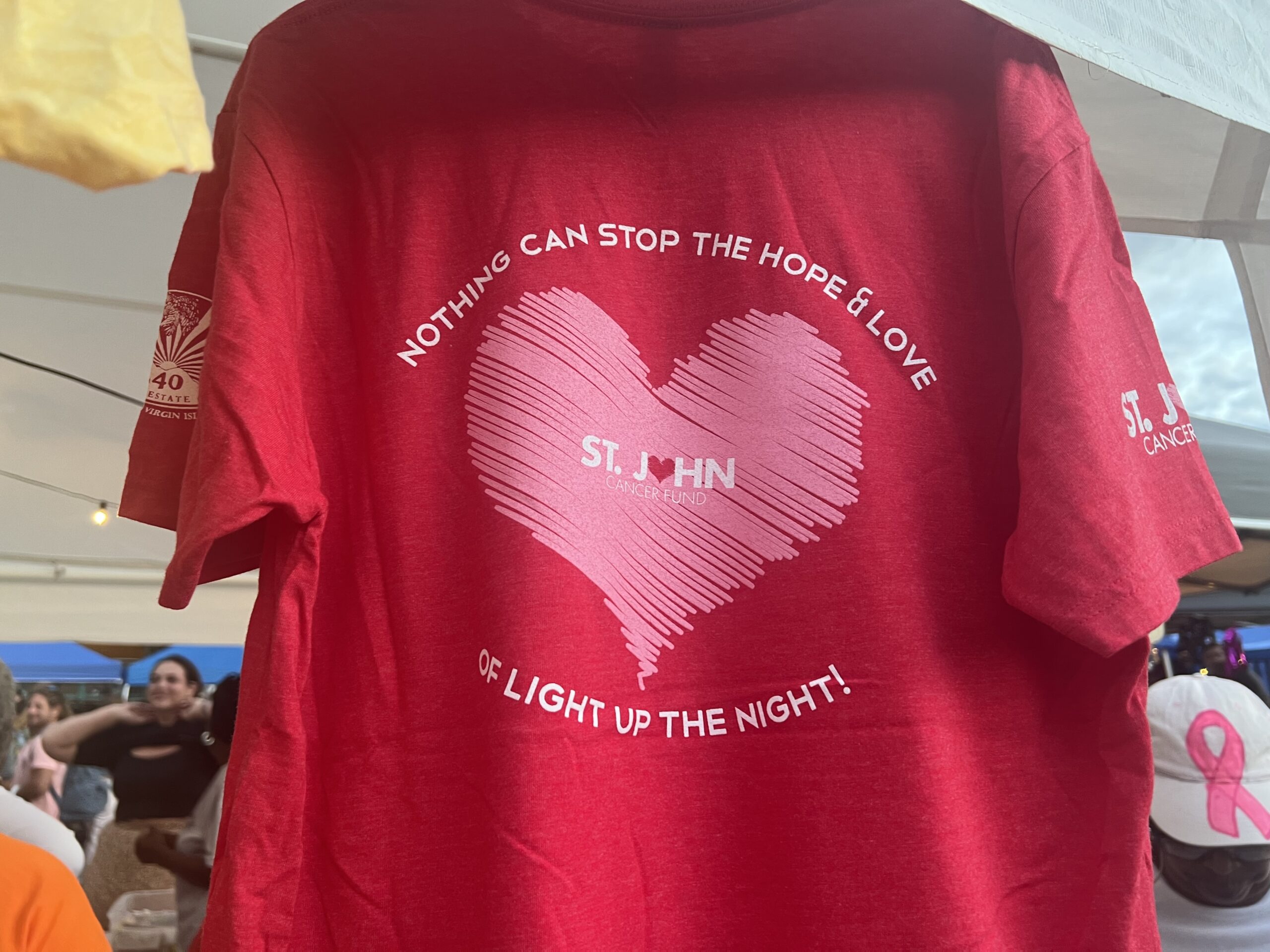
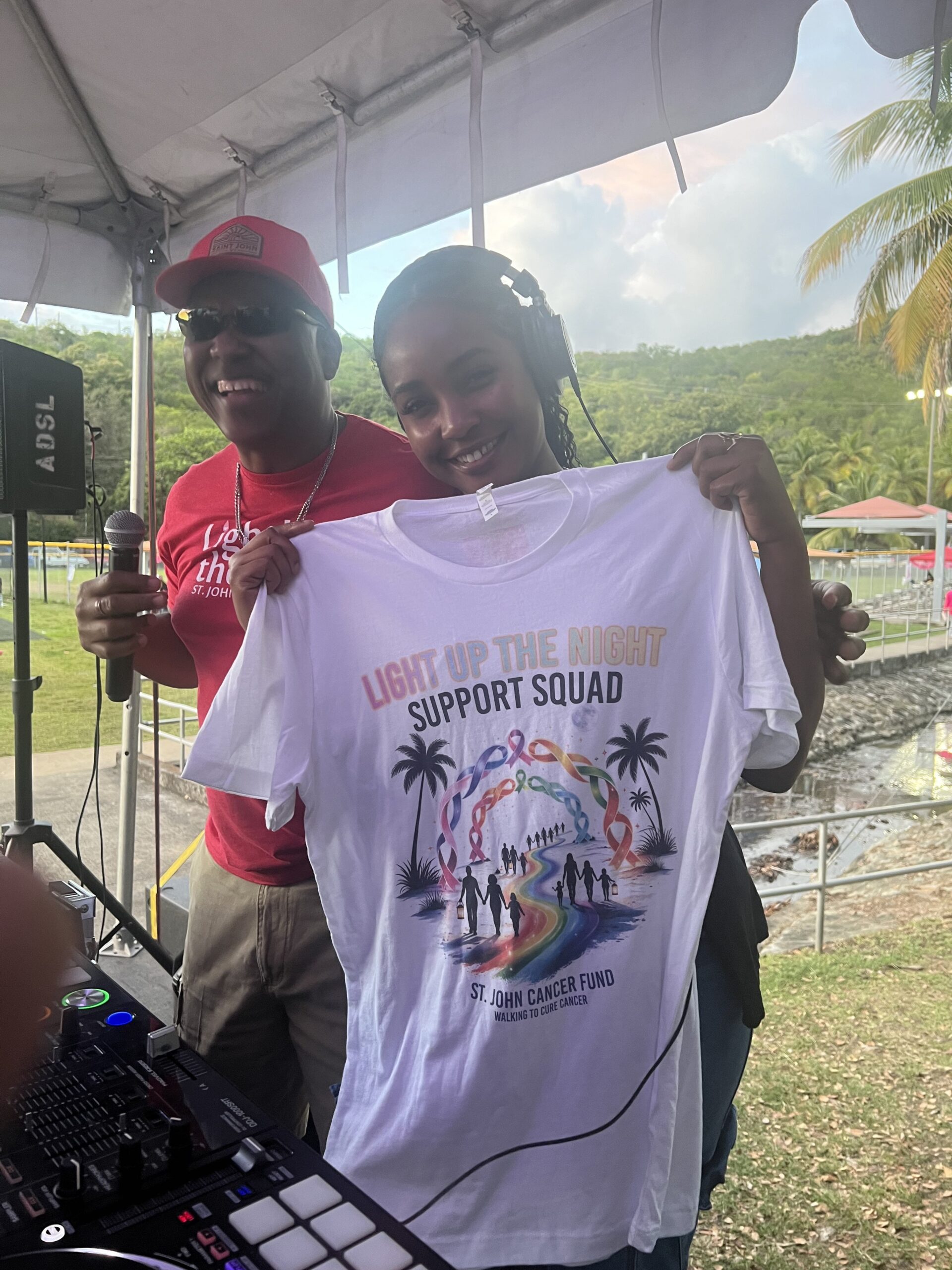
A heartfelt message printed on a T-shirt. (Source photo by Judi Shimel)
A cordial atmosphere brought smiles from participants and spectators alike.
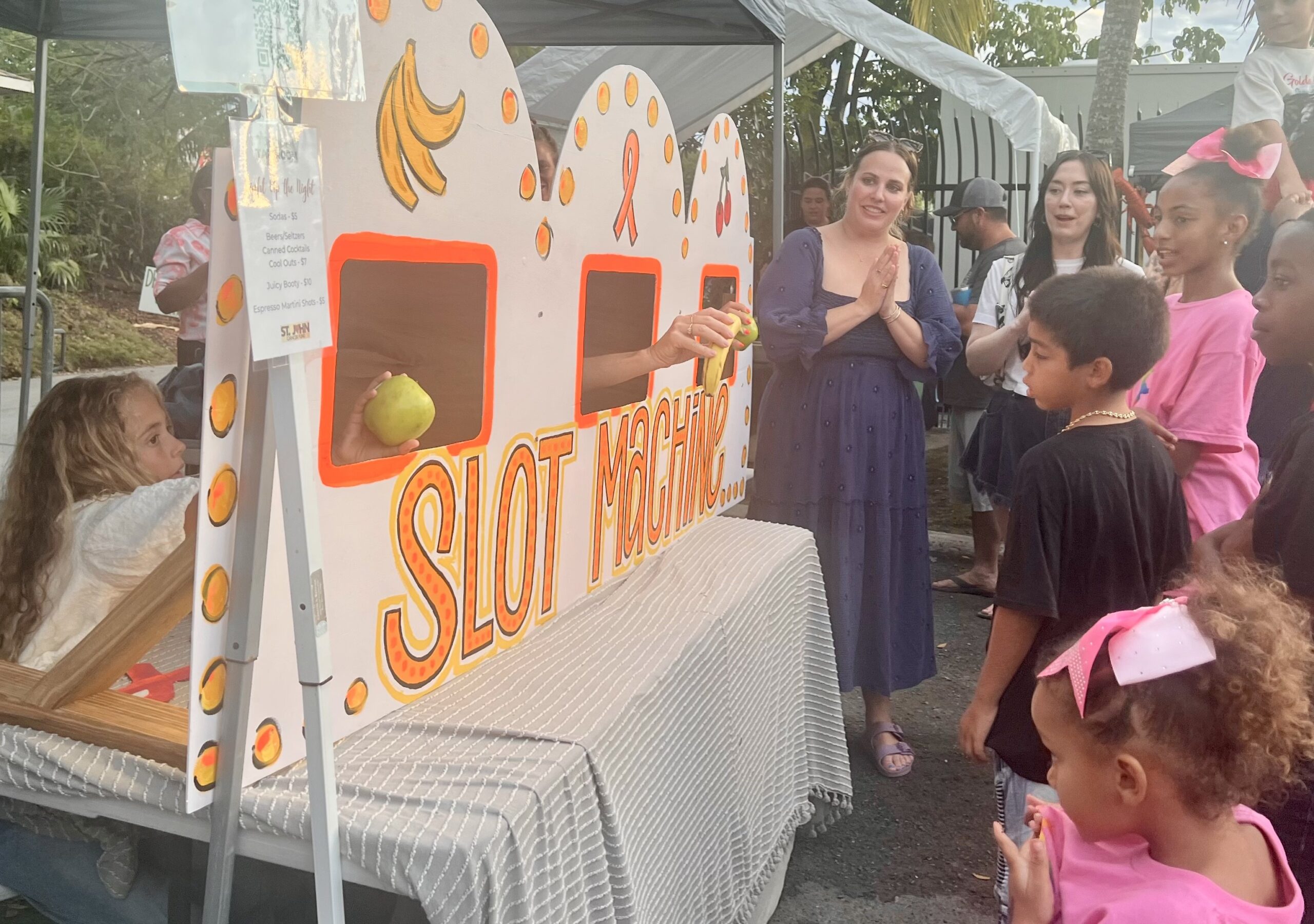
A human-powered slot machine grabs attention in the ball field parking lot. (Source photo by Judi Shimel)
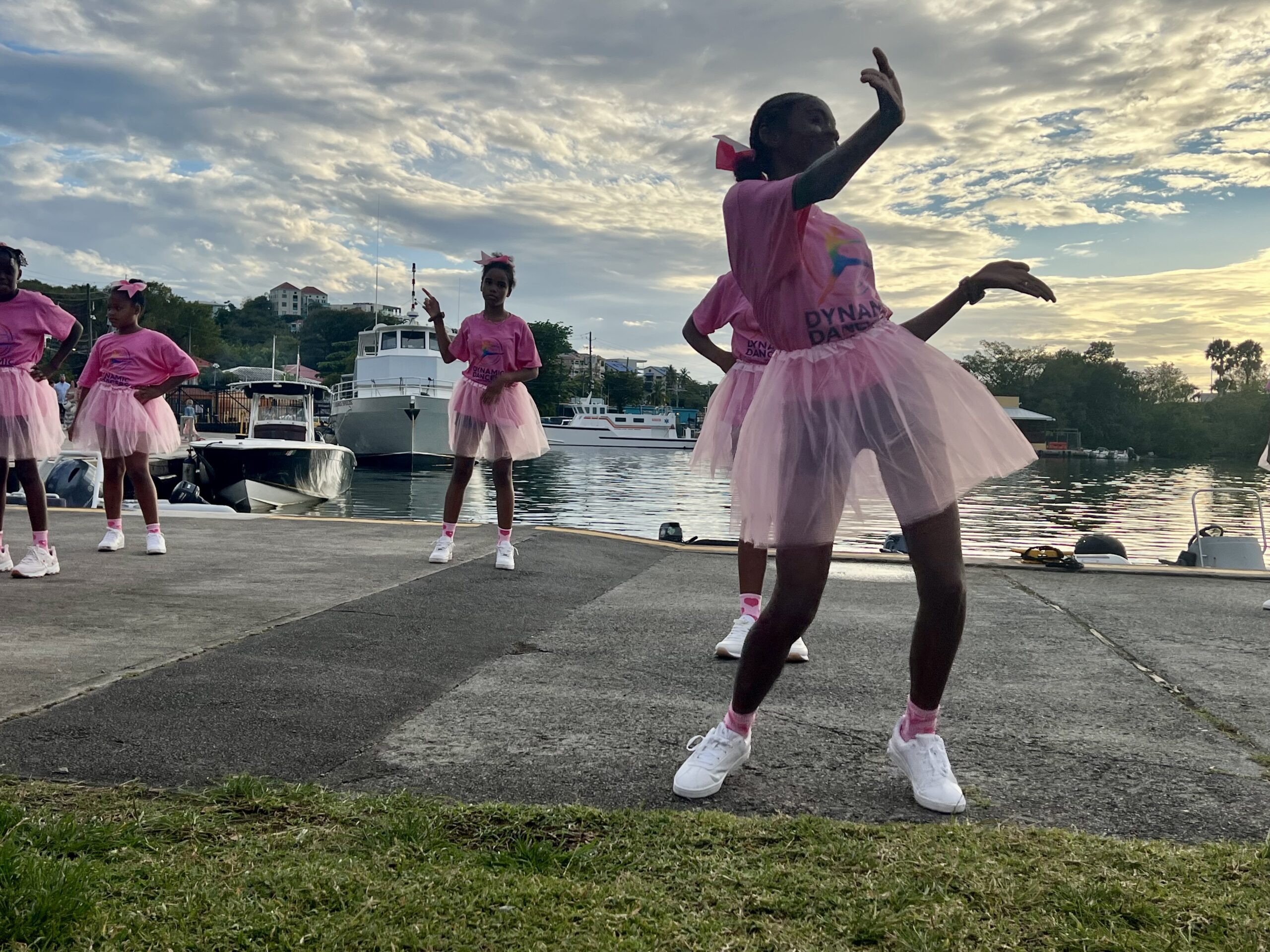
Food vendors and game tables filled the parking lot entrance to the ball field. The St. John Recovery Choir sang on stage for those enjoying the sunset; the Dynamic Dancers youth group entertained near the waterside of Cruz Bay Creek.
Dynamic Dancers strike a pose. (Source photo by Judi Shimel)
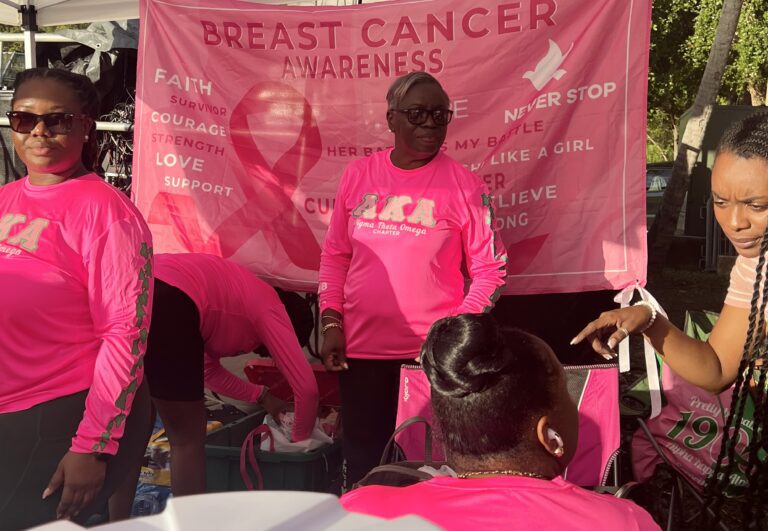
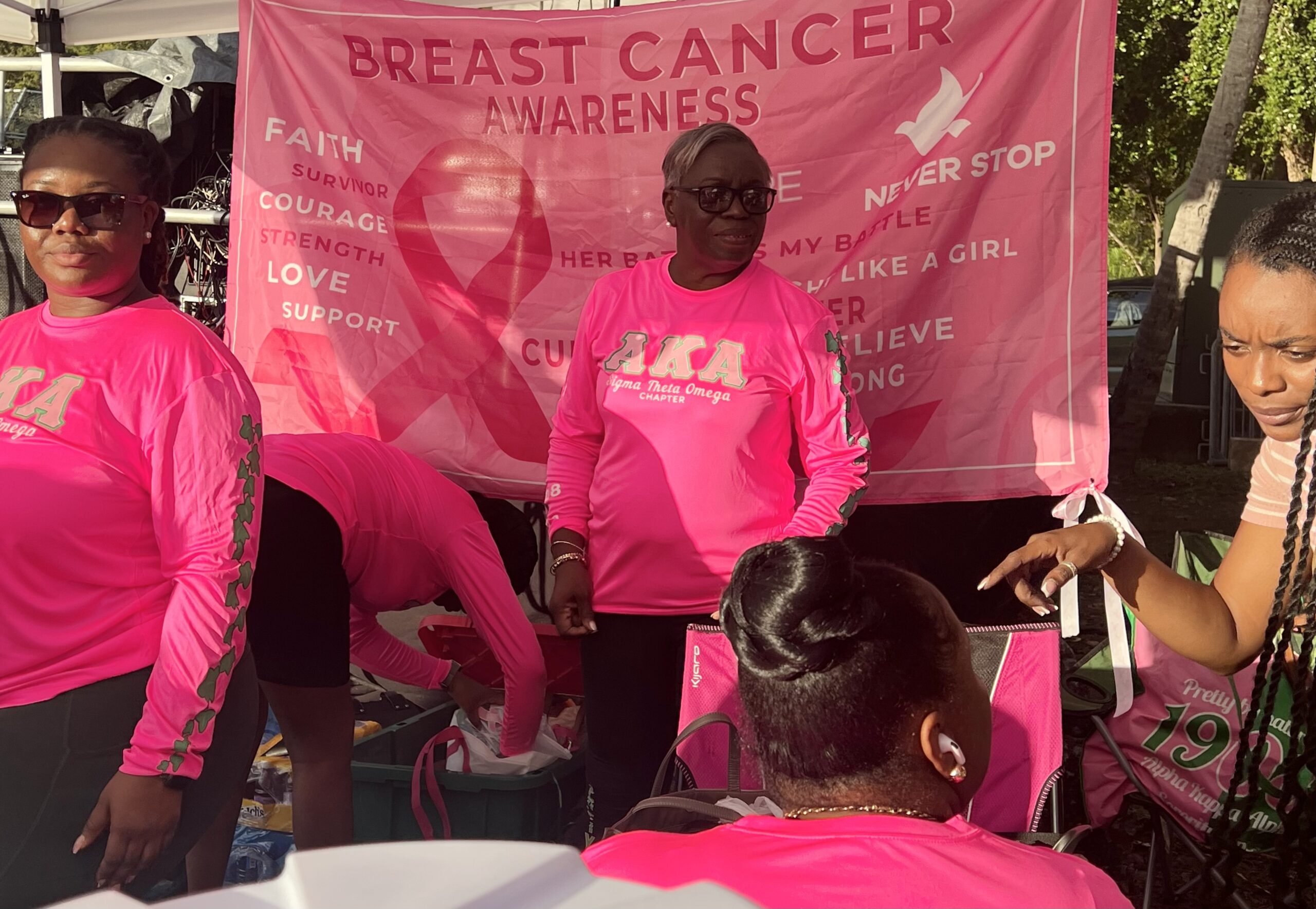
At the Pink Heart and Soul tent, sorority sisters sold refreshments so they could contribute the proceeds. “We are walking with our sorority sisters who have been in the fight or are still fighting the battle with cancer, said group president Lineek Williams.
The Pink Heart and Soul Team says they show their support every year. (Source photo by Judi Shimel)
At the popular dunk tank, a small boy sat dripping on the collapsible seat while classmates hurled softballs at the trigger target. Liz Lowe stood at a table nearby, filling trays with New England-style lobster rolls. “Boston Sword and Tuna, which is a wholesaler down here, donated all the lobster,” Lowe said.
They were among a host of local businesses showing their support for the St. John Cancer Fund, hosts of the walkathon.
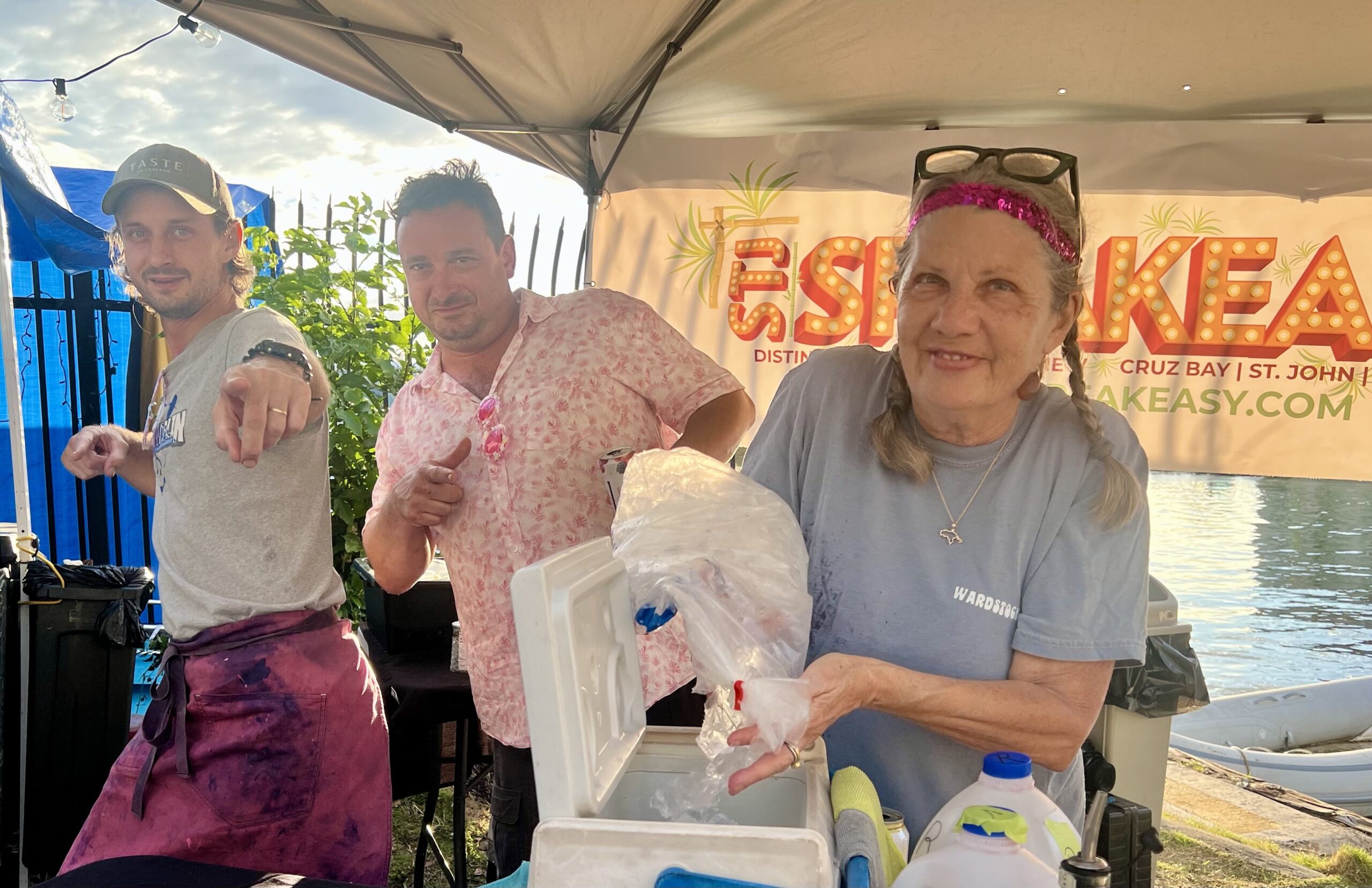
Trace Miller, Chef Vincent Alterio and Kim Rollins show their support on Saturday night. (Source photo by Judi Shimel)
As the evening continued, one business owner shared a personal story of life, love, and loss to cancer on social media. Elizabeth Miller of Miller Properties said her company will pledge $5 for each guest arriving at their vacation rentals throughout 2026.
“Thank you for listening to my journey and remember NEVER, NEVER GIVE UP!” Miller said.
Dance tunes pumped through speakers on stage set the pace for walkers, keeping teammates on the track from 4 p.m. to 11:45 p.m.
Adonis Morton and Ayana Phillips driving the rhythm for Light Up the Night. (Source photo by Judi Shimel)
A live band set up to take over the music as evening skies set in.
Editor’s Note:
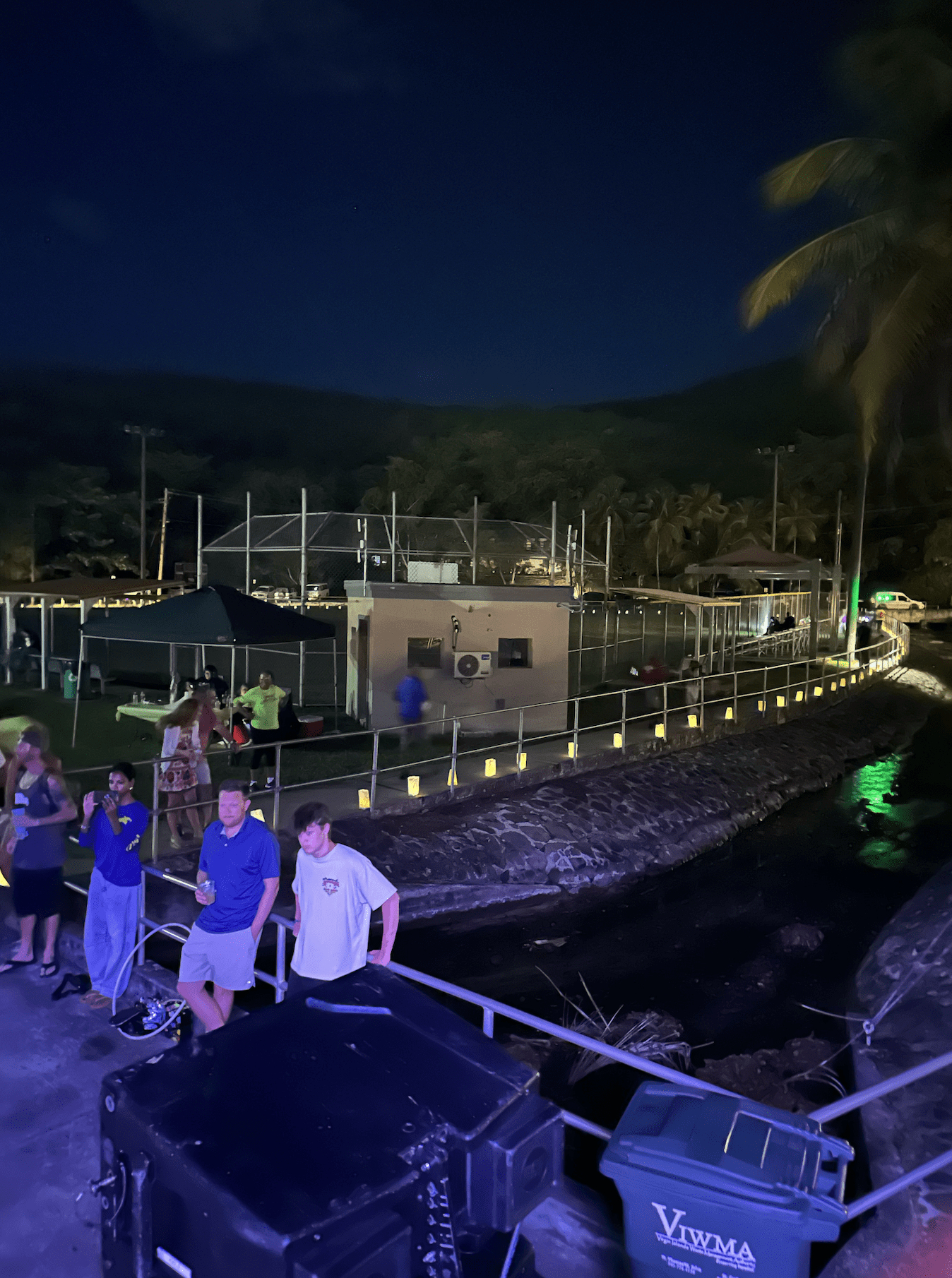
“We had an amazing response and turnout at our event. We had power from a generator donated by Love City Strong and were never tied in to a WAPA line, so the Luminary Service and entire event was unaffected by the power outage on St John.
“In fact, the WAPA outage actually made the Luminary Service more special during the luminary service period, as it was already dark.
“Thank you to our sponsors, teams, and all participants in Light Up The Night,“ Adonis Morton, member of the Cancer Fund committee, said.
(Photo courtesy Adonis Morton)
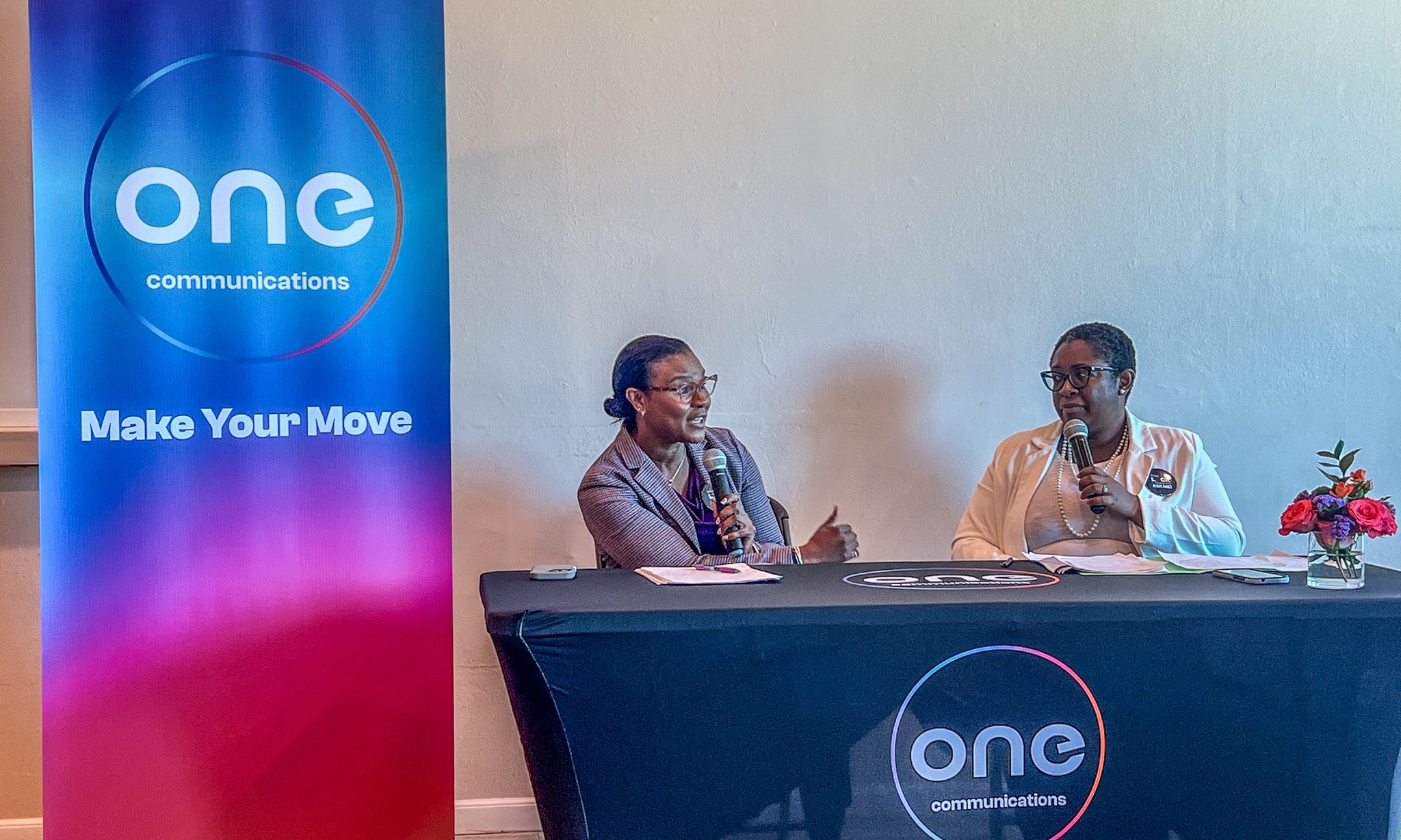
One Communications CEO Siobhan Paul-Alexander, left, and Communications Director Patria Aarons speak during a media roundtable, addressing the company’s recent restructuring, workforce changes, and customer-focused initiatives. (Photo by Ananta Pancham)
One Communications Chief Executive Officer Siobhan Paul-Alexander says the company’s recent restructuring — including the closure and regionalization of its call center — reflects a broader shift in how telecommunications companies operate, even as the changes have raised concerns locally about job losses and customer service.
Speaking during a small media roundtable last week alongside Communications Director Patria Aarons, Paul-Alexander said more than 60% of affected employees were retained and repositioned within the company, as operations moved away from a traditional call-center model toward a mix of digital support, field service, and multiskilled technical roles.
“We didn’t eliminate the work — we changed where and how it happens,” she said, pointing to evolving customer touchpoints and the need for employees who can handle multiple functions as technology shifts. The company has also rolled out training programs aimed at reskilling workers, allowing technicians and engineers to take on broader responsibilities across the network.
Still, the restructuring has not come without impact. Prior Virgin Islands Source reporting has highlighted concerns from employees and lawmakers about job displacement, reduced local presence, and customer frustration during the transition. The changes have also drawn formal review from regulators. In hearings last year, Public Services Commission members said they were seeking clarity on the scope of the restructuring, including how operational shifts could affect service standards and compliance with existing agreements in the territory.
That review has focused on whether current regulatory frameworks keep pace with how telecommunications companies now operate — particularly as functions move off-island — and what that means for oversight of both service delivery and workforce commitments going forward.
Paul-Alexander acknowledged that reality at last week’s panel, saying, “People’s lives were impacted — that’s real,” but added that the company must balance those outcomes with financial sustainability and its obligations as a private, shareholder-driven business.
At the same time, she pointed to pricing as one of the ways the company is trying to respond to those pressures. One Communications has introduced a five-year price lock on certain mobile and internet plans, which Paul-Alexander said is meant to provide stability for customers as the cost of living continues to rise. She noted that while operating costs have increased, the company made a decision not to raise base prices, framing the move as a direct response to customer feedback.
Beyond pricing, company leaders emphasized continued investment in network infrastructure, workforce training, and community initiatives, from youth programs to cultural events. But even as the company highlights those efforts, questions remain about how the restructuring will shape long-term service delivery and employment in the territory.
Paul-Alexander said the company plans to remain engaged with both customers and stakeholders as those changes continue, emphasizing transparency and ongoing dialogue, even as the transition continues to play out across the community.
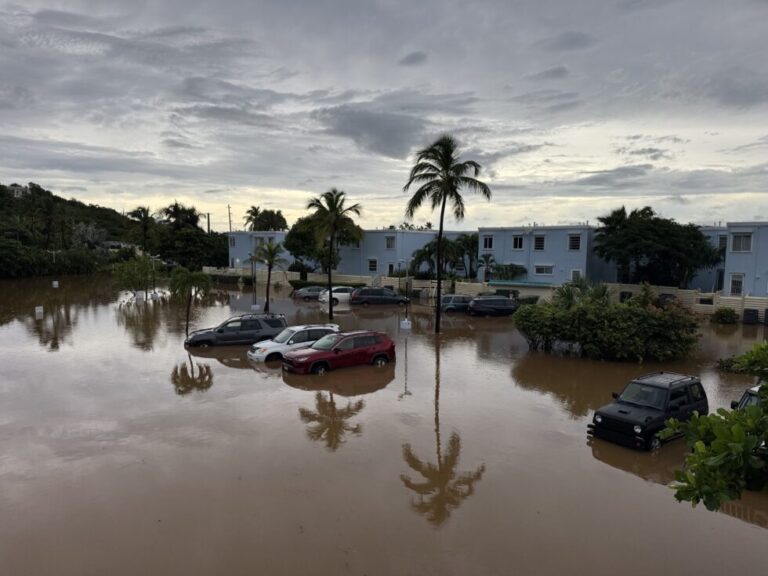
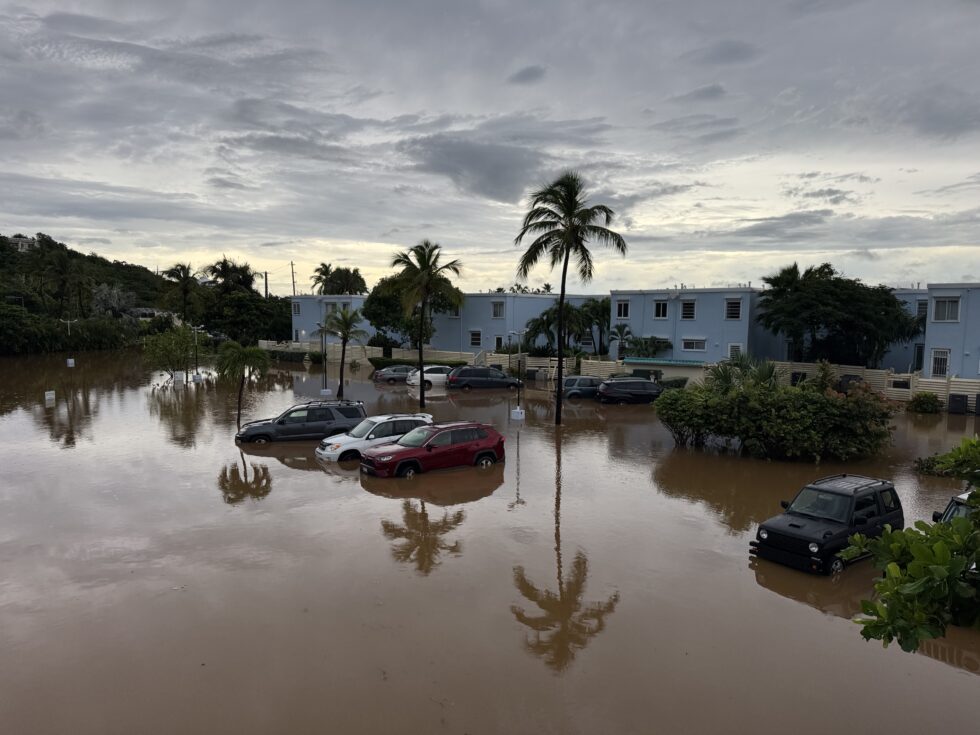
A new stormwater mitigation initiative will combine student learning, community outreach, and small-scale projects to address rain runoff. Stormwater worsens flooding on land and carries sediment and pollution into coastal waters.
Where stormwater flows, pollutants and debris can travel with it into waterways and downstream ecosystems. (Photo courtesy Environmental Protection Agency)
The Virgin Islands Conservation Society is partnering with the Department of Planning and Natural Resources’ Coastal Zone Management Division to expand the VI Clean Coasts Program into stormwater education and intervention work on St. Thomas.
The Stormwater Resilience and Outreach Program is centered on the community of Bovoni on St. Thomas, where organizers say flooding, erosion, and runoff concerns have made the area a strong place to begin. The project will pair outreach and education with practical, nature-based improvements designed to help slow stormwater, reduce erosion, and keep sediment and pollutants out of nearshore waters.
Flooding shown on the Virgin Islands Conservation Society’s Stormwater Resilience and Outreach Program page highlights the kind of runoff impacts the initiative aims to address. (Photo courtesy Virgin Islands Conservation Society)
“Together with partners at DPNR and utilizing local resources such as the USVI Watershed Plans, the neighborhood of Bovoni in the Jersey Bay watershed was selected to be the pilot area for this project,” according to a recent press release from VICS.
“Specifically, VI Clean Coasts has been working with Bertha C. Boschulte Middle School (BCB) and other community stakeholders to provide a curriculum … that integrates watershed education with real-world examples of stormwater interventions on campus,” the press release said.
How Runoff Affects Land and Sea
As a recent Source article reported, improperly managed stormwater can cause problems once it reaches the ocean, including increasing bacteria in the water.
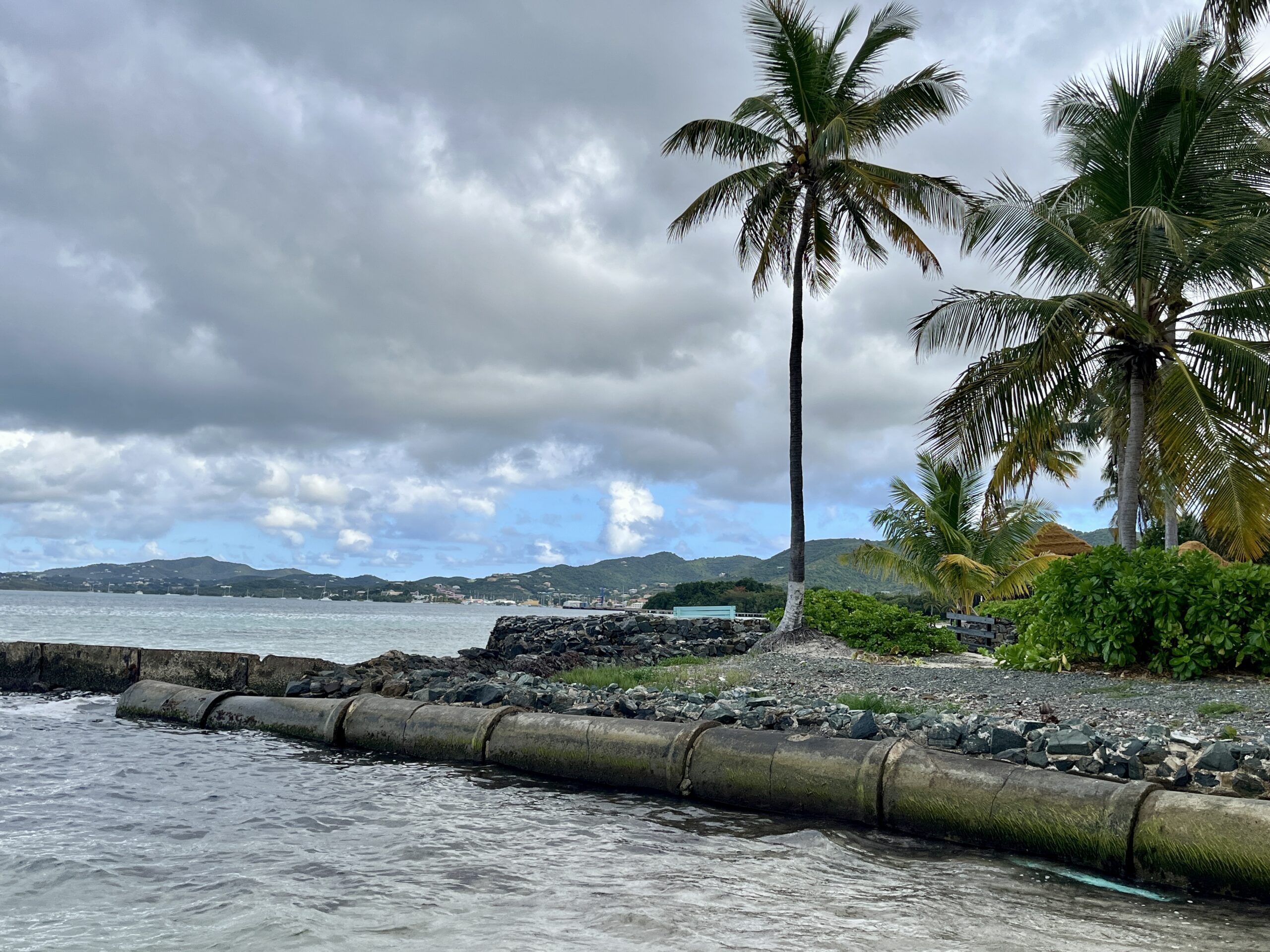
A stormwater drainage pipe on the north shore of St. Croix, included in a recent Source article, shows where runoff from land can flow directly into coastal waters after heavy rain. (Source photo by Jesse Daley)
Additionally, the VICS press release said that stormwater can increase flooding and erosion on residential and commercial properties while also carrying sediment and pollutants along roads and guts into the marine environment. Organizers say that runoff can harm fragile coastal habitats, including coral reefs, while also reducing quality of life in communities dealing with repeated drainage and flooding problems.
The Source connected with Anne Marie Hoffman, executive director of VICS, and Sienna Gray, deputy director of VICS, to learn additional details about the program.
Hoffman said stormwater and sedimentation impacts are well documented in coastal areas, and that runoff can carry bacteria, oils, and other pollutants into nearshore waters, creating challenges for coral reefs, mangroves, and other ecosystems that support the territory.
Why Bovoni Was Chosen
Gray told the Source that the project team looked at a range of factors before selecting Bovoni as the location for the stormwater resilience project, including flooding risk, social vulnerability, past hurricane damage, elevation, and watershed flow.
Gray said the group drew on DPNR’s Coastal Zone Management research and the St. Thomas East End Reserves Watershed Management Plan study, sponsored by the National Oceanic and Atmospheric Administration’s Coral Reef Conservation Program. The team then visited the area after rain events to see firsthand where flooding and runoff were occurring.
She explained that the Bovoni area stood out not only because of flooding conditions, but also because Bertha C. Boschulte Middle School, located within Bovoni, helped connect the project’s education and outreach goals.
Hoffman said that the broader VI Clean Coasts partnership with DPNR began with a focus on reducing Styrofoam and single-use plastics but has expanded into other resilience efforts, including this particular stormwater project. She noted that the project is funded through a cooperative agreement with NOAA.
School Partnership at Bertha C. Boschulte Middle School
A major part of the project will involve Bertha C. Boschulte Middle School, where students and teachers will be introduced to stormwater concepts through classroom instruction and real-world examples on campus. The school component includes a three-session curriculum, optional field trips, and an outdoor classroom designed to connect watershed education with visible stormwater solutions.
Gray said the school’s role goes beyond hosting part of the project. She said VICS developed a watershed curriculum after shifting its focus to BCB, with the goal of helping students understand how watersheds work. The students connect that learning to the stormwater interventions happening on their own campus.
“We created a watershed curriculum, and students can see the stormwater interventions happening on their campus. They learn how water flows down and ends up in our oceans,” Gray stated.
Hoffman added that the lessons developed through the project could extend beyond one campus, and she referenced the Eco-Schools initiative, which the USVI participates in.
“Eco-Schools is the world’s largest international environmental education program engaging PreK-12 school students, faculty, administrators, and community volunteers in a comprehensive, environment-based program to improve student environmental literacy and skills,” according to information on the official website for VICS.
“While this project is specifically focused on the neighborhood of Bovoni and includes a curriculum at Bertha C. Boschulte Middle School, it will be available to schools throughout the territory,” VICS indicated.
Part of a Broader Effort
The Stormwater Resilience and Outreach Program is one part of VI Clean Coasts, the broader partnership between VICS and DPNR that also includes Eco-Certification, Refill Bottles, Not Dumpsters, and Clear Waters. According to the organization, the broader program has installed more than 30 water filling stations in the territory, while more than 100 local businesses now participate in the eco-certification effort.
Hoffman said the project is part of a larger network of community-based conservation work already underway across the territory. The long-term goal, organizers said, is not only to reduce runoff impacts in one neighborhood but also to build awareness and stewardship among students, families, and the wider community. The objective is to protect nearshore water quality and marine ecosystems.
“The Virgin Islands Conservation Society programs are very hands-on, including working at the school level as well as at the business level. We have an umbrella of community programs that support the Virgin Islands,” Hoffman affirmed.
More information about the Stormwater Resilience and Outreach Program is available on the VICS website.
The flag of the U.S. Virgin Islands. (Shutterstock photo)
Dear Friend and Virgin Islander,
I’m Attorney Russell Pate. As an attorney, I fight every day for good, regular, hard-working people like you. I believe that a senator’s No. 1 job is being a good steward for future generations.
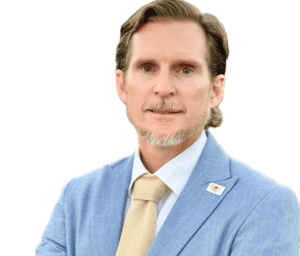
St. Croix attorney Russell Pate.
We must protect our islands, beaches, and culture while creating a more effective and accountable government. Our government should serve all Virgin Islanders — not just the elite and their special interests — but all ah we. Make sure to vote! Virgin Islanders risked their lives for equal rights to vote: Princess Breffu, General Buddhoe, the Four Queens, Queen Coziah — they fought for freedom, justice, dignity and equal rights. Your vote continues their fight for justice and fairness.
For voters and those running for office in 2026, I have some thoughts on reform. For most of the issues below, I have already drafted legislation.
Safe Communities
Justice Reform
Quality of Life
Economic Opportunity
Empowerment for All ah We
Safe Communities
a. Murders: Mainland states have fewer than 10 murders per 100,000 people, yet the USVI has 30 to 60 murders every year. Fear of murder of our children is on every parent’s mind, and it contributes to brain drain of our youth. Many of our promising Virgin Islanders leave the territory by high school. During the coronavirus pandemic the governor issued Emergency COVID Orders. The Senate should request the governor issue an Emergency Crime Order that will allow us to stop these outlaws killing our children. When criminals see consequences, violence will stop. Also, to double-down on violent crime; we ask the Feds to help prosecute more murders in the federal courts.
b. Gun Licenses: We have the strictest gun laws under the U.S. Flag, yet the highest murder rate per capita. Even the U.S. government is suing the USVI for unconstitutional overly-strict gun laws. After 40 years, we need to try something new. The criminal element has illegal firearms; while law-abiding citizens have a confusing and expensive firearm permit process. Our firearm licensing system evolved because U.S. Navy officers (who ran the V.I. from 1917-1931) believed in Jim Crow laws and did not want “colored” citizens to be armed for self-defense. Forty-three states have simple, straightforward gun licensing rules for law-abiding citizens. The Senate should just adopt the moderate rules of a small state, like Vermont or Maine.
c. Traffic Enforcement: We live on an island. We should have no deaths from traffic accidents. It’s innocent families who suffer when reckless or drunk drivers put every law-abiding driver at risk. It’s 5% of reckless drivers causing 90% of the accidents by overtaking, speeding, or driving while drunk or high. No family should suffer injury to their precious child, spouse, or grandparent because of a reckless driver. The Senate should work with Government House to bolster traffic law enforcement, along with making some key law changes, such as:
Dash-Camera Law: Dash-cam footage of reckless driving can be sent to the police department, so tickets can be assessed as a lien on the recklessly driven car. Community policing will make everyone safer.
Over-Service of Alcohol Law: 47 states out of 50 States and Washington, D.C., have laws against the over-service of alcohol; if a bar or restaurant has patrons highly intoxicated and sends them out to drive, and they kill, paralyze or harm an innocent motorist, the innocent person has a claim for reckless over-service; but not the drunk. The Virgin Islands has no law protecting innocent motorists (and innocent children) in this regard. You and your family members are on your own. In my legal practice, I have seen families bankrupted because they were hit by a drunk driver who carried only $10,000 in car insurance, while the surgeries and rehabilitation for a broken leg, arm, or brain injury were over $150,000. This loophole can be fixed by adopting the legal protections of one of 47 states or Washington, D.C., that protect their innocent citizens.
Insurance Coverage Law: When you’re hit by a reckless driver who then leaves the USVI to go back home (wherever in the world that may be), sometimes the insurance company will say “since you cannot find and sue the driver” you get no insurance coverage. This is unfair: We are islands with visiting tourists from around the world. We also drive on the left side, confusing unfamiliar drivers, contributing to our higher accident rates. A direct-action law allows innocent motorists to access the insurance that has been bought and paid for to cover their injuries, instead of insurance companies playing games. Guam, the North Marianna Islands, Puerto Rico, and many states have direct-action laws to protect their residents. I have a draft bill based on Guam’s law that will protect you and your family.
Justice System Reform
a. Court Delay: Justice delayed is justice denied. Just like an island-wide WAPA power outage, court delay affects every person. Businesses cannot quickly enforce contracts; people negligently injured do not have money for rehabilitation or surgery; parents die and children do not get their timely inheritance. The majority of the state trial courts clear 95% of criminal trials in less than 1.5 years and civil trials in less than 2 years.
b. Specialization: Efficiency comes from specialization. Each island has four trial judges, so I believe that each should specialize: Two judges can handle criminal cases, and the other two handle civil cases. Also, magistrates should be converted to full judges so they can handle all disputes, instead of being pigeon-holed.
c. Court Modernization: Our local courts do not follow the modern practices of the 50 states. Most state trial courts hold monthly motion hearings and rule from bench on the transcript record instead of writing lengthy published opinions.
d. Court Interest: The Virgin Islands had a 9% post-judgment interest rate, but it was reduced to 4% in 2000, yet most states have interest set at 9-13%. Justice delayed is a problem, but when interest is so low, those harmed are now double-harmed when their final payment is eroded by inflation and cost-of-living far outpacing the 4% interest rate. The 9% rate should be restored.
e. Witness Fees and Juror Pay: Juror pay and witness fees are tied to a 1957 law of $4 a day. I drafted Bill 35-0121 to raise juror pay and witness fees to modern values. That Bill passed Committee, but the whole Senate never voted on this simple modernization measure. The Senate should fix this so jurors are paid in 2026 dollars, not 1957 dollars.
f. Delay and Death: There are some cases pending in court for 10, 20, or even 30 years. We are human. People die. The USVI has a unique and bizarre substitution statute for death, 5 V.I.C. § 78, which unfortunately can disqualify people who patiently waited but died before court resolution. The Statute should be amended to follow the federal substitution rule that is used by all the federal courts and most states. Or the Statute deleted, so the court adopted the federal rule.
g. Statute of Limitations: When a person is hurt wrongfully, he or she has two years to sue. However, many injured people must travel off-island for medical care and may not return within the two-year window. Most states have three years (or more) as their limitation period, even though those states have adequate medical care right at home. It would be more fair if the USVI moves to three years to ensure that our residents are taken care of medically and financially.
h. Bad Faith Insurance Law: In all 50 states, when there is a disaster, be it a fire, earthquake, hurricane, or car accident, there’s a clear law, called a “Bad-Faith Insurance Law,” that makes sure the insurance company is protecting the best-interests of the insured. Unfortunately, the USVI has no Bad-Faith Insurance Law Statute. Thankfully, Judge Almeric Christian wrote clear case law in 1981 setting a common law Bad-Faith Standard. Still, having the Senate codify Judge Almeric Christian’s standard into Statute would make the law clearer, help encourage earlier amicable settlements and reduce delays in the courts.
i. Judges: Judges are initially nominated by the governor and confirmed by the Senate. However, after six years, judges are re-nominated by the governor. This keeps judges under the thumb of the governor, who directs the Department of Justice in handling every criminal prosecution and government civil lawsuit in court. Most states use a governor to initially nominate, but then use either their Legislature, a special committee, or retention-elections to decide judicial retention. Judges should be independent. The USVI should have the Senate handle retention, so that a judge’s track record, rather than relationship to a governor, can be assessed for re-nomination.
Quality of Life and Infrastructure
a. Beach Access: In 25 years Dorsch Beach in Frederiksted will be no more. Villas and condos will cover the beach, with fence lines right up to the road. Gone will be the days of parking near the beach, carrying food and chairs, and children running to the beach. The 1971 Open Beach Access Law is 55 years old. It must be updated to mandate that all roads near the beach have a 12-foot easement on either side for parking, so emergency vehicles can pass. All beachfront housing must have easement public parking and access walkways on the side of the property to the beach. If we don’t protect beach access, it will be lost to our children’s children.
b. Roads and Sidewalks: We live in Paradise. Every man, woman, and child should be able to walk across the island in safety. Sidewalks must be a priority. With sidewalks, locals and tourists alike can walk, jog, or run from Frederiksted Pier to Point Udall or on St. Thomas from Port to Paradise Point. Like other islands, we should use traffic circles. Traffic circles are hurricane-proof, with no stoplights to lose power or be knocked down by wind. Potholes are also a risk to road safety. We should utilize a brigade of good behavior inmates to assist in filling the many potholes around our islands that turn a simple commute into a nightmare.
c. Derelict Buildings and Historical Preservation: Derelict buildings foster crime, litter and ruin island pride. Historical areas like New Orleans have derelict building laws. A building that cannot be renovated to be productive rots away. The Historical Commission tends to focus on people who are actively trying to remodel old buildings, yet does nothing about the hundreds of structures falling into ruin. People attempting to improve old buildings should not be punished. The Historical Commission should be directed to focus only on abandoned derelict buildings.
d. WAPA and Solar Power: The Virgin Islands is in the tropics. The sun is our No. 1 resource. We should have the best laws encouraging solar power. After hurricanes Irma and Maria, the federal government promised $4 billion to WAPA. That is more than $40,000 for every man, woman, and child in the Virgin Islands. We should channel funding to solar panels for every home and business. No more WAPA bills. No more random outages. No more diesel needed for generators. Free solar energy to power homes and electric cars. No more buying gasoline. No more car exhaust. No more road smog; only pure Caribbean air.
e. Uber and Taxis: We live in the 21st century. The Taxicab Commission is a disaster. Tourists expect Uber and Lyft. Not having modern ride-share services is like the USVI not accepting credit cards. Further, people use these apps for safety, security, and peace-of-mind that their location and trip is being tracked. Further, modern taxi services cut down on drunk driving deaths and accidents. It’s time to deregulate and let more people enter into the transportation business. Young people should have the opportunity to open up a transportation business, or drive for Uber and Lyft, for the convenience of both locals and tourists.
f. Tourism: Tourism is best improved by focusing first on Virgin Islanders. Fix WAPA, fix the roads, have sidewalks, fix old buildings, stop the murders, have a working taxi system, in sum, take care of residents (and tourists will benefit too).
Economic Opportunity
a. Tax Refunds: Tax refunds are the people’s money, not a forced government loan. Perhaps we should consider that no salary shall be paid to the governor, lieutenant governor, commissioners, and senators, until yearly tax refunds are paid.
b. Get Government Out of Business: Government should never be in business. In a free, fair, and open democracy, businesses are the players, and the government is the referee. A referee makes sure the playing field is even and that no one is cheating. A referee should never step into the game and play. Business decisions by the Government of the Virgin Islands have been one disaster after another, and it is time to put an end to this chain of events.
c. One-Stop-Shop for Business: A business license requires the business owner to navigate the complex red-tape at DLCA, DPNR, Fire Services, BIR, Finance, Labor, Department of Health, and others. We need a One-Stop-Shop for business compliance. A One-Stop-Shop where people are greeted: “Good day taxpayer, how may I help you.”
d. EDC (Tax Credits): The USVI rolls out the red-carpet using tax credits for stateside millionaires, while our Virgin Islanders’ children are told to “do their best” in crumbling schools. Tax subsidies are used as a Band-Aid for larger problems. The USVI should be fair to all businesses, local and stateside, by removing red-tape regulations, making government offices more helpful, overhauling the gross receipts tax, and removing the need for “connections.” Once we have a fair system, no tax subsidies would be needed to draw foreign businesses to the USVI.
e. Teachers and Doctors: What is wealth, without health? If you are sick, how can you work and be productive? How can our children lead the USVI (and the world) if they are not properly educated in clean and healthy schools? You do not build a house from the top to the bottom. Tax credits for EDC/EDA focus on the top, when our children and our health are the real foundation of a productive society.
We need more teachers in our territory. And, our children deserve the best teachers. We should modify our tax laws so that local schoolteachers from pre-K to UVI only pay ½ tax to the BIR. This can encourage qualified teachers to remain in the territory. The foundation of every successful society is the education of its children.
All medical professionals (MDs, DOs and RNs) should be exempt from Gross Receipts, to encourage more health-care professionals to practice in the USVI.
The USVI has a dangerous law called Certificates of Need (CONs) that reduces health care. These CONs create needless hurdles for doctors to open up new hospitals, clinics, surgical centers, and to buy new modern equipment. We want the USVI to have the best doctors and most modern equipment so that the USVI can be a medical destination, instead of a medical desert. We should abolish CONs from the VI Code.
Empowering Virgin Islanders (this lion should roar!)
Virgin Islanders have always fought for their Human Rights: 1733 St. John slave rebellion, 1848 Emancipation, 1878 Fireburn, and 1892 Dollar-for-Dollar coal strike. The USVI was purchased in 1917. Waiting 109 years for equal treatment is too long. Don’t give up on the fight for equality.
a. End the Custom Zone: Puerto Rico is inside the Custom Zone, while we are outside. We should end the discriminatory Custom Zone; the indignity of going through Custom screenings at the airport (where your phone, tablet or laptop can be searched without a warrant or even reasonable suspicion) and being treated like second-class citizens. Also, end the frustrating and arbitrary duties on cargo shipments. Perhaps the best solution is to have it both ways: we keep two special ports for St. Thomas and St. Croix outside the Custom Zone, but allow the rest of the islands to be inside the Custom Zone; a win-win.
b. Elected Attorney General: We should change the laws to have elections for a Virgin Islands Attorney General who serves the people, not the governor. An elected Attorney General has independence to investigate local corruption. Also, for the nay-sayers, the Revised Organic Act doesn’t not bar this change. The A.G. should be elected in off-governor election years.
c. Numbered Senate Seats: Senators competing against each other in elections makes it harder for them to work together to create effective laws. A simple fix is “numbered seats” where each senate seat has an assigned permanent number. Then candidates can run for a specific seat number. Numbering seats is a better solution than sub-districting because it avoids partisan districting maps. Also, numbering reduces the “bullet vote.”
d. Our Own Constitution: The USVI has had five Constitutional Conventions. All failed (and cost millions). The Revised Organic Act (ROA) is already our Constitution. Just adopt the ROA and create a simple amendment process, like a super-majority vote in the Senate, so Virgin Islanders will finally be in local control of their rights and their destiny.
e. Military Draft: The USVI has one of the highest rates of military service, with heroes fighting for freedom abroad in WWI, WWII, Korea, Vietnam, Iraq and Afghanistan, while freedoms and equal rights are denied at home. The Senate should draft a resolution for our young men NOT to be drafted, until we have the right to vote in Congress and for the U.S. President. The United States’ 250th birthday is in 2026; for that celebration, the best gift the United States can give itself is equality for ALL its citizens.
f. The VOTE in Washington: The Senate can change the election laws so we can vote for two Senators and a Representative in Congress. When we elect our three congressional representatives, we charter an airplane and fill it will military veterans (holding pictures of other veterans killed or injured in foreign wars) to escort our representatives to Congress to their rightful seats in the House and Senate.
g. European Union: For 109 years, the United States has treated Virgin Islanders as second-class citizens, refusing voting rights and equal rights to U.S. citizens in the USVI. We must stand up for ourselves. It’s possible the USVI could be traded to Denmark for Greenland, or sold outright. We should explore whether the European Union will allow the USVI to join their Parliament. This is an option of last resort. But if the USA says we will “never be equal,” or seeks to trade or sell the USVI, we should have a back-up plan.
— Russell Pate is an attorney on St. Croix.
Editor’s Note: Opinion articles do not represent the views of the Virgin Islands Source newsroom and are the sole expressed opinion of the writer. Submissions can be made to visource@gmail.com.
The sound of gunfire echoed across Peter’s Rest early Sunday morning, as more than 100 rounds were fired in the area near Carlos Bar, according to the Virgin Islands Police Department.
The 911 Emergency Call Center received a ShotSpotter alert around 4:50 a.m., with multiple residents also calling to report what officials described as an “enormous amount” of gunfire.
Shortly after, staff at the Juan F. Luis Hospital reported that two gunshot victims had been dropped off in a private vehicle. Both individuals were admitted and are being treated for injuries sustained in the incident.
Officers, along with detectives from the Criminal Investigation Bureau and forensic units, responded to the scene as the investigation got underway. Authorities have not released additional details, and the incident remains under active investigation.
Crime Stoppers is offering a cash reward for information leading to an arrest. Anyone with information is asked to call 1-800-222-TIPS or 911.