



Plaskett and Bryan Call for U.S. to Disavow Racist Rulings

EPA Slams Port Hamilton’s Bid to Dodge Consent Decree Mandate
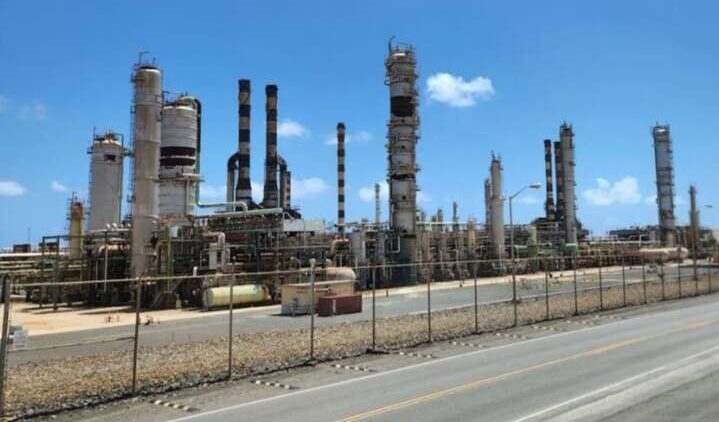

When it purchased the shuttered St. Croix refinery at a bankruptcy auction in December 2021, Port Hamilton Refining and Transportation was fully aware that, under a federal consent decree governing the facility since 2011, it must install a flare gas recovery system before restarting operations, the EPA said in a court filing Friday.
The agency was responding to a motion Port Hamilton filed last month seeking “judicial clarification” of the consent decree that was modified to include Limetree Bay Refining after it purchased the refinery in December 2015 from founding owner Hovensa, which had idled the refinery in 2012 and declared bankruptcy in September 2015. Limetree subsequently declared bankruptcy in June 2021, with Port Hamilton emerging as the successful bidder in a deal that was finalized on Jan. 21, 2022 for $62 million.
At issue is whether Port Hamilton must install a flare gas recovery system, or FGRS, before it may restart the refinery. The company claims that under the modified consent decree, Limetree Bay was allowed to resume operations with the caveat that it would have two years to install an FGRS if it exceeded Clean Air Act emissions standards — and Port Hamilton should be allowed to do the same.
Without that guarantee the facility might not reopen “because the purchase, installation, and operation of a flare gas recovery system would require a substantial expenditure of resources that could prevent Port Hamilton from restarting the refinery or, upon restart without such a system, would expose Port Hamilton to enforcement proceedings, including significant penalty claims,” according to its motion.
The EPA argues that Limetree was given that latitude because the modified consent decree was still being drafted when it proposed restarting operations in April 2018 after 18 months of mandated evaluations of the plant, and under the original decree, the deadline for installing an FGRS was less than two months away.
It’s not an uncommon approach in such cases, given that “[t]he alternative of requiring a defendant to stand still until a consent decree is entered at some future unknown date creates too much uncertainty,” the EPA said in its response.
The first modification of the decree was lodged with the court on Aug. 25, 2020, and after numerous hearings was entered by the court on Dec. 30, 2021, after Limetree Bay’s restart efforts that proved disastrous.
“LBR’s operations between December 2020 and May 2021 resulted in at least six significant air emissions events, including emissions from Flare 8. On May 14, 2021, after determining that the Refinery operations presented an imminent and substantial endangerment to public health or, welfare, or the environment,” the EPA issued an administrative order for the refinery to temporarily cease operations.
On June 12, 2021, the United States filed a complaint against Limetree Bay in V.I. District Court for violations of the Clean Air Act, and that same day the company filed for Chapter 11 protection in the U.S. Bankruptcy Court for the Southern District of Texas.
Port Hamilton now contends in its filings that since the two-year deadline for installing an FGRS was not in effect when Limetree restarted, it should be allowed to restart to prove it can operate without such a system and then have two years to install one if it exceeds Clean Air Act standards.
In its response, the EPA called Port Hamilton’s argument a “red herring because when they (and West Indies Petroleum Limited) purchased the Refinery in the LBR bankruptcy, Port Hamilton knew full well 1) that they would be governed by the First Modification, 2) that the enforcement of the FGRS mandate in the First Modification would take into account the post-lodging activities occurring prior to the effective date, and 3) that if the First Modification does not govern on this issue, then Port Hamilton is bound by the original Consent Decree which clearly requires installation of the FGRS.”
Regardless of whether it is the first modification or the original consent decree that governs, “the FGRS must be installed and operational before Port Hamilton restarts the refinery, the EPA said.
“Paragraph 50B [of the modified decree] gave LBR the opportunity to demonstrate that it could operate the Refinery without the need to install FGRS. However, it also made clear that if LBR exceeds the gas flow rate threshold, as specified in Paragraph 50B.a.i, during the first year of operation, then FGRS must be installed on the FCCU Flare. Once the obligation is triggered, Paragraph 50B.a.i provides two years for the installation and operation of the FGRS,” it said.
Moreover, despite titling its motion as one seeking clarity, “Port Hamilton’s Motion is a motion for relief under F.R.C.P. 60(b). Port Hamilton has neither alleged nor met the standard for such relief. Port Hamilton’s Motion should be denied,” the EPA argued, citing federal rules of civil procedure governing relief from a judgment or order.
As a stand-alone flare, Flare 8 is a safety device used to burn off excess gasses to prevent the dangerous buildup of pressure in refinery equipment, the EPA said.
“Flare 8 is also an air pollution control device that destroys volatile hazardous air pollutants, volatile organic compounds, methane, and hydrogen sulfide (H2S). The burning of excess gasses in Flare 8 results in the emissions of air pollutants, including carbon dioxide (CO2), sulfur dioxide (SO2), and H2S, into the environment,” it said.
“The purpose of the FGRS required under the Consent Decree is to recapture and repurpose the excess gasses as a fuel to produce usable energy, thus reducing emissions from the flare and ensuring compliance with emission limits that apply at the flare. This also enables the Refinery to use less of other fuels at the Refinery, resulting in reductions in the amount of CO2, SO2, H2S, and other air pollutants being emitted into the environment from the Refinery,” according to the EPA’s motion.
Port Hamilton’s actions for the first 17 months after acquiring ownership of the refinery made it clear that it understood the obligation to install an FGRS, the agency said, citing the company’s weekly progress reports that stated as much.
However, after that time Port Hamilton changed its position, filing a motion for an information status conference in which it alleged for the first time that “[t]here is no obligation to install a flare gas recovery system,” according to the EPA. U.S. Magistrate Judge Emile A. Henderson III denied that motion.
“Port Hamilton is now looking for a loophole that will allow it to restart the Refinery without installation of the FGRS as required by the First Modification and the original Consent Decree,” the EPA states in its motion.
“Port Hamilton … made strategic decisions to purchase a refinery, that LBR invested $4.1 billion into over a five-year period, for $62 million. Those decisions were made with the full understanding of the FGRS obligation under the Consent Decree and the First Modification, with the full understanding that LBR had triggered the requirement to install the FGRS, and the full understanding that the FGRS was required to be installed by March 14, 2023,” according to the EPA.
“Despite 1) taking initial steps (including hiring engineers to develop the design basis and the mechanical design for the FGRS) to comply with the FGRS obligation; 2) making representations to the United States from February 2022 through April 2023 that the FGRS design work continued; and 3) having 26 months (and counting) to design and install an FGRS, Port Hamilton’s Motion argues that the company is under no obligation to install the FGRS and that requiring it to install the FGRS prior to restart would be inappropriate and inequitable,” it said.
“The primary purpose of the Consent Decree to protect public health and safety from excess air emissions would not be served by a delay in the requirement for installation of the FGRS,” the EPA concluded, urging the court to reject Port Hamilton’s motion.
V.I. District Court Chief Judge Robert A. Molloy is presiding over the case, USA et al v. HOVENSA LLC et al, and had not ruled on the motions as of Wednesday afternoon.
Cannabis Board Approves Rules and Regs, Announces New OCR Executive Director


The Cannabis Advisory Board (CAB) convened on Wednesday to finalize the approval of published rules and regulations and to announce Joanne Moorehead as the Office of Cannabis Regulation’s new executive director.
“I’d like to extend my gratitude to the board for having the confidence in me and the job that I will be doing as the new executive director,” shared Moorehead, who has 15 years of experience in non-profit administration and fundraising. “I would also like to echo the board’s comments that the former executive director did an amazing job, and I look forward to continuing that trajectory so that we can finally realize the vision that started with the Cannabis Use Act and the Office of Cannabis Regulation.” Five candidates had applied for the position, board members shared.The published rules and regulations, meanwhile, were released on Feb. 14, marking a significant milestone in the Virgin Islands’ cannabis industry. The board’s decision to approve them, made in a unanimous vote, solidifies the framework for the Office of Cannabis Regulation (OCR) and signals a pivotal moment in the evolving cannabis landscape.
Chair of the Cannabis Advisory Board, Dr. Catherine Kean, expressed her satisfaction with the outcome, stating, “This is a historical moment. I have been on the board for five years and I am just really happy that we remained dedicated to going through multiple versions of these rules and regulations to where we can finally approve them and move forward.”
The newly approved rules and regulations, which have been in development for over a year, will serve as a foundational framework for the OCR. Terrence Positive Nelson, a board member, remarked, “I am very pleased that we’ve made it to this point. I’m looking forward to the day when I can join the general public in walking to a public dispensary and purchasing some V.I. produced cannabis.”
During the meeting, board member Richard Evangelista provided an overview of public comments received during the 30-day comment period. Two areas that received the most feedback were: Section 777-14E1, which addresses the amount of product that a cannabis manufacturer must purchase from unaffiliated third parties monthly, and Section 777-14F, which eliminates the requirement for a manufacturer to purchase or acquire 15 percent of the cannabis in its inventory for manufacturing.
In response to the comments, Kean stated, “We thank the public for the comments given to us, they are all very insightful and at some point, we will try to address most of the comments in a manner that befits rolling out the product safely.”
New Seven Flags Museum Features Antiques from Around the World

Most people know Teddy Richards for his catering and elegant cooking, but after collecting antiques for 30 years, he opened the Seven Flags Museum a few months in downtown Christiansted. Now he can host events, cater and display elegant antiques at the same time.
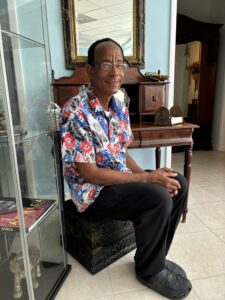
He considers his ability to spot beautiful and valuable antiques, as a “gift from God.” Many of the items are not for sale because they are so unique.
“They’re one of a kind,” Richards said, referring to one of the large armoires he says is one of his favorite pieces. That wardrobe and other heavy furniture won’t be moved “until Jesus comes,” he added.
Richards’ collections include dozens of fine china plates from around the world. Around a dozen moko jumbies – adults and children – overwhelm the senses with color and size, at the entrance to the museum. There are clocks that run on batteries, representing each time zone, in the main room. They are reset before each event.
The collection of teapots, in another room, is extensive and includes a hot beverage receptacle from Egypt.

Other collections, displayed in highly-polished furniture cases and groupings, are from Denmark, England, France and America and were either donated or purchased on St Croix. One piece of furniture is identical to a cupboard seen in the historical-drama television series, “The Crown,” Richards told the Source.
The collection of shoes, in the back room, includes vintage boots, fashion heels, cowboy boots and antique shoe molds. There also are mugs shaped like shoes and a glass table set on an ornate black mid-sized heel from the last century.

A collector leaving St. Croix gave Richards “thousands” of ceramic hands and only about five percent are on display. He plans to rotate the statues.
The sugar mill room includes renderings from the sugar mill period. There is a big dinner bell that Richards uses to get attention during exhibitions.

A single statue – a large head – rests on top of one of the large armoires. Richards said it came from the iconic Violette Boutique, a local boutique that sold exclusive perfumes.
The Seven Flags Museum is open to the public. General admission to is a $7 donation. Adults with disabilities and senior citizens over the age of 60, are admitted free. People can also schedule private tours.
Annual memberships are $70 for an individual or $270 for a family. Members qualify for free admission, complimentary admission for a guest, quarterly newsletters, early access to exhibition tours and member-only events. Members also enjoy priority reservations for pop-up events.
DiasporaLink Act Could Save Internet Provider, viNGN Says
St. Thomas Native Excels in U.S. Navy; Plans Return to Give Back


Senior Chief Petty Officer Asiem McBean, from St. Thomas, serves in the U.S. Navy and is assigned to Strike Fighter Squadron (VFA) 106, which operates the U.S. Navy’s F/A-18 Super Hornet, nicknamed the Rhino.
McBean, who joined the Navy 24 years ago, believes the skills and values needed to succeed in the Navy are similar to those found in St. Thomas, according to a press release.
“Growing up, I learned to always work hard, no matter the limits or limitations put on you,” said McBean. “Some people see something is hard and they give up on it. I punch through and try all I can to get it done.” “I was recruited by the Navy to be on their track team,” said McBean. “I picked up rank quickly so I gave up the track team and decided to become an aviation machinist’s mate.” McBean currently works to support the Super Hornet demonstration team. The mission of the Rhino demonstration team is to share the rich heritage of naval aviation and display the hard work and dedication of U.S. Navy service members to the public, the release stated. McBean has many opportunities such as this to achieve accomplishments during his military service, stated the release. “My proudest accomplishment is the personal relationships I have built,” said McBean. “When people treat you like family they become your family. When your time in the service is finished, you will still have those people you built those relationships with.””It means the world to me to serve,” said McBean. “To have the opportunity to be an ambassador for the Navy to the people in my community and the kids I coach in soccer is very rewarding.” According to the release, McBean is grateful to others for helping make a Navy career possible. “I have to thank my parents for the opportunity to join,” added McBean. “I was 17 and they had to give me permission to sign up. There have been so many mentors along the way and what they put into me in terms of time and caring has made me successful.” McBean has big plans for his future after military service, the release stated. “I want to return to St. Thomas and be a governor for the Virgin Islands,” added McBean. “I want to let people know there are opportunities out there and the military is one of those options that can be a stepping stone. I want others to see they can come back here afterward and change things that will help the people.”VIPA Unveils State-of-the-Art Transportation Facility at Cyril E. King Airport


Tuesday marked a major milestone for residents and visitors alike, as the Virgin Islands Port Authority (VIPA) unveiled its newly completed multi-level transportation facility at Cyril E. King Airport on St. Thomas, named in honor of VIPA’s former Director of Engineering, Dale A. Gregory. It will be open to the public beginning Monday, April 22.
The facility boasts a myriad of features aimed at improving both convenience and accessibility for travelers, including 311 paid public parking spaces and nine accessible parking spaces. Speaking at the unveiling ceremony, VIPA Executive Director Carlton Dowe expressed his pride in the project and the significance of naming it after Gregory.
“For what Dale Gregory meant to this Authority, I believe it was only fitting that this facility that he spent so much time at, and this place that he called his home away from home and gave so much of himself to – that the best thing to do was to name this building, this facility in his honor.” Dowe added, “I couldn’t think of a better person.”
Gregory began his journey with VIPA over 40 years ago, ultimately becoming the director of engineering. Throughout his tenure, he played a pivotal role as the lead engineer and project manager for multiple major capital projects, where his leadership and expertise were instrumental in spearheading the modernization and enhancement of airports and seaports across the territory.
“Today, as we gather to dedicate this transportation center in my name, I’m reminded of the countless individuals who have supported and collaborated with me over the years,” shared Gregory. “This honor is not just mine. It belongs to every person who has been a part of this incredible journey. I would like to extend my heartfelt gratitude to the Port Authority for this recognition.”
Designed by Kimley-Horn and Associates and constructed by AT Construction Solutions, the new facility includes a dedicated floor for taxis and other ground transportation along with a centralized car rental area that will create a more efficient and streamlined transportation experience for travelers.
“I take delight in seeing continued investment into our tourism product. Year to date tourism air arrivals are up 28 percent for the territory,” noted USVI Department of Tourism Commissioner Joseph B. Boschulte. “Our best year in air arrivals was 2022, and currently we’re up 15 percent compared to those numbers.”
Funding for the project was made possible through a combination of sources, including a substantial hurricane recovery grant from the US Department of Commerce-Economic Development Administration, as well as a local match provided by VIPA.
Emphasizing the collaborative efforts between the federal government and local stakeholders, Linda Cruz-Carnall, regional director of the US Economic Development Administration (EDA) noted, “In 2019 EDA was proud to provide $20 million towards the construction of this facility. It was our goal to help improve transit access and operational capacity to drive both economic recovery and resilience following the devastation caused by hurricanes Irma and Maria.”
Dowe noted that while the project was part of a larger goal to continue modernizing the territory and advancing its infrastructure, VIPA was resolute in its commitment to ensuring local engineers and contractors played a significant role in the project.
Closing out the ceremony, Gov. Albert Bryan Jr., offered a few final thoughts, adding, “Change is hard, and progress is even more difficult…we make commitments to fix things as an administration, but if we make a commitment to fix things as a community, there’s nothing we cannot accomplish.”
Two Killed in Single-Car Crash on St. Thomas, Officials Report


Two people are dead following a single-car accident just after midnight Tuesday on Weymouth Rhymer Highway on St. Thomas, the V.I. Police Department and St. Thomas Rescue reported.
According to Public Information Officer Chris Watson, St. Thomas Rescue was notified of the crash at 12:48 a.m. Tuesday by the V.I. Territorial Emergency Management Agency, which reported that people were said to be trapped in the vehicle.
Upon arrival at the scene, medical personnel determined that the occupants of the car were dead, and St. Thomas Rescue, the V.I. Fire and Emergency Medical Services and the VIPD undertook a joint operation to extricate the victims using mechanical means, according to the press release.
Police spokesman Glen Dratte said the accident happened when a silver Acura TSX traveling east on Weymouth Rhymer Highway between New Herrnhut Road and the Donoe Bypass lost control and climbed the embankment of the shoulder of the eastbound lane. The right side of the vehicle then struck a tree, causing injuries to the driver and the passenger, he said.
Next of kin identified the driver as Vernon Ferris, 28, and the passenger as Tiniesha Smith, 29.
Christianne P. John Dies at 79


Loanna Cameron-Vanterpool Dies at 69