Campbell Ottile Francis Sr.
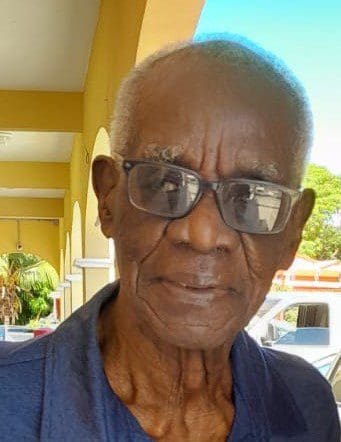
Mr. Campbell Ottile Francis Sr. died on Saturday, Oct. 7. He was affectionately known as “Nat King Cole” because of his singing abilities and “Brother, the Black Frenchie.”
He was preceded in death by his wife, Albertha Francis.
He is survived by his sister, Winifred Scott; children: Curby Francis, Alvion Francis, Campbell Francis Jr. and Zenobia Francis; grandchildren: Ajani George, Aminah Abdullah, James Gunter, Richard Gunter, Campbell Francis III, Jessica Francis, Jalissa Francis and Ah’Venique Francis; great-grandchildren, Raina Thomas, Al-Kawan Sullivan Jr., Gabriella Francis and Greyson Shines; niece, Rita Robbins; nephew, Jeffrey Scott; and other family and friends too numerous to mention.
His Celebration of Life services will be held on Saturday, Oct. 28, at Blyden Memorial Chapel. The viewing will be held from 9-10 a.m., followed by a memorial service.
Expressions of sympathy to the family may be made online at www.turnbullsfuneralhomevi.com.
Gov. Albert Bryan Jr. said people in four St. Croix areas should not use WAPA water and others should be wary. (Screenshot from Government House live feed)
Do not drink, bathe in, cook with, or even brush your teeth using water from municipal pipes containing extraordinarily high levels of lead and copper in parts of St. Croix, government officials warned Tuesday.
Gov. Albert Bryan Jr. issued a “no drinking” advisory for Water and Power Authority water in Estates Diamond, Castle Burke, Colquhoun, and Mon Bijou late Monday. Boiling water does not remove these harmful metals.
Cistern water remains safe, he said, but warned WAPA water could be connected in unexpected places, such as the Government House ice maker. Likewise, water outside the four elevated-contaminant-level areas should have safe drinking water but avoiding it or running WAPA-connected pipes for three to five minutes was not a bad idea, Bryan said.
“So if you’re not mentioned in the area, more than likely your water is safe. If you feel safer just using bottled water for now until we retest the system, please go ahead and do so. Once again, there is no cause for panic,” he said.
Tests conducted Sept. 30 and returned to the territory Oct. 13 showed elevated amounts of lead in 35 of 65 test sites and elevated copper levels at 15 sites. A few test sites revealed dangerously toxic water.
Lead levels in one pipe tested at more than 1,340 times the threshold set by the Environmental Protection Agency. Another site had 601 times the lead considered an EPA “action level.” Another test site had water with more than 105 times the allowable copper levels. Exposure to either metal at those levels can cause severe, long-lasting health problems, federal officials warn, especially in children.
WAPA urged people in affected areas not to use their water for baby formula. Lead exposure can cause developmental disabilities in children, especially the very young.
Don Gregoire, WAPA’s director of water distribution, said in most cases, the test site pipes returned to safe or non-existent lead and copper levels after water was flushed through for three to five minutes.
“In four cases, samples exceeded the EPA action level even after the flushing. EPA is also actively providing technical assistance, including assessing the underlying cause of the lead and copper and planning for additional samples and analysis as soon as possible,” Gregoire said. “If you are concerned about lead exposure, you may want to ask your healthcare provider about testing to determine lead blood levels.”
Since 2021, the Centers for Disease Control and Prevention has set the acceptable limit for lead in a child’s blood at 3.5 micrograms per liter. Blood levels above 10 micrograms are cause for concern, according to the CDC. The worst of the water recently tested was 20,100 micrograms per liter.
Acute exposure to high amounts of lead can produce abdominal pain, cramps, and vomiting. Brief exposures to low or moderate lead levels may not cause any specific symptoms, but continued exposure to lead may cause encephalopathy — a range of disorders that affect mental function, according to the CDC.
Bryan described a fluid emergency-response operation where a protocol with the Health Department was still being worked out.
Gregoire urged people to drink bottled or cistern water and run their WAPA tap water for several minutes before bathing.
“Avoid using hot water, as lead dissolves more easily in hot water. Boiling water does not remove lead,” he said. “When bathing, use cold water for a brief amount of time, as lead can also be absorbed through the skin and the eyes. Identify and replace plumbing that contains lead in the house. Brass, faucets, fittings, valves, including labels that indicate lead-free may still contribute to lead in drinking water.”
Bryan said pallets of bottled water had been delivered to affected schools and warned bottled water sellers and other private water distributors to not raise prices during a possible demand increase, saying illegal gouging would be penalized.
“This morning, we were delivering pallets to schools, schools specifically affected include John Woodson, which is virtual right now, the Complex and several others. We’re asking water vendors to maintain reasonable prices on this essential commodity. We will not hesitate to penalize and punish anybody who has taken advantage of our residents and this current situation ’cause it’s very serious. Furthermore, if further testing confirms unsafe levels in these areas, we will consider issuing a state of emergency that will avail us to the resources of FEMA and the federal government,” he said.
Hours earlier, Sen. Angel Bolques Jr. called on Bryan to direct the Licensing and Consumer Affairs Department to institute a price freeze on all water sales on St. Croix.
“This price freeze should encompass bottled water, water hauled for human consumption, and water filtration products. In light of recent concerns about price gouging, we must prevent any opportunistic exploitation of our residents during this crisis. Price gouging in times of need is not only morally reprehensible, but it undermines the well-being of our people. Water is the most precious resource for human survival. In these challenging times, we must ensure that our people are not deprived of adequate drinking water or taken advantage of due to the ongoing crisis at the Virgin Islands Water and Power Authority,” Bolques said.
The EPA said approximately 13,000 of St. Croix’s roughly 41,000 residents depend on WAPA water.
The problem did not originate at the WAPA water plant or in the main lines but in smaller pipes, Bryan said, especially those that had maybe not been used in a while.
EPA officials told WAPA and the Department of Planning and Natural Resources that “the high lead levels may be impacted by stagnant water combined with aging infrastructure.”
While the source of the lead had not been identified, leaded solder or lead joints in the distribution system — possibly at the meter where some of the samples were taken — could account for the contamination. “There may also be brass couplings connecting copper lines and other brass plumbing in the distribution system,” EPA officials said.
The governor said all the territory’s WAPA water was regularly tested and had not shown elevated lead or copper levels. Earlier St. Croix tests in September had come back normal.
Early in September, many St. Croix WAPA customers started noticing discolored water from the tap. This prompted the authority to do additional testing. The EPA lab results showed unexpectedly high lead and copper levels, but not in all the brown water.
“Some good news is that we recently discovered that we do have a machine at the Department of Health now that can identify lead in water,” Bryan said. “Part of the challenges is we don’t really have labs on the island and the EPA was giving us one or two weeks in terms of return. We have identified some labs in Puerto Rico where we can get two-day return on results. So after we finished flushing all of this system out, we’re going to get these lab samples.”
While water testing may be streamlined, getting information to people possibly drinking the dangerous water was initially slow. The EPA’s response letter outlining the extent of the lead and copper was dated Oct. 12. WAPA said they were not informed of the findings until late afternoon Oct. 13. The authority then double-checked their public advisory about the contaminated water with the EPA and DPNR, issuing a media release after 4 p.m. Saturday, Oct. 14 entitled “Authority Collaborates for Water Quality Enhancements with Additional Technical Assistance.” Government House said Bryan was not briefed until Monday morning. Bryan’s “no drinking” advisory wasn’t sent to media outlets until after 8 p.m. Monday — four days after EPA labs tested extraordinarily high lead and copper levels in public drinking water.
Bryan said aside from having people avoid the water, his priority was testing, flushing the lines, and retesting. If it doesn’t get better, he was prepared to use Virgin Islands Territorial Emergency Management Agency resources.
“Once we ascertain that this is truly a full-blown emergency and we confirm these tests, then VITEMA and FEMA and the Virgin Islands Emergency Management System will be taking over and we will be figuring out how to get water, drinking water to our residents. And that may include getting trailers of water and bringing it to residents. We know we really don’t want to go there. That’s a lot of logistical nightmare, trying to figure out who lives in those areas. So we’re just asking people to be patient. The prudent replacement and everything else for the water system is moving along,” Bryan said.
As for a long-term solution, replacing the island’s pipes could take five or 10 years to replace, if needed, Bryan said. WAPA CEO Andrew Smith has said it was more likely closer to 20 years to do the whole island.
The presence of lead pipes isn’t a new revelation. In December 2021, Congressional Delegate Stacey Plaskett announced nearly $32 million in funding to replace lead pipes via President Joe Biden’s Bipartisan Infrastructure Investment and Jobs Act.
Bryan, ever the optimist, said the territory was up to the task.
“If we figure out we have a situation where we need to replace a certain level of pipes or whatever in order to get the clean water back to where it needs to be, we can just move ahead and do that. We’ll find the resources to do that. That’s not a problem,” he said.
On Wednesday morning, Government House announced that two Health Department hotlines are available for residents to call from 8 a.m. to 5 p.m., Monday through Friday, with any concerns regarding health related to water quality. Individuals may call 340-712-6299 on St. Croix and 340-776-1519 on St Thomas-St. John. The Department of Planning and Natural Resources also operates a hotline number, 340-514-3666, Monday through Friday from 8 a.m. to 5 p.m.
The Health Department advises the community that testing for lead exposure is available at the Frederiksted Health Center on St. Croix and the East End Medical Center at Tutu Park Mall on St. Thomas.
A Texas bankruptcy court judge involved in USVI cases resigned on Monday after the Fifth Circuit Court of Appeals issued a formal complaint against him, finding that he should have disclosed a romantic relationship with an attorney who until December worked for a firm that regularly brought cases before him.
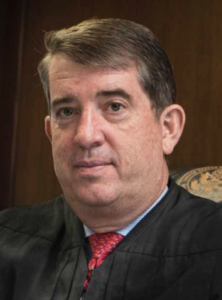
Judge David Jones
Judge David Jones of the U.S. Bankruptcy Court in Houston is the mediator in a lawsuit brought by 900 Virgin Islanders over asbestos injuries when Hess Corp. subsidiary HONX owned the St. Croix refinery. His longtime girlfriend was an attorney with Jackson Walker LLP — the lead counsel for the defense in the HONX case and dozens of others — until she left to start her own firm in December.
In her complaint dated Friday, Chief Judge Priscilla Richman with the Fifth Circuit Court of Appeals in Louisiana wrote that “there is probable cause to believe that misconduct by Judge Jones has occurred.” In particular, the Code of Conduct for U.S. judges provides that they should avoid impropriety and the appearance of impropriety in all activities, she said.
The Wall Street Journal first reported on the apparent conflict Oct. 7 after a plaintiff in another case sued Jones, alleging his relationship with Elizabeth Freeman tainted his rulings while he was presiding over the 2020 bankruptcy of offshore-drilling company McDermott International, represented by Jackson Walker LLP.
The plaintiff, shareholder Michael Van Deelen, said in his pro se filing that Freeman clerked for Jones for six years before joining Jackson Walker and worked on the McDermott case for its entirety.
Deelen also alleged that on March 6, 2021, he received an anonymous letter via the U.S. mail that “complained of alleged corruption between Defendant Jones, Jackson Walker and Freeman in a scheme in which corporate bankruptcy filers would hire Jackson Walker to represent them and then get favorable treatment from Defendant Jones because of his amorous relationship with Freeman. Defendant Jones subsequently denied that he had a romantic relationship with Freeman.”
Multiple media outlets reported on the lawsuit, prompting the review by the Fifth Circuit Court of Appeals. The relationship also prompted a complaint by litigants in bankruptcy settlement talks involving prison health care provider Corizon, according to a report by Business Insider.
Jones confirmed the relationship to the Wall Street Journal and told the paper he had no duty to disclose it because while he and Freeman have lived together for years at his Houston home, they are not married, have no communal property, and agreed that she would never appear in his courtroom. (Exhibits in Deelen’s suit show that in 2016, the judge bought the home that Freeman had been living in since 2007 and that they are listed as co-owners of the property assessed at $1.07 million.)
However, Judge Richman wrote in her complaint that “the Commentary to Canon 3C of the Code of Conduct for United State Judges provides ‘[r]ecusal considerations applicable to a judge’s spouse should also be considered with respect to a person other than a spouse with whom the judge maintains both a household and an intimate relationship.’”
She found that members of the Jackson Walker LLP firm “have regularly appeared before Judge Jones since 2017. Judge Jones has approved attorneys’ fees payable to that firm in which supporting documentation, that was submitted to Judge Jones and is part of public records, reflects that services by Elizabeth Freeman were performed in connection with a number of cases for which fees were sought and approved, though Elizabeth Freeman was not shown as counsel of record on the face of pleadings. The amounts billed for Elizabeth Freeman’s services in those cases were substantial,” Richman said.
Jones did not recuse in Jackson Walker cases, nor did he disclose his relationship with Freeman to the parties or their counsel in which the firm appeared before him, said Richman.
Based on the foregoing, she said, “there is probable cause to believe that Judge Jones has engaged in misconduct, as that term is defined or described in the code of conduct applicable to federal judges including bankruptcy judges.”
Jones was invited to respond to the complaint, either orally or in writing, but instead submitted a letter of resignation to the Fifth Circuit Court of Appeals on Monday, effective Nov. 15.
In an emailed statement, Jones told Bloomberg Law: “I have become a distraction to the good work that the court does. To end that distraction and hopefully return focus, I have resigned.”
Hess Oil Virgin Islands Corp. (HOVIC), now called HONX, filed for Chapter 11 protection in Houston in April 2022, claiming in court filings that given the number of plaintiffs in the asbestos case, it would take 40 years to litigate each claim in V.I. District Court.
The Official Committee of Unsecured Creditors — seeking last year to have the case dismissed and the asbestos litigation heard outside of bankruptcy court — has alleged that HONX is just a hollow shell of a company that was revived to shield Hess Corp’s $37 billion in assets against the suits.
U.S. Bankruptcy Judge Marvin Isgur, who is presiding over the case in Houston and appointed Jones as a mediator, denied the motion to dismiss in December.
Numerous news reports have painted the U.S. Bankruptcy Court in Houston as a place companies go to get favorable rulings, with the Wall Street Journal characterizing it as “a premier landing spot for corporate reorganizations.” The Houston Chronicle published a business feature, calling Jones the judge who saved the Texas bankruptcy court.
Companies are known to take advantage of what is known as the “Texas two-step,” where they split into two parts — funneling assets into one and debts into the other, which then files for bankruptcy.
Hess and its subsidiaries ran the Limetree Bay refinery on St. Croix’s south shore from 1965 to 1998 — when its partially owned subsidiary Hovensa was formed — allegedly exposing a generation of Crucians to unchecked toxins in their workplace.
Hovensa sold the refinery to Limetree Bay in 2015, which attempted several restarts of the plant — shuttered in 2012 — to disastrous ends. In May 2021, oil spray from a flare coated homes downwind, leading the Environmental Protection Agency to order it shut down for 60 days. Limetree filed for bankruptcy protection shortly thereafter and current owner, Port Hamilton Refining and Transportation, acquired the refinery at an auction that December, presided over by Jones.
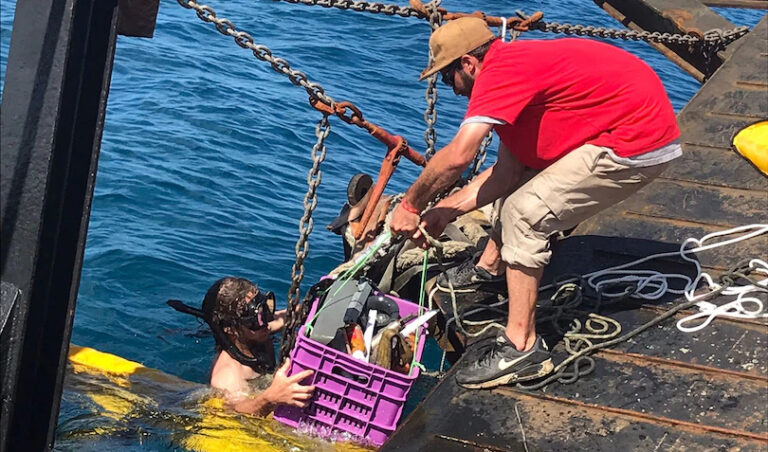
Salvage crews brought 2,500 pounds of debris from the wrecked Bonnie G to the surface recently, including the ship’s anchor. (Photo courtesy of U.S. Coast Guard)
Divers surfaced some 2,500 pounds of debris from the seafloor during salvage operations where the 195-foot Bonnie G lays grounded just south of Cyril E. King Airport, officials said Tuesday.
Crews had removed roughly 2,100 gallons of petroleum since the cargo ship ran aground early Oct. 4 as the remnants of Tropical Storm Philippe passed over St. Thomas, according to the U.S. Coast Guard. No oil or other petroleum pollutants had leaked from the Vanuatu-flagged, Florida-owned vessel but more work was needed.
The 200-foot offshore supply ship Harvey Challenger left Louisiana early Monday, bound for the Bonnie G wreckage, where it will remove fuel. Coast Guard officials estimated the Harvey Challenger to arrive Oct. 22 but other reports have the offshore supply ship arriving Oct. 24.
Potential pollutants like batteries from the six cars, truck, trailer and two pallets of other cargo on the Bonnie G had been secured, officials said.
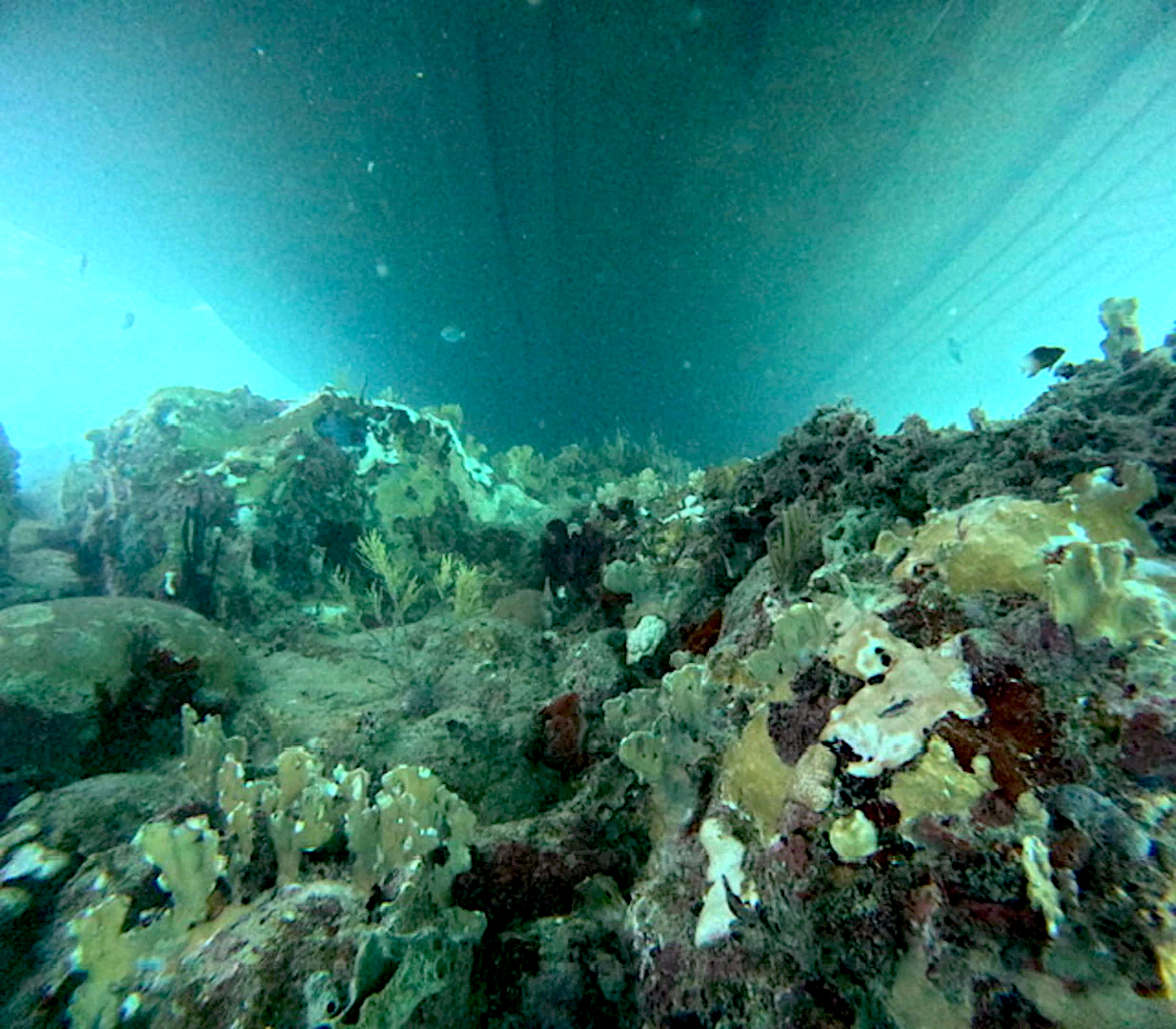
Coast Guard photos show the Bonnie G lodged in a rock and coral mound. An assessment over the weekend asserted salvage vessel activity nearby did not pose a threat to the coral present; however, salvage crews prepared for possible rough weather should another storm pass nearby.
The 195-foot Bonnie G has been aground south of the St. Thomas airport since Oct. 4. (Photo courtesy of U.S. Coast Guard)
Among the items pulled from the seafloor was a Bonnie G anchor lost in the storm. Investigators had not yet released the likely cause of the wreck but it was possible the ship had not been able to dock during the storm and attempted to anchor.
The Bonnie G left Christiansted at 6:41 p.m. Oct. 3 in stormy seas, bound for St. Thomas, according to the website vesselfinder.com. But the route became erratic as it approached St. Thomas Harbor from the east, according to information from the website marinetraffic.com.
The Bonnie G passed between Hassel Island and Water Island shortly after 3 a.m., passed Crown Bay, and back out to sea west of Honeymoon Beach. It abruptly turned around roughly 2,000 feet southwest of the airport runway and started back toward Water Island before running aground.
The ship, designed to handle rolling cargo like cars, needs a minimum depth of roughly 10.8 feet to operate safely, according to the Boat Watch app.
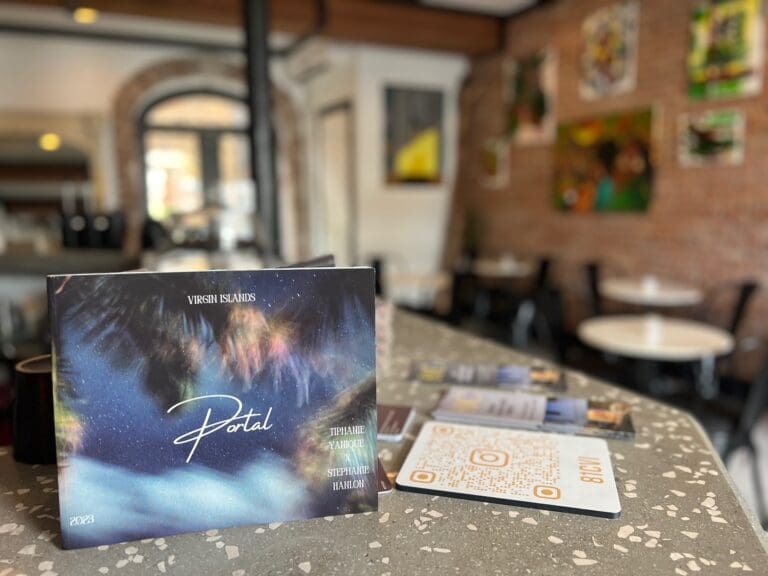
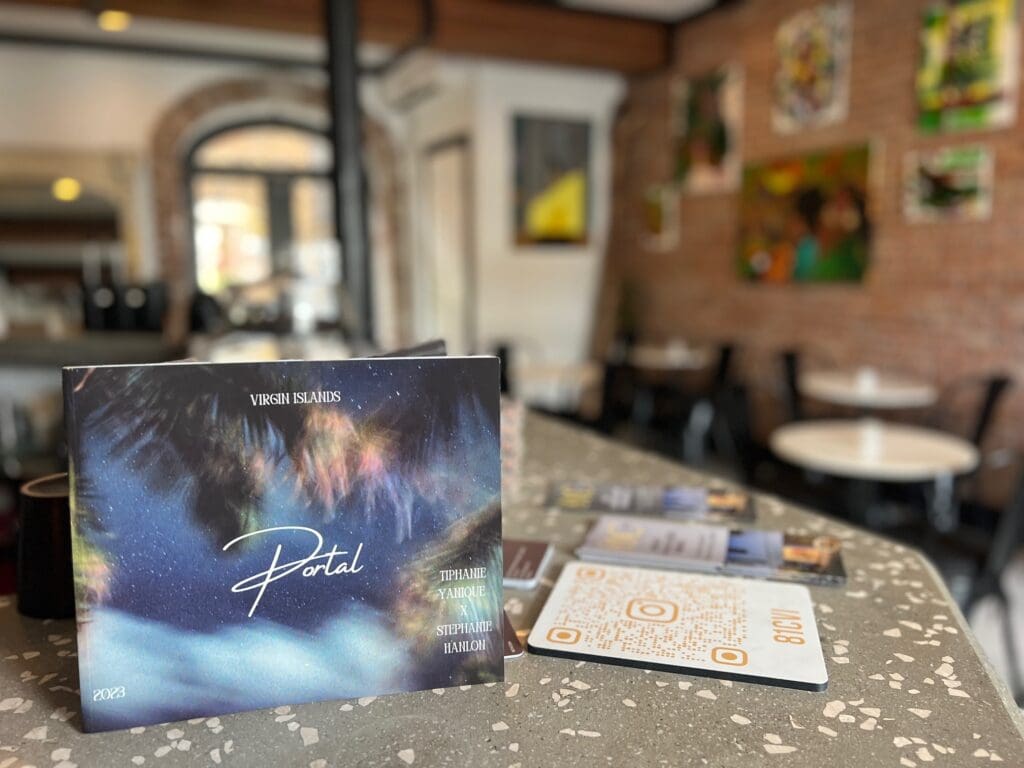
Only 175 copies of “Portal” are being sold exclusively at 81C on St. Thomas. (Photo by Ananta Pancham)
A new book of poetry and photography is meant to inspire readers to think more deeply about the territory’s legacy of revolution, but also the reality of its environmental beauty and how those two seemingly separate concepts are connected.
“Portal” by V.I. author Tiphanie Yanique and visual artist Stephanie Hanlon, is now available for purchase at 81C on St. Thomas, and functions, in its most basic form, as a piece honoring the U.S. Virgin Islands’ 175th year of emancipation from slavery. The two collaborators were working on projects separately before Yanique was asked to participate in an ongoing exhibit on Emancipation displayed at St. Croix’s Fort Frederik, but being a writer, she thought creating a book that also incorporated artwork would be more fitting.
The idea was a win for Monica Marin, Territorial Chief Curator for Planning and Natural Resources’ Division of Libraries, Archives and Museums, and Yanique reached out to Hanlon.
The collective lens that the two offered – one as an ancestral native Virgin Islander and the other as a person who has committed themselves to the Virgin Islands – piqued Yanique’s interest.
“I wanted to work with a different kind of Virgin Islander than I am,” Yanique shared. “I’m committed to my ancestral heritage but also to the big idea of what it means to be a Virgin Islander and how the territory continues to be reimagined through new iterations of Virgin Islanders.”
For her part, Yanique’s poetry offers that historical voice, with poems sourced from the territory’s archives, while Hanlon’s photography highlights modern-day local scenery through a range of techniques, including slow and fast exposure, to show the passing of time. It reminds us, Yanique said, that the beauty of the territory isn’t meant to simply be showcased on a postcard but rather savored and enjoyed by its residents.
“Together, it is this idea that Virgin Islanders and people who have committed themselves to the Virgin Islands can find belonging in the land itself, and that the land itself is also kind of an ancestor that we can look to for wisdom just as we look to each other for wisdom,” Yanique said.
After thinking about the concept of the book, the two also looked at its design and how it could be most easily accessed by Virgin Islanders. Different iterations – one a pamphlet and the other a bound book – were created, with the bound version sold in limited form, only 175 editions, at 81C and on Amazon. Once the books are sold, the pamphlet would be released, creating a price point for all readers, she said. Further, in its printing, “Portal” would ultimately have its own space in the written and visual history of the territory because, as Yanique says, anything that we write, record or even post on social media inevitably becomes part of that legacy.
Meanwhile, Zack Zook and the team at 81C have also committed to programming that engages students in learning Yanique’s poetry and Hanlon’s photography form and technique. Starting in December, Yanique will host workshops in collaboration with art teachers at All Saints Cathedral School and Ivanna Eudora Kean that will span over months, enabling its participants to combine both worlds, just like “Portal” does.
“This is an amazing initiative and more than that, it’s part of an overall goal to support artists, poets, writers, who want to be published and help to develop V.I. literature that is alive and available to Virgin Islanders in the diaspora,” Yanique said. “It’s important for others to see the level of intellectual and creative output that the Virgin Islands has.”
Only puppies will be available for adoption at Barktoberfest on Oct. 21, but there are kitties to meet at Pet Place next door to Foodtown. (Photo courtesy John Eastman Photography)
Leatherback Brewery will host Barktoberfest for the St. Croix Animal Welfare Center (SCAWC) on Nov. 12 from 1-6 p.m. and the number of pets available for adoption and the variety of fun activities and goodies to eat is almost scary.
All of the pups available for adoption will be there, some in costume, to impress and give love to potential new pet parents. Becca Hughson, marketing and public relations director for SCAWC, said the pups will be taken home by 3:30 p.m. or so to avoid overheating.
“Because there is pet overpopulation and a housing crisis, we’re having this large-scale adoption event. There are many ways to donate but the entire theme is to get animals in loving homes,” Hughson said.
A puppy costume parade, around 2 p.m., should be the highlight of the day. People are invited to bring their well-behaved puppies and dogs on a leash to participate in the parade with the shelter pets.
While humans and canines are getting acquainted, live music will energize the crowd all afternoon. Headliners are Jubal, featuring ISB, Supa Traks, DJ Chubby, DJ Genius and Mr. Energy.
Also, Miss St. Croix and Miss Cultural Queen will meet and greet their fans.
Traditional trick-or-treating will give little people a chance to weave their way through the vendor booths, boosting their energy and sugar levels all the way.
Speaking of food, vendors will have an array of deliciousness, including Wayne’s Wieners Wagon – hotdogs and chili dogs with Skyline chili – to raise funds for SCAWC. On the other end of the flavor scale, Umami Sushi will offer its unique flavor combinations. Love Kroix and Cruzan Freeze will also be offering their wares.
Some vendors, including Mutiny Island Vodka and Crucian Rum, will donate their proceeds to the SCAWC.
Brian Louden, the former host of the Discovery Channel’s Mythbusters, will be a special guest during the afternoon with a meet and greet booth.
Another special guest, EmpowHer Magazine – VI Women in Business – will be on hand to share their secrets for success.
Replastic Recycle, the new innovative business on the island, will have some of their creations – keychains and magnets, for sale. A must-see is their raffle prize – a dog house made of recycled plastic.
The V.I. Lottery will also have a booth to display their new lottery tickets with photos of SCAWC pets. Tickets will also be for sale.
Patrons who are looking for special treats and treatment can sign up for Pawsitive Vibes with an open bar and catered lunch from Savant Restaurant’s chef under a tent. The cost is $100, which will benefit all the animals at the Animal Welfare Center.
SCAWC merchandise will be available for sale, including a special Barktoberfest tee shirt for $25. There will also be collars, leashes and other pet supplies.
An East to West raffle for an overnight at Divi Carina Bay and Lyric Sail for 12 with drinks and appetizers will also raise funds for the Animal Welfare Center. Tickets are $20 or six for $100.
In case there is a storm, the rain date is Nov. 12.
“It’s a free event for the community. We appreciate the support and kindness of our community. And hopefully, we will send some home with a pet,” Hughson said.
The University of the Virgin Islands conducted water sampling tests for Coral Bay Community Council (CBCC) that show the Coral Bay Harbor meets USVI water standards for recreation and human contact, Coral Bay Community Councilannounced in a press release Monday.
Coastal water testing sites. (Photo courtesy of CBCC)
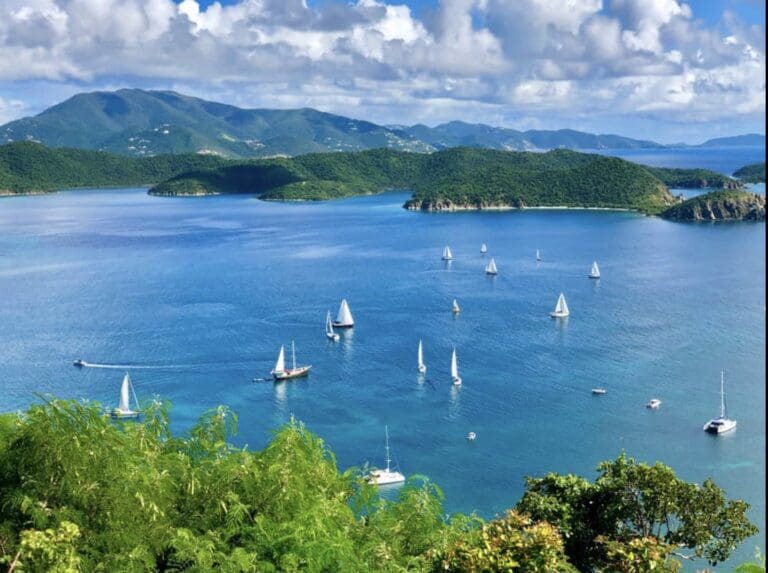
CBCC hired UVI to test water samples taken from Coral Harbor and Johnson Bay in Coral Bay, St. John, on Oct. 31, 2022. Although UVI conducts this kind of testing in several places in Coral Bay quarterly for the Department of Planning and Natural Resources water quality monitoring program, residents at a July 2022 Coral Bay community meeting expressed concerns that the single test taken quarterly near the town dock might not be representative of all places people often wade into Coral Harbor or into Johnson Bay or nearby bays, according to the press release.
Everyone is concerned that E. Coli and other harmful bacteria and viruses should not be present in our nearshore ocean waters that we use for recreation. The government has detailed testing standards for coastal waters, and we all want to be sure that Coral Bay’s waters are safe for human contact – wading, swimming, boating, and fishing, the press release stated.
Thus, CBCC pledged to try to do more testing to help satisfy people’s concerns about the safety and quality of the ocean water and worked with the Environmental Analysis Laboratory at UVI to undertake special sampling at the same time the regular quarterly sampling was conducted. The report and data can be read on CBCC’s website, the release stated.
The good news is the ocean water tested safe!
Sampling was accomplished at 11 locations around Coral Harbor and Johnson Bay: near the Coral Bay Town Dock (normal quarterly sampling spot) and 100 feet from the shoreline in front of places known as Pickles, Flamingo Pond, Lime Out, Harolds Way, Island Blues, Shipwreck, Calabash Market, and three locations along Johnson Bay Beach. The test date was four days after a two-inch rainfall event and with only limited or no sargassum seaweed nearby (which can interfere with accurate test results), according to the release.
Testing the amount of Enterococci in seawater is the standard scientific measure used by government agencies to judge the presence or absence of harmful bacteria and viruses and, thus, the safety of water for human contact, it said.
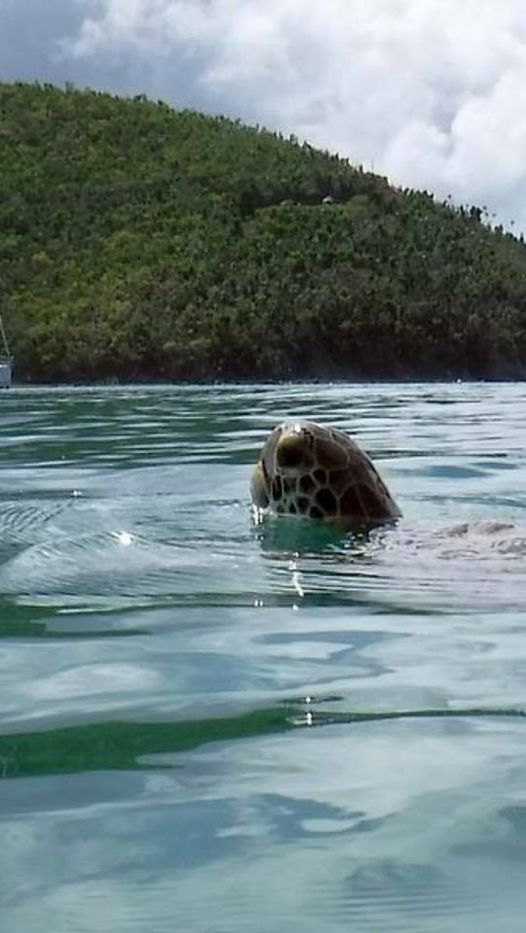
Sea turtle living in Coral Harbor. (Photo courtesy of CBCC)
The test results showed the levels of Enterococci were significantly below the maximum considered safe. The EPA and USVI standard is a finding of no more than 70 Enterococci colonies in 100 milliliters of water. All 11 samples showed 10 or less than 10 colonies, which is far below the maximum allowable of 70, the release stated.
Sharon Coldren, CBCC voluntary executive director, said, “The good news is that no scientific sampling in any location showed the water being unsafe for human contact (or even close to that in the measurement system), and I think that’s really important for people to see. Coral Harbor, despite being under continual development, has not started to have unsafe ocean water problems either from land, boats, or other sources. We need to continue to remain vigilant.”
Coral Harbor also met Virgin Islands standards for “Turbidity” in the testing, which is a measure of cloudiness of the water due to suspending particles, such as living plankton, mangrove leaves, sargassum, other vegetative debris, or suspended sediment (dirt). More scientific research is needed to understand what is in our waters and its overall health as a marine nursery ecosystem, it said.
The important takeaway of this testing is that the bay is safe for swimming and recreation, even in these more populated areas. CBCC plans another round of similar testing in November 2023, according to the release.
More about past water quality monitoring and the USVI standards can be found in the 2021 Coral Bay Watershed Management Plan Section 9 or on DPNR’s website at Water Quality Management Program – VI DPNR.
Coral Harbor and Johnson Bay met USVI water quality standards for human contact after water testing that sampled 11 locations, the release stated.
Karrl Foster (Submitted photo)
81C will host a special fundraising event from 5-8 p.m., Friday, (Oct. 20, has been changed to Friday, Oct. 27) in Charlotte Amalie, for long-time St. Thomas entrepreneur/ restaurateur Karrl Foster to help with his medical expenses from a recent serious medical emergency.
The event location is 81C Kronprindsens Gade, by Market Square, Charlotte Amalie, USVI. Artist Pamela Larsen (Submitted photo)
There will be live musical entertainment by Andy Easton. The exhibit will showcase artists Amy Gibbs, Rae Kehoe, Pamela Larsen and Doreen Walsh. Visit the ‘Discussion’ tab on the Facebook event for more details on each artist, wine-tasting selections and raffle items. (Wine Tastings by CC! Virgin Islands and non-alcoholic herbal cocktails by Kirrye Majors).
Doreen Walsh (Submitted photo)
There will be a $25 donation at the door. Raffle tickets are on sale for a chance to win artwork by the exhibiting artists, an art piece by donor Heinemann Images, and other wonderful items.
Those who want to support can also donate directly via the Fundly website https://fundly.com/a-hand-for-a-friend.
Artist Amy Gibbs (Submitted photo)
Anyone who is familiar with Karrl knows he is an incredibly kind, generous and beloved community member who goes above and beyond to help those in need. Unfortunately, Karrl is now in need of support. In response, a group of friends has organized fundraising campaigns and this event to help alleviate some of the financial burden from his prolonged hospital stay as well as the cost of post-surgical therapies and recovery.
Andy Easton will entertain at the 81C event. (Submitted photo)
81C invites everyone to join it at this event to celebrate local artists, enjoy great live music by Andy Easton, savor delightful wines, win raffle prizes and demonstrate why the St. Thomas community is truly exceptional.
Artist Rae Kehoe (Submitted photo)
For more information, email plynn333@gmail or call 227-8451.
Do not drink or cook with WAPA’s water in St. Croix, officials warned Monday, as it may be contaminated with lead and copper. (Photo by Mat Probasco)
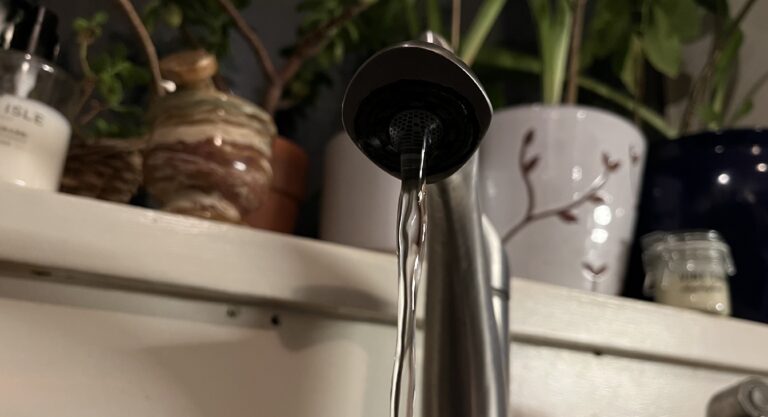
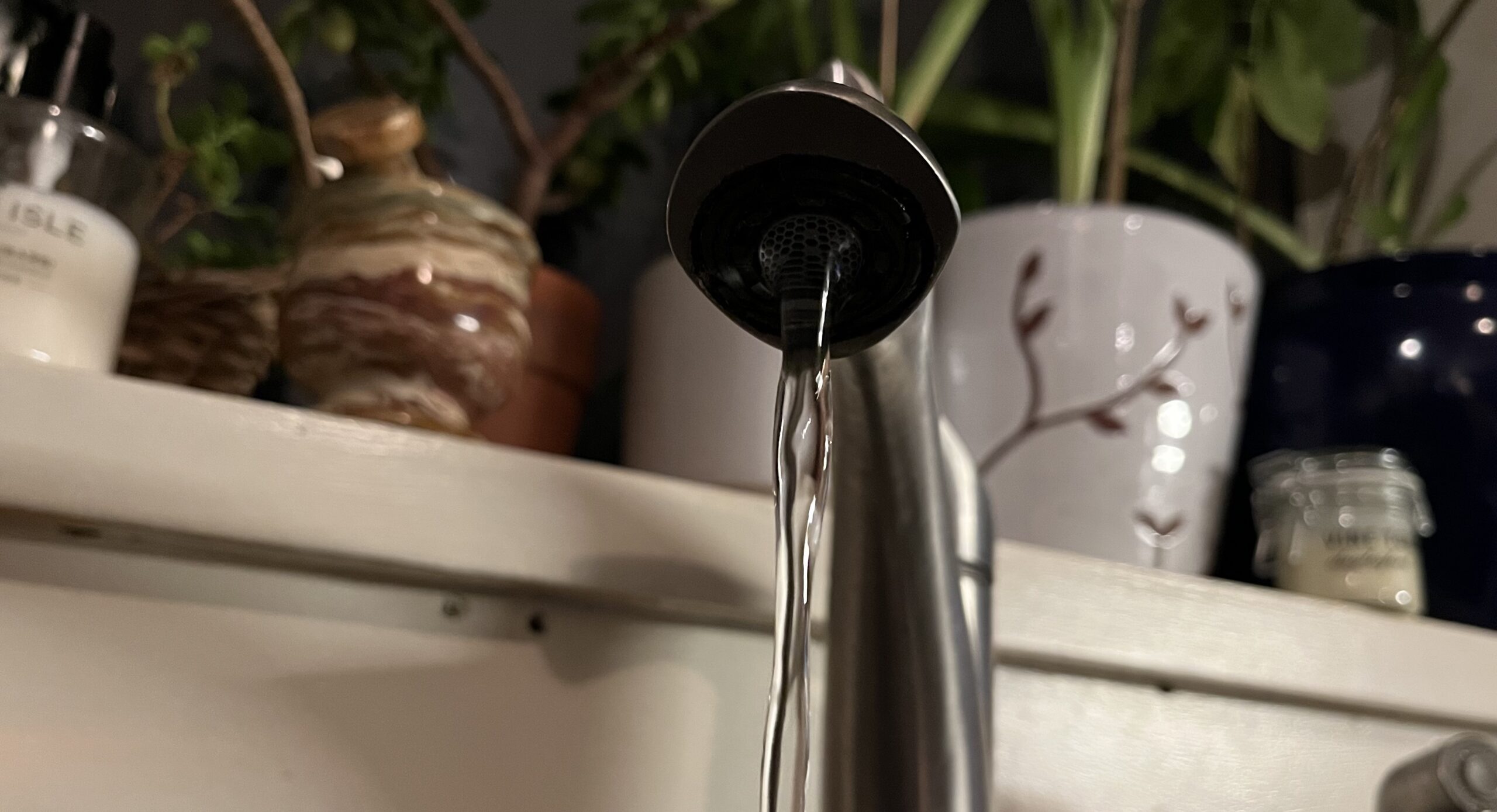
Do not drink or cook with St. Croix tap water from municipal pipes, officials warned Monday.
While cistern water was fine, municipal water in parts of St. Croix contained elevated levels of lead and copper and should not be consumed before pipes are properly flushed, said officials from the Water and Power Authority.
Water from more than half of the 66 pipes tested by WAPA had raised levels of the metals.
While most of the community drinks and bathes in unaffected cistern water, people who drink WAPA water, especially those in Estate Diamond, Colquohoun, Mon Bijou, and the Castle Burke Community, should run their water for three to five minutes first. This would likely flush out contaminants in the line, WAPA officials said.
But it remained unclear for how long this flushing would be effective.
Hot water from the tap would likely contain higher levels of lead than cold because the dangerous metal dissolves more readily at higher temperatures. Officials warned against consuming hot water from the faucet — especially if used for baby formula.
St. Croix residents, including a restaurant owner using WAPA water, said Monday afternoon they had not heard the warning against drinking the water and were concerned.
The issue may be linked to stagnant water running through older pipes, the authority said but warned further investigation was needed to be sure.
Shanell Petersen, WAPA’s communications director, said resampling was already underway.
“Simultaneously we’ve reinstated an aggressive flushing program for the most impacted areas. As we gain more information on the source and have gained the results from the resampling, we’ll be updating the public in collaboration with the Office of the Governor, VITEMA, Department of Health, and other federal and local agencies,” Petersen said.
Last week, researchers from WAPA, the Environmental Protection Agency, the Department of Natural Resources, and the University of the Virgin Islands tested discolored water plaguing St. Croix for months.
Petersen said EPA test results revealed the water was “above action level for lead and copper.”
Since 1991, the EPA has required water providers to inform the public if their water exceeds 1.3 parts-per-million of copper or 15 parts-per-billion of lead. Petersen did not answer requests for how many parts-per-million or parts-per-billion of copper and lead were in St. Croix’s municipal water. She also didn’t answer when the last time St. Croix’s water had been tested in this manner.
Sen. Angel Bolques Jr. said he was gravely concerned about the elevated lead and copper levels, citing a “significant public health concern” to people drinking or bathing in the contaminated water.
“Elevated levels of lead in drinking water can lead to lead poisoning, which can cause developmental delays, learning difficulties, and behavioral problems, particularly in children,” the St. John senator said in a media release. “Showering with water containing lead and copper can lead to the inhalation of these contaminants, potentially affecting respiratory health.”
Drinking water with high levels of copper can lead to gastrointestinal problems, liver damage, and even the rare genetic disorder Wilson’s disease.
Richard Motta, a spokesperson for Gov. Albert Bryan Jr., said data was still being collected and tested, and pipe replacement was underway.
“There is a pretty large scale project going on to address the piping,” Motta said. “This is a work in progress. It’s obviously something we’re concerned about.”
The presence of lead pipes isn’t a new revelation. In December 2021, Congressional Delegate Stacey Plaskett announced nearly $32 million in funding to replace lead pipes via President Joe Biden’s Bipartisan Infrastructure Investment and Jobs Act.
But in addressing the discolored water in September, WAPA CEO Andrew Smith said replacing nearly 200 miles of 60-year-old pipes could take 20 years or more.
The reddish-brown water issue caused Sen. Samuel Carrión to ask Gov. Bryan to declare a state of emergency. No such declaration has been made and as of press time Monday night, the governor had not spoken on the lead and copper in St. Croix’s tap water.
DPNR did not respond to requests for comment on the Department’s role in testing or regulating the St. Croix water. The EPA acknowledged similar requests but did not respond with answers before press time.
SAT Prep Course students attending the first session on Oct. 14. (Submitted photo)
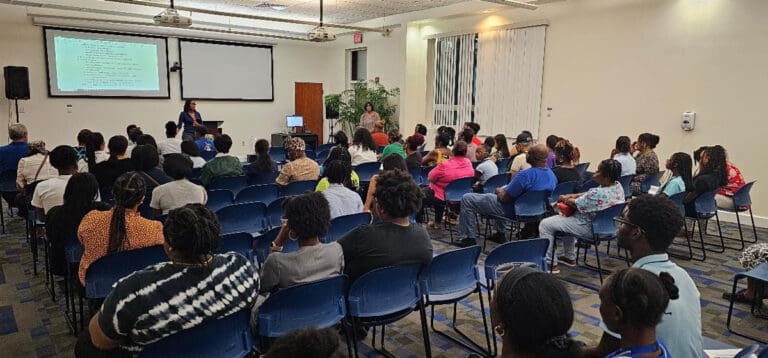
On Saturday, Oct. 14, local high school students attended the first SAT Prep Course presented by University Bound and Alpine Securities at the University of the Virgin Islands. The program aims to help Virgin Islands high school students boost their scores on the SAT, which is a standardized test widely used for college admissions in the United States.
The program started with a practice SAT exam and will continue with math and language arts lessons every Saturday for five weeks. The program will then end on Saturday, Dec. 2, with a final practice SAT exam to gauge students’ achievement.
“Alpine is dedicated to providing opportunities for students and young people to reach their full potential,” said Charles Kim, Alpine’s managing member. “Preparing for the SAT exam is an important part of the college application process. We are happy to partner with University Bound to offer this program once again.”
Over the years, Alpine has been involved with numerous charitable initiatives on the island that focus on investing in the youth and bringing the community together.
More information can be found at https://www.uvi.edu/student-success/upward-bound.html People may also contact University Bound Director Rosalia Rhymer-Rohan at rrohan@uvi.edu or 693-1133.




 He is survived by his sister, Winifred Scott; children: Curby Francis, Alvion Francis, Campbell Francis Jr. and Zenobia Francis; grandchildren: Ajani George, Aminah Abdullah, James Gunter, Richard Gunter, Campbell Francis III, Jessica Francis, Jalissa Francis and Ah’Venique Francis; great-grandchildren, Raina Thomas, Al-Kawan Sullivan Jr., Gabriella Francis and Greyson Shines; niece, Rita Robbins; nephew, Jeffrey Scott; and other family and friends too numerous to mention.
His Celebration of Life services will be held on Saturday, Oct. 28, at Blyden Memorial Chapel. The viewing will be held from 9-10 a.m., followed by a memorial service.
Expressions of sympathy to the family may be made online at www.turnbullsfuneralhomevi.com.
He is survived by his sister, Winifred Scott; children: Curby Francis, Alvion Francis, Campbell Francis Jr. and Zenobia Francis; grandchildren: Ajani George, Aminah Abdullah, James Gunter, Richard Gunter, Campbell Francis III, Jessica Francis, Jalissa Francis and Ah’Venique Francis; great-grandchildren, Raina Thomas, Al-Kawan Sullivan Jr., Gabriella Francis and Greyson Shines; niece, Rita Robbins; nephew, Jeffrey Scott; and other family and friends too numerous to mention.
His Celebration of Life services will be held on Saturday, Oct. 28, at Blyden Memorial Chapel. The viewing will be held from 9-10 a.m., followed by a memorial service.
Expressions of sympathy to the family may be made online at www.turnbullsfuneralhomevi.com.