




The other day, while I was searching my office archive for information on fresh water fishes in streams of the Virgin Islands for a graduate student researcher from Clemson University, North Carolina, I came across some rare information about the ethnohistory of the French settlement on the island of St. Thomas during the Danish rule of these islands.

In the 16th century, the French privateers opposed Spain’s claim to the monopolization on all the islands in the Caribbean and wealth of the Antilles. However, by the 17th century, Spain’s power began to weaken as French settlements began to appear in several islands in the Lesser Antilles.
By the 1650s, the French were in possession of Guadeloupe, Martinique, St. Kitts, St. Martin, St. Barthelemy, and St. Croix, which was a French possession for 83 years. What is left of the French identity on St. Croix are a few estates names such as Montpelier, Bonne Esperance, and the like. Flamboy (flambeau) is a French term for the torch that was commonly used for catching lobsters at night around the rocky shoreline of St. Croix up until the 1960s.
Kribeshee was another French term for catching “gut lobster” or shrimp in the streams of St. Croix. Both words are no longer in use today, culturally, due to the traditional loss of catching lobsters along the rocky shoreline with a flamboy (flambeau) torch at night, and fishing for kribeshee in our once-flowing streams all year around. In a few places on St. Croix, French names have been renamed: Sandy Point from Pointe de Sable, Salt River from Riviere Salee, and several other names on the island.

Other cultural elements of the French are seen in the remnants of dance, music, or folk literature, which lingers to this day among older Virgin Islanders telling stories of long ago. However, the French Creole language didn’t survive on St. Croix, like other islands in the Caribbean such as St. Lucia and Dominica. However, on St. Thomas, the French dialect survived until recently, due to the generation gap of the older and younger French of the Virgin Islands. In other words, the French dialect, or Creole speaking, on St. Thomas has not been continually passed down as it once was years ago to the younger generations.
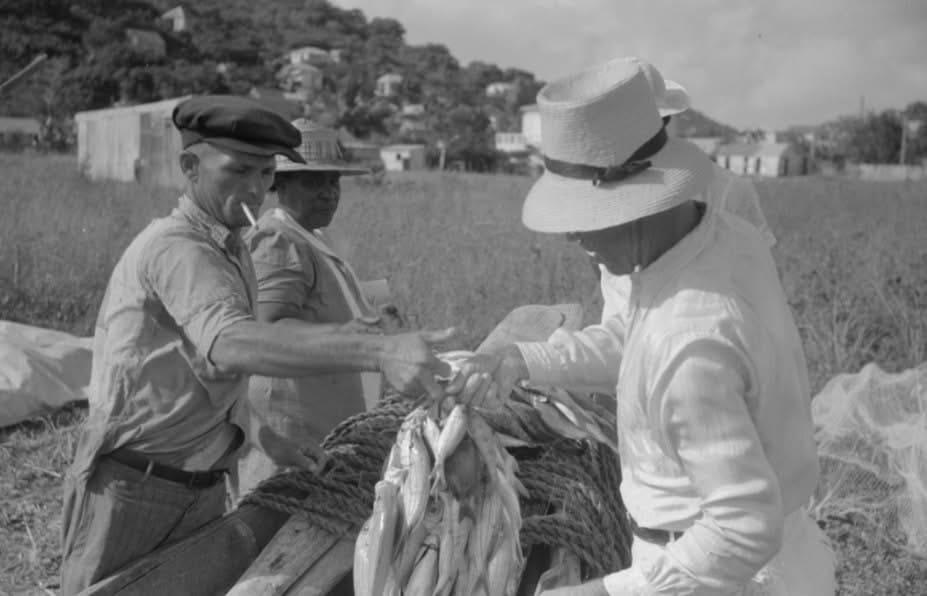
In 1979, the late Dr. Arnold R. Highfield wrote a small book titled, “The French Dialect of Thomas U.S. Virgin Islands: A Descriptive Grammar with Texts and Glossary.” By profession, Highfield received his PhD in Romance Linguistics from Ohio State University. He also attended the universities of Madrid and Lausanne and contributed scholarly articles to several journals. Such a book he translated into English was, “Description of the Island of St. Croix in America in the West Indies,” written by a Danish man named Reimert Haagensen in the 1730s.
Almost 50 years ago, Highfield conducted a scientific survey on the ethnolinguistic history of the French community of St. Thomas. His research traces the history of the small village, or what was known back then as Carenage, a neighborhood in Frenchtown, or also known then as Gallows Bay on the west side of Charlotte Amalie, St. Thomas.
Another settlement of French descent was on the North Side of St. Thomas. From what Highfield gathered in his research, the North Side French Creole is of the Lesser Antilles region of Martinique, Guadeloupe, Dominica, Trinidad, and St. Lucia, whereas the Carenage is clearly a dialect of Gallo-romance. From what I gather from the French research of St. Thomas by Highfield, the exact time French immigrants came to St. Thomas is not certain.
Some documents say 1865. Others say after 1870. Whatever the date was, it is well established that a small but steady stream of French immigrants migrated from St. Barthelemy to St. Thomas, with, eventually, the development as a linguistic community in the Virgin Islands. Why the migration of the French settlers from St. Barts to the Danish West Indies, particularly the island of St. Thomas? Without a doubt, St. Barts was the least important of the French possessions in the Caribbean.
It was a history of hardship for the French people on St. Barts. The island soil was extremely rocky for agriculture development. Then in 1656, the French people had a surprise attack and massacre by the Kalinago’s “Island Carib,” which forced settlers off St. Barts temporarily. In 1659, Phillippe de Longvilliers de Poincy, who once owned St. Crox, sent a second group of Frenchmen to resettle St. Barts. By 1664, the island inhabitants had grown from 30 men to 100. Linguistically speaking, Highfield believed this bit of evidence from the history of French on St. Barts is important in his study of the dialect among the French people on St. Thomas.
In his notes, Highfield stated, “the French community on St. Barts can be traced back directly to 1664 with little interference from the outside. Clearly, the form of French (i.e., French, and not Creole) spoken in St. Barts is the lineal descendant of the form of speech which prevailed there in 1664.” Nevertheless, by the beginning of the 19th century, people from St. Barts begin to migrate, particularly from a small community at Gustavia, which traded with other West Indies islands.
This trading, Highfield believed, gave some of them some idea of the outside world. As economic conditions on the island worsened by the mid-19th century, they began to entertain emigration for the first time. In 1871, France was in a war with Prussia. Thereafter, France’s economy collapsed. As a result, a small group from St. Barts decided to go elsewhere to provide for their families.
Because of the maritime trade between the Caribbean islands, St. Thomas became a major attraction for the poverty-stricken migrants from St. Barts, where they could find suitable employment in fishing and in agriculture. I have not yet touched the surface of the history of the French people on St. Thomas, especially their music, dancing, culture, religion, courtship practices, folklore, intermarriage with local Blacks, etc. A Part 2 will be coming!
— Olasee Davis is a bush professor who lectures and writes about the culture, history, ecology and environment of the Virgin Islands when he is not leading hiking tours of the wild places and spaces of St. Croix and beyond.