Senators Praise Progress, Press for Specifics After Bryan’s Final State of the Territory

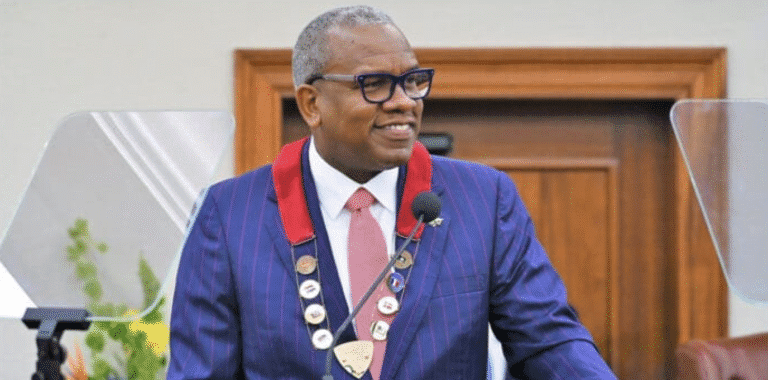
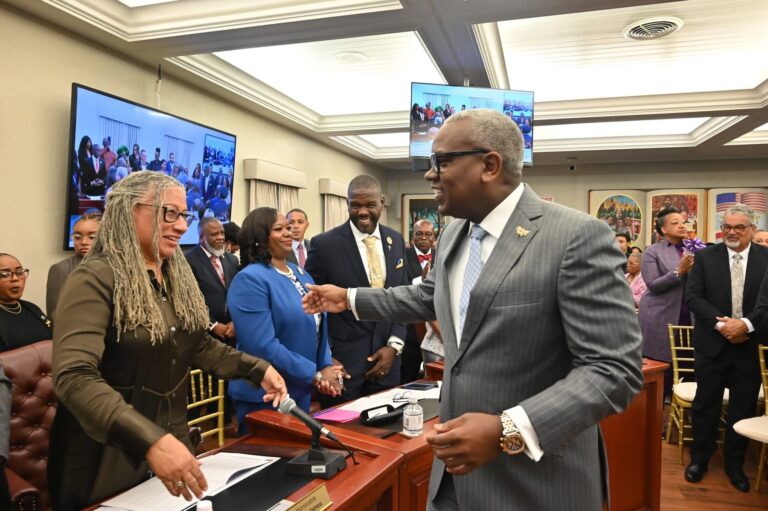
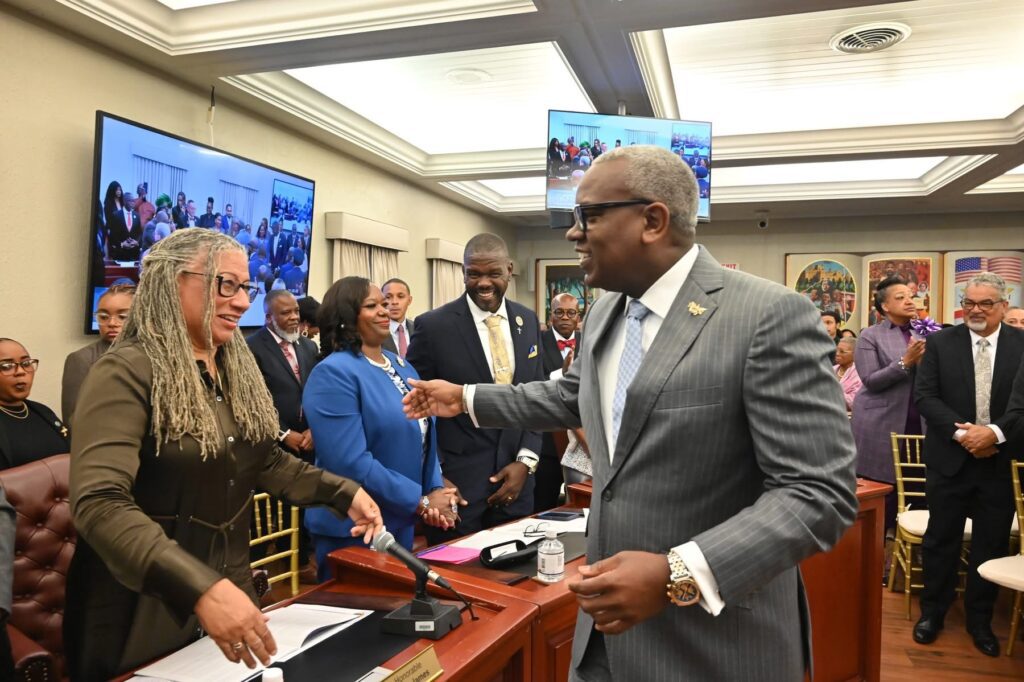
Gov. Albert Bryan Jr. greets senators as he enters the Earle B. Ottley Legislative Hall on St. Thomas ahead of his final State of the Territory address. (Photo courtesy Barry Leerdam for the V.I. Legislature)

Lawmakers offered a mix of praise, concern and cautious optimism following Gov. Albert Bryan Jr.’s final State of the Territory address Monday night, with several senators acknowledging progress made over the past eight years while pressing the administration for clearer timelines, deeper detail and stronger accountability in its final year in office.

Bryan’s nearly two-hour address, delivered during an open session of the 36th Legislature, focused on stabilizing government finances, rebuilding infrastructure, modernizing healthcare and restoring trust following federal corruption convictions involving senior officials. In interviews afterward, senators largely agreed the speech reflected the arc of Bryan’s tenure — but differed on whether it sufficiently addressed the realities constituents continue to face.

Sen. Marise James said she appreciated the governor’s decision to emphasize accomplishments, noting that progress is often overshadowed by unmet expectations.

“I thought it was important for the governor to outline all his accomplishments over the last seven years,” James said. “Sometimes we forget that things have improved. Most of the time we focus on what hasn’t happened yet — and he’s right that a lot of these things take time.”

James pointed to Bryan’s remarks on education outcomes and workforce readiness, saying she was encouraged by improvements in student performance but stressed the need to further strengthen skills training and prepare residents for future industries.

“I was happy to hear that student scores are improving,” she said. “Now we need to keep improving skills and make sure we’re meeting the future.”

At the same time, James said affordability remains a major concern, particularly as inflation and housing costs continue to strain residents.

“Affordability is a big thing in the Virgin Islands,” she said. “Even with all the work that’s been done on housing, it still needs to increase more than it has.”

James also said she agreed with Bryan’s broader point that communities cannot function without residents contributing to shared needs such as waste removal and healthcare.

Near the end of his address, Bryan posed a broader question about priorities, suggesting that solving persistent “life problems” such as healthcare and infrastructure may ultimately require thinking differently about how resources are dedicated — a reflection he offered without outlining a proposal or policy.

James praised the territory’s handling of the COVID-19 pandemic as one of the administration’s most significant accomplishments, while noting areas she felt were missing from the speech, including agriculture and redevelopment of Paul E. Joseph Stadium on St. Croix.

“For me, agriculture factors into whether we survive or thrive in the future,” she said.

Sen. Franklin Johnson described his reaction as mixed, saying he was “a little disappointed” but still hopeful that long-promised projects could be completed before Bryan leaves office next year.

“This is his last State of the Territory and his last year in office,” Johnson said. “Hopefully some of the things he’s been promising for quite some time can be fulfilled.”

Johnson pointed to the Juan F. Luis Hospital rebuild — which Bryan said is in the final stages of contracting — noting that earlier timelines have already passed. He also cited long-neglected roads in Frederiksted, including Strand, King and Queen streets, as examples of projects that remain unfinished.

“The Legislature has a lot of work to do to hold the administration’s feet to the fire,” Johnson said, adding that he remains ready to work with the governor while demanding results.

Sen. Novelle Francis said Bryan’s address was consistent with expectations for a final-term overview, highlighting both achievements and challenges.

“I think he talked about the successes, and I also think he was forthright about some of the challenges,” Francis said, pointing specifically to the federal corruption convictions of two former commissioners and the former Office of Management and Budget director — cases Bryan described in his address as “perhaps the most painful test of this term.”

Francis said he hoped to hear stronger commitments to expanding local tools to address corruption, including strengthening the Department of Justice’s capacity to prosecute white-collar crime and implementing a local grand jury system.

“We have to stress the integrity of government,” Francis said. “We can’t let corruption fester.”

Francis also emphasized the Legislature’s role in many of the initiatives Bryan cited, noting that several accomplishments required legislative action.

“His successes are the successes of the community,” Francis said. “And we all have a responsibility to make sure he finishes strong.”

Sen. Alma Francis Heyliger said she appreciated Bryan’s acknowledgment of tourism’s role in stabilizing the economy and his public disappointment over the corruption convictions involving former cabinet members. But she questioned why corruption enforcement continues to rely on federal intervention.

“My disappointment is why it’s always the federal government that has to come in,” she said. “Why isn’t our local government at the forefront of addressing corruption?”

Heyliger said she would have liked to hear more detail about healthcare, citing her own recent hospitalization and the strain she observed on doctors and nurses — an issue Bryan addressed by outlining plans to unify the territory’s hospital system under a single leadership structure and expand telehealth services.

She was also sharply critical of the absence of any mention of recent power outages on St. Thomas and St. John, which occurred just days before the address.

“After what people went through Friday, Saturday and Sunday with power going on and off, I was totally livid,” she said. “This is what our people have to suffer through.”

Sen. Angel Bolques, the St. John senator-at-large, described the speech as upbeat but lacking specificity.

“It was very broad,” Bolques said. “It wasn’t detailed or specific to the concerns Virgin Islanders are facing right now.”

Bolques cited the absence of discussion on agriculture, food security, mental health services and youth support, though he acknowledged that Bryan was clear about not being able to resolve every issue before leaving office.

“He’s letting the next administration know that some responsibilities will be inherited,” Bolques said, “but that he’ll knock out as much as he can before he leaves.”

Bolques also pointed to ongoing disaster recovery projects on St. John — including schools, health facilities, fire stations and the Cruz Bay police station — saying lawmakers will be pressing for clearer timelines as members of the Disaster Recovery Committee.

Sen. Clifford Joseph echoed concerns about agriculture and food security, framing the issue through the lens of emergency preparedness following hurricanes and the pandemic.

“We should at least be able to sustain ourselves for two weeks,” Joseph said.

Joseph also addressed Bryan’s remarks on the Fire and EMS merger, saying the consolidation has produced some improvement but remains constrained by staffing shortages.

“We’ve moved forward from where we were,” he said, “but there’s still room for growth.”

Sen. Kurt Vialet offered one of the most detailed critiques, describing the address as a compilation of themes from previous years rather than a roadmap for the administration’s final months.

“I really thought I was going to hear specifics about the next 11 months,” Vialet said. “Exactly what’s going to be accomplished, and when.”

Vialet took issue with what he described as credit being claimed for initiatives that required legislative action, including pension funding measures, minimum salary increases and the Hotel Development Act. He also raised concerns about delays in implementing pay increases already approved by law.

At the same time, Vialet praised progress in stabilizing the unemployment trust fund and the creation of a government stabilization fund, calling both significant accomplishments.

But he said cash-flow issues remain evident, citing unpaid vendors, delayed allotments to agencies and declining income tax collections late last year.

“The picture painted today is not what everyday people are experiencing,” Vialet said, pointing to ongoing road conditions, healthcare shortages and infrastructure challenges, particularly on St. Croix.

Despite the criticism, several senators said they remain committed to working with the administration during its final year.

“There are things that have improved,” Vialet said. “There are a lot of things we could do better. Now the job of the Legislature is to demand timelines and accountability.”

Sen. Kenneth Gittens echoed concerns about the lack of specificity in the governor’s remarks, saying he had hoped to hear clearer plans for the administration’s final months in office. Gittens said the address revisited themes from prior years but offered few concrete timelines, particularly for education, healthcare and mental health services. He also questioned whether the financial picture presented aligned with what residents and businesses are experiencing, pointing to ongoing vendor arrears and cash-flow pressures. While acknowledging progress in some areas, Gittens said lawmakers will need to press the administration for clearer answers and accountability as it works to close out the term.

Together, the reactions underscored the central tension of Bryan’s final State of the Territory address: a record defined by stabilization and incremental progress, weighed against persistent challenges lawmakers say residents continue to feel — and a narrowing window to deliver on promises before a new administration takes over.
Labor Unions Protest Outside of State of the Territory

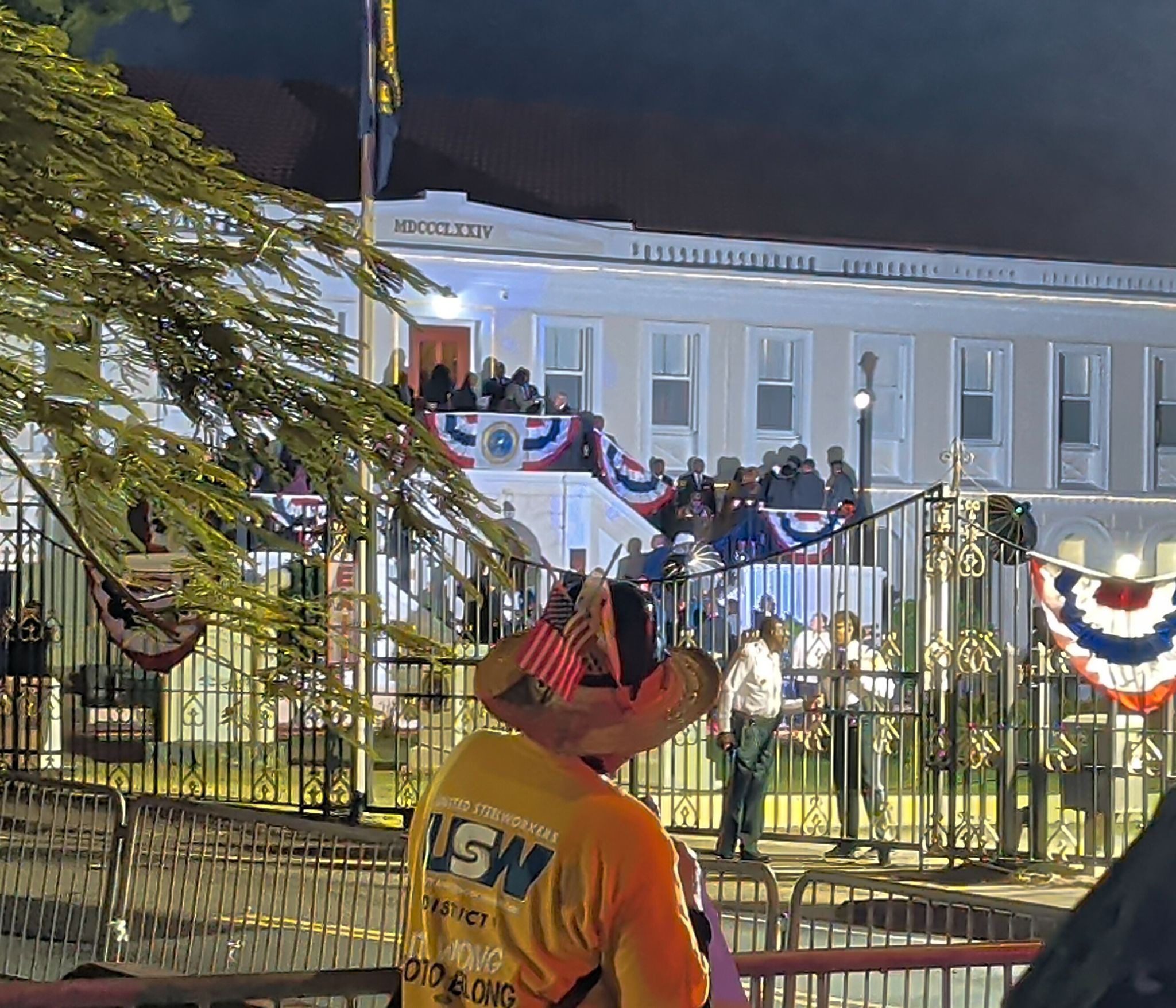
Gerard Jackson, a staff representative for the United Steelworkers, looks toward the Legislature building from a distance ahead of the State of the Territory address on Jan. 26, 2026. Union leaders said demonstrators were directed to stand farther from the building than in previous years. (Source Photo by Finn Sharpless)

Representatives from multiple labor unions protested outside the Legislature Monday night as Gov. Albert Bryan Jr. delivered his final State of the Territory Address, citing years of unaddressed grievances, expired contracts, and unsafe working conditions. Union leaders said the government has repeatedly failed to negotiate wages, honor collective bargaining agreements, or address concerns about workplace safety.

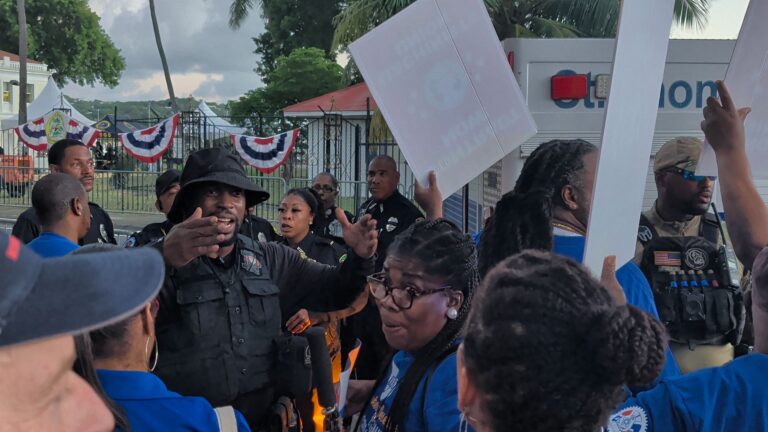
Union leaders said they were initially permitted to protest closer to the Legislature building but were ordered days before the event to relocate farther down the road toward Vendors Plaza. They described the change as unnecessary and perhaps unlawful.

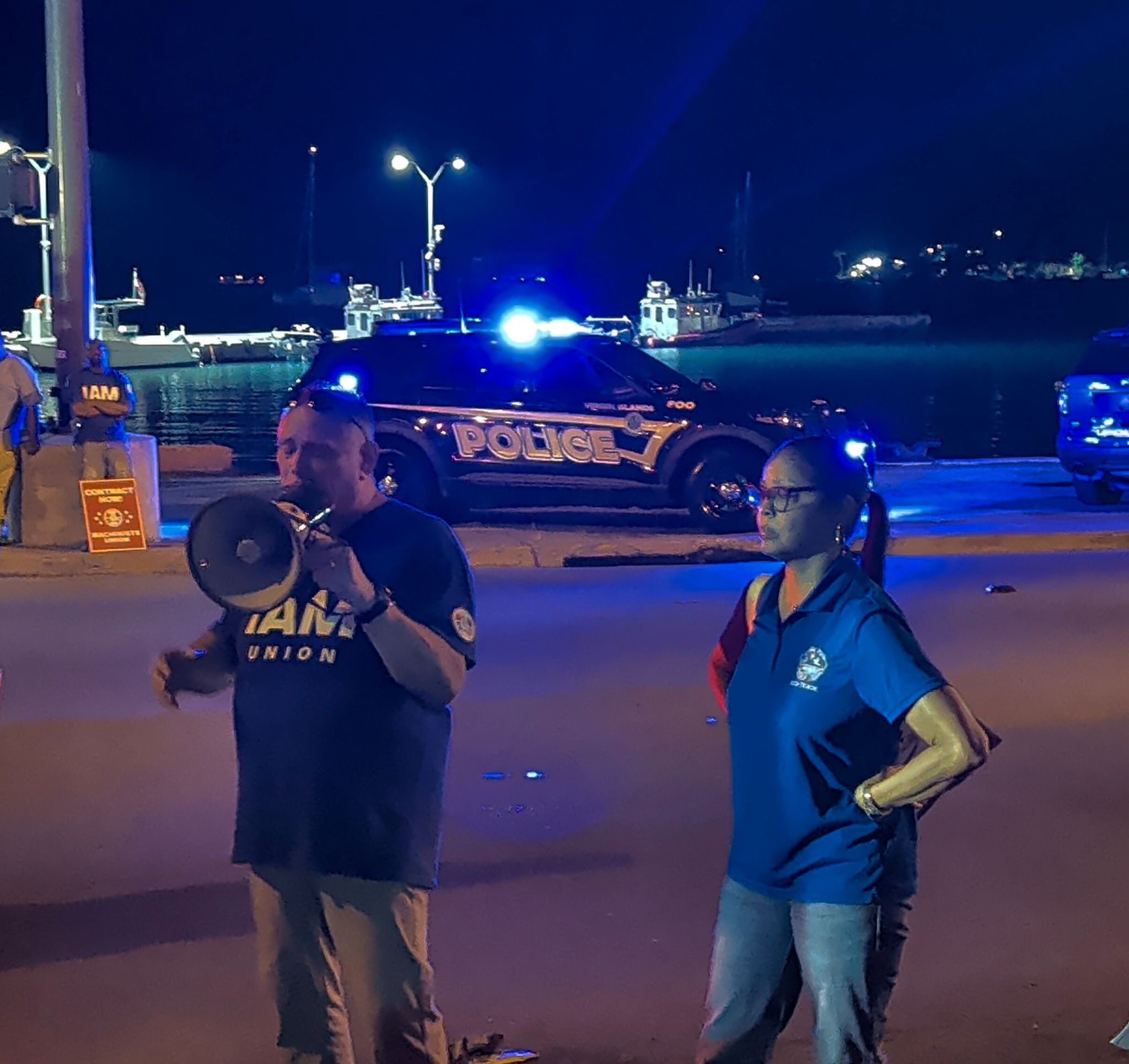
John Vigueras, an international special representative for the International Association of Machinists, said, “We had negotiated in front of the building, and they pushed us all the way over here. Now they cut down the traffic, so we have zero impact. This is a way of silencing us. This is not working with us. This is working against us.”

John Vigueras, an international special representative for the International Association of Machinists (left), and Leontyne Jones, president of the St. Thomas–St. John Federation of Teachers, Local 1825 (right), spoke at the conclusion of the protest, urging multiple labor unions to vote together as a single bloc under the new Area Labor Federation. (Source photo by Finn Sharpless)

Vigueras said police told union leaders the relocation was required by law, but that explanation was later disputed by lawmakers. “I’ve been in constant contact with Senator Franklin Johnson,” Vigueras said. “He told me himself there’s no law that stipulates that.”

Multiple union representatives noted that in previous years, protesters had been allowed to stand much closer to the Legislature building.

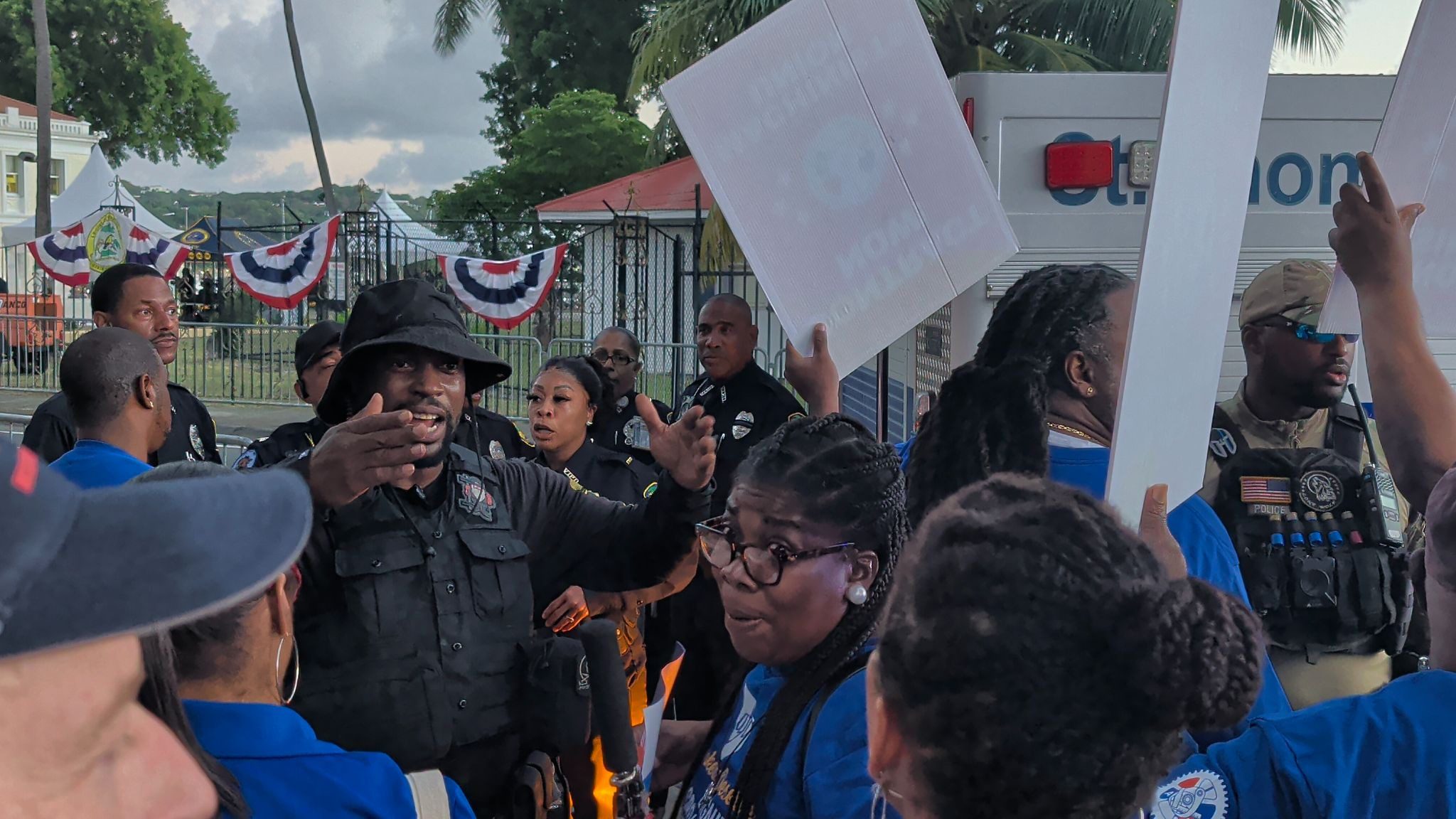
Police officers and union protesters peacefully clashed outside Fort Christian ahead of the State of the Territory, after protesters were directed to relocate farther from the building, a move they said limited the visibility of their demonstration. (Source photo by Finn Sharpless)

Beyond the dispute over the protest site, union leaders said the demonstration reflected deeper, long-running tensions between workers and the government. Representatives from education, waste management, health care and public service unions said the protest was driven by expired contracts, stalled negotiations, unsafe infrastructure, and what they described as the current administration’s anti-labor stance.

“The common adversary is the government,” Vigueras said. “They don’t want to negotiate with us. They don’t want to respect the contracts. They don’t want to pay progression rates.”

Several union officials said collective bargaining agreements have lapsed for years, preventing workers from receiving progression pay and leaving grievances and arbitration cases unresolved. Others cited unsafe or unhealthy working conditions, including mold in schools and government buildings, staffing shortages, and persistent backlogs at labor boards and arbitration panels, which they said reflect broader neglect of public-sector workers.

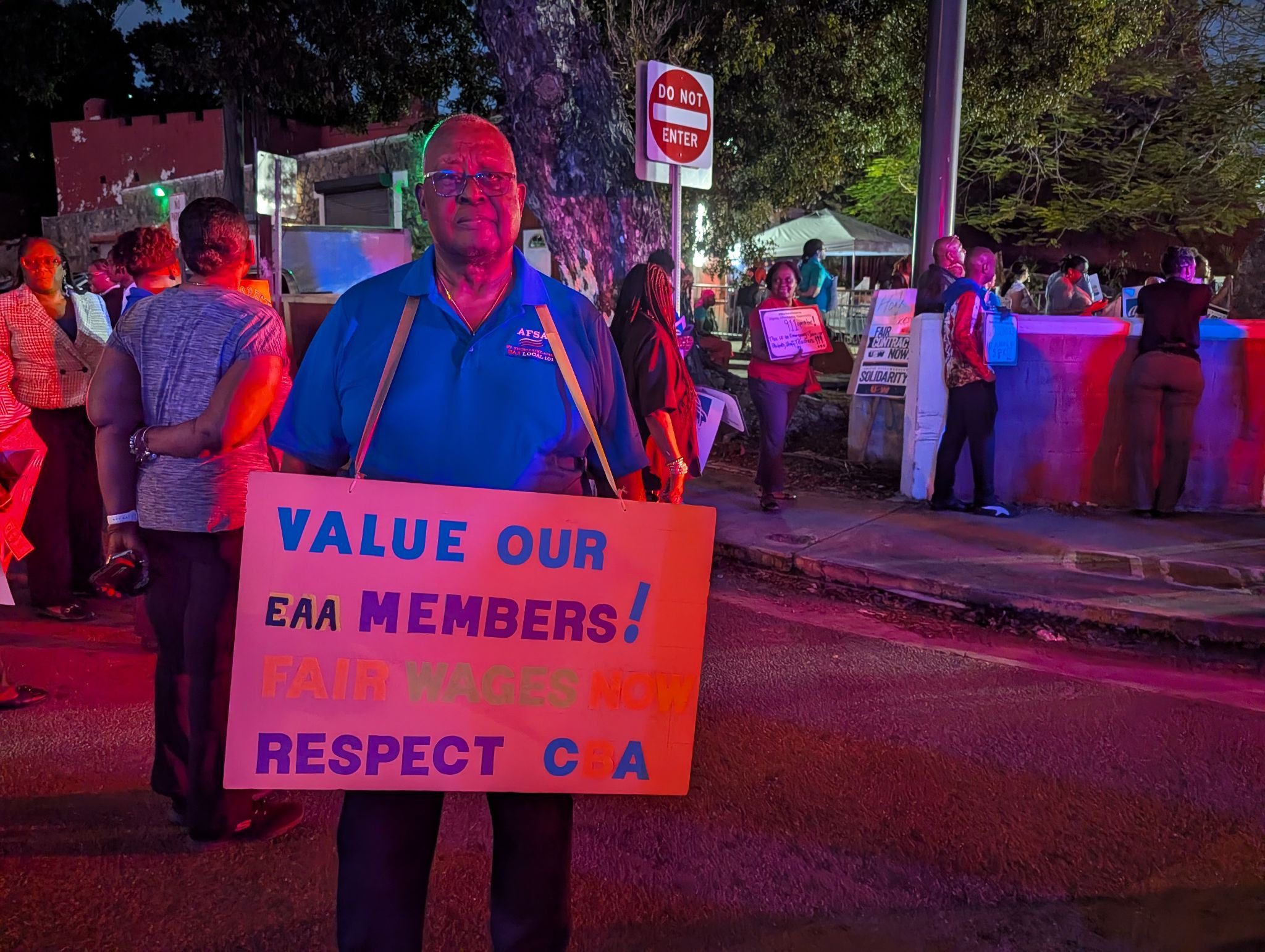
Union leaders said the government has repeatedly ignored agreements negotiated with workers, leaving employees without promised protections or pay increases. “They do not respect our CBA, they don’t respect our members, and it’s really a problem for us when our leaders don’t respect us or our CBA,” said Carver Farrow, president of the Education Administrators Association on St. Thomas and St. John. A collective bargaining agreement, or CBA, is a legally binding contract between a union and an employer that sets wages, benefits, and working conditions.

Carver Farrow, president of the Education Administrators Association on St. Thomas and St. John, with a sign reading “Value our EAA members! Fair wages now. Respect CBA.” during the protest. (Source photo by Finn Sharpless)

Farrow, and other labor leaders, said grievances are piling up at the Public Employees’ Relations Board, the agency that handles labor disputes for public-sector workers, and in arbitration, leaving hundreds of cases unresolved.

“PERB has over 100 cases … If I have a grievance, I expect it to be settled in a reasonable amount of time,” said Farrow “If you go to arbitration, there’s over 300 cases in arbitration. When are those cases going to be heard? These are the type things that we just can’t stomach anymore. We need some action. We need the governor to do something. We need our senators to look into these things for the working class.”

John Merchant, general counsel to a seafarers union, said, “There’s just been this atrophy of the mechanisms that we have to peacefully resolve our disputes, the bargaining table, the arbitration, the public employee board. So without that, all we have to do is to speak with our feet and our signs.”

Teachers and administrators said deteriorating school buildings and air quality are making staff and students sick. “Our schools are not healthy for teachers and students,” said Leontyne Jones, president of the St. Thomas-St. John Federation of Teachers, Local 1825. “We have mold issues. We have CO2 issues in some of the schools …. I don’t want my people to get sick and then have these chronic health issues.”

Linda Edmead-Glesford, second vice president of Local 1825, said those problems are visible in classrooms every day. “Just today, one of my co-workers, she had to open her door … because the mold was giving both her and the students a headache,” she said. “The mold is in the lights in the classroom. The mold is in the wall … People are getting sick constantly. The students are getting sick constantly. We need to be heard.”

Union leaders said they are responding by coordinating more closely across sectors and planning for a sustained campaign. Vigueras said local unions have formed an Area Labor Federation, allowing them to pool resources and present a united front.

“We created what’s called an Area Labor Federation that’s been sanctioned by the American Federation of Labor, the AFL-CIO,” he said. “These are all unions working together for the same common issues.”

Several labor leaders said their unity will extend to the ballot box, with unions now planning to act as a single voting bloc in upcoming elections. Farrow emphasized the impact this coordinated effort could have: “What we are planning on doing is working together from this point on, and we are going to vote in a bloc. We are going to be a major player in who the next governor is going to be. We’re going to be a major player on which senators get in there.”

Linda Edmead-Glesford added, “I am totally in agreement with all the unions coming together, because that’s unity, strength, and when everybody comes together, then action takes place.” Jacqueline Dickenson, vice president of the United Industrial Workers of the Virgin Islands–Service Employees International Union, urged voters to support labor-friendly candidates: “Election is coming this year, and we need for you to get out and vote, vote union friendly. We need people inside there who are going to work for us.”

Jones concluded the remarks, stressing that this is only the beginning: “This is just the first step. We are going to keep doing this until we see a change. We have power in numbers. We can vote these people out of office.”

Op-Ed: A State of the Territory Requires a State of the Truth

As the Governor prepares to deliver his State of the Territory Address, the people of the Virgin Islands deserve more than optimism, selective framing, or recycled talking points. They deserve the truth. And the truth is this. The Government of the Virgin Islands is in a deeply precarious financial position, one that can no longer be obscured by messaging or managed away with hopeful projections. The numbers already tell the story, and they tell it plainly. For years, the government’s finances have revolved around two primary accounts. Understanding the distinction between them is essential, because confusion, intentional or not, has helped mask the severity of the problem. Bank One is the government’s operating account. It is the checkbook. This is where payroll and vendor payments are made, utilities are covered, and routine government expenses are handled. It is funded by recurring revenues such as taxes, fees, and collections. When officials say cash is tight, what they really mean is that Bank One is stressed or depleted. Bank Two is not an operating account and was never intended to function as one. It is a clearing and holding account for restricted and pass through funds. This includes the Tourism Advertising Revolving Fund, which is largely funded by hotel room taxes and legally designated for tourism marketing, not general government spending. Bank Two also temporarily holds taxes and fees collected for agencies, fines and penalties, permits, refunds, and internal transfers awaiting reconciliation. Here is the reality leadership has avoided stating clearly. Bank One is empty. Bank Two is empty. Not low. Not strained. Empty. This is not conjecture. The Department of Finance’s monthly revenue reports, publicly posted, show ongoing stress in operating cash balances and recurring revenues that consistently underperform projections. The Internal Revenue Bureau’s reports reinforce the same conclusion. Month after month, the data shows declining balances, weak collections, and no meaningful cushion left to absorb fiscal shocks. These are government documents telling a glaring story. With the unprecedented level of federal relief funds received by the territory in recent years, the Virgin Islands should not be in this position. There is no defensible explanation for being this financially depleted after historic federal support. None. Yet instead of addressing the structural failures early, the government leaned on temporary money. Restricted funds were treated like flexible cash. Bank Two became a crutch rather than a clearing account. Now, there is nothing left to lean on. Quiet signals suggest that borrowing may once again be floated as a solution. Bonds. Financing. Short term fixes. This playbook should look familiar. Borrowing to plug holes created by mismanagement is not a strategy. It is a warning sign that the fundamentals have collapsed. Then there is the Epstein money. Those funds were spent. They were never properly reported as spent. To this day, there is no comprehensive public accounting, no transparent breakdown, and no clear explanation to the people of this territory about where that money went. That alone should alarm everyone, regardless of political affiliation. This is not a personal attack. This is not partisan. This is math. This is governance. The financial crisis facing the Virgin Islands did not happen overnight. It was created over time through poor fiscal discipline, weak internal controls, and a persistent refusal to confront reality early enough to correct course. A State of the Territory Address that does not grapple honestly with this financial condition is not leadership. It is avoidance. The people deserve candor. They deserve to hear where things went wrong, what guardrails failed, and what will be done differently moving forward. They deserve transparency, not reassurance. Markets do not respond to optimism. Creditors do not operate on vibes. Federal partners do not rely on talking points. They look at balance sheets. At some point, the Governor must reckon with the truth. The numbers already have. The Government of the Virgin Islands is broke. Literally. And the people of this territory did not deserve that.
Editor’s Note: Opinion articles do not represent the views of the Virgin Islands Source newsroom and are the sole expressed opinion of the writer. Submissions can be made to visource@gmail.com.

Related Link: Op-Ed: The State of the Territory Is an Institutional Memory Crisis

New in Coral Bay: Dazey’s Bayhouse

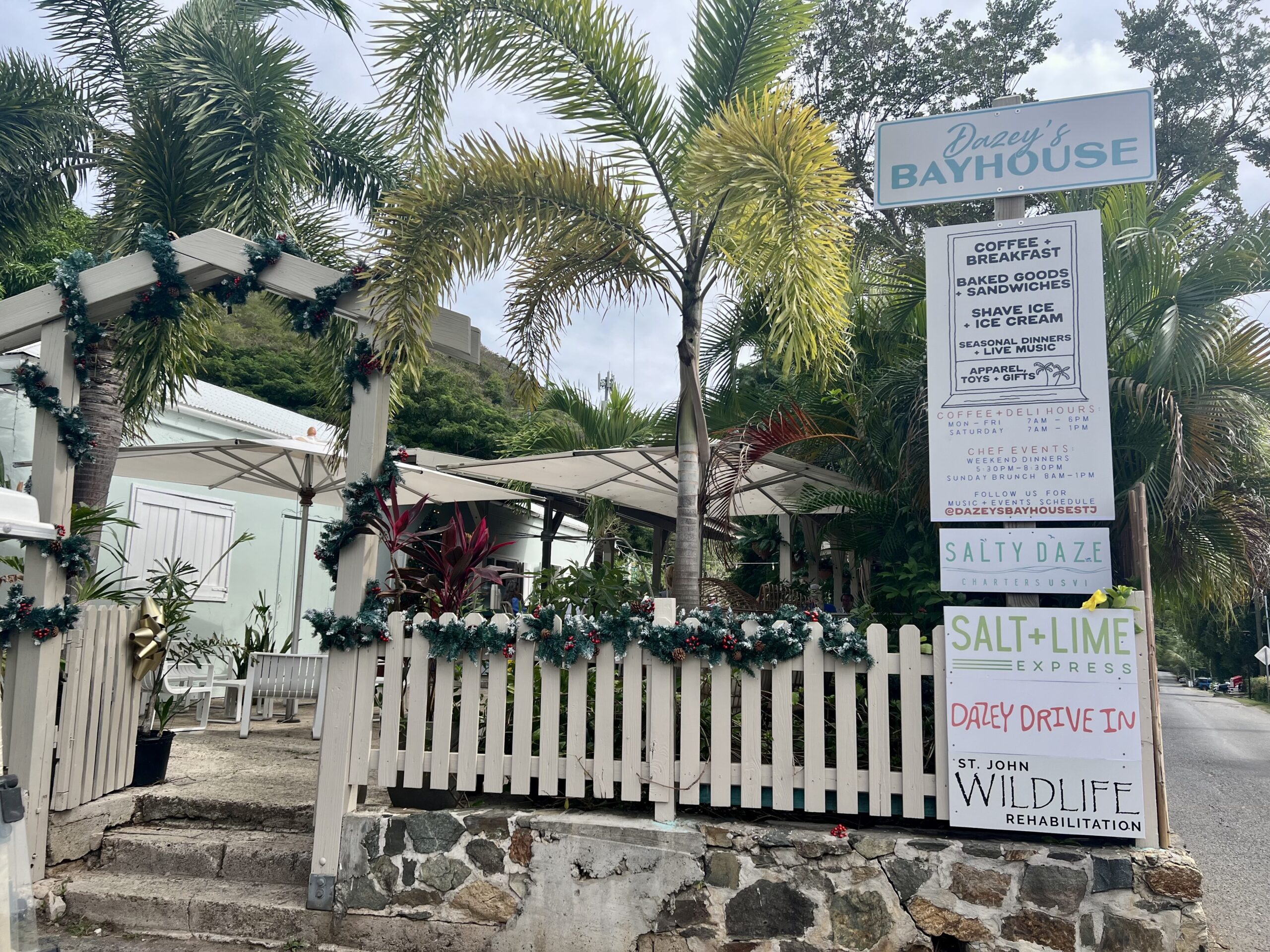
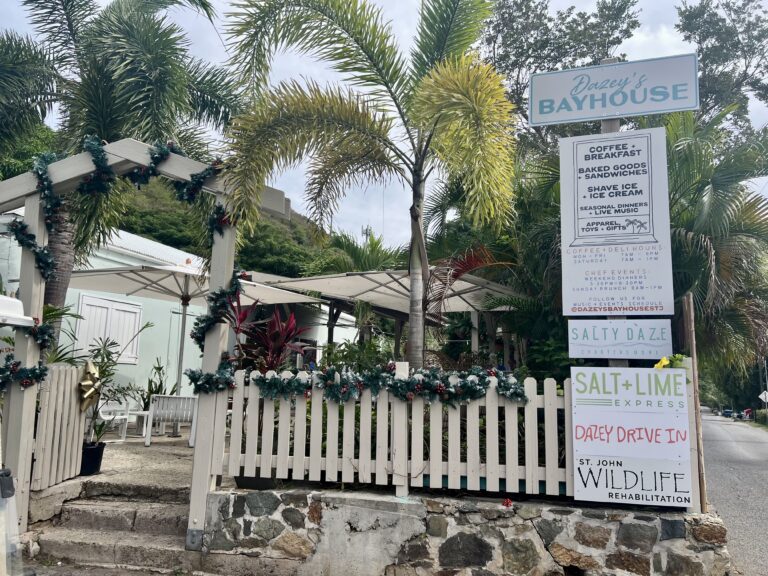
Dazey’s Bayhouse opened in Coral Bay on Jan. 1. (Source photo by Amy H. Roberts)
Since Dazey’s Bayhouse opened its doors on New Year’s Day, residents and visitors to Coral Bay, St. John have enjoyed a new source of bakery items, specialty coffees, sandwiches, and cool treats. Starting this weekend, they will offer new additions, including Saturday night dinners catered by Shaibu, and pizzas on weeknights. The Bayhouse is located at the site of Sputnik, the restaurant/bar established by owner Uris Dalmida in 1957, back when Coral Bay and the famous satellite were both considered w-a-y-y-y-y out there. Since then, the restaurant has been through several incarnations, including Donkey Diner, Indigo, and, most recently, Rhumb Lines.
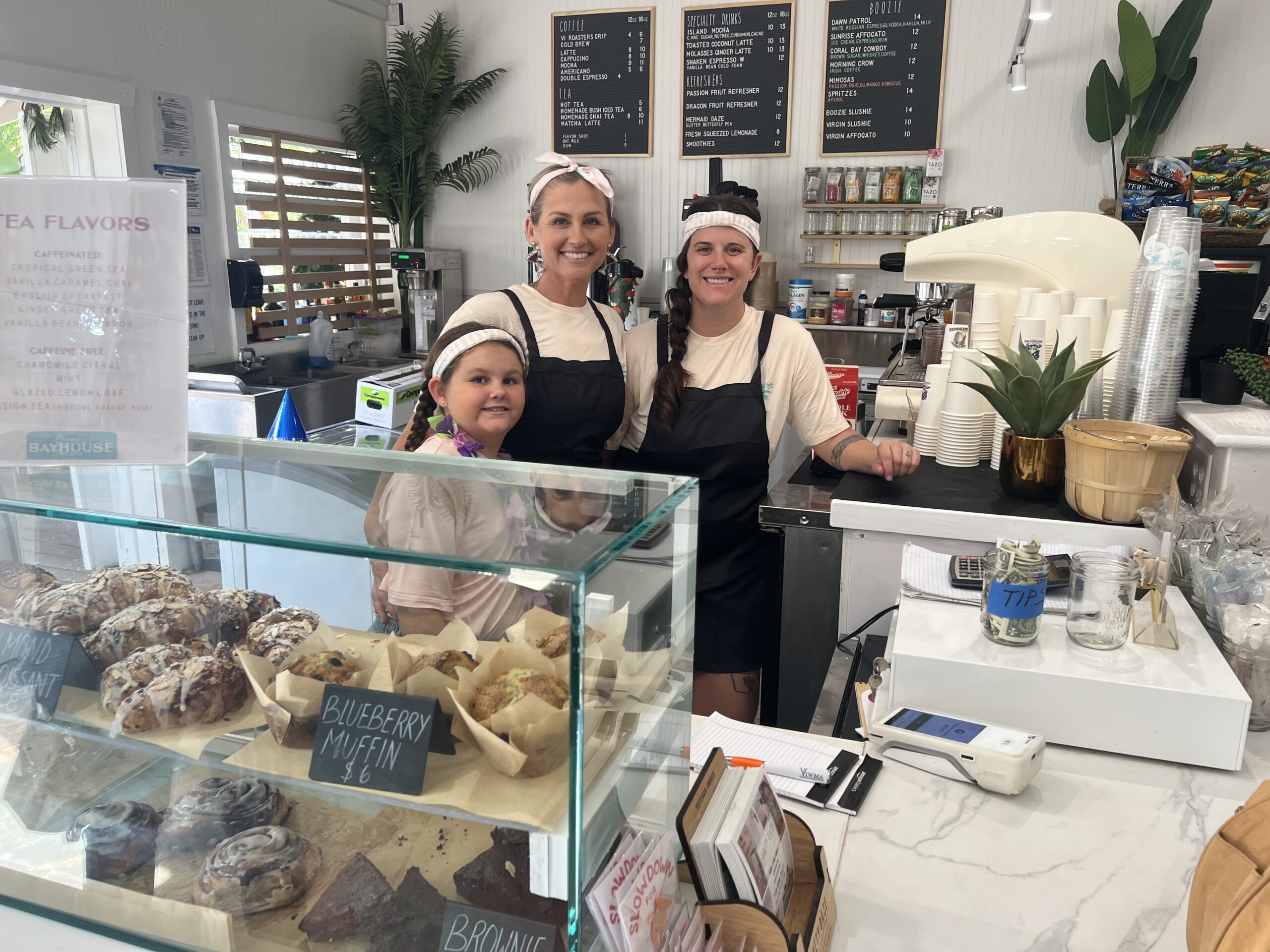
Magnolia Nesbitt, her mother Kate, and Julie Isaacson take a moment from helping customers to pose for a photo on opening day. (Source photo by Amy H. Roberts)
The new operators are Kate and Justin Nesbitt, who launched a number of marine-based businesses after moving to St. John in 2018. In 2023, they opened Dazey Drive In, a shave ice stand in the old Pickles complex. The shave ice stand proved to be very popular, but given its limited space, the Nesbitts were unable to offer much beyond snow cones and smoothies. After Rhumb Lines closed, the building lay vacant for six months. Kate Nesbitt kept her eye on the site, seeing an opportunity to centralize their businesses and establish a family-friendly eatery that offers treats throughout the day: early morning espresso drinks and fresh pastries, lunchtime sandwiches, and all-day ice cream, smoothies, and shave ice concoctions. They also have a bar, and yes, slushies can be spiked with liquor. The Nesbitts did a complete makeover of the Sputnik site, building out a professional kitchen with separate equipment for a bakery.
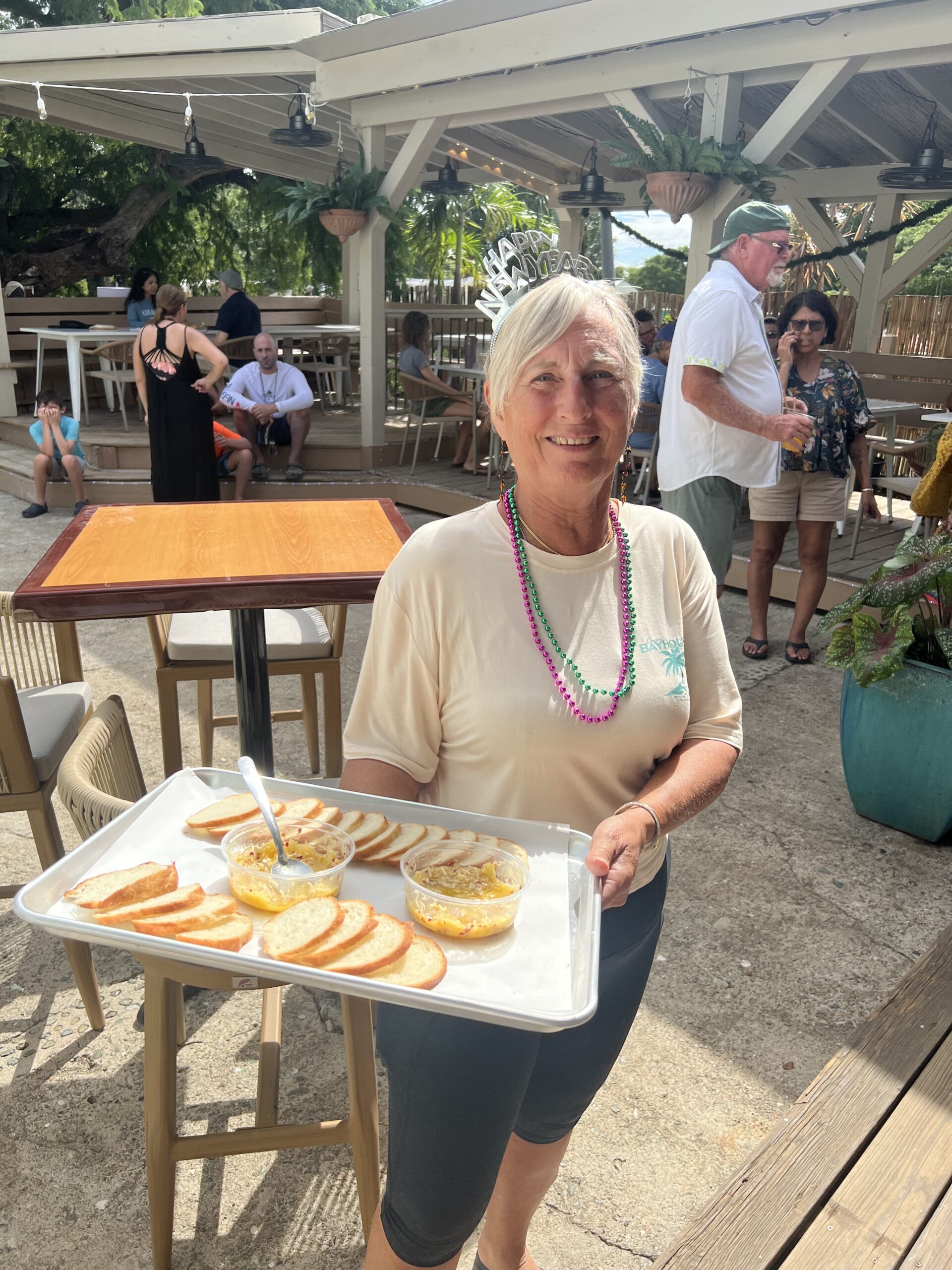
Sandra Miller helps out opening day at Dazey’s Bayhouse by serving samples of freshly baked bread with a topping. (Source photo by Amy H. Roberts)
They came up with an original idea for evening meals: Instead of establishing their own dinner service, they are inviting local chefs and caterers to come in and prepare their unique menus on different nights. “It’s a way of bringing in amazing chefs who don’t have their own establishments,” said Kate Nesbitt. The offerings of the first two participating chefs are eagerly anticipated. On Saturdays, Shaibu Abdulai (of Oasis Private Chefs and Shaibu’s Gourmet Grab & Go) will be preparing dinners served from 5 to 7 p.m. “It will be very exciting,” he said. “I’ll be changing the menu every week.” Soon, Erin Durrell (of Coral Bay Catering and St. John Veg Head) will be preparing sit-down brunch offerings on Sunday mornings. Durrell was one of the partners of Triple B, a Coral Bay food truck that became wildly popular until Hurricane Irma hit in 2017 and most businesses in Coral Bay came to a screeching halt. Tuesdays through Fridays, Dazey’s Bayhouse will be serving Neapolitan pizzas during the evening. The Nesbitts have three young children, and Bayhouse’s covered eating area is designed so that parents can easily keep an eye on their youngsters while they play in a special area for children.
A young girl aboard Salt Deck slides into the sea. (Photo by Sarah Swan)
Reservations can be made by calling 340-204-2333 or by booking on OpenTable or their website. The Nesbitts began their enterprises on St. John with a day charter business, Salty Daze. (Justin is a captain.) Their special contribution to the day charter industry is the Salt Deck, a 34-foot pontoon boat that typically plies the calm waters of Coral Bay and Hurricane Hole. They now count three pontoon boats among their fleet. They also offer boat shuttle service (Salt + Lime) to Lime Out, the floating taco bar in Coral Bay, and marine salvage and trucking services (known as Dirty Daze). Dazey’s Bayhouse serves as a central location for all of the family’s businesses and includes a shop stocked with clothing, toys, and beach gear. (Dazey, a pet goat, is the source of the name that appears in their various businesses.)
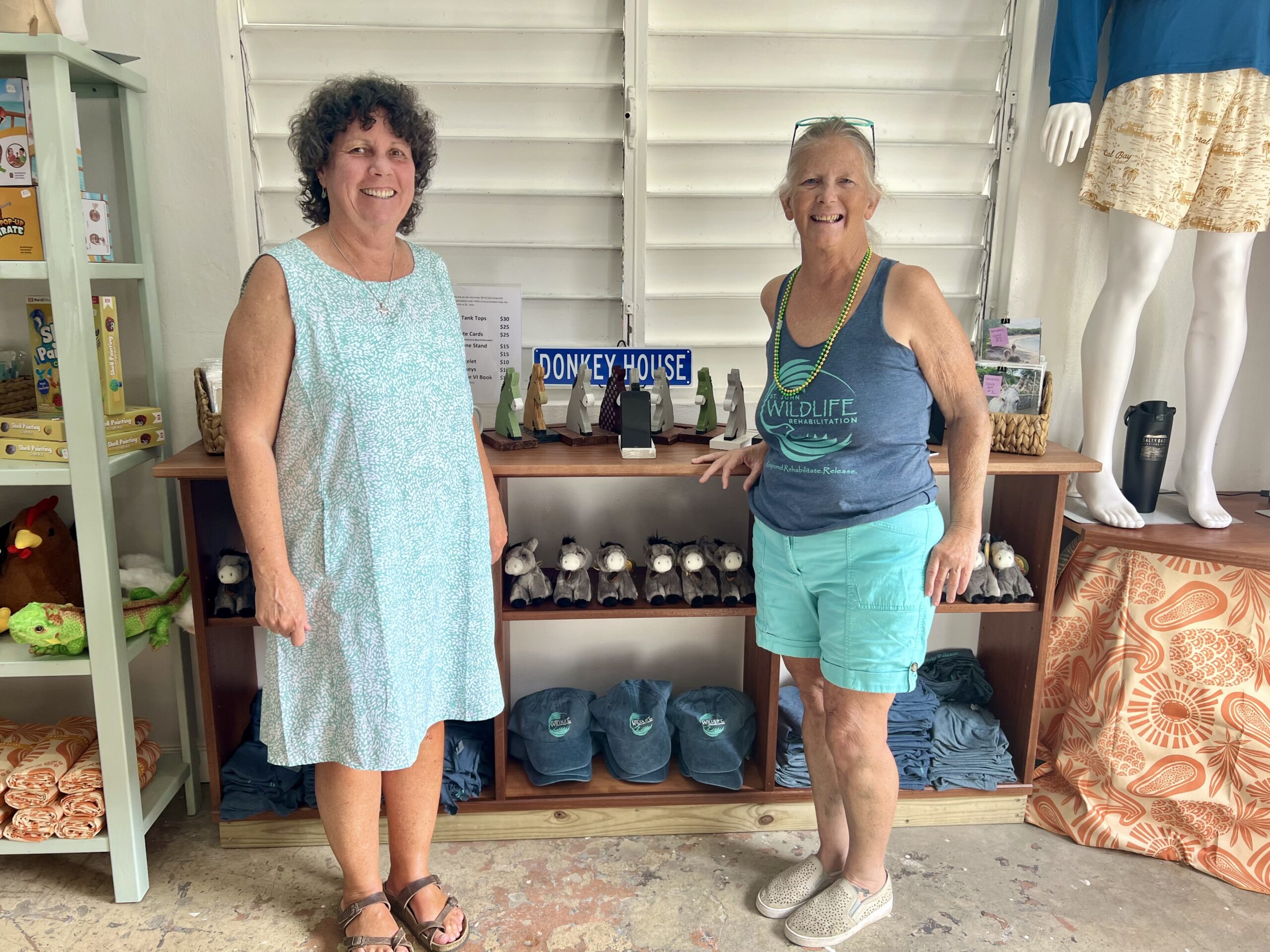
Debbie Proffitt and Leslie McKibben stand near merchandise to benefit St. John Wildlife Rehabilitation. (Source photo by Amy H. Roberts)
Because family members share a love of wildlife, the Nesbitts have created a space for the nonprofit St. John Wildlife Rehabilitation to share information and raise funds by offering merchandise for sale.

U.S. Virgin Islands Earns Three Honors at 2026 Caribbean Travel Awards

0
Cruise ships dock on St. Thomas, part of the U.S. Virgin Islands, recently named Caribbean Cruise Destination of the Year at the 2026 Caribbean Travel Awards. (Submitted photo)

The U.S. Virgin Islands received three top honors at the 2026 Caribbean Travel Awards, including New Hotel of the Year, Caribbean Cruise Destination of the Year and Experiential Destination of the Year.

The Saint, an adults-only boutique hotel in Cruz Bay on St. John, was named New Hotel of the Year. The property is the first new hotel to open on St. John in several years and features a full-service spa and destination dining, according to a press release from the U.S. Virgin Islands Tourism Department.

The territory was also recognized as Caribbean Cruise Destination of the Year, citing its ports of call on St. Thomas and St. Croix. Cruise visitors have access to shopping, historic sites, beaches, dining and excursions, including day trips to St. John that feature locations such as the Annaberg Plantation and Trunk Bay Beach, the press release stated.

The Experiential Destination of the Year award recognized the U.S. Virgin Islands for immersive travel offerings, including kayaking through mangroves, exploring historic Charlotte Amalie, chef-driven dining experiences, and excursions to Buck Island, the release stated.

“These recognitions reflect the dedication of our tourism partners, hospitality professionals, and local communities,” said Jennifer Matarangas King, commissioner of Tourism. “Together, we continue to elevate the U.S. Virgin Islands as a destination that delivers authentic experiences, exceptional service, and unforgettable moments for everyone.”

According to Tourism, the awards add to recent honors for the territory, including 2025 Cruise Destination of the Year from Porthole Magazine, USA Today 10Best Readers Choice Awards No. 6 Best Caribbean Island to Visit in 2026 for St. Croix, and TripAdvisor 2025 Best of the Best Top Ten Beaches for Trunk Bay Beach and Magens Bay Beach.

Man Shot in Face Found in Simmonds Alley

0
A man suffering from a gunshot wound to the face was found Sunday night in Simmonds Alley on St. Thomas, the Virgin Islands Police Department reported. Police said patrol officers and detectives from the Criminal Investigation Bureau were dispatched to the area at about 10:08 p.m. Sunday after reports of a gunshot victim. Upon arrival, officers located a male victim with a single gunshot wound to the face. Emergency medical services transported the victim to Schneider Regional Medical Center, where he was evaluated and treated for his injuries, police said. The circumstances surrounding the shooting remain under investigation, police said. Anyone with information about the incident is urged to contact police by calling 911, the Police Chief’s Office, or the Criminal Investigation Bureau at 340-774-2211, extensions 5577 or 5578. Anonymous tips may also be submitted to Crime Stoppers VI at 800-222-8477.

Man Arrested on St. Croix After Father Reports Strangulation Threat

0

A St. Croix man was arrested Sunday after police said he assaulted and threatened to kill his father during a domestic dispute.

According to a police report from the Virgin Islands Police Department, the 911 Emergency Call Center received a call at about 5:39 a.m. Sunday, from a man who reported that his son, Chavez Ali, had strangled him and threatened to kill him. Patrol officers responded and transported the victim to Juan F. Luis Hospital for treatment.

Police said the incident occurred around 7:30 p.m. Jan. 24 while the victim and Ali were at their home. Investigators reported that Ali began cursing, ranting and acting erratically before physically assaulting the victim, causing him to lose consciousness and sustain visible injuries.

A detective from the Domestic Violence Unit was assigned to the case. Ali was later located at his residence and transported to the Wilbur H. Francis Command Police Station. Police said he declined to provide a statement.

Ali was arrested and charged with assault in the second degree as an act of domestic violence, simple assault as an act of domestic violence, and disturbance of the peace. He was booked and remanded to the John Bell Adult Correctional Facility pending an advice of rights hearing, police said.

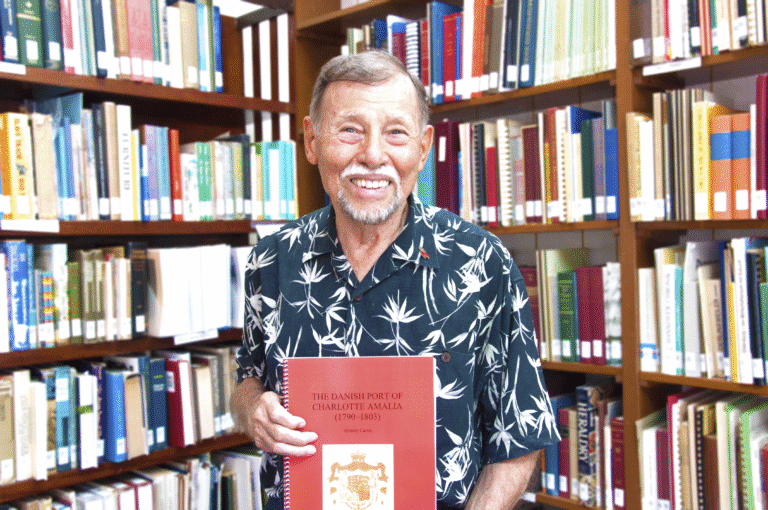
Dr. Aimery Caron Presents the History of Charlotte Amalia, 1803 to 1823

The Caribbean Genealogy Library on St. Thomas will have its Annual Membership Meeting on Sunday, Feb. 1 at 2 p.m.
Dr. Aimery Caron discusses his book on Ameridians of the Virgin Islands with library member at the Caribbean Genealogy Library. (Submitted photo)
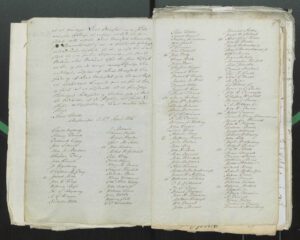
The meeting will feature a discussion with Dr. Aimery Caron on his newest research and book “The Danish Port of Charlotte Amalia II, 1803 to 1823”. This work is a 20-year extension of Dr. Caron’s previous book, “The Danish Port of Charlotte Amalia, 1790 to 1803”.  To conduct his research Dr. Caron used historical newspapers, specifically the Sancte Thomæ Tidende of 1816 and 1817. He identified the names of people in the community within the newspapers and documented the context. He also reviewed government records related to tax collection. In the Danish West Indies, property in land, houses and enslaved people, was registered for the purpose of collecting taxes. By using tax roll documents from 1803 to 1823 Dr. Caron identified the names of, tax paying, white and free people of color living in Charlotte Amalia. Also included in the book is a list of names of free people of color that signed a petition in 1816 requesting specific privileges and relief from certain grievances. The petition was signed by a total 331 free people of color on St. Croix, St. Thomas and St. John.  In addition to lists of people, Dr. Caron adds context to the history of the period, including information on the British takeover of the Danish West Indies between 1807 and 1815. His book also contrasts the demography, rights, privileges and duties of the whites with the free people of color living in the town.
Part of a petition from 1816 signed by free people of color in St. Croix, St. Thomas and St. John. (Submitted photo)
Dr. Caron is a scientist by education and career. He worked as a chemist, and as an associate professor of chemistry between the 1960s and 1990s. He retired from the University of the Virgin Islands in 2000. He served as the honorary Consul of France for the US Virgin Islands from 1983-2001. Since retiring from university work in 2000, Dr. Caron has dedicated substantial time and effort to researching and documenting the history of the US Virgin Islands. He has published over 20 papers and books on Virgin Islands and Caribbean history topics.  Some of Dr. Caron’s research topics include the French on Sainte Croix in the 17th century, the St. John Slave Revolt of 1733-34 and the French intervention, the Catholic Church on Sainte Croix between 1650-1696, General Santa Anna in St. Thomas, the Amerindians and their legacy in the Virgin Islands, and the German Empire and the American Purchase of the Danish West Indies.    Dr. Caron’s presentation at the Caribbean Genealogy Library’s annual meeting on February 1st at 2pm, will be in a discussion format. He will be interviewed and discuss his most recent book, “The Danish Port of Charlotte Amalia II, 1803 to 1823”, with fellow Virgin Islands historian and author Nadine Marchena Kean. Both Dr. Caron and Mrs. Marchena Kean are members of the Caribbean Genealogy Library and are enthusiastic about the study and preservation of the Virgin Islands’ history, culture and family stories.   For people interested in doing their own research or in seeing digitized versions of the Danish West Indies taxation records used in Dr. Caron’s research on Charlotte Amalia, those can be found on the Rigsarkivet (the Danish National Archive) website. The historical newspapers from the Danish West Indies can be found on the Danish Royal Library website. When looking for records from the Danish West Indies, a good place for researchers to start is https://en.rigsarkivet.dk/guide/the-danish-west-indies/. 
Dr. Aimery Caron, with his book on Charlotte Amalia, at the Caribbean Genealogy Library. (Submitted photo)
The Caribbean Genealogy Library’s annual membership meeting on Feb. 1 at 2 p.m., will also include the election of the 2026 board of directors and a review of library projects. Attendance at the meeting, including the presentation, is free for current library members. The public is welcome to attend at a $5 admission. Anyone interested in becoming a member of the Caribbean Genealogy Library is encouraged to visit the membership page of the organization’s website at www.cgl.vi or they can join at the library. For more information about the event and library, email caribgenlibrary@gmail.com.  The Caribbean Genealogy Library is a research library located in St. Thomas, U.S. Virgin Islands. It was founded in 2000 and is a 501(c)(3) non-profit organization. The library’s mission is to identify, preserve and provide access to Caribbean genealogy, history and cultural heritage resources for the Virgin Islands and the Caribbean, and to promote and encourage their use for history documentation, education, and scholarship. The library is in building 3 of Al Cohen’s Plaza at the top of Raphune Hill, St. Thomas. 

Robert David Dies

0

It is with deep sorrow that we announce the passing of Robert “Dude/Bobby” David, who departed this life on Jan. 15, 2026, in Houston Texas.

Robert David

Robert is proceeded in death by his brother Gaston David, his daughter Tammy David, and his wife Yvette “Helen” Walters.

He is survived by his daughter Brigette “Peggy” David, his sons Robert, Patrick and Shamoy David. His daughter-in-law, Deanna David. Grandchildren, Denny, Roquan, Savannah, Kaylee and Cassidy David, Kwanasia Charles, Kamron, Adrain and Rhianna David, Jerikai Francis and Lily Henry. His brothers Sim London, Emile Smith, Carlisle and Winston Davis. Many nieces, nephews and cousins too numerous to mention.

Family and friends are respectfully invited to attend the Memorial Service on Friday, Feb. 6, at Dan Hurley Home for Funerals Celestial Chapel at 10 a.m.

Funeral arrangements are under the care of Dan Hurley Home for Funerals and Cremation Centers of St. Thomas, St. John, and St. Croix. For online directions or to share a special memory, visit www.hurleydavisfuneralhome.com

W. B. Thompson: Made from Scratch at Mango Tango Art Gallery

Island icon W. B. Thompson will unveil his latest exhibition, Made from Scratch, at Mango Tango Art Gallery on Saturday, Jan. 31, from 5:30 p.m. to 8:30 p.m.
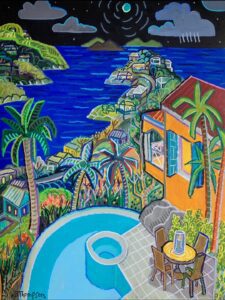
Artwork by W. B. Thompson. (Submitted photo)
The exhibition features Thompson’s dynamic mixed-media works on panels, canvas, and marine board assemblages, filling the gallery with the bold textures, layered materials, and inventive energy that define his style. The celebration extends outdoors with appetizers, spirits, and the Cuban Fusion and Ethnotronica DJ set of Neko Crush, creating a lively island evening. Mango Tango gallery owner Jane Coombes notes that Thompson is intentional about presenting his work in carefully curated venues both within and beyond the Virgin Islands. Visitors to Mango Tango often recognize his work from exhibitions in Key West, Best in Show honors in Connecticut, and installations at his alma mater, Trinity University in San Antonio. Locals take particular pride in Thompson’s participation in the Absolute Vodka Art Project: Absolute Connections, an international exhibition that traveled to ten Latin American museums before arriving at Mango Tango in 2008. Thompson’s work is deeply influenced by the improvisational spirit of Quelbe, or Scratch music, where creation emerges from instinct and whatever materials are at hand. That philosophy continues to shape his intuitive, unrehearsed approach to artmaking. As Thompson notes, creativity is “an itch I must scratch,” a drive that persists even during fallow periods. Guided early on by mentor Professor Bill Bristow, Thompson approaches each drawing and assemblage as a fresh opportunity for invention, guided by intuition rather than rigid structure. Thompson’s assemblages can be found in public and unexpected spaces, from the Montessori School playground to the Key West International Airport. When offered in the gallery, his work is quickly claimed by dedicated collectors. For more than thirty years, Mango Tango Art Gallery has been a creative home for Thompson’s work, fostering a community that continues to inform and inspire his evolving practice. Made from Scratch will be on view for seven weeks. For more information, visit mangotangoart.com or call 340-777-3060.