
NHC Monitoring Storms in Atlantic; Hazardous Marine Conditions and Showers Forecast Across USVI, Puerto Rico

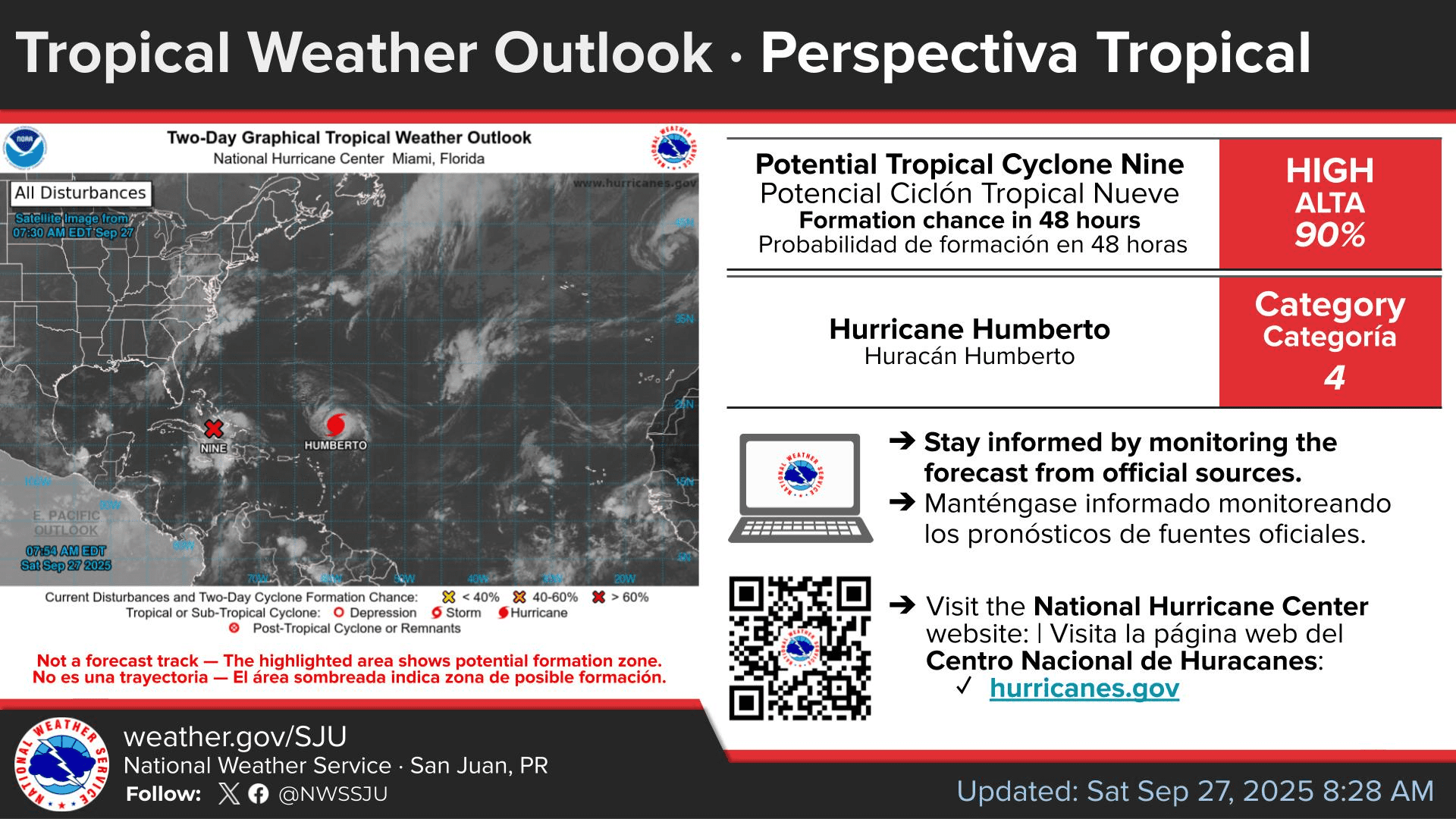
The NHC is currently monitoring two systems in the Atlantic basin: Hurricane Humberto and Tropical Depression Nine. (Photo courtesy NHC and NWS)

The National Hurricane Center is monitoring two systems in the Atlantic basin: Hurricane Humberto and Tropical Depression Nine, anticipated to intensify into Tropical Storm Imelda. While neither storm is expected to directly affect the USVI and Puerto Rico, showers are possible, and marine conditions will be hazardous.

Tropical Cyclones Monitored by NHC
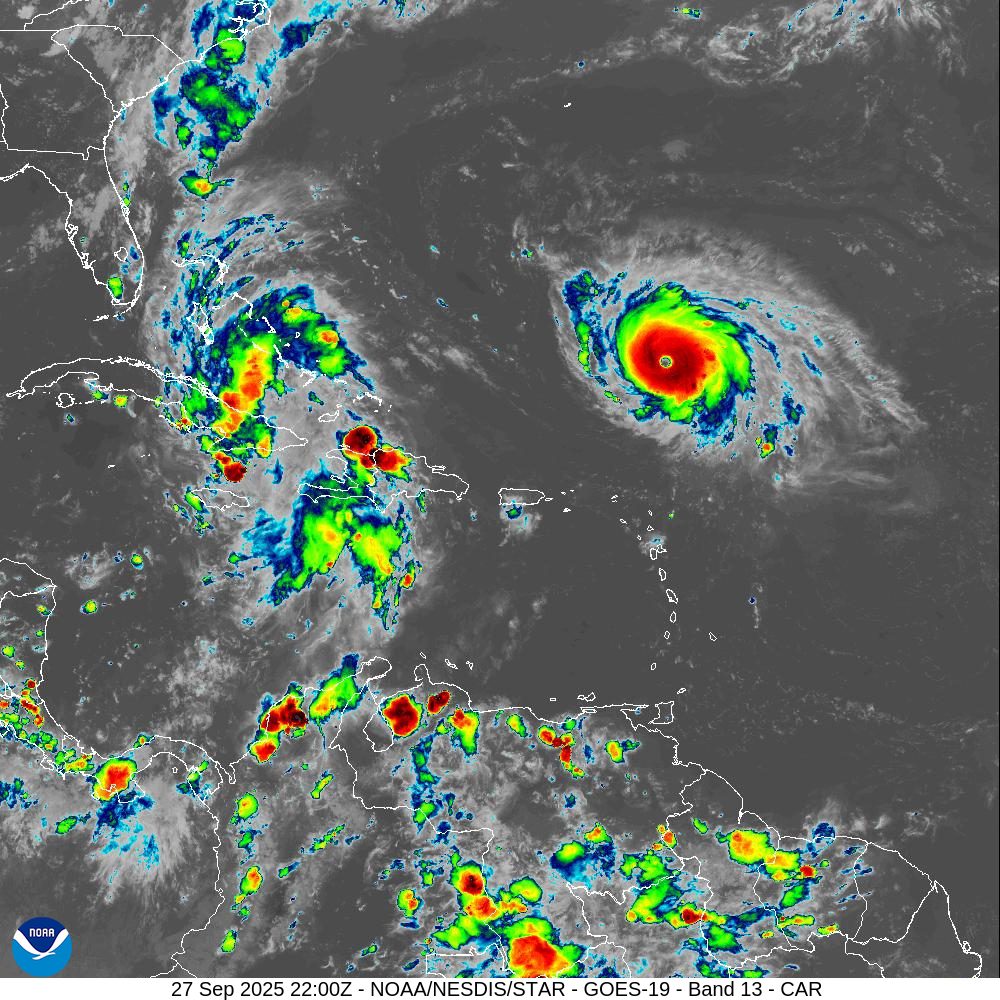
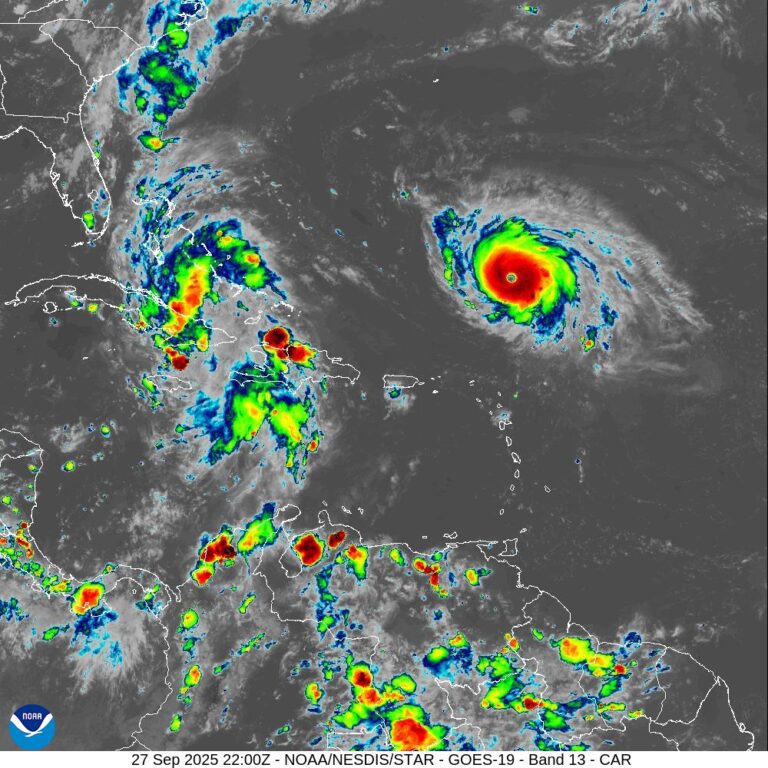
Infrared satellite imagery obtained at 6 p.m. AST shows Hurricane Humberto located well to the northeast of the USVI and Puerto Rico. Tropical Depression Nine is also visibly located near the Bahamas. (Photo courtesy NOAA)

As of a 5 p.m. update from the NHC on Saturday, Hurricane Humberto, a major Category 5 hurricane, was located approximately 300 miles north north-east of the northern Leeward Islands. The storm is expected to remain over water as it moves in the general direction of Bermuda, though the cyclone is forecast to pass west of the island.

Hurricane Humberto
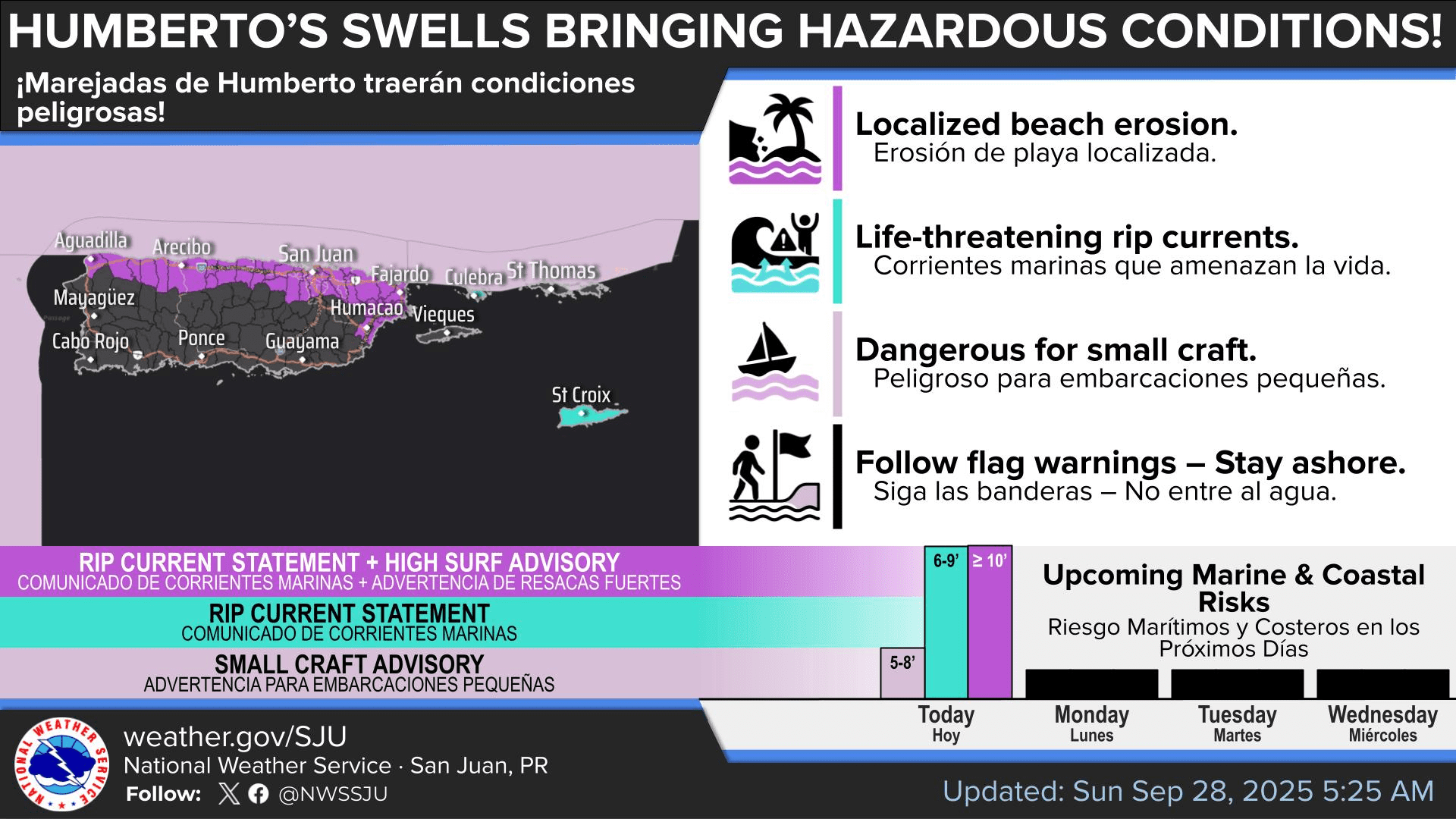
The NWS in San Juan, Puerto Rico, warned on Saturday of choppy seas due to swells generated by Hurricane Humberto. Several marine alerts have been issued. (Photo courtesy NWS)

However, powerful swells generated by Hurricane Humberto will cause dangerous marine conditions across several areas, including the USVI and Puerto Rico.

“Swells generated by Humberto will affect portions of the northern Leeward Islands, the Virgin Islands, Puerto Rico, and Bermuda beginning tonight and continuing next week,” the NHC warned. “Swells from Humberto will also affect the U.S. East Coast beginning Monday. These swells are likely to cause life-threatening surf and rip current conditions.”

In anticipation of the hazardous conditions, the National Weather Service in San Juan, Puerto Rico, has issued a Small Craft Advisory for portions of the waters surrounding the local islands, with seas expected to reach between at least four and seven feet. Additionally, a High Surf Advisory is in effect for areas of Puerto Rico.

The NWS also said that the risk of rip currents will be elevated at coastlines across the region due to the strong swell. A High Rip Current Risk is in effect for portions of Puerto Rico and the USVI until 6 a.m. on Monday.

“A long period northeasterly swell from Hurricane Humberto will continue to increase seas and breaking waves during the weekend, resulting in a high risk of rip currents,” the NWS reported on Saturday. “There is a Small Craft Advisory in effect across the offshore Atlantic waters.”

“Improving coastal conditions are expected beginning on Monday,” the NWS added.

Additionally, the NWS noted that trailing moisture associated with Humberto could bring periods of rainfall and thunderstorms to areas across the local islands over the coming days, and minor concentrations of Saharan dust are also anticipated.

“An increase in moisture is forecast from Monday into Tuesday; however, Saharan dust will also move in, resulting in hazy skies in some isolated areas,” the NWS stated.

As of Saturday afternoon, there were no reports online from the Virgin Islands Port Authority regarding changes to port conditions across the territory.

Tropical Depression Nine

In addition to Humberto, the NHC is closely watching Tropical Depression Nine, which is expected to become Tropical Storm Imelda soon. As of Saturday afternoon, the cyclone was moving across the Bahamas, bringing rainfall and wind. Tropical weather alerts have been issued for the Bahamas as well as areas along the east coast of Florida.

The NHC has noted that there is significant uncertainty regarding the track of the cyclone as it moves toward the southeastern U.S. Due to the interaction between Humberto and Tropical Depression Nine, the system could move over land near South Carolina, or it may stall offshore. Either way, the NHC has warned that weather impacts are expected to occur along the U.S. East Coast, and travelers are encouraged to monitor flights regarding any possible disruptions.

Weather Updates

Finally, the NWS has cautioned that very warm temperatures will continue to occur across both Puerto Rico and the USVI. Heat alerts may be issued.

It is crucial to remember that the forecast can change very quickly. USVI residents and visitors are encouraged to continue to remain prepared. Weather information is available from the NWS, the NHC, and NOAA.

Additionally, the local weather forecast for the U.S. Virgin Islands is regularly updated on the Source Weather Page and VI Source YouTube Channel. A weekly Tropical Outlook article from the Source is also published throughout hurricane season to provide in-depth updates. Residents and visitors can find additional weather alerts and preparedness information from the Virgin Islands Territorial Emergency Management Agency.


Steelworkers Union Stalwart Frederick Joseph dies at 81

0

Frederick Joseph, a Virgin Islands labor leader who helped secure better wages and working conditions for unionized refinery workers, is being remembered for his activism and community support.

Joseph — known to his friends as Freddy — passed away Sept. 23 at the age of 81. Among those paying tribute was Delegate to Congress Stacey Plaskett, who called Joseph “a fierce, passionate, and meticulous” advocate.

He was best known for his work with the United Steelworkers Union, Local 8248, where in 2001, he helped preserve the jobs of about 240 Hovensa refinery workers when the Texas-based subcontractor they worked for was replaced by Triangle Construction and Maintenance. At the time of the transfer, there were concerns that the local workers would be replaced by imported labor brought in from the U.S. mainland.

Prior to that — in 1999 — Joseph led the civilian staff at the Virgin Islands Police Department through an effort for better workplace conditions. And, in 2002, the Steelworkers leader helped resolve a strike involving workers at Innovative Communications.

“He was a fierce champion of the rights of the working men and women, and was instrumental in shaping the pillars and building the foundation of organized labor locally,” said Democratic Party Chairwoman Carol Burke in her condolence message issued Thursday.

Joseph held the title of Steelworkers subdistrict director until his retirement. Plaskett credited him for supporting her first Congressional campaign and his continued support through her years of service. Although the delegate also mentioned the verbal jabs she suffered from Joseph and the late labor leader Luis “Tito” Morales during the days when they sat on opposite sides of the negotiating table.

“I enjoyed being jointly — affectionately — challenged, badgered, and harassed by him and Tito Morales … As can happen in the practice of law, when you find worthy competitors, it breeds mutual respect and oftentimes friendships,” Plaskett said.

Those who paused to acknowledge his passing expressed condolences for Joseph’s wife, Amy, other relatives, and members of his swimming group.

Funeral services are pending.

Averil Gwenette Smith Dies

0
With deep love and profound sorrow, we announce passing of Averil Gwenette Smith on Sept. 15, 2025. 
Averil Gwenette Smith
She is survived by Husband Raymond A. Smith; Children: Orville Webster, Alvery Smith, Casey Smith, Shermon Smith; Grandchildren: Leon Pennyfeather, Jilyssa Smith Cross, Alonte Smith, Lorenz Smith Brothers-in-Law Conrad Hodge, Sheridan Smith, Burnet Hodge, Kennedy Hodge; Sisters-insLaw Shirley Hodge Ryan, Marcia Hodge, Eglantine Vanterpool; Daughter-in-laws: Patricia Webster, Nicole Smith, Ana Cristina Garcia; Great-Grandchildren: Leandra Pennyfeather, Kayla Pennyfeather, Daken Pennyfeather, Phoenix Pennyfeather, Jaylyn Cross; Extended Children: John Garcia, Tristan Montalvo, Tony Samuel; Extended Grandchildren: Taj Alexander Garcia, Matteo Corralez, Antonio Samuel, Jr. Funeral service will be held on  Oct. 5 Philadelphia SDA Church #5 Raphune Hill  St. Thomas, VI 00802 Viewing: 9 a.m. to 10 a.m. Service: 10 a.m. Internment Eastern Cemetery, Smith Bay, St. Thomas, VI 00802 Arrangements will be provided by Turnbull’s Funeral Home.

Magens Bay Authority to Commence Bath House #1 Reconstruction Project

0
The Magens Bay Authority is pleased to announce that construction on Bath House #1 will commence with mobilization beginning Sept. 29.
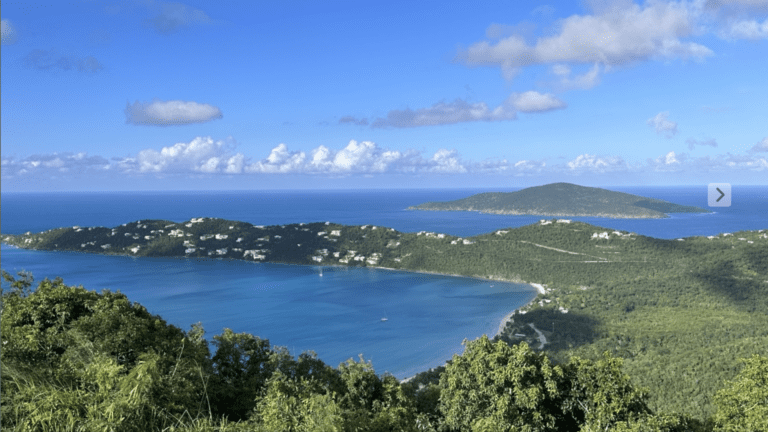
Magens Bay, St. Thomas, USVI (Shutterstock)
This long-awaited project is funded by the Federal Emergency Management Agency and awarded to Rumina Construction, LLC. Bath House #1 sustained severe damage during Hurricanes Irma and Maria in Sept. 2017,  and its reconstruction marks a significant step in restoring and improving the park’s facilities. “As we move forward, the Authority remains committed to ensuring that this project enhances the visitor experience while preserving access to Magens Bay,” said Monique Simon, General Manager of the Magens Bay Authority. During construction, traffic and parking adjustments in the area may be necessary. The Authority will provide timely updates to keep the public informed of any changes. The Magens Bay Authority kindly requests the cooperation of all patrons during this period of progress. For additional information and updates, please contact the Magens Bay Authority at (340) 777-6300 or via email at info@magensbayauthority.org.

Sustin Alexander Donovan Dies at 59

0
The family of Sustin Alexander Donovan, fondly known as ‘Nun Nun’ is deeply saddened to announce his passing on August 17, 2025, in St. Thomas, at the age of 59. 
Sustin Alexander Donovan
He is survived by his children Taresha and Josiah Donovan and Kyliel Barnes, his siblings Austin ‘Jelly’ Donovan, Stephanie V.D. Homme, Winifred Lewis, Henry Petersen, and James Donovan, his late parents, Susthen Donovan and Muriel Testamark Donovan. His late sister, Colleen Donovan Lowry. And other family and friends are numerous to mention.  A memorial service will be held on Sept. 30, at 10 a.m. at the Memorial Moravian Church – #5023 Norre Gade, Charlotte Amalie, St. Thomas, VI. Tributes will be between 9 a.m. and 10 a.m. Interment at the Eastern Cemetery at #8 Smith Bay Road, St. Thomas.

VIWMA Temporarily Accepting Sludge and Other Wastewater

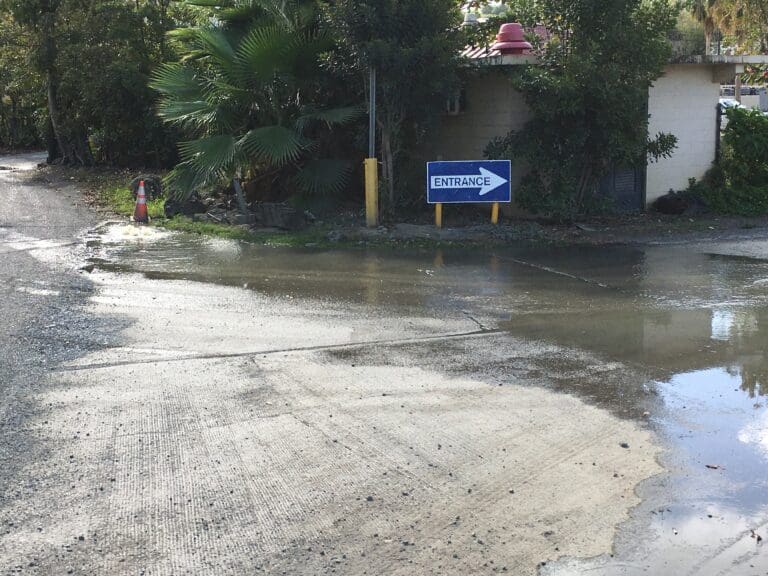
The Virgin Islands Waste Management Authority would like to inform all wastewater haulers that, due to technical issues at the Mangrove Lagoon Wastewater Treatment Plant, sludge, septage, and gray water are temporarily being accepted at the Cancryn Pump Station on St. Thomas. This service is available on Mondays, Wednesdays, Fridays, and Saturdays from 7 a.m. to 1 p.m. Grease will NOT be permitted. 
Virgin Islands Waste Management Authority
Haulers are reminded to adhere to all safety protocols, rules, and regulations when entering the facility.  We understand the inconvenience this may cause and rely on your cooperation and continued patience as we work towards a permanent solution.  For updates or further assistance, please contact the Division of Wastewater at (340) 715-9151 or Communications Management at communications@viwma.org. Stay connected with us on Facebook, X, and LinkedIn for updates.

Pinktober! 20 years of Support for Battling Cancer in the Virgin Islands

0
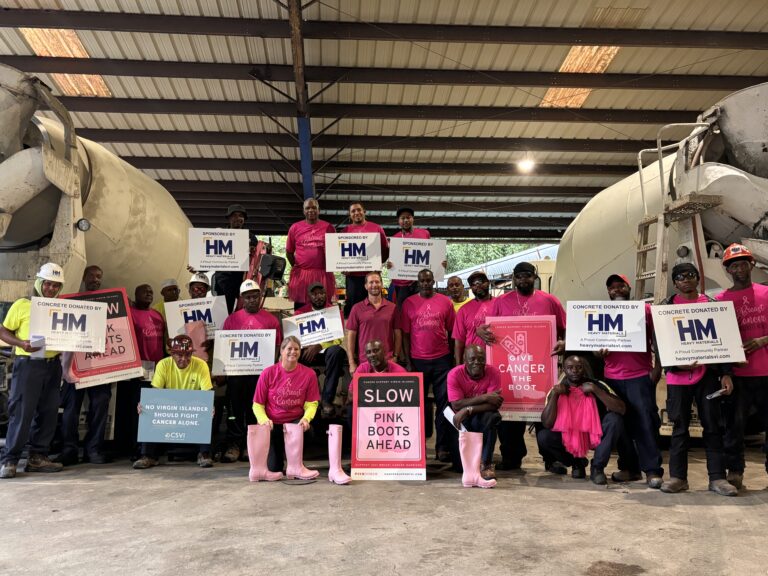
Cancer Support Virgin Islands launches its 12th Annual Pinktober, a month-long series of events, community initiatives, and fundraising efforts, dedicated to providing direct financial support to warriors across the territory. This milestone also marks Cancer Support VI’s 20th year of service: two decades standing shoulder to shoulder with cancer warriors, patients and their families when they need it most.
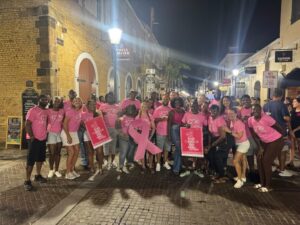
The Left Lane Cyclers celebrate Pinktober. (Submitted photo)
Since its founding in 2005, Cancer Support VI has assisted over 4,800 cancer warriors exceeding $6 million in assistance to Virgin Islanders. Each October, Pinktober has united schools, businesses, and community members to raise awareness and much needed funds. This year CSVI sets a bold goal: raise more than $900,000 dedicated to sustaining and expanding critical services. Local businesses, churches, schools, and organizations are invited to become Partners with a Purpose by hosting events, selling CSVI pink logo pins, or joining the Give Cancer the Boot campaign. “Cancer doesn’t wait, and neither can we,” said Barb Michaud, director of Cancer Support VI. “For 20 years, our communities have rallied around cancer warriors, ensuring they are never alone in their journey. Pinktober is both a celebration of that legacy and a call to action for the future.”  Cancer Support VI patient grants and advocacy efforts are made possible entirely through the generosity of donors and community partners, ensuring that EVERY dollar raised stays in the US Virgin Islands. Throughout October, our community partners will host a full calendar of Pinktober events designed to engage every corner of the community. Territory-wide events including pink drink specials, specialty dinners and brunches, Pink Out volleyball games, pickleball tournaments, art & fitness classes, and even pumpkin carving! From workplace fundraisers and school activities to island wide campaigns like “Give Cancer the Boot” there are countless ways to get involved. You can find our complete list of events, initiatives, and ways to contribute by visiting www.cancersupportvi.org  About Cancer Support Virgin Islands Cancer Support Virgin Islands is a 501(c)(3) nonprofit organization dedicated to providing advocacy, outreach, financial assistance, and resources for cancer patients and their families in the Virgin Islands. Since 2005, CSVI has been a vital lifeline for cancer warriors, offering support for medical treatments, travel, and essential living expenses, while promoting awareness and education across the community

Op-Ed: Recognizing Black Contributions to Ornithology in the Virgin Islands

Zenaida doves are very common in the Virgin Islands. In April 1857, Alfred Newton stated in his notebook that a Black woman was walking on a mountain dirt road north of Estate Castle Burke where she spotted a Zenaida dove ( Zenaida amabilis). (Photo courtesy Wikipedia)
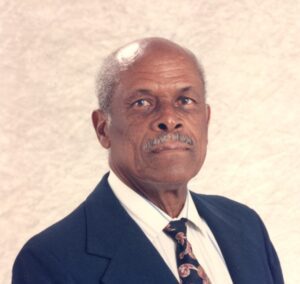
Earl G. Roebuck, a native Virgin Islander and ornithologist. (Source file photo)

George A. Seaman, Harry A. Beatty, and Earl G. Roebuck, all native Virgin Islanders now deceased, are well known in our history as ornithologists. The study of birds is called ornithology, from the Greek word ornis, bird, and logos, study. I believe it was 2023 when I got an email message from Dr. Jake Subryan Richards, an assistant professor in the Department of International History at the London School of Economics and Political Science.

If I remember the conversation correctly, we were talking about birds and how enslaved laborers in the Danish West Indies didn’t get credit for their contributions in ornithology.  Richards enlightened me about how enslaved and “free slaves” made great contributions to the ornithology history of the Virgin Islands as well as the world and did not get credit for the work of what he called the “invisible technicians.”

Olasee Davis
Olasee Davis (Submitted photo)

He forwarded me a scientific paper he wrote, entitled “Black Ornithology:  Ecology, Emancipation, and the Birth of a Professional Scientific Discipline between the Caribbean and Britain.”  In the world of ornithology, Alfred Newton and his brother Edward Newton are well known worldwide as ornithologists. Alfred was the founding member of the British Ornithologists Union in 1858 and its journal. His brother Edward was a British colonial administrator.

In 1857, the Newton brothers visited the Danish West Indies and conducted ornithological observation on the island of St. Croix. In Richards’ scientific research paper about birds, he mentioned the interaction of birds with Black people on St. Croix and the understanding of the island ecology among enslaved and runaway slaves known as Maroons, in relation to ornithology. In other words, Blacks in the Danish West Indies during slavery and post- emancipation, had an understanding of wildlife behavior in the natural world of birds on the islands.

Richard argues in his scientific paper that “… Black people were not simply invisible technicians but rather developed a specific post-emancipation practical knowledge about organisms and their environment which included a flexible familiarization with birds.” He further stated, “The knowledge draws on ecological understanding among both Indigenous Kalinago and maritime maroon groups.” The Newton brothers recorded the knowledge of Black people, which helped them gather traditional knowledge about birds that they documented in their field notebooks.

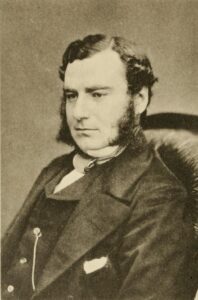
Alfred Newton, 1829-1907, an ornithologist who was a founding member of the British Ornithologist Union in 1858 and its journal. (Photo courtesy Wikipedia)

However, the Newton brothers erased the role of Black Crucian ornithologists when they published their findings of birds on St. Croix. This was the first professional ornithologist journal in Britain. Believe me, the publication on the Black Crucian ornithology is fascinating, by Richards scientific research. It is a pity, however, that I can’t go into detail on the research of birds by Richards and the history of 1857 when the Newton brothers visited St. Croix due to space in this article.

However, I will try to summarize an episode where Alfred Newton reported in his field notebook about a Black Crucian woman. This is one of many notes where Alfred Newton wrote about his encounters with local people between 1857 and 1858 on St. Croix. In April 1857, Newton stated in his notebook that a Black woman was walking on a mountain dirt road north of Estate Castle Burke where she spotted a Zenaida dove (Zenaida amabilis). He reported that the woman had given two eggs and the bird nest to her doctor, Dr. Cardin, who brought them to Alfred Newton.

In his field notebook, Newton reported that the woman found the eggs in a cashew tree in the vicinity of Blue Mountain. He had little or no doubt that the eggs are rightly named by her because of her practical knowledge of birds on the island and the habit of her taking the same route to the mountain to see her doctor. According to Newton’s notebook, he evaluated the veracity of the Black woman’s observational narrative and the specimen she collected, which was the Zenaida dove eggs and nest.

Then, he decided that the Black woman was trustworthy based on her frequent route or pathway for medical care from her doctor. The post-emancipation era interaction between former slaves and white former slave owners must have raised questions of truth and trust in Newton’s mind. In his field notebook, Alfred considered  himself as a neutral arbiter person. He was the one who decided on the validity of each person’s testimonies, as part of his professional scientific research.

In Alfred’s ornithology research on St. Croix, he seems to accept Black knowledge and testimonies of birds and discounted white testimonies, although he relied upon a racialized social structure to support his research. As an interlocutor or go-between person, it seemed not to affect him gathering information from Black Crucians about birds on St. Croix.

When he interacted with Black Crucians, he didn’t label them as untrustworthy as was the case with Thomas Catchure and William Macintosh, both white men. He labelled those men “remarkable for not adhering to the truth,” according to his field notebook documentation on birds of St. Croix. However, if you read Alfred Newton’s notebook, it seems contradictory with some of the things he said as he interacted with people on St. Croix, while conducting his research on birds.

Nevertheless, regardless of trustworthiness based on the social status of people that Alfred Newton encountered, he believed the Black woman was truthful based on her practical knowledge of birds, yet he didn’t see her account as trustworthy enough to record  her name in the publication, but mentioned  William Macintosh, also known as Dobbo, and Thomas Catchure, both of whom he considered  to be untrustworthy.

In the appendix of Richards’ bird scientific research paper, he listed Estate Castle Burk 1850 census with Black participation in ornithological research on St. Croix. I would say this, bird watching worldwide is a billion-dollar industry. Even today, with systemic barriers for Black ornithologists to participate in the industry of birders, they are thriving and making their contributions to science, education, and conservation in so many ways that benefit the world community.

Believe me, I appreciate Richards’ sharing with me the history of Black ornithologists during the Danish era of the Virgin Islands.

— Olasee Davis is a bush professor who lectures and writes about the culture, history, ecology and environment of the Virgin Islands when he is not leading hiking tours of the wild places and spaces of St. Croix and beyond.

Judge Maintains VIPD on ‘Right Track’ to Lift Consent Decree

0
(Shutterstock image)
Attorneys for the U.S. Justice Department and the territory convened Friday at the U.S. District Court of the Virgin Islands on St. Thomas to hear testimony related to the V.I. Police Department’s 16-year-old federal consent decree. (Shutterstock image)

A federal judge Friday told attorneys for the U.S. Justice Department and the territory that the V.I. Police Department is on the “right track” and “right path” to achieving compliance with a 16-year-old consent decree.

A hearing at the federal courthouse on St. Thomas Friday largely focused on findings outlined in a report filed in U.S. District Court last month by court-appointed monitor Sydney Roberts. That report covered the second quarter of 2025 and found that VIPD had made progress toward compliance with three outstanding paragraphs related to citizen complaints, officers’ use of force and management and supervision.

The monitoring period covered by Roberts’s report ended on May 31, but several questions asked by Chief Judge Robert Molloy hinted at more recent incidents. In July, officers shot and killed Alejandro Torres III in the LBJ Gardens neighborhood on St. Croix. One month later, officers on St. Thomas responding to a burglary call shot and killed 36-year-old Tyler Simpson. In the parlance of law enforcement, officers firing a gun constitutes a “Level 1” use of force. The U.S. Justice Department acknowledged Simpson’s killing in a status report filed this week, writing that “three VIPD officers fatally shot a suspect while they were investigating an alleged burglary in progress.”

“The investigation of this Level 1 use of force is ongoing, but VIPD has informed the [Independent Monitoring Team] and the United States that it has already incorporated some lessons learned from its initial review of the incident into upcoming firearms training,” attorneys with the department’s Civil Rights Division wrote. “In the past, such a response might only have occurred after VIPD had completed a full investigation of the incident, a process that can take several months to more than a year. We commend VIPD for its proactive response to this incident.”

On Friday, VIPD’s internal affairs director, Vivianne Newton, said the department had five Level 1 use-of-force cases pending. Three others were presented to the department’s Force Review Board in July, and two of those were closed. Molloy later asked Deputy Commissioner Jason Marsh, who heads VIPD’s professional standards division, whether he’d observed any patterns or trends related to officers’ use of force at the highest level in the first half of 2025. Marsh said the number of incidents wasn’t much higher than in previous years and pointed to the need for more training.

That exchange came after Molloy noted adjudicating previous cases during which it was discovered that police officers had failed to activate their body-worn cameras. He asked Marsh if that was “an area of concern.” Marsh said it wasn’t. Molloy followed up by asking when the cameras are supposed to be activated, and Marsh said it’s supposed to happen when an officer begins engaging with a civilian and that they can be turned off after the encounter ends.

After former Police Commissioner Ray Martinez fired his gun while officers apprehended a suspect in March 2024, Justice Department attorneys reported to the court that VIPD “has revised its body-worn camera (BWC) policy to ensure that officers do not intentionally obstruct BWCs or position themselves to impede the BWC’s recording of an incident,” according to an October 2024 status report.

“Further, VIPD officers will no longer be expected to charge their cameras at home, as VIPD is placing docking stations in each zone and requiring officers to dock their BWCs at the end of their shift to ensure that they are charged, and that recorded videos are downloaded once their shifts end.”

The Source has repeatedly requested body-worn camera footage captured by the officers involved in Torres’s and Simpson’s killings, as well as VIPD’s body-worn camera policy under U.S. Virgin Islands public records laws. On Wednesday, VIPD spokesperson Glen Dratte said there are two investigations related to Torres’s case — one “criminal” and one “internal/administrative.”

“Therefore, the bodycam footage is not available, audio, or visual,” he said. “We are reviewing the policy and will get back to you as soon as possible.”

Asked about the Source’s request after Friday’s hearing, Police Commissioner Mario Brooks said the department is working on releasing the policy. Brooks noted the need to protect police officers and referenced their collective bargaining agreement with the Virgin Islands Government, through which the government could be sued. Addressing the consent decree more broadly, Brooks said the goal is to have a “constitutional” police force, and he credited VIPD personnel with bringing the department within sight of full compliance.

During the hearing, Molloy also asked Marsh whether anyone at VIPD keeps track of court decisions that affect law enforcement procedure. That question came hours after the Virgin Islands Daily News broke the story that a V.I. Superior Court judge threw out charges against three men in July after finding that police improperly searched their car because they supposedly smelled marijuana.

“The possession of marijuana in the Virgin Islands, however, is now a presumably legal activity,” Judge Ernest Morris Jr. wrote in a July 21 opinion. “In states where the use of marijuana has been legalized, courts have held that the smell of marijuana alone is not enough to justify a warrantless search.”

Morris further questioned the sworn statements of a Special Operations Bureau K-9 handler, Raheem Benjamin.

“When Officer Benjamin approached the vehicle, all of the windows were partially down, and there were already four other officers surrounding the vehicle and interacting with the occupants,” he wrote. “If the smell of marijuana was strong, as alleged by Officer Benjamin, it is highly unlikely that none of the other four officers who approached the vehicle before Benjamin would have made note of the smell. Although the Court does ‘not evaluate probable cause in hindsight, based on what a search does or does not turn up,’ the fact that no marijuana was found in the vehicle or on the person of any of the Defendants further belies Officer Benjamin’s testimony that he smelled a strong odor of marijuana emanating from the vehicle.”

Amid questioning from Molloy Friday, Marsh said the department does get briefed on court rulings and he acknowledged that VIPD maintains a so-called “Brady List” — an informal list of non-credible police officers typically kept by prosecutors — which the department shares with the V.I. Justice Department. The list is named for the 1963 U.S. Supreme Court decision in Brady v. Maryland, which found that law enforcement personnel have to turn over potentially exculpatory evidence to criminal defendants.

Molloy said before adjourning that VIPD, in its current state, was a far cry from the one he grew up with and heard stories about in the ‘90s and that it was “worth repeating that this department is much further along than it was in 2008.”

Third Circuit to Consider Death Penalty Appeal in Dangleben Case

0

The Third Circuit Court of Appeals has referred the U.S. Justice Department’s interlocutory appeal of an order striking the death penalty in the murder case of Richardson Dangleben Jr. — and the defense’s motion to dismiss that appeal on jurisdictional grounds — to a merits panel for consideration after expedited briefing, according to an order issued Friday.

Given the schedule outlined in the order, Dangleben’s trial, which was to start Oct. 6 in District Court on St. Thomas, will be delayed yet again. A jury trial was initially set for Dec. 11, 2023, and then Oct. 28, 2024, before the case was continued.

The order by Third Circuit Judges Thomas M. Hardiman, Stephanos Bibas and Arianna J. Freeman stipulates that the DOJ’s brief must be filed within 14 days of Friday’s order, the defense’s brief within 14 days after that, and the government’s reply brief within seven days thereafter.

The clerk will calendar the appeal before the panel scheduled to sit in the U.S. Virgin Islands during the week of Dec. 8, according to the order. Because the government has indicated it also plans to appeal an order dismissing two counts of Dangleben’s indictment, the court advised it to file notice of that as soon as possible so the related matters may be heard together.

A grand jury returned a 13-count indictment against Dangleben in October 2023, charging him with violations of federal and territorial laws in connection with the shooting death of V.I. Police Detective Delberth Phipps Jr. on July 4 that year, and the assault of another officer who also responded to the 911 call concerning a man with a gun in Hospital Ground on St. Thomas.

While the DOJ said in February 2024 that it would not seek the death penalty, it reversed course in May after an executive order from President Donald Trump lifting former President Joe Biden’s moratorium on federal executions. Dangleben’s attorney, Public Defender Matthew Campbell, filed a motion opposing the about-face and after briefing by both sides, V.I. District Court Chief Judge Robert Molloy struck the government’s notice from the record in August, ruling that the case will proceed as a non-capital case.

In a memorandum opinion issued Sept. 15 explaining his decision, Molloy listed a number of concerns regarding the timing of the government’s death notice so late in the process, including that it was not based on new information that wasn’t previously available to the government; it was filed 459 days after the Feb. 7, 2024 filing of the original “no-seek” notice; 22 months after Dangleben’s initial arrest; 19 months after the filing of the first indictment; and less than five months before trial.

“Even if the Government now seeks relief from the deadline, it has waived or forfeited any right it had or may have had to such relief,” he wrote.

Moreover, the “preparation for a death penalty case is dramatically different in approach and scope from a non-death penalty case. Clearly, the Government’s Death Notice, if allowed to stand, would require Defendant ‘to substantially alter his years-long preparations for trial,’” Molloy said.

The DOJ appealed that order to the Third Circuit on Sept. 15, raising jurisdictional questions as to whether it can do so while the case is ongoing. Campbell filed an emergency motion to dismiss, or to at least hear the appeal on an expedited basis, on Sept. 19.

Molloy also issued an order Thursday dismissing Counts 2 and 3 of the superseding indictment — discharge of a firearm in furtherance of a crime — that Campbell argued failed to state an offense under the United States Code because the predicate offenses upon which the charges are based are local territorial offenses.

The DOJ said in its response to Campbell’s motion to dismiss the death penalty appeal, filed Wednesday with the Third Circuit, that it also plans to appeal that ruling.

Campbell also sought to dismiss Count 1, use of a firearm during a crime of violence resulting in death, because it also was based on three territorial predicate offenses, but the government amended that to add a federal predicate offense when it filed a superseding indictment in April ahead of its “no-seek” notice reversal in May. Molloy instead dismissed the territorial offenses in Count 1.

The judge explained his decision in a memorandum opinion filed Thursday.

“Dangleben argues that even if the plain language of the statute can be read to allow local offenses to serve as predicate offenses under Section 924(c), such an interpretation would lead to the absurd result of Virgin Islands defendants being able to be prosecuted under a version of a federal offense not available in any other federal court. Consequently, Virgin Islands defendants would be subjected to harsher punishment under a version of Section 924(c) that could not be applied anywhere else in the United States. The Court agrees,” said Molloy.

The judge also noted that the Virgin Islands is a non-death penalty jurisdiction, capital punishment having been abolished in the territory since 1957.

“Of course, the federal government can seek the death penalty in federal court in any jurisdiction regardless as to whether that jurisdiction allows for this penalty under its local laws. Here, the United States is seeking the penalty of death pursuant to Count One. It would seem somewhat nonsensical, oxymoronic, and certainly inconsistent, that a Virgin Islands defendant could be subject to the death penalty in federal court for committing a Virgin Islands crime when the laws of the Virgin Islands do not allow for the penalty of death,” Molloy said.

“Stated another way is that a Virgin Islands defendant could be subject to the death penalty in federal court for violating a version of a federal statute with predicate offenses passed by the Virgin Islands Legislature and not by an act of Congress. There is no indication that this is what Congress intended,” the judge wrote.