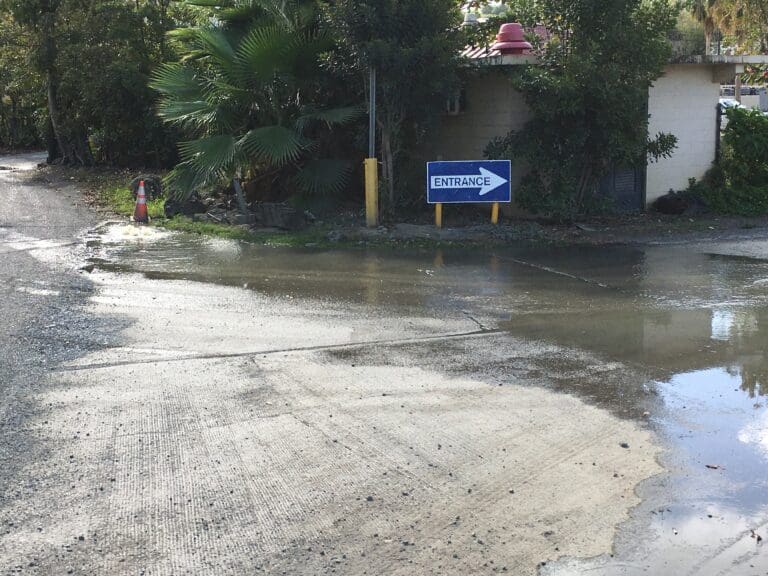
The Virgin Islands Waste Management Authority would like to inform all wastewater haulers that, due to technical issues at the Mangrove Lagoon Wastewater Treatment Plant, sludge, septage, and gray water are temporarily being accepted at the Cancryn Pump Station on St. Thomas. This service is available on Mondays, Wednesdays, Fridays, and Saturdays from 7 a.m. to 1 p.m. Grease will NOT be permitted.Virgin Islands Waste Management Authority
Haulers are reminded to adhere to all safety protocols, rules, and regulations when entering the facility.
We understand the inconvenience this may cause and rely on your cooperation and continued patience as we work towards a permanent solution.
For updates or further assistance, please contact the Division of Wastewater at (340) 715-9151 or Communications Management at communications@viwma.org. Stay connected with us on Facebook, X, and LinkedIn for updates.
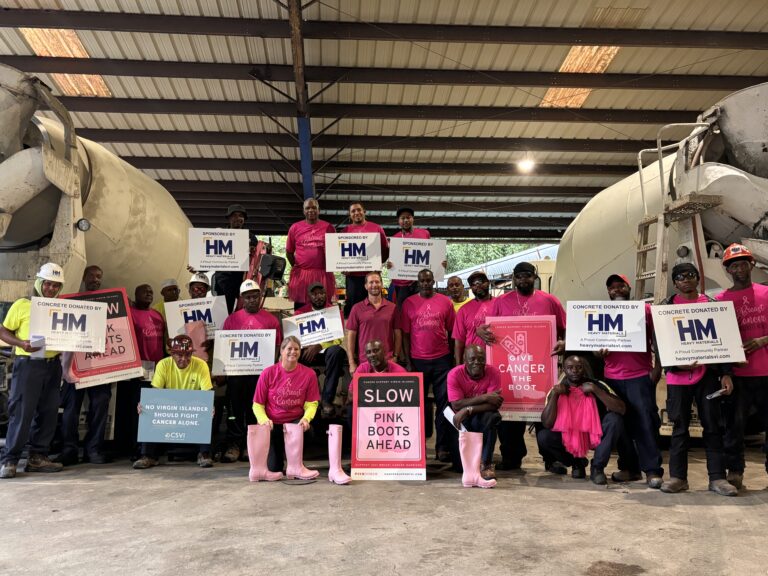
Cancer Support Virgin Islands launches its 12th Annual Pinktober, a month-long series of events, community initiatives, and fundraising efforts, dedicated to providing direct financial support to warriors across the territory. This milestone also marks Cancer Support VI’s 20th year of service: two decades standing shoulder to shoulder with cancer warriors, patients and their families when they need it most.
The Left Lane Cyclers celebrate Pinktober. (Submitted photo)
Since its founding in 2005, Cancer Support VI has assisted over 4,800 cancer warriors exceeding $6 million in assistance to Virgin Islanders.
Each October, Pinktober has united schools, businesses, and community members to raise awareness and much needed funds. This year CSVI sets a bold goal: raise more than $900,000 dedicated to sustaining and expanding critical services. Local businesses, churches, schools, and organizations are invited to become Partners with a Purpose by hosting events, selling CSVI pink logo pins, or joining the Give Cancer the Boot campaign.
“Cancer doesn’t wait, and neither can we,” said Barb Michaud, director of Cancer Support VI. “For 20 years, our communities have rallied around cancer warriors, ensuring they are never alone in their journey. Pinktober is both a celebration of that legacy and a call to action for the future.”
Cancer Support VI patient grants and advocacy efforts are made possible entirely through the generosity of donors and community partners, ensuring that EVERY dollar raised stays in the US Virgin Islands.
Throughout October, our community partners will host a full calendar of Pinktober events designed to engage every corner of the community. Territory-wide events including pink drink specials, specialty dinners and brunches, Pink Out volleyball games, pickleball tournaments, art & fitness classes, and even pumpkin carving! From workplace fundraisers and school activities to island wide campaigns like “Give Cancer the Boot” there are countless ways to get involved.
You can find our complete list of events, initiatives, and ways to contribute by visiting www.cancersupportvi.orgAbout Cancer Support Virgin Islands
Cancer Support Virgin Islands is a 501(c)(3) nonprofit organization dedicated to providing advocacy, outreach, financial assistance, and resources for cancer patients and their families in the Virgin Islands. Since 2005, CSVI has been a vital lifeline for cancer warriors, offering support for medical treatments, travel, and essential living expenses, while promoting awareness and education across the community
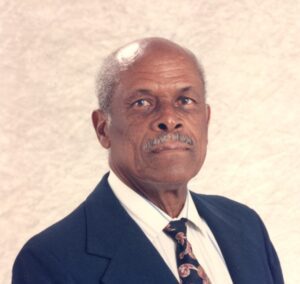
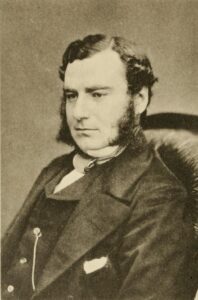
Zenaida doves are very common in the Virgin Islands. In April 1857, Alfred Newton stated in his notebook that a Black woman was walking on a mountain dirt road north of Estate Castle Burke where she spotted a Zenaida dove ( Zenaida amabilis). (Photo courtesy Wikipedia)Earl G. Roebuck, a native Virgin Islander and ornithologist. (Source file photo)
George A. Seaman, Harry A. Beatty, and Earl G. Roebuck, all native Virgin Islanders now deceased, are well known in our history as ornithologists. The study of birds is called ornithology, from the Greek word ornis, bird, and logos, study. I believe it was 2023 when I got an email message from Dr. Jake Subryan Richards, an assistant professor in the Department of International History at the London School of Economics and Political Science.
If I remember the conversation correctly, we were talking about birds and how enslaved laborers in the Danish West Indies didn’t get credit for their contributions in ornithology. Richards enlightened me about how enslaved and “free slaves” made great contributions to the ornithology history of the Virgin Islands as well as the world and did not get credit for the work of what he called the “invisible technicians.”
Olasee Davis (Submitted photo)
He forwarded me a scientific paper he wrote, entitled “Black Ornithology: Ecology,Emancipation, and the Birth of a Professional Scientific Discipline between the Caribbean and Britain.” In the world of ornithology, Alfred Newton and his brother Edward Newton are well known worldwide as ornithologists. Alfred was the founding member of the British Ornithologists Union in 1858 and its journal. His brother Edward was a British colonial administrator.
In 1857, the Newton brothers visited the Danish West Indies and conducted ornithological observation on the island of St. Croix. In Richards’ scientific research paper about birds, he mentioned the interaction of birds with Black people on St. Croix and the understanding of the island ecology among enslaved and runaway slaves known as Maroons, in relation to ornithology. In other words, Blacks in the Danish West Indies during slavery and post- emancipation, had an understanding of wildlife behavior in the natural world of birds on the islands.
Richard argues in his scientific paper that “… Black people were not simply invisible technicians but rather developed a specific post-emancipation practical knowledge about organisms and their environment which included a flexible familiarization with birds.” He further stated, “The knowledge draws on ecological understanding among both Indigenous Kalinago and maritime maroon groups.” The Newton brothers recorded the knowledge of Black people, which helped them gather traditional knowledge about birds that they documented in their field notebooks.
Alfred Newton, 1829-1907, an ornithologist who was a founding member of the British Ornithologist Union in 1858 and its journal. (Photo courtesy Wikipedia)
However, the Newton brothers erased the role of Black Crucian ornithologists when they published their findings of birds on St. Croix. This was the first professional ornithologist journal in Britain. Believe me, the publication on the Black Crucian ornithology is fascinating, by Richards scientific research. It is a pity, however, that I can’t go into detail on the research of birds by Richards and the history of 1857 when the Newton brothers visited St. Croix due to space in this article.
However, I will try to summarize an episode where Alfred Newton reported in his field notebook about a Black Crucian woman. This is one of many notes where Alfred Newton wrote about his encounters with local people between 1857 and 1858 on St. Croix. In April 1857, Newton stated in his notebook that a Black woman was walking on a mountain dirt road north of Estate Castle Burke where she spotted a Zenaida dove (Zenaida amabilis). He reported that the woman had given two eggs and the bird nest to her doctor, Dr. Cardin, who brought them to Alfred Newton.
In his field notebook, Newton reported that the woman found the eggs in a cashew tree in the vicinity of Blue Mountain. He had little or no doubt that the eggs are rightly named by her because of her practical knowledge of birds on the island and the habit of her taking the same route to the mountain to see her doctor. According to Newton’s notebook, he evaluated the veracity of the Black woman’s observational narrative and the specimen she collected, which was the Zenaida dove eggs and nest.
Then, he decided that the Black woman was trustworthy based on her frequent route or pathway for medical care from her doctor. The post-emancipation era interaction between former slaves and white former slave owners must have raised questions of truth and trust in Newton’s mind. In his field notebook, Alfred considered himself as a neutral arbiter person. He was the one who decided on the validity of each person’s testimonies, as part of his professional scientific research.
In Alfred’s ornithology research on St. Croix, he seems to accept Black knowledge and testimonies of birds and discounted white testimonies, although he relied upon a racialized social structure to support his research. As an interlocutor or go-between person, it seemed not to affect him gathering information from Black Crucians about birds on St. Croix.
When he interacted with Black Crucians, he didn’t label them as untrustworthy as was the case with Thomas Catchure and William Macintosh, both white men. He labelled those men “remarkable for not adhering to the truth,” according to his field notebook documentation on birds of St. Croix. However, if you read Alfred Newton’s notebook, it seems contradictory with some of the things he said as he interacted with people on St. Croix, while conducting his research on birds.
Nevertheless, regardless of trustworthiness based on the social status of people that Alfred Newton encountered, he believed the Black woman was truthful based on her practical knowledge of birds, yet he didn’t see her account as trustworthy enough to record her name in the publication, but mentioned William Macintosh, also known as Dobbo, and Thomas Catchure, both of whom he considered to be untrustworthy.
In the appendix of Richards’ bird scientific research paper, he listed Estate Castle Burk 1850 census with Black participation in ornithological research on St. Croix. I would say this, bird watching worldwide is a billion-dollar industry. Even today, with systemic barriers for Black ornithologists to participate in the industry of birders, they are thriving and making their contributions to science, education, and conservation in so many ways that benefit the world community.
Believe me, I appreciate Richards’ sharing with me the history of Black ornithologists during the Danish era of the Virgin Islands.
— Olasee Davis is a bush professor who lectures and writes about the culture, history, ecology and environment of the Virgin Islands when he is not leading hiking tours of the wild places and spaces of St. Croix and beyond.
Attorneys for the U.S. Justice Department and the territory convened Friday at the U.S. District Court of the Virgin Islands on St. Thomas to hear testimony related to the V.I. Police Department’s 16-year-old federal consent decree. (Shutterstock image)
A federal judge Friday told attorneys for the U.S. Justice Department and the territory that the V.I. Police Department is on the “right track” and “right path” to achieving compliance with a 16-year-old consent decree.
A hearing at the federal courthouse on St. Thomas Friday largely focused on findings outlined in a report filed in U.S. District Court last month by court-appointed monitor Sydney Roberts. That report covered the second quarter of 2025 and found that VIPD had made progress toward compliance with three outstanding paragraphs related to citizen complaints, officers’ use of force and management and supervision.
The monitoring period covered by Roberts’s report ended on May 31, but several questions asked by Chief Judge Robert Molloy hinted at more recent incidents. In July, officers shot and killed Alejandro Torres III in the LBJ Gardens neighborhood on St. Croix. One month later, officers on St. Thomas responding to a burglary call shot and killed 36-year-old Tyler Simpson. In the parlance of law enforcement, officers firing a gun constitutes a “Level 1” use of force. The U.S. Justice Department acknowledged Simpson’s killing in a status report filed this week, writing that “three VIPD officers fatally shot a suspect while they were investigating an alleged burglary in progress.”
“The investigation of this Level 1 use of force is ongoing, but VIPD has informed the [Independent Monitoring Team] and the United States that it has already incorporated some lessons learned from its initial review of the incident into upcoming firearms training,” attorneys with the department’s Civil Rights Division wrote. “In the past, such a response might only have occurred after VIPD had completed a full investigation of the incident, a process that can take several months to more than a year. We commend VIPD for its proactive response to this incident.”
On Friday, VIPD’s internal affairs director, Vivianne Newton, said the department had five Level 1 use-of-force cases pending. Three others were presented to the department’s Force Review Board in July, and two of those were closed. Molloy later asked Deputy Commissioner Jason Marsh, who heads VIPD’s professional standards division, whether he’d observed any patterns or trends related to officers’ use of force at the highest level in the first half of 2025. Marsh said the number of incidents wasn’t much higher than in previous years and pointed to the need for more training.
That exchange came after Molloy noted adjudicating previous cases during which it was discovered that police officers had failed to activate their body-worn cameras. He asked Marsh if that was “an area of concern.” Marsh said it wasn’t. Molloy followed up by asking when the cameras are supposed to be activated, and Marsh said it’s supposed to happen when an officer begins engaging with a civilian and that they can be turned off after the encounter ends.
After former Police Commissioner Ray Martinez fired his gun while officers apprehended a suspect in March 2024, Justice Department attorneys reported to the court that VIPD “has revised its body-worn camera (BWC) policy to ensure that officers do not intentionally obstruct BWCs or position themselves to impede the BWC’s recording of an incident,” according to an October 2024 status report.
“Further, VIPD officers will no longer be expected to charge their cameras at home, as VIPD is placing docking stations in each zone and requiring officers to dock their BWCs at the end of their shift to ensure that they are charged, and that recorded videos are downloaded once their shifts end.”
The Source has repeatedly requested body-worn camera footage captured by the officers involved in Torres’s and Simpson’s killings, as well as VIPD’s body-worn camera policy under U.S. Virgin Islands public records laws. On Wednesday, VIPD spokesperson Glen Dratte said there are two investigations related to Torres’s case — one “criminal” and one “internal/administrative.”
“Therefore, the bodycam footage is not available, audio, or visual,” he said. “We are reviewing the policy and will get back to you as soon as possible.”
Asked about the Source’s request after Friday’s hearing, Police Commissioner Mario Brooks said the department is working on releasing the policy. Brooks noted the need to protect police officers and referenced their collective bargaining agreement with the Virgin Islands Government, through which the government could be sued. Addressing the consent decree more broadly, Brooks said the goal is to have a “constitutional” police force, and he credited VIPD personnel with bringing the department within sight of full compliance.
During the hearing, Molloy also asked Marsh whether anyone at VIPD keeps track of court decisions that affect law enforcement procedure. That question came hours after the Virgin Islands Daily News broke the story that a V.I. Superior Court judge threw out charges against three men in July after finding that police improperly searched their car because they supposedly smelled marijuana.
“The possession of marijuana in the Virgin Islands, however, is now a presumably legal activity,” Judge Ernest Morris Jr. wrote in a July 21 opinion. “In states where the use of marijuana has been legalized, courts have held that the smell of marijuana alone is not enough to justify a warrantless search.”
Morris further questioned the sworn statements of a Special Operations Bureau K-9 handler, Raheem Benjamin.
“When Officer Benjamin approached the vehicle, all of the windows were partially down, and there were already four other officers surrounding the vehicle and interacting with the occupants,” he wrote. “If the smell of marijuana was strong, as alleged by Officer Benjamin, it is highly unlikely that none of the other four officers who approached the vehicle before Benjamin would have made note of the smell. Although the Court does ‘not evaluate probable cause in hindsight, based on what a search does or does not turn up,’ the fact that no marijuana was found in the vehicle or on the person of any of the Defendants further belies Officer Benjamin’s testimony that he smelled a strong odor of marijuana emanating from the vehicle.”
Amid questioning from Molloy Friday, Marsh said the department does get briefed on court rulings and he acknowledged that VIPD maintains a so-called “Brady List” — an informal list of non-credible police officers typically kept by prosecutors — which the department shares with the V.I. Justice Department. The list is named for the 1963 U.S. Supreme Court decision in Brady v. Maryland, which found that law enforcement personnel have to turn over potentially exculpatory evidence to criminal defendants.
Molloy said before adjourning that VIPD, in its current state, was a far cry from the one he grew up with and heard stories about in the ‘90s and that it was “worth repeating that this department is much further along than it was in 2008.”
The Third Circuit Court of Appeals has referred the U.S. Justice Department’s interlocutory appeal of an order striking the death penalty in the murder case of Richardson Dangleben Jr. — and the defense’s motion to dismiss that appeal on jurisdictional grounds — to a merits panel for consideration after expedited briefing, according to an order issued Friday.
Given the schedule outlined in the order, Dangleben’s trial, which was to start Oct. 6 in District Court on St. Thomas, will be delayed yet again. A jury trial was initially set for Dec. 11, 2023, and then Oct. 28, 2024, before the case was continued.
The order by Third Circuit Judges Thomas M. Hardiman, Stephanos Bibas and Arianna J. Freeman stipulates that the DOJ’s brief must be filed within 14 days of Friday’s order, the defense’s brief within 14 days after that, and the government’s reply brief within seven days thereafter.
The clerk will calendar the appeal before the panel scheduled to sit in the U.S. Virgin Islands during the week of Dec. 8, according to the order. Because the government has indicated it also plans to appeal an order dismissing two counts of Dangleben’s indictment, the court advised it to file notice of that as soon as possible so the related matters may be heard together.
A grand jury returned a 13-count indictment against Dangleben in October 2023, charging him with violations of federal and territorial laws in connection with the shooting death of V.I. Police Detective Delberth Phipps Jr. on July 4 that year, and the assault of another officer who also responded to the 911 call concerning a man with a gun in Hospital Ground on St. Thomas.
While the DOJ said in February 2024 that it would not seek the death penalty, it reversed course in May after an executive order from President Donald Trump lifting former President Joe Biden’s moratorium on federal executions. Dangleben’s attorney, Public Defender Matthew Campbell, filed a motion opposing the about-face and after briefing by both sides, V.I. District Court Chief Judge Robert Molloy struck the government’s notice from the record in August, ruling that the case will proceed as a non-capital case.
In a memorandum opinion issued Sept. 15 explaining his decision, Molloy listed a number of concerns regarding the timing of the government’s death notice so late in the process, including that it was not based on new information that wasn’t previously available to the government; it was filed 459 days after the Feb. 7, 2024 filing of the original “no-seek” notice; 22 months after Dangleben’s initial arrest; 19 months after the filing of the first indictment; and less than five months before trial.
“Even if the Government now seeks relief from the deadline, it has waived or forfeited any right it had or may have had to such relief,” he wrote.
Moreover, the “preparation for a death penalty case is dramatically different in approach and scope from a non-death penalty case. Clearly, the Government’s Death Notice, if allowed to stand, would require Defendant ‘to substantially alter his years-long preparations for trial,’” Molloy said.
The DOJ appealed that order to the Third Circuit on Sept. 15, raising jurisdictional questions as to whether it can do so while the case is ongoing. Campbell filed an emergency motion to dismiss, or to at least hear the appeal on an expedited basis, on Sept. 19.
Molloy also issued an order Thursday dismissing Counts 2 and 3 of the superseding indictment — discharge of a firearm in furtherance of a crime — that Campbell argued failed to state an offense under the United States Code because the predicate offenses upon which the charges are based are local territorial offenses.
The DOJ said in its response to Campbell’s motion to dismiss the death penalty appeal, filed Wednesday with the Third Circuit, that it also plans to appeal that ruling.
Campbell also sought to dismiss Count 1, use of a firearm during a crime of violence resulting in death, because it also was based on three territorial predicate offenses, but the government amended that to add a federal predicate offense when it filed a superseding indictment in April ahead of its “no-seek” notice reversal in May. Molloy instead dismissed the territorial offenses in Count 1.
The judge explained his decision in a memorandum opinion filed Thursday.
“Dangleben argues that even if the plain language of the statute can be read to allow local offenses to serve as predicate offenses under Section 924(c), such an interpretation would lead to the absurd result of Virgin Islands defendants being able to be prosecuted under a version of a federal offense not available in any other federal court. Consequently, Virgin Islands defendants would be subjected to harsher punishment under a version of Section 924(c) that could not be applied anywhere else in the United States. The Court agrees,” said Molloy.
The judge also noted that the Virgin Islands is a non-death penalty jurisdiction, capital punishment having been abolished in the territory since 1957.
“Of course, the federal government can seek the death penalty in federal court in any jurisdiction regardless as to whether that jurisdiction allows for this penalty under its local laws. Here, the United States is seeking the penalty of death pursuant to Count One. It would seem somewhat nonsensical, oxymoronic, and certainly inconsistent, that a Virgin Islands defendant could be subject to the death penalty in federal court for committing a Virgin Islands crime when the laws of the Virgin Islands do not allow for the penalty of death,” Molloy said.
“Stated another way is that a Virgin Islands defendant could be subject to the death penalty in federal court for violating a version of a federal statute with predicate offenses passed by the Virgin Islands Legislature and not by an act of Congress. There is no indication that this is what Congress intended,” the judge wrote.
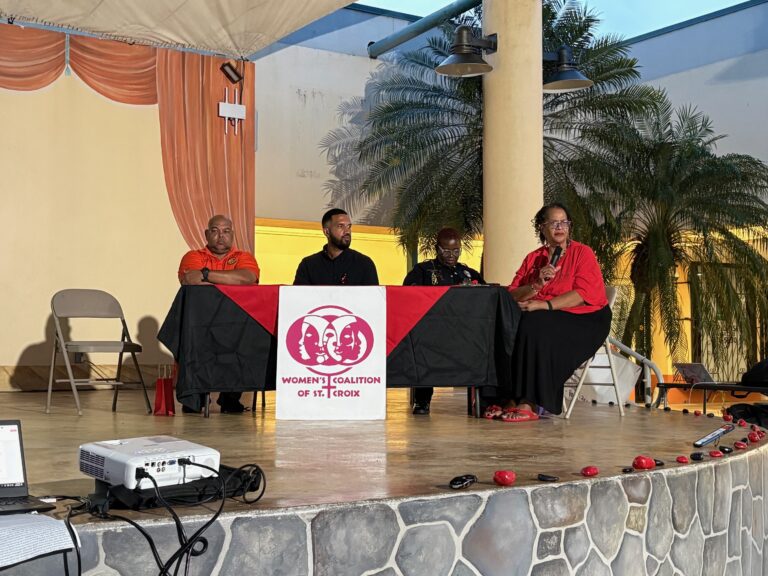
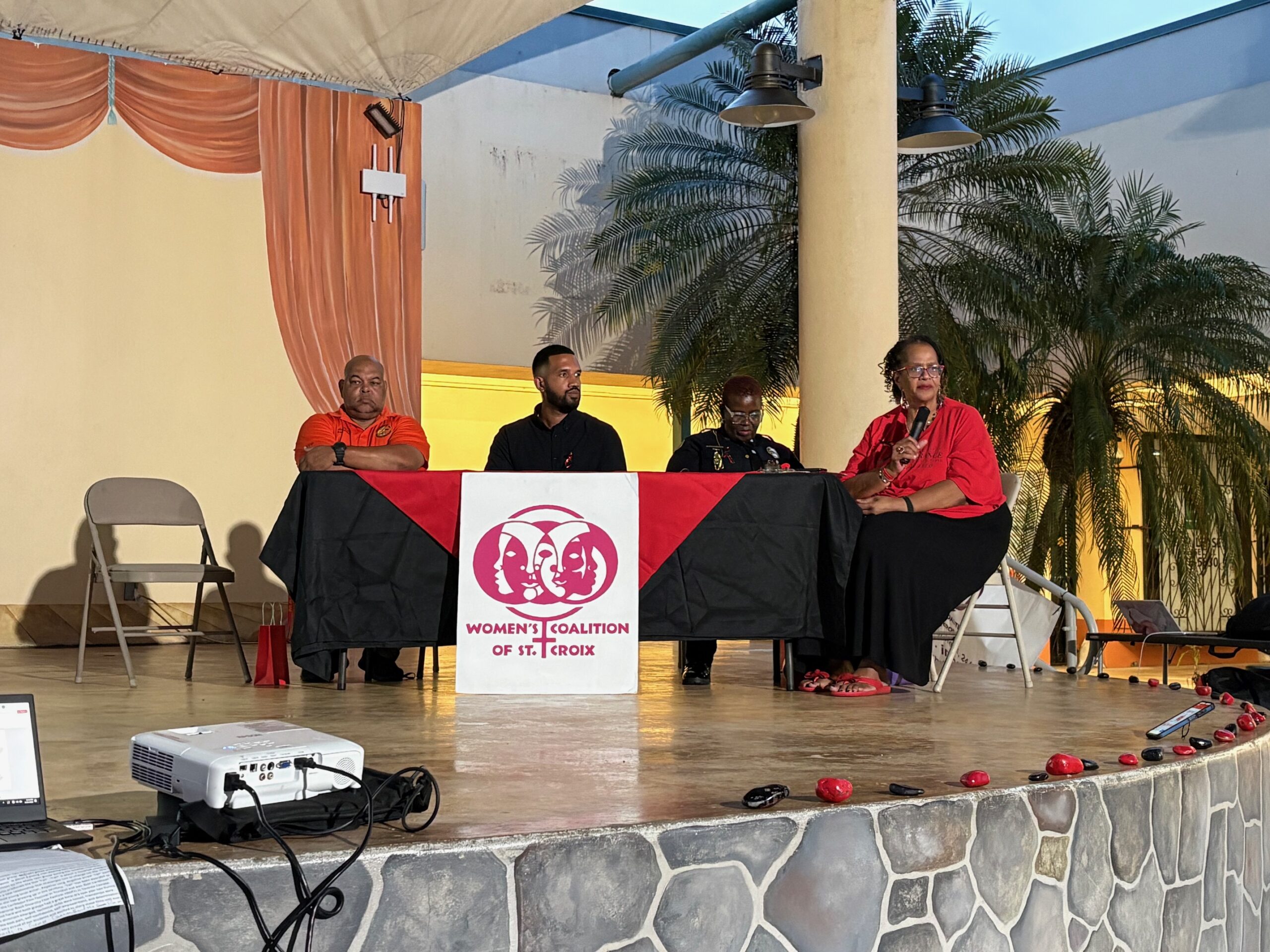
A panel for the National Day of Remembrance on Thursday included panelists Antonio Emanuel, Marcus Moorhead, Naomi Joseph, and Clema S. Williams, the executive director of the Women’s Coalition of St. Croix. (Source photo by Diana Dias)
About 60 people gathered at the Sunny Isles Amphitheater Thursday to mark the National Day of Remembrance for Murder Victims. The annual event, hosted for 14 years by the Women’s Coalition of St. Croix, united law enforcement, prevention leaders, mental health professionals, and grieving families in a call for healing and change.
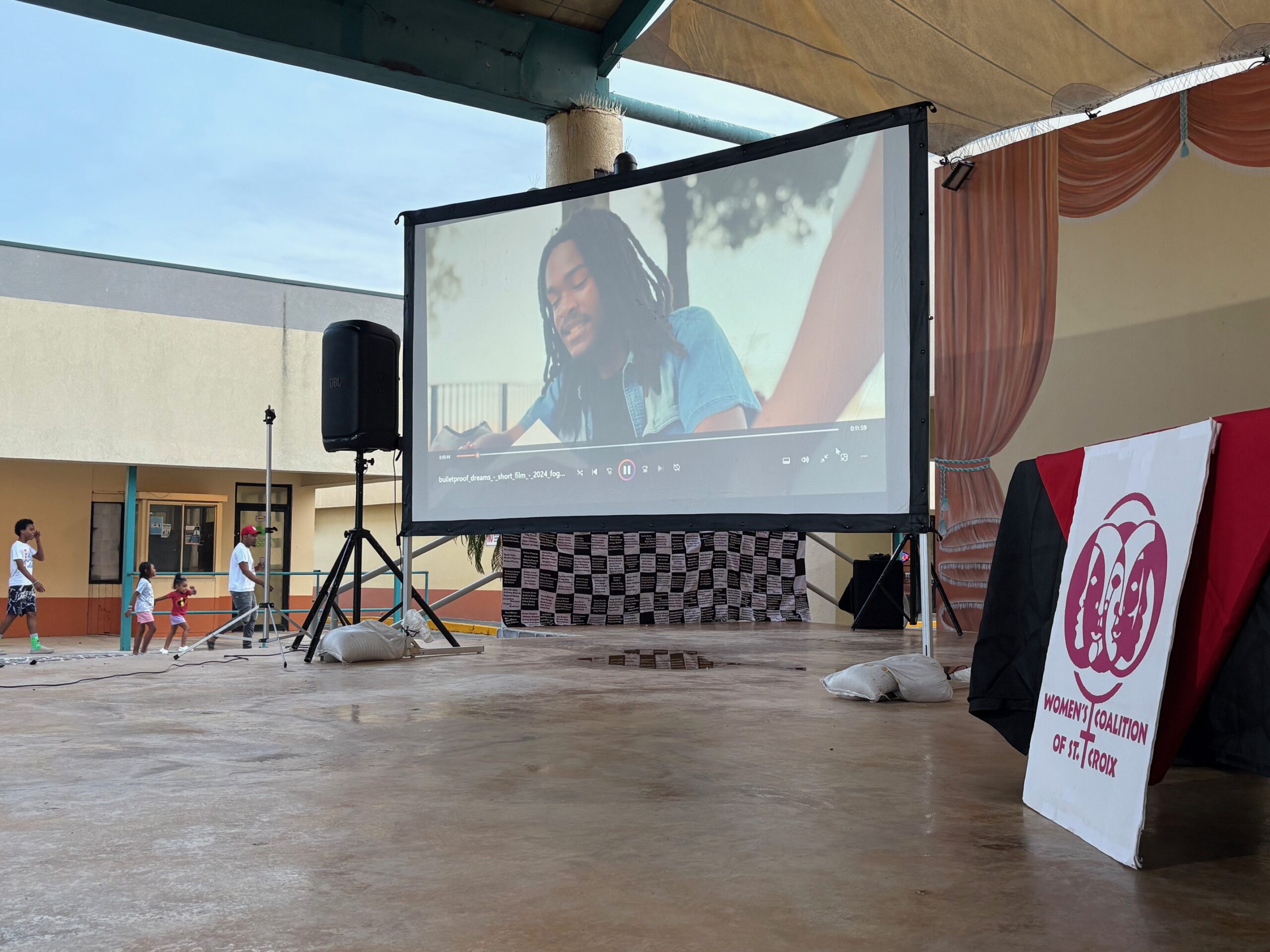
In one segment of the program, organizers featured “Bulletproof Dreams,” a short film by the Film Over Gun Violence organization, which encourages young people to put down weapons and pursue positive paths. Attendees also reflected at the Wall of Remembrance, a visual display of St. Croix’s murder victims since 1999, updated each year, and shared their experiences during an open mic for survivors.
Movie “Bulletproof Dreams” about young people battling with the effects of gun violence. (Source photo by Diana Dias)
Although the official National Day of Remembrance is observed nationally on Sept. 25, Thursday’s gathering gave the St. Croix community a chance to honor lost loved ones and strengthen their resolve against violence.
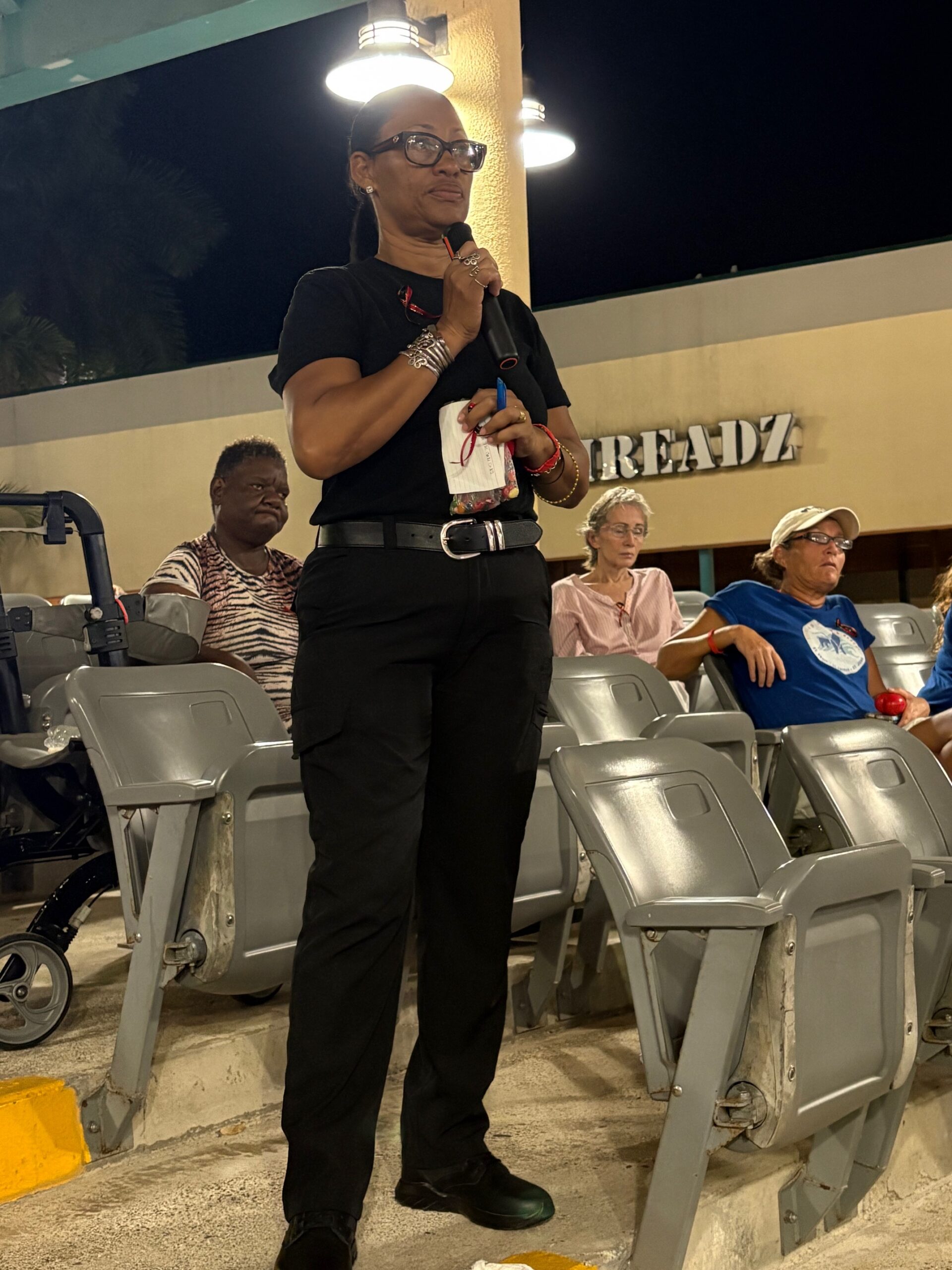
A panel of experts in gun violence, led by the executive director of the Women’s Coalition of St. Croix, Clema Wiliams, answered questions and shared their thoughts on gun violence. Antonio Emanuel, director of the Office of Gun Violence Prevention, opened the discussion by sharing the personal loss that drives his work. “I took this job out of anger,” Emanuel said. “Two young men that I mentored were killed and losing them at the most critical point in their lives inspired me to do this work as my way of avenging their deaths.”
He explained that his office’s mission extends beyond reactionary measures, providing support to families after tragedies, teaching conflict resolution, working with schools and reentry programs, and partnering with the Police Athletic League.“We try to keep people safe, alive, and free,” Emanuel said. “But we can’t do this ourselves. We need community support.”
Deputy Chief Naomi Joseph, who has decades of experience in law enforcement, spoke candidly about the ongoing pain of unsolved murders.“I’ve had to tell mothers their child is dead. That never gets easier,” Joseph said. “Even if a case is 20 or 40 years old, families are still calling, still asking, ‘Why my child?’ We can’t give them closure without the community’s help.”
Mother Denise Christian Edwards asks Deputy Commissioner Naomi Edwards for more information on cold cases. (Source photo by Diana Dias)
She urged residents to break the silence that often shields perpetrators. “A lot of times we know who’s doing it, but people don’t want their family member to go to jail — until it’s your child, your relative. We need you to speak up.”
Adding the mental health perspective, Marcus Moorhead, a licensed professional counselor with Island Therapy Solutions, reminded the audience that trauma ripples through families and communities.“When trauma impacts one person, it’s never just one person – it’s somebody’s son, daughter, cousin,” he said. “Some people feel powerless, but there is power in your voice. Saying, ‘I’m not okay,’ makes people pay attention.”
The most emotional part of the evening came from mothers who have turned their grief into action. Founders of the Dave Edwards Jr. Foundation, created after their loved ones were killed, spoke about their journey. One mother shared through tears how her 15-year-old son was killed in a hail of 52 bullets while playing dominoes.
“We decided we’re not going to die for this anymore,” she said. “We came together to create a community of support, education, and resources.”
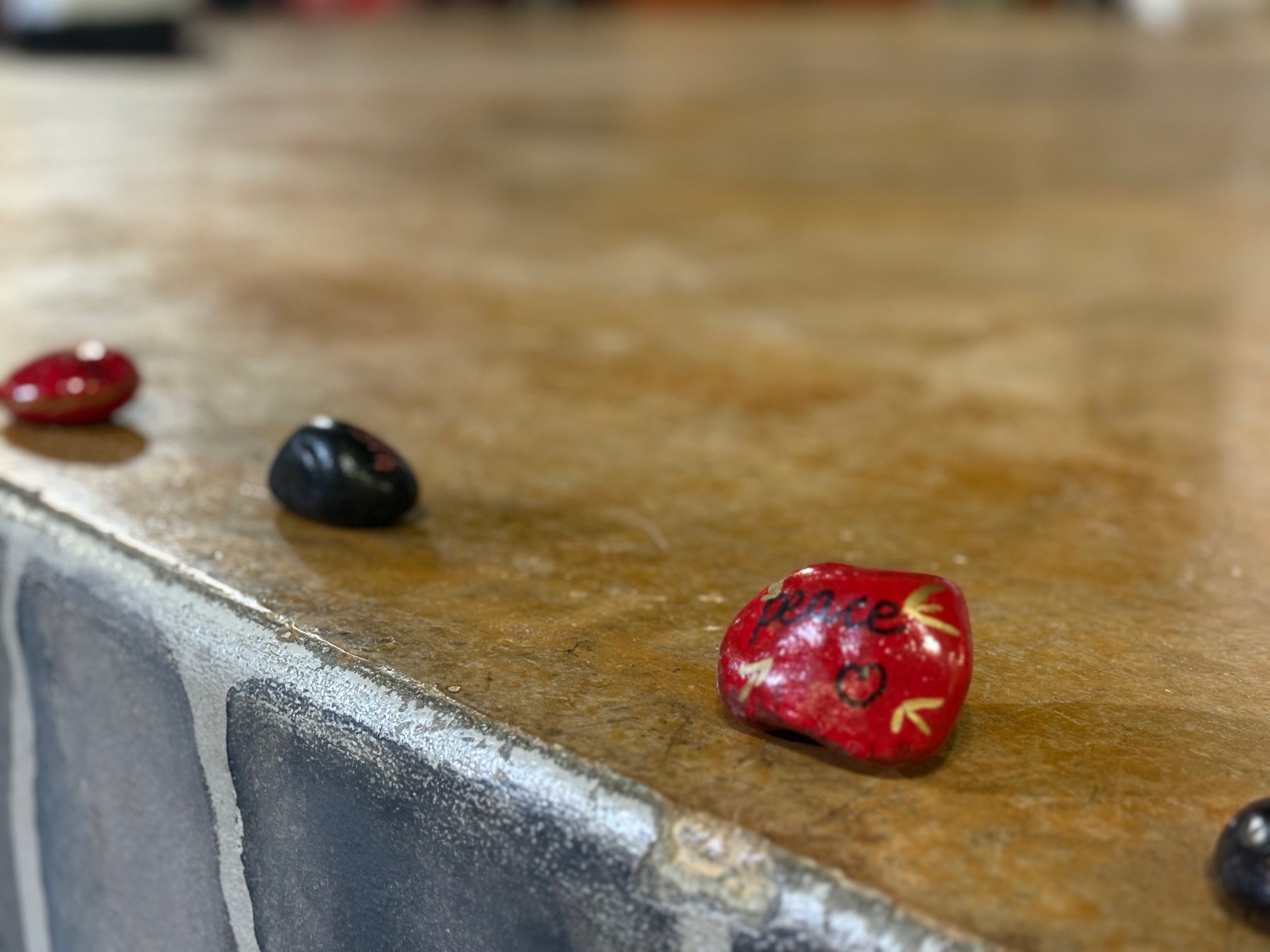
Decoration of stones is done every year in honor of National Day of Remembrance. (Source photo by Diana Dias)
The foundation announced its first major event, scheduled for Nov. 16, starting at 10 a.m. at Dorsch Beach and continuing to the Vincent F. Mason Sr. Coral Resort and Park until 6 p.m. The public is encouraged to attend and join the fight to end gun violence.
SCEC Drama Club during “Queen Mary and Dem” rehearsals, 2024 (Photo courtesy Chalana Brown)
The St. Croix Educational Complex Drama Club will perform “Queen Mary and Dem” Oct.1, at 5:30 p.m. in the UCA parking lot in downtown Frederiksted.
This is the third year for the commemoration performed under the direction of the Complex drama teacher, Sayeeda Carter.
SCEC Drama Club director and teacher Sayeeda Carter (Photo courtesy Ayanna McKay)
The script is taken from “Queen Mary and Dem,” which was written by native Virgin Islander Richard Schrader in the Crucian dialect and depicts the conversation between Queen Mary and the other Queens. It is the 1878 second struggle for freedom from slavery in the U.S. Virgin Islands in commemoration of the 150th anniversary of the original Emancipation Proclamation of 1848 at Fort Frederik in Frederiksted, St. Croix, in the then Danish West Indies. Schrader is a noted Virgin Islands historian and a prolific author and poet.
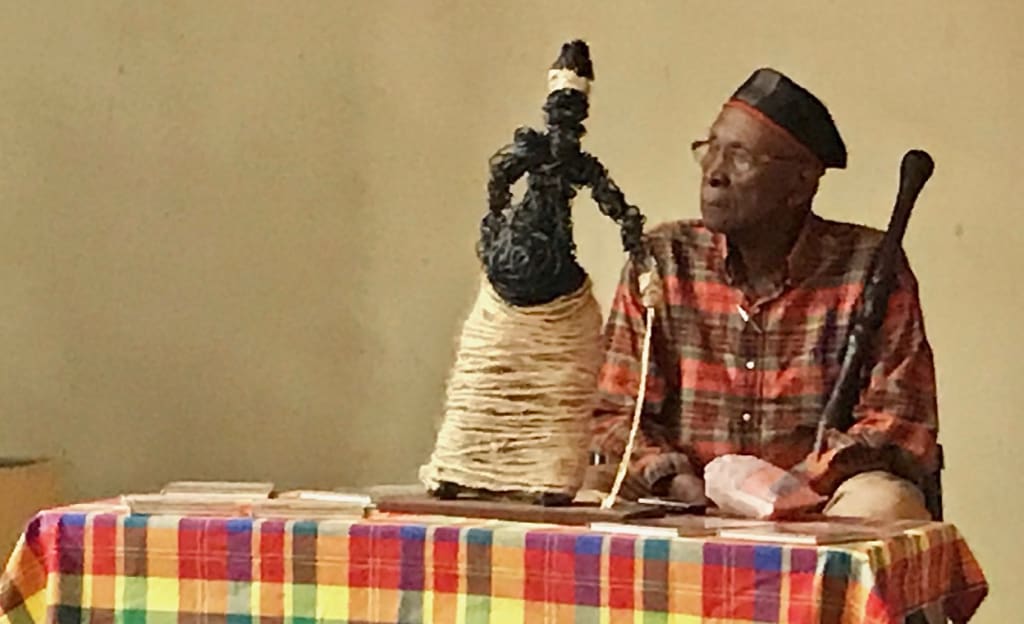
Author and poet Richard Schrader (Source photo by Elisa McKay)
“The commemoration of the Fireburn is one of the most significant events in our Virgin Islands history,” organizer Val Rawlins said. “Each year we pay homage to this date, Oct. 1, 1878, because of the labor riots that changed the working conditions in our society,” Rawlins continued.
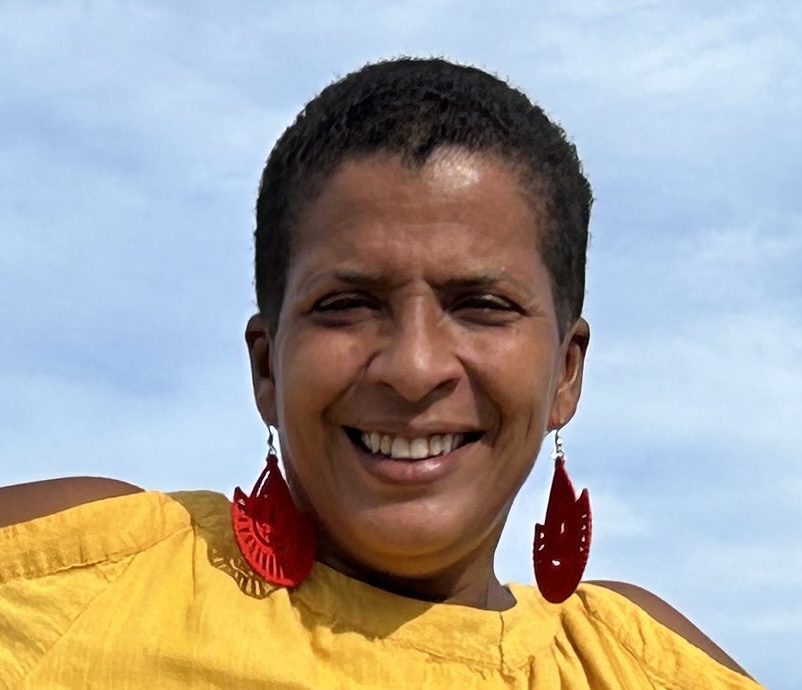
1878 Fireburn organizer Val Rawlins (Photo courtesy Val Rawlins)
“Two years ago, the elders passed the torch into the hands of the younger generation. Their confidence, knowledge, pride and artistic skills have kept that torch shining in the darkness. The work has been outstanding. We are extremely confident that being a united group, the annual observation of the Fireburn will always be remembered in our islands,” Rawlins said.
Organizer Shanarae Matthew spoke to the Source about the addition to the evening’s program. “We want to draw more people, especially young people to come to this event, she said. This year, we are highlighting women and girls in the community who embody or carry the spirit of the Fireburn Queens in the ‘Leadership and Service Awards 2025.’”
1878 Fireburn organizer Shanarae Matthew (Photo courtesy Shanarae Matthew)
The awards will acknowledge girls and women who uphold all of the following virtues:
Cooperation; Integrity; Empathy; Perseverance; Helpfulness; Determination; Reliability; Unity; Prayerfulness; Assertiveness; Accountability; Fairness; Courage; Creativity; and Respect.
One person will be selected from each group in the
Nominee Age Ranges:
8-11 years; 12-17 years; 18-30 years; 31 years and up.
Any member of the community can nominate someone from each of the age ranges.
The community is encouraged to submit their nominations by Monday, Sept.29 and email ShanaraeMatthew@gmail.com.Program Overview:
Conch Shell Libation: 5:30 p.m.
Keynote Speaker: Mario Moorhead
Richard Schrader’s “1878 Queen Mary and Dem” play: Performance by SCEC Drama Club
Fireburn Queens Leadership and Service Awards
Fireburn March and Bantaba Community Drum Dance Circle
Matthew encourages the community to come out and support this event. “This is an excellent way for community members to connect with their ancestors. We really want the young people to be a part of this event. They are the ones who will be carrying this forward. People,come out and celebrate with us,” Matthew said.
Location: UCA Building, Custom House St., Frederiksted.
Please bring your own chairs. Food and drinks will be available for purchase.
For more information:
Call: Val Rawlins: 340-514-5228
Email: ShanaraeMatthew@gmail.com
Members of the Virgin Islands Police Department’s Criminal Investigation Bureau on Friday apprehended a 29-year-old man wanted for sexually assaulting a minor female, according to the department.
Police said the case began on Jan. 27 when the 911 Emergency Call Center received a report of a sexual assault. Detectives were assigned to investigate, and information gathered indicated that Lerone Smith Jr. had sexually assaulted the victim. Following the investigation, a Superior Court judge signed an arrest warrant on June 5.
Detectives attempted to locate Smith but were unsuccessful. A wanted poster was later distributed through social media and news outlets to assist in his apprehension, according to the police report.
On Friday, officers arrested Smith without incident. He was booked and unable to post his $75,000 bail. He has been charged with second-degree rape and was remanded to the John Bell Adult Correctional Facility pending his Advice of Rights hearing, scheduled for Sept. 29 in Superior Court, the police report said.
A 39-year-old man was arrested Thursday night after Virgin Islands Police Department officers responded to a report of a disturbance on St. Thomas, the department announced.
Police said the incident was reported around 8:21 p.m. by a concerned citizen who told officers they heard a woman screaming for her life. Officers traced the noise to a couple who initially told police they had been arguing verbally, but the dispute escalated into violence.
After interviewing both individuals, officers arrested Rodney Charlien, who was accused of squeezing his girlfriend’s face and repeatedly punching her in the stomach and forearms. Charlien was charged with simple assault, domestic violence, and disturbance of the peace, domestic violence, police said.
The case remains under investigation. Police urged anyone with information to call 911, the Domestic Violence Unit at 340-715-5535, or the Office of the Police Chief.
A Dominican Republic national has been ordered detained pending trial after his arrest on federal drug and immigration charges, acting U.S. Attorney Adam F. Sleeper announced Friday.
Carlos Alexis Olivares-Taveras, 34, was taken into custody Monday, after Homeland Security Investigations and partner agencies stopped the vehicle he was driving during an immigration enforcement operation on St. Thomas. Agents said they observed a white powdery substance in the driver’s side door panel. A search of the vehicle turned up 11 baggies of cocaine and about $4,000 in cash, the Justice Department said.
According to court documents, Olivares-Taveras admitted during questioning that both the cocaine and the money belonged to him. He also admitted that he entered the United States unlawfully by boat from Tortola to St. John in February 2025 without presenting himself at a lawful port of entry.
Olivares-Taveras has been charged with possession with intent to distribute cocaine, in violation of 21 U.S.C. § 841(a)(1), and with illegal entry into the United States, in violation of 8 U.S.C. § 1325(a)(1). If convicted, he faces up to 20 years in prison on the drug charge.