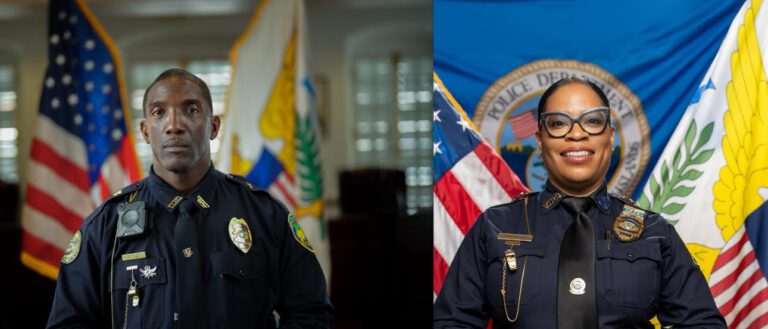
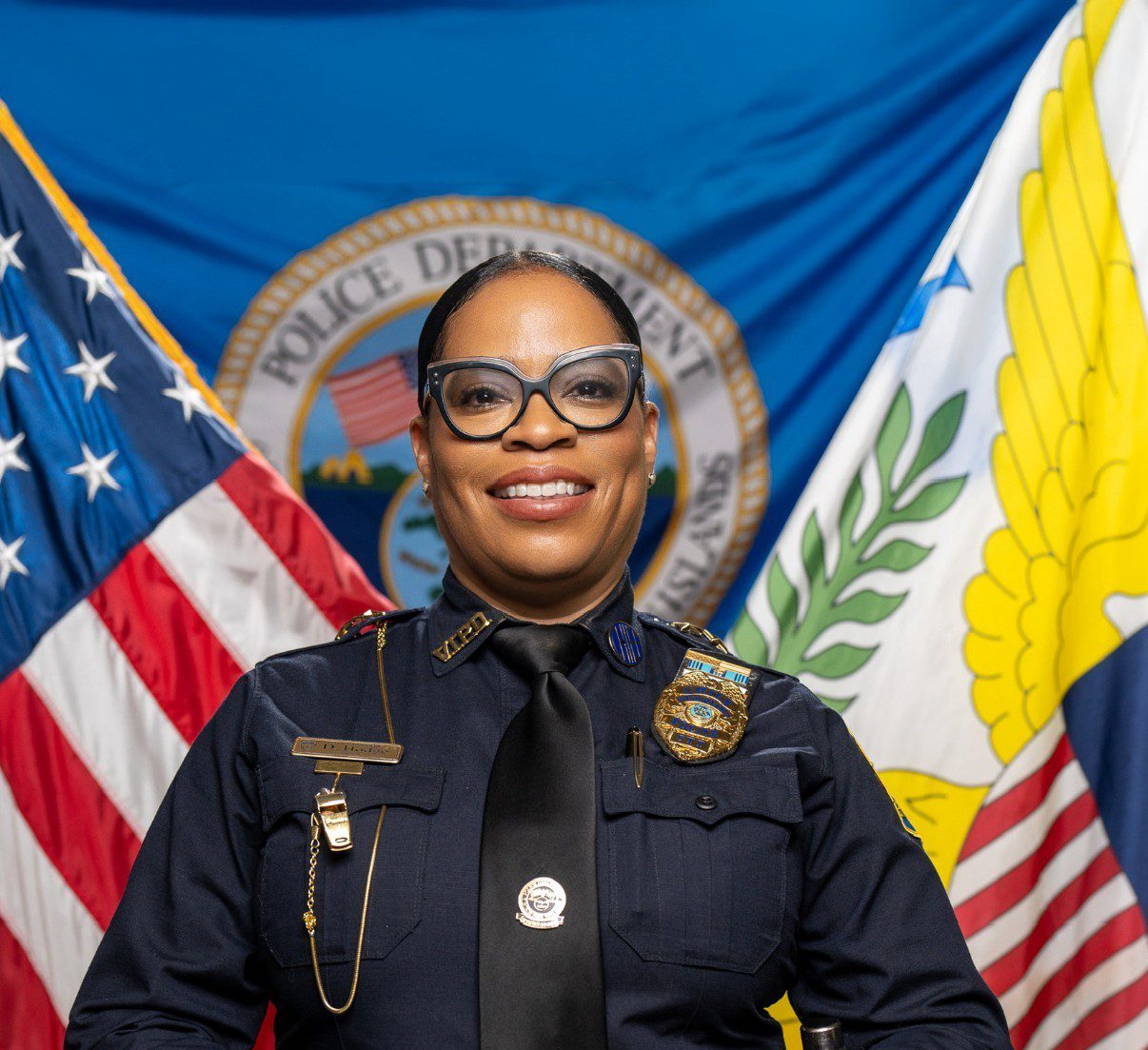
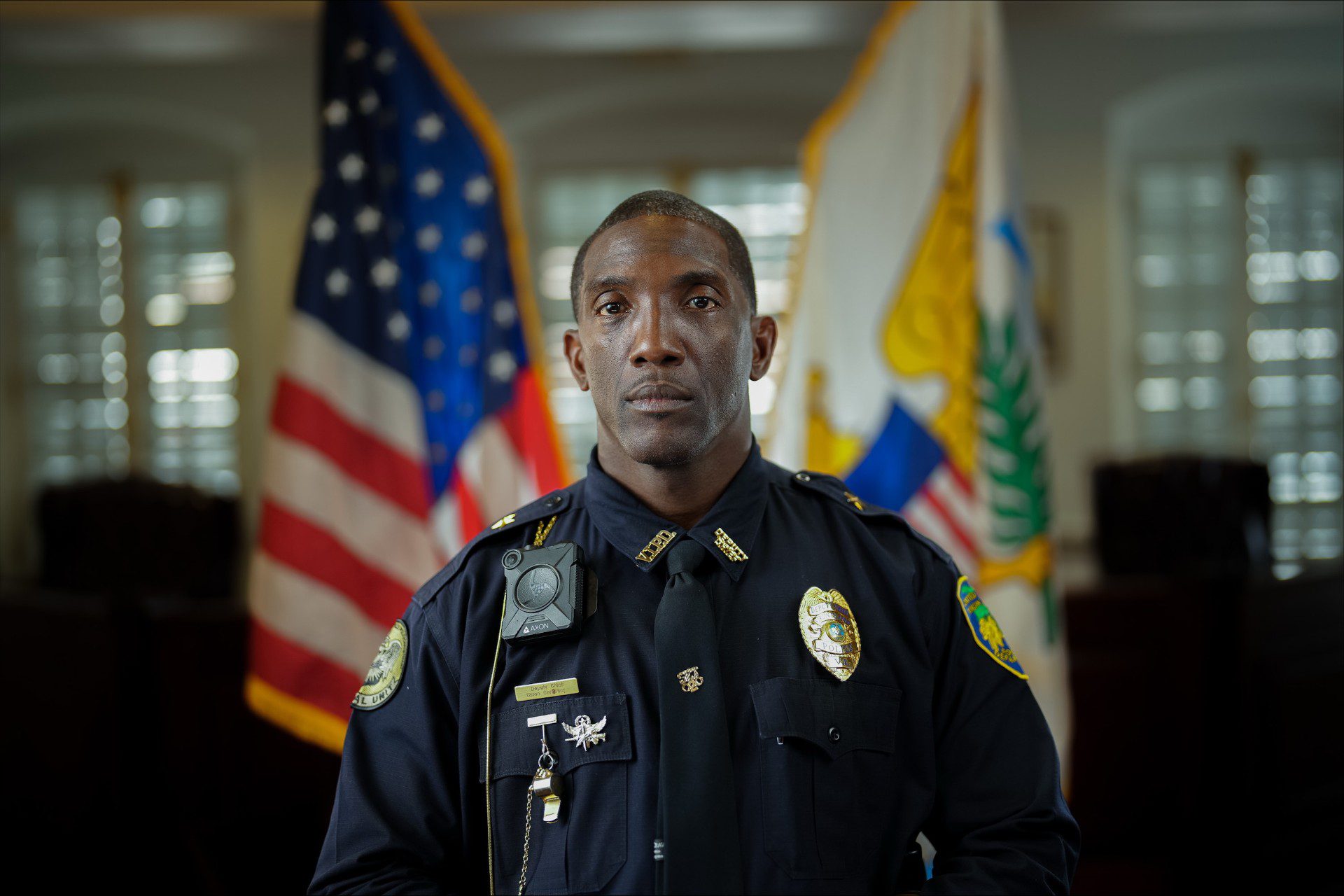
The Virgin Islands Police Department will hold a formal swearing-in ceremony on Tuesday, Aug. 5, for its newly appointed chiefs of police, Deborah L. Hodge and Uston A. Cornelius.
The event is scheduled for 10 a.m. at the University of the Virgin Islands’ Elridge W. Blake Sports and Fitness Center on St. Thomas. Hodge will lead the St. Thomas–St. John district, while Cornelius will head the St. Croix district.
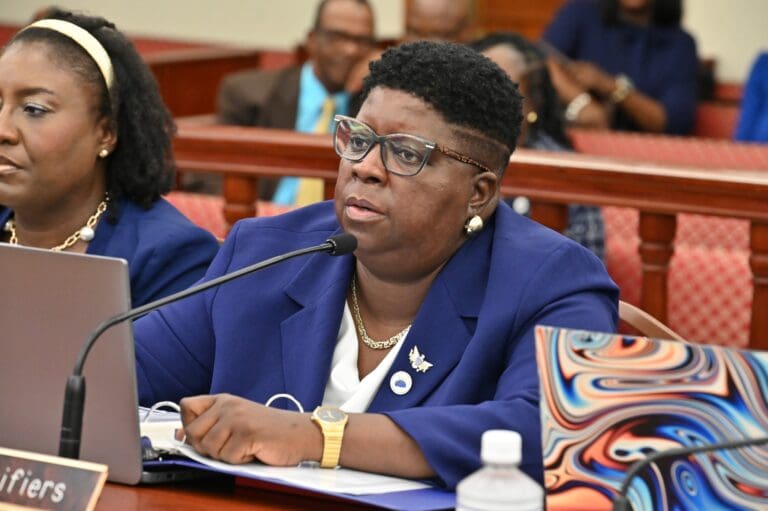
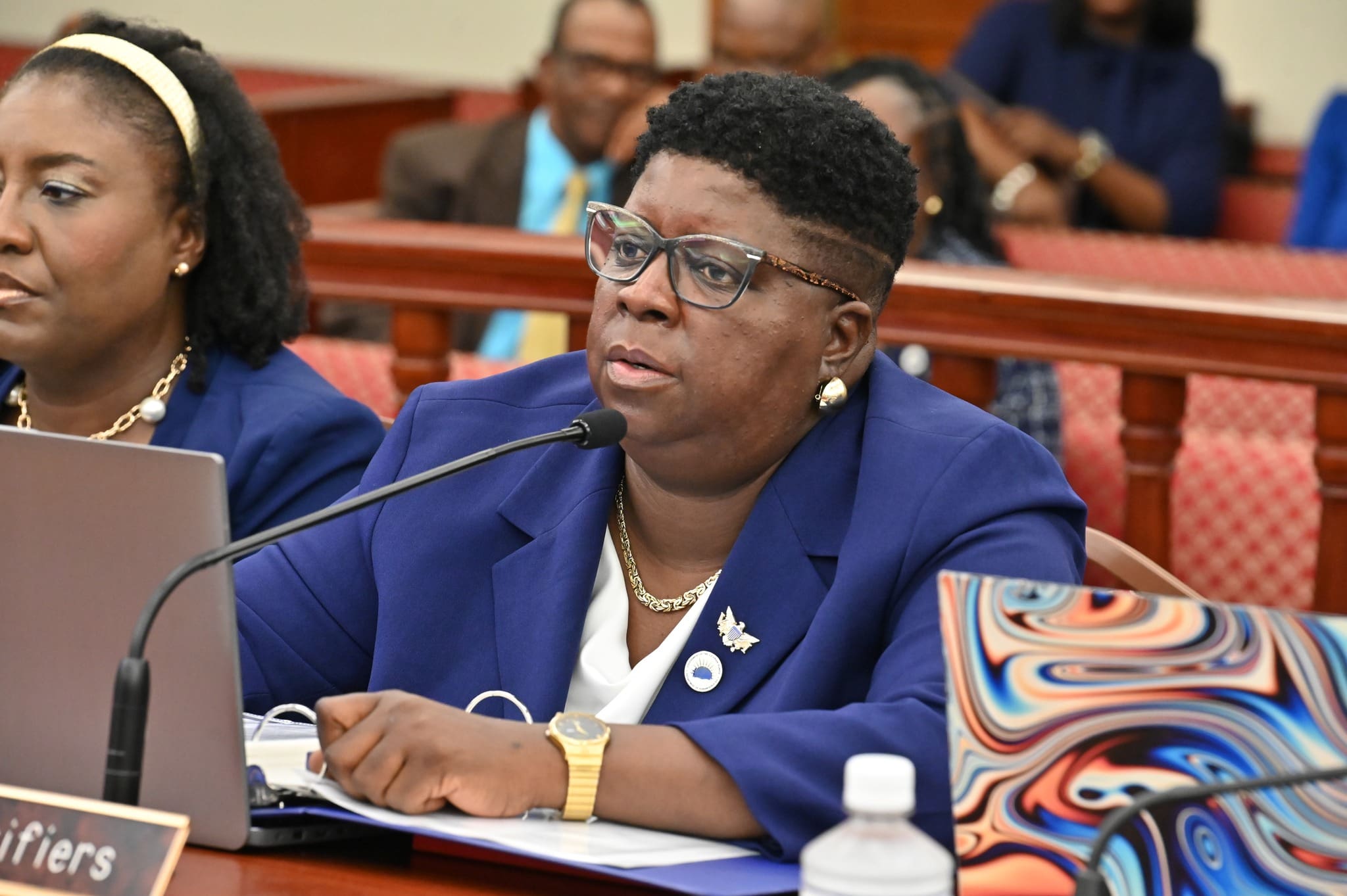
St. Thomas-St. John district Police Chief Deborah Hodge (Photo courtesy VIPD)
According to a VIPD press release, the ceremony marks a new chapter in the department’s leadership. Both Hodge and Cornelius bring decades of experience, strong community relationships, and a shared commitment to public safety and professional development within the force.
St. Croix district Police Chief Uston Cornelius (Photo courtesy VIPD)
“Chief Hodge and Chief Cornelius have consistently exemplified the true spirit of leadership, service, and professionalism throughout their careers,” Police Commissioner Mario M. Brooks said. “Their deep-rooted commitment to our community and the development of our officers will undoubtedly strengthen the department’s future. On behalf of the entire VIPD family, I congratulate them on this well-deserved achievement and look forward to the positive impact their leadership will bring.”
The Virgin Islands Board of Education is excited to announce the extension of a transformative one-time Amnesty Program for Professional Educator Certification holders. This groundbreaking initiative is designed to empower educators, offering enhanced flexibility and innovative opportunities to meet certification requirements while advancing their professional growth.
Through streamlined processes and adjusted standards, VIBE is paving the way for educators whose certifications have expired or who face challenges with recertification.
Amnesty for Conditional Certificate Holders
If you hold an expired conditional certificate, this is your moment! The amnesty program allows you to apply for a penalty-free extension, granting an additional three years to complete necessary certification requirements. Whether it’s coursework, testing, or teaching experience, this extension ensures you have the time and resources to achieve your goals.
Amnesty for Recertification Candidates
For educators seeking recertification, VIBE is making the journey more accessible by temporarily reducing the required professional development hours. During this program, recertification will require just 75 hours of professional development, a significant adjustment from the standard 125 hours outlined in the Professional
Staff Certification & Higher Education policy.
“We are proud to launch this amnesty program as a testament to our unwavering support for educators and their professional journeys,” said Dr. Kyza A. Callwood, Chairperson of the Board. “This initiative reflects our deep commitment to empowering educators, equipping them with the tools to succeed in the classroom, and fostering a brighter future for our students.”
This exciting opportunity is effective immediately and will remain available until Dec. 31. For more information, visit www.myviboe.com or contact your district certification officer via email at jedwards@myviboe.com on St.
Thomas, dmheath@myviboe.com on St. Croix, or call 340-774-4546 for St. Thomas or 340- 772-4144 for St. Croix. This is your opportunity to reignite your professional certification journey with confidence and ease. Join us in shaping the future of education in the Virgin Islands!
For 90 years, Social Security has been a promise kept to generations of hardworking Americans. This summer, AARP is joining with communities across the country to celebrate that legacy, while rallying public support to protect its future.AARP Virgin Islands will host a series of celebrations from August 14th through August 16th on St. John, St. Thomas, and St. Croix. The party starts on St. John with an Ice Cream Social at Bajo El Sol Gallery Courtyard in Mongoose Junction on August 14th, from 2pm-5pm. On August 15th at 6:30pm, join them on the lawn of Cutlass and Cane Restaurant in Yacht Haven Grande for a Birthday Block Party. On August 16th, come to the AARP Family Fun Day on St. Croix at Sion Farm Distillery from 10am-2pm.
“For nine decades, Social Security has delivered earned payments that help tens-of-thousands of Virgin Islanders stay financially secure,” said Troy de Chabert-Schuster AARP Virgin Islands State Director. “We’re proud to honor that legacy while also calling attention to the importance of strengthening and protecting Social Security for the generations to come.”
Event Highlights Include:
St. John – Thursday, August 14th from 2pm – 5pm, join AARP for Ole’ Thyme Ice Cream Social that honors the past and uplifts the present! We’ll be at Bajo El Sol Gallery Courtyard in Mongoose Junction.
oEnjoy the sounds of folk band Quelbe Resurrection Band, DJ Pete, enjoy the Allan “Yisrael” Petersen Mocko Jumbies, Quadrille Dancing led by Culture Bearer Kendell Henry, and indulge in some birthday cake and ice cream too. On-site tools for attendees to take action and learn more about Social Security advocacy.
St. Thomas – Friday, August 15th starting at 6:30pm. It’s a birthday block party like no other on the lawn of Cutlass and Cane Restaurant in Yacht Haven Grande!
oJoin AARP VI in celebrating the 90th anniversary of Social Security with a Block Party – and salute the powerhouse workers of this territory who keep our islands moving! We’re bringing the vibes and energy with live music by “It Is What It Is” band, the islands’ number one Soca band. Performances by DJ Pete, Caribbean Ritual Dancers, and What Ah Party Carnival Troupe! Come celebrate our legacy, enjoy our AARP signature drink and eat cake too – because 90 never looked so good!
St. Croix – Saturday, August 16th from 10am – 2pm. Join AARP for a Family Fun Day at Sion Farm Distillery!
oReggae sensation, Fyah Train will be on stage and keeping the party flowing through the whole event! Child’s Party Service will be offering free face painting and balloon animals for the children. Sion Farm Distillery will be crafting FREE signature AARP cocktails, so you can drink “like you earned it.”
Stop by the vendor booths for fun, games, prizes and information. The St. Croix Animal Welfare Center and Ruff Start will be there with puppies. Fitter Futures will capture the moment with their free photo booth. The Virgin Islands Youth Advocacy Coalition will be there to help empower our elders through technology.
This event is part of a nationwide effort to engage AARP members, elected officials, and local communities in a conversation about the role Social Security has played—and must continue to play—in helping secure the financial futures of Americans of all ages.
“Social Security isn’t just a retirement plan—it’s a promise to every American who pays into it,” said AARP Virgin Island Volunteer Coordinator, Lucie Rodriguez, “We’ll celebrate its success and stand together in protecting it.”
Social Security in the US Virgin Islands:
More than 22,000 residents in the Virgin Islands rely on Social Security
80.3% of recipients in the Virgin Islands are age 65 or older
Social Security contributes approximately $406.8 Million annually to the state economy
The event is free and open to the public, and participants are encouraged to RSVP for the St. John and St. Croix events here: https://states.aarp.org/virgin-islands/three-free-events-across-all-three-islands-come-celebrate-the-90th-anniversary-of-social-security-with-aarp
EVENT DETAILS
WHAT: Ole’ Thyme Ice Cream Social
WHEN: August 14th from 2pm-5pm
WHERE: St. John – Bajo El Sol Gallery Courtyard in Mongoose Junction
WHO: Everyone is Invited, Everyone is Welcome!
COST: Free
WHAT: Social Security Birthday Block Party
WHEN: August 15th, starting at 6:30pm
WHERE: St. Thomas – the lawn of Cutlass and Cane Restaurant in Yacht Haven Grande
WHO: Everyone is Welcome
COST: Free
WHAT: Family Fun Day
WHEN: August 16th, from 10am – 2pm
WHERE: St. Croix – Sion Farm Distillery (Mutiny Island Vodka)
WHO: Everyone is Welcome! Fun for All Ages!
COST: Free
For more information, visit https//:states.aarp.org/virginislands or follow @AARPVI on social media.
At a time when the financial environment demands greater agility and strategic focus, First BanCorp has succeeded in distinguishing itself as a benchmark for financial strength in its category. The financial institution, headquartered in Puerto Rico and the parent company of FirstBank, was recognized as the best performing bank among public banking institutions with assets between $10 billion and $50 billion, according to the list published by American Banker, and developed in conjunction with Capital Performance Group for the 2024 period.
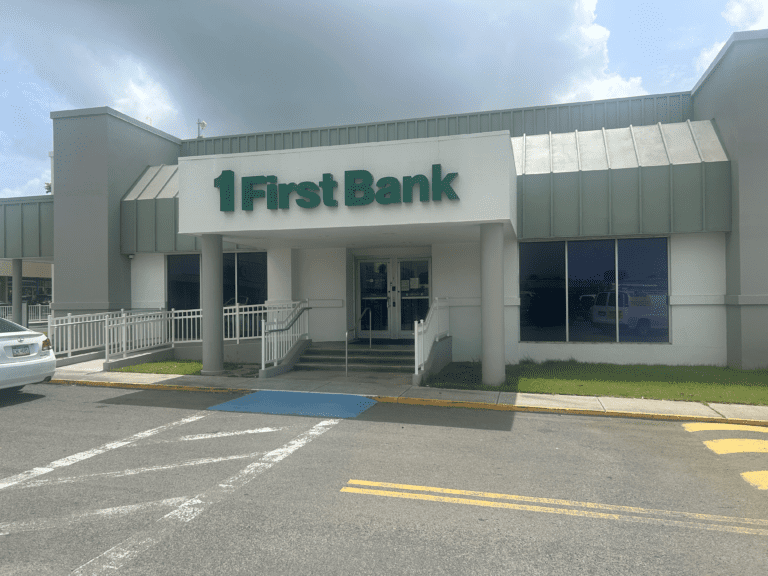
FirstBank Plaza in St. Thomas. (Submitted photo)
Across the U.S. and Puerto Rico, First BanCorp is positioned as a national leader in its category, driven by outstanding indicators such as its return on average equity (ROAE), operating efficiency, and sustained growth in loan originations.
Aurelio Alemán, president and CEO of First BanCorp, commented: “This recognition validates the financial strength and capabilities of our institution to maintain a resilient, disciplined business model focused on sustainable results. Given the quality of our performance and the value we generate for our customers and shareholders, we’re proud that a prestigious financial publication such as American Banker has distinguished us as the leading institution in our category at the national level. I’m proud of our leaders and employees, whose commitment and talent have been key to achieving this recognition. I’m also grateful to our customers for the trust they place in us,” continued Alemán.
This recognition consolidates First BanCorp as one of the strongest financial institutions within the U.S. banking system. In an environment marked by interest rate volatility, inflationary pressures, and greater regulatory demands, the institution has demonstrated disciplined execution, and a vision focused on consistent results.
American Banker is a leading independent publication that provides news, analyses and trends in the banking and financial services industry. American Banker’s ranking is based on an analysis of key financial metrics over a three-year period, including average return on equity (ROAE), revenue growth, operating efficiency, and lending performance.
To learn more about FirstBank’s recognitions and initiatives in Puerto Rico, Florida and the Eastern Caribbean Region, visit www.1firstbank.com.
FirstBank is a member of FDIC in PR & USVI only.
About First Bancorp
First Bancorp. is the parent corporation of FirstBank Puerto Rico, a state-chartered commercial bank with operations in Puerto Rico, the U.S., and the U.S. and British Virgin Islands. FirstBank Puerto Rico’s subsidiaries include First Federal Finance Limited Liability Company (a small lending company), FirstBank Insurance Agency, LLC. and FirstMortgage. First Bancorp’s common stock trades on the New York Stock Exchange under the symbol FBP. FirstBank is a Puerto Rican financial institution with a 76-year history of providing a superior service experience through a total of 3,150 employees distributed among the locations where it has a presence.
The Community Foundation of the Virgin Islands (CFVI) announced today that applications for the 2025 Judith A. Towle Environmental Studies Fund open on Aug. 1, 2025. Managed by CFVI, the Fund will award $12,000 to support initiatives that address shared environmental concerns in the insular Caribbean.
“The Judith A. Towle Fund empowers environmental leaders and innovators to explore and address our most pressing environmental challenges,” said CFVI President Dee Baecher-Brown. “This opportunity is about finding smart, scalable solutions that have transboundary relevance, benefitting multiple communities not just in the Virgin Islands, but across the Caribbean.”
Grants are awarded to individuals who are residents of the Caribbean, nonprofit organizations working in the Caribbean, and/or graduate students whose applied research focuses on the insular Caribbean. Applications must demonstrate innovative, collaborative and regionally impactful solutions to critical environmental challenges affecting the Caribbean region, such as biodiversity loss, climate change and the need for nature-based solutions. Eligible projects may include research, community engagement programs, education initiatives and conservation efforts that promote sustainability and environmental resilience.
“CFVI is a proven leader in growing philanthropic resources that make a lasting impact and understands the unique needs of the Caribbean,” said Judith Towle. “This Fund was created to invest in those working across the islands to address our region’s evolving environmental challenges. CFVI is a true partner in making this vision sustainable.”
Applications will be accepted via email to general.info@cfvi.net starting Aug. 1, 2025, with a deadline of Sept. 15, 2025. Selected grantees will be notified in October.
Application Format: Use the following ten (10) headers when preparing your proposal. All information requested within each header must be included. Please note that all proposals must follow this format.
1. Project Title
2. Name of Applicant (select one)
Individual: Identify Individual
Non-profit Institution: Identify Non-profit institution
3. Contact Information: Name, address, telephone number(s) and email address of the applicant. If applicant is an institution, a contact person at the institution must be provided.
4. Applicant Qualifications: A brief introduction to the applicant, highlighting the applicant’s qualifications for undertaking the proposed project.
5. Short Summary of Project: A two or three sentence introduction that briefly summarizes the project and provides the reader with a quick overview.
6. Proposed Activity: A fuller description of the proposed activity, including who will do what; the extent of local collaboration and partnership; and anticipated accomplishments, results, or products.
7. Time Frame: Identify when the project will begin and end.
8. How the proposed activity relates to the objective of the Towle Fund: Explain how the proposed activity furthers the overall purpose of the Towle Fund.
9. Budget: Amount of money requested and how it will be expended.
10. References: Provide the names and contact information for 3 persons familiar with the applicant’s work and accomplishments. Also, include the institutional affiliation or field of expertise for each name submitted.
Supporting documentation may be submitted, not to exceed an additional three (3) pages. Documentation exceeding three pages will not be considered as part of the review process.
Application Process: Applications will be accepted as a single-file attachment, not to exceed four (4) single-spaced typed pages, sent via email to general.info@cfvi.net. Please use the subject line: Application for Judith Towle Environmental Studies Fund.
For more information about eligibility, past grantees and how to apply, please visit the Judith A. Towle Environmental Studies Fund website or contact Beth Nuttall, Director of Grants and Programs, at bethn@cfvi.net.
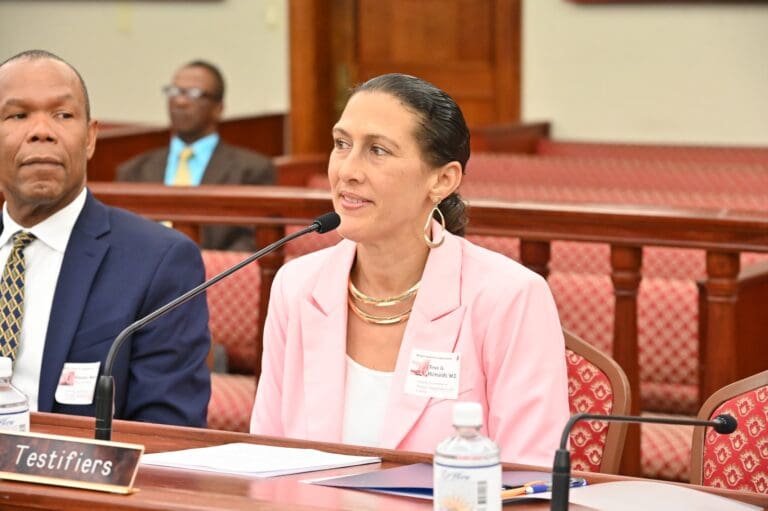
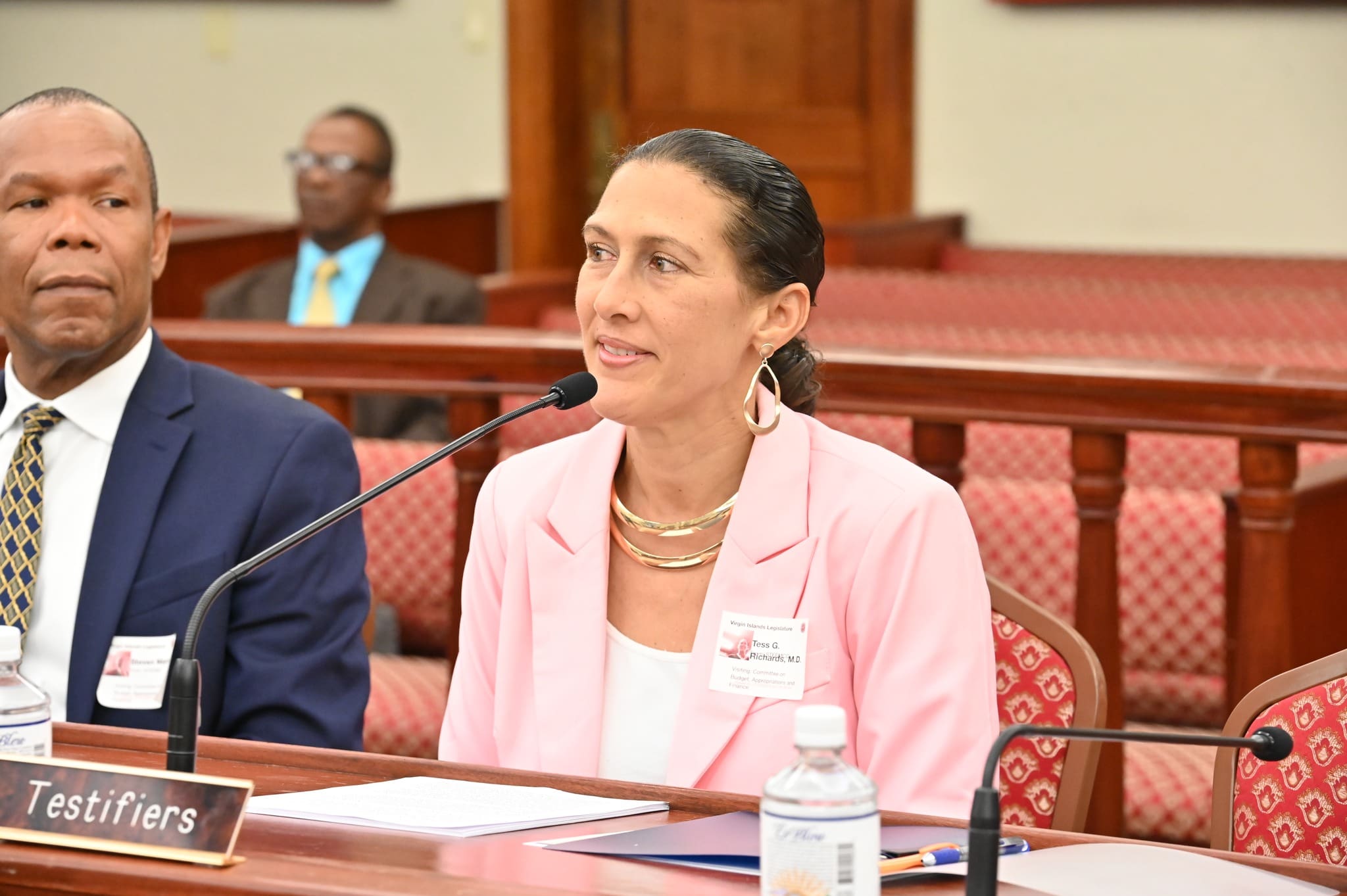
Dr. Tess Richards, executive director of the St. Thomas East End Medical Center Corporation, testified before the Senate Budget, Appropriations and Finance Committee Wednesday on St. Thomas. (Photo courtesy V.I. Legislature)
Lawmakers on the Senate Budget, Appropriations and Finance Committee heard from two of the territory’s medical care providers Wednesday.
Dr. Tess Richards, St. Thomas East End Medical Center executive director, led testimony in support of a $2.7 million funding request. Richards told lawmakers that the medical center has made strides after years of weathering “a quiet storm — trapped in a cycle of mismanagement, limited funding and uncertainty that threatened to erode the very care our community depends on.”
“But we did not falter,” she said. “Through bold choices and unshakable resolve, we rose — steadily and deliberately — out of a long and difficult chapter.”
To right the ship, Richards said the center reduced its workforce in 2023 from 103 employees to 58 and reduced the number of its directors from nine to four. In 2024, it also furloughed staff and implemented an 8% salary reduction before restoring the salaries and reimbursing employees for the lost wages four months later. Despite progress, Richards said the center continues to struggle with nearly $3.76 million in “legacy debt.”
Richards said most of what STEEMCC owes is divided between rent and arrears to the Internal Revenue Service and the V.I. Internal Revenue Bureau.
“We are able to make our monthly obligations,” she explained to Sen. Novelle Francis Jr., who chairs the Senate Finance Committee. “It’s the old debt — the debt from a couple years ago — that we are not able to bring down. And as that is still sitting there, that’s where the interest and the penalties are coming from.”
Like other medical providers in the territory, STEEMCC has seen a sharp increase in the amount of uncompensated care it provides. Richards testified that the number of self-pay patients increased from 1,662 in 2023 to 2,115 in 2024, and 2,407 uninsured patients have already been seen in 2025.
“If we are unable to meet the community’s primary care needs, patients will inevitably turn to an already overburdened hospital system,” she said. “As primary care providers, it’s our responsibility to keep patients out of the hospital — out of the emergency department — but we can only do that if we are given the resources and funding necessary to deliver that care.”
Testifying in support of a $3 million appropriation later, Frederiksted Health Care chief executive Masserae Sprauve Webster said the funds are needed both to cover the local Medicaid match and to cover uncompensated care. During testimony, Sprauve Webster said FHC had yet to receive $1 million earmarked for the health center from Epstein-related settlement funds. Further, FHC had to underwrite $22,000 worth of electrical repairs at its Ingeborg Nesbitt location, she said. Repeated power outages forced the medical center to run a generator and spend $15,000 on diesel.
“Those were definitely unexpected. It was not something budgeted for, nor is it FHC’s responsibility,” she said. Frederiksted Health Care has a 99-year lease on the building, which is owned by the Virgin Islands government.
Sprauve Webster said FHC treats one out of every four residents of St. Croix, 21% of whom are uninsured.
“And with the present administration … more than likely, those numbers are gonna grow,” she said. “Because our Medicare and Medicaid will be reduced in the coming months.”
Human Services Commissioner Averil George testifies before the Senate Budget, Appropriations and Finance Committee Wednesday on St. Thomas. (Photo courtesy V.I. Legislature)
Human Services Commissioner Averil George testified during a Senate Budget, Appropriations and Finance Committee hearing Wednesday that the recently enacted One Big Beautiful Bill Act maintains most existing rules for the territory’s Medicaid program.
George led testimony in support of a $69 million General Fund appropriation for 2026. The bulk of the department’s projected funding comes from federal sources for a total operating budget of more than $297 million. During her prepared testimony, George said the U.S. Virgin Islands will also be excluded from several Medicaid provisions that only affect states.
New federal Medicaid requirements include:
Reductions in retroactive coverage, limiting backdated Medicaid eligibility to one or two months, beginning in 2027
Amended definitions of “qualified aliens” and updated rules regarding eligibility for Medicaid and the Children’s Health Insurance Program
Immediate removal of Federal Medical Assistance Percentage for specified gender dysphoria services
Requirements for participation in federal pharmacy data surveys if the territory’s Medicaid Drug Rebate Program is active
Implementation of a federal system to identify duplicate Medicaid enrollees
Immediate prohibitions on Medicaid funding for providers who perform abortions beyond cases of rape, incest or when the pregnant person’s life is in danger
Stricter provider enrollment checks
Stricter eligibility verification and a prohibition on FMAP funds for people with unverified citizenship or immigration status
An update to asset limits for long-term care services, including a maximum home equity cap of $1 million
The territory is excluded from “state-only” provisions like work requirements for Medicaid expansion for adults and caps on state-directed payments related to Medicaid rates. Gary Smith, DHS’s Medicaid director, said the OBBBA will not affect the territory’s overall Medicaid funding.
“The only FMAP impact will be on the undocumented population,” he said, but the territory can still provide emergency medical services in those cases. That cost-share will be reduced from 90 percent federally funded and 10 percent locally funded to 83 percent and 17 percent. Smith said the prevailing sentiment in Washington, D.C., is that the territory already receives “disparate” treatment regarding its Medicaid program, “and they made that decision not to burden us with those changes that are applicable to the … states.”
Assistant DHS Commissioner Taetia Phillips Dorsett added that if a work requirement was implemented, roughly half of the territory’s 20,512 Medicaid recipients would become ineligible. Approximately 7,000 people would be exempted due to age or disability and only 3,258 are listed as currently working.
The most tense moments in Wednesday’s budget hearing came when Senate Majority Leader Kurt Vialet questioned outstanding vendor payments from the Office of Child Care and Regulatory Services, which is funded entirely through the federal Office of Child Care and Development Fund.
“What takes so long to process a hundred percent federally-funded program to individuals who are providing services?” he asked, including some vendors who have been working with DHS for years. Tishma Tucker-Lans, the office’s administrator, said delays can occur when vendors fail to timely submit invoices or don’t provide all of the necessary documentation.
“So you’re telling me you have a vendor that has been under your purview for years and that vendor has all these outstanding documents from last year, and you don’t have a system to remedy that,” he said.
Tucker-Lans maintained that vendors do submit documents late and that her office has reached out to offer assistance, adding that providers also have to keep their DHS licenses active.
“You’re making up all type of excuses,” Vialet replied. “The long and short is, your office is not producing. I am seeing emails — the same emails — over and over from the same individuals to your office, and no movement. I just actually called you up here because I want you to know that you cannot have federal funds from last year — one hundred percent funded — and it’s not being paid to providers. And these are providers that provide service to you for years.”
Later, Tucker-Lans said it wouldn’t be fair to lay the blame entirely at the feet of OCCRS, because the office has to follow federal guidelines, policies and procedures.
“And at this present time, I will uphold to that as long as I’m standing in this position,” she said.
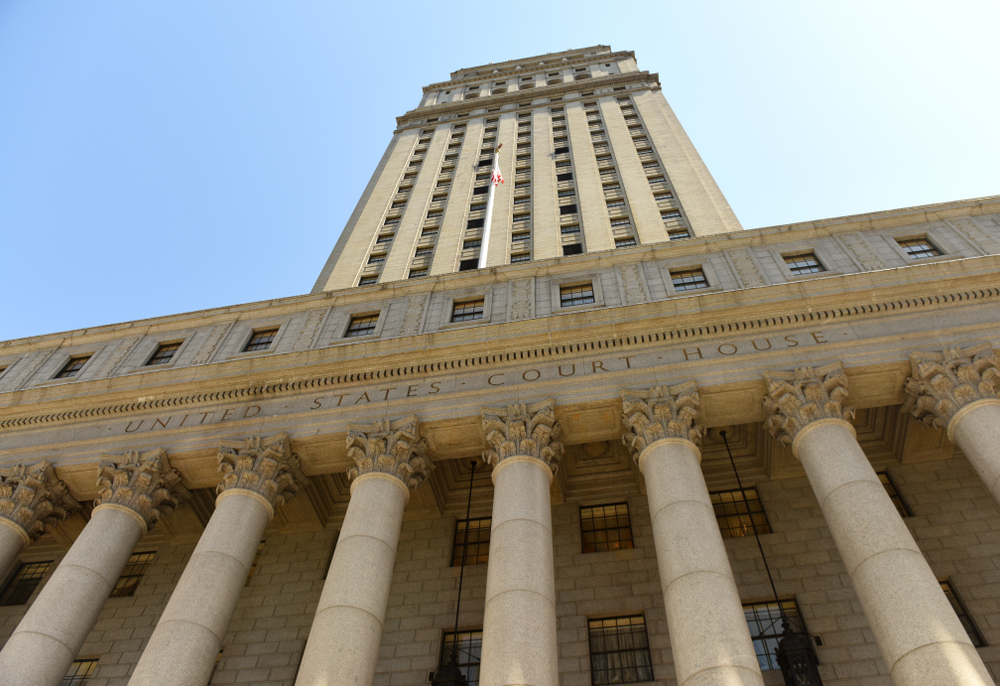
The U.S. District Court for the Southern District of New York in Manhattan. (Shutterstock image)
The federal judge for the Southern District of New York presiding over a lawsuit brought by six Jeffrey Epstein victims against various Virgin Islands officials has denied their motion for entry of a partial judgment after he dismissed the claims against all the defendants but V.I. Delegate to Congress Stacey Plaskett in March.
The plaintiffs, known only as Jane Does 1-6 to protect their identities as victims of sex crimes, had sought a partial judgment as to the dismissed defendants so they could immediately begin an appeal, rather than wait for the case against Plaskett to conclude.
However, Judge Arun Subramanian said Wednesday in a three-page order that granting a partial judgment “would risk piecemeal appeals that would require two or more three-judge panels to familiarize themselves with a given case in successive appeals from successive decisions on interrelated issues.”
Furthermore, the plaintiffs’ surviving claims against Plaskett will be resolved at trial in a matter of months, he said. “Given the schedule in this case, it is nearly impossible that the dismissed claims could be reviewed on appeal ‘in time to be tried with the other claims’ without ‘delaying prosecution’ of those claims,” Subramanian wrote, quoting from a 1997 case, Harman v. City of New York.
In fact, entering a final judgment on some but not all claims would derail the trial schedule, said the judge, who most recently presided over the sex trafficking trial of rapper Sean “Diddy” Combs.
“Here, the Court observes that denying certification will cause little delay and will permit the parties to engage in one round of appeals after trial is complete at which all the parties’ issues can be addressed. This will save time and resources all around,” Subramanian ruled in denying the motion the plaintiffs filed in April.
He ordered the plaintiffs and Plaskett to meet and confer by Aug. 21 and to jointly propose three separate weeks for trial this year.
The Jane Does’ complaint — first filed in November 2023 by Jane Does 1-5, amended that December to add a sixth plaintiff, and amended again last May — alleged negligence and violations of the Trafficking Victims Protection Act, or TVPA, and the Racketeer Influenced and Corrupt Organizations Act, or RICO, claiming territory officials actively conspired with Epstein to perpetuate his sex-trafficking scheme for their own gain.
A registered sex offender who pleaded guilty to procuring a minor for prostitution in Florida in 2008, Epstein died by apparent suicide in August 2019 at age 66 while in detention in New York on federal trafficking charges. His primary residence was Little St. James, his private island off St. Thomas, where for years he ran a complex web of shell companies registered in the USVI — and was afforded some $300 million in tax breaks through the territory’s Economic Development Commission — that enabled his crimes.
Plaskett remains the sole defendant after Subramanian ruled in March that the court lacks personal jurisdiction over the other six officials named in the complaint. They included the V.I. government, former governors John de Jongh and Kenneth Mapp, former senators Celestino White and Carlton Dowe, and former Attorney General Vincent Frazer. The charges against former first lady and longtime Epstein office manager Cecile de Jongh were dismissed because she is protected by a broad release the plaintiffs signed when they settled a previous suit against Epstein, which bars all claims against any of his employees.
While Subramanian dismissed the RICO claims against Plaskett in her official capacity as “an alleged USVI employee,” he denied her motion to dismiss the Trafficking Victims Protection Act and negligence charges.
“Unlike John de Jongh, Mapp, White, Frazer, and the USVI, who are not alleged to have specifically desired New York money from New York bank accounts, the [second amended complaint] adequately pleads that Plaskett traveled to New York and met with Epstein in the hopes of accessing the New York donor market,” Subramanian wrote in his March order.
While cautioning that the allegations have not been tested against the evidence, he cited claims in the complaint that Epstein made the maximum contributions to Plaskett’s campaigns, hosted a fundraiser for her, and gave her a $30,000 loan.
“In Plaskett’s case, the money she solicited from Epstein in New York and eventually received is directly related to the alleged quid pro quo to facilitate Epstein’s sex-trafficking enterprise,” so long-arm jurisdiction is established “at this stage,” the judge wrote.
Plaskett has strenuously denied the allegations in the suit and last July filed notice with the court that she would seek sanctions against Jordan K. Merson, the attorney representing the six Jane Does, saying the claims against her amount to “outright untruth, fiction, and misrepresentation.”
Members of the convention’s Human Rights Committee debated the wording and placement of water rights and shoreline access at its recent meeting. (Photo by Jamal Potter and Alvin Burke Jr., Legislature of the Virgin Islands)
The Sixth Constitutional Convention Human Rights Committee, meeting earlier this week, addressed the placement of environmental and cultural rights and considered what was termed a new human right to natural resources. Delegates also began refining protections for vulnerable populations, including children, the elderly, and those living with disabilities.
All committee members were present at the Monday virtual meeting. Three non-committee delegates joined in the discussions.
Committee Co-Chair Rudel Hodge Jr. recapped the work done at the last meeting. “We were able to get through the right to health care and social well-being on that would have been section 11,” he said.
The committee introduced a new “Right to Water Sovereignty” document. It proposes government steps to conserve and manage water sustainably. This includes promoting rainwater harvesting, protecting aquifers and watersheds, preventing pollution, and investing in resilient infrastructure. The document states people should have the right to participate in water resource planning and governance.
Delegate Rudel Hodge stressed the language’s importance in light of emerging global water crises. Delegate Imani Daniel supported its inclusion. Daniel raised concerns about water privatization and the fundamental nature of rainwater harvesting in the Virgin Islands.
A significant discussion followed on the subject of environmental rights. Committee Chair Stedmann Hodge Jr. expressed support for placing environmental rights under human rights. He cited recent U.N. declarations and statements by the U.S. Environmental Protection Agency.
” … As recently as 2022, the United Nations declared a new human right which is environmental rights,” the chair said.
David Silverman proposed wording to point out the difference between principles, rights, structure, and function. He argued that while principles belong in the preamble and individual rights in the Bill of Rights, governmental environmental obligations might belong in a separate article.
The committee agreed to review language proposed by committee member Devin Carrington. The committee at its Monday meeting also finalized language about beaches and shorelines, but Delegate John Abramson Jr. objected to the finalized language.
The committee also refined language for cultural rights and heritage. Cultural heritage preservation language for the Bill of Rights was approved.
While crafting language on the rights of children and vulnerable persons, delegates agreed to include specific protections for children, the elderly, disabled individuals, abuse victims, unhoused persons, and the chronically ill. A motion to update the wording passed, with further discussions set to take place at the next meeting.
The Human Rights Committee is part of the ongoing work of the Sixth Constitutional Convention, a process to create a modern constitution for the U.S. Virgin Islands. Voters approved the convention in November 2020, and legislation passed in early 2023 cleared the way for delegate elections in 2024.
Delegates must produce a proposed constitution by Oct. 31. This draft will then be reviewed by the governor, Congress and the White House. It will head to a binding referendum in November 2026, aiming for law by March 31, 2027.
The Sixth Constitutional Convention builds on the draft completed by the Fifth Constitutional Convention. Its 2009 draft failed federal approval due to various objections. These included concerns over U.S. sovereignty, local ancestry advantages, and imprecise Bill of Rights wording.
Current delegates are actively reviewing and revising language, using the Fifth Constitutional Convention draft as a foundation. Committees are closely examining both existing and proposed provisions through an iterative process designed to produce a clear, legally sound constitution that reflects the needs of all Virgin Islanders and can stand up to federal review.
The public is invited to attend all committee meetings and general (plenary) sessions of the Constitutional Convention.
The Committee on Government Structure meets Thursday, between 5 p.m. and 9 p.m.
A link for meeting registration is available by clicking here.
A dispute between VIEDA and the Board of Education over tracking EDC scholarship contributions has raised concerns about delays that could impact funding for students pursuing higher education. (Shutterstock image)
A dispute between the Virgin Islands Board of Education and the Virgin Islands Economic Development Authority has exposed gaps in information-sharing that may be hindering enforcement of EDC mandatory scholarship donations.
During a July 24 budget hearing before the Legislature’s Budget, Appropriations, and Finance Committee, Board of Education Chair Kyza Callwood told senators that 41 of 99 companies benefiting from Economic Development Commission tax breaks were delinquent in their contributions to the Territorial Scholarship Fund, Callwood said the responsibility for ensuring those payments were made fall on the Virgin Islands Economic Development Authority, which administers the EDC program.
In a formal response issued Tuesday, VIEDA CEO Wayne Biggs Jr. challenged that claim, stating that VIEDA had not received the board’s 2024 report. “VIEDA strongly supports its beneficiaries’ commitment to the Board of Education. However, the statutory responsibility for collecting and tracking these payments rests squarely with the Virgin Islands Board of Education, and the law stipulates that VIBE must submit an annual report to VIEDA, within 60 days after the close of each calendar year … This report is essential for VIEDA to perform its oversight role and follow up with beneficiaries as necessary.”
According to VIEDA, the board’s report for calendar year 2022 was received in August 2024, and the 2023 report was received in March 2024. As of July 24, the 2024 report had not yet been received by VIEDA.
Callwood confirmed with the Source Wednesday that the calendar year 2024 report is in its final stage of review and is expected to be submitted to VIEDA by the end of the day. “We prioritize accuracy and completeness in all submissions,” said Callwood. “As such, we do not release reports until all required information has been thoroughly verified.”
Callwood emphasized that the board is not responsible for enforcing compliance, noting that VIBE lacks both the legal authority and access to the necessary data, such as beneficiary certificates, to track whether contributions have been made.
He said the board’s role is limited to receiving, acknowledging, and reporting contributions made to the Territorial Scholarship Fund. It does not track compliance, he added, because it is not privy to the compliance certificates or other documentation needed to verify payment requirements.
Callwood said the relevant statutes — 29 V.I.C. §§ 707 and 708 — make clear that the Economic Development Authority, not the Board, is responsible for oversight. “Monitoring and enforcement duties fall squarely under the Virgin Islands Economic Development Authority — not the board,” he said. “The law directs VIBE to report only the contributions actually received, not to track delinquencies.”
In an interview with the Source Wednesday, Celina D. Morris, director of Marketing for VIEDA, confirmed that enforcement does fall under the agency’s Compliance Division, but only after the board’s annual report is submitted.
“Because they receive the payments — we don’t — they would then send us the report,” Morris said. “Once we receive it, we can track and see who may be missing, and the compliance unit will follow up to ensure they get into compliance.”
However, according to Callwood, VIEDA has not provided updated beneficiary data or compliance certificates, despite repeated requests since July 2024. “A key challenge we’ve encountered is the inconsistent or delayed transmission of updated beneficiary data and certificate information from EDC to VIBE,” he said. “This impacts our ability to reconcile disbursements and provide accurate reporting.”
Morris said that VIEDA did respond to a request for updated beneficiary information sent from the board on July 10, 2024. “We compiled the information and responded on July 31, 2024, with a complete listing of beneficiaries and their obligations to the Territorial Scholarship Fund at that time,” she said. Morris added that the Board of Education acknowledged receipt of the information but did not provide any further follow-up.
Callwood said the Board of Education did receive some documents from the Economic Development Authority in response to a July 10 request, but described the material as incomplete. He explained that while VIEDA indicated additional compliance certificates would be provided, those documents never arrived, which are needed to verify each company’s specific donation requirement.
Morris noted that the beneficiary list is a “living document,” with updates posted regularly on VIEDA’s website. “The live listing is available on the website with all the beneficiaries at any given time,” Morris said, referencing. She added that members of agencies impacted by the EDC program, including the Board of Education, serve on a task force and are directed to where they can find the most current beneficiary listing online.
However, Callwood disagreed that the Board of Education is a part of said task force with the VIEDA. Callwood also criticized the idea that the board should rely on VIEDA’s website to access information about EDC beneficiaries. “If we are agencies working together, the Board of Education shouldn’t have to go on a website and navigate through different areas to get information,” he said. He questioned the accuracy of online data and noted that staff would still need to contact VIEDA to verify details.
Callwood said the Board of Education has not received any confirmation or feedback from VIEDA regarding its 2022 or 2023 scholarship reports. “When I send the report, they’re supposed to acknowledge receipt and follow up to confirm whether it’s correct, based on our compliance standards,” he said. “But they don’t tell me that — I wouldn’t know, and I don’t have the certificates to verify it myself.”
Callwood said the process needs more structure and clarity, including a documented workflow between agencies. “There should be a documented process — from when they send us the list and certificates, to when we submit our report, and then when they respond to confirm compliance,” he said. “For example, they could say, ‘Based on your report, these 12 beneficiaries are missing, and they’ve committed to submitting $3,000 by a certain date … But nothing like that happens.”
While both agencies agree on the importance of the scholarship fund, the public back-and-forth has highlighted issues in sharing information to ensure enforcement of EDC beneficiaries making their minimum required donations.
Biggs called for continued dialogue with the board and reaffirmed the commitment of VIEDA to “accountability, partnership, and the continued success of the Virgin Islands Economic Development Commission program.”
“The Territorial Scholarship Fund is very important. Through the Economic Development Commission, it helps prepare the next generation of Virgin Islanders for the workforce,” said Morris. “It has supported many students — myself included — in pursuing their higher education goals. The program enriches the local talent pool, and we hope many recipients return home to become members of the community again and be a part of the USVI workforce. As our statements have indicated, we are fully in support of the fund and look forward to continuing our collaboration with the Board of Education to ensure all required contributions from EDC beneficiaries are made.”
“While tracking and enforcement responsibilities fall under the purview of VIEDA, we recognize the importance of collaboration and transparency,” Callwood said. “We welcome the opportunity to work more closely with VIEDA to improve data sharing, clarify roles, and strengthen the effectiveness of the scholarship fund.”
Callwood also highlighted the importance of these funds “These funds help bridge access to higher education and create pathways to economic mobility. We strongly support the original intent of this initiative and are committed to doing our part to ensure the funds are used equitably, efficiently, and with accountability.”