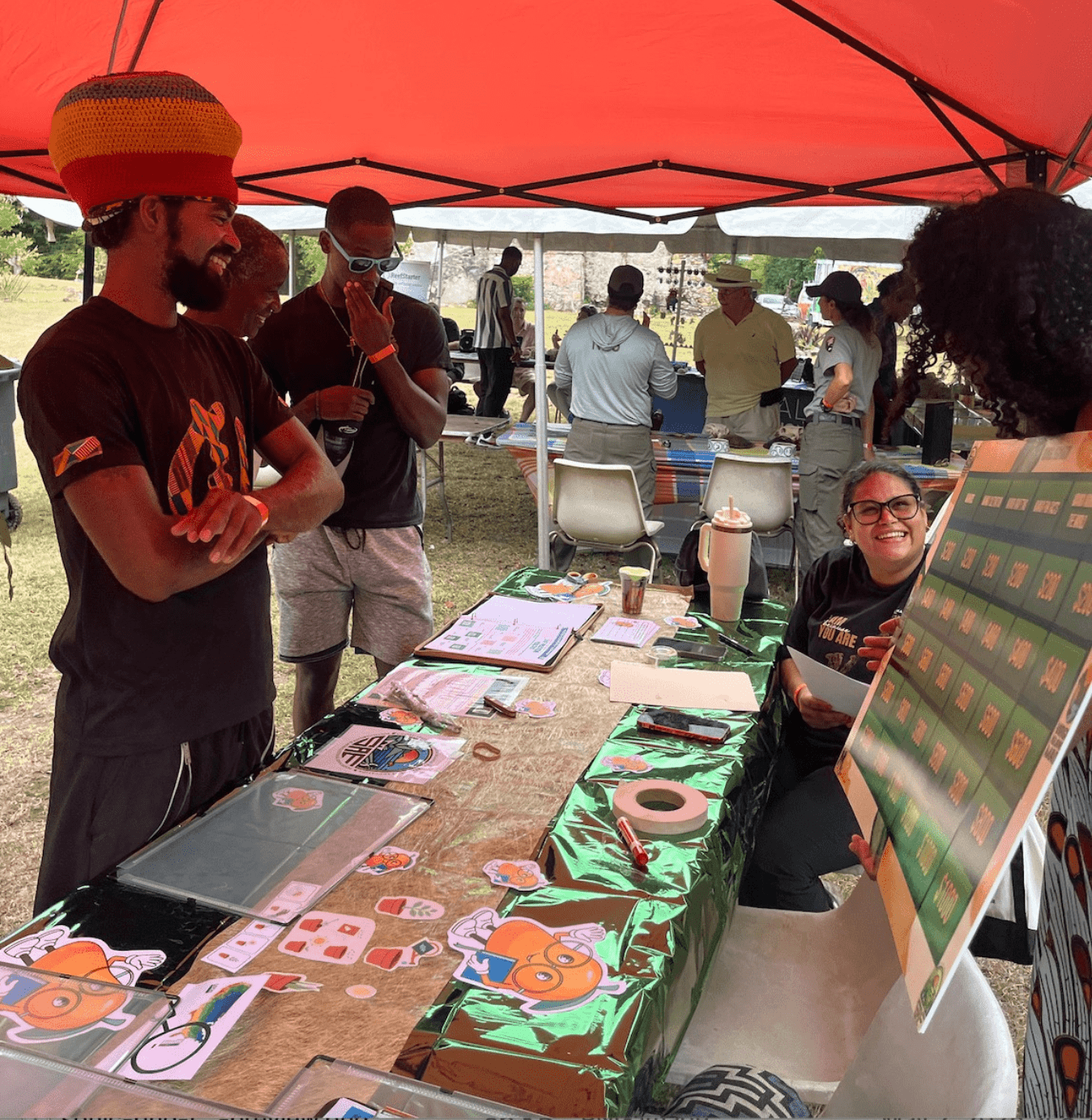
Visitors engage with the Virgin Islands Department of Education’s Division of Sustainability & Agricultural Education’s “Mango Jeopardy” game during the 29th Annual Mango Melee at St. George Village Botanical Garden. The interactive activity, developed in partnership with MANRRS, challenged participants’ knowledge of agriculture, sustainability, and mango facts in a fun and educational format. (Photo courtesy VIDE)
The Virgin Islands Education Department’s Division of Sustainability & Agricultural Education, in partnership with Minorities in Agriculture, Natural Resources, and Related Sciences, hosted a vibrant and educational community showcase at the 29th annual Mango Melee, held at the St. George Village Botanical Garden, according to a press release issued by the department.
The exhibit attracted hundreds of families, students, and community members with hands-on activities that blended science, sustainability, and cultural heritage. A major highlight was “Mango Jeopardy,” a spirited quiz-style game that tested attendees’ knowledge of tropical fruit biology, climate-smart agriculture, and local food systems, the press release stated.
The showcase supported SAE’s mission to promote food sovereignty and security as outlined in the Territorial Agricultural Plan. Climatized seeds and grow bags featuring plant varieties tailored to the Virgin Islands’ unique environmental conditions were on display, demonstrating SAE’s innovative strategies for advancing sustainable agriculture in the territory, the release stated.
“This year’s Mango Melee offered a tremendous opportunity to blend education with tradition,” said Cydney Meadows, director of Sustainability & Agricultural Education. “Our partnership with MANRRS is helping to cultivate the next generation of agricultural leaders and empower the wider community with practical knowledge.”
The event also spotlighted SAE’s ongoing efforts, including school garden programs, aquaponics systems, and youth development in sustainable agriculture. MANRRS representatives engaged with students and families about career pathways in agricultural sciences and emphasized the role of diversity, equity, and inclusion in shaping the future of food and environmental stewardship, the release stated.
Timed just ahead of International Mango Day on Tuesday, the celebration served as a tribute to the mango’s cultural, nutritional, and economic importance. The event underscored the need to preserve mango biodiversity and support local agriculture as a means of enhancing environmental resilience and community health, it said.
For more information on SAE programs and future collaborations, contact Sumayah Bryan at sumayah.bryan@vide.vi.
With deep sorrow, the family of Eunice Ambrozine Rogers Gumbs announces the passing of their beloved wife, mother, and grandmother at her home in Tabor and Harmony, St. Thomas, VI, on June 30, 2025.Eunice Gumbs
Eunice was a pillar of strength and love in her family and community. Her unwavering faith, warm spirit, and generous heart touched the lives of all who knew her. She dedicated her life to nurturing her family, supporting her church, and giving back to those in need.
Eunice was born on September 1, 1949, to Reuben and Robertine Rogers on the island of Anguilla. She attended The Valley Primary and Secondary School. In 1967, she moved to Antigua for Nursing Training. While there, she married the love of her life, Alfred W. Gumbs, of Anguilla. Eunice worked for Antigua’s Department of Health for two years before moving back to Anguilla to pursue employment with Anguilla’s Department of Health.
In 1976, Eunice moved with her husband and children to St. Thomas, Virgin Islands. She continued her nursing career there, bringing compassion and dedication to every patient she served. Eunice worked at the Knud Hansen Complex, Department of Health, and then at the Roy Lester Schneider Regional Hospital. Throughout the years, she continued her education, achieving a Bachelor of Science in Nursing and a Master’s in Psychology from the University of the Virgin Islands. She also earned a master’s in special education from the University of Miami.
As a registered nurse, Eunice served for many years as the Head Nurse of the OBGYN ward. She left the hospital to serve as the Nursing Director of the Seaview Nursing Home. Eunice later returned to the Roy Lester Schneider Hospital where she served as Director of Nursing until her retirement.
Eunice is preceded in death by her parents, Reuben and Robertine Mathilde Rogers; brothers, Ralph, Charles and Rufus; and sister, Rosalyn Riley-Hansby. She is survived by her loving husband, Alfred W. Gumbs; her children, Desiree, Tara, Amin and Tamera Gumbs; grandchildren, Shawn Smith Jr., Jaelen Thelusma and Gabrielle Thelusma; sisters Eva (Rogers) Richardson and Carmen Rogers-Green; sister-in-law Verona Rogers (of Texas), numerous nieces and nephews, extended family and countless friends who will forever cherish her memory.
Funeral services will be held on Saturday, July 26, at 10 a.m. at the Blyden Chapel of The Turnbull’s Funeral Home.
St. Croix Foundation for Community Development is proud to announce the recipients of $28,000 in scholarships awarded to eight exceptionally talented, rising first-year university students in a Virtual Awards Presentation held on July 7th, 2025. Scholarships were awarded through the Lang-Wise STEM Scholarship Fund and the Patrick and Amelia Williams Opportunity Fund.
Lang-Wise STEM Scholarship Fund
In 2025, the Lang-Wise STEM Scholarship Fund awarded a total of $10,000 in awards ranging from $1,000 to $3,000 to five youth whose talent, skill, and leadership will allow them to contribute to the Virgin Islands and the Global Community:
Curtis Charlery, Jr., George Washington University, Major: Mechanical and Aerospace Engineering
Nakai Theodore, University of the Virgin Islands, Major: Nursing
Nathan Langley, New York University, Major: Mechanical Engineering
Patrick & Amelia Williams Opportunity Fund
The Patrick and Amelia Williams Opportunity Fund awarded a total of $18,000 to six outstanding young people who demonstrated their ability to persevere against the odds to meet their goals.
One Invitation-Only Scholarship was issued to Jahnaiy Rodriguez to support his second year studying Physical Therapy at Florida A & M University.
Five Competitive Scholarships, ranging from $1000 to $4000 each, were awarded to:
Nia Francis, Tennessee State University, Major: Biology
Nayelis A’Shante’ St. Omer, Tuskegee University, Dual Major: Architecture & Construction Management Science
J’Neolise Sirraya Green, Winston-Salem State University, Social Work
Curtis Charlery, Jr., George Washington University, Major: Mechanical and Aerospace Engineering
Taking advantage of an early start, Curtis Charlery, Jr., an ambitious scholarship recipient for both funds, matriculated over the summer. In his pre-recorded statement, he described the impact of community-rooted philanthropy.
“These scholarships mean more to me than just financial assistance. They are an investment in my future, and they give me the support and confidence I need as I begin my first year of college. Because of your generosity, I can begin this experience focused and determined, not burdened by financial stress. Your support is not only opening doors for me but also showing me that people believe in my potential. That is a gift I will never take for granted.”
Fund Background and Impact
Lang-Wise STEM Scholarship Fund
The Lang-Wise STEM Scholarship Fund, now in its third year, continues to be a beacon of hope and opportunity for students pursuing careers in Science, Technology, Engineering, and Math. Established by Crucian Raydiance Wise, herself an aerospace engineer, the Fund’s purpose is specifically designed to offset unexpected expenses for first-year university students. At the heart of this fund’s purpose lies philanthropy itself, with each applicant being asked to describe how they envision themselves giving back to the Virgin Islands and on a global level.
Since 2023, the Lang-Wise STEM Scholarship Fund has awarded $41,900 to 15 ambitious St. Croix graduates studying forensic accounting, plant genetics, and aerospace engineering. To expand opportunities and access, the Lang-Wise STEM Scholarship Fund has also awarded grants to STEM-related youth organizations such as the St. Croix Rocketry Association.
Patrick and Amelia Williams Opportunity Fund
The Patrick and Amelia Williams Opportunity Fund was established in 2018 by Junior Gaspard, a distinguished alumnus of Central High School and John H. Woodson Junior High School. Created in honor of his grandparents, one year after Hurricanes Irma and Maria, the Fund embodies a spirit of resilience and determination. Patrick Williams, a trailblazer who moved his family from St. Vincent to St. Croix, and Amelia Williams, who faced the challenges of losing her eyesight with grace and courage, serve as inspirations for this Fund. It aims to support public high school graduates who have encountered and overcome significant obstacles, empowering them to pursue higher education and achieve personal and professional success.
To date, the Patrick and Amelia Williams Opportunity Fund has awarded $113,000 to 24 young people pursuing a diverse range of degrees, from social work and music education to biochemistry and meteorology. Of those young people, seven were invited back for one to three more years of support, ensuring that as studies become more intensive and financial aid decreases, awardees receive sustained support that is critical to success.
St. Croix Foundation President, Deanna James, stated that “Each year, St. Croix Foundation continues to intentionally cultivate coherence within our scholarship fund portfolio to nurture a pipeline of support for our young people. By continuously assessing the landscape and adapting our approach, we strengthen the foundation for a resilient, thriving future for the Virgin Islands. The candidates for this year’s scholarship exemplified perseverance, ambition, and represent diverse fields of study – all of which are directly related to their experiences growing up in the Virgin Islands and their commitment to give back.”
St. Croix Foundation wishes to extend its sincerest appreciation to the Donors and Advisors of the Lang-Wise STEM Scholarship Fund and the Patrick and Amelia Williams Opportunity Fund, as well as the Foundation’s Grants & Scholarship Committee for their time and care in evaluating applications.
For more information about how to support these special funds, please visit the Foundation online at www.stxfoundation.org or call 340-773-9898.
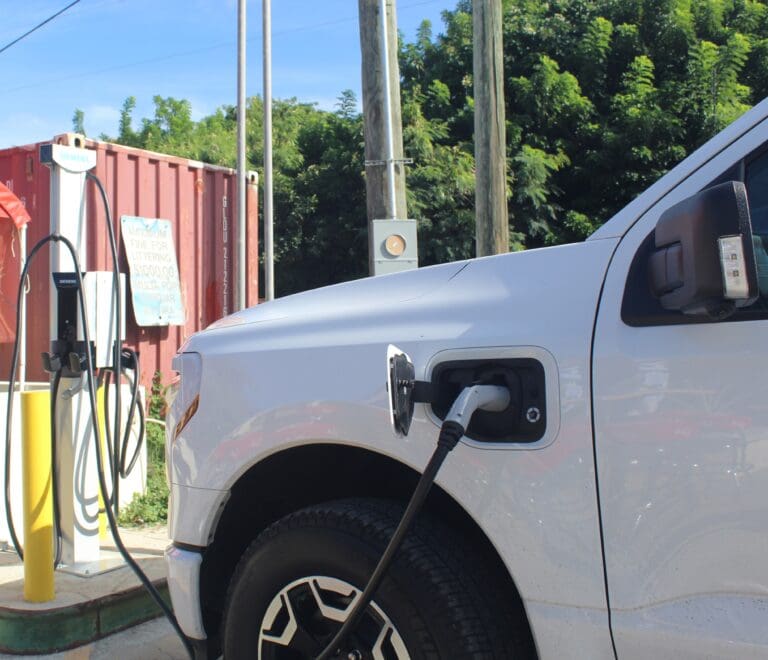
Virgin Islands Energy Office (VIEO) Director Kyle Fleming is pleased to announce the execution of a subgrantee award that will pave the way for the first domestic sales of electric vehicles (EV)in the territory by an affiliate of an American automobile manufacture, as well as the establishment of state of the art EV service centers in both Districts. The contract between VIEO and Metro Motors VI will eliminate long standing barriers to EV ownership in the territory and make this exciting technological evolution accessible to the Virgin Islands community.
(Submitted photo)
The agreement, which goes into force August 1st, outlines how VIEO will reimburse Metro Motors for purchasing the tools needed to fully service electric vehicles, procuring and installing Level III DC fast charging stations on St. Croix and St. Thomas. As well as committing to carrying popular EV models on their showroom floors in both districts. The deal also ensures that government and private sector electric vehicles from manufacturers affiliated with Metro Motors VI will have local access to the rare servicing needs that may arise.
“One year ago this week, VIEO hosted the territory’s first ever EV summit, which highlighted how the Energy Office was going to leverage federal funding to create a sustainable EV ecosystem in the Virgin Islands. This partnership with Metro Motors VI represents one of the most significant milestones we’ve achieved towards that goal, and ensures that EV owners can feel confident that they will be able to depend on their vehicles over their useful life,” Director Fleming said.
The effort to create a viable pathway toward anxiety free EV ownership has benefited greatly from the leadership of Governor Albert Bryan Jr. who fully supported and facilitated VIEO’s long term vision, as well as robust legislative support for renewable and energy efficient solutions which stretches back decades in the territory.
Congressional support has also been instrumental, as it has allowed VIEO to leverage US Department of Energy State Energy Program formula funding made available under the Infrastructure Investment and Jobs Act (IIJA) to fund the subgrantee award.
VIEO has taken a holistic approach to nurturing the territory’s transportation electrification ambitions. Under the auspices of the Government Operations Fleet Efficiency and Electrification Transformation (GO FLEET) initiative VIEO has facilitated the procurement of dozens of EVs for public service use, vehicles that have markedly cut down not only on governmental fuel costs and polluting emissions. But also served to demonstrate the capacity of the technology to work across the territory’s varied terrain, all while fulfilling a tertiary mission of educating the public about the capabilities of EVs.
Aside from leading the charge on fleet electrification, VIEO has been at the forefront of efforts to equip the territory with public EV charging infrastructure. Over the Christmas Holiday season VIEO and its partner contractors installed eight pedestal mounted Level II EV chargers on St. Croix, including the Christian “Shan” Hendricks Vegetable
Market in Christiansted. In July VIEO broke ground in the Northern District on the second wave of charger installations, beginning work on installing six pedestal mounted chargers at the Fort Christian Parking Lot. In total VIEO will install 16 public facing chargers as part of this latest infrastructure build out. Each of the Siemens VersiCharge pedestals is equipped with two chargers, and are currently configured to allow for free charging thanks to the leveraging of Department of the Interior Energizing Insular Communities grant. The chargers in the St. Thomas and St. John District are expected to undergo final commissioning by the manufacturer in the next six to eight weeks.
Although the price gap between EVs and their conventional counterparts is shrinking, making the switch to a battery powered vehicle is still a significant investment. To help defray some of the cost VIEO is administering the Electric Mobility program, an incentive that offers Virgin Islanders a rebate of up to $5,000 when they register their new or used eligible electric vehicle at the Bureau of Motor Vehicles. VIEO advises consumers to take advantage of federal tax credits worth up to $7,500 for new qualifying plug‐in electric vehicles, (EV) and as much as $4,000 for used EVs before they expire after Sept. 30th.
Currently Metro Motors VI has one EV technician on staff. But thanks to efforts spearheaded by the Virgin Islands Department of Education (VIDE) Career and Technical Education Center (CTEC) the company’s dealerships will soon have a pipeline of locally cultivated talent to hire from. Beginning at the start of the 2024‐2025 academic year CTEC opened enrollment for its Electric Vehicle (EV) Maintenance and Repair course. Under the guidance of Automotive Service Excellence (ASE) Master Automobile Technician Christopher Smith, the program’s four students have completed during the courses first semester a capstone project that saw them assemble from the wheels up a fully functional Switch EV kit car. Going into their second semester the students will focus on gaining hands on experience working on a commercial EV while they study for the ASE Light Duty Hybrid/Electric Vehicle Specialist (L3) certification exam, currently the gold standard for EV technicians.
Virgin Islands sprinter Brandon Pemberton took to the track at the 2025 FISU World University Games in Rhine-Ruhr, Germany, with great aspirations despite challenging conditions that tested every athlete’s resolve.
Brandon Pemberton (Submitted photo)
Scheduled to compete in Heat 7 of the Men’s 100m, Brandon’s race was delayed by 15 minutes due to technical issues, leaving competitors waiting in the rain-soaked stadium for the start. The unexpected pause added tension to an already high-stakes event, but Brandon remained composed.
When the race finally began, Pemberton powered through the wet conditions to finish 5th in his heat, placing 42nd overall among a deep international field. Though the result didn’t secure a spot in the semi-finals, his performance reflected resilience and professionalism under pressure.
The FISU Games, known for showcasing the world’s top university athletes, offered Brandon a valuable opportunity to represent the Virgin Islands on a global stage. His effort in Rhine-Ruhr adds another chapter to his growing athletic journey, and the experience gained will fuel future races.
Brandon will be back in action as he races in the Men’s 200m at the 2025 FISU World University Games this Wednesday at 12:40 PM (local time in Germany) — that’s 6:40 AM in the Virgin Islands.
Fast food, while convenient, packs enough calories, fat, sodium and sugar to derail a day’s diet in a single sitting. (Shutterstock photo)
A boy no older than eight sits in the back seat of a Toyota Corolla, legs swinging as he unwraps a foil-warmed cheeseburger. His mother, still in her scrubs from Schneider, hands him a Styrofoam cup larger than his forearm. Outside the car window, a digital display beams down like a sermon as they are greeted by Raphune Hill traffic: a cartoon chicken dances beside a $5 combo on the chyron.
Oliver Wilson Ottley III (Submitted photo)
A few blocks away, a community clinic prints its daily report: two deaths from heart disease, five new cases of high blood pressure, 20 new diabetes referrals, and another mother asking if they can test her six-year-old daughter’s blood sugar since she was recently diagnosed as obese.
There is no mystery here. Just a quiet system working exactly as designed.
If you’re craving a quick meal in the Virgin Islands, your options are few — but familiar: Wendy’s, KFC, McDonald’s, and Little Caesars. These four chains dominate the islands’ fast-food landscape. But a recent national report lists them all among the 10 most unhealthy chains in the United States — each one packing enough sodium, fat, and sugar to derail a day’s diet in a single sitting.
For Virgin Islanders, that’s not a warning. That’s the menu.
Now, let’s be clear: the Virgin Islands isn’t short on choices. We have plenty of local restaurants — some family-owned, some farm-to-table — that offer healthier, more culturally rooted alternatives. But when it comes to commercialized fast food, the possibilities are narrowed down to this quartet. Successfully singing their way onto the national health hazard charts. Which is not just unfortunate. It’s potentially deadly.
The World Atlas list didn’t hold back. These chains weren’t just singled out for calorie counts — they were called out for marketing tactics, portion sizes, and menu designs that encourage regular overconsumption.
A Triple Baconator meal at Wendy’s pushes past 2,100 calories.
A three-piece combo at KFC loads nearly 3,000 milligrams of sodium — more than a day’s limit.
A Hot-N-Ready pizza from Little Caesars hits 2,140 calories before you even touch the Crazy Bread.
A Big Mac meal at McDonald’s? Over 1,300 calories, and that’s without dessert.
In most cities, these chains are just several out of thousands you can decide on. In the Virgin Islands, they are the decision.
And it’s not just what’s here — it’s what’s missing. While we have Subway, notably missing are Chipotle, Panera, or even Chick-fil-A — brands that, while far from perfect, at least attempt to market leaner meats, vegetables, or customizable meals. Here, we don’t even get the illusion of variety. Just the worst America has to offer, exported wholesale.
Which raises a bigger question: why are the only big-box giants operating here the ones ranked the severest impact in terms of health?
The consequences are real — and rising.
According to the Institute for Health Metrics and Evaluation (IHME), the top causes of poor health and early death in the U.S. Virgin Islands are ischemic heart disease, diabetes, and COVID-19 complications. The No. 1 risk factor? High blood sugar. And it’s growing faster than any other major health threat.
Government data backs this up. A 2021 health survey reported that:
8.7% of Virgin Islanders live with diabetes
67% of women and 50% of men are overweight or obese
Nearly 90% don’t get enough physical activity
Over 80% don’t eat enough fruits and vegetables
Based on the numbers we’ve moved past concern. We’re now managing fallout. Which makes it ironic that the only quick service restaurants allowed to push their products across our islands are the very chains that exploit and feed these exact conditions.
No one’s saying fried chicken or pizza shouldn’t exist. Culture matters, comfort matters, and nobody’s coming for your occasional cravings. But what does matter is how often, how aggressively, and how exclusively these meals are marketed and made available — especially in communities already battling chronic disease.
From $5 Biggie Bags to 44-ounce sodas to late-night “third meal” advertising, these brands don’t just sell food. They sell habits. Habits that become normalized. Habits that become addictive.
And when the same meal deals, mascots, and jingles keep showing up on every container, cup, combo, and commercial, those habits have nowhere to hide. That addiction becomes instinct.
The Healthy Virgin Islands 2030 plan aims to tackle this. It lays out a bold public-health vision built on education, equity, and access. Local leaders are pushing for things like:
National nutrition guidelines
Collaboration with food importers to reduce trans fats and sugar
Expansion of community-based counseling and exercise programs
A territory-wide push to “Change Systems, Live Healthier”
All of it sounds good — on paper. But we can’t just educate our way out of this. We need to confront the prepackaged bias already baked into our food environment. If the average resident sees billboards of smiling children holding Happy Meals and beaming over Chicken McNuggets — but not one shows a local kid planting a garden or holding a bowl of fruit, and not one lesson is taught about fiber, diabetes, or real nutrition — that’s not just marketing. That’s miseducation.
We can’t preach healthy living while serving up a 24-hour diet of America’s most profitable poison — designed by chemists, not chefs.
Yes, personal responsibility plays a role. But so does food access, pricing, and corporate presence. If your only fast, affordable meal on the way home from work is a $5 pizza or a hot wings combo, it may not look like entrapment — but then again that’s the point. What trick ever does?
The truth is, the Virgin Islands is not some passive consumer. It’s a target market — one that corporations have flooded with high-calorie, low-nutrition menus while offering none of the healthier or even mid-tier alternatives available in larger stateside cities.
And while the burden is heaviest on our health systems, the impact runs deeper — into our schools, our families, our lifespan.
This story isn’t about guilt — it’s about awareness. If we want a healthier Virgin Islands by 2030, we need more than public service announcements. We need:
Greater support for local food entrepreneurs
Policies that hold franchises accountable to health standards
Conversations about why we only have the most harmful chains in our backyard
The islands deserve better than conglomerate leftovers. We deserve food that doesn’t come with a side of fatality. And we deserve a public health system that doesn’t have to clean up what billion-dollar businesses leave behind.
Because if all we get is the worst America has to offer, the question isn’t what we’re eating — it’s who’s deciding we deserve it. This isn’t just a red flag — it’s a stop sign we’ve been running for years. Maybe it’s time we pump the brakes — because no one deserves to be handed their fate out of a drive-thru window.
— Oliver Wilson Ottley III, St. Thomas
Editor’s Note: Opinion articles do not represent the views of the Virgin Islands Source newsroom and are the sole expressed opinion of the writer. Submissions can be made to visource@gmail.com.
One of the jewels of Whim Museum is the library, but as a people, we should be ashamed of its current physical state. (Photo by Olasee Davis)
In 1949, Axel H. Oxholm conducted a survey of the Virgin Islands. He received wholeheartedly the cooperation and assistance from local and federal officials, civic organizations, the business community, and industrialists of the islands. This survey of the Virgin Islands took place during the William H. Hastie administration, the first appointed Black governor of the Virgin Islands. We are in the beginning of the hurricane season. September of 2025 will be eight years if nothing has been done to restore Whim Museum’s historic structures since the impact of Hurricane Maria in 2017.
Olasee Davis (Submitted photo)
Listen to what Oxholm said 76 years ago as part of his report to the local government. So interesting are these old buildings, he said, that the Danish government is now selecting a typical plantation mansion to be dismantled and rebuilt in Denmark. It would be of great cultural value, Oxholm said, if a representative mansion of the island’s golden age in the 18th century could be set aside, equipped with period furniture, and otherwise restored to give posterity an idea of life in the Virgin Islands during the period when sugar was King.
One of the jewels of Whim Museum is the library. In my opinion, there are no libraries in the Virgin Islands, both public and private, that can stand taller with the wealth of cultural information to the people of these islands and the wider Caribbean region than the Whim Museum library. It is one of the best cultural treasures comprising historic documents, reports, old photographs of the islands and it people, historic maps, letters of the 17th 18th and 19th centuries, sketches, magazines, and old books — an endless list of information about the history of the Virgin Islands.
What put the Whim Museum library on the worldwide map digitally is when the African Roots Project came online. Dr. George Tyson, a local historian and president of the Virgin Islands Social History Associates, and others for more than seven years worked on transcribing thousands, and tens of thousands of records from the Danish colonial period of St. Croix, which includes census reports, church records, tax records, enslaved and “free slave” lists, school records, and centuries of unread documents on the shelves of the Danish National Archive, as well as the United States Archives of early rule of these islands.
This database created at the Whim Museum library is a search engine of more than 1.8 million entries that helps researchers, educators, archeologists, historians, students — an endless list of professional and ordinary people like you and me. But, most importantly, Crucians can learn about their ancestors or people in general of how they lived back then, from 1734 when St. Croix was purchased from the French to when the islands were transferred to the United States in 1917.
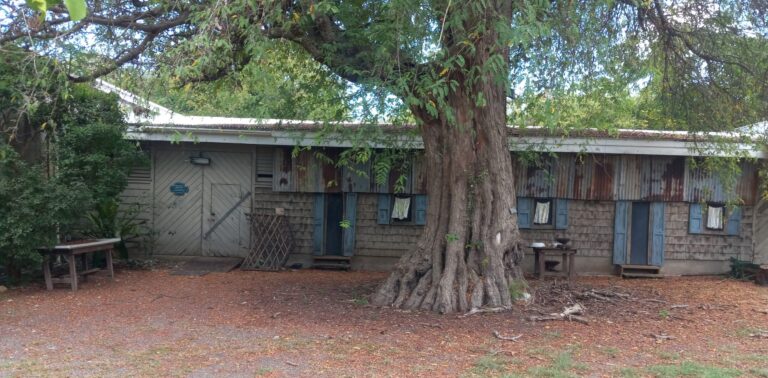
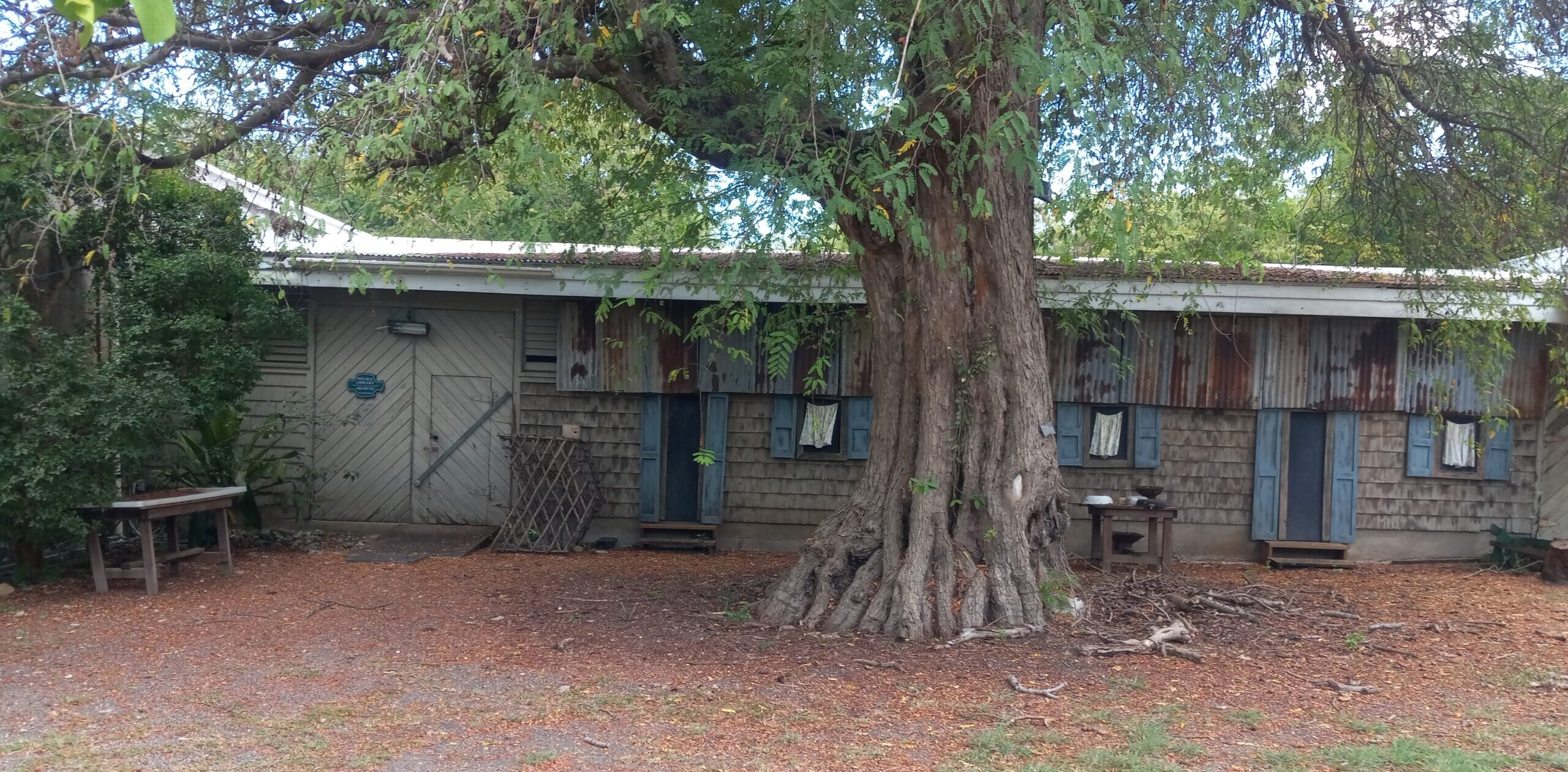
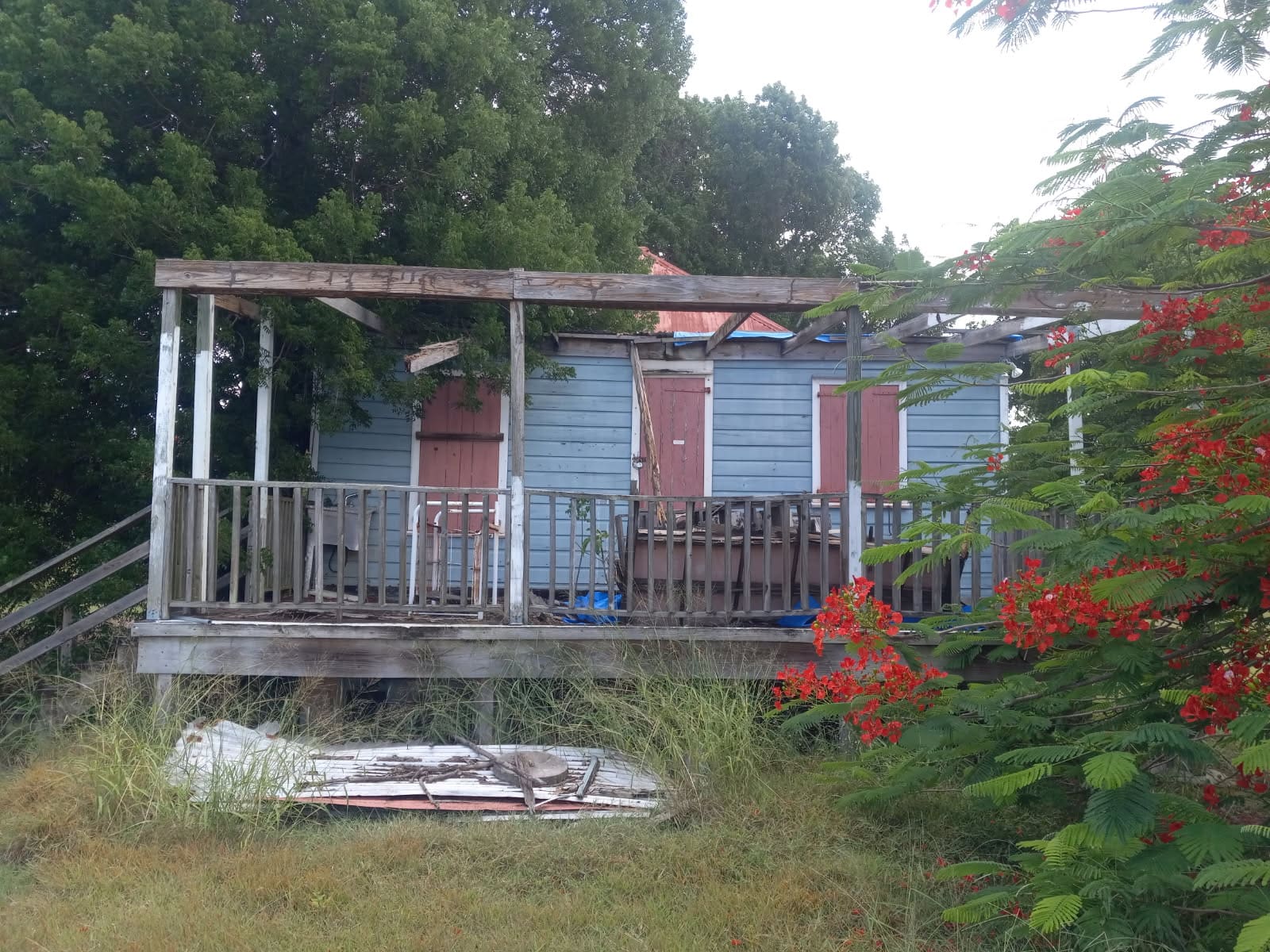
Not only the great house at Whim Museum needs to be restored. Other structures on the site, such as this wood building, are in need of restoration. This wood structure was impacted by Hurricane Maria almost eight years ago. (Photo by Olasee Davis)
Crucians or Virgin Islanders can trace their families back and even at times what slave ship our ancestors came on or the place in Africa where they had been kidnapped and brought to the Danish West Indies colonies. Believe me, these are powerful historical documents the Whim Museum library possesses. It has become well known worldwide for its cultural and historical resources.
During the Danish West Indies era, Bay Rum or Cinnamon Bush (Pimental racemosa) trees were once common on plantation grounds. Whim Museum’s is one of few historic sites in the Virgin Islands where Bay Rum trees can still be found. (Photo by Olasee Davis)
With the digital age that we live in, the Whim library has become a mecca where hundreds or even thousands of people have come to the shores of St. Croix throughout the years to use its resources for obtaining valuable historical documents for conducting research, such as writing a thesis, dissertation, research paper, genealogy of searching family roots, researching who owned what estates on St. Croix — documenting the very essence of peoples’ lives who lived several centuries ago.
Over the years, people worldwide have donated boxes of historical materials relative to Virgin Islands history, the Caribbean, and research conducted by professional researchers, students, etc. In fact, I have worked over the years with students from Denmark and the U.S., as well as internationally giving researchers assistance with their research findings. Believe me, Whim library was the major source to gather this information, particularly its historical documents.
The library at Whim has grown so much that the old historical cistern under the library building was converted to a state-of-the-art storage facility with air conditioning with shelves housing thousands upon thousands of materials pertaining to the history of the Virgin Islands, the Caribbean, Denmark, and other regions around the world. Carol Wakefield has worked for donkey years at Whim Museum as a librarian. Carol was a great asset to the development of the museum library. After she retired, she still can be found at the museum volunteering her expertise in the library.
She was credited for the establishment of the family history center and research library and archives of Whim library museum. Jerry Dorward and Mary Roebuck, who I call cultural historians, are valuable assets as volunteers to the library. Dorward can speak Danish and Mary Spanish, which are valuable assets doing research at Whim. These two native Crucians helped hundreds of people over the years searching for family trees, etc., etc., and people who visit the library from around the world. All in the name of volunteerism!
I was taught as a child that when you are in the library you must be quiet. I was told that Whim library is not all the time quiet. People cried when they found information about their family tree. I mean really crying where tears run down their faces. Whim library archives are so powerful, it moves you emotionally. You can feel the spirit of people in the pages as you read the historical documents, census reports, etc. Your very hair on your body literally will stand up. People do laugh at Whim library sometimes when something sweetening them, but also the realization that our ancestors had to overcome many obstacles is the reason why we are here today.
Dr. Olaf “Brono” Hendrick, a volunteer at Whim, was a major contributor of items and knowledge of the island’s history along with others in the community, such as the late Doc Petersen, Winifred Clarke-Hardy, Joan Keenan, Tommy Mckay, and Derby. These individuals and other volunteers play major roles, especially in cultural exhibition events at the museum as well as tracing their family history back several generations.
Whim Museum is more than a museum. It is a place where we all have connections locally and globally through our ancestors, whether they were Black, white, or some other color of the Homo sapiens species. Therefore, it is extremely critical to preserve the artifacts, historical documents, and other valuable materials by the restoration of the great house, library, and other historic structures at the Estate Whim Museum site.
— Olasee Davis is a bush professor who lectures and writes about the culture, history, ecology and environment of the Virgin Islands when he is not leading hiking tours of the wild places and spaces of St. Croix and beyond.
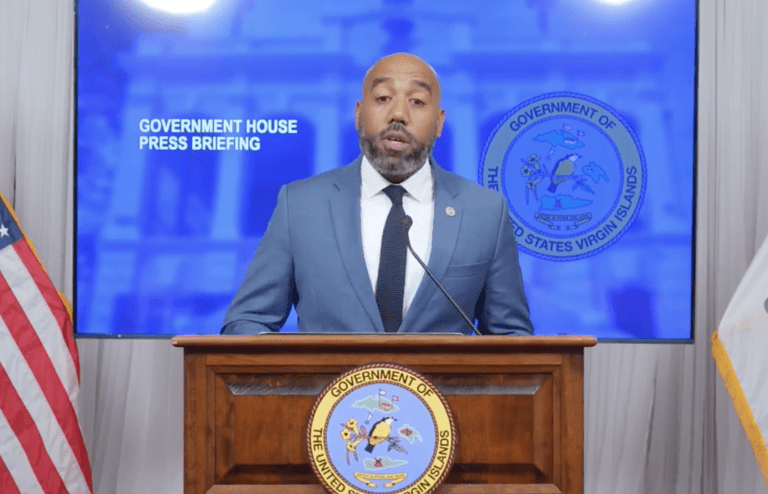
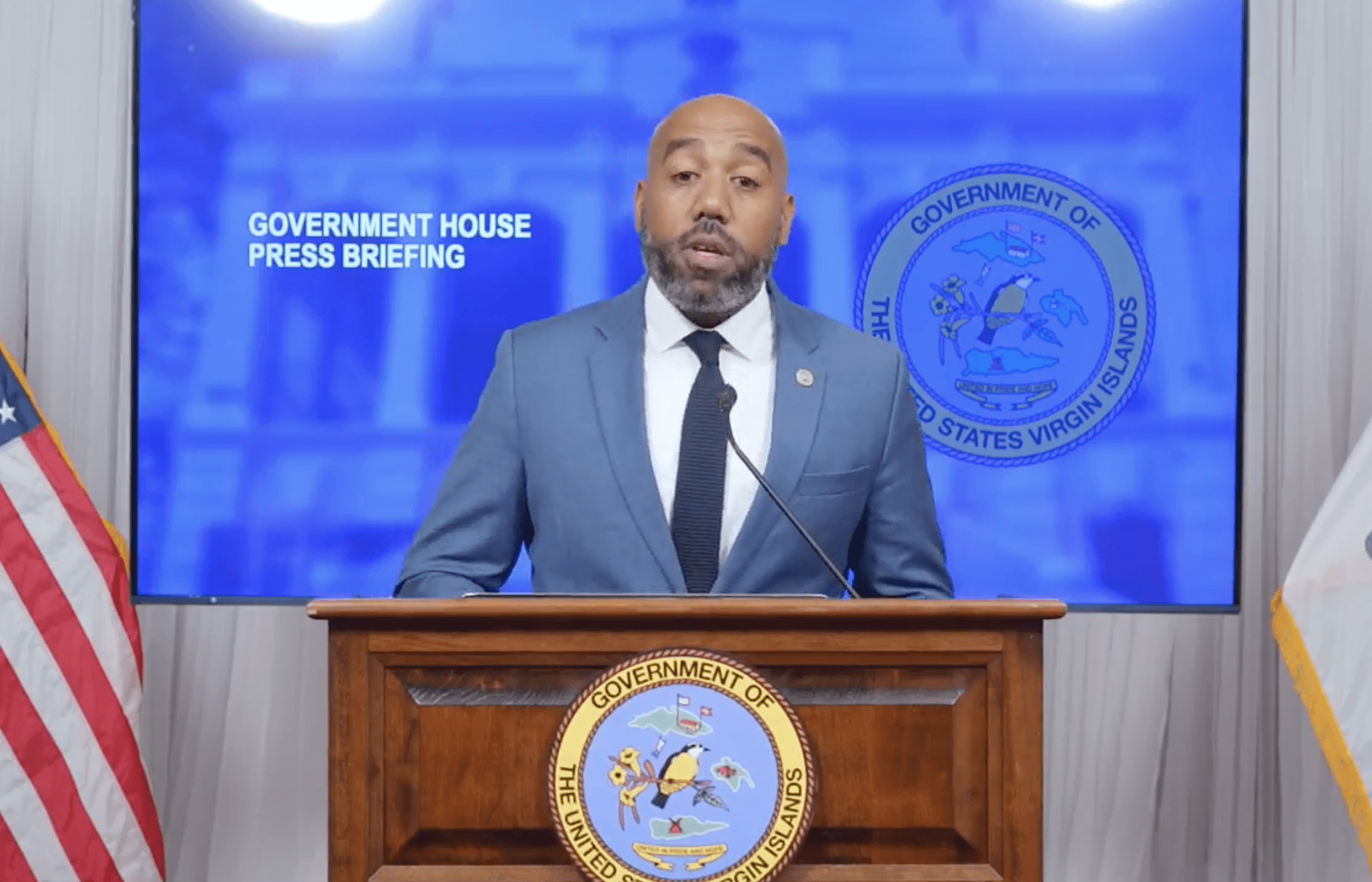
Government House Communications Director Richard Motta urged Virgin Islanders Monday to phone their senators to support three new laws proposed by Gov. Albert Bryan Jr. (Screenshot from V.I. Government House Facebook livestream)
Bryan called for the Senate’s special session to address, in part, an aberration in V.I. law that allows for legislators to collect pensions from previous government jobs while collecting their Senate salaries, said Government House Communications Director Richard Motta.
“The Double Dipping Act of 2025 would end a deeply unfair practice in Virgin Islands law that allows members of the legislature to collect a full pension — a full government pension — for prior service while also receiving a legislative salary,” Motta said during Monday’s press briefing.
“But it doesn’t stop there. While collecting both, senators are also accruing additional pension benefits based on their legislative service, all funded by the same government retirement system — essentially being allowed to stack benefits from the same Government Employees’ Retirement System. This is not allowed for other public employees or elected officials who return to government service. It is a carveout that benefits only one class of public servants and it places an increasing strain on an already burdened pensions system,” Motta said. “The governor believes this not only fiscally irresponsible but also erodes public trust.”
The Senate calendar published Monday has Senate President Milton Potter chairing the special session at 10 a.m. Monday before a 1 p.m. Committee of the Whole session.
Potter had rejected a previous call from Bryan for a special session, saying he’d been given improper notice, having only learned of the proposed meeting through media reports.
Potter said Bryan’s reasoning for the session was disingenuous and was in fact retaliation for legislators cutting executive branch pay raises.
“Let us be honest: this sudden push is a direct response to the Legislature rightfully repealing a $50,000 salary increase that the governor quietly inserted into the FY2024 budget,” Potter stated July 2. “Rather than accept that decision, the governor has chosen to lash out, dressing up political spite as policy reform.”
Potter said Bryan was attempting to “divide lawmakers and incite public ire without offering policy clarity or legal grounding” on the pension issue.
Two other changes proposed by the governor deserved inspection but were not as simple as they may seem, Potter said.
Moving government employee health insurance to a self-funded model might seem like a fiscally responsible choice, potential budget shortfalls and lack of cash reserves, Potter said.
“Under a self-funded model, the government is responsible for paying claims directly. Any disruption in liquidity puts employees’ access to care at risk. A misstep here would result in delayed payments to providers, eroded trust in the system, and serious legal and ethical consequences,” Potter said
He advocated investigating the issue with input from the Lieutenant Governor’s Office and GERS.
Another proposed law would repeal rules barring public employees from seeking elected office unless they took a leave of absence from their current government job.
Motta said it would allow more Virgin Islanders to run for office without having to choose between public service and financial stability.
“Instead, it would allow them to campaign while remaining in their position providing they do not use work hours or government resources for political activity,” he said.
Motta said there would be fines for violations.
Potter acknowledged there had been efforts within the Legislature to change the law but that the issue was more complex. Unlike federal and state legislative bodies on the mainland, Virgin Islands senators don’t go on recess. They have to campaign while still conducting budget hearings and other forms of oversight.
Motta said the three proposals were resolutions to long-standing problems and asked Virgin Islanders to phone their elected officials.
“Now is the time for the legislature to act,” Motta said. “Call your senators and urge them to support this legislation on Aug. 1 during that special session hearing.”
Hurricane preparedness
Also during Monday’s briefing, officials from the Virgin Islands Territorial Emergency Management Agency and the Human Services Department said they’d identified seven emergency hurricane shelters that met Federal Emergency Management Agency standards. FEMA required shelters to have 20 square feet per person during evacuation and 40 square feet per person after evacuation.
Averil George, Human Services Department commissioner, said there were three hurricane shelters on St. Thomas — one of which, at Lockhart School, was pet friendly. Lockhart School could accommodate 248 people before and during a storm, and half as many after. The Eudora Kean High School cafeteria could shelter 166 people pre-landfall and 80 post-landfall, and the same school’s gym could accommodate 782 before the storm hits and 390 after.
The two shelters on St. John — the Adrian Senior Center and the Gifft Hill School upper campus — would not allow pets.
There were two shelters on St. Croix — with D.C. Canegata Recreational Center, able to shelter 161 pre-landfall and 80 post-landfall, and the pet-friendly Educational Complex, able to accommodate 466 people before and during the storm and 233 after it passes.
People sheltering with their pets would need to bring leashes and cages, food and water, and, if needed, medicine for their cats and dogs, VITEMA Director Darryl Jaschen said.
Electric vehicles
Kyle Fleming, director of the Virgin Islands Energy Office, said the Virgin Islands had executed a contract with TJ Ocean Auto Group to help service both public and private electric cars in the territory.
“This partnership builds upon our promise to make sure that we’re not just bringing vehicles and deploying charging stations but we’re also that the life cycle of these vehicles can continue to be supported,” Fleming said.
The territory offers a rebate of $5,000 for new and used electric vehicle purchases.
“Most of those purchases so far have been for vehicles outside of the territory. This agreement also opens up the door for locally purchased vehicles to qualify for a rebate,” he said.
The $7,500 federal tax credit for new electric vehicles expires Sept. 30.
“If you are thinking about investing in an electric vehicle, now is the perfect time to combine an expiring federal incentive with a $5,000 local incentive to really drive down the up front cost of electric vehicle investment, which has really been a barrier,” Fleming said.
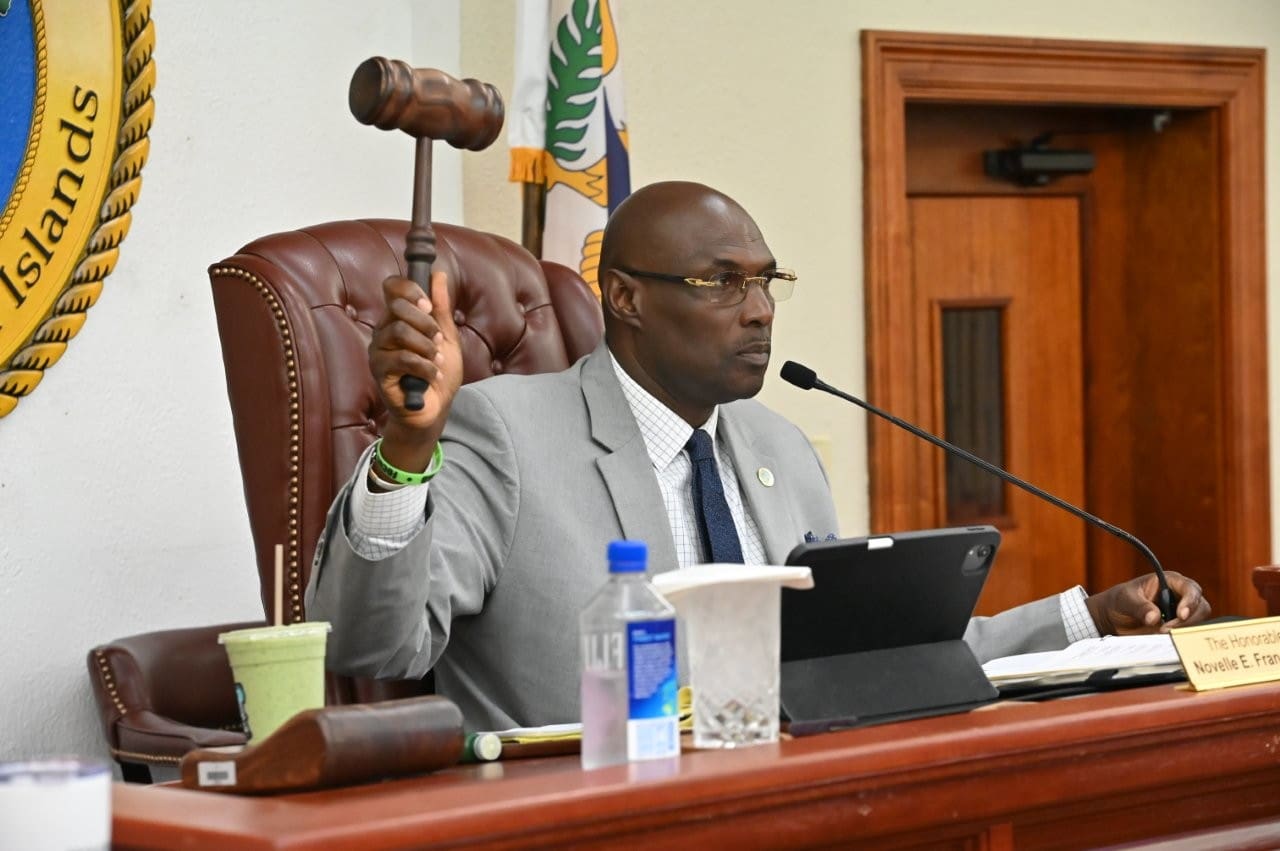
Sen. Novelle Francis chairs the Senate Budget, Appropriations and Finance Committee Monday. (Photos by Alvin Burke Jr. and Barry Leerdam Legislature of the Virgin Islands)
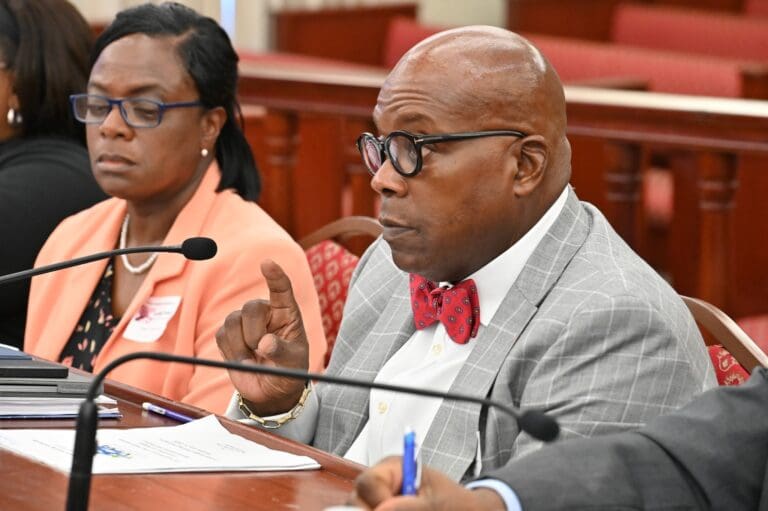
The Virgin Islands Economic Development Authority is requesting a $7.3 million budget for fiscal year 2026 to support expanded efforts in lead generation, international outreach, small business development, and industrial growth across the territory.
The budget request — presented Monday to the Senate Budget, Appropriations and Finance Committee — includes a $6.6 million General Fund appropriation and $700,000 in internally generated revenue. EDA CEO Wayne Biggs said the proposal goes beyond operational needs.
“This budget is not solely about maintaining current operations,” said Biggs. “It is about building capacity, driving outcomes, and expanding our reach throughout the territory.”
The agency, which promotes sustainable economic growth by attracting investment, supporting entrepreneurship, and enhancing workforce development, plans to expand enterprise zones, promote new industrial hubs, and increase access to moderate-income homeownership in FY 2026.
Approximately 70% of the proposed budget is allocated to personnel costs supporting 46 full-time positions. Professional services — such as legal counsel, audit, and marketing — make up the second-largest expense, according to EDA Chief Financial Officer Kelly Thompson Webb.
In FY 2025, the agency celebrated several milestones. The South Shore Trade Zone welcomed its first approved client, Mix Cakery, marking a step toward building a new industrial and logistics hub. EDA also participated in international investment events in Miami, Maryland, Puerto Rico, and Trinidad, boosting the territory’s visibility among global investors.
Media exposure increased as well, with a national feature on PBS’s “Viewpoint with Dennis Quaid” scheduled to showcase the USVI’s growing appeal. The agency reported generating over $650 million in qualified investment leads and a 26% increase in participation in the Economic Development Commission program, which provides tax incentives for companies serving markets outside the territory.
Through the Economic Development Bank, EDA leveraged local and federal funds to support small businesses, energy sustainability, and homeownership. A major initiative was the State Small Business Credit Initiative 2.0, which reduces lender risk and increases access to capital.
“The U.S. Virgin Islands was awarded $57.8 million under the SSBCI program,” said Biggs. “As of July 15, 2025, $15.7 million of the first tranche has been expended or obligated through small business loan guarantees. These investments are projected to create 109 new jobs and retain 100 existing jobs across the territory. Approved businesses represent a diverse cross-section of our economy, from aviation and construction to health care, marine services, social support, hospitality, tourism, and more.”
In addition to SSBCI funding, the EDB approved $705,000 in direct loans in FY 2025, supporting 22 new jobs and retaining 13 across sectors such as food service, transportation, retail, and wellness.
“In total, EDB approved or committed over $16.4 million in financing through both direct loans and SSBCI loan guarantees. These efforts are projected to create 131 new jobs and retain 113 existing positions, reflecting EDB’s critical role in supporting sustainable economic growth and financial empowerment across the territory,” Biggs said.
The VI Slice Moderate Income Home Ownership Program also made headway, with 82 applications requesting $8.7 million in gap financing and 61 approvals totaling $6.2 million. Those funds supported $17.6 million in home purchases and construction.
The EDA’s role in tourism development continues under the Hotel Development Act, which incentivizes hotel construction, renovations, and expansions. Projects supported by the program include the $44.1 million Hampton by Hilton on St. Thomas — set to open in August — along with a luxury resort at Botany Bay, a $12 million revitalization of Sugar Bay, and the historic Hotel 1829 restoration.
Sen. Marvin Blyden emphasized the importance of supporting the local food economy and referenced the success of Tart Wars on St. Croix. He urged the EDA to invest in cultural culinary staples like tarts and johnny cakes. Biggs responded, noting that the upcoming Agro and Food Innovation Center at the Padilla Complex in Frederiksted will provide critical resources to support and grow food businesses.
Sen. Hubert Frederick praised the agency’s return on investment. “The EDA’s ability to secure over $81 million in grant funding — far exceeding its $6.3 million government allocation — speaks for itself,” he said. He rejected the narrative that the agency wastes money and highlighted its community impact, including charitable support for schools.
Sen. Kurt Vialet raised questions about how the territory can attract companies looking to reshore or expand manufacturing, particularly in pharmaceuticals and light manufacturing. He pointed to the EDC’s tax benefits, modern ports, and strategic location as selling points.
“The Virgin Islands lie outside the U.S. Customs zone, meaning recent tariff policies do not apply here,” Biggs replied. He said this has attracted interest from companies in India, China, and Vietnam that are considering establishing production lines in the territory to avoid U.S. tariffs without relocating entire operations.
Vialet said this benefit needs broader promotion and called for legislative support to fund a targeted marketing campaign to attract manufacturers.
VIHA Executive Director Dwayne Alexander spoke Monday about the impact of federal funding cuts (Photo courtesy V.I. Legislature)
Confronted with what both housing leaders described as a “dire” situation, senators pressed officials from the Virgin Islands Housing Finance Authority and Virgin Islands Housing Authority Monday for solutions to the territory’s worsening housing crisis — where thousands of families remain on waiting lists and affordable units remain scarce.
“We have a very strong need for low-income housing,” VIHA Executive Director Dwayne Alexander told senators. “That’s where any community starts — that’s almost the next stop before you become homeless.”
Testifying during a Senate Finance Committee budget hearing, Alexander stressed that discussions around “affordable housing” often exclude the poorest Virgin Islanders. While “affordable housing” typically targets residents earning between 100% to 130% of the area median income, Alexander said federal guidelines define “low-income” as 80% or less of AMI — and that’s where the demand is greatest.
“When people talk about affordable housing, they leave the low-income folks out,” he said bluntly.
VIHA, which oversees 2,129 public housing units across 18 communities, presented a FY 2026 budget built almost entirely on federal HUD funds — yet those funds face deep cuts under President Donald Trump’s proposed federal budget. Alexander warned that HUD support could shrink by 44%, threatening both public housing operations and rental assistance programs. At this point, Alexander said VIHA remains designated as “troubled” under HUD’s Public Housing Assessment System — which he added could eventually put it at risk of receivership — though it is working to improve the overall outlook with reported clean audits and improved metrics, among other things.
“If Congress converts rental assistance into block grants, the burden will fall squarely on the local government,” Alexander said, warning that such a move could destabilize public housing across the territory.
Meanwhile, VIHFA Executive Director Eugene Jones Jr. said the lack of stable, predictable federal and local funding is hamstringing his agency’s ability to respond to the crisis.
VIHFA Executive Director Eugene Jones Jr. shares about the authority’s efforts to collect Stamp Taxes owed since fiscal year 2022. (Photo courtesy V.I. Legislature)
“We’re pointing fingers at the wrong people,” Jones said. “It’s Congress — it’s the appropriators. There’s no commitment to providing affordable housing, additional housing, and until we get Congress to understand what housing means to every American, it’s going to be highly impossible to commit to 100 units, 1,000 units; whatever the number is it’s not going to be attainable until we have a national housing policy.”
Jones emphasized that wages and housing must be addressed together: “How do we keep our young people here? Wages need to go up, but you also have to balance that with affordable housing — and that’s always the difficult task.”
VIHFA, responsible for financing homeownership and development projects, requested a flat $2 million General Fund appropriation for FY 2026 — funded entirely by Stamp Tax collections. But, Jones revealed, the agency still has not received its $2 million Stamp Tax allocation since fiscal year 2022, which now amounts to about $20 million. “We still haven’t gotten our money,” Jones said, underscoring the pressure on the agency’s staffing and operations.
That $2 million covers just 20 of VIHFA’s 105 employees, all classified as “core” positions—non-federally funded personnel. Senators repeatedly questioned how the agency funds its remaining 33 “core” employees, with Jones and VIHFA Chief Financial Officer Valdez Shelford eventually explaining that revenues from home sales, mortgage payments, commercial leases, and collections cover the difference. Senators added that they needed the facts and figures in order to “clearly” understand how the employees are covered, and what the Stamp Tax funds are being used for, as it also is supposed to be used for “infrastructure and other areas as prescribed by law,” along with administration, said Sen. Kurt Vialet.
“We do talk about the Stamp Tax every day,” Jones told Sen. Hubert Frederick later in the hearing. “We’re advising the board and being responsive, but it’s tight.”
Senators, including Sen. Dwayne DeGraff, raised concerns over VIHFA’s missing funds from both the Stamp Tax and the Land Bank Fund, which Jones confirmed had not been received.
While VIHFA relies on Stamp Tax collections for its core operations, its broader portfolio is dominated by federal funding streams:
$749.6 million in CDBG-DR (Disaster Recovery) funds.
$774 million in CDBG-Mitigation funds.
$67.6 million in electrical grid modernization grants.
These funds are designated for long-term projects and are not available for staffing or operational costs.
At the same time, Jones acknowledged that more outreach is needed about critical federal programs under VIHFA’s management, such as the Homeowner Assistance Program and the Emergency Rental Assistance Program, both of which have helped thousands of Virgin Islanders stay housed. “Those programs — it’s so critical that the message gets out,” said Sen. Marvin Blyden.
While VIHFA focuses on development and financing, VIHA directly manages public housing units and the Housing Choice Voucher Program, serving 2,092 families — but with over 3,500 on waiting lists.
Senators zeroed in on VIHA’s backlog of vacant units and unpaid rents. Alexander admitted that several units had been vacant for extended periods and said the agency was using a combination of contractors and in-house staff to bring those units back online, with turnaround times ranging from 15 days to over 100 days depending on the unit’s condition. “Some of these units have been sitting for years,” Alexander said.
He also confirmed that VIHA is carrying more than $1 million in outstanding tenant rents —funds senators said could be critical for making repairs. Nearly $8 million is spent yearly on water, Alexander added, explaining to senators that it’s the authority’s duty to cover that cost for its tenants, though he was urged to find a way to decrease it.
“We need creative ways of bringing in more revenues,” Blyden told both agencies, pressing VIHA on how much it receives per occupied unit from HUD. Alexander explained that rental income is minimal and said the agency depends on HUD subsidies to fund operations. Even so, Alexander said VIHA’s modernization department is making progress on capital improvements, including rehabilitation projects and efforts to exit its federal “troubled” designation.
Throughout the hearing, senators pressed both Jones and Alexander to explain not only how they’re using current funds but also how they’re preparing for potentially steep federal cuts.
In closing, Jones called for a broader national conversation. “Until we have a housing policy, until Congress appropriates year after year, we’re going to be fighting the same battle.” Alexander agreed, but added: “Here in the Virgin Islands, our situation is already dire.”






 In 2025, the Lang-Wise STEM Scholarship Fund awarded a total of $10,000 in awards ranging from $1,000 to $3,000 to five youth whose talent, skill, and leadership will allow them to contribute to the Virgin Islands and the Global Community:
 The Patrick and Amelia Williams Opportunity Fund awarded a total of $18,000 to six outstanding young people who demonstrated their ability to persevere against the odds to meet their goals.