Carnival fans from far and wide filled Veterans Drive Thursday morning to celebrate J’ouvert. Revelers tramped behind live bands rolling east toward Carnival Village; some breaking off from the crowd as bands reached the stopping point at Vendor’s Plaza, running back to join crowds following the next band coming up.
By tradition, J’ouvert morning trampers are supposed to show up in their bedclothes. Many instead show up in costume, wearing masks or bathing suits. A trio perched atop a parked water truck, armed with a hose, may have prompted beach attire.
Dancing under a water truck spray on Veterans Drive (Source photo by Judi Shimel)
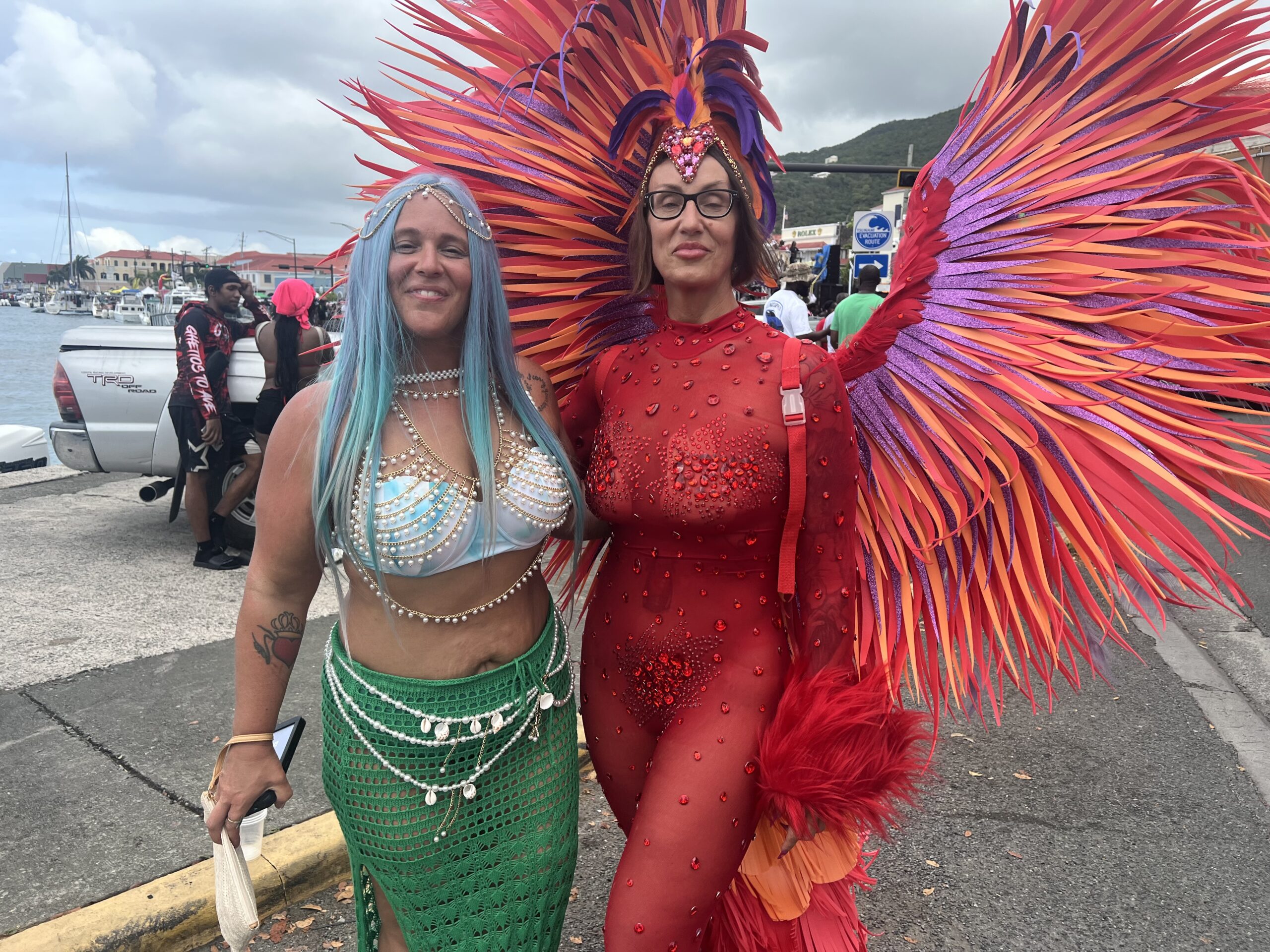
Melissa Romig from Arizona dressed in red from head to toe, complete with batwings. “I ordered this from a lady in Ireland. She shipped it to me,” Romig said. Rebecca Braun, her cousin, said they both enjoyed the musical tramp.
Cousins Melissa and Rebecca in costume for J’ouvert (Source photo by Judi Shimel)
Up by Fort Christian, Bernice Flavian from St. Lucia said she enjoyed J’ouvert back home but Thursday was her first St. Thomas experience. Back home, she said, revelers spend the night at parties then take to the road by early morning. “I’m used to going straight through, but here they start a little later,” Flavian said.
And while it seemed the fun would end when the band reached the finish line, many found ways to keep the party going.
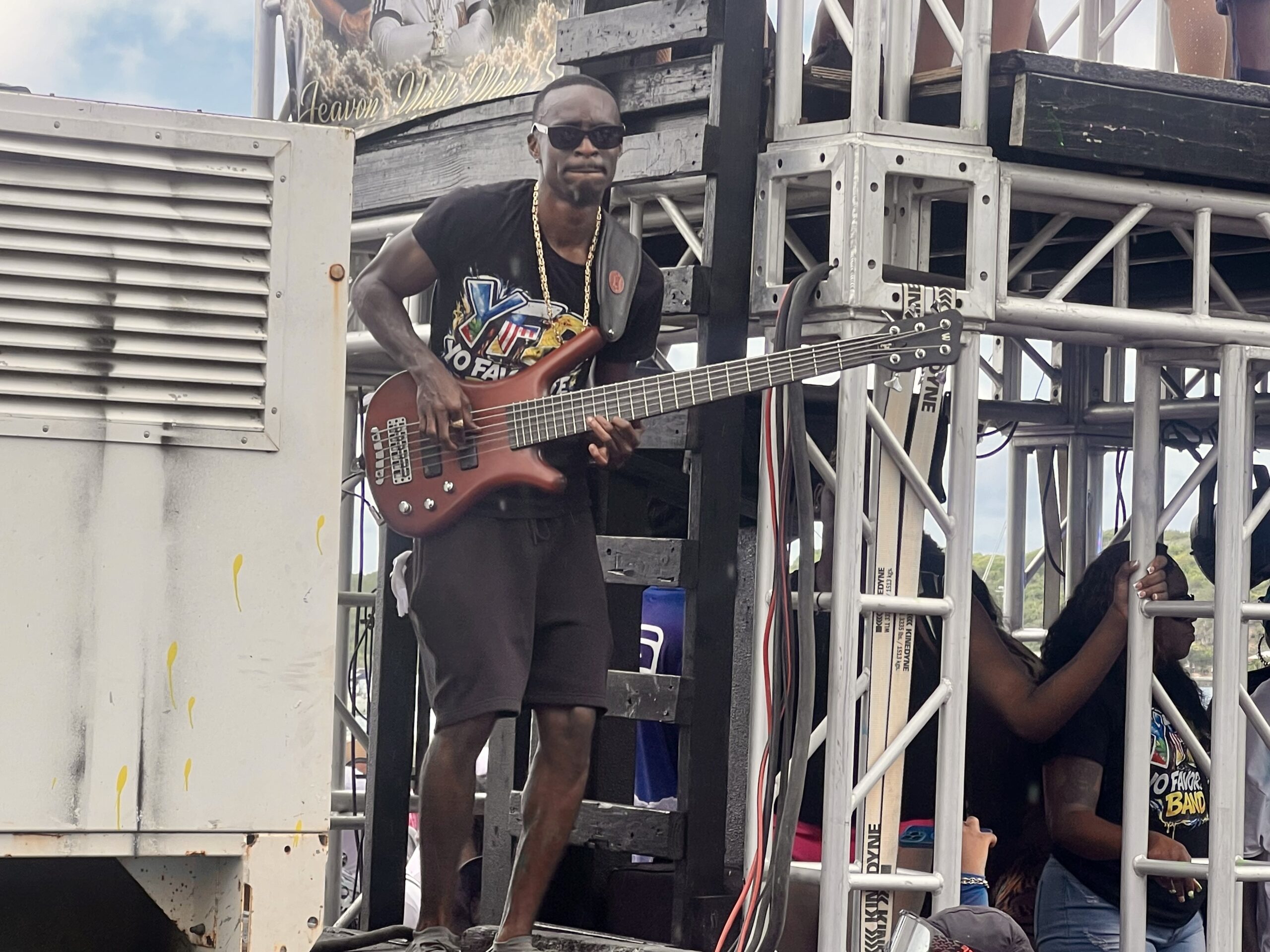
Sound truck stops, but music continues (Source photo by Judi Shimel)
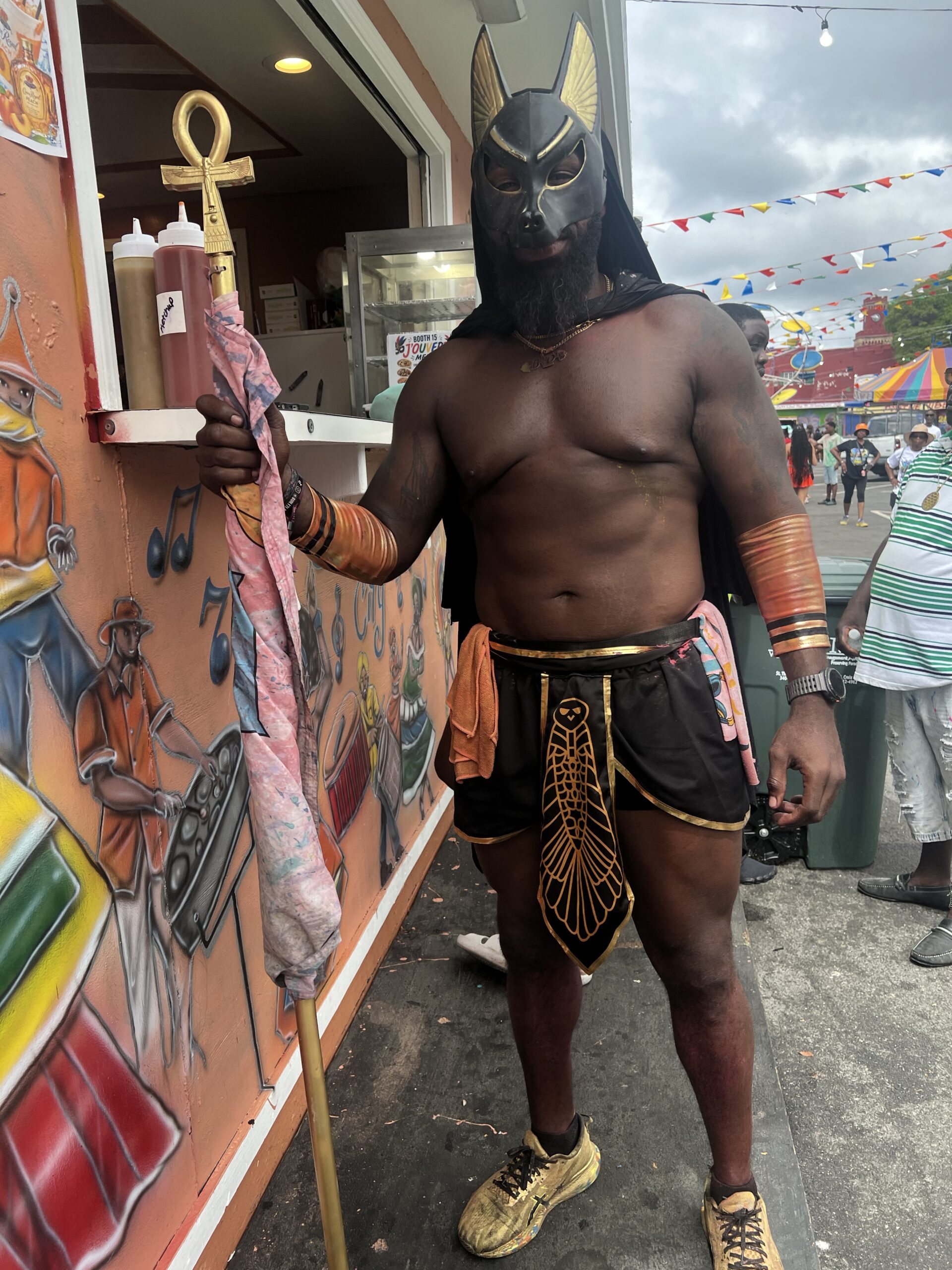
The most popular move took revelers into Carnival Village, where a deejay pumped up the volume. Bernard Douglas Jr. was among those stopping by a booth serving breakfast.
Coach Douglas comes to J’ouvert in a new costume every year. (Source photo by Judi Shimel)
“J’ouvert was amazing. They kept it short — just a few bands — that means people could really congregate and really fellowship,” he said.
And with thousands of people still tramping up the road, an announcer in the village told those cooling off that it was almost time for the Wet Fete, a musical jam to dance under more water spray.
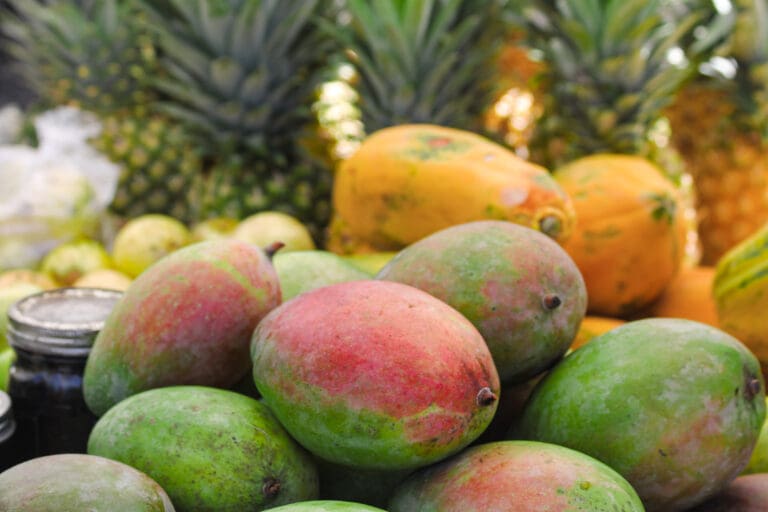
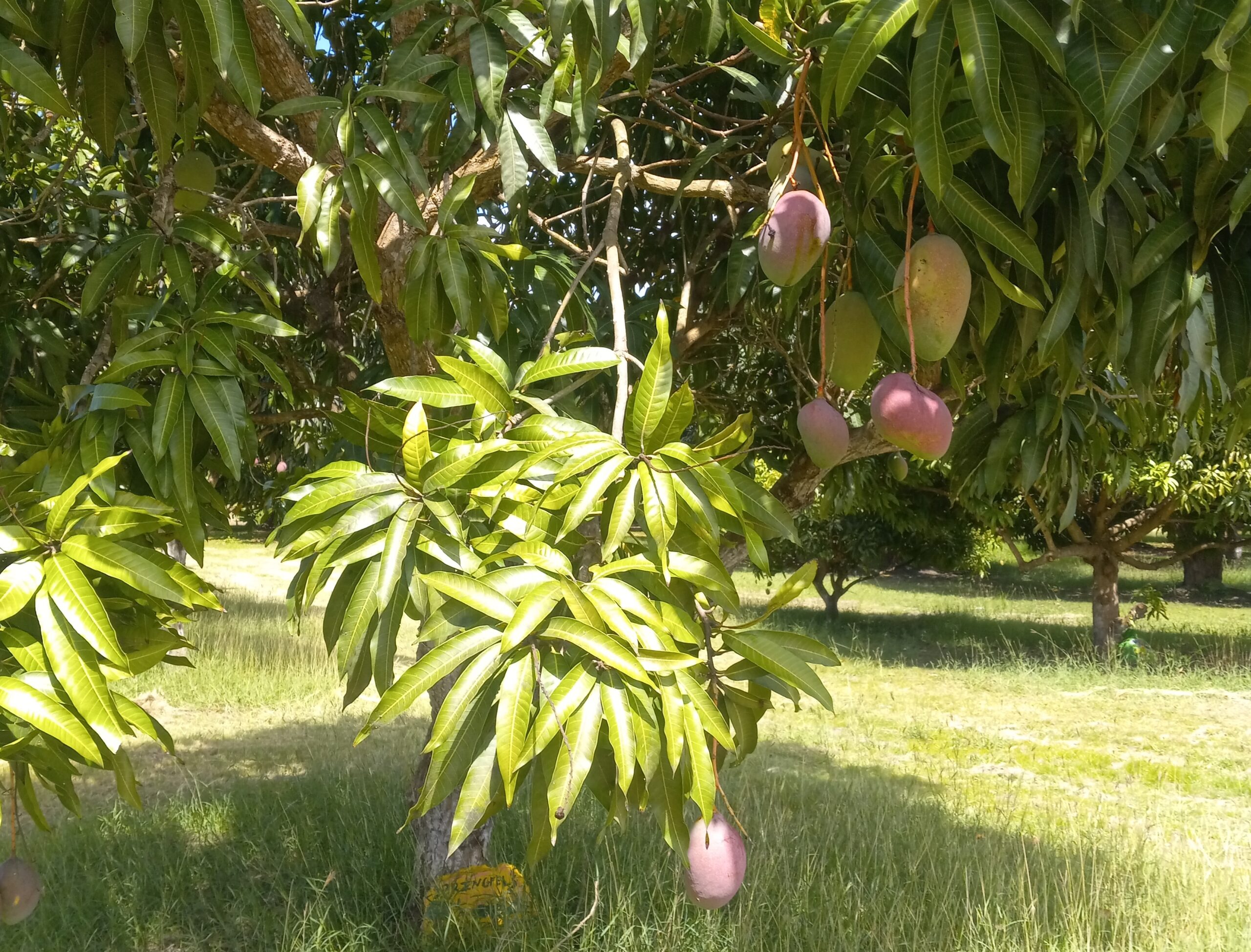
Mango (Mangifera indica L.) flowers mainly in winter and spring (recorded from November to July) and produces maturing fruits mostly from May to September. Mango is an excellent shade tree. It is also among the important honey plants, secreting quantities of nectar, and the flowers reportedly are edible. (Photo by Olasee Davis)
If you are paying attention this year, there are not a lot of mango trees flowering. You (Virgin Islands residents) probably didn’t notice that with the many issues our global community is facing these days, who has paid attention to if a mango tree is blossoming or not? We are in April, and soon it will be hurricane season. However, the greatest teacher of humankind is the environment. Thus, from living organisms such as plants, animals, and fungi, we can learn a whole lot. By observing our natural world surroundings, we can learn more about our weather system, food, and about ourselves on a physical and spiritual level.
Olasee Davis, Ph.D. (Submitted photo)
Mangoes are very prone to environmental conditions. Bearing of fruits is irregular or biannual. This habit, however, varies between varieties of mango trees. Although no solution has yet been found for this behavior of flowering mango trees, the climatic conditions appear to have considerable effect on their characteristics. The longer and more severe the dry season is, the more regular the cropping habit. This is not just with mangoes, but every living organism on Earth, including the human species.
We are already in the dry season. The trees’ foliage is changing colors and falling. The blowing of winds is more often, as well as erratic rainfall, ocean currents’ movement, and animal behavior patterns. Believe me, we are in a different climate zone this time of the year. It is for this reason that man is forever gaining knowledge of what season and what months play a major role in our Earth ecosystems. Thus, our tradition as the human species is dictated by the season of a changing environment. For example, it is Carnival time in the Virgin Islands, April, and May on the island of St. Thomas — springtime. For the island of St. Croix, December and January, the fall and winter seasons, bring Crucian Christmas Festival. And, for the island of St. John’s summer, the June and July season yields Festival time and the celebration of the U.S. Virgin Islands’ Emancipation.
Where are we? Let us get back to mango and how this fruit is so much a part of our lives, from food to festivals like the Mango Melee on the Big Island of St. Croix. In fact, this year, 2026, will be the 30th anniversary of the mango festival. All thanks to the late Clinton George, a colleague of mine at the University of the Virgin Islands School of Agriculture, who came up with the idea and implemented it as a mango summer festival in the Virgin Islands.
Nevertheless, mango is native to southern Asia, especially eastern India. It was said that the Buddhist monks took mango to Malaya and eastern Asia in the 4th and 5th centuries B.C. History also mentioned that the Persians carried the fruit to East Africa about the 10th century A.D. The Portuguese, we were told, also introduced the fruit to West Africa in the early 16th century and later to Brazil.
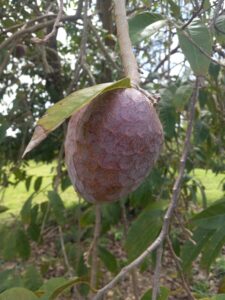
Custard-apple (Annona reticulata L.) is an extremely rare native fruit in the wild of the Virgin Islands. It flowers from June to September and is in fruit from September to April. (Photo by Olasee Davis)
From Brazil, the mango found its way to the West Indies, being first planted in Barbados about 1742 and later carried to the Dominican Republic. Later, the fruit arrived in Jamaica about 1782 and in the early 19th century to Mexico and from the Philippines to the entire West Indies. On a cultural level in the Virgin Islands, as a child I learned about local fruits. One of my favorite teachers was the late Dr. Ruth Moolenaar and others who put a booklet together called “Sugar Apples Are ApplesToo! (A Read and Do Book About Our Fruits).” It was a small book about fruits for Virgin Islands schoolchildren. Today, I don’t know if our children learn about local fruits and their nutritional values in school.
There was also a cultural Virgin Islands song about various foods back in my day when I was a child. Probably children today can learn the song. As you know, children learn faster when they sing.
“The West Indian Weed Woman”
“One day I met an old woman selling. And I wanted something to eat. I thought I was going to put a bit in her way. Bit I take back when I meet. I thought she had bananas, oranges pears, but ‘twas nothing that I need. For when I asked the old woman what she was selling. She said she was selling weeds.
“She had her dress tied up over her waist. And was wriggling down the street. She had on a pair of old slaps on her feet. And was wriggling down the street. Just then she started to name the different weeds. And I really was more than glad. Although I can’t remember all that she called. These are a few she had:
“Man tiabba, woman tiabba, Tantan fall back and lemon grass Ninny root, gully root granny backbone, Bitter payee, Lime leaf and toyo, Coolie bitters, corilah bush, That ah the old time iron weed, Sweet broom, sprout and wild daisies, Sweet fate and even toyo.
“She had bitter gomma, portogee bomba, Conga Larua and twelve o’clock broom, Sarsparilla, wild tomato, sour sop leaf and Papa bitch weed, Wild bush, wild cane, wild leaf, monkey liver, That’s bitterer than wild bay root, Action stands and even monkey liver, And all the rest you may need.
“When I hear how much bush she had. I was dumb. I couldn’t even talk. She started to call from Capry Corner. And never stop ‘till she reached Orange Walk. The woman had me so surprised. That I didn’t know what to do. That my girl came and give me. A cuff in my eye and I didn’t even know who was.
“Sweet broom, sweet fate, and lemon grass. I hear them good for making tea. And then I hear bed grass and wild daisy. Is good to cool the body. The woman’s tongue was even lisping. But she was calling out all the time. She even had a little canawa eye. And the other that left was blind.
“She had pap bush, elder bush, black pepper bush. Then soldier, corporal and carpadulla. Fabian leaf, money bush, soldier posely. Pumpkin blossom and even devil doer. Demon congo, grass in galore. Physic nut, and lily root. In fact, the only bush she didn’t have. Was the bush for the everyday soup.”
The source of this local food song is from: Jones, Trandailer: Impressions of Nutrition Habits in the Virgin Islands Bulletin 11. Virgin Islands Department of Health 1952.
Enjoy your mangoes! There are no guarantees mangoes will be bountiful this year, as they were last year.
— Olasee Davis is a bush professor who lectures and writes about the culture, history, ecology and environment of the Virgin Islands when he is not leading hiking tours of the wild places and spaces of St. Croix and beyond.
Editor’s Note: Opinion articles do not represent the views of the Virgin Islands Source newsroom and are the sole expressed opinion of the writer. Submissions can be made to visource@gmail.com.
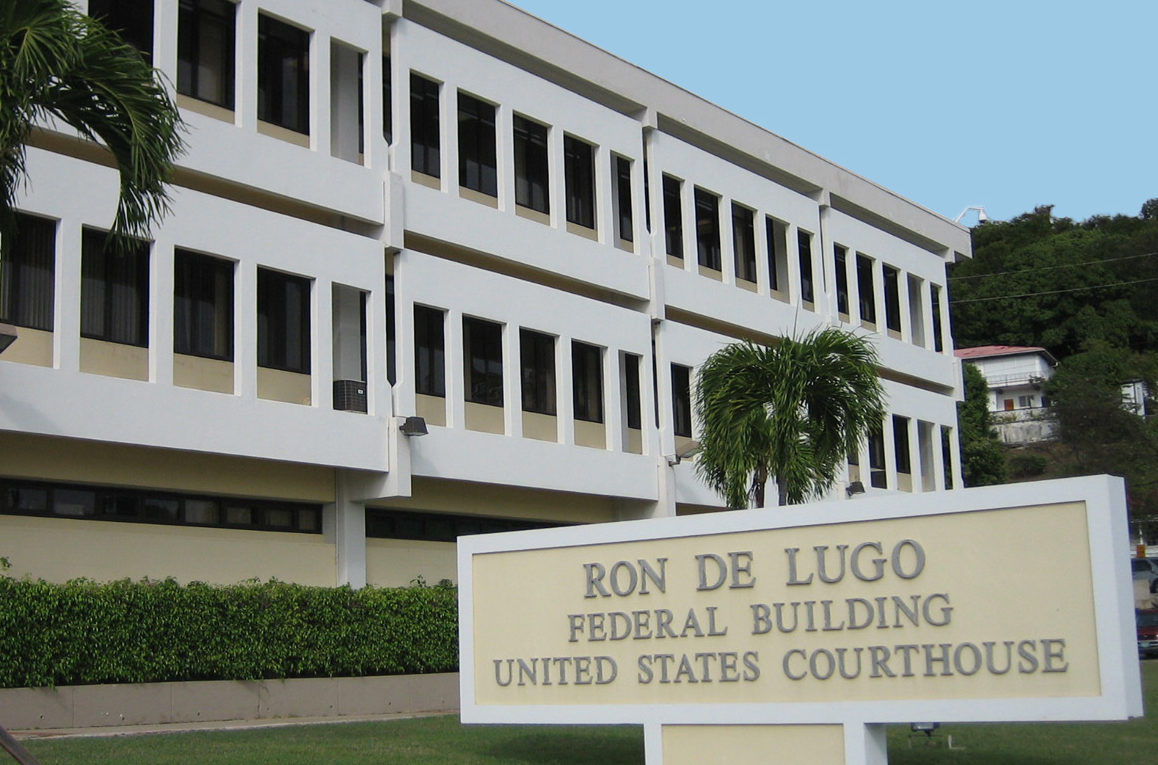
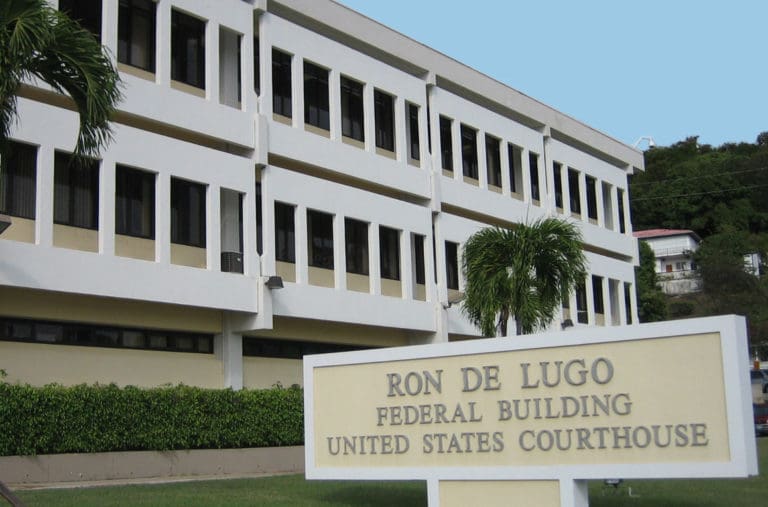
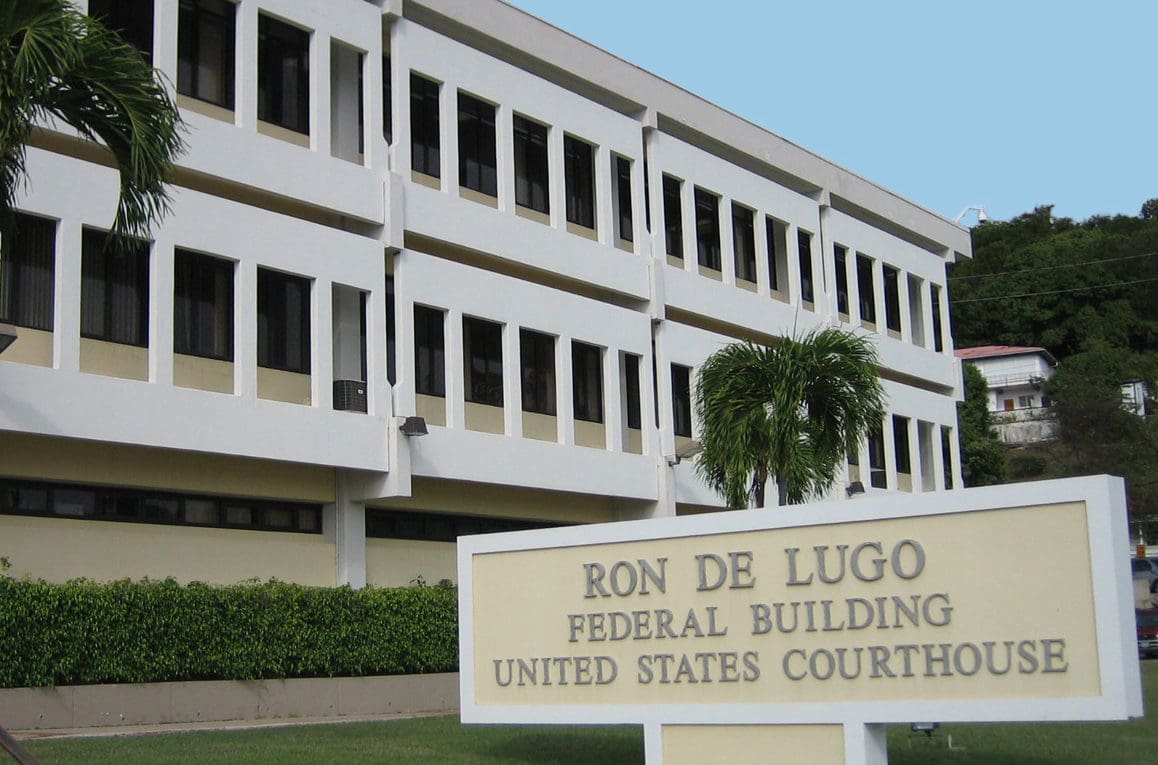
The judge presiding over the hearing said he would allow lawyers to question the witness and documents but he would rule based on information contained in an affidavit filed April 17. (Source file photo)
On Thursday, the federal magistrate presiding over a hearing for three people accused of sex trafficking on St. Thomas said the court found probable cause to uphold the charges. That ruling by U.S. Magistrate G. Alan Teague came at the end of two days of testimony and arguments by the legal teams involved.
In doing so, the judge rejected pronouncements made by lawyers representing Hussein Jamil, Magda Castro Santos and Julio Hidalgo de Pena. Defense attorneys said the government lacked sufficient proof that their clients broke the law.
All three are charged with conspiracy to transport women and girls to a business they ran to commit commercial sex acts. They were also charged with conspiracy to harbor aliens for financial gain and conspiracy to violate the Mann Act.
Teague said the ruling was based on an affidavit filed April 17 and testimony given at the hearing by FBI Special Agent Kiernan Whitworthy. “The court finds that there is sufficient evidence that probable cause has been found,” the judge said. He also said the ruling from the bench would be followed by a written order documenting his decision.
The Mann Act — established in 1910 — makes it illegal to transport persons across state or foreign borders for the purpose of committing sex acts. Prosecutors with the U.S. Justice Department say Jamil, Santos and de Pena used Tootsys Gentleman’s Club on St. Thomas as a place to connect exotic dancers they recruited with patrons willing to pay for sex.
Over the course of two days, lawyers for the accused cross-examined Whitworthy, the one witness put on the stand by Assistant U.S. Attorney Natasha Baker.
Attorneys Carlos Sanchez LaCosta, Raul Bandas and Robert Millan claimed details in the affidavit and heard in testimony failed to connect their clients with criminal activity. The judge explained it was a preliminary hearing and there was a low threshold needed to establish probable cause.
The three defendants were returned to detention after the hearing pending further court action.
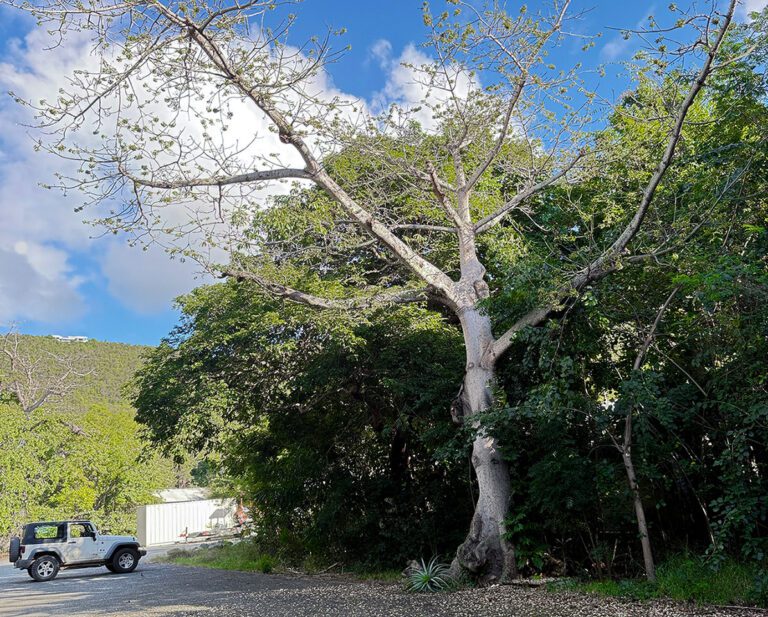
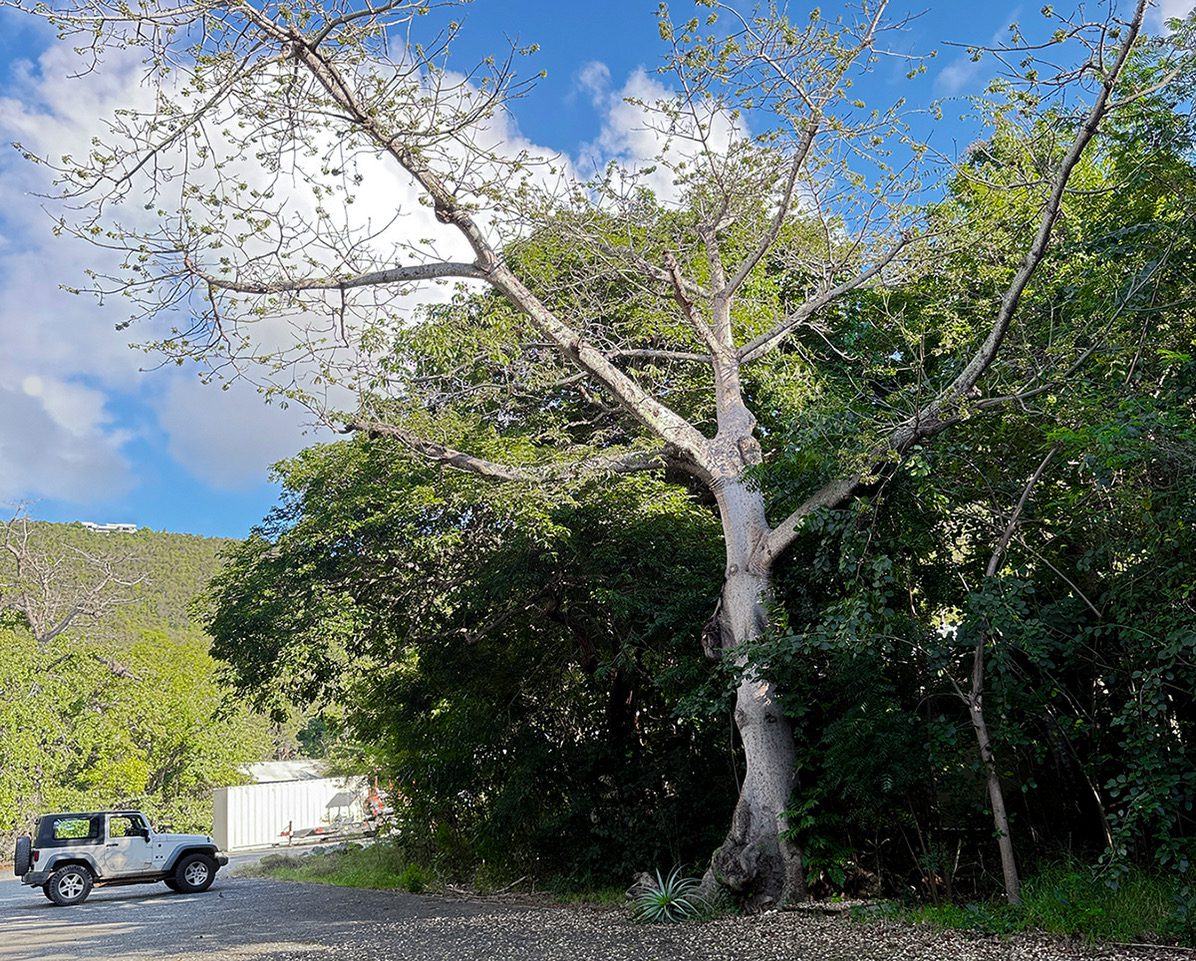
Kapok trees grow quickly, and this flowering one on the edge of the parking lot may have shot up since the 2017 storms. (Photo Gail Karlsson)
When the hurricane-damaged Caneel Bay property on St. John was opened up for limited public access, I was able to visit with some of my old friends there. I was relieved to find at least eight big kapok trees (Ceiba pentandra) in the area that used to be the employees’ parking lot.
A few of the older kapoks are looking pretty gnarly now, like those ancient sculptures with missing arms. The storm winds definitely came through fiercely and reshaped them, tearing off large branches.
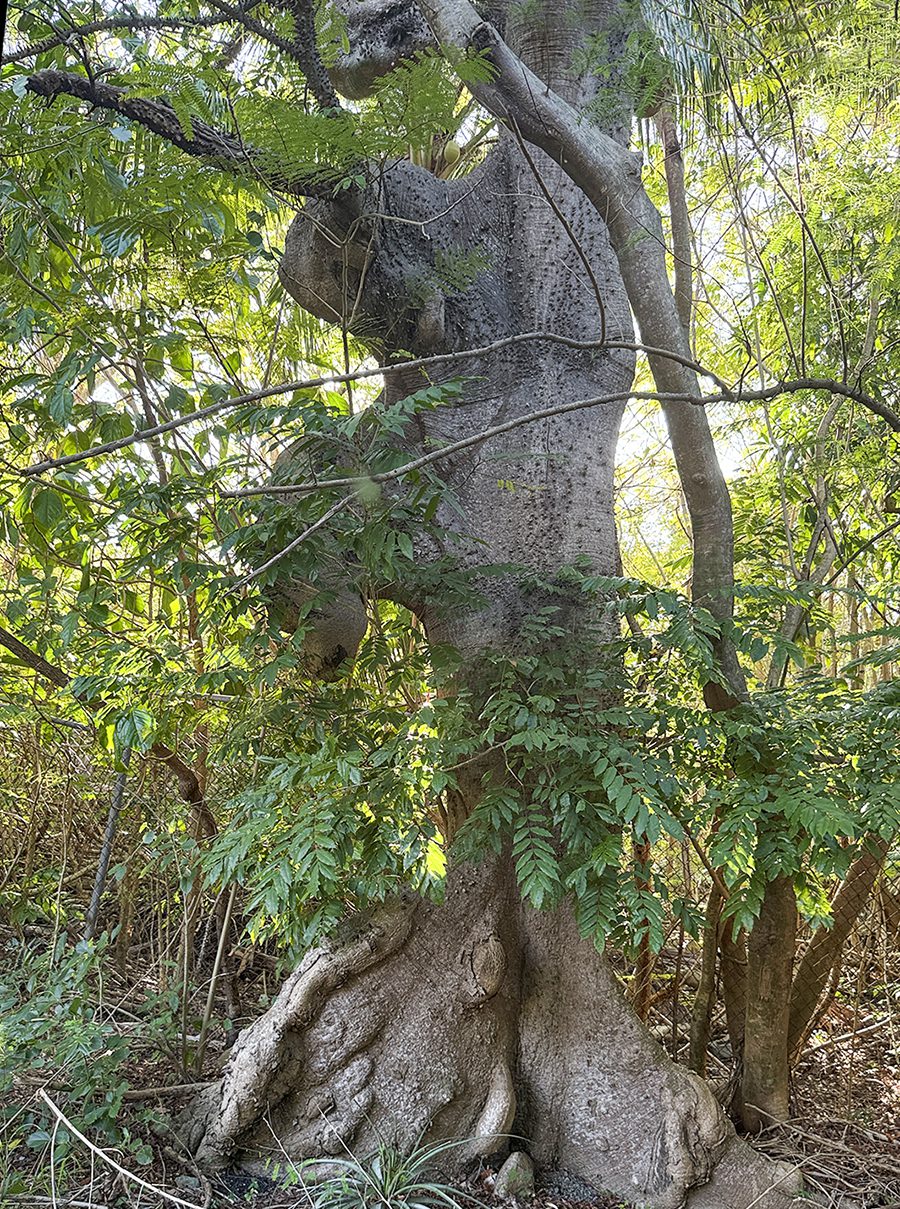
This tree trunk made me think of the Bible story about Lot’s wife, who was turned into a pillar of salt for looking back, against God’s instructions. (Photo Gail Karlsson)
Many of the trees’ wounds have healed over in the isolated years following the storms, often leaving bulging scars where branches were lost.
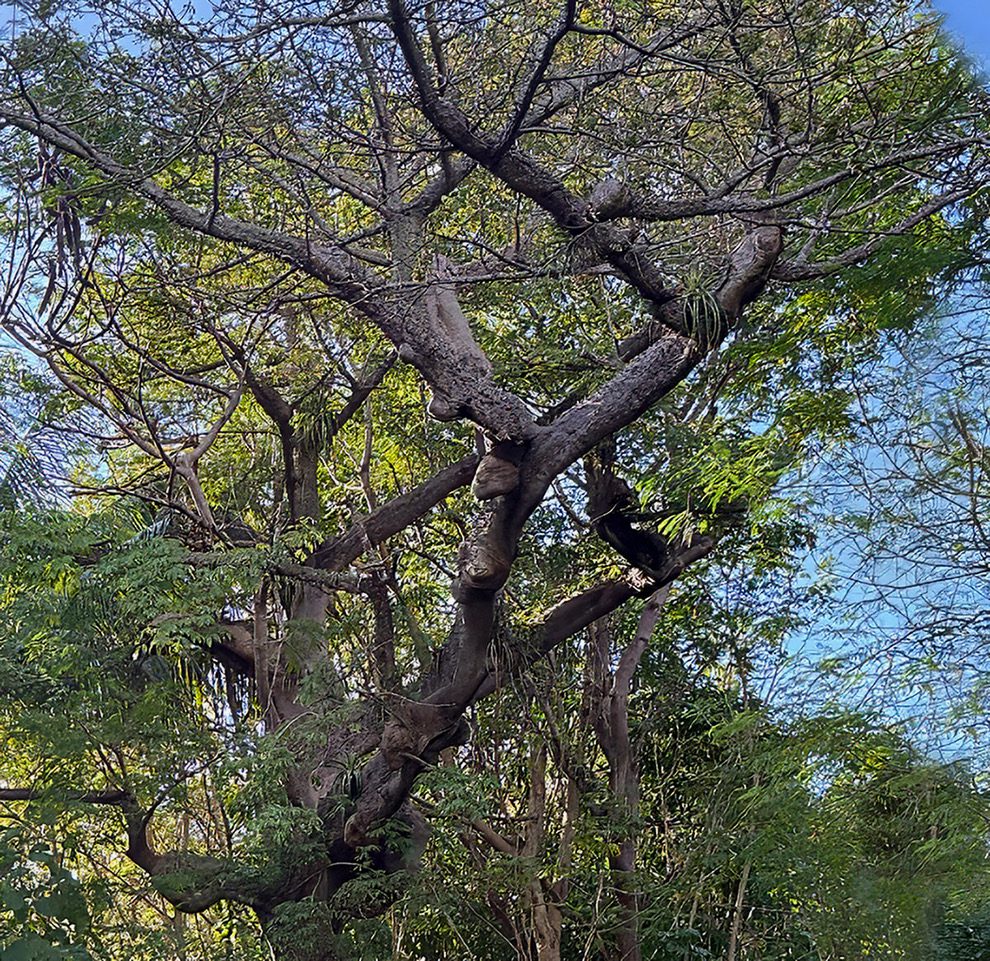
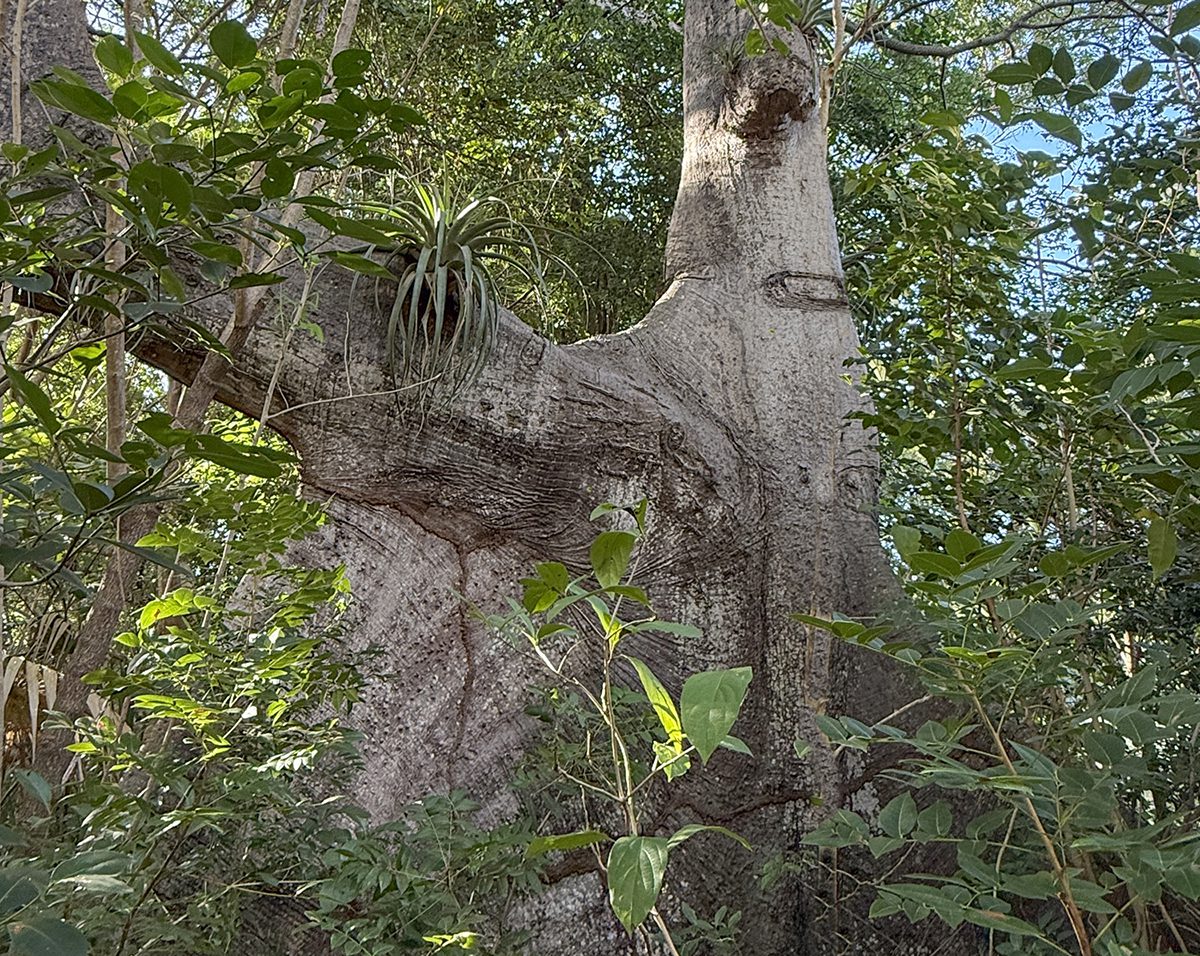
These thick upper branches swirl around like a whirlwind with face-like images protruding from their surfaces. (Photo Gail Karlsson)
The growths where branches seem to have broken off caught my eye and began to look like fanciful faces.
This stump reminded me of the Cheshire cat from the Alice in Wonderland story, lying in a tree and giving advice to Alice through riddles. (Photo Gail Karlsson)
Several stumps have a protruding ghostlike appearance, like weathered gargoyles on the top of a medieval building.
I was reminded of the time I climbed to the top of the Cathedral of Notre Dame in Paris. (Photo Gail Karlsson)
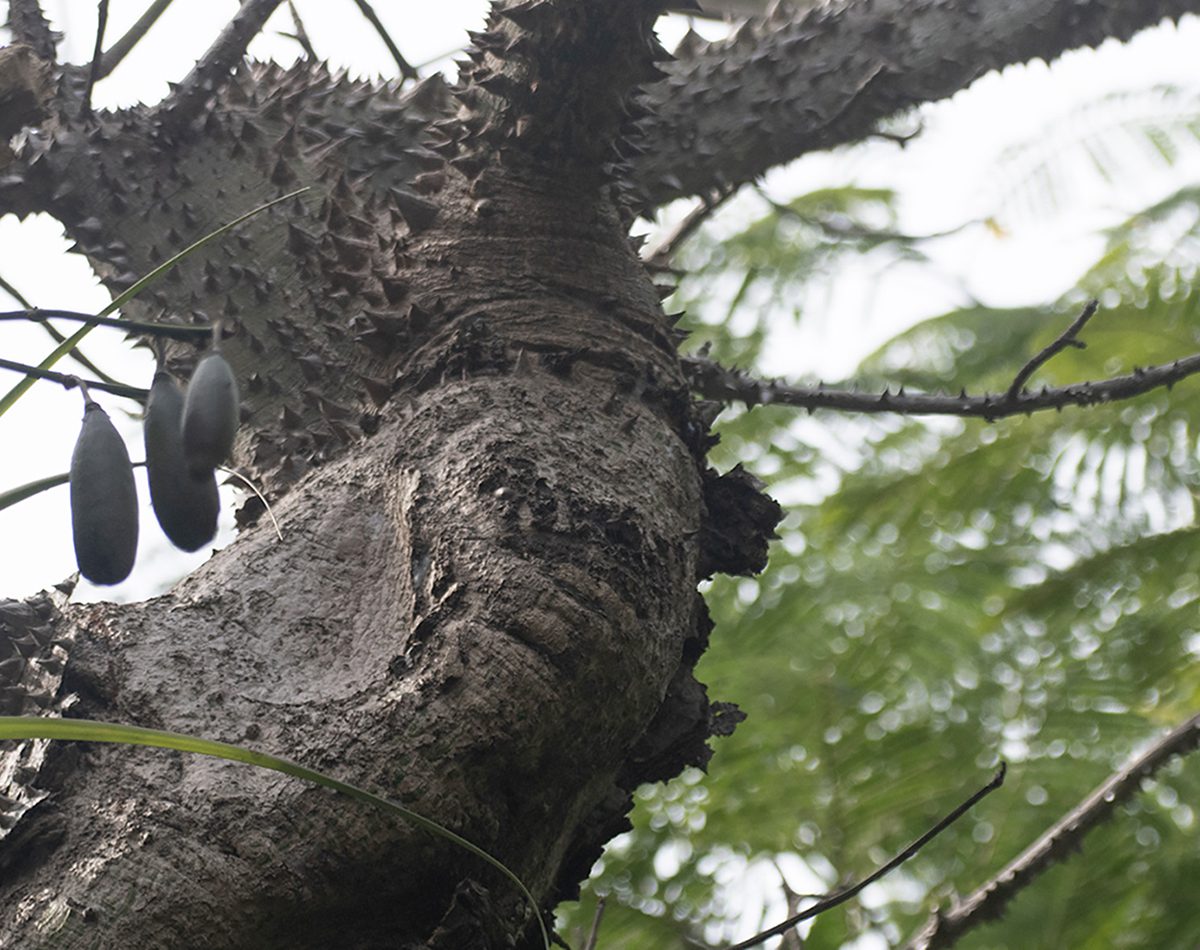
And some look quite dark and menacing, possibly threatening to hurl their seed pods down on intruders standing below in the parking lot.
When the trees’ pods open up they are filled with soft fluff that floats through the air, carrying the seeds over a large area. (Photo Gail Karlsson)
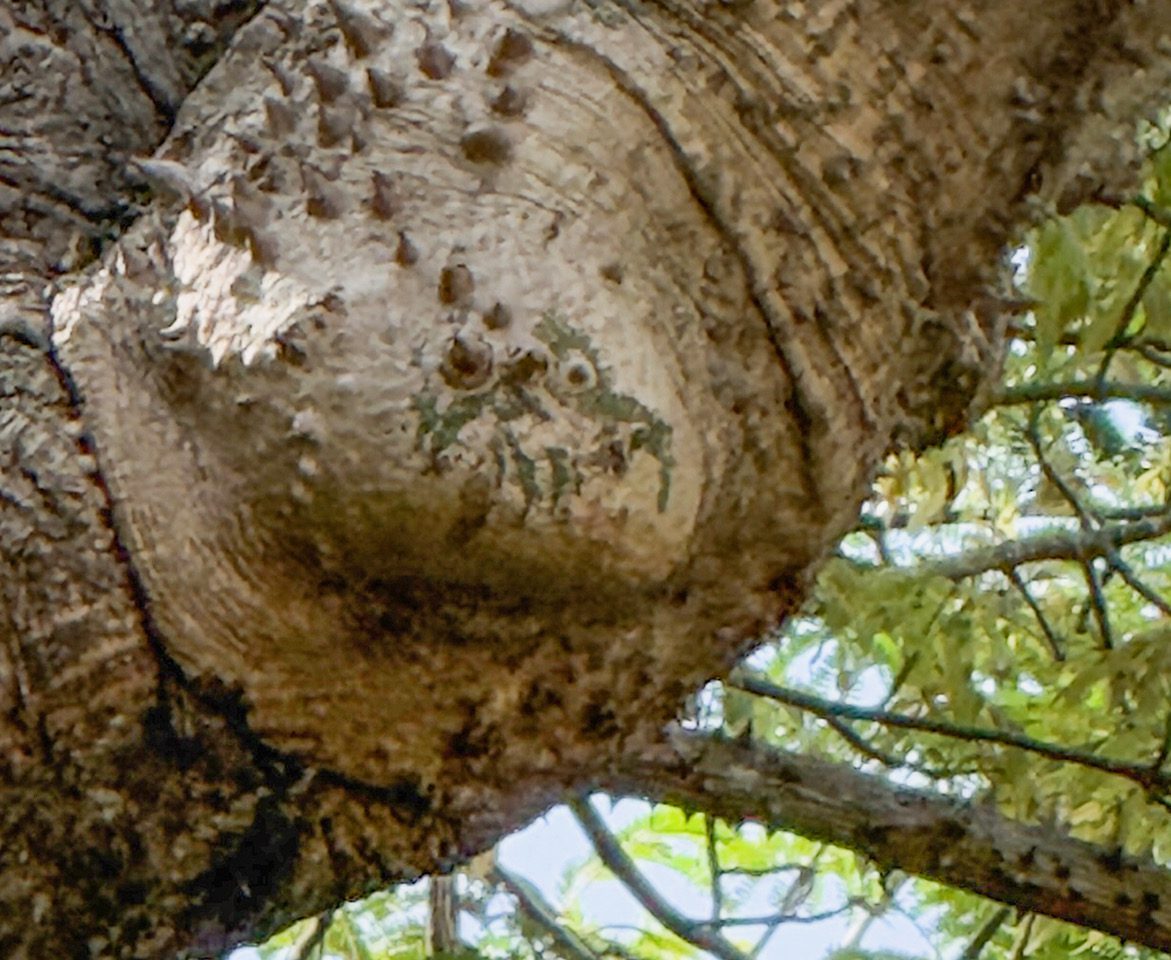
A few of the tree faces are more friendly and whimsical.
This lumpy spot looked a bit like an owl to me, with thorns for eyes. (Photo Gail Karlsson)
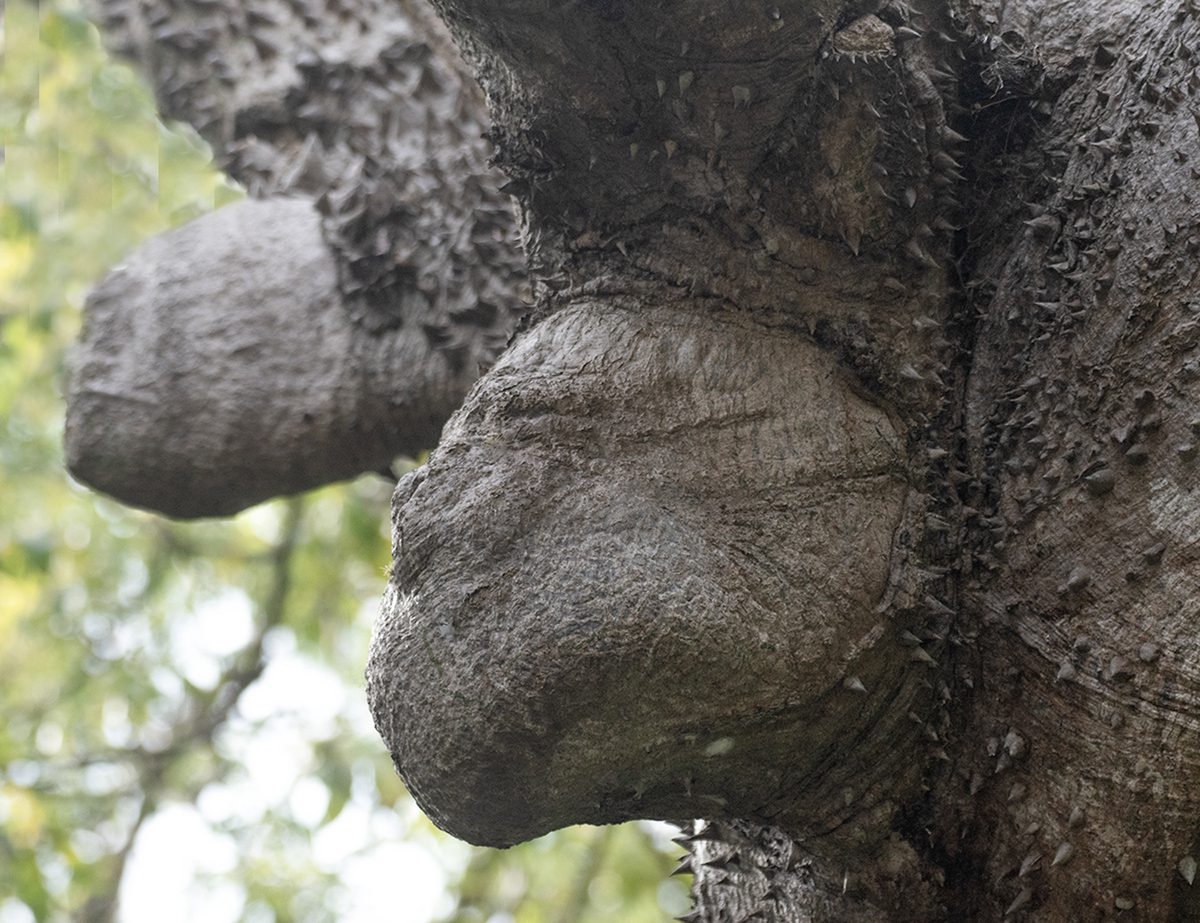
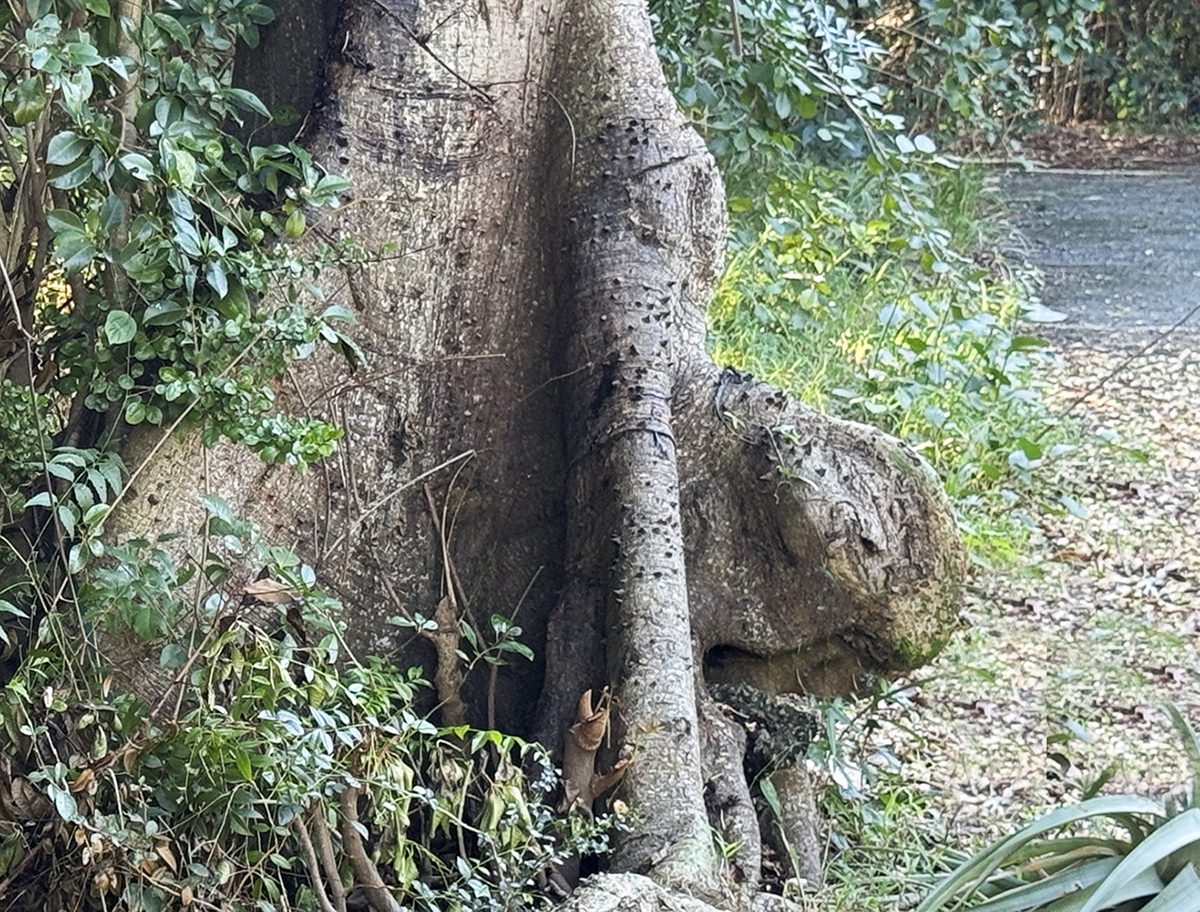
On one tree, the buttress roots at the bottom seemed to have grown out like the head of a tortoise.
Kapok trees grow buttress roots to help stabilize their trunks so they can grow tall in shallow soil. (Photo Gail Karlsson)
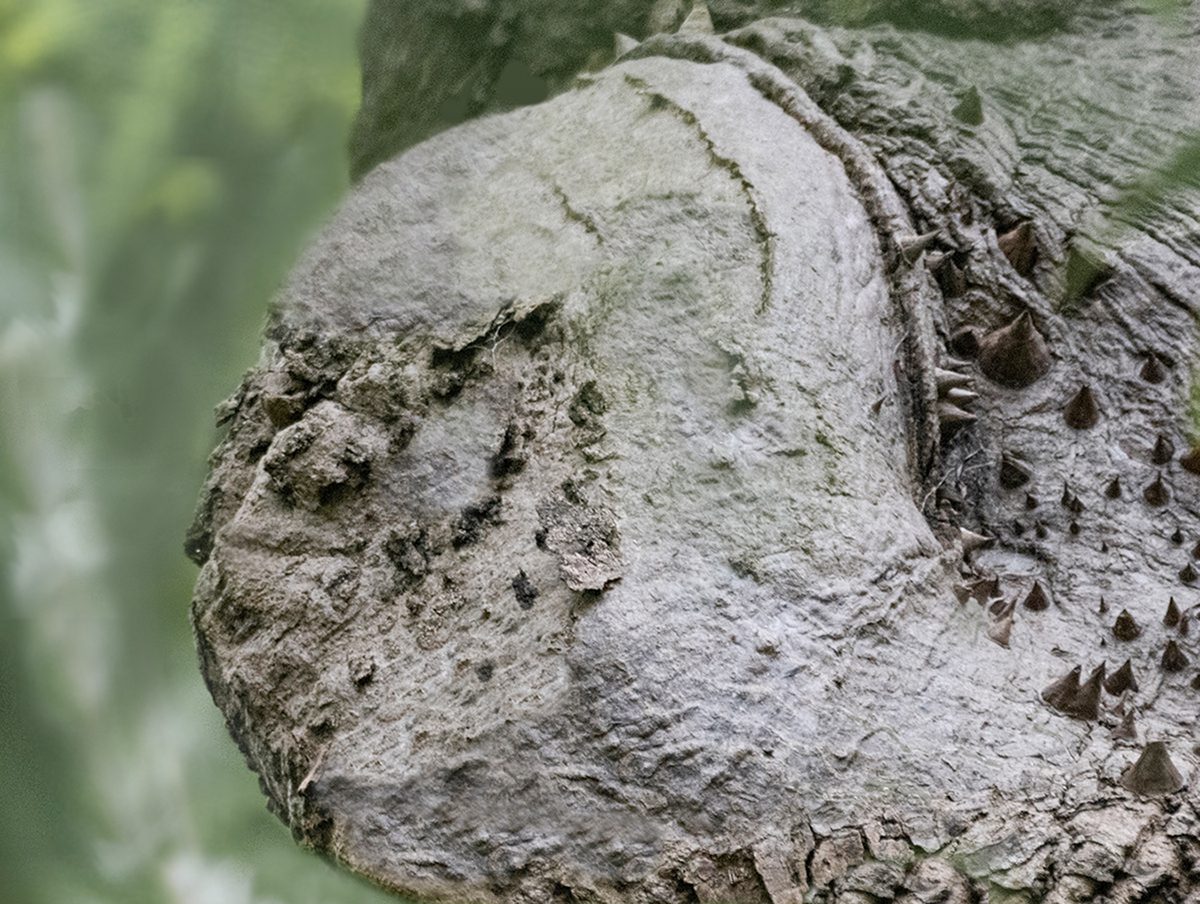
My favorite is one I used to call the elephant tree because of its really wide base, which has expanded into huge gray hump. It is now battered and partially hidden behind bushes, but still thriving, producing flowers and making seed pods.
This tree’s base is more like a bark-covered boulder than a buttress. (Photo Gail Karlsson)
These trees are not statues, though. They are living beings – and they have definitely seen some things. I can feel their dynamic energy surrounding me when I am standing among them.
Since no one was able to visit the Caneel Bay property for many years after the storm, I imagine that the kapoks and other great trees appreciate that I remember them with fondness and have come back to look for them. But probably they were comfortable enough just being left alone, and are fine with the fact that hardly anyone sees them there, even now.
Still, I worry about their future. Who will value these dramatic trees, I wonder, and care enough to protect them. Or will they just be knocked down, because they are old and weird looking and in the way, when the plans for redeveloping Caneel Bay as a new resort are finally implemented.
——————————
Gail Karlsson is the author of a photo book Looking for Birds on St. John, as well as two other books about nature in the Virgin Islands –The Wild Life in an Island House, and Learning About Trees and Plants – A Project of the Unitarian Universalist Fellowship of St. John. Follow her on Instagram @gailkarlsson and gvkarlsson.blogspot.com. More info at gailkarlsson.com
Full power has been restored as of 5:55 p.m.
Earlier:
All feeders with the exception of feeders 6A and 6B have been restored. We are currently experiencing reduced generation capacity, due to one of the units stalling, and the Aggreko units undergoing previously scheduled maintenance. Plant Personnel are working to bring online additional units to restore all affected customers.
Police seek former Senate candidate Ke’Shawn Louis on attempted murder charges. (Photo from Facebook)
Officers have apprehended a man wanted for attempted murder after the former Senate candidate escaped police custody Wednesday morning, officials said.
A concerned citizen phoned police around 11 p.m. Tuesday to report a gunpoint robbery in Grove Place, police said. When officers arrived, however, they found no guns or robbery but a fight, where Ke’Shawn Louis, 27, had allegedly attempted to run someone over with a car.
Louis was taken into custody but early Wednesday morning, while not wearing handcuffs, he was able to slip away from Frederiksted’s Wilbur Francis Command police station, according to authorities.
Police issued a wanted poster Thursday morning and, by 3 p.m., he was found in the Gentle Winds area, near Salt River, more than six miles away, they said.
Known for his mild manner, Louis, manager of the multi-island Gold Star All-In-One Service landscaping company, was on stage at St. Croix Educational Complex April 22 talking with youth about career options. In photos of the event, Louis, in a button-down pink dress shirt, is smiling with other presenters. In stark contrast to this, and Louis’ soft-spoken persona during his 2022 Senate campaign, police said in the wanted poster that he was now considered dangerous and should not be approached.
In June 2025, Louis pleaded guilty to four counts of grand larceny. Four other charges of obtaining money by false pretense were dropped. In August 2025, he received a two year suspended sentence and two years’ probation.
In the sentencing order, Superior Court Judge Denise Francois warned against violating the terms of probation.
Louisran for Senate in 2022 on a platform emphasizing affordable housing. He’d hoped to represent St. Thomas-St. John. The then-23-year-old garnered 599 votes, or about 5% of ballots.
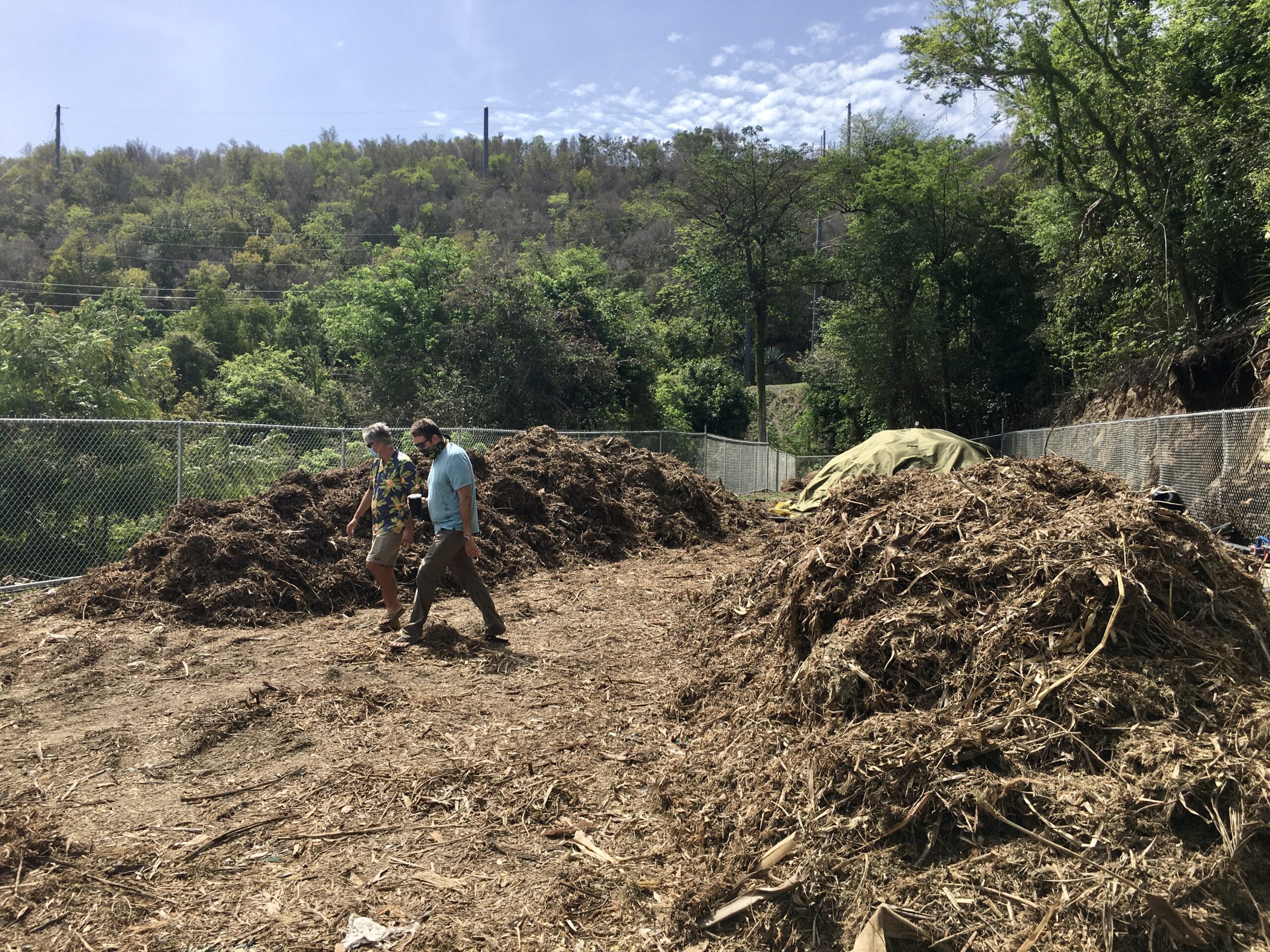
The Island Green Living Association piloted a green waste composting program after the 2017 hurricanes. (Source file photo by Amy H. Roberts)
On April 17 the Local Food and Farm Council (LFFC), co-chaired by Agriculture Commissioner Louis E. Petersen Jr. and UVI President Safiya George, passed an urgent resolution.
Proposed by a local farmer, Royce Creque, and home gardener Harith Wickrema, and seconded by farmer Dr. Nate Olive, the motion was adopted unanimously:
We, the members of LFFC, appeal to the Virgin Islands Waste Management Authority (VIWMA) and our senators to change course and support a sustainable waste management policy whereby the USVI prioritizes the chipping, shredding and composting our green and brown debris in order to support agriculture and our farming community as opposed to burning this rich resource.
One of the biggest challenges for farmers is the poor soil quality of our land in the territory. Vegetative debris is an invaluable resource which can be turned into much needed compost and mulch. We consider this material as “black gold” as it adds essential nutrients back into our soil. In addition to serving as an agricultural product and soil amendment for farmers and gardeners, it can also be used for landscaping and erosion control as well as an export product similar to Puerto Rico’s compost.
We urge our policy makers not to rob our farmers of this precious natural resource.
Ninety-seven percent (97%) of our food supply is currently imported, a fact that led to the passage of Act 8404, mandating the creation of a Territorial Agricultural Plan in 2021 to support food security and food sovereignty. In order to ensure the success of this Plan, which the LFFC was established to manage, a primary need is the improvement of our soil quality.
Dr. Nate Olive, president of V.I. Farmers Alliance, shared his firsthand feedback from farmers who are asking for clean mulch and compost to increase yield. The way to reduce green waste from entering our overburdened landfills is to start chipping, mulching and composting tomorrow and not wait for a lengthy legal process that air curtain incineration will face.
Please help support food security, the livelihood of our farmers, and the health and welfare of our community by chipping, mulching and composting our vegetative debris.
The LFFC is charged with guiding the implementation of the Territorial Agricultural Plan and its eight mandates, which were approved and endorsed by the governor and ratified by the Legislature of the Virgin Islands.
The Local Food and Farm Council is made up of 17 members, including Co-Chairs Petersen and George; Dr. Usman Adamu, dean and director of the School of Agriculture, UVI; Dr. Dionne Wells-Hedrington, commissioner, Education Department; Jean-Pierre L. Oriol, commissioner, DPNR; Wayne L. Biggs Jr., CEO, USVI Economic Development Authority; Honorary Farm Members Abeba Sellassie, Ityopia Rootz Farm; Dr. Nate Olive, Ridge to Reef Farm; Edmon Titre, New Breed Farm; Royce Creque, Greenridge Guavaberry Farm; Honorary Fisher Members Winston Ledee and Mavel Maldonado; VIDE Designees Dr. Renee Charleswell, deputy commissioner of Curriculum and Instruction, VIDE; Harith Wickrema, president, Island Green Living; and Cydney Meadows, territorial director of Sustainability and Agricultural Education, Division of Curriculum and Instruction, VIDE; and DPNR Designees Dr. Nicole Angeli, director of Fish and Wildlife, DPNR, and Dr. Sennai Habtes, bureau chief, Fisheries, DPNR.
There is an districtwide outage impacting all customers on St. Croix due to loss generation at the Richmond Power Plant. Plant Personnel are working to restore power as soon as possible.
The Crown Bay Shopping Center was packed for Wednesday’s event, drawing crowds into the late afternoon (Photo by Ananta Pancham)
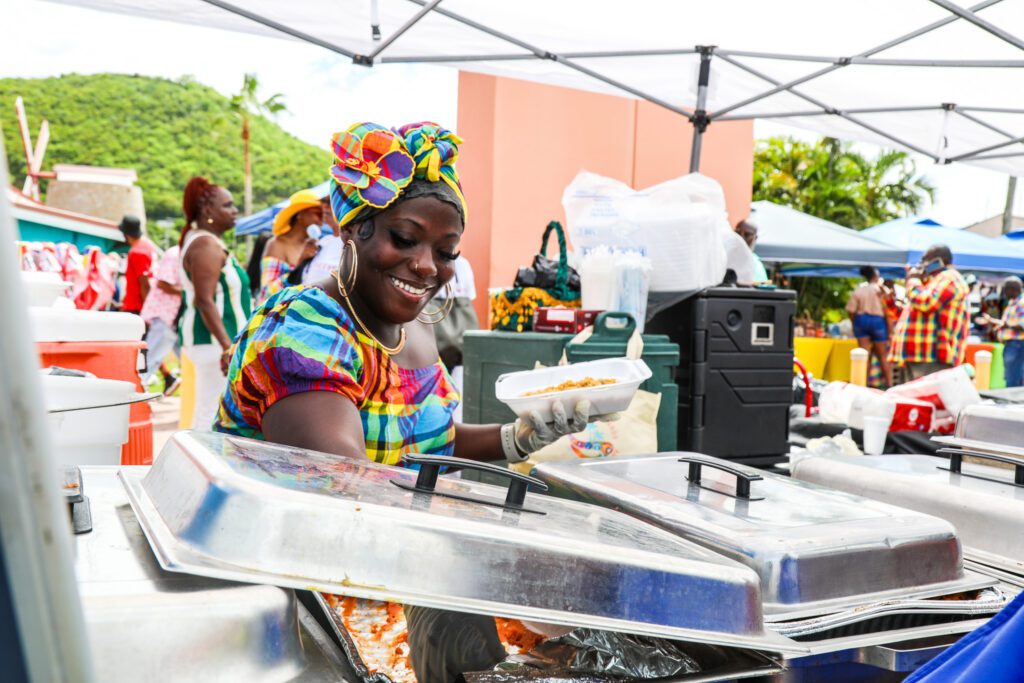
Whether you sat patiently in bumper-to-bumper traffic, opted to get in a few extra steps and walk to the venue, braved the midday heat, or stood in line for your favorite local delicacies, the 2026 St. Thomas Food Fair delivered an experience that made it all worthwhile.
Held at the Crown Bay Shopping Center in and around the Austin “Babe” Monsanto Marine Terminal on Wednesday, the annual event brought together more than 150 vendors, offering something for every palate and interest. From traditional Virgin Islands dishes and seasonal must-haves to cakes, sweets, hearty stews, and fresh local produce, the fair was a vibrant showcase of the territory’s culinary richness. Beyond the food, patrons browsed an array of handcrafted goods, including jewelry, plants, candles, sandals, and an assortment of locally made products that reflected the creativity and entrepreneurial spirit of the community.
Honoree Junior Cecil Huggins helps officially open this year’s Food Fair, along with Gov. Albert Bryan Jr., Lieutenant Gov. Tregenza Roach, Delegate Stacey Plaskett, Senate President Mitlon Potter and other dignitaries, along with Department of Tourism officials (Photo by Government House)
This year’s celebration also paid tribute to longtime vendor Junior Cecil Huggins, who was recognized as the 2026 Food Fair honoree. Huggins, who has been a consistent presence at the event since 2007, represents the dedication, resilience, and cultural pride that have helped sustain the Food Fair as a cornerstone of the Carnival experience, according to organizers. Speaking after the official ribbon cutting, Huggins reminisced about this 19 years as an Armstrong Homemade Ice Cream distributor on St. Thomas, saying that he was on a trip overseas when he told his wife this was what he was going to do – and since then, he hasn’t looked back.
“I’m not necessarily a sweets guy myself, but people love Armstrong Ice Cream,” he said, sharing that his favorite flavor – contrary to those who flock to the gooseberry – is actually banana.
“Once you find something you just love to do, there’s nothing else better,” Huggins said. “It’s really the most important thing.”
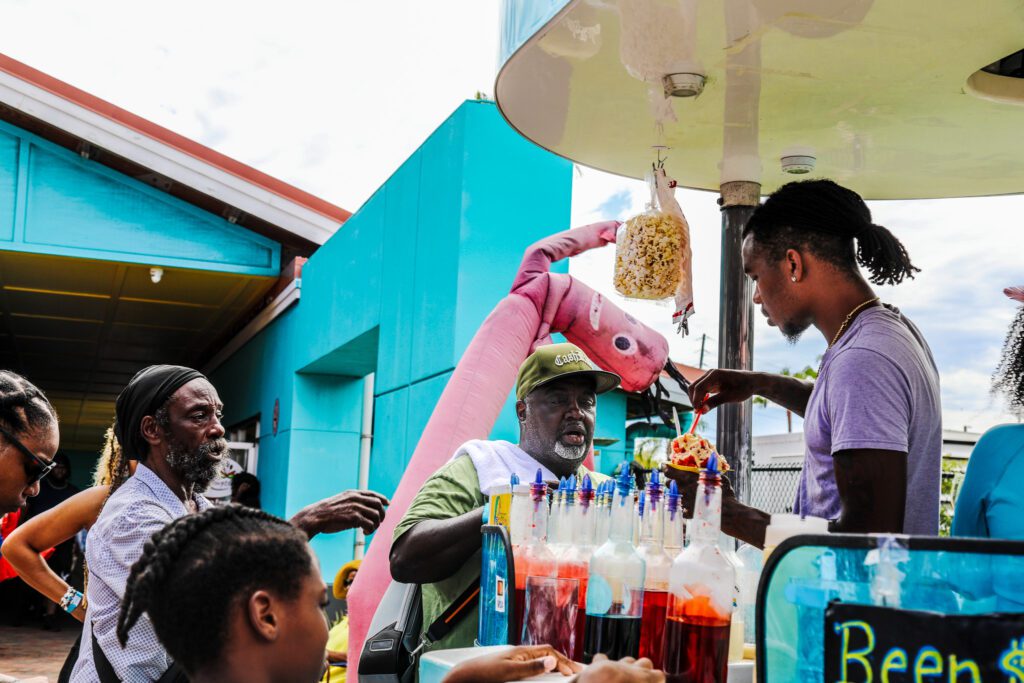
To beat the heat, many flocked to either the ice cream stands, or fracos, with vendors offering up every kind of flavor. (Photo by Ananta Pancham)
Behind the scenes, the success of the event was driven by a committed organizing team. Co-Chair Kyza Callwood shared that he was pleased with both the turnout and the overall execution of the day’s event, noting that the committee of six, led by Chair Lu’Anne Roberts, remains keen on preserving and promoting the cultural traditions that define the Food Fair. He also lauded the contributions of students from Charlotte Amalie High School, along with Shamang Straun, a teacher, who played a key role in developing the vendor layout schematics — an effort that helped ensure a smooth and engaging experience for both vendors and patrons.
The committee also expressed its gratitude to Banco Popular de Puerto Rico for serving as a sponsor of this year’s event, underscoring the importance of private-sector support in sustaining large-scale cultural celebrations.
And for many visitors Wednesday, experiencing the territory at its best was certainly worth every penny of their trip down.
“I came with a friend whose wife is from St. Thomas – he made me,” joked Julius Harris, who came down just a few days ago from Valrico, Florida. Harris said that his favorite Carnival, up to now, has been Toronto’s Caribana, but his time in the territory might just have been enough to change his mind.
“In Canada, it’s large-scale – days filled with parades and activities,” he said. “Events like that, it’s about going with someone that you know, and hoping you can get into the action. Here, you feel welcomed every where. We’re really having a blast.”
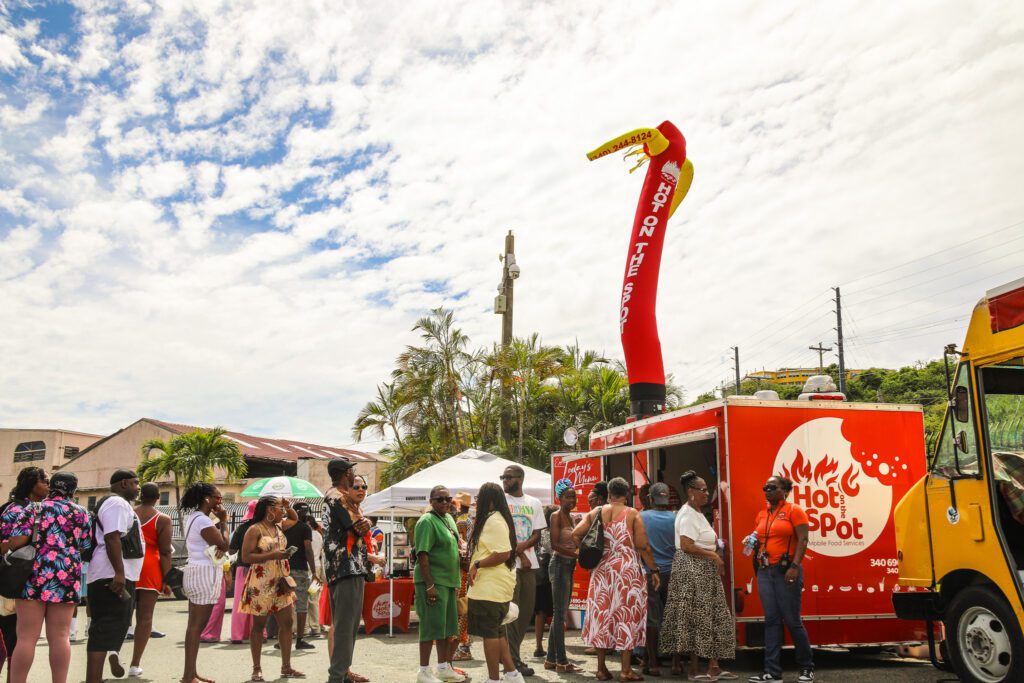
The line for Hot on the Spot stretched wide for most of the afternoon, with residents sharing their excitement over sampling the truck’s famous lobster plate (Photo by Ananta Pancham)
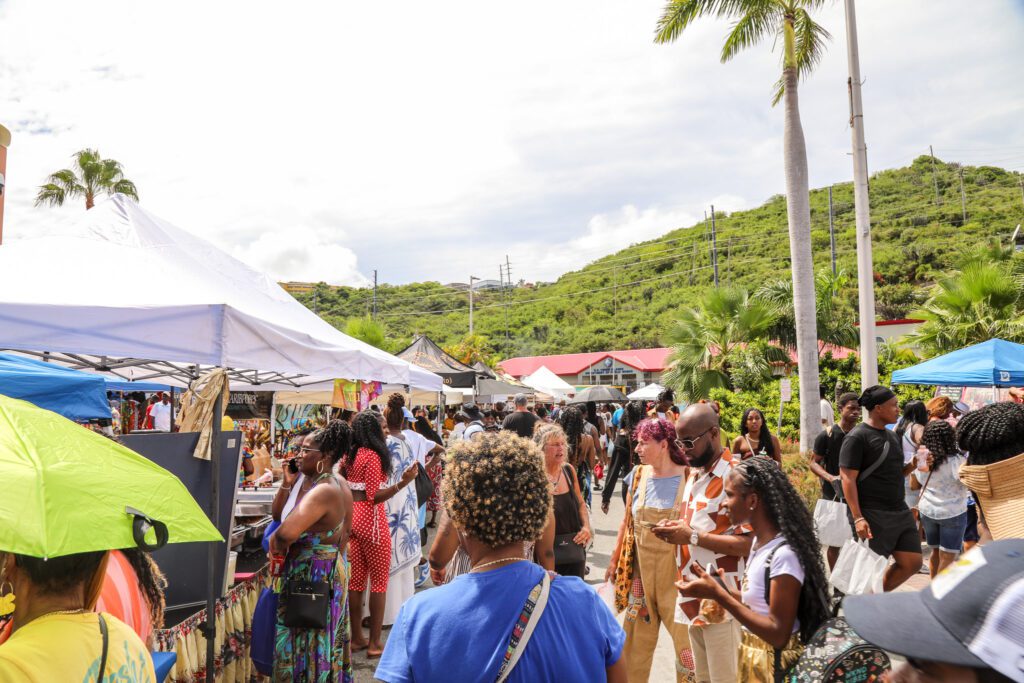
Around the center, the aroma of sizzling meats, spices, and sweet confections filled the air, blending seamlessly with the sounds of laughter, conversation, and music. Thousands gathered to celebrate the splendor of the Carnival season, creating a space where locals and visitors alike could reconnect with family and friends, meet new people, and simply enjoy an afternoon rooted in culture and community.
Despite the day’s heat, the energy remained high. Attendees moved from vendor to vendor, supporting local businesses, while others paused to take in live performances from bands such as Spectrum Band, Razor Blades, Quelbe Resurrection, and Par T Band. The rhythmic sounds of steel pan music, delivered by the Rising Stars Steel Orchestra, added another layer of cultural authenticity.
Madras prints were also a staple for many vendors, who also got to share with visitors the significance of the fabric (Photo by Ananta Pancham)
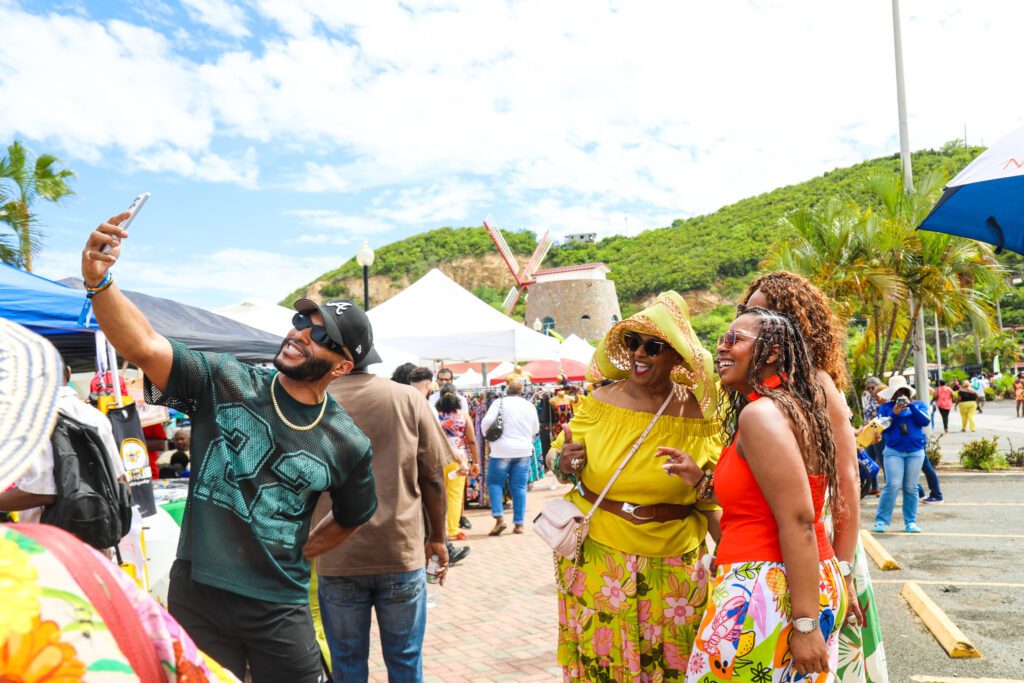
In true Carnival fashion, the Food Fair was not only a feast for the palate but also a showcase of style and cultural expression. Many attendees were adorned in vibrant madras prints, colorful ensembles, and festive pieces that reflected the spirit of the season. From coordinated outfits to bold, statement accessories, the crowd embodied a visual celebration of heritage and creativity. Flowing dresses, headwraps, and handcrafted adornments added to the tapestry of color, transforming the grounds into a living display of Virgin Islands culture. In many ways, the fashion was as much a part of the experience as the food itself.
Among the most heartwarming sights were those who chose to slow down and simply take it all in — families seated on the lawn, friends gathered under shaded areas, and elders congregating in cool spots, sharing meals, stories, and laughter. These moments spoke to the true essence of the Food Fair: connection, continuity, and community.
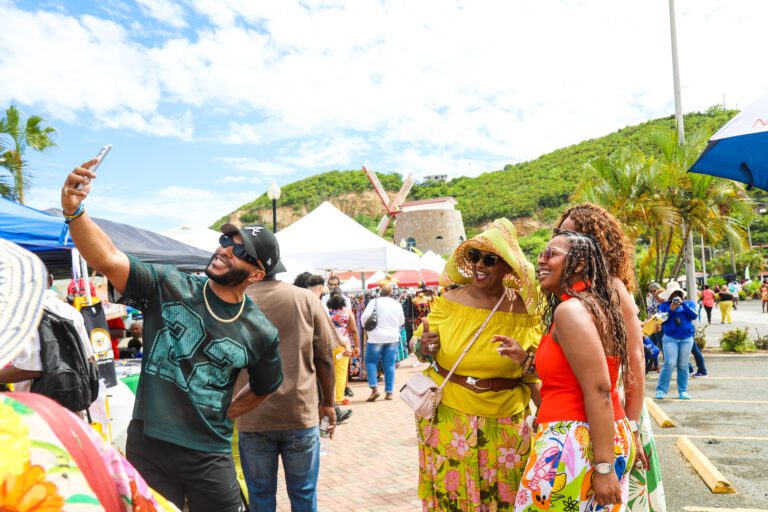
V.I.-born soca sensation Adam O. stops to take a selfie with fans – among them Barbara Petersen. (Photo by Ananta Pancham)
As an election year adds another dimension to the social landscape, political candidates were also present, engaging with attendees and connecting with supporters throughout the day. Their presence, while notable, blended into the larger atmosphere of fellowship and celebration that defined the event.
All good things must come to an end, and the 2026 St. Thomas Food Fair once again affirmed its place as a cornerstone of Carnival — where culture is not only preserved, but proudly lived, shared, and celebrated.
The magistrate judge said the preliminary hearing would resume Thursday morning. (Source file photo)
Three people charged in a sex trafficking conspiracy tied to Tootsys Gentleman’s Club appeared for a preliminary hearing Wednesday in District Court on St. Thomas, where hours of testimony and cross-examination pushed proceedings into the late afternoon and prompted a judge to continue the case for a second day.
U.S. Magistrate Judge G. Alan Teague cited the Federal Rules of Criminal Procedure as he allowed attorneys representing Hussein Jamil and Magda Castro Santos to question an FBI investigator at length during that hearing. Special Agent Kiernan Whitworthy answered questions about surveillance and undercover operations conducted in and around Tootsys Gentleman’s Club in Red Hook.
Information obtained from those operations helped investigators file an affidavit with the court on April 17. Authorities staged a raid on the club hours later, arresting club manager Santos and Hidalgo de Pena.
Court records show that Jamil was taken into custody the following day at a property in Bolongo Bay, where several of the performers at Tootsys rented sleeping quarters.
Under questioning by Assistant U.S. Attorney Natasha Baker, Whitworthy described his role in the operation, working as part of a team led by the FBI and Homeland Security Investigations.
Defense attorney Carlos Sanchez La Costa began his cross-examination by producing a series of photos from inside the club. Baker said she did not object and asked that they be entered as evidence before the questioning began.
Questions ranged from the immigration status of dancers and the manager to evidence recovered from the club showing that commercial sex acts were taking place there. Sanchez also asked Whitworthy if agents entering the club took note of a posted sign saying prostitution was prohibited at Tootsys.
No, the witness said, he was not aware. Jamil’s lawyer also asked if Whitworthy knew about passports found at the club during the raid. That prompted the judge to remind the legal teams they agreed to question information contained in the affidavit only, and that the Affidavit in Support of a Criminal Complaint was filed earlier in the day on April 17, prior to the raid.
Bandas took over the cross-examination on behalf of Santos after being told by the judge to avoid redundancy. “You don’t need to ask questions if matters have already been answered,” Teague said.
Bandas told the court that he and Sanchez had a late-afternoon flight to catch back to Puerto Rico, but he felt obliged to question the witness on behalf of his client. He began by asking Whitworthy if he had ever gone to Tootsys himself.
The answer began with a pause — “No.” Bandas asked how long the special agent had been working on the Tootsys case.
Since 2023, Whitworthy said.
The lawyer asked whether there was evidence that his client transported persons to St. Thomas, and if any of the recorded receipts handled by the club manager indicated commercial sex transactions. “Did any of those receipts clearly state that those customers were paying for sex?” Bandas asked.
“No,” Whitworthy said.
“But you clearly understand that there were clients paying for sex there?” Bandas asked.
“Yes. There was an undercover operation there,” producing statements from agents that transactions with the dancers were taking place, the witness said.
Additional questioning followed about surveillance operations conducted on different occasions.
By then, it was almost time for the traveling lawyers to leave.
Baker for the prosecution said, although the government agreed to let the cross-examination go forward, “95 percent of these questions were arguments and could have been asked at a later proceeding.”
Teague agreed and noted that while some questions posed by Bandas sought information about criminal acts directly committed, the charges against the three defendants pointed to conspiracy.
The judge told those at Wednesday’s hearing to return to the courtroom Thursday at 10:30 a.m. At that time, defense attorney Robert Millan would conduct his cross-examination, and Baker for the government would offer her rebuttal.
“The court is going to be ruling from the bench, and the court is going to have a pretty extensive ruling as to whether there is probable cause,” Teague said.