Sen. Samuel Carrión, the primary sponsor of the initiative to construct steel roofs over Virgin Islands basketball courts, joined residents and community leaders to celebrate the groundbreaking ceremony for the roof construction at Estate Profit. This landmark project marks a transformative step towards strengthening our recreational infrastructure and enhancing the quality of life for the youth and families of St. Croix.
“Today’s groundbreaking is more than a construction milestone; it represents our commitment to investing in our communities and in our young people,” Senator Carrión said. “With this project, we’re not only enhancing local amenities, but also building a foundation where young athletes can thrive, and our families and neighbors can gather in a safe, welcoming environment.”
The construction of a roof over the basketball court will turn the facility into an all-weather venue, offering year-round access for athletes, youth, and community members. This enhancement will enable the court to serve as a community hub for activities and gatherings, aligning with Senator Carrión’s broader vision of strengthening community resources and expanding opportunities for youth and families across the Virgin Islands.
Sen. Carrión was joined by Senate President Novelle Francis Jr., Sen. Angel Bolques, and keynote speaker Judge Emile E. Henderson III, along with other community members in support of the project. The Estate Profit Basketball Court will be the first court that is completed.
This project is part of a larger vision to cover basketball courts throughout the Territory, creating spaces that promote health, unity, and recreation. By supporting projects that directly serve the community, Senator Carrion is hoping to help to build more resilient and supportive environments for all Virgin Islanders.
Sen. Carrión worked closely with the Eddie Ortiz Annual Three Kings Tradition, Inc., whose dedication and partnership were instrumental to the project’s success. He expressed his gratitude for their steadfast commitment to advancing this community initiative, recognizing the positive impact it will have on the Estate Profit area and beyond.
Sen. Carrion said he got the idea to cover the territory’s courts when he noted that many outdoor basketball courts in Puerto Rico had steel roof coverings.
The Virgin Islands Waste Management Authority informs the community of delays in house-to-house waste collection in the following areas due to inclement weather:
• Estate Grove
• Estate Plessen
• Estate Cane (Behind of the Sunshine Mall)
• Mount Pleasant
• Paradise
• Frederiksted Town
• Adventure
• Diamond West
Collection services for these areas are expected to be completed as soon as possible. We
apologize for any inconvenience this may cause and rely on your cooperation as we are
working to resume our regular service schedule.
For more information, contact the Division of Education and Communications Management
at 340-474-2811 or email communications@viwma.org. Stay connected with us on
Family and friends are advised of the passing of Maurice Todman. Maurice was preceded in death by his parents, Jureen Francis Todman and Jens Todman, and his brother Jens E. Todman.
Maurice Todman
He is survived by his wife Griselda Mieses Luis Todman; sister, Monique Todman Matthews, sister-in-law Cheryl Todman; aunts: Iris Frett Chinnery and Gladys Todman; uncle: Guillermo Todman; nieces Nikysha Mariah and Aniqua Mone Matthews, Jennelye and Jennell Todman; nephews: Will Smith and Jecoi Todman; great-niece Jeleah Cargill; great-nephew: Jason Cargill; niece-in-law: Shelby Moss Todman
He is also survived by cousins: Janice Hodge, Jacquelyn Thomas, Joan Frett, Joycelyn Frett, Jedwyn Frett, Arrick Todman, Orville Todman, Carmen Turnbull, Delia Todman, WillaMae Dawson, Darrel Dawson, Denise Dawson, Moretta Dawson Fahie, Laurel Dawson, Jennifer Dawson, Elwyn Dawson, Patrice Joshua, Paulette Joshua, Patricia Joshua, Michelle Joshua, Mona Francis, Laverne Francis, Michelle Francis, Dale Francis, Vance Francis, Keith Francis, Anthony Petersen, Lydia Duran Jackson, Nanette Duran, Michelle S. Francis, Celina Francis, Terry Francis, Faye Francis, Michael Haynes, and Earl Haynes Jr.
Maurice’s cherished friends include Jay Blash, Lincoln Gumbs, Robby Gregory, Royce Wallace, Kesia King, Simone Letang Freeman and Julia Benjamin, and many other relatives and friends too numerous to mention.
The first viewing will take place at Turnbull’s Funeral Home on Friday, Nov. 22 from 4 p.m. to 6 p.m. A second viewing will be held at the Cathedral Church of All Saints on Monday, Nov. 25 beginning at 9 a.m. with the service to follow at 10:00 AM. Interment will be at Western Cemetery #1. Arrangements have been entrusted to Turnbull’s Funeral Home.
Diwali magic – you’ll love the dances – and the opening of VIDE’s D Hamilton Jackson student exhibit at Cane Roots Art Gallery on St. Croix, along with the week’s biggest headlines. Watch and stay informed on Consider the Source – there’s always something new!
In her bi-weekly column, “State of the Territory,” former Sen. Janelle K. Sarauw delves deeper into issues of concern for V.I. residents.
In today’s world, data drives policy. Without credible, up-to-date data, any meaningful progress in the public sphere remains elusive, leaving communities flying blind, disconnected from reality and sound decision-making. For the U.S. Virgin Islands, the absence of robust data systems has left a gap so wide that federal agencies have paused critical economic reporting, putting the territory’s progress in further jeopardy.
The recent announcement from the U.S. Bureau of Economic Analysis (BEA) that it will discontinue producing GDP statistics for the U.S. Virgin Islands due to “severe data issues” and “untimely unaudited financial statements” is a wake-up call for all who care about the Virgin Islands’ future. For a territory facing negative economic growth, shrinking private investment, a declining population, and a cost of living second only to Hawaii, accurate data is not just a convenience—it’s a necessity. Without it, the government and the people are left in the dark, unable to make informed decisions or attract the investment that is critical for sustainable growth.
Reliable data collection and transparent reporting are pillars of governance. In most U.S. jurisdictions, the BEA, Bureau of Labor Statistics (BLS), and other agencies provide timely, precise data that local governments depend on for economic planning and policy-making. However, the Virgin Islands lacks an equivalent infrastructure, which has real consequences. It’s no coincidence that federal monitors remain in the Virgin Islands: their presence is a direct result of the territory’s inability to provide the data needed to ensure accountability.
Consider the absence of financial statements from the Water and Power Authority (WAPA) over the last three years. This lack of transparency doesn’t just undermine confidence in public institutions—it creates real barriers to investment. Who would invest in a region where the economic landscape is a black box, where accountability is an afterthought, and where even basic financial data is out of reach? It’s telling that, over the last 20 years, the territory’s real economic growth rate has averaged a dismal -0.8%, with little to no growth in private investment.
Currently, the only credible data sources in the territory are from departments funded directly by federal dollars. But these represent only a fraction of the broader economic picture. The local government’s own economic reporting, through VIBER, often paints an unrealistically optimistic view, disconnected from the stark reality of dwindling private investment, a shrinking population, and economic stagnation. In contrast, the United Nations’ population projections suggest a decline to 84,000 residents by 2024, signaling deeper structural issues that can’t be addressed without acknowledging them fully through unbiased data.
Data’s Vital Role in Policy and Economic Health
In the U.S. Virgin Islands, the lack of credible data has left policymakers and citizens grasping at straws, unable to assess the territory’s real needs or make strategic decisions. Without accurate information on economic growth, employment, or investment trends, the government cannot responsibly allocate resources, attract businesses, or plan for future demands. Simply put, data is the language of modern governance. Without it, a government cannot fully understand its people, its economy, or the challenges it faces.
The BEA’s decision to halt GDP calculations is a stark indictment of the Virgin Islands’ data crisis. These GDP figures are not just numbers; they are indicators of economic health, offering a baseline to measure success or failure. Without them, the Virgin Islands loses its ability to benchmark against other territories or the mainland, and the people lose a key measure of accountability for their government. It is almost as if we are driving a car without a dashboard—no speedometer, no fuel gauge, no indicators to tell us if the car will make it to its destination or break down along the way.
Why Federal Monitors Remain
The continued presence of federal monitors in the territory underscores just how critical data issues have become. With financial reporting gaps and unaudited statements, federal agencies cannot trust local authorities to manage funding responsibly. This distrust has a price: federal oversight restricts the territory’s autonomy and limits its ability to control its own resources. If the Virgin Islands could reliably generate its own data and demonstrate transparency, it could reduce the need for external intervention, reclaiming a greater degree of control over its governance.
Moreover, federal agencies are unlikely to withdraw until the territory can show an improved track record in data collection, reporting, and financial accountability. Programs in health, education, and disaster recovery depend on accurate information to assess needs, allocate funding, and evaluate impact. Each year that goes by without solid data further erodes the territory’s reputation, making it harder to secure funding and partnerships for essential services.
A Call to Action: Building a Culture of Transparency
Addressing the Virgin Islands’ data deficit requires a shift in mindset and a commitment to transparency. Government agencies must prioritize data collection and auditing practices, developing protocols that ensure consistency, accuracy, and accessibility. This effort must be led by independent bodies that can operate without fear of political pressure or interference. If economic data is skewed or withheld to maintain a certain narrative, the Virgin Islands will continue to lose credibility in the eyes of both investors and federal partners.
Local leaders must embrace a data-driven approach to governance, recognizing that policy decisions are only as strong as the information on which they’re based. This means not only collecting data but also publishing it openly, allowing citizens to see, understand, and trust the government’s actions. Building data literacy among the public would further support this shift, encouraging a more engaged, informed community capable of holding leaders accountable.
Moving from Data Deficit to Data Leadership
Imagine a future where the Virgin Islands is not only a reliable source of local data but also a model of best practices for other territories. This vision is within reach, but it requires immediate, coordinated action. By investing in data infrastructure and cultivating a culture of accountability, the Virgin Islands could lead the way, showing how even small jurisdictions can uphold standards of transparency and integrity.
Ultimately, data is not just about numbers; it’s about trust. Reliable statistics allow citizens to trust their leaders, investors to trust their projects, and federal partners to trust their local counterparts. For the Virgin Islands to thrive, this trust is indispensable.
Editor’s Note: Opinion articles do not represent the views of the Virgin Islands Source newsroom and are the sole expressed opinion of the writer. Submissions can be made to visource@gmail.com.
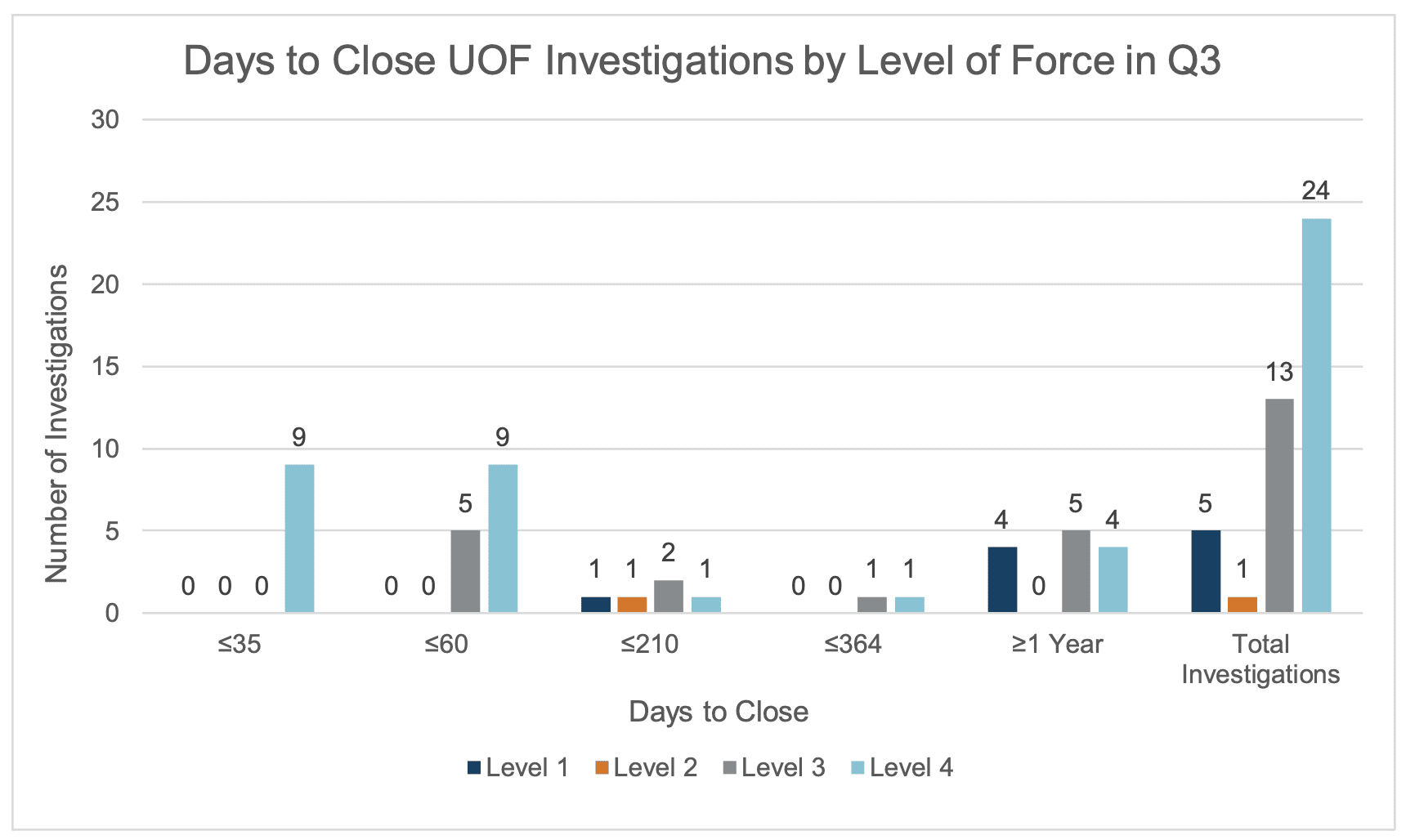
This chart shows the number of days to close use of force investigations in the third quarter of 2024 based on the level of force used, with Level 1 being the most serious. Of the 43 cases closed from June 1 to Aug. 31, nine were closed within 35 days of occurrence, 14 were closed between 36 and 60 days, while 13 took a year or more to close. Of the total investigations closed, 53 percent were closed within 60 days. Of the cases that took over one year to close, six were from 2016, two from 2021, three from 2022, and five from 2023. The 2016 investigations have in some instances been hampered by the loss of records during the 2017 hurricanes. (Image and information from monitor’s third quarter report)
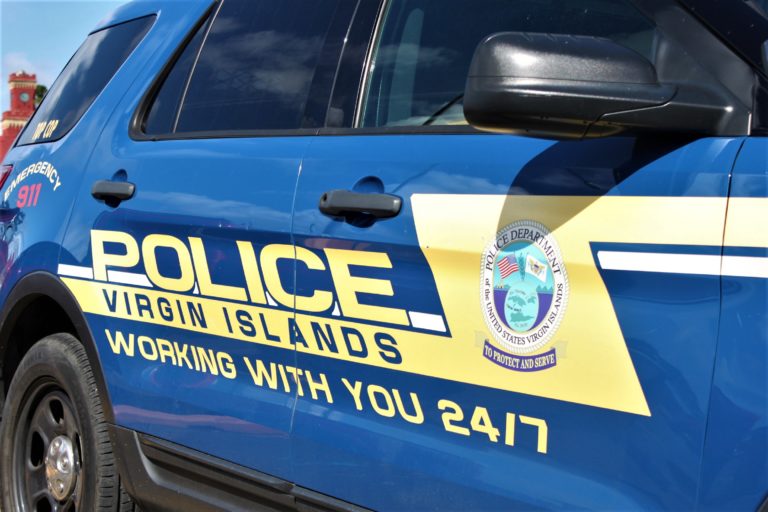
The V.I. Police Department will hold a two-day summit in December to identify obstacles to achieving compliance with the federal consent decree it has been under since 2009 to address allegations of a pattern of uses of force by its officers.
According to the 72-page third quarter report the independent monitoring team filed in V.I. District Court on Friday, the goal of the summit scheduled for Dec. 10-11 for the ranks of sergeant and above “is to identify obstacles to achieving compliance and develop strategies to overcome them.”
The team’s most recent report covering June 1 through Aug. 31 found continued “sustained compliance” with most of the consent decree mandates concerning police use of force and citizen complaint investigations. However, some deficiencies remain in completing thorough and timely investigations and holding those that fall short to account, it said.
While the consent decree includes 51 compliance paragraphs directly targeting the policing practices of the VIPD, the summit will focus on helping the department’s supervisors and leadership “work in earnest to achieve substantial compliance with paragraphs 37, 64 and 71.”
Those paragraphs concern deputy chiefs’ evaluations of performance reviews by supervisors to identify and correct any deficiencies in use of force cases; adherence to the 11 protocols for using the department’s electronic risk management system, called IAPro; and training in use of force standards.
“Consistent with previous quarters, VIPD has demonstrated partial compliance with these three paragraphs and continues to make incremental progress,” according to the third quarter report by monitor Sydney Roberts, who was appointed in November 2022 following the 2021 death of her predecessor, Charles Gruber, who had served since 2014.
“To bring about meaningful change, the supervisors responsible for untimely investigations must be held accountable, especially when retraining has not resulted in improved performance or enhanced organizational commitment,” Roberts wrote. “Appropriate disciplinary and/or non-disciplinary action should be taken every time a supervisor fails to conduct a timely and/or thorough investigation.”
When deadlines continue to be viewed as only suggestions, it is difficult to create a culture of accountability and a functional disciplinary process, the report states.
For example, a partial audit of supervisors responsible for untimely investigations, “absent the presence of a valid stay or waiver, provided evidence of investigators receiving documented counseling after a single incident of failing to complete a case on time, while others involved with multiple untimely investigations have nothing in their file documenting the corrective action. The department’s efforts must be consistent to ensure the effectiveness of the accountability structure and disciplinary process and to improve the timeliness of these investigations,” the report states.
In one case, a deputy chief directed a lieutenant to complete seven outstanding personnel investigations (four use of force cases, two citizen complaints and one vehicle accident) by a specific date, according to the report. When the lieutenant failed to complete the work on time they were given a second deadline, which they also missed, and a command investigation was initiated that found they violated “Category B:39 — Refusal to obey any lawful order or directive,” it said.
“Although the lieutenant did not complete the seven investigations as directed, the island’s police chief served as the hearing officer and did not sustain the charge,” because the charging document used one word from an outdated VIPD policy that had been modified to read “failure” instead of “refusal” to obey a lawful order, the report states. The acting commissioner concurred with the findings, it says.
“Thanks to the tenacity and initiative of the Deputy Commissioner and the St. Croix deputy chief, the charges were refiled,” but while they were sustained, “the charged officer was only ordered to serve a one-day suspension without pay and a two-day suspension held in abeyance for a period of six months,” the report states.
Of note, this was the first quarter wherein the monitoring team observed operations personnel express frustration that their peers were not completing assigned investigations in a timely manner, whereas in the past, the citizen complaint and use of force investigation inspectors “were the only people addressing investigators for untimely or incomplete investigations,” it said.
During one of the weekly “VIPD Commander Calls” for the St. Thomas-St. John district, held to review all open use of force and citizen complaint cases, for example, “an Operations commander commented, ‘We look at facts and hold people liable for crime, but we cannot do the same and hold people accountable for not doing their job.’ In another call, a supervisor said, ‘Why take it [completing investigations timely] serious if no one [is] ever terminated or seriously suspended for not doing it?’ and suggested there is a ‘need to make [an] example of those not doing their job,’” according to the report.
On a positive note, the department has completed all outstanding quarterly audits from 2023, is current with its audits so far this year and “is positioned to maintain the timely completion of its audits moving forward,” according to the report.
Additionally, “VIPD has made progress in investigative timeliness, particularly relative to the closure of some of its oldest [Use of Force] investigations. Of note, VIPD was successful in reducing the overall number of pending cases for the third consecutive quarter,” according to the report, which cites 43 cases closed from June through the end of August.
However, while the monitoring team is encouraged by accountability measures imposed for the untimely completion and/or review of investigations, “corrective action has been intermittent and inconsistent,” it said.
“To facilitate organizational compliance with the timeliness mandates under paragraphs 37 and 71, VIPD must be vigilant and unwavering in its commitment to holding personnel accountable for violating the timelines set forth in VIPD policy,” the report states.
Still, the monitors are optimistic that with the right leadership, full compliance will come, said Roberts.
“The key to achieving substantial compliance with paragraphs 37, 64 and 71 is an inspired commitment, driven by [the commissioner] and reinforced throughout the organization, that prioritizes completing administrative investigations in a timely manner, analyzing risk data and ensuring accountability when standards are not met,” according to Roberts’ summary of the third quarter report.
“Successful compliance with the remaining paragraphs is within reach and can be realized if approached strategically, buttressed with realistic benchmarks, and given the full and active support of VIPD leadership,” she said.
VIERS lab undergoing interior remodeling. (Photo by Paul Jobsis)
The Virgin Islands Environmental Resource Station (VIERS), a world-renowned research facility on St. John, is taking significant steps toward revitalization. The University of the Virgin Islands recently completed crucial renovations to the lab with a $245,000 grant from the National Science Foundation. This marks an essential first step in the journey to rebuild a facility that has been closed since the devastating 2017 hurricanes.
Paul Jobsis, director of Marine and Environmental Studies at UVI, who first assessed the damage in September 2017, has remained steadfast in his commitment to the facility’s restoration. “UVI is looking to renew their long-term contract with the National Park for management of the lab and camp,” Jobsis noted, highlighting the university’s dedication to the lab’s future.
Since its inception, VIERS has thrived through a unique collaboration with the Virgin Islands National Park, making it a hub for scientists, students, and community members alike. Positioned in Lameshur Bay within the park’s boundaries, the facility’s fate rests in part with the park’s management. Deputy Superintendent Scott B. Simmons shared, “The $4.2 million disaster relief allocated for VIERS went toward schematic design and funding larger projects.”
While there is no definitive timeline for the full restoration, Simmons indicated that about 30 percent of the VIERS schematic design is complete, with 70 percent of the Lameshur Road project close to final design. Rebuilding the road, which is the only land access to VIERS, is a critical step toward fully reopening the facility.
The lab’s history dates back to 1966, making it the second-oldest research collaboration between a university and the National Park Service in the U.S. Parks System. VIERS has gained international acclaim, particularly in 1969, with the Tektite project—the world’s first underwater habitat—which put the Virgin Islands at the forefront of marine research. In 1970, Sylvia Earle shattered gender norms by leading the first all-female research team during Tektite II.
Tonia Lovejoy, executive director of Friends of Virgin Islands National Park, emphasized VIERS’ legacy. “Prior to 2017, VIERS was an internationally recognized marine science and education facility with a fascinating history. Beyond world-class research, it inspired and engaged hundreds of Virgin Islands youth.”
The facility provided critical exposure to marine science and water safety for underrepresented children from across the Virgin Islands, laying the groundwork for today’s park education programs. Simmons affirmed, “Science and scientific education have long been a key part of the National Park Service’s mission.”
The impact of VIERS ranges from early education to university-level study, fostering a passion for environmental stewardship. Former participants often recall how their experiences changed their lives and express a deep desire to support its restoration. One such advocate is Cortney Balcer, now a National Park guide, who attended the 2010 Ranger in Training Camp. “I’d love to see this resource open to continue the natural and cultural significance this site holds,” she said.
Danielle Fibikar, a visiting researcher from the College of Staten Island and VIERS volunteer since 2014, shared how the facility influenced her career, echoing the sentiments of many who have passed through its doors. Lovejoy reiterated the commitment of the Friends of Virgin Islands National Park. “We would love to see the place and programs restored and would happily roll up our sleeves and engage in making it happen,” she said, expressing her gratitude for the opportunities VIERS provided.
VIERS’ role in nurturing leaders in marine science is more crucial now than ever as research into fragile coral reef ecosystems becomes increasingly vital. Steve Simonsen, a local photographer, is working on a documentary to capture VIERS’ global impact and its importance to the environment.
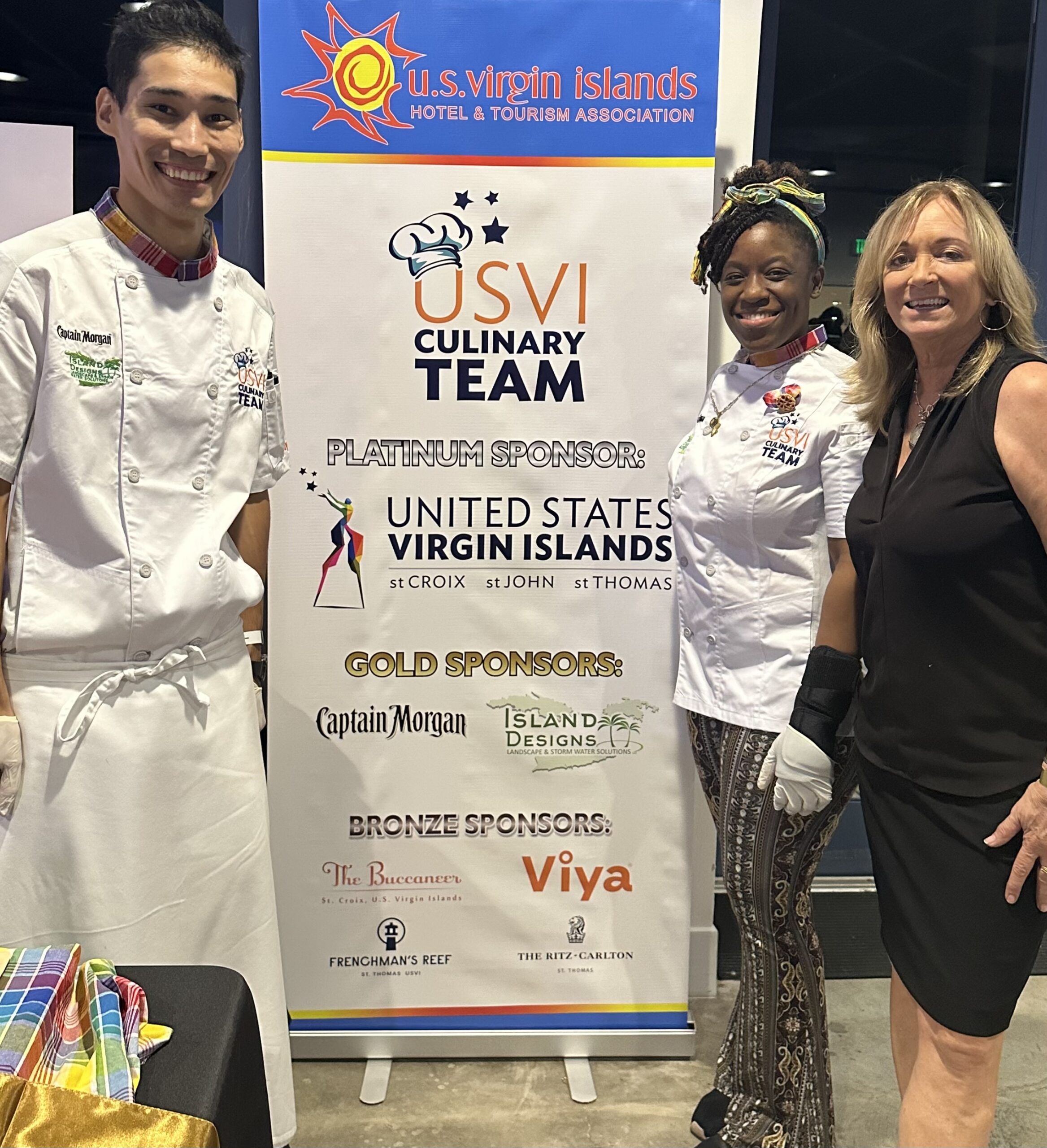
The U.S. Virgin Islands Culinary Team is set to compete at the Taste of the Caribbean in Miami, Florida, from Nov. 18 to 20, marking its return after a seven-year hiatus. The team, consisting of Chef Kerish Robles, pastry chef Azamat Sabyrkulov, and bartender Putrice Bush, has been preparing to bring home top honors in 2024, the Virgin Islands Hotel and Tourism Association (USVIHTA) announced.
From left, Pastry chef Azamat Sabyrkulov, chef Kerish Robles and USVIHTA President Lisa Hamilton at WTJX Channel 12’s Taste of Two Islands on Nov. 14. (Photo courtesy USVIHTA)
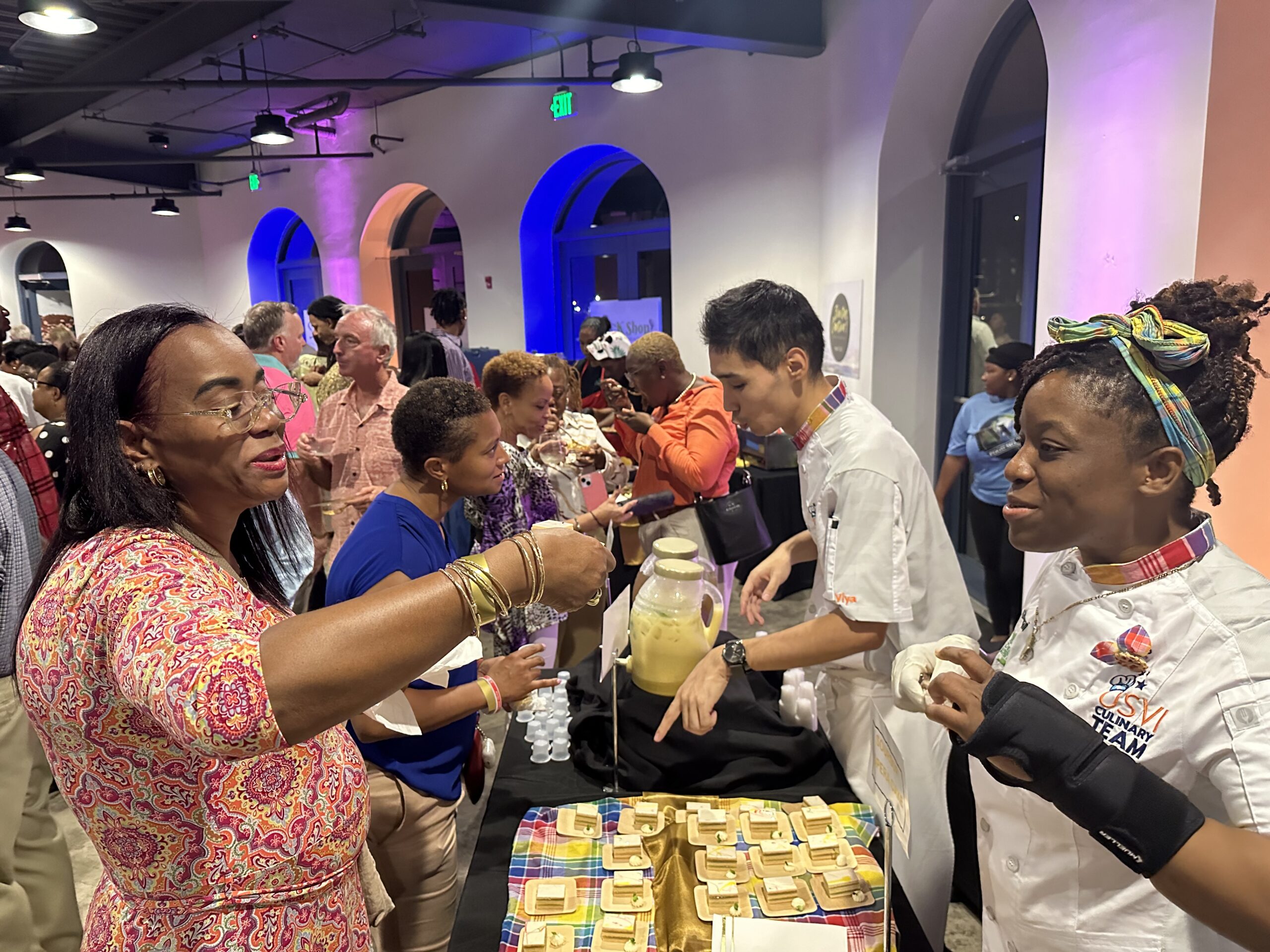
Sponsoring the team for 13 years, the USVIHTA supports these professionally trained chefs in the annual culinary competition where they will face off against other Caribbean nations. The event features various timed challenges assessing creativity, presentation, and showmanship, according to the press release.
“We have a spectacularly talented team representing the USVI this year. The 2024 team is comprised of dedicated professionals who have evolved their expertise in numerous settings spanning the globe. We are delighted to see what this group of brilliant and creative individuals will cook up at the Taste of the Caribbean competition,” said USVIHTA President Lisa Hamilton.
Chef Kerish Robles, who previously participated in the Junior Chef Competition at the Taste of the Caribbean, returns to the competition. Born and raised on St. Thomas, Robles is a certified vocational education teacher and culinary mentor with over 20 years of experience. Currently, she is developing a new culinary program for UVI CELL. Known for her innovative approach to cooking, Robles emphasizes unique flavors and elevating everyday ingredients, the press release stated.
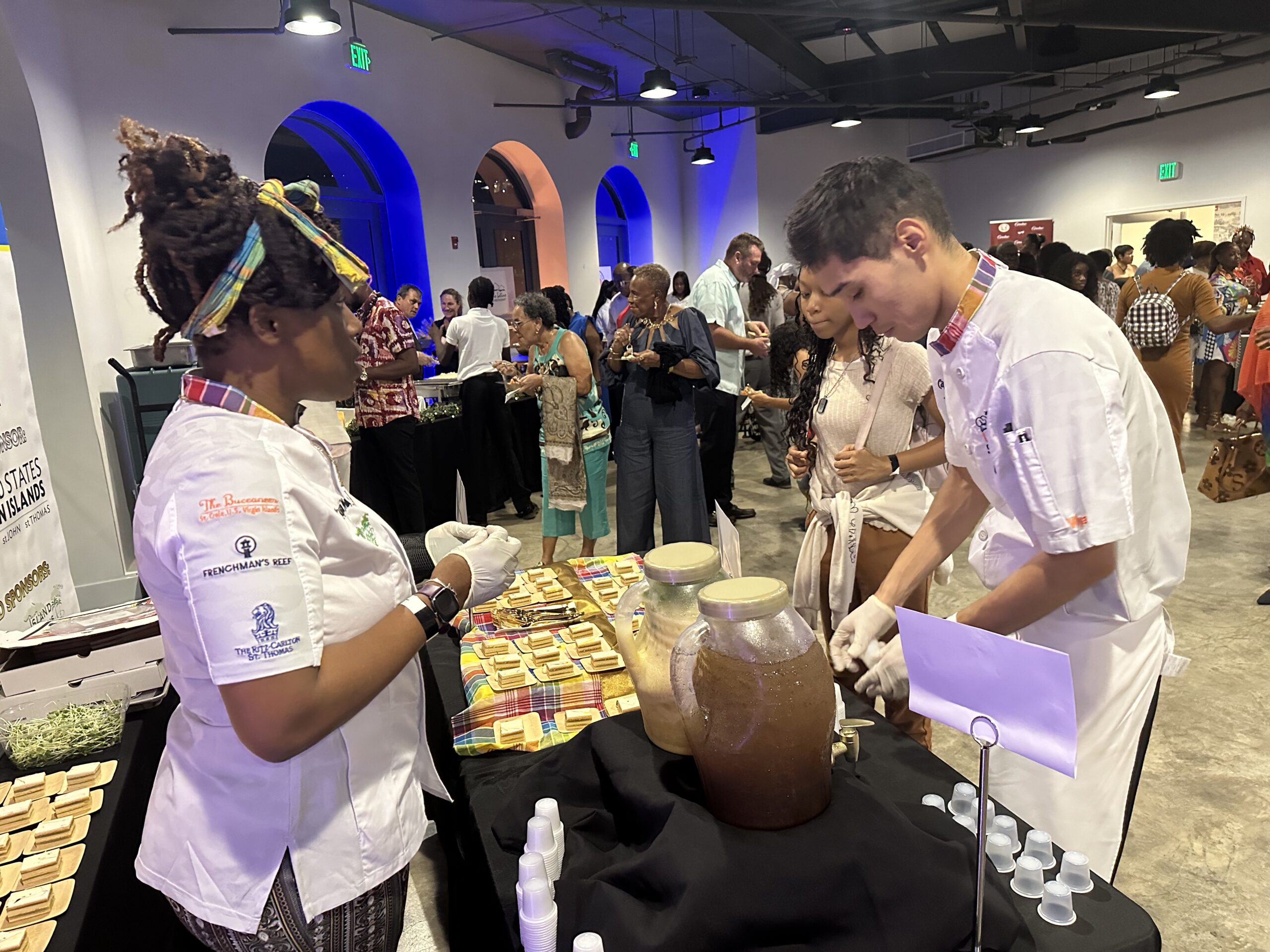
Chef Kerish Robles (front right) and pastry chef Azamat Sabyrkulov (back right) discuss their pastry dish at WTJX Channel 12’s Taste of Two Islands on Nov. 14. (Photo courtesy USVIHTA)
“Being a part of building up a home has always been the most exciting part of my career and the most honorable decision I made in bringing my talents home to boost our community rather than using them elsewhere,” said Robles.
International pastry chef Azamat Sabyrkulov, originally from Kazakhstan, currently serves as the pastry chef at The Ritz-Carlton, St. Thomas. He has previously worked at The Ajman Saray in Dubai and held a junior pastry sous chef position at The Ritz-Carlton, Abu Dhabi Grand Canal. Sabyrkulov earned his hospitality degree from the Hospitality Management Professional Technical College in Astana and won first place in the 2016 World Skills Kazakhstan Pastry Competition, specializing in cake artistry and chocolate, the release stated.
Chef Kerish Robles (left) and pastry chef Azamat Sabyrkulov (right) prepare for Taste of the Caribbean by participating in WTJX Channel 12’s Taste of Two Islands on Nov. 14. (Photo courtesy USVIHTA)
Talented bartender Putrice Bush, self-proclaimed “city girl turned island girl,” who began her career in Atlanta, Georgia, shifted to a professional bartending role at The Buccaneer on St. Croix four years ago. She is passionate about connecting with people by offering memorable experiences through cocktails and conversation, it said.
“Embracing the Caribbean culture while exploring new flavors and textures has been a truly unique highlight of my voyage,” said Bush.
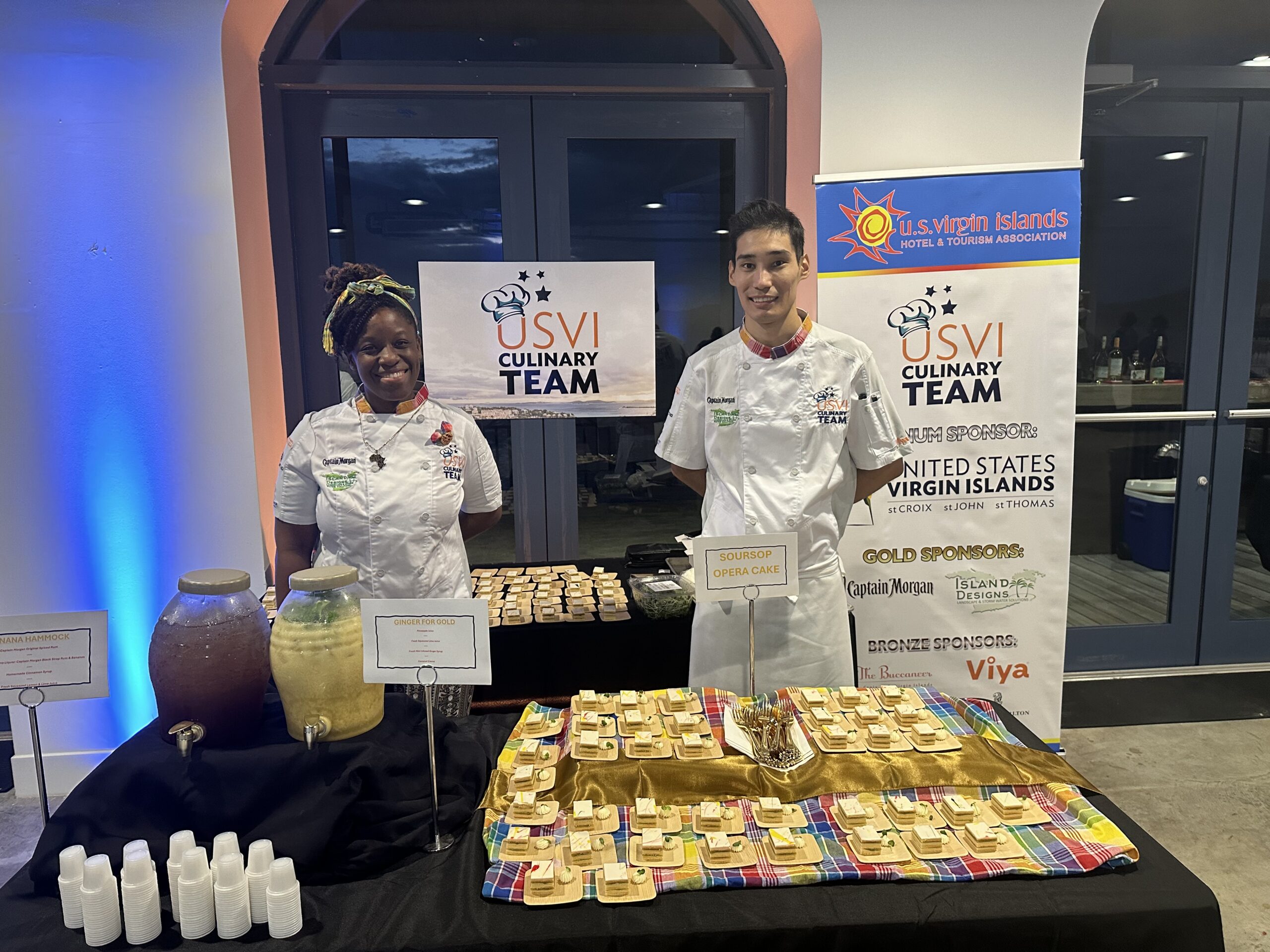
The team’s sponsors provide support for travel and accommodation, team jackets, fundraising, student apprentice training, and competition supplies. The USVIHTA expressed gratitude to the sponsors, including the USVI Department of Tourism (Platinum Sponsor), Captain Morgan, Island Designs Landscape & Storm Water Solutions LLC (Gold Sponsors), along with The Buccaneer, The Ritz-Carlton, St. Thomas, The Westin Beach Resort & Spa at Frenchman’s Reef, and VIYA (Bronze Sponsors), the release stated.
Form left, Chef Kerish Robles and pastry chef Azamat Sabyrkulov pose with their dishes and beverages at WTJX Channel 12’s Taste of Two Islands on Nov. 14. (Photo courtesy USVIHTA)
The Taste of the Caribbean event is organized by the Caribbean Hotel & Tourism Association and takes place alongside the Caribbean Hospitality Industry Exchange Forum, bringing together tourism and hospitality professionals to engage with Caribbean culture and discuss relevant industry topics, it said.
A St. Croix man wanted for murder was arrested Saturday, the V.I. Police Department reported.
On July 2, 2022, officers responded to the Juan F. Luis Hospital on St. Croix after two male victims arrived at the Emergency Room with gunshot wounds, according to the police report.
A Criminal Investigation Bureau detective’s investigation revealed that the suspect, Geraldo Jose Ojeda Montiel, and his accomplice engaged in an argument with the two victims at Yamasa Bar. Ojeda Montiel left the bar and returned with a firearm, shooting one victim in the back and the other in the foot, the police report stated.
The victim shot in the back fell to the ground, at which point Ojeda Montiel, operating a gray Toyota Tundra, struck him with the vehicle and ran over him. The suspects fled the scene in the Toyota Tundra and later abandoned the vehicle in the Work and Rest area. Both suspects escaped the territory on Montiel’s boat to St. Martin and subsequently disappeared, the report stated.
A warrant for Ojeda Montiel’s arrest was issued on Sept. 28, 2022. On May 9, agents from Customs and Border Protection apprehended him in Texas, charging him with illegal entry into the United States, for which he was detained for six months. He was extradited back to the Virgin Islands on Saturday, the report stated.
Ojeda Montiel, 34, was placed under arrest for attempted murder, booked, and transported to the John Bell Correctional Facility, pending his advice of rights hearing scheduled for Monday, it said.
Virtue of the Week – Diligence
Virtue of the Week focuses on building peaceful and caring communities through understanding and fostering the practice of virtues. The Source supports the Virtues Project and will publish one virtue developed by the project each week.
Diligence
Diligence is doing what needs to be done with care, concentration and attention. It springs from our desire for excellence. When we are diligent, we give our absolute best. We craft whatever we create with love. We work meticulously in alignment with our purpose. Diligence is needed in tending our relationships. We choose them with discernment, then give them our full commitment, joy, love and excellence to keep them strong.
Quote: “If you do not have time to do it right, when will you have time to do it over?”
-John Wooden
The Practice of Diligence
I give 100% to the work I do.
I strive for excellence.
I pay full attention to whatever I am doing.
I am conscientious and careful.
I work with love.
I give my best to relationships.
Questions for Discussion
What conditions empower me to work with diligence? What factors inhibit my ability to work with diligence?
What does working with love look like working at home, professionally, and in your closest relationships?
Is there anything from the past that is getting in the way of you doing your best?
Is there anything in your relationships that need tending to? What does that look like to tend to your relationships as a daily practice?
Sign up to receive the Virtue of the Week by email!
Visit https://cfvi.net/Virtues-Project and scroll to the end of the page to fill out the form.
Virtue of the Week is provided by the Community Foundation of the Virgin Islands (CFVI) in partnership with the VI Source and Virtues Matter.About the Community Foundation of the Virgin Islands
Since 1990, CFVI has been a catalyst for positive change in the territory through initiatives committed to youth, learning, family support and the environment. With a professional staff and a volunteer Board of Directors composed of community leaders, CFVI is a trusted advocate and supporter of programs that ensure opportunity and sustainability for current and future generations. CFVI is a registered non-profit organization entirely supported by individual donors, grants, trusts, corporate donations and estate planning. For more information, visit cfvi.net.
About Virtues Matter Virtues Matter was started by a passionate wife-husband team of social entrepreneurs seeking to positively uplift as many lives as possible. We aim to inspire and empower, to build capacity, strengthen relationships, and help everyone lead lives of passion and purpose.
Virtues Matter believes in a world where people are committed to kindness and respect, strive to be their best, and live with hope, courage and in unity. We built the Virtues Cards mobile app, an interactive personal and team development tool, to help people identify and develop key virtue skills. We also offer dynamic workshops, online training, and customized programs to help people cultivate these positive qualities of character. To learn more, visit virtuesmatter.com.
To learn more about the Virtues Project, visit www.virtuesproject.com.







 In her bi-weekly column, “State of the Territory,” former Sen. Janelle K. Sarauw delves deeper into issues of concern for V.I. residents.



 Virtue of the Week – Diligence
Virtue of the Week focuses on building peaceful and caring communities through understanding and fostering the practice of virtues. The Source supports the Virtues Project and will publish one virtue developed by the project each week.
Diligence
Diligence is doing what needs to be done with care, concentration and attention. It springs from our desire for excellence. When we are diligent, we give our absolute best. We craft whatever we create with love. We work meticulously in alignment with our purpose. Diligence is needed in tending our relationships. We choose them with discernment, then give them our full commitment, joy, love and excellence to keep them strong.
Quote: “If you do not have time to do it right, when will you have time to do it over?”
-John Wooden
The Practice of Diligence
I give 100% to the work I do.
I strive for excellence.
I pay full attention to whatever I am doing.
I am conscientious and careful.
I work with love.
I give my best to relationships.
Questions for Discussion
Virtue of the Week – Diligence
Virtue of the Week focuses on building peaceful and caring communities through understanding and fostering the practice of virtues. The Source supports the Virtues Project and will publish one virtue developed by the project each week.
Diligence
Diligence is doing what needs to be done with care, concentration and attention. It springs from our desire for excellence. When we are diligent, we give our absolute best. We craft whatever we create with love. We work meticulously in alignment with our purpose. Diligence is needed in tending our relationships. We choose them with discernment, then give them our full commitment, joy, love and excellence to keep them strong.
Quote: “If you do not have time to do it right, when will you have time to do it over?”
-John Wooden
The Practice of Diligence
I give 100% to the work I do.
I strive for excellence.
I pay full attention to whatever I am doing.
I am conscientious and careful.
I work with love.
I give my best to relationships.
Questions for Discussion
 About the Community Foundation of the Virgin Islands
Since 1990, CFVI has been a catalyst for positive change in the territory through initiatives committed to youth, learning, family support and the environment. With a professional staff and a volunteer Board of Directors composed of community leaders, CFVI is a trusted advocate and supporter of programs that ensure opportunity and sustainability for current and future generations. CFVI is a registered non-profit organization entirely supported by individual donors, grants, trusts, corporate donations and estate planning. For more information, visit
About the Community Foundation of the Virgin Islands
Since 1990, CFVI has been a catalyst for positive change in the territory through initiatives committed to youth, learning, family support and the environment. With a professional staff and a volunteer Board of Directors composed of community leaders, CFVI is a trusted advocate and supporter of programs that ensure opportunity and sustainability for current and future generations. CFVI is a registered non-profit organization entirely supported by individual donors, grants, trusts, corporate donations and estate planning. For more information, visit  About Virtues Matter Virtues Matter was started by a passionate wife-husband team of social entrepreneurs seeking to positively uplift as many lives as possible. We aim to inspire and empower, to build capacity, strengthen relationships, and help everyone lead lives of passion and purpose.
Virtues Matter believes in a world where people are committed to kindness and respect, strive to be their best, and live with hope, courage and in unity. We built the Virtues Cards mobile app, an interactive personal and team development tool, to help people identify and develop key virtue skills. We also offer dynamic workshops, online training, and customized programs to help people cultivate these positive qualities of character. To learn more, visit virtuesmatter.com.
To learn more about the Virtues Project, visit
About Virtues Matter Virtues Matter was started by a passionate wife-husband team of social entrepreneurs seeking to positively uplift as many lives as possible. We aim to inspire and empower, to build capacity, strengthen relationships, and help everyone lead lives of passion and purpose.
Virtues Matter believes in a world where people are committed to kindness and respect, strive to be their best, and live with hope, courage and in unity. We built the Virtues Cards mobile app, an interactive personal and team development tool, to help people identify and develop key virtue skills. We also offer dynamic workshops, online training, and customized programs to help people cultivate these positive qualities of character. To learn more, visit virtuesmatter.com.
To learn more about the Virtues Project, visit