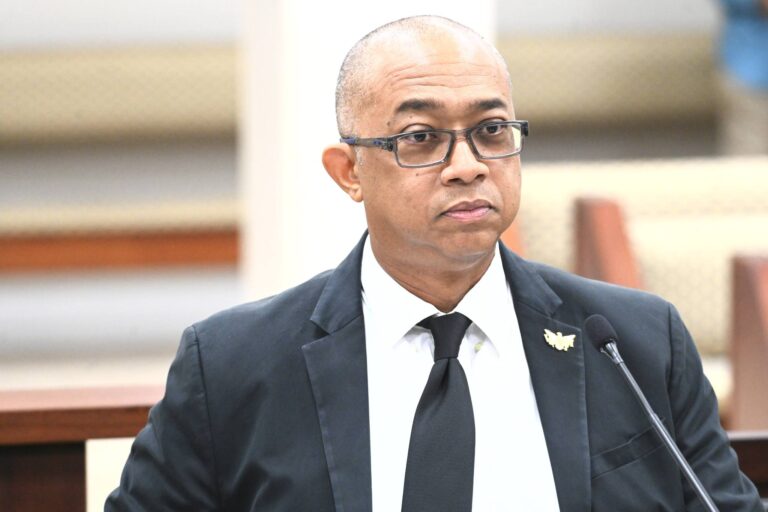
Senate Majority Leader Kenneth L. Gittens is calling on the Supreme Court of the Virgin Islands to render its opinion in the case, which focuses on the validity of Act 8472 – Legislation to reorganize the composition of the Water and Power Authority Board, he announced Friday.
“Parties in the suit argued their case before the esteemed appellate panel on March 12 and we are now more than 100 days past that date, and it is time that we put this issue to rest,” Gittens said. “Justice delayed in this instance is certainly a case of justice denied for the people of the territory who have been held hostage by WAPA for too long.”
Act 8472 was passed into law unanimously by members of the 34th Legislature on Aug 3, 2021, after previously being vetoed by Gov. Bryan. The legislation restructures the WAPA Board to afford greater independence and establishes professional criteria for those who serve. Following the unanimous override of the veto, the administration took steps to prevent the implementation of the new law by filing for both a temporary restraining order and a permanent injunction with the Virgin Islands Superior Court of the Virgin Islands but did not prevail and later appealed the lower court’s decision, according to the press release.
Gittens said he and his colleagues acted in the best interest of the ratepayers when the bill was approved by the full body more than three years ago. He added that today, the State of Emergency on WAPA expires, and with that expiration, it is automatically extended for an additional 30 days. The administration has already petitioned the Legislature, seeking to have the State of Emergency extended for an additional 90 days, the press release stated.
“It is time to reform the authority and bring relief to the residents of this territory,” Gittens said. “This refusal to follow the law and this delay rendering an opinion is costing our territory and our people time and money.”
Virtue of the Week – Awe
Virtue of the Week focuses on building peaceful and caring communities through understanding and fostering the practice of virtues. The Source supports the Virtues Project and will publish one virtue developed by the project each week.
Awe
Awe is deep respect and reverence for the Source of life. It is humility and wonder before the power of God. Contemplating life’s beauty and mystery leads us to communion. Reflecting on our place in the universe, we seem small and insignificant, yet it is awe-inspiring to realize that no one else on earth is just like us. Each of us has a unique potential for reflecting the Divine virtues in our souls. We awaken them by choosing to live them. When we practice awe, we are alert to the signs and wonders placed in our path. We open ourselves to Grace.
Quote: “The highest point a man can attain is not Knowledge, or Virtue, or Goodness, or Victory, but something even greater, more heroic and more despairing: Sacred Awe!” -Nikos Kazantzakis
The Practice of Awe
I am humble before the power of the Creator.
I take time to contemplate and commune.
I am aware of the sacredness of life.
I cultivate the Divine virtues in my nature.
I discern the signs and synchronicities of life.
I deepen my connection to Grace.
I am thankful for the gift of Awe. It fills me with wonder.Questions for Discussion
How can we use reflection to strengthen our community?
In our community, do we offer space to celebrate our lives?
Through the lens of social justice, how do we honor everyone’s unique potential?
How do we leave space for grace in our interactions?
Sign up to receive the Virtue of the Week by email!
Visit https://cfvi.net/Virtues-Project and scroll to the end of the page to fill out the form.
About the Community Foundation of the Virgin Islands Since 1990, CFVI has been a catalyst for positive change in the territory through initiatives committed to youth, learning, family support and the environment. With a professional staff and a volunteer Board of Directors composed of community leaders, CFVI is a trusted advocate and supporter of programs that ensure opportunity and sustainability for current and future generations. CFVI is a registered non-profit organization entirely supported by individual donors, grants, trusts, corporate donations and estate planning. For more information, visit www.cfvi.net.
About Virtues Matter Virtues Matter was started by a passionate wife-husband team of social entrepreneurs seeking to positively uplift as many lives as possible. We aim to inspire and empower, to build capacity, strengthen relationships, and help everyone lead lives of passion and purpose.
Virtues Matter believes in a world where people are committed to kindness and respect, strive to be their best, and live with hope, courage and in unity. We built the Virtues Cards mobile app, an interactive personal and team development tool, to help people identify and develop key virtue skills. We also offer dynamic workshops, online training, and customized programs to help people cultivate these positive qualities of character. To learn more, visit virtuesmatter.com.
To learn more about the Virtues Project, visit www.virtuesproject.com.
The Source Arts & Literature section highlights the work of our creative readers. All visual artists and creative writers are encouraged to share with us new works. Please see below for full submission guidelines.
PAY DAY
The best things in life, they tell me, are free,
But it’s becoming less a reality.
For many persons it seems to be
That the best things in life need lots of money.
For money, my friend, can be prized more than gold,
And many, to maintain it, would pawn their very soul.
Essential to this world it is, just like gravity,
But what you do to get it doesn’t require honesty.
There are those you will find who make more than most,
With multiple perks of which they can boast.
Yet, for them this lifestyle still falls short,
And with their hands in the cookie jar they are caught.
Conflict of interest, does that really exist?
Or just a routine way of doing business.
You wash my hands, I wash yours.
This type of hygiene doesn’t wash away germs.
Values and virtues abandoned for vice.
Immediate gratification, no sacrifice.
And many enablers who turn a blind eye,
So they all can enjoy a piece of the pie.
They have plenty of dollars but so little sense,
For deeds committed there’s a consequence.
In the face of such wanton gluttony,
There is little room for integrity!
A lavish lifestyle is one to envy,
Only if you make it your priority.
Love of service, or love of self?
All for you and yours and no one else.
When you go to the gravesite, what do you see?
The question: “Whose shall these things be?”
Cars, bank accounts, houses and lands…
You: six feet under with two empty hands.
Be very wise about how you invest.
The best dividend is true happiness.
Peace of mind, an asset that won’t depreciate.
Contentment comes with having a clean slate.
Sandra C. Bradley is a Source reader who loves to explore the power of words, the pits of an avocado and the peacefulness of nature.
Poetry and creative prose submissions are limited to 1,500 words and should include a brief bio of the writer. Visual art submissions should include at least one high-quality image or video and a very brief bio along with an artist’s statement that speaks to the inspiration of the work. The statement should include the title if there is one, the medium used and what the work means to you.Please send submissions and questions to visourceart@gmail.com.
The police arrested two suspects in connection with the theft of a vehicle on St. John, the V.I. Police Department reported.
On June 20, at approximately 1:49 p.m., VIPD was dispatched to the Marketplace in the area of the St. John Hardware store in reference to a stolen vehicle. The responding unit met with the complainant, who stated that she parked her rental vehicle, a gray Kia Soul, with a small terrier dog inside, at the upper parking lot in front of St. John Hardware, according to the police report.
The complainant also indicated that she left Amie Vieira, who was later identified as one of the suspects, inside of the vehicle. The complainant went on to state that she walked to the nearby store to pick up food; however, upon her return, the vehicle was removed from the area, the police report stated.
On June 2, the stolen vehicle was observed around the bottom of Black Point Hill on St.
Thomas, with two occupants inside. Vieira and Richie Welsh were detained and transported to the Criminal Investigation Bureau, located at the Richard Callwood Command. Vieira, 40, was arrested for unauthorized use of a vehicle, grand larceny and possession of a stolen vehicle. Welsh, 60, was charged with aiding and abetting for each charge, the report stated.
Unable to post bail of $25,000, Vieira and Welsh were turned over to the Bureau of Corrections pending their advice of rights hearing, police said.
Youth Advisory Council meeting on St. John in 2014. (Source file photo)
Dear Editor,
I write this Op-Ed not only as a Virgin Islander but as a Voice for my fellow peers in our community. I have the distinct pleasure of serving as Youth Chairperson on the Legislative Youth Advisory Council, however, my members and I have been unable to convene as we are now in the 35th Legislature. I have been in this fight to get the Legislative Youth Advisory Council restored, so the members and I can continue to work on behalf of our peers. To fully understand my level of disappointment and frustration, let’s go back to the beginning of this journey.
Early June of 2021, Advertisement regarding the Reinstatement of the Legislative Youth Advisory Council was shared via newspapers and social media news outlets, along with the Official Facebook page of the Legislature of the Virgin Islands. Many individuals including myself applied to serve, got appointed on September 30, 2021 by then Senate President Donna Frett -Gregory and met on Thursday, October 21, 2021 at the Respective locations in the Territory.
The Members and I met, introduced ourselves and were ready for the next step. As weeks passed by, COVID-19 cases increased, and our meeting for December was postponed, and rescheduled for a virtual meeting in January 2022. That meeting occurred on Tuesday, January 4, 2022. This meeting allowed us to recap what was discussed from the last meeting in October. As more Weeks passed by, we received an email scheduling a meeting for Sunday, March 2, 2022 to meet and recap the last meeting’s agenda and to complete new business. In this meeting, we heard nominations for the leadership positions of the council. The meeting concluded and the next one was scheduled for Sunday, March 13, 2022. At this meeting, we talked about the standing Committees we were considering having in the Council and who might be the chairpersons of each one. After this meeting concluded, we scheduled our next meeting for Sunday March 20, 2022. In this meeting, we unofficially voted for the leadership of the council, and I became Youth Chairperson. The following week, a meeting was held to unofficially vote on the Chairs and Vice Chairpersons of the standing Committees of the council.
Throughout the next scheduled meeting days, Sunday, April 3 and Sunday, April 24, 2022, we went over Parliamentary Procedures and preparations in anticipation for our Pinning Ceremony.
As Weeks went by again, we finally received an email for a scheduled meeting on Thursday, June 2, 2022 to go over finalized changes and updates for the Pinning Ceremony scheduled the following Tuesday. June 6, 2022 came, and we were officially pinned as Council Members and officially voted on the leadership and standing Committees of the Council. After this ceremony, our next meeting was scheduled and held on Thursday, June 16, 2022 to discuss the ceremony and for the first meeting of the Economical, Environmental and Industrial Development Committee.
After this meeting, the Legislative Youth Advisory Council hasn’t met as a group in a meeting since. That was Two Years and some days ago, and haven’t even fulfilled the requirements of the law that created and established this organization. I have sent letters and emails requesting updates, former Senator Genevieve Whitaker has sent letters on behalf of the youth as well to current Senate President Novelle Francis and Senator at Large Angel Bolques. I decided to create a petition to get signatures to Reinstate the Council. However, the lack of attention for the youth from both the Legislative and Executive Branches are concerning, because the Governor, Albert Bryan Jr., has failed in this area as well. He has the duty to reinstate the Youth Commission and has failed to do so. He created the Millennial Council, but you hardly see or hear from any of them. When are we going to begin to follow the laws, because right now you are violating them. The Sections of the VI Code which speaks to the establishment and creation of Youth Council and Commission are listed below;
27. Virgin Islands Commission on Youth
(a) There is established within the Office of the Governor, the Virgin Islands Commission on Youth, hereinafter referred to as the “Commission.”
The Commission is a nine member governing board appointed by the Governor with the advice and consent of the Legislature. At least five of the members must, at the time of appointment be between the ages of 14-24; at least two of the members must be regularly enrolled, full time students at the University of the Virgin Islands who are United States citizens; four members must be residents of the island of St. Thomas, four must be residents of the island of St. Croix; and one must be a resident of the island of St. John or a person with a disability who shows interest.
(1) Of the members first appointed, three shall serve terms of two years, four shall serve terms of three years and four shall serve terms of four years. Terms thereafter are four years, except that each member shall serve until the member’s successor is appointed and qualified in the same manner as original appointments are made.
(2) Hereunder, provided that no member shall serve more than 90 days beyond the expired term and any action taken by the Commission wherein a vote was cast by a member whose term expired is void Ab initio. A member may be removed by the Governor for neglect of duties, malfeasance or for other good and sufficient cause. Any person appointed to fill a vacancy occurring before the expiration of the term for which the person’s predecessor was appointed shall serve only the remainder of such term.
(3) The members of the Commission shall, at the first Commission meeting, select a Chairperson from among their number. The term of the Chairperson is two years. A quorum for the purpose of conducting the business of the Commission consists of six members. The Commission shall meet at least once every three months, and more often at the call of the Chairperson or upon the request of at least six of the members.
(4) Each appointed member of the Commission is entitled to receive a per diem of $75 per meeting for each day or part of a day spent in the performance of official duties, and, in addition, each appointed member is entitled to receive actual and necessary travel expenses incurred in the performance of official duties; at the discretion of the Governor.
(5) Reference to the Commission in the remainder of this section must be construed to include any person authorized to act for the Commission, including the Director or any of his assistants.
(b) The Commission is the sole Virgin Islands governmental agency for the initiation, implementation, administration, supervision coordination and monitoring of programs, services and activities oriented exclusively toward “youth services” and which are publicly funded, in whole or in part, but excluding those programs or activities for which other provision is specifically made by this Code. The Commission has powers and duties:
(1) To monitor and evaluate all new and all existing youth programs, services and activities whether locally or federally funded, for the purpose of determining the effectiveness of same, and in connection therewith to submit a report to the Governor, the Legislature and the Director of the Budget by January of each year containing detailed results of those evaluations as well as recommendation for the alteration or discontinuance of existing programs, services and activities or the establishment of new programs, services and activities;
(2) To study, collect, maintain, publish and otherwise disseminate statistical data and pertinent information relative to all aspects of youth activities and problems, including social, economic, educational, employment, recreational and physical and behavioral health needs and opportunities for young people;
(3) To serve as the sole agency through which various public and nonpublic organizations concerned with young people can obtain and exchange information, coordinate programs and enter into joint endeavors;
(4) To provide consultation and assistance to other organizations which are concerned with or may be interested in providing programs, services, activities or facilities for young people;
(5) To coordinate all programs, services and activities under its jurisdiction with the programs, services and activities of other governmental and nongovernmental entities;
(6) organizations to permit the efficient and effective functioning of all such programs, services and activities in a manner which will promote economy and prevent duplication of efforts;
(7) To promote employment and training opportunities in cooperation and coordination with other public and private agencies as well as opportunities for the proper use of leisure time for young people, including opportunities for volunteer work by said young people;
(8) To identify research needs; encourage research; assist in obtaining funds for research and demonstration projects; and establish and participate in the establishment of those projects;
(9) To provide such special personnel training as is necessary to carry out the programs, services and activities of the Commission;
(10) To plan, implement, administer and supervise a summer youth employment program, undertaken in such manner as the Commission considers appropriate and pursuant to rules and regulation promulgated by it;
(11) To accept gifts, donations, contributions, bequests, devises or other monies for expenditure for the purposes for which they are provided or as the Commission sees fit in executing its duties under this section;
(12) To plan, establish, administer and supervise programs and activities providing special services for youth, including, youth centers, counseling and referral services, outreach programs, volunteer activities and those encouraging community involvement;
(13) To cooperate with the federal government, its agencies and instrumentalities and with other public and private agencies in establishing, extending and strengthening various youth activities, services and programs; and
(14) To perform such other functions and duties as the Governor may from time to time prescribe or may be required by law.
(c) The Commission constitutes the sole government agency of the Government of the Virgin Islands for participation in all federal programs and for receipt of federal funds for youth programs, when such programs relate exclusively to youth and require action within the Virgin Islands, and when such programs are not the specific responsibility of a federal agency located within the Virgin Islands.
(d) The Governor, upon recommendation of the Commission and subject to confirmation by the Legislature, shall appoint an Executive Director of the Virgin Islands Commission on Youth. The Executive Director must be a person qualified by education, training and experience in the administration, coordination and supervision of youth programs. The salary of the Executive Director is provided by appropriation. The Executive Director must be provided with such assistants, secretarial and other personnel, office space and equipment, subject to appropriations as is necessary for the proper performance of his duties pursuant to this section.
(e) The Executive Director shall act in the name of the Commission, and has the following powers and duties:
(1) To administer all policies, programs services and activities of the Commission on a day to day basis, subject to such general guidelines as the Commission may establish, but exercising such discretion and making such management decisions as are necessary to the proper execution and operation of Commission programs, services, activities and policies;
(2) To attend all Commission meetings and submit such reports and make such recommendations with regard to youth programs, services and activities as may be requested by the Commission;
(3) To provide for the detailed administration and close supervision of youth programs, services and activities under the jurisdiction of the Commission and for the monitoring of other programs, services and activities with which the Commission is coordinating its programs, services and activities;
(4) With the cooperation of the Director of the Budget, to identify all funds, personnel, records, equipment and other resources of the Government of the Virgin Islands which provide services to youth and to report his findings in this regard to the Commission in order that steps may be taken, where necessary and appropriate, to obtain statutory or other authority to transfer funds, personnel, records, equipment and other resources to the jurisdiction of the Commission when such transfers are consistent with the intents and purposes of this section;
(5) To cooperate and collaborate with the Commissioner of Housing, Sports and Recreation, The Commissioner of Police and the Commissioner of Human Services in the administration, implementation and supervision of existing recreational programs, services and activities for youth, and in the planning, establishment and implementation of new recreational programs, services and activities for youth where considered necessary or desirable; and
(6) To perform such other functions and duties as may be assigned to him by the Commission.
Legislative Youth Advisory Council
151. Duties
The Council shall perform the following duties:
(a) Advise the Legislature on proposed and pending legislation, budget expenditures and policy matters related to youth;
(b) Consult with study commissions, committees and task forces regarding issues related to youth;
(c) Conduct periodic seminars for its members regarding leadership, civic, government and the Legislature;
(d) Meet at least 3 times but not more than 6 times per year, including not more than 2 public hearings on issues of importance to youth in the legislative chambers, one on the island of St. Croix and one on the islands of St. Thomas. However the council may meet up to an additional 3 times in a year if the Executive Director of the Legislature determines that sufficient budgeted resources remain after paying all costs associated with the initial 6 meetings to pay any additional costs associated with any additional meetings; and
(e) Report annually to the Legislature on its activities by December 1st of each year. The council may submit proposed legislation as part of its report to the Legislature to implement its recommendations.
153. Jurisdiction
The Council shall examine issues of importance to youth, including, but not limited to, education, employment, entrepreneurship, strategies to increase youth participation in Government, safe environments for youth, substance abuse, emotional and physical health, foster care, poverty, homelessness and youth access to services territory-wide.
2 V.I.C. § 154
Virgin Islands Code Annotated
TITLE TWO Legislature (Chs. 1 — 12)
Chapter 9. Legislative Youth Advisory Council (§§ 150 — 163)
154. Membership
(a) The Council consists of 16 voting members who are Virgin Islands residents and appointed in accordance with this subsection. In appointing members, the appointing authorities shall consider geographic distribution. All youth and legislative appointments must be made within 180 days after the convening of each new term of the Council.
(b) All appointments are for the duration of the legislative term for which the members are appointed and expire upon the appointment of new Council members by the next Legislature.
(c) The appointing authorities shall select youth members from youths recommended by principals, guidance counselors or administrative heads of secondary or postsecondary school systems, representatives of equivalent instruction programs or other organizations having an interest in youth activities.
(d) Members may be reappointed to subsequent terms on the Council as long as they are eligible at the time of their reappointment.
(e) The Selection Committee shall appoint the following 20 members:
(1) Sixteen youths who have attained 14 years of age but not older than 23 years of age, and who are enrolled in programs that lead to a secondary school diploma or certificate of attendance or a general equivalency diploma, or enrolled at a postsecondary educational institutions located in the Virgin Islands with 8 being from the St. Croix District and 8 from the St. Thomas/St. John District provided that at least one member is a resident of the island of St. John; and
(2) Four members of the Legislature serve as non-voting ex officio members.
(f) Chairs. There is a legislative chair and a youth chair of the Council. The members shall elect one of their youth members to serve as the youth chair.
(g) Tie or Split Vote. In the event of a tie or split vote, the non-voting ex officio members of the Legislature, excluding the legislative chair, shall serve as the tie-breaker.
So, As I close, this is a public request to all that have the authority to change this ongoing process, to please do so, because the young people deserve it, and they have a fighter, me!
Anthony Mardenborough Jr. is a Secondary Education Teacher, Nonprofit Founder and Executive Director, and a Candidate for the Board of Elections.
Check out our weekly weather forecast with Jesse Daley, covering Sunday, June 23, through Saturday, June 29. Our YouTube playlist is updated every week, AND check out Jesse’s daily weather updates here.
BIR Director Joel Lee said not many tax checks are bouncing. (V.I. Senate photo)
Joel Lee, director of the Bureau of Internal Revenue, told the Committee on Budget, Appropriations, and Finance that his bureau did not have a problem with bouncing checks.
Kevin McCurdy, the commissioner of Finance, told the same committee earlier in the week that the government had accepted over $2 million in bad checks this fiscal year, and BIR had accepted most of them. His comments raised the concern of Finance Committee Chair Sen. Donna Frett-Gregory, who said something had to be done. She suggested that it become the government policy that if a check is over $25,000, it must be a cashier’s check.
The government has a service, Telecheck, that guarantees checks under that amount.
Lee said Friday most checks that BIR receives that must be returned are not for insufficient funds. They are for minor mistakes—wrong dates or missing signatures—and can be easily rectified. Lee said that of the $1.7 million returned checks the bureau received last fiscal year, $900,000 worth was quickly corrected.
Lee said he would not recommend requiring cashiers’ checks for amounts over $25,000 because doing so would just add an extra burden on taxpayers.
Lee added that writing a bad check to the Bureau is not like writing a bad check to a business. A person writing a bad check to a business walks away with something “tangible,” a product. A person writing a bad check to the Bureau still owes the tax.
However, even if the Bureau has no problem with bounced checks, it is owed about $150 million in back taxes.
Lee said tax debt is less than 1 percent of what is billed. The Bureau predicts collecting $855 million in taxes in the upcoming fiscal year. It collected $829 million in fiscal year 2023.
Lee testified, “We paid $15 million in refunds for this fiscal year. Currently, the Bureau has $68 million in refunds processed and ready to be paid.”
The Bureau requests that its entire $13 million budget be funded from the general fund. This is a decrease from the FY 2024 budget recommendation of $14.4 million.
Eighty-two percent of the budget, $10.6 million, is for personnel services. There are 152 positions: 101 in St. Thomas, 50 in St. Croix, and 1 in St. John. There are 31 vacancies. Some of the vacancies are cut in the proposed budget. Only 134 positions are requested to be funded.
Supplies are budgeted at $224,500, other services and charges at $1.9 million, and utilities at $93,601.
Travel and cash advances are budgeted at $30,000; advertising is budgeted at $10,000 and printing costs are budgeted at $5,000.
Rental obligations include properties on St. Thomas and St. Croix totaling $889,129 for fiscal year 2025.
Senators attending the committee hearing included Frett-Gregory, Novelle Francis, Diane Capehart, Dwayne DeGraff, Ray Fonseca, Kenneth Gittens, Javan James, and Carla Joseph.
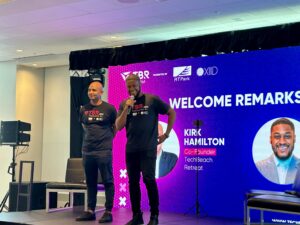
Co-founders of TBR Kirk Hamilton and Kyle Maloney, provide welcome remarks to the audience. (Source photo by Nyomi Gumbs)
The V.I.’s inaugural Tech Beach Retreat (TBR) USVI Summit in partnership with UVI Research and Technology Park (RTP), drew entrepreneurs and innovators from around the globe to the Westin Beach Resort in St. Thomas this past week.
During the three-day event from Wednesday through Friday, attendees immersed themselves in a dynamic environment of collaborative brainstorming, information sharing, and networking.
The agenda was packed with comprehensive and enlightening discussions, starting with several key leaders outlining the V.I.’s vision for a resilient, technology-driven economy.
Michelle Francis, executive director at the Office of Health Information Technology, shed light on the healthcare sector’s advancements and challenges. “Our hospitals and health centers in the USVI, and about 60 percent of our physicians do have electronic medical records—integrating them is the problem,” she explained. “We are about to launch our first-ever health information exchange. It has been a 20-year journey for the Virgin Islands to go from a fragmented process…to now incorporating telemedicine and integrating our siloed data sources for a holistic picture.”
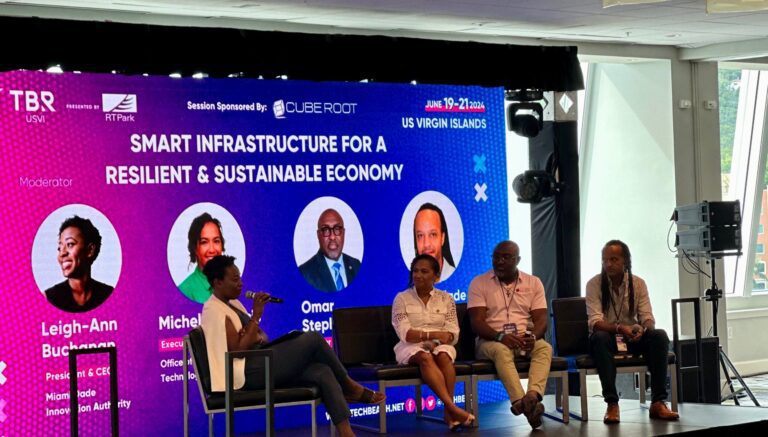
From left, Leigh-Ann Buchanan, president and CEO at Miami Innovation Authority, Michelle Francis, executive director at Office of Health Information Technology USVI, Omar Stephenson, founder and CEO at CubeRoot and Daryl Wade, CIO at VI Next Generation Network. (Source photo by Nyomi Gumbs)
Siobhan Cioppa, associate director of Business Development at RTP, further emphasized the crucial role of tech partnerships in revitalizing struggling industries in the V.I. “Over the last several years, our medical technology center has really grown, and it says something that we [actively seek] companies in that sector because healthcare is such a dire need here,” she said. “If we can bring in companies with professionals who are experienced and have knowledge and are building things in the med tech field, that’s helpful, and that also means we’re bringing people to the territory who have healthcare experience.”
From left, Shaun Van Weelden, Human Data and Former Open AI, Mark Minevich, president & GP at Going Global Ventures and AI contributor at Forbes, and Juan Manuel Rodriguez, senior manager ISOC at Liberty Latin America. (Source photo by Nyomi Gumbs)
As tech continues to be integrated, and more specifically generative artificial intelligence, into society’s framework, Mark Minevich, president at Going Global Ventures and AI contributor at Forbes, discussed how governments can spearhead progress by re-educating the younger generation for a rapidly evolving job market. Shaun Van Weelden from Human Data noted, “If you were in a small town and your teacher didn’t know about [something], well you’re out of luck. Now, AI can continue that knowledge, so the only limit is…how fast you can learn, and that’s a cool opportunity for both adults and young children trying to learn in this new world that we’re finding ourselves in.”
Juan Manuel Rodriguez, senior manager ISOC at Liberty Latin America, provided some practical AI applications for smaller businesses in the Caribbean. “Microsoft is now including Copilot as part of Windows and Office, so it’s very simple to start using AI in Excel [for instance] to improve how you do the analysis of your numbers, budget and so on.”
Delving a bit deeper into how businesses can set themselves up for success, investor and TBR panelist Junior Gaspard, born and raised in St. Croix, stressed the importance of showing employees what excellence looks like in execution, design, delivery, and customer success. “Investing in your employees and creating an environment where radical candor is supported is key,” he said.
From left, Kirk Hamilton, co-founder of TBR, Tamra James, general manager and senior research analyst at 13D Research and Richard Powell, founder and executive chairman of APCH Holdings. (Source photo by Nyomi Gumbs)
As another part of the business success formula, Richard Powell, founder and executive chairman of APCH Holdings, underscored three critical elements: business collaboration, radical transparency, and being obsessively customer focused. “In today’s world, collaboration and strategic partnerships are far more powerful than a ruthless winner-takes-all approach in the marketplace.”
Concluding three days of engaging panelist sessions, lively fireside chats and valuable networking events, the event represented a new hub for connection and collaboration within the tech ecosystem in the territory.
While generators can be extremely useful when the power is off, improper use can be dangerous and even deadly. A common risk associated with fuel-powered generators is carbon monoxide poisoning.
“Carbon monoxide, also known as CO, is called the ‘invisible killer,’ because it’s a colorless, odorless, poisonous gas,” according to information from the United States Consumer Product Safety Commission. “More than 200 people in the United States die every year from accidental non-fire related CO poisoning associated with consumer products. Nearly 100 of those deaths are linked to portable generators,” the CPSC said.
The CPSC explained that toxic CO fumes released from portable generators operating on fuel, including gasoline, propane, or diesel, can emit high amounts of poisonous gas.
“Many Americans own portable generators to keep the power on after a storm,” the CPSC stated. “However, many people don’t realize that one portable generator [which operates on fuel] can produce the same amount of carbon monoxide as hundreds of cars.”
The CPSC offers the following advice to ensure that a generator is being utilized safely and to avoid exposure to carbon monoxide:
Never use portable generators inside homes or garages, even if doors and windows are open. Use generators outside only, at least 20 feet away from homes with exhaust facing away.
Install battery-operated CO alarms or CO alarms with battery backup on every level of the home and outside sleeping areas. Interconnected CO alarms are best; when one sounds, they all sound.
Know the symptoms of carbon monoxide poisoning: headache, dizziness, weakness, nausea, vomiting, sleepiness, and confusion. If you suspect CO poisoning, get outside to fresh air immediately, and then call 911.
Notably, generators that operate on solar power do not emit any amount of poisonous gas and can be a good option for residents across the territory to consider.
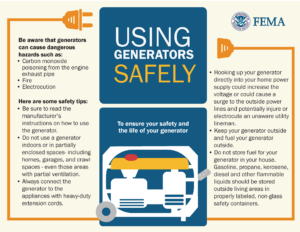
Operating a generator safely can help reduce risks of carbon monoxide poisoning, fires, or electrocution. (Photo courtesy FEMA)
The Federal Emergency Management Agency notes that using a generator can pose additional hazards, including possible electrocution or fire risk. To help avoid an electrical shock, FEMA offers the following safety information:
Always connect the generator to appliances with heavy-duty extension cords.
Hooking up your generator directly into your home power supply could increase the voltage or could cause a surge to the outside power lines and potentially injure or electrocute an unaware utility lineman. It also bypasses some of the built-in household circuit protection devices. Connecting the generator to your home could cause a surge in electricity that might result in injury or death to yourself or your family.
Use a qualified electrician to install the appropriate equipment in accordance with local electrical codes or ask your utility company to install an appropriate power transfer switch.
Additionally, it is essential to operate a generator in a dry area to help avoid the risk of electrocution.
FEMA also shares the following tips to help avoid a potential danger of fire due to generator use:
Keep your generator outside and fuel your generator outside.
Do not store fuel for your generator in your house. Gasoline, propane, kerosene, diesel, and other flammable liquids should be stored outside living areas in properly labeled, non-glass safety containers.
Do not store fuel near a fuel-burning appliance, for example a gas stove.
If the fuel is spilled or the container is not sealed properly, invisible vapors from the fuel can travel along the ground and be ignited by the appliance’s pilot light or by arcs from electric switches.
Before refueling the generator, turn it off and let it cool down. Gasoline or other flammable liquids spilled on hot engine parts could ignite, and invisible vapors from the fuel can travel along the ground and be ignited by the generator’s pilot light or by arcs from electric switches in the appliance.
Generator safety tips from the National Weather Service and the National Oceanic and Atmospheric Administration. (Photo courtesy NWS)
Generator Maintenance
In addition to understanding how to use a generator properly, regular machine maintenance is essential to ensure reliability and safety.
Consumer Reports, described as “an independent, nonprofit member organization that works side by side with consumers for truth, transparency, and fairness in the marketplace,” shares helpful information about generator maintenance. The organization offers recommendations, including testing the machine at least twice a year and emptying the fuel tank when not in use. Replacing and cleaning generator components is also advised.
“In addition to replacing or cleaning all parts, check the engine oil level and add just enough to bring it to the ‘full’ mark on the dipstick,” according to information available online from Consumer Reports. “If you can’t diagnose the generator’s ailment after your test run, contact the company if it’s still under warranty, or reach out to a repair shop,” Consumer Reports added.
Wardell also explained that, depending on the type of machine, oil changes should be conducted at least once per year or every 250 hours of use. She advises residents in the territory to keep oil filters on hand during an extended power outage, such as in the aftermath of a hurricane.
A generator should only be used in a dry area, and away from water or wet conditions. Wardell reminds residents never to use a generator during a storm, as this can raise the risk of electrocution.
Annette Hodge Corbett-
Annette Hodge-Corbett died on Sunday, June 9.
She was preceded in death by her parents: Eileen Freeman and Walter Hodge.
She is survived by her children: Dianna Dowe-Frett (Charles “Cupid”), Daphine Hodge, Edston Corbett Jr. and Laurel Smith; granddaughter, Camille Frett; adopted granddaughters: Jelanie Penn andJ’Nae Wong; brothers: Nelson Freeman, Norris “Bob Cat” Gordon, Terrence Freeman, Elvis “Dillinger” Freeman and Sheroll Hodge (Beverly Illidge-Hodge); sisters: Silvia Freeman, Rochelle Hodge, Gerdia Hodge-Harrigan (John) and Veda Cognette (Alixson); and aunts: Beryl Smith, Adora “Dorothy” Foy and Violet Freeman.
She is also survived by uncles: Edgar Hodge Sr. (Zulah), Basil Hodge (Evelyn), Calvin Turnbull (Eloudia), Charles Freeman (Elmena) and Alfred Freeman; aunts-in-law: Joyce Hodge, Iris Freeman, Ena Freeman and Dorothy Turnbull; nieces: Charlene Brewley, Marlene Smith, Kimberly Gordon, Terrencia Fornord (Jerald), Samantha Freeman, Jewel Hodge, Shantisia Hodge-Dongo (Ludson), Johniela Harrigan and Johnessa Harrigan; and nephews: Justin “Lincoln” Mactavious, Michael Scatliffe, Joseph Smith Jr., Sabiohn Freeman, Norris Gordon Jr., Jovanie Richardson, Shamaki Hodge and Joshua Cognette.
More survivors are great-nieces: Orriyanni Lewis, Cerina Brewley, Celia Brewley, Kacinda Ettienne, Khimora Campbell, Christina-Rose Fornord, Noemi Fornord, Everly Fornord; great-nephews: Jeremy Penn, J’Moi Penn, J’Quann Smith, Marric Ettienne, Joseph Smith III, Michael Coggins and Armani Dongo; great-great niece, J’Daya Liburd and J’Nyla Penn; godchildren: Kharid Frett, Deyante Charles, Bria M. A. Gumbs, Bria’Nique E. V. Gumbs and Mikey Hart; and cousins too numerous to mention, including heirs of the Freeman family, heirs of Anna McKelly, and heirs of Isaac and Rosanna Hodge.
Other survivors include special cousins: Eleanor Archibald, Dexter Freeman, Elvette “Dell” Hodge and Lucia Christopher; special friends: Camille Aubain, Monroe Charles, Raul Corneiro, Dorothy Payne, Carolyn Webster, Norma Mascole, Claudine Berkley, Lydia Magras, Albert Pogson, Lori Pickering, Bryan Cox, Virgil Benjamin, Claricia Chinnery, Melania Rodriquez, Eustace Roach, Alphenice Lewis, Sharon Hodge, Maxine Fleming, Vaughn “Andy” Walwyn, Tessa Hart, Vinette Garfield Willock, Joycelyn I. Smith, Stacy Kingston, Andrea Francis, Samantha Graneau Garfiled, Ramiz Hurtault and MacBirde Leslie; as well as many other friends too numerous to mention.
The first viewing will be held from 4-6 p.m., Friday, June 28, at Blyden Memorial Chapel. The second viewing will be held at 10 a.m. followed by funeral services at 11 a.m., Saturday, June 29, at Christ Church Methodist, Market Square. The interment will be at Western Cemetery No. 1.
Funeral arrangements are by Turnbull’s Funeral Home.



 Virtue of the Week – Awe
Virtue of the Week focuses on building peaceful and caring communities through understanding and fostering the practice of virtues. The Source supports the Virtues Project and will publish one virtue developed by the project each week.
Awe
Awe is deep respect and reverence for the Source of life. It is humility and wonder before the power of God. Contemplating life’s beauty and mystery leads us to communion. Reflecting on our place in the universe, we seem small and insignificant, yet it is awe-inspiring to realize that no one else on earth is just like us. Each of us has a unique potential for reflecting the Divine virtues in our souls. We awaken them by choosing to live them. When we practice awe, we are alert to the signs and wonders placed in our path. We open ourselves to Grace.
Quote: “The highest point a man can attain is not Knowledge, or Virtue, or Goodness, or Victory, but something even greater, more heroic and more despairing: Sacred Awe!” -Nikos Kazantzakis
The Practice of Awe
I am humble before the power of the Creator.
I take time to contemplate and commune.
I am aware of the sacredness of life.
I cultivate the Divine virtues in my nature.
I discern the signs and synchronicities of life.
I deepen my connection to Grace.
I am thankful for the gift of Awe. It fills me with wonder.
Questions for Discussion
Virtue of the Week – Awe
Virtue of the Week focuses on building peaceful and caring communities through understanding and fostering the practice of virtues. The Source supports the Virtues Project and will publish one virtue developed by the project each week.
Awe
Awe is deep respect and reverence for the Source of life. It is humility and wonder before the power of God. Contemplating life’s beauty and mystery leads us to communion. Reflecting on our place in the universe, we seem small and insignificant, yet it is awe-inspiring to realize that no one else on earth is just like us. Each of us has a unique potential for reflecting the Divine virtues in our souls. We awaken them by choosing to live them. When we practice awe, we are alert to the signs and wonders placed in our path. We open ourselves to Grace.
Quote: “The highest point a man can attain is not Knowledge, or Virtue, or Goodness, or Victory, but something even greater, more heroic and more despairing: Sacred Awe!” -Nikos Kazantzakis
The Practice of Awe
I am humble before the power of the Creator.
I take time to contemplate and commune.
I am aware of the sacredness of life.
I cultivate the Divine virtues in my nature.
I discern the signs and synchronicities of life.
I deepen my connection to Grace.
I am thankful for the gift of Awe. It fills me with wonder.
Questions for Discussion
 About the Community Foundation of the Virgin Islands Since 1990, CFVI has been a catalyst for positive change in the territory through initiatives committed to youth, learning, family support and the environment. With a professional staff and a volunteer Board of Directors composed of community leaders, CFVI is a trusted advocate and supporter of programs that ensure opportunity and sustainability for current and future generations. CFVI is a registered non-profit organization entirely supported by individual donors, grants, trusts, corporate donations and estate planning. For more information, visit www.cfvi.net.
 About Virtues Matter Virtues Matter was started by a passionate wife-husband team of social entrepreneurs seeking to positively uplift as many lives as possible. We aim to inspire and empower, to build capacity, strengthen relationships, and help everyone lead lives of passion and purpose.
Virtues Matter believes in a world where people are committed to kindness and respect, strive to be their best, and live with hope, courage and in unity. We built the Virtues Cards mobile app, an interactive personal and team development tool, to help people identify and develop key virtue skills. We also offer dynamic workshops, online training, and customized programs to help people cultivate these positive qualities of character. To learn more, visit virtuesmatter.com.
To learn more about the Virtues Project, visit www.virtuesproject.com.
About Virtues Matter Virtues Matter was started by a passionate wife-husband team of social entrepreneurs seeking to positively uplift as many lives as possible. We aim to inspire and empower, to build capacity, strengthen relationships, and help everyone lead lives of passion and purpose.
Virtues Matter believes in a world where people are committed to kindness and respect, strive to be their best, and live with hope, courage and in unity. We built the Virtues Cards mobile app, an interactive personal and team development tool, to help people identify and develop key virtue skills. We also offer dynamic workshops, online training, and customized programs to help people cultivate these positive qualities of character. To learn more, visit virtuesmatter.com.
To learn more about the Virtues Project, visit www.virtuesproject.com.










Legislature Corner: Gittens Calls for Opinion of WAPA Board Composition
Senate Majority Leader Kenneth L. Gittens is calling on the Supreme Court of the Virgin Islands to render its opinion in the case, which focuses on the validity of Act 8472 – Legislation to reorganize the composition of the Water and Power Authority Board, he announced Friday.
“Parties in the suit argued their case before the esteemed appellate panel on March 12 and we are now more than 100 days past that date, and it is time that we put this issue to rest,” Gittens said. “Justice delayed in this instance is certainly a case of justice denied for the people of the territory who have been held hostage by WAPA for too long.”
Act 8472 was passed into law unanimously by members of the 34th Legislature on Aug 3, 2021, after previously being vetoed by Gov. Bryan. The legislation restructures the WAPA Board to afford greater independence and establishes professional criteria for those who serve. Following the unanimous override of the veto, the administration took steps to prevent the implementation of the new law by filing for both a temporary restraining order and a permanent injunction with the Virgin Islands Superior Court of the Virgin Islands but did not prevail and later appealed the lower court’s decision, according to the press release.
Gittens said he and his colleagues acted in the best interest of the ratepayers when the bill was approved by the full body more than three years ago. He added that today, the State of Emergency on WAPA expires, and with that expiration, it is automatically extended for an additional 30 days. The administration has already petitioned the Legislature, seeking to have the State of Emergency extended for an additional 90 days, the press release stated.
“It is time to reform the authority and bring relief to the residents of this territory,” Gittens said. “This refusal to follow the law and this delay rendering an opinion is costing our territory and our people time and money.”