

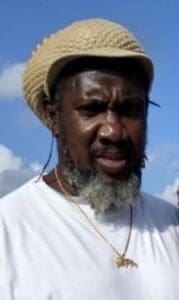
Donald Pickering (Submitted photo)
Donald “Icha” Pickering (pronounced “Isha”) died on May 4.
He was preceded in death by his mother, Lantis Phillip (pronounced “Iyantis”); and father, Alvin Duncan.
He is survived by brothers: Francisco (Cisco) Jennings, Alexander (Ipa) Pickering, Mario (Map) Pickering, and Melvin (Jah Ruby) Pickering; sisters: Lauris (Girley) Brown, Vanessa (V) Brewley and Susan Frett-Potter; and nephews: Peter (Danny) Mitchell, Everette Wilkinson, Marcus Pickering, Derek Brown Sr., Maurice (Lil Ruby) Pickering and Evonte Ray.
He is also survived by nieces: Shenell Jennings, Nichole Brooks, Monique, Maureen, Larissa Pickering, Jakeema Smalls, Joyneisha Stephens and Joyneida Brown; many great nieces and great nephews. Special mention relations include cousins: Howard “Howie” Gray Jr. and Samuel “Sam” Gordon.
Other survivors include special friends: Teacher Lyn-Lyn Smith, Andy (Simba) Turnbull, Ted (Midnight) Rabsatt, Louis (Dock) Frett, Jenny Hodge, Walter Bostwick, Leah Estrill, Belrice Hodge, Renee Simon and Nichole Smith.
The viewing will be held at 10 a.m. followed by a funeral service at 11 a.m., Monday, May 20, at Blyden Memorial Chapel. Interment will be in Eastern Cemetery, Smith Bay.
Professional services have been entrusted to Turnbull Funeral Home and Crematory Services at 3815 Crown Bay Suite 10, Charlotte Amalie, St. Thomas, U.S. Virgin Islands 00802.
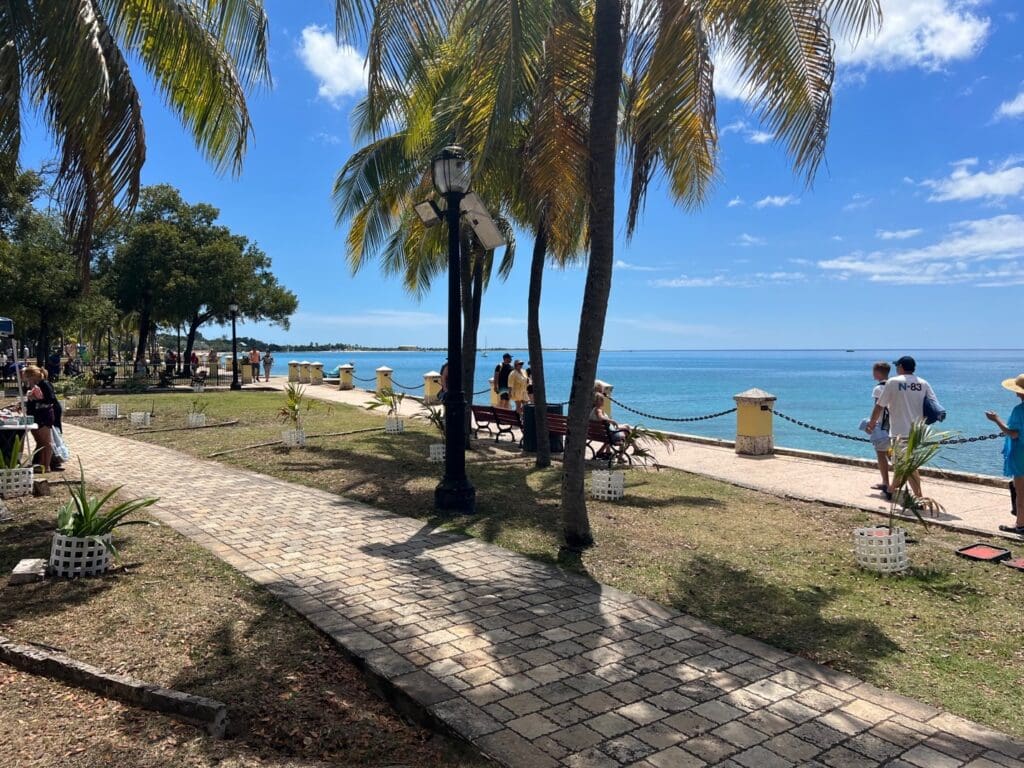
Frederiksted’s Amazing Waterfront Promenade (Submitted photo)
From Neglect to Prosperity: A Guide to Frederiksted’s Waterfront Revitalization
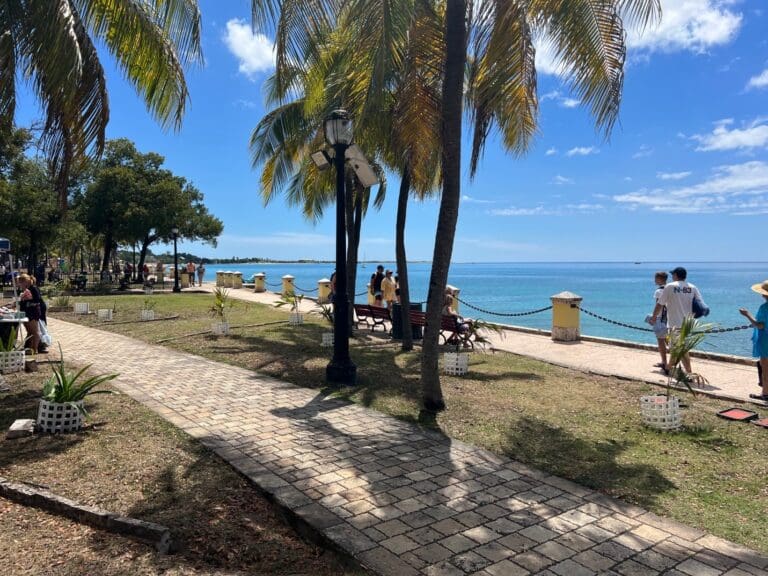
Down the dead streets of sun-stoned Frederiksted,the first free port to die for tourism,strolling at funeral pace, I am remindedof life not lost to the American dream; — St. Lucian Poet Derek Walcott, The Virgins. 1948
Growing up in Frederiksted, I cherished countless memories, from lively family gatherings at Dorsch Beach to the joys of the Learn to Swim summer camp at ‘the pool’, and the vibrant bustle of Saturday mornings at the fish market. However, returning home after a quarter-century of global travels, I cannot ignore the stark reality: Frederiksted, despite its stunning vistas and rich cultural heritage, pales in comparison to modern coastal towns in terms of year-round vibrancy, community engagement, and public safety.
With its breathtaking views, the waterfront stands as a testament to Frederiksted’s potential as a jewel of the Virgin Islands and holds the key to redeveloping Frederiksted town. Yet, it is evident that years of neglect and mismanagement have taken their toll, leaving Frederiksted longing for a revitalization fit for the 21st century. This Op-ed aims to dissect the detrimental planning decisions contributing to Frederiksted’s decline and proposes a roadmap towards its much-needed renaissance.
Missed Opportunities: The underutilization of Frederiksted’s waterfront represents a missed opportunity for economic stimulation and community enrichment. With its prime location and historical significance, this area has the potential to be a thriving hub of commerce, entertainment, and cultural exchange. Instead, it languishes in the shadows of a bevy of government assets, disconnected from the community and cutting off its pulse.
Path Forward: To unlock the full potential of Frederiksted, we must prioritize community-driven development initiatives that emphasize commerce, culture, innovation, sustainability, and connectivity.
We need to:
Drastically reduce government activity on the waterfront and relocate ill-fitting businesses.
Bring back the beach!
Incentivize better-suited businesses to fill vacated storefronts
Make Strand Street pedestrian-only
Improve public safety
This includes reimagining the use of existing government-occupied buildings, fostering partnerships with local businesses, and creating incentives for private investment in commercial ventures. Additionally, public spaces should be re-designed to accommodate a variety of recreational activities, from waterfront dining to a permanent stage for Jazz in the Park and other community events, ensuring that the waterfront remains a vibrant destination for all.
Comparison to Other Waterfronts: As we look at other waterfront promenades in the Virgin Islands and thriving coastal cities worldwide, numerous lessons can be learned from their planning efforts. Stroll along the bustling waterfronts of Charlotte Amalie, Cruz Bay, or Christiansted, and you will find a vibrant tapestry of commerce, culture, and community. These areas boast diverse shops, restaurants, and recreational activities that attract locals and visitors alike. In contrast, it is often quiet and deserted during most trips to Frederiksted when a cruise ship is not in port. The reason is that Frederiksted’s waterfront is dominated by government activity and other ill-fitting pieces, leaving little room for commercial development or public engagement. I estimate that over 65% of Frederiksted’s pristine waterfront south of the stadium has been dedicated to various government uses. Frederiksted’s waterfront contains the following: a courthouse, a ballpark, four local parks, a federal park, a public housing community, an abandoned senior citizen center, a library, two hospitals (one functioning, one abandoned), a hospital parking lot, and several government offices. Adding insult to injury, a manufacturing facility for dental water management products lies one block off the pier in the old Virgin Islands Community Bank Building. While these businesses and government offices may make great tenants, the unfortunate byproduct is that their collective presence has stifled commercial activity. After 5 PM on weekdays and on weekends, the town is deserted. The government can serve the city better by utilizing other parcels of Frederiksted real estate and leaving waterfront property for commercial, retail, and community-based activities. It is important to note that all other towns in the Virgin Islands have a shopping and entertainment district on their waterfront promenade that does not compete with government activity. This would be akin to the government placing a hospital in the middle of the boardwalk in Christiansted or placing the Supreme Court in the middle of Havensight. That sounds silly, right?
Friendly disclaimer: During a recent guest appearance on a radio program, former Senator Adelbert M. Bryan challenged the benefit of moving government buildings out of Frederiksted. My answer to the legendary senator was that I fully advocate for these government assets to be a part of the town. However, I question the additional benefit of placing all these assets on prime waterfront property. Would the Supreme Court be less effective two blocks away from the waterfront? No. However, one can easily argue that retail shops and restaurants benefit from increased proximity to the waterfront.
A crucial aspect of revitalizing economic development zones involves the strategic relocation of businesses that do not align with the planned goals of these areas. Governments, recognizing the long-term benefits of cohesive economic zones, have sometimes provided financial incentives or compensation to facilitate the relocation of businesses that detract from the zone’s core function. For instance, to foster a pedestrian-friendly retail district, the government might offer relocation costs and a cash incentive for the dental water management manufacturer to move to a more suitable location, such as the Industrial Park. This not only aids in preserving the integrity and vision of the development zone but also supports the relocated businesses by helping them domicile in a neighborhood more suited to their operational needs. By carefully managing these transitions, cities can ensure that new and existing economic activity areas are optimized for success and sustainability.
Beach Nourishment and Lessons Learned from Thriving Coastal Cities: Look beyond the Virgin Islands, and you’ll find countless examples of waterfront revitalization projects that have transformed once-neglected areas into vibrant urban centers. Cities like San Francisco, Barcelona, and Sydney have capitalized on their waterfronts’ potential, creating dynamic spaces that attract residents and visitors alike. Frederiksted can learn valuable lessons from these success stories and apply them to its waterfront redevelopment efforts. For example, I admired a picture-perfect shoreline from my hotel room during a recent visit to Rio de Janeiro, Brazil. However, I noticed that the beach was almost too perfect. The beach was very wide and maintained that width for the entire coastline. Impossible! After some brief internet sleuthing, I discovered that Rio and many coastal communities worldwide participate in a practice known as “beach nourishment,” which is defined as placing additional sand on the beach or near the shore.
Furthermore, this process is prevalent in Brazil and widely used in the United States. Since 1923, the United States has spent $9 billion rebuilding its beaches, with the most famous project being the reconstruction of Miami Beach, which cost $87 million and took approximately five years. Before beach nourishment, Miami Beach was, in many places, too narrow to walk along, especially during high tide. The resulting economic impact on the surrounding communities has been remarkable. Today, one cannot imagine Miami without Miami Beach.
In addition to the economic benefits, oceanographers highly recommend sustainable beach nourishment strategies to protect against storms. According to the US Army Corp of Engineers, a wide, nourished beach absorbs wave energy, protects upland communities from flooding, and mitigates erosion. Nourishment costs are estimated to be one to four million dollars per coastline mile, which should equal an approximately $10 million project for the Frederiksted waterfront. That would be money well spent. In addition, beach nourishment projects in the United States are usually funded by the federal government and executed by the US Army Corp of Engineers. Typically, the federal government pays approximately two-thirds of nourishment costs, and the local and state governments combine to fund the remainder. In small communities like Dare County, North Carolina, a Beach Nourishment Fund was established to collect occupancy taxes and help fund the project. The Virgin Islands Government could do the same to fund beach nourishment projects throughout the territory.
I remember playing on the beach below the Frederiksted waterfront as a kid. However, the cumulative effect of numerous storms has decimated that beach. All that remains is a vast network of rocks. We must bring the beach back and ensure that it remains for future generations. Utilizing sustainable beach nourishment strategies, we can make the beach even bigger than it was before. If we bring the beach back to the waterfront, people will follow. A 1989 New Jersey poll found that 74% of respondents said the New Jersey shore was “going downhill.” By 1998, only 27% thought the New Jersey shore was in decline, with 86% saying that the shore was one of New Jersey’s best assets. The difference in perception between 1989 and 1998 was due to the construction of the world’s largest beach nourishment project.
Tax Incentives for New Frederiksted Businesses: Frederiksted needs more economic activity, and our government should take the lead on incentivizing new Frederiksted businesses by creating a series of programs and initiatives focused on attracting business activity to St. Croix’s west end. Research has shown that public-private partnership is the best model for revitalizing economically depressed neighborhoods. Governments have created economic incentives for business development in formerly blighted areas throughout the country. For example, the City of Chicago created an online site selection tool to market vacant and historic properties to aspiring entrepreneurs needing real estate. The City of Myrtle Beach created a financial incentive program worth up to $2 million to encourage new economic activity in designated areas. Note that these programs do not have to be exclusive to new businesses; they can also target existing companies. The City of Philadelphia launched a business expansion program in target neighborhoods that gave local businesses a 50% grant for business expansion activities, up to $25,000.
We need to give people more reasons to visit Frederiksted besides its beautiful surrounding beaches and carnival. And we need to ensure that people continue coming year-round. Similar to Christiansteds’ Art Thursdays or Jump Up, Frederiksted needs a routine, widely marketed activity to draw the entire island’s dollars to our town.
We may need to get creative to attract businesses to Frederiksted, but I am confident we have the raw materials to succeed.
If the Frederiksted waterfront is key to unlocking Frederiksted’s economic success, then Strand Street is the keychain. We need to re-envision “The Strand”. Vehicular traffic and parking along the waterfront promenade serve little to no purpose. We need to make Strand Street pedestrian-only, fostering additional economic activity. We have tested this concept many times for political rallies, Jazz in the Park, and other community-based events. As a child, I have fond memories of attending Harbor Night – a bi-weekly block party where cruise ships would stay in port until 8 PM, and entertainment, food, and fun were had by locals and tourists alike. Vehicular traffic and parking must be banned permanently on Strand Street. The approximately 20 eliminated parking spaces will not be missed.
Public Safety: A key benefit of transforming the Frederiksted waterfront into a pedestrian-only zone is the significant improvement in public safety. The area’s reputation for being unsafe, particularly after dark, deters residents and visitors from enjoying the waterfront’s potential as a community space. By restricting vehicular access, the risk of accidents is greatly reduced, and the area becomes less accessible for potential criminal activities. Furthermore, a well-designed pedestrian zone would include improved lighting, surveillance cameras, and regular patrols, proven deterrents to crime. These changes make the waterfront safer and more inviting, encouraging more people to visit after sunset and revitalizing the area as a vibrant evening destination. By fostering a safer environment, we can rebuild trust and confidence among the community members, enticing them to return and enjoy the improved waterfront.
Conclusion: Frederiksted’s waterfront has the potential to become a thriving economic and cultural hub, but realizing this vision requires bold action and community collaboration. As we re-envision the Frederiksted waterfront, I urge our leaders to not only replace what was there before but also to utilize foresight to help Frederiksted unlock its true potential. As we position the Virgin Islands to compete with other Caribbean destinations, we must also include plans to make Frederiksted more enjoyable for us. By drawing inspiration from successful waterfront revitalization projects worldwide, we can transform our beloved, sleepy town into a dynamic space that reflects the spirit and vitality of the Virgin Islands. It is time for Frederiksted to move into the 21st century. Working together, we can reimagine a Freedom City that we can all be proud of.
About the AuthorJed JohnHope (Submitted photo)
Jed JohnHope is president of Generation Next, an organization driven to make meaningful, enduring change in our beloved islands. In addition, Mr. JohnHope is a former Investment Banker and Professional Engineer. He is a strategy and finance professional with over twenty years of experience in the Energy, Manufacturing, Financial Services, and Oil and Gas sectors. This experience includes significant work within the USVI. Former employers include Morgan Stanley, the Hess Corporation, Liberty Mutual, and ARCADIS. Mr. JohnHope is a native Crucian and an alumnus of the Good Hope School, the University of Delaware, London Business School, and the Kellogg School of Management at Northwestern University. In his spare time, Jed is an avid chess player, traveler, and CrossFit athlete.
Rachel Conhoff (Submitted photo)
We are thrilled to announce that Rachel Conhoff, a member of the Virgin Islands Track and Field Team and a postgraduate student at Indiana State University, has shattered two Virgin Islands national records. In the 3000m Steeplechase, she outdid her previous best, setting a new record for the USVI. This achievement took place at the Missouri Valley Conference Championship in Terra Haute, Indiana, from May 10-12.
Conhoff completed the 3000m Steeplechase in an impressive 10:54.51, finishing under 11 minutes for the first time and surpassing her old record by nine seconds. Additionally, she participated in the 1500m race and made it to the finals by placing third in the preliminaries with a time of 4:31.14. In the finals of the 1500m race, Conhoff set another Virgin Islands record with a time of 4:25.93, earning her an outstanding fourth-place finish.
Davina Browne (Submitted photo)
The Virgin Islands Track and Field Federation extends congratulations to Davina Browne, an athlete of the St. Croix Track Club and a St. Croix Educational Complex High School student. Browne shattered the V.I. National record in the Javelin throw.
She showcased her prowess at the AAJI Juvenil Championships final held in San German, Puerto Rico. On her fifth attempt, she threw the javelin a staggering 30.56 meters, breaking the previous 9-year-old record of 29.00 meters set by Shanice Cazaubon and securing a bronze medal in the process. Browne also marked her stand in the Shot Put by securing the 4th position with a throw reaching 8.19 meters.
St. Croix Track Club Mustangs, May 2024 (Submitted photo)St. Croix Mustangs 2024
Davina Browne – Bronze in Javelin – 30.56m – and 4th in Shot Put – 8.19m – 18/19 age group
Safiya Prasad – Gold in 400mH-70.63se, – 14/15 age group
Jordan Vaughn – Gold in Javelin- 34.09m, Silver in Shot Put – 11.80m – Over 19 age group
Wilfredo Concepcion – Bronze in Javelin – 39.89m, 4th in Shot Put – 9.94m in the 16/17 age group
A’Sharia Bernadine – Bronze in Shot Put – 9.02m, 6th in Javelin – 8.60m 14.15 age group
Aminah Prasad – Bronze in 100mH-17.09sec – 14/15 age group
Jahleya George – 8th in Javelin-15.95min, in Shot Put – 7.65m in the 16/17 age group
Kahlan Beaupierre – 5th in Javelin-33.10m, 8th in Shot Put – 8.92m in the 16/17 age group
A total of 8 athletes from the St. Croix Track Club Mustangs 14 and Over Team qualified to participate in the AAJI Juvenil Championships. The Mustangs brought home a total of 7 medals: 2 gold, 1 silver and 4 bronze.
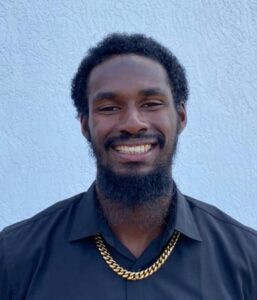
Malique Smith (Submitted photo)
Virgin Islands Track and Field Team member Malique Smith participated in the Jamaica Invitational on May 11, in Kingston, Jamaica. He finished 8th in the final of the 400m Hurdles in a time of 52.43.
Looking ahead, Smith will compete in 400m Hurdles in Fort-de-France, Martinique, on May 18 in “Le Meeting de Martinique.”
Tatyana Muntyan and Bruce Arnold on the podium winning Silver Medal at the Youth and Masters Pan American Championships, San Salvador 2024 (Submitted photo)

After scoring a World Record of 1228 points in the recurve 50+ mixed team qualifying round at 60 meters, the pair of Tatyana Muntyan and Bruce Arnold of the U.S. Virgin Islands, won a Silver Medal in San Salvador, El Salvador. The pair lost in the Gold Medal match to the United States by less than a centimeter in their final shoot-off arrow of the 2024 Pan American Youth and Masters Championships.
Muntyan and Arnold added a remarkable 47 points to the previous record set in 2022 by the United States during the Pan American Championships in Halifax, Canada. In addition to this record, Muntyan also broke the Pan American record with 656 points after the 72-arrows shot in qualifying.
In the elimination rounds, Arnold finished in 5th place. (Submitted photo)
In the individual gold medal match Tatyana finished on top. In another one arrow shot-off, Tatyana shot a perfect 10 when she needed it, beating Jani Grellner of the United States in the finals of the Recurve 50+ Women category. After setting a world record and winning a silver medal in the Mixed Team event, Tatyana can now add Pan American Champion to her resume.
Even if Almighty God Himself came down and said, “Elections System of the Virgin Islands, y’all have time to appeal Judge Molloy’s Jan. 10, 2024 ruling on election unconstitutionality,” as a current Board Member, I know there was, is, nor will be no money to appeal it. The Federal Rules of Civil Procedure allow 30 days for appeals as a civilian; 60 days for government officials. Understanding the background is equally as important. I am intricately aware of the Republican Party concerns long before this ruling, which took so long to come down. I was the sole Board member who voted against what it took to cause the lawsuit in the first place! The Party alleged that the System and Board of Elections was broadly overreaching into its internal affairs. I concurred then. Judge Molloy happens to agree now.

Harriet A. Mercer (Submitted photo)
I credit Elections Supervisor Caroline Fawkes for always immediately forwarding everything to whomever she deems should have them. As she said on record, she forwarded copies of the subject Jan. 10 ruling to the senators, Attorney General, etc. The courtesy was set. In my opinion, it was incumbent upon all recipients to decide how to move forward.
In April, Board Chairwoman Alecia Wells set courtesy again; but she shouldn’t have had to exponentially reach out to the same senators nor the AG office which since January had immediately been sent a copy. The same discussion being heard now should have been heard in January, before the six-month prohibition of changes to election laws.
Chairwoman Wells did the members of the 35th Legislature a huge favor by applying courtesy to remind it of its neglect of the impact of Judge Molloy’s judgment. Had it not been for her letter (since we still haven’t received a response from the AG’s office — a response sought via motion and vote), the Democrats would have been scratching the door at midnight come this August’s primary election. But, as a side note, once conducted within the bounds of all precedent local and federal laws, I question the right of any Legislature to tell any party exactly when it must hold its primary. Like, control y’all own purse strings, senators. Not the purse strings of the political parties.
In his live stream comments, Jelani Ritter wisely stated: “But that was the ruling months ago. That falls back on the [P]arty.” To that, I replied: Jelani Ritter you are correct. It is safe to assume that just like the plaintiffs (the Republican Party) knew of this ruling, all other parties knew too. Bottom line is the ruling was well-circulated. There was time for anyone who wanted to act, to act. We all heard Senator Alma Francis Heyliger say “she came up with FOUR amendments on January 11th,” the very next day after this epic ruling. So at least she acted somewhat. Why didn’t her colleagues? Whoever could have acted, should have.
Essentially, the Elections System and the Board was done with the matter at that point and until we’re legally mandated to act any further. As Supervisor Fawkes said on record: “They’re not many days left.” (Eighteen days to casting lots IF involvement permissed/82 days to lawful date of all primaries.)
The senators should not be blaming the Board of Elections nor Elections System, because it was immediately notified. All any of the 15 had to do was pass it on to their own legal counsel. Unlike us who up to now can’t hear from the AG and/or would’ve had to jump through hoops in any appeal process, it would’ve no doubt had this matter resolved by now.
This is not rocket science.
Let every party pay for its own primary — as long should have been the case — because the law never said that the people in general should be doing so. NOR SHOULD ANY LAW EVER SAY SO.
The manner in which the candidates for this November’s General Election ballot are determined can be as inexpensive or as costly as the parties want it to be. Just give the internally agreed to results to the ESVI and roll on.
In closing, I must differ with the Supervisor and anyone else in that if in fact we cannot proceed with the Primary Election, then we also cannot proceed with the casting of lots on May 31. That event would be an exercise in futility.
Essentially, at this writing, each political party is on its own until October/November re the General Election.
— Harriet Mercer (Republican) is a member of the Virgin Islands Board of Elections representing the St. Thomas-St. John district.
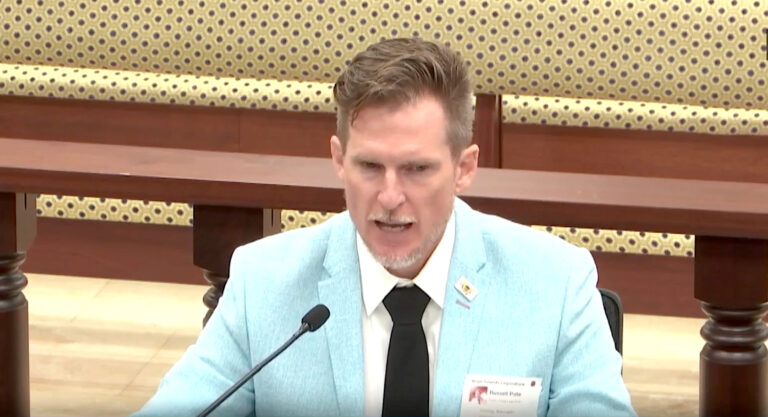
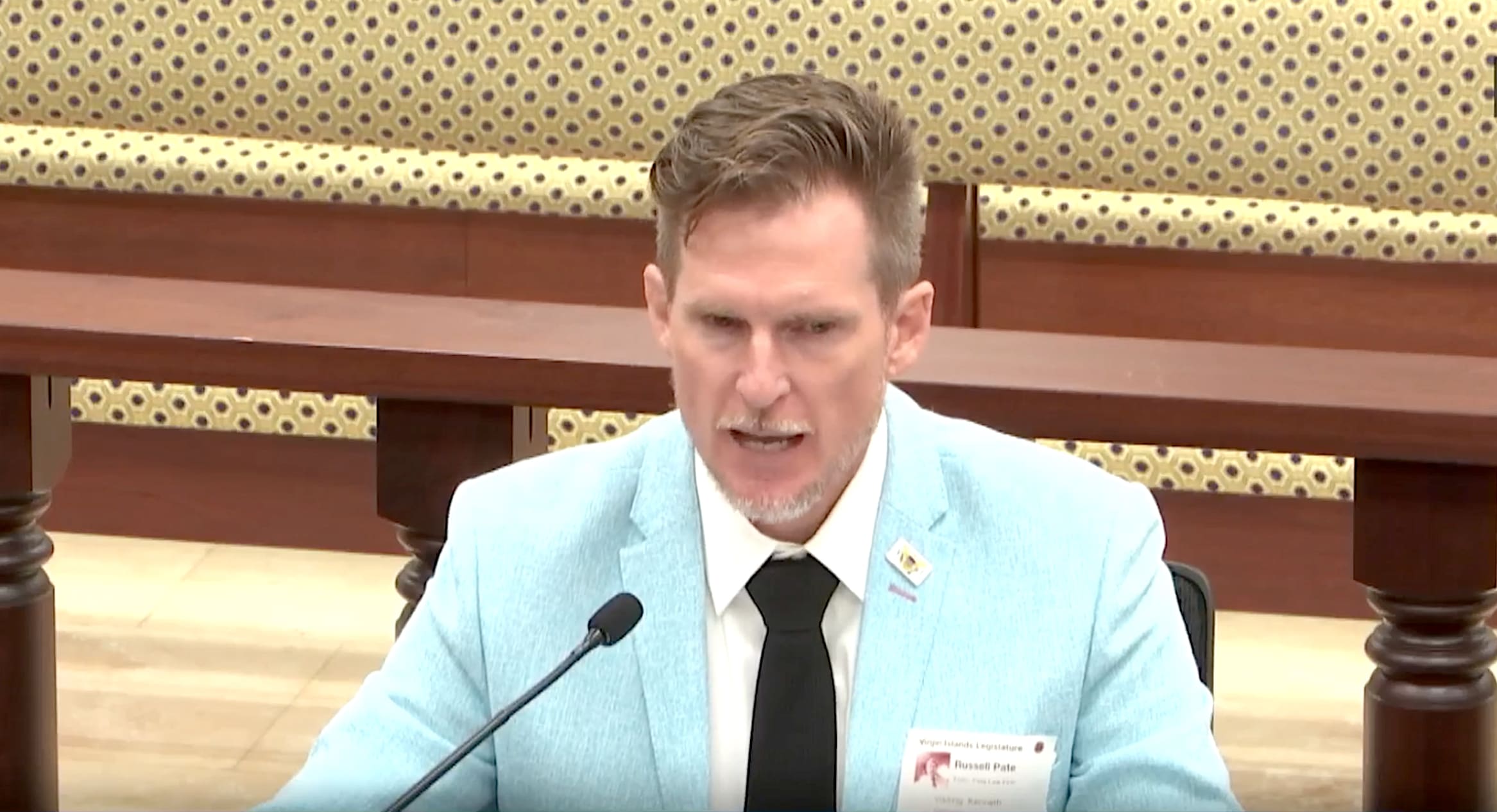
St. Croix attorney Russell Pate argued Tuesday that electing the Virgin Islands attorney general, rather than having the position appointed by the governor, gave power to the people. (Screenshot from V.I. Legislature Facebook live stream)
Virgin Islands lawmakers heard pros and cons Tuesday of a plan to petition Washington to change the Revised Organic Act to allow election of the local attorney general, a position now filled and vacated at the governor’s pleasure. The Committee on Homeland Security, Justice and Public Safety ultimately declined to forward the legislation out of committee, but the debate touched on many hot-button issues around elections, public integrity, and territorial autonomy.
Acting Attorney General Ian Clement said his office did not have an official position on whether the resolution was a good idea but suggested increasing residency requirements in the legislation as well as how long a candidate must have practiced law in the territory, ensuring they are intimately connected to the U.S. Virgin Islands. While 43 states elect their attorney general, Clement warned what works on the mainland might not work in the USVI.
Attorney Russell Pate, president-elect of the Virgin Islands Bar Association’s Board of Governors, liked the idea but recommended reducing residency and local practice minimums to entice highly qualified Virgin Islanders working abroad to seek office at home.
Chief Territorial Public Defender Julie S. Todman told the committee that she feared elections might introduce political pressure — including the need to fundraise for campaigns — into a system meant to bolster fairness not popularity.
Caroline Fawkes, the Elections System of the Virgin Islands’ supervisor of Elections, maintained her customary neutrality on such issues. Fawkes did, however, emphasize any proposed changes in elected offices needed to be in line with existing elections laws.
Previous attempts to move legislation allowing for local election of the attorney general, going back to at least 1998, have been scuttled by wording within the Organic Act, which is the de facto Virgin Islands constitution. Currently, the Virgin Islands governor chooses the attorney general and can remove the person at will.
The resolution considered Tuesday would ask the U.S. Congress to change the Organic Act allowing for the possibility of changing how the top law enforcement officer is chosen. Only then could local legislators pass a bill to change the law, including a provision that the attorney general only be removed for cause in an impeachment process.
Gov. Albert Bryan Jr. has gone through several.
Sen. Ray Fonseca noted the rapid appointment and release of attorneys general in the past five years: Denise George-Counts headed the office from 2019 to 2023 when she was fired in the wake of her suit over the banking entanglements with Jeffery Epstein. Attorney-turned-judge Carol Thomas-Jacobs briefly held the position before being replaced by Ariel K. Smith, who resigned suddenly in March after less than 260 days on the job. Bryan nominated Clement for the job five days later.
Sen. Kenneth Gittens said the issue hinged on protecting the attorney general from the whims of a governor. Gittens said he planned to introduce legislation creating a committee to investigate ethics and conflicts of interest in government.
Sen. Marise James raised the specter of Epstein as well, expressing concern that a bad-actor’s money could influence what laws are enforced.
Sen. Alma Francis Heyliger, the resolution’s sponsor, bristled at the Epstein comment, saying many local elected officials accepted donations from the notorious sex offender before his public downfall and ultimate death in jail. She said the legislation had been drafted in 2021 and was in no way related to Epstein nor George-Counts’ firing.
Sen. Franklin Johnson said spending money often won elections. He and other senators wondered if low residency requirements could attract rich off-islanders perhaps seeking celebrity over service to the community.
Pate said the voter should be the ultimate decider and is smart enough to weed out any “carpetbagger” candidate.
“You have to trust the voters,” Pate said. “Do you trust the voter or not? If you’re making good money in the States, you’re not going to come down just to run the Virgin Islands Department of Justice, which is like a small city. You’re going to be someone who has a heart, who was born and raised here, who says ‘I want the opportunity to come home.’”
Pate ended the session by telling the Senate they could enact legislation to protect the attorney general position from capricious removal. A new law could make removing the top lawmaker dependent on legislative approval.
Todman agreed.
“It should not be a removal by will; it should be removal for cause,” she said.
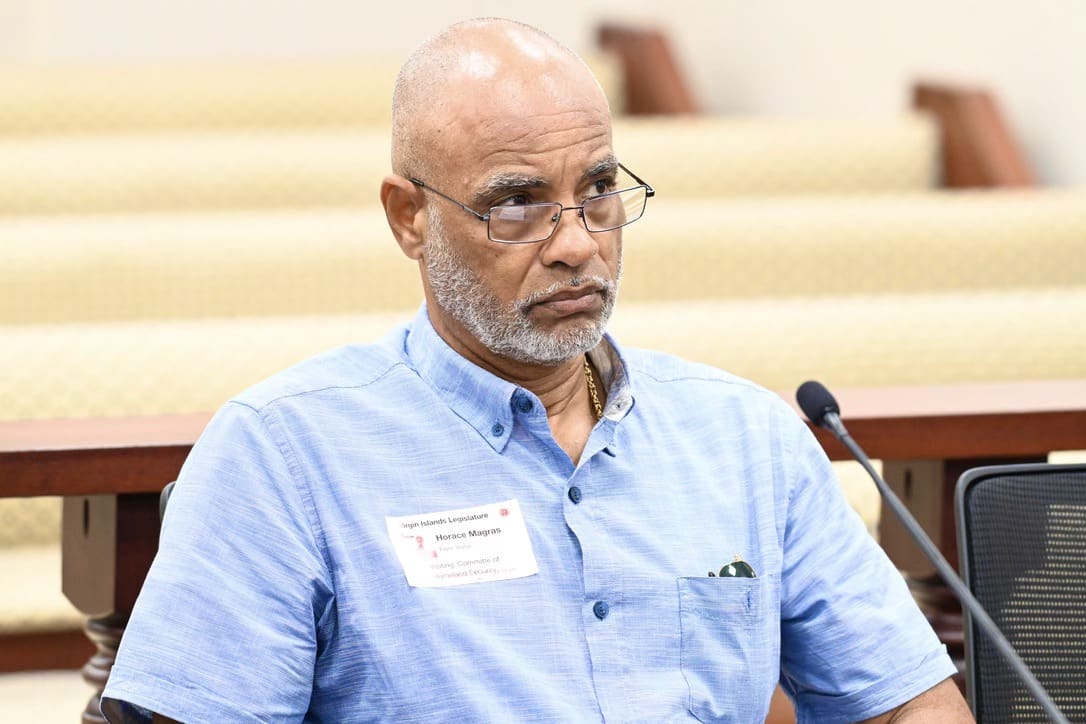
Horace Magras objected to the proposed ban on assault weapons on constitutional grounds during a meeting Tuesday of the Senate Committee on Homeland Security, Justice and Public Safety. (Screenshot from V.I. Legislature Facebook live stream)
The Senate Committee on Homeland Security, Justice and Public Safety on Tuesday tried to determine who should carry a gun and what guns residents should be allowed to carry.
During its afternoon session, one of the four bills the committee considered was whether enforcement officers at the Havensight Mall on St. Thomas should be granted peace officer status.
Angel Dawson, administrator of the Government Employees’ Retirement System, testified that giving peace officer status to at least four of the 17 GERS officers now responsible for security at the mall, which will see about a million guests and residents visit this year, enhances Havensight’s security. He said the mall, with its popular restaurants and the West Indian Company Limited dock, was not only serving cruise ship passengers but a nighttime crowd of locals.
It was the only bill voted on favorably by the committee and forwarded to the Rules and Judiciary Committee.
The bill that would ban assault rifles raised objections and was held in committee, as was a bill to increase the length of time a firearm can be licensed and one to regulate gun components being mailed.
Senate President Novelle Francis challenged testifiers Ian Clement, acting attorney general, and Sidney Elskoe, assistant police commissioner, to define what weapons were assault rifles. Their definitions did not match his. They would have included semi-automatic weapons. Francis said semi-automatic weapons could never be banned.
Residents Gregory and Horace Magras objected passionately to the proposed ban on constitutional grounds.
Horace Magras said that, according to the Supreme Court, the public benefit could not interfere with individual rights. Sen. Milton Potter disagreed, saying lawmakers needed to do what was suitable for the public. Potter said there was “no purpose for assault weapons in the Virgin Islands.” Magras said that law-abiding citizens needed to meet the threat from criminals with the same firepower the criminals had.
Sen. Kenneth Gittens, who chaired the meeting, said there was not enough data available to decide on the bill, and more work needed to be done. He said the committee could call up the bill at its next meeting. Twice, the Senate legal counsel has questioned if the Senate had the constitutional right to institute such a ban. They were told yes if the ban appeared “reasonable.”
Several senators raised concerns that the bill to extend gun licenses from three to five years would have an economic impact. Sen. Angel Bolques was concerned it would negatively affect the police department’s revenues.
However, Sen. Franklin Johnson pointed to recently increased fees for licensed firearms. He said the fees had been raised from $75 to $150 per weapon, and the government could be pricing a gun collector out of his hobby.
Sens. Bolques, Dwayne DeGraff, Alma Francis Heyliger, Novelle Francis, Kenneth Gittens, Franklin Johnson, and Milton Potter attended the meeting.
Election process activity is beginning across the territory. (Shutterstock image)
While in the early stages of the 2024 election process, both the St. Croix and St. Thomas-St. John districts saw a flurry of activity Tuesday, with more than two dozen candidates showing interest in various races.
On St. Croix, officials reported that by Tuesday afternoon, six candidates had already filed their nomination papers. The breakdown includes one candidate for the Board of Elections, three for the Senate (with two Democrats and one Independent), one for Constitutional Convention delegate and one for the Democratic Party’s territorial district committee.
Meanwhile, another 14 nomination packets for Constitutional Convention delegates and 26 for Senate candidates have been picked up, covering Republican, Democratic, and Independent hopefuls. This level of early engagement surpasses the activity seen in the previous election cycle, according to Elections’ Terrell Alexandre.
Meanwhile, on St. Thomas-St. John, the current tally of picked-up packets includes one for Senate at-large, 13 for Democratic Senate candidates, four for Democratic Board of Elections candidates, two for Republican Delegate to Congress candidates, six for Republican Senate candidates and four for ICM Party Senate candidates, including one senator-at-large. Additionally, eight candidates have shown interest in the Constitutional Convention delegate positions.
Keevermay Douglas, deputy Elections supervisor, confirmed that four candidates have already filed their nomination papers. She reminded all interested parties that the final deadline to file is May 21, urging those considering a run to complete their paperwork promptly.
If the Elections System of the Virgin Islands cannot hold primary elections, the Republican Party plans to do it themselves. (Submitted photo)
The Republican Party in the Virgin Islands plans to run its own primary if the Elections System of the Virgin Islands cannot, according to a letter received by the Source Tuesday.
The note on Republican Party letterhead asked Supervisor of Elections Caroline Fawkes and the Board of Elections to confirm by 5 p.m. Friday if the candidates chosen in the privately-run primary would appear on the 2024 General Election ballot.
The letter, signed by Republican Party in the Virgin Islands Chairman John Yob, was copied to members of the Virgin Islands Legislature. It claimed only candidates selected through the private primary process would be allowed to list themselves as Republicans on the General Election ballot.
“A candidate who filed for the primary election but was not nominated by the Republican Party in the Virgin Islands through its process would not be a lawful and legitimate Republican nominee for public office,” Yob purportedly said in the letter. “This letter shall serve as official notice that the Republican Party in the Virgin Islands is prepared to administer its own process to nominate Republican candidates for federal and territorial offices in the 2024 general election. A special meeting of the Republican State Committee is being called to officially authorize the process. Once authorized, we will inform you of the process.”
Yob did not immediately answer email, text, and voicemail messages requesting more information Tuesday afternoon and evening. Questions included how would the primary be tabulated, would the party procure voting machines or use another process, does the party have existing bylaws for such situations, and has the local Republican Party corresponded with the national party on the matter?
In January, the District Court had sided with the Republican National Committee and ruled portions of USVI elections laws unconstitutional. The ruling upended how primary elections worked in the territory. Unless new laws were passed, the Elections System would not be able to conduct a primary, Fawkes told the Legislature Monday.
While Government House representatives posted on social media that it was too late for a new law because rules prevented changes up to six months before an upcoming election, Fawkes wrote the Source Tuesday noting sleight-of-hand linguistic workarounds that had worked in the past.
By inserting the language “Notwithstanding Title 18” in a bill, the Legislature and governor ensured the 2020 and 2022 pandemic-era elections could be largely conducted by absentee ballot.
Election laws can be generally confusing and each state and territory has its own way of doing things. The mainland’s federal elections Electoral College — 538 electors divided across 50 states by population — has hundreds of millions of Americans scratching their heads every four years.
Primary elections are even more confusing. Some states’ political parties caucus. They get together in groups and try to talk out who they think would be the best choice. Other states hold ballot elections. Some allow only members of a party to vote in that party’s primary. Other states allow any registered voter to help pick their eventual ballot choices. Still, other states have some sort of hybrid primary system.
Barred from participating in federal elections, the U.S. Virgin Islands has its own primary and general election rules that are, naturally, confusing.
The window for candidates to file their paperwork with the Board of Elections opened Tuesday at noon — less than 24 hours after the primary election’s very existence was an open question juggled between all three branches of local government.
The fatal shooting of Marcos Guerrero marked the first homicide in the Virgin Islands in 2023. (Shutterstock image)
A man who was scheduled to face trial in a St. Thomas murder case pleaded guilty at a hearing held Monday in Superior Court. A Superior Court judge accepted the change of plea from defendant Luis Mota Rivas.
Rivas was arrested on Jan. 16, 2023, in connection with the death of Marcos Antonio Guerrero. Police responding to a report of shots fired in Charlotte Amalie found Guerrero slumped over the steering wheel of his car in the area of Market Square.
First responders transported the victim to Schneider Regional Medical Center for treatment, but he did not survive. An autopsy performed after Guerrero’s death cited multiple gunshot wounds as the cause.
Investigators obtained images taken from a security camera located near the shooting that showed a gunman firing shots through the driver’s side window where the victim was seated. They were able to identify Rivas as the man firing a black handgun on that recording.
A second suspect, identified as Aneudy Guerrero, was arrested and, along with Rivas, charged with multiple offenses, including first-degree murder.
In a change of plea motion filed in early May, Rivas agreed to admit his role in Marcos Guerrero’s death in exchange for admitting to a lesser charge of second-degree murder.
Superior Court Judge Carol Thomas-Jacobs accepted the deal and an amended complaint was filed reflecting the change. As part of Monday’s hearing, government lawyers read a statement describing what they could prove at trial, based on the evidence.
With help from a Spanish-language interpreter, the defendant agreed that the prosecutor’s account was factual and that he was the gunman seen in the surveillance recording.
The judge set a sentencing date of June 21 at 1 p.m.