



Op-Ed: When the World Shifts, We Feel It First: A Structural Analysis of Global Energy Disruption and Its Impact on the U.S. Virgin Islands

The global economy is not a collection of isolated systems operating independently of one another. It is an interconnected network where disruptions in one region can produce immediate and measurable consequences in another, particularly in small, import-dependent economies. Nowhere is this more evident than in the U.S. Virgin Islands, where global energy instability translates quickly into local economic pressure. What is unfolding in international energy markets is not a distant geopolitical concern; it is a real-time stress test of the Territory’s structural vulnerabilities. Understanding the present moment requires not only acknowledging rising fuel prices, but examining the underlying systems that make those increases both inevitable and disproportionately impactful. At the center of the current disruption is the Strait of Hormuz, one of the most critical energy transit corridors in the world. Approximately twenty percent of global oil supply moves through this narrow passage, making it a central artery in the international energy system. Recent geopolitical tensions and escalating conflict in the region have created near-closure conditions, significantly reducing tanker traffic and increasing the risk profile for any vessel attempting to pass through. As a result, insurers have imposed substantial war-risk premiums, and producers have begun adjusting output in response to constrained transport capacity. These developments have immediate consequences for global markets. Oil prices do not wait for physical shortages to materialize; they respond in anticipation of disruption. In this case, analysts have already described the scale of the shock as comparable to, and potentially exceeding, historic oil crises. For a territory like the Virgin Islands, which relies almost entirely on imported fuel, this exposure is direct and unavoidable. The relationship between global oil prices and local fuel costs is not speculative. It is grounded in well-established economic principles. A widely accepted rule of thumb within energy economics indicates that every one-dollar increase in the price of crude oil translates to approximately ten to twelve cents per gallon at the pump. When global prices increase by fifteen to twenty dollars per barrel, the resulting impact on retail fuel prices becomes mathematically predictable, ranging from roughly one dollar and fifty cents to over two dollars per gallon. Importantly, these figures reflect only the base cost of crude oil. They do not account for additional expenses associated with transportation, insurance, storage, and distribution, all of which are amplified in a high-risk shipping environment. Consequently, the actual price experienced by consumers in the Virgin Islands is likely to exceed these baseline estimates. This is why projections of sharp increases at the pump should not be dismissed as alarmist; they are the logical outcome of quantifiable inputs within a constrained supply system. Compounding this global pressure is a parallel issue unfolding locally: the question of pricing transparency and regulatory compliance within the Territory’s fuel market. The Department of Licensing and Consumer Affairs has taken the significant step of escalating enforcement actions by seeking judicial intervention to compel fuel retailers to produce historical pricing, cost, and sales records after prior requests were not honored.  This development is particularly consequential because it suggests that concerns about pricing practices existed prior to the current global disruption. In practical terms, this means that residents may be facing the dual burden of externally driven price increases layered on top of a market that is already under scrutiny for potential inefficiencies or excess margins. The intersection of global supply shocks and local regulatory uncertainty creates a scenario in which public trust is strained and the need for transparency becomes even more urgent. It is also important to recognize that the present situation was not unforeseen. The Virgin Islands Energy Strategy explicitly identified the Territory’s dependence on imported fossil fuels as a primary vulnerability, noting that geopolitical instability, supply chain disruptions, and price volatility would pose significant risks to economic stability. What is occurring now is not an unexpected anomaly, but rather a real-world validation of those projections. The implications of this validation are profound. It suggests that the current challenges are not solely the result of external events, but also of internal policy decisions that have not yet sufficiently mitigated known risks. In this context, the conversation must shift from reacting to immediate price increases to addressing the structural conditions that make such increases so disruptive. Beyond the direct impact on fuel prices, the secondary effects of global energy disruption must be understood as part of a broader economic chain reaction. One of the most immediate and often underestimated factors is the cost of shipping and insurance. In conflict zones, war-risk premiums can add several dollars per barrel to the cost of oil, expenses that are passed along the supply chain and ultimately borne by consumers. For island economies, where all goods must be transported by sea, these additional costs extend far beyond fuel. They influence the price of nearly every imported product, magnifying the overall cost of living. This dynamic is particularly evident in the food supply system. Fuel is an embedded cost in every stage of food production and distribution, from international shipping and port operations to local transportation and refrigeration. As fuel prices rise, these costs are transferred to consumers in the form of higher grocery prices, often within a relatively short timeframe. For households already managing high living expenses, this creates an immediate and tangible strain. The relationship between fuel and food is not indirect; it is structural, and its effects are both rapid and cumulative. The impact on electricity further intensifies this pressure. In the Virgin Islands, where energy generation remains heavily dependent on fuel, fluctuations in global oil prices directly influence the cost of electricity. This places additional stress on household budgets, increases the financial burden on public utilities, and often necessitates greater government subsidies to stabilize rates. The result is a compounding effect in which residents experience rising costs across multiple essential services simultaneously. This convergence amplifies the economic impact of global disruptions and underscores the interconnected nature of the Territory’s energy and financial systems. In periods of crisis, it is critical to maintain a clear distinction between legitimate market responses and unjustified pricing behavior. While certain price increases are unavoidable due to external factors, this does not eliminate the need for regulatory oversight and consumer protection. On the contrary, moments of instability heighten the importance of transparency and accountability. Ensuring that price adjustments are supported by verifiable cost data is essential to maintaining public confidence and preventing opportunistic practices that could further burden residents. The role of regulatory agencies is therefore not diminished in times of crisis; it is strengthened. Ultimately, the current situation reinforces a fundamental principle that has often been discussed but insufficiently operationalized: energy policy is inseparable from cost-of-living policy. Decisions related to energy sourcing, infrastructure, and diversification have direct and lasting implications for economic stability and household affordability. Investments in renewable energy, efficiency measures, and localized capacity are not abstract environmental goals; they are practical strategies for reducing exposure to external shocks and improving resilience. Each dollar spent mitigating dependency is a dollar that reduces vulnerability in future crises. The convergence of global conflict, market volatility, and local structural challenges presents a clear and urgent reality. The Virgin Islands is not merely observing these events; it is experiencing them in real time. Fuel prices, food costs, electricity rates, and overall affordability are all part of the same interconnected system, and disruptions in that system reverberate quickly through the Territory. The path forward requires more than acknowledgment. It requires deliberate, sustained action to address the vulnerabilities that have been identified repeatedly over time. The question is no longer whether these risks exist, but whether the Territory is prepared to confront them with the seriousness and urgency they demand.

Editor’s Note: Opinion articles do not represent the views of the Virgin Islands Source newsroom and are the sole expressed opinion of the writer. Submissions can be made to visource@gmail.com

Federal Judge Dismisses Claims That Officials Failed to Stop Alfredo Bruce Smith, Allows Plaintiff to Amend Complaint

0
U.S. District Court Chief Judge Robert Molloy gave a former Charlotte Amalie High School student until April 17 to refile a civil lawsuit against the government and school officials. (Shutterstock image)

A federal judge last week dismissed, without prejudice, a slew of claims against the Virgin Islands government and former V.I. Education Department staff members who were accused of failing to stop sexual abuse by former Charlotte Amalie High School hall monitor and track coach Alfredo Bruce Smith.

The wide-ranging civil suit was brought in late 2024 by a former CAHS student, identified as John Doe in court filings, who claimed that school officials and others failed to stop Smith despite knowing about his crimes. Smith was arrested in 2021 and pleaded guilty in 2023 to raping, assaulting and exploiting a dozen students over a 15-year period. He was sentenced to 35 years in prison.

The civil suit named Smith, the V.I. Education and Human Services departments, the V.I. Education Board and the Virgin Islands government as defendants. Former CAHS principal Alcede Edwards and teacher Camelia Febres were also named in the initial complaint, and CAHS principal April Petrus was added to an amended complaint filed last year. Edwards and Petrus retired last January amid an internal investigation into their handling of complaints about Smith. Febres remains employed at CAHS, according to the school’s website and the government’s transparency website.

According to the complaint, the former student had already been sexually assaulted by Smith three times when, in 2019, he learned that he would have to share a room with his abuser on a school trip to Puerto Rico. He complained to school officials, who called a meeting attended by Smith, “chaperones on the trip, a CAHS teacher, defendant FEBRES, and other agents of Defendants.”

“SMITH was visibly angry at this meeting, in view of the other attendees and Defendants, and the other attendees did nothing to stop SMITH’s intimidation of the Plaintiff for raising this issue,” according to the complaint, which added that the attendees “knew Plaintiff was in danger but no actions were taken.”

The plaintiff said he was abused by Smith a fourth time on the trip, after which he ran from the room and called his mother, who reported the incident to Edwards, Febres and other unnamed school personnel “who falsely promised they would speak with SMITH and address the situation.” When nothing happened, the plaintiff’s mother contacted Homeland Security Investigations, “which was the only reason Smith was arrested in September 2021 … and not because of anything Defendants did to stop SMITH,” according to the complaint.

The civil suit accused the defendants of: deliberate indifference to Smith’s multiple assaults; creation of a hostile environment; failure to train; retaliation; violating the student’s constitutional right to bodily integrity; violating the 14th Amendment’s Equal Protection Clause; conspiracy; negligence; civil assault and battery; and intentional and reckless infliction of emotional distress.

On Thursday, U.S. District Court Chief Judge Robert Molloy granted motions to dismiss a number of those claims but said he will allow the plaintiff to replead most of them.

The Equal Protection claims against Edwards were dismissed because the plaintiff failed to “allege sufficient facts regarding whether Defendant Edwards was in a supervisory position at the time of the alleged assaults.” A conspiracy count was dismissed for all defendants because the complaint did not “provide some factual basis to support the existence of elements of a conspiracy: agreement and concerted action.” Molloy also dismissed all claims against the Education Board, which had argued that it “did not appoint, employ, supervise or certify Smith.” The board also argued that it’s not subject to liability under Title IX because it doesn’t receive federal funds and that the entity is not a mandatory reporter under Virgin Islands law.

Concerns about whether school officials knew about Smith persisted in the years following his arrest. The government produced a long-awaited audit of the Education Department’s abuse reporting protocols in 2024 that highlighted significant systemic failures like cultural barriers to reporting, fears of retaliation and a general lack of training. VIDE updated its reporting policies and guidelines later that year.

In September, VIDE confirmed that assistant principal Clifton Boyd was suspended after a former student claimed that Boyd had abused him while he was a student at Joseph Gomez Elementary School. The Source confirmed that Boyd had previously been reported to school officials. He was arrested in November.

The V.I. Police Department did not respond to emails this week requesting information about investigations into government employees who failed to report Boyd. Teachers and other school personnel are required by the V.I. Code to report suspected abuse. Failure to report is a felony offense punishable by up to five years in prison and a $10,000 fine.

On Tuesday, Gov. Albert Bryan Jr. told the Source that an investigation is ongoing and being handled by the V.I. Justice Department.


Futurist to Headline Free 13D Lecture Wednesday at UVI

0

A global futurist who has advised major organizations on navigating technological and social change will speak Wednesday as part of the 13D Annual Lecture Series, offering residents a chance to explore how emerging trends could shape the territory’s future.

Nikolas Badminton, a global futurist and bestselling author, will headline the 13D Annual Lecture Series on Wednesday at the UVI 13D Innovation Center. (Photo courtesy 13D)

The free event will begin with a reception at 4:30 p.m. at the UVI 13D Innovation Center, followed by the lecture at 5:30 p.m. A livestream will be available through the University of the Virgin Islands’ Facebook and YouTube platforms, and a watch party will be held simultaneously on St. Croix at the UVI RTPark headquarters. RSVP links for the St. Thomas event and the St. Croix watch party, along with additional information, are available on the UVI RTPark Facebook page.

Nikolas Badminton will headline the event, where leaders, students and community members are invited to engage in conversations about innovation, uncertainty and long-term change.

Badminton, a bestselling author and self-described “hope engineer,” has advised more than 450 organizations, including NASA, Google, Microsoft and the United Nations. His work focuses on helping leaders anticipate disruption, navigate uncertainty and design resilient strategies for the future.

The lecture series, now in its fourth year, is designed to bring global perspectives to the territory.

“We intentionally bring speakers who will challenge the way that we think about the world and where it’s going,” said Tamra James, general manager and senior research analyst for 13D’s U.S. Virgin Islands region. “I like to tell people it’s not just a lecture, but an experience and a spark for new ideas.”

James said the goal is to foster forward-looking conversations in the Virgin Islands.

“This is really about exposing the territory to cutting-edge thinking and future-focused conversations,” she said.

She added that Badminton’s focus on optimism and future-building fits the tone of the series.

“With the volatile times that we are facing in the world, we’re not only bringing someone to share knowledge, but someone who can help infuse hope,” she said.

Following the lecture, attendees will participate in a 45-minute, fireside-style question-and-answer session, allowing for direct dialogue with Badminton.

“He’s really coming here not just to tell us what he knows, but also to learn from us, understand our challenges and even offer ways that we could think about them differently — and maybe spark an idea we may not have come across yet,” James said.

“These are the types of future-focused conversations that we like to bring on island,” she added, “and hopefully get conversations going.”

James said the event also highlights the importance of access to global ideas in a small territory.

“We have a lot of great talent here, and for a place like the Virgin Islands, where we sometimes don’t have these speakers come here as often, it’s wonderful when we have someone who is able to have these conversations with us that allow us to dream even bigger and really encourage people to think differently.”

Rough Seas, Breezy Weather, Passing Showers Expected Across the USVI and Puerto Rico This Week

0
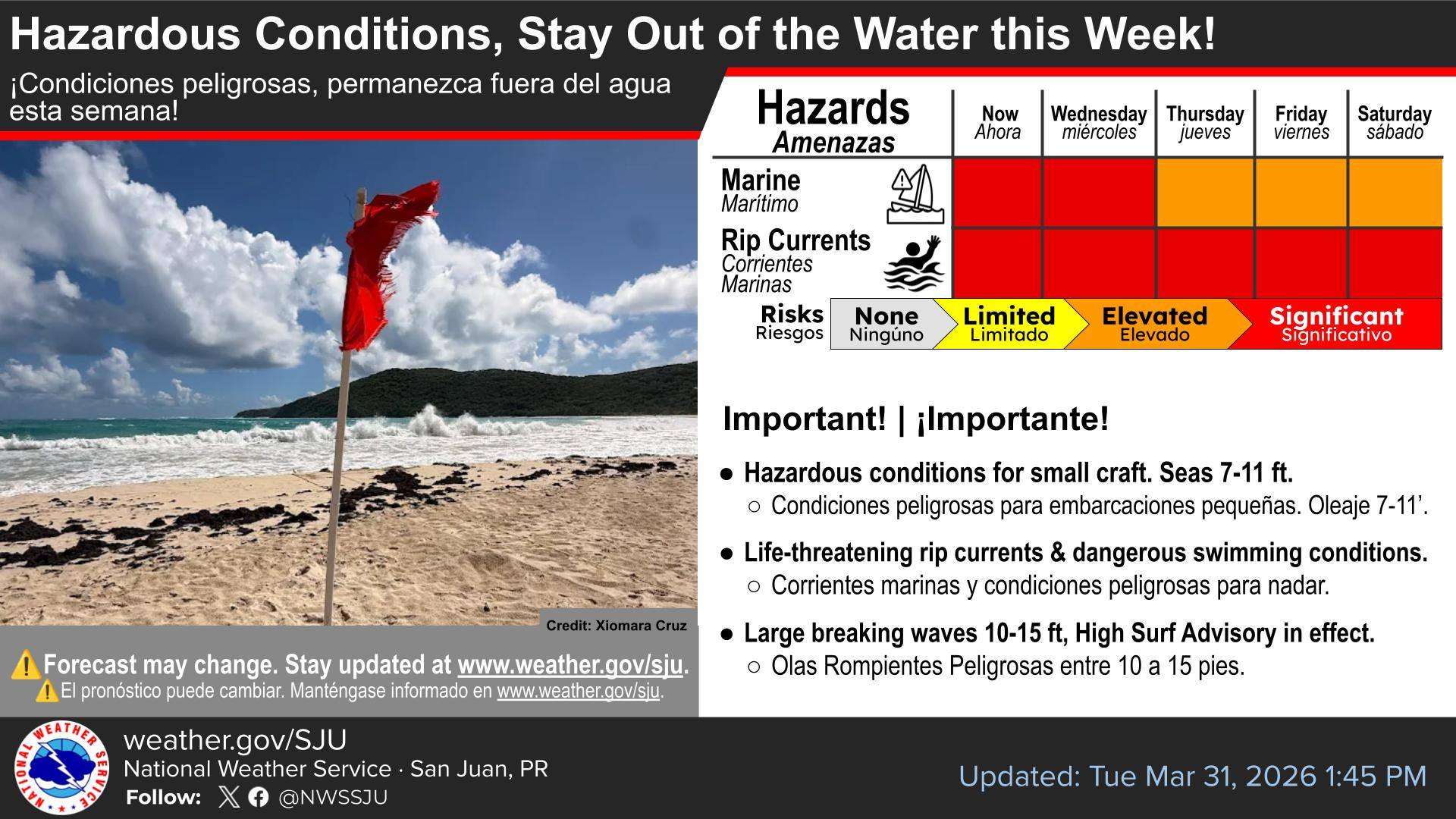
The National Weather Service in San Juan, Puerto Rico, is warning that rough seas, gusty winds, and unsettled weather will affect Puerto Rico and the U.S. Virgin Islands this week, with dangerous surf, life-threatening rip currents, and marine alerts among the main concerns.
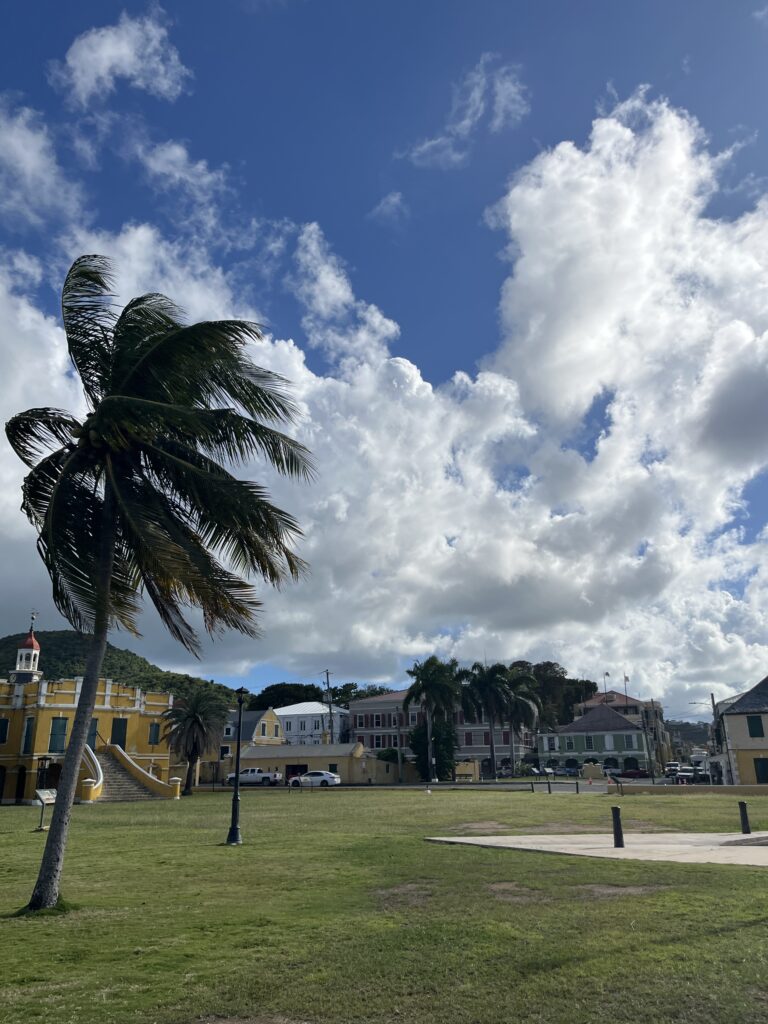
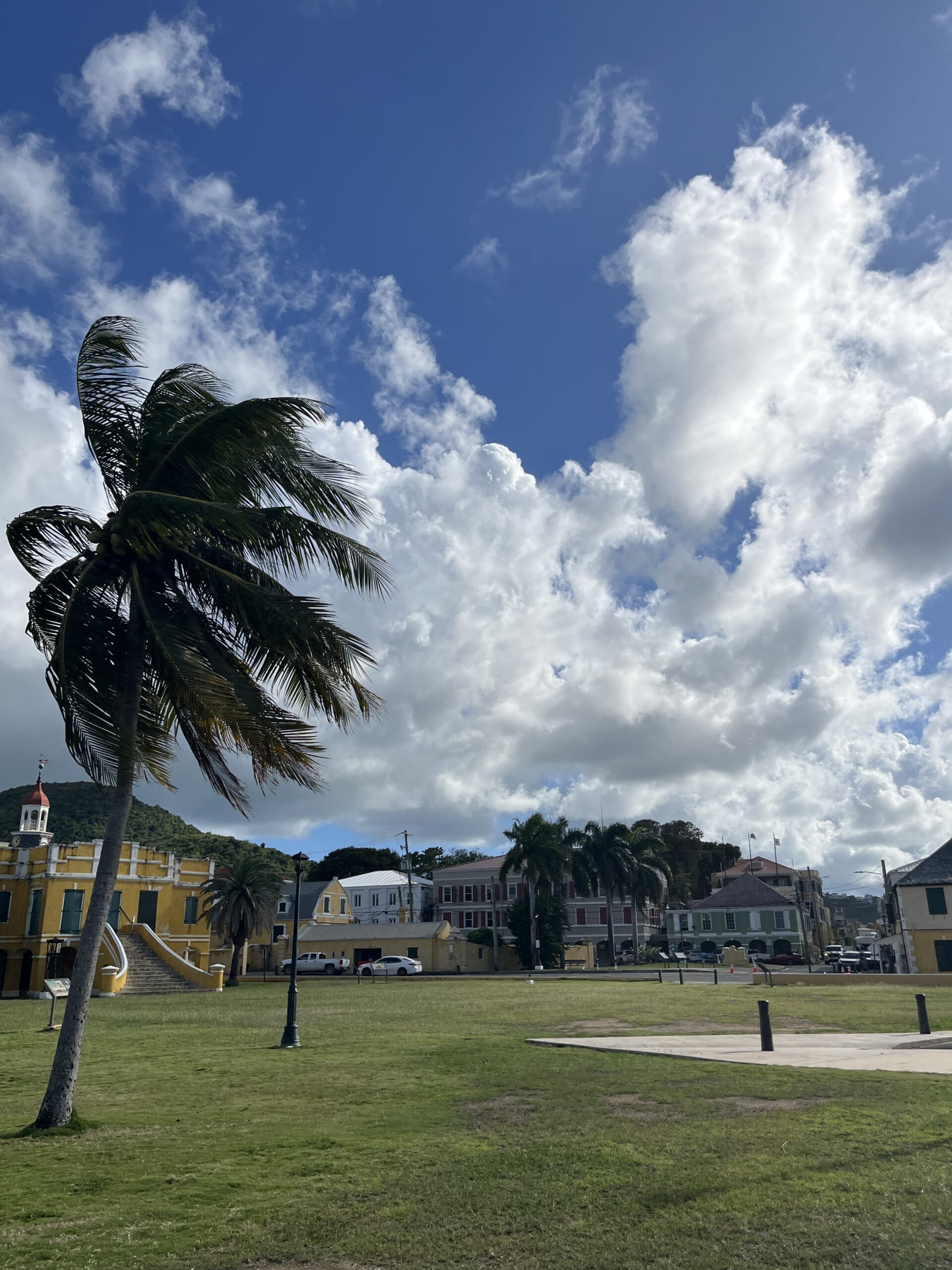
Breezy conditions and passing clouds are seen over the Christiansted National Historic Site on St. Croix, USVI. (Source photo by Jesse Daley)
Hazardous Marine Conditions In an update on Tuesday, NWS forecasters said an area of high pressure over the Western Atlantic will produce gusty east-northeasterly winds that, combined with a long-period northerly swell, will create hazardous seas expected to remain choppy over the coming days.
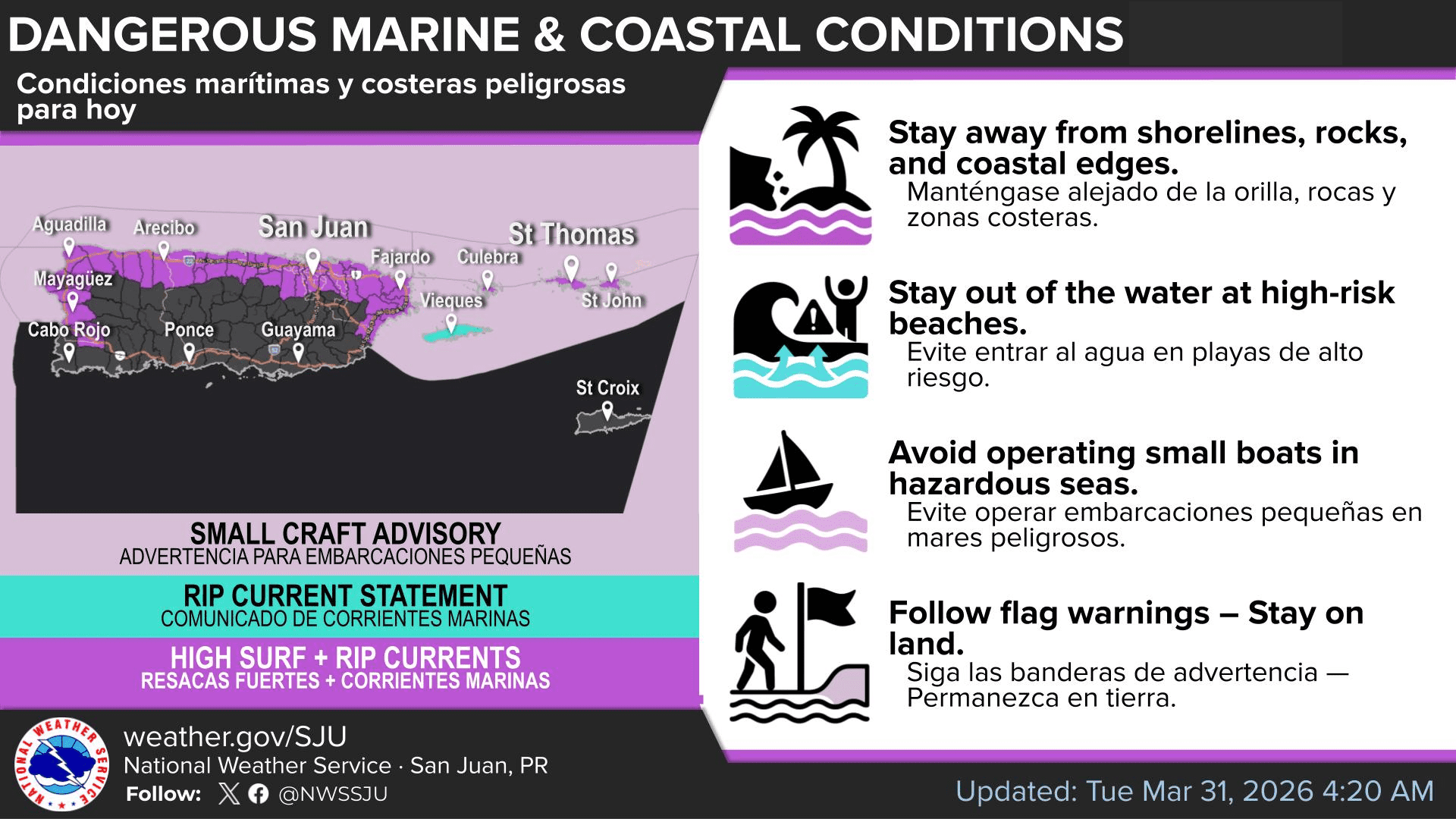
A marine and coastal hazards graphic from the NWS in San Juan, Puerto Rico, warns of dangerous conditions across Puerto Rico and the U.S. Virgin Islands, including high surf, rip currents, and hazardous seas for small craft. (Photo courtesy NWS)
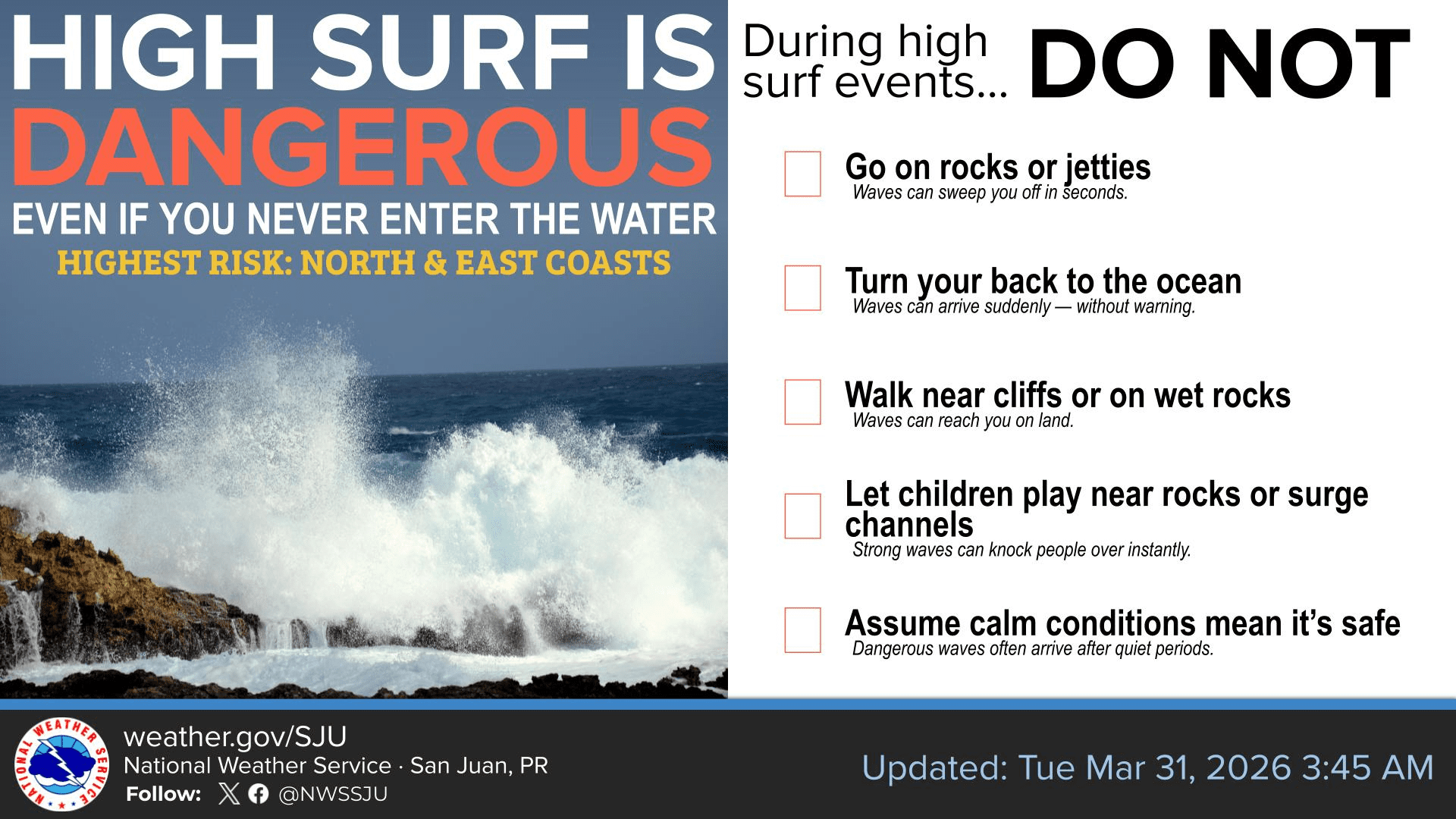
“The combination of these winds and a building swell will result in hazardous marine conditions, with choppy to rough seas across the local waters,” the NWS reported. Unsafe marine conditions are particularly possible along north- and east-facing coastlines across both U.S. territories. “Dangerous surf will create life-threatening rip currents and hazardous shoreline conditions, including strong breaking waves and wave run-up that can sweep people off rocks or the shoreline,” the NWS warned. For St. Thomas, St. John, and adjacent islands, a High Surf Advisory is in effect until at least 6 p.m. Wednesday, and a High Rip Current Risk remains in effect through at least 12 a.m. on Saturday.
A high surf safety graphic from the NWS in San Juan, Puerto Rico, warns that dangerous waves can pose a threat along north- and east-facing coastlines, even for people who stay out of the water. (Photo courtesy NWS)
Small Craft Advisories are also in effect for surrounding waters, including those around St. Thomas and St. John, until at least 12 a.m. on Saturday, according to the latest NWS update. While St. Croix was not included in the High Surf Advisory or High Rip Current Risk alerts as of Tuesday afternoon, the waters east of St. Croix are included in the Small Craft Advisory. Additionally, NWS meteorologists reported that showers and thunderstorms will affect the area at times, creating further hazards. “Periods of frequent showers, and possibly isolated thunderstorms, will also move across the waters, locally reducing visibility and producing brief higher winds and rougher seas. Overall, hazardous marine conditions are expected to persist through much of the week,” forecasters explained. “Beachgoers are urged to stay out of the water and use caution near the shoreline at affected beaches, as conditions can be dangerous even for those not entering the water,” the NWS said.
A beach hazards graphic from the NWS in San Juan, Puerto Rico, shows high rip current risk and warns that high-risk beaches are not safe for swimming across parts of Puerto Rico and the U.S. Virgin Islands. (Photo courtesy NWS)
Breezy Weather, Showers and Thunderstorms Possible Across the region, breezy conditions and passing showers, with isolated thunderstorms possible at times, are expected to continue into early next week. The NWS said the weather could affect outdoor plans during the holiday week, including Easter Sunday, for example. “During this ongoing holiday week, periods of showers and breezy conditions may lead to interruptions in outdoor activities across the islands,” the NWS cautioned. “While showers will move quickly, repeated activity may result in localized flooding in urban areas, roadways, and poor drainage locations, especially by midweek as moisture increases,” the NWS said. “Breezy to locally windy conditions will persist, especially across exposed coastal areas and higher elevations,” the NWS added. Looking further ahead, the NWS local forecast for the USVI notes that breezy conditions and passing showers will prevail, with an unsettled pattern possible from Friday into the weekend and early next week, and isolated flooding is possible. Temperatures across the area are also forecast to trend above normal. Local Weather Updates As the Source reported in a recent interview with the NWS, weather hazards can occur year-round. Information regarding the weather across the USVI, including marine forecasts, is available from the NWS and NOAA. And with the Atlantic hurricane season set to begin June 1, the Source recently covered AccuWeather’s latest 2026 hurricane season forecast, which can be viewed here. Additionally, the local forecast is regularly updated on the Source Weather Page, where a weekly video forecast is available. Finally, residents and visitors can also view weather alerts and disaster preparedness information from the Virgin Islands Territorial Emergency Management Agency.

Open Forum: Grateful for the Compassion and Care at Luis Hospital

To Our Community,

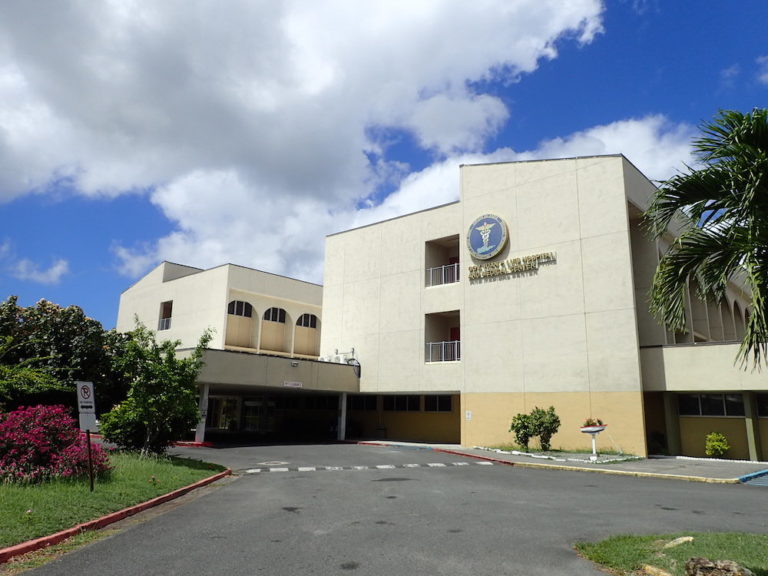
In recent years it has become almost second nature to speak critically about our local hospital, the Governor Juan F. Luis Hospital and Medical Center. While no institution is perfect, I feel compelled to share a very different experience — one that deserves to be heard.

Over the course of three weeks, I accompanied a dear friend through the Emergency Room, into the Intensive Care Unit, and later onto the Medical-Surgical floor. My friend was facing stage four cancer. There was little expectation of recovery, but there was a profound need for comfort, dignity, and compassion during his final days.

However, what we experienced though, day after day, was extraordinary. Every doctor, nurse, assistant and staff member we encountered treated my friend — and all of us — with kindness, patience, and genuine care. This was not a single moment or a lucky shift. I was there almost daily, and the consistency of compassion and professionalism never wavered. Each interaction reflected not just competence, but humanity.

The staff created an environment where my friend felt safe, respected, and cared for. In a time filled with grief and uncertainty, they brought calm, comfort, and even moments of peace. They did not just provide medical care — they provided dignity at the end of life, which is one of the greatest gifts anyone can offer.

I even found myself telling several nurses that, in all those weeks, I had not encountered a single person who was unkind. That is truly something worth recognizing.

It is important for our community to hear stories like this. While criticism can be necessary, so too is acknowledgement of what is working — and working well. There are dedicated, compassionate professionals at the Governor Juan L. Luis Hospital and Medical Center who show up every day and give their best to our community.

For that, I am deeply grateful.

— Mary C. Mingus, St. Croix

Electric Service Returns to Most of St. Thomas and St. John

0
Power has been restored to Feeders 5A, 7A, 8A, 6B, 7B, 8B, 9B, 10B, 7E, 6A (partial), 7C (partial), and 9C (partial). Crews continue working to fully restore service to the remaining affected areas.

Oriental Bank Branches Closed Friday, April 3

0
Oriental customers can access their accounts using any of the following convenient methods:
Oriental-Bank in Puerto Rico
– Online Banking and Mobile Banking – check account balances, make payments, transfer funds, verify transactions and send money to other people. Our new Online Service Portal offers you all the benefits of online banking plus the ability to make loan payments, check loan balances, request payoff letters and more. Mobile Banking offers all of the online banking functions plus the ability to deposit checks using a smartphone camera. – Phone Customer Service Center – Customers can check balances, make payments, transfer funds between accounts, and verify the status of their transactions and paid checks. To contact the Service Center, call our toll-free number 1-800-981-5554, open from 7:00am -1:00pm. – Make Loan Payments Online – Customers can make payments through ‘My Payments’ for personal loans, car loans and leases, even if they do not have a deposit account with Oriental. Customers can access ‘My Payments’ at orientalbank/usvi.com. – Automated Telephone Services: Call 1-866-622-6800 to check account balances, transfers, recent transactions and other services. – ATM Services – Customers can make deposits using the Branch ATM until 9:00pm daily and receive the same benefits as depositing with a teller at the branch. You can also check account balances, make withdrawals, transfer funds between accounts and change your PIN. All non-branch Oriental ATMs allow customers to check balances, make withdrawals and transfer funds between accounts.

No Kings Rally Draws Large Crowd on St. Thomas; Mass Call Planned Tuesday Night

0
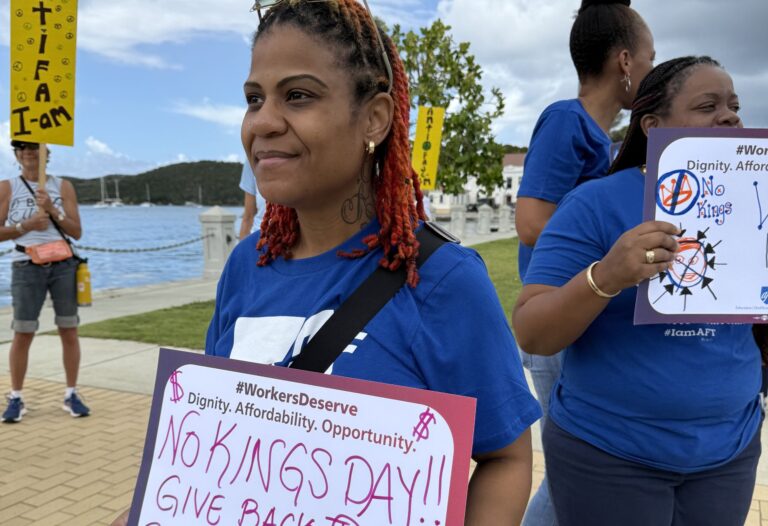
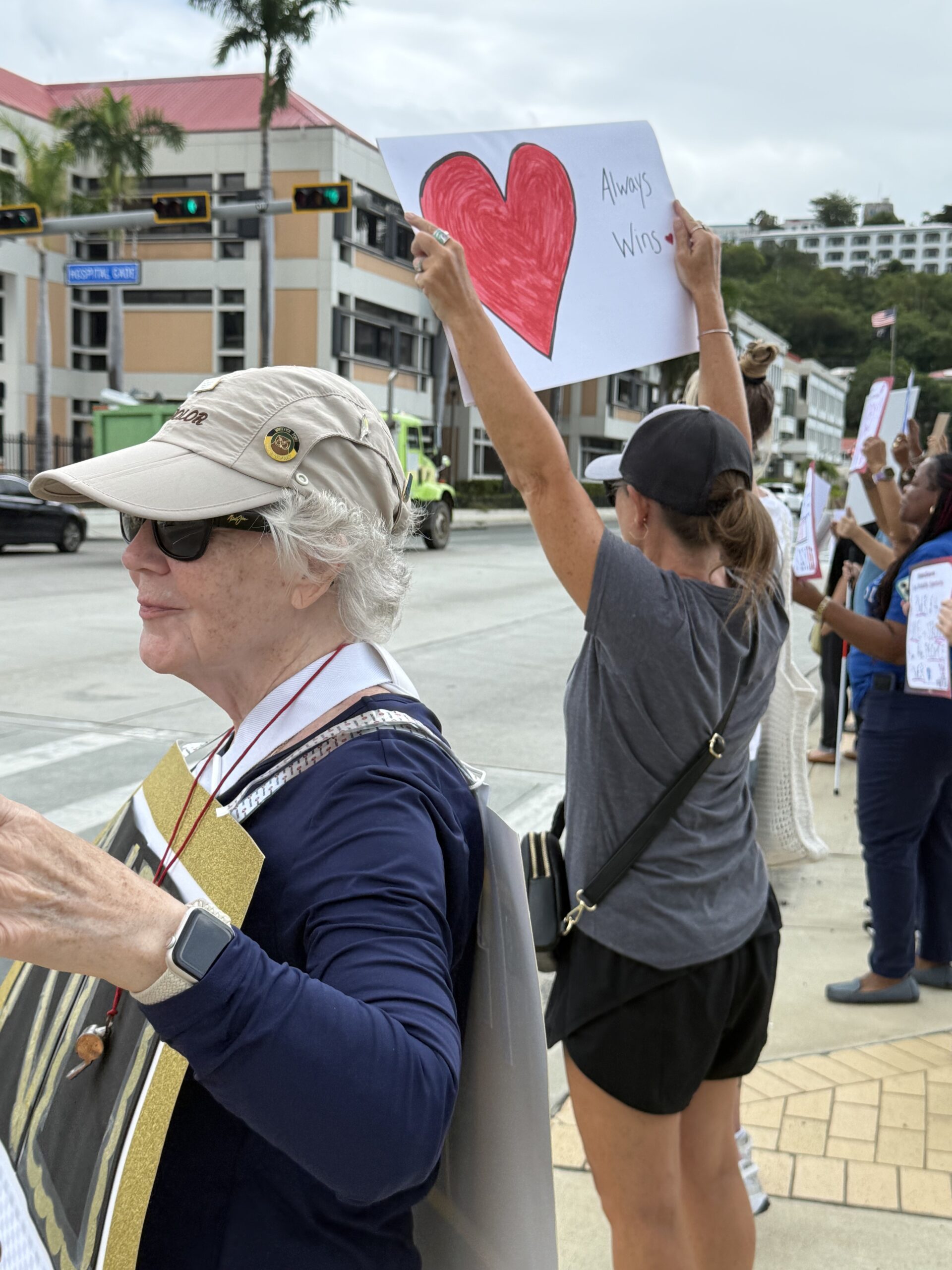
No Kings rally goers line the promenade Saturday in downtown Charlotte Amalie. (Photo courtesy Jane Higgins)
No Kings rallygoers line the promenade Saturday in downtown Charlotte Amalie. (Photo courtesy Jane Higgins)

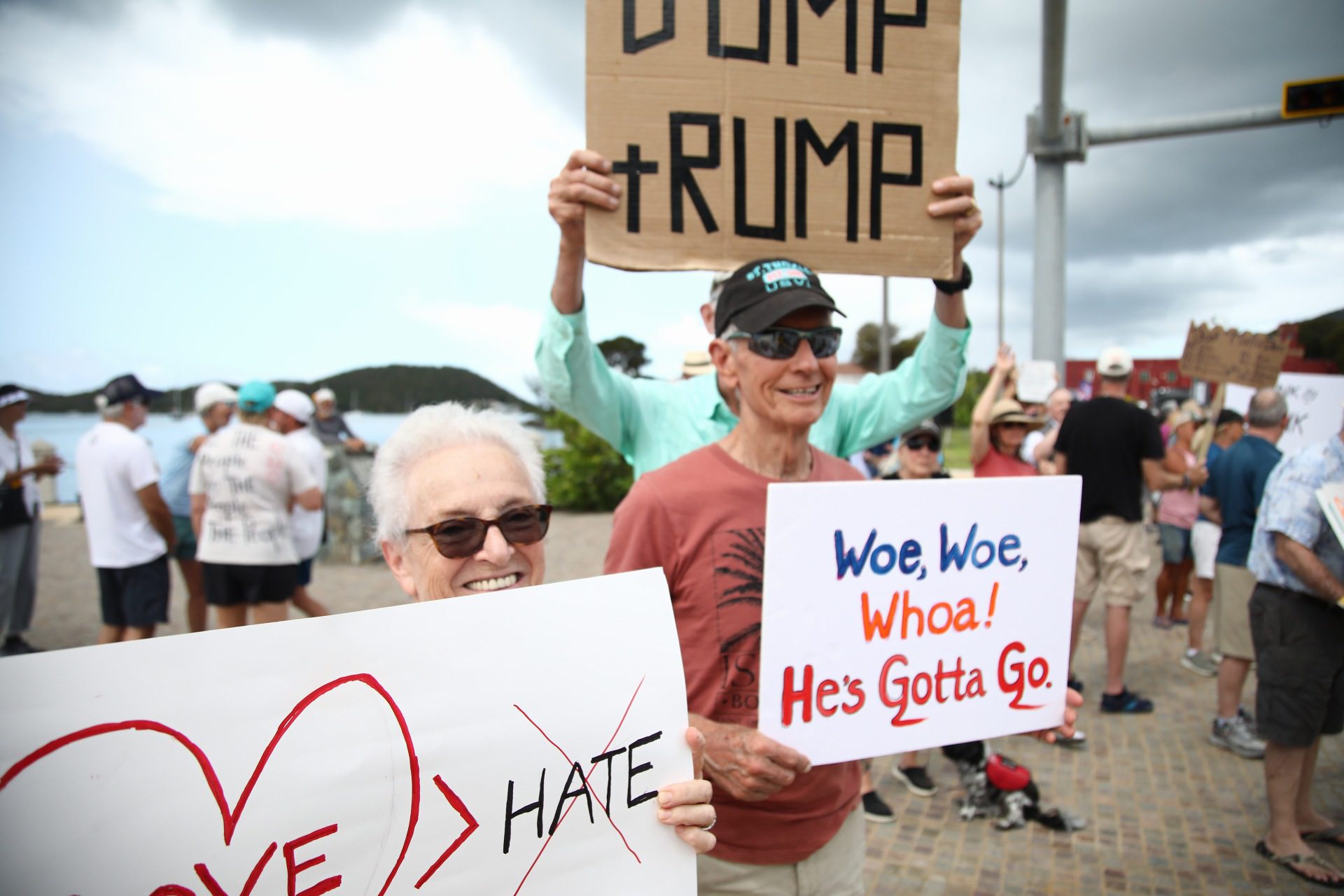
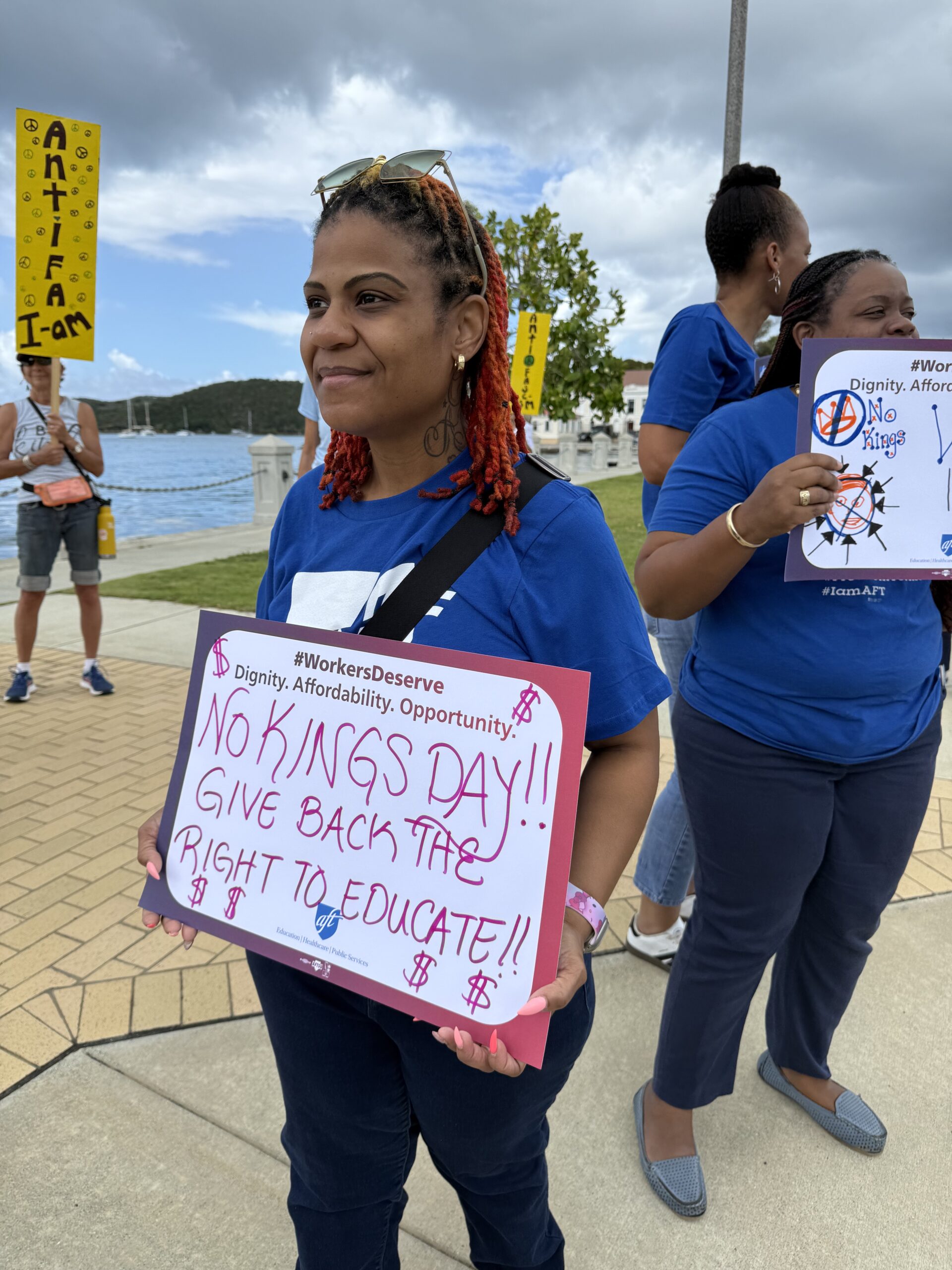
Despite driving rain and power outages to contend with, some 200 people turned out Saturday for the No Kings rally on St. Thomas — the third such protest since President Donald Trump took office in 2025, with corresponding rallies held on St. Croix and St. John.

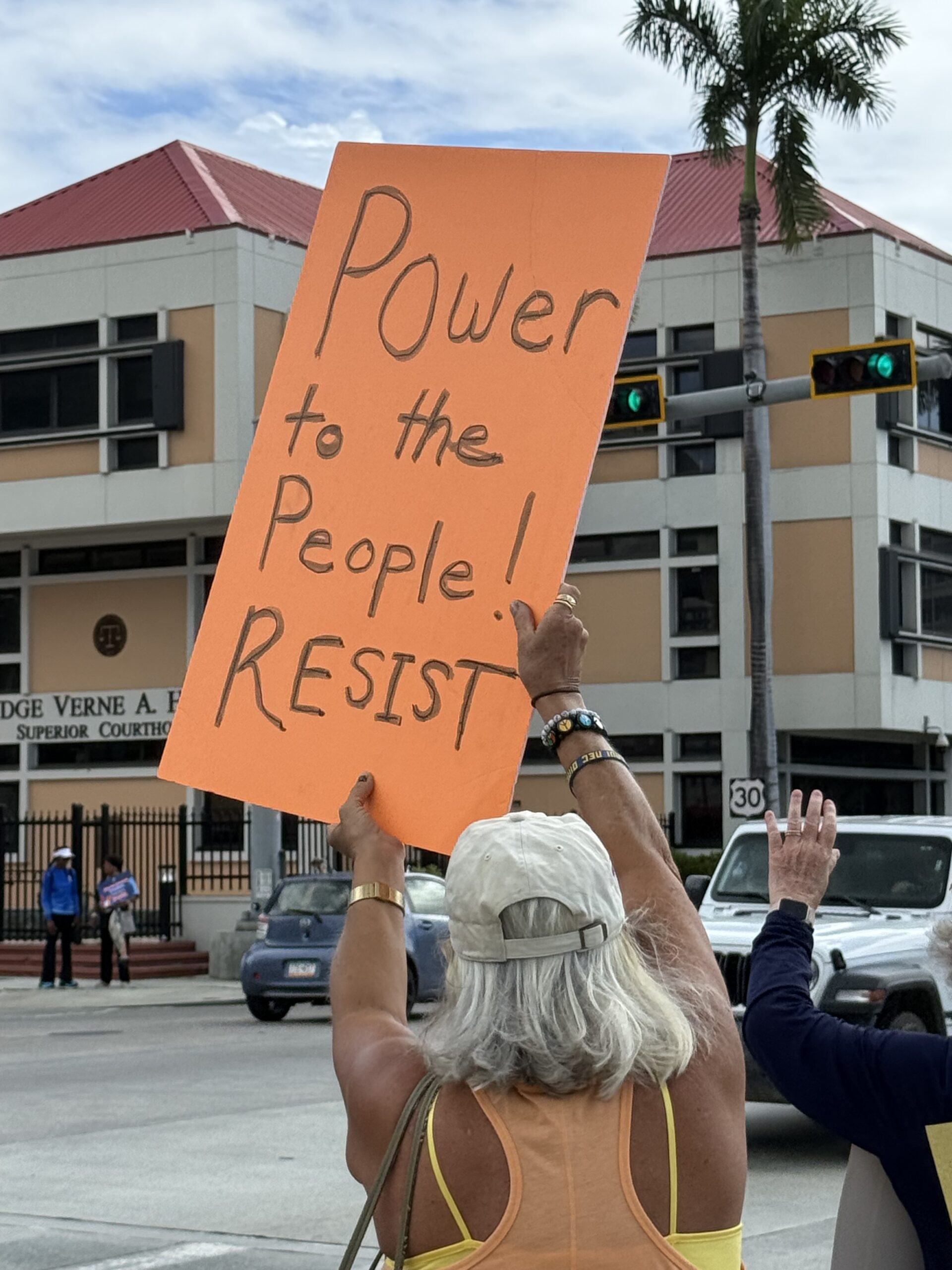
St Thomas Indivisible organizer Jane Higgins reported that many hundreds gave a thumbs up or honked their horns as they drove by the rally on the waterfront promenade, across from the courthouse in downtown Charlotte Amalie.

“There will be continuous No Kings rallies across the USA until our Democracy is saved by the millions of resister citizens,” said Higgins in an emailed message.

On the mainland, and in cities across the world, millions of people took to the streets to protest Trump’s second term, including the war in Iran, the Justice Department’s handling of the Epstein files, the erosion of democratic norms, and the administration’s crackdown on immigration.

“Many thanks to our DJ Petty Jazzman Group for playing all the well-known freedom songs, including Power to the People and Mississippi GD,” said Higgins, adding that the rally was filled with dancing, joy and a strong sense of community.

The national No Kings organization will hold a community “mass call” on Tuesday at 8 p.m. with movement leaders and local activists to “celebrate this historic mobilization, and get plugged into what comes next.” To RSVP, visit nokings.org.

The signs say it all at the No Kings rally Saturday on St. Thomas. (Photo courtesy Jane Higgins)
A No Kings rally participant gets the attention of passing motorists during the protest Saturday on St. Thomas. (Photo courtesy Jane Higgins)
 
Protestors hold their signs high at the No Kings rally Saturday on St. Thomas. (Photo courtesy Jane Higgins)

Shifting Roots, Fluid Horizons Exhibition

Bajo el Sol Gallery is pleased to present Shifting Roots, Fluid Horizons, a group exhibition featuring internationally exhibited artists Sigi Torinus, José Seone, and Janet Cook-Rutnik. The exhibition explores how place and memory shape ways of seeing and being.
Interior by Sigi Torinus
Opening Reception: Saturday, April 4 from 4 p.m. to 7 p.m. “In Shifting Roots, Fluid Horizons, the work of Janet Cook-Rutnik, Sigi Torinus, and José  Seoane converges as a dynamic dialogue between three creative and established practices that continue to evolve. Each artist persistently challenges their own boundaries—at times in quiet isolation, and at others through shared creative exchange. Together, their works reflect on fragile environments, lives in flux, where identity and place are continuously reshaped through processes of migration and transculturation. This exhibition is both a meditation and a conversation”— curator, Priscilla Hintz Rivera
Cage by Sigi Torinus
Each artist brings a distinct, yet interconnected perspective rooted in experience and ecological awareness. Together their works reinforce a sense of identity grounded in place while remaining fluid, evolving, and responsive to change. Sigi Torinus presents new media installations and immersive visual language in a body of work that occupies the space between the underwater and sky, holding moments of sinking and surfacing, nearness and distance, and quiet suspension.
Peace On Earth by Janet Cook-Rutnik
Born and raised in the Virgin Islands, Torinus studied Art and Philosophy, earning her MFA from the Braunschweig Art Institute in Germany and San Francisco State University. Her work reflects migration and movement, using light and sound in poetic, playful ways. José Seoane, a Cuban–Canadian artist living part-time on St. John, explores transculturation and diasporic identity through hybrid works that merge painting, sculpture, and time-based media. In this exhibition, he repurposes bird cages with organic materials alongside watercolor abstractions, creating layered compositions that evoke memory, displacement, and belonging.
Lucy in the Sky Janet Cook-Rutnik
Janet Cook-Rutnik, who has lived and worked in the Virgin Islands since 1969, presents Orgánica, a series incorporating handmade paper and upcycled materials. Her multidisciplinary practice—spanning painting, sculpture, printmaking, video, and public art—engages deeply with Virgin Islands history and environment. In this body of work, she emphasizes sustainability and transformation, reimagining discarded materials as renewed forms. The opening reception will take place on Saturday, April 4, from 4–7 PM and will feature live music by emerging artist Adeline Shaw.
Artwork by Sigi Torinus
Bajo El Sol Gallery is home to thought-provoking monthly exhibitions, readings by award winning V.I. writers & poets, documentary screenings on some of the Caribbean’s most respected thinkers, as well as talks by local academics and visiting curators.  The gallery is in Mongoose Junction, St. John a 5min walk from the Cruz Bay ferry.

WAPA Predicts Early Afternoon Electricity Return

0
WAPA plant personnel are making significant progress in restarting the power plant. Restoration for some customers is estimated within 90 minutes (12:45 pm). At this time, we do not anticipate that a rotation schedule will be needed, pending the successful restoration of all customers.