A St. Croix woman has been charged with theft and fraud after embezzling over $48,000, the V.I. Police Department reported Thursday.
On Nov. 11, 2022, the Economic Crimes Unit initiated an investigation into multiple obtaining money by false pretense complaints filed by a business. The investigation revealed that Jahreema Barnes embezzled $48,891.48 from the complainant’s business account by depositing several different vendor checks into her personal account at USAA without authorization, according to the police report.
As a result, an arrest warrant was issued for Jahreema Barnes on Oct. 24, the police report stated.
On Nov. 15 at approximately 11:20 a.m., Barnes, 39, turned herself into authorities, where she was arrested and advised of her Miranda Rights, which she waived and signed. Barnes was subsequently booked and charged with obtaining money by false pretense, grand larceny, embezzlement by employee, identity theft, and access to computer for fraudulent purposes, the report stated.
Barnes was unable to post bail in the amount of $35,000 and was remanded to John A. Bell Adult Correctional Facility pending her advice of rights hearing scheduled for Friday at the Superior Court of the Virgin Islands, police said.
V.I. Department of Planning and Natural Resources
The V.I. Division of Fish & Wildlife recently received its first Competitive State Wildlife Grant (C-SWG), awarded for large-scale conservation projects and related activities.
The U.S. Fish & Wildlife Service granted $229,130 to the V.I. Division of Fish & Wildlife to provide a sub-award to the Southeastern Association of Fish and Wildlife Agencies’ Southeast Aquatic Resources Partnership (SARP) and Clemson University to study the distribution and habitat associations of Species of Greatest Conservation Need and to assess aquatic organism barriers in the freshwaters of the Virgin Islands. The initiative was selected along with 17 others out of 29 eligible applicants for $7.7 million available for the program.
“These fragile ecosystems and their fauna are becoming increasingly threatened by numerous human activities. Among these threats, loss of connectivity to the ocean is among the most dire,” said Sean Kelly, Ph.D., wildlife biologist and coordinator of State Wildlife Grants.
“Because most of the freshwater species spend some portion of their life cycle in the ocean, barriers restricting species movement between marine and freshwater environments cut off their critical habitat and choke out freshwater biodiversity in the V.I.,” Kelly concluded.
The project includes Southeast Aquatic Resources Partnership using their road-stream-crossing protocol to assess 40 potential barriers, along with training for local stakeholders occurring this week. Clemson University will be subcontracted to survey sites across the territory for fish, fauna and instream habitat to collect information on the American eel (Anguilla rostrata), as well as other critical species including the freshwater crab (Epilobocera sinuatifrons), various shrimp, clams and aquatic insects.
For more information, call 773-1082.
Rosemary Sauter-Frett (Source file photo)
The fugitive real estate broker who bilked clients out of millions of dollars between 2008-2010 was sentenced in late October after nearly a decade, her plea deal getting her out of jail time but ordering more than $500,000 worth of restitution to victims.
In February 2010, Rosemary Sauter-Frett’s real estate firm on St. Thomas, RE/MAX Dream Properties in Lockhart Gardens, was closed and locked after Sauter-Frett disappeared and was being hunted down by local authorities. At that time, a V.I. Superior Court warrant was issued for her arrest after local real estate agents reported that checks worth tens of thousands of dollars drawn on the RE/MAX escrow account had bounced and clients reported that they were not able to close on their houses.
Sauter-Frett had gotten as far as Miami, but as authorities prepared to corner her before she boarded her next plane, Sauter-Frett gave them the slip once again. A federal warrant was subsequently issued for her arrest but Sauter-Frett was not found until February 2014, when she was picked up by FBI agents in San Diego and brought in.
When initially arrested, Sauter-Frett was facing 13 counts of embezzlement by fiduciary (with each count carrying a possible sentence of 10 years in prison) along with two counts of obtaining money by false pretenses and charges under the Criminally Influenced and Corrupt Organizations Act. A conviction under CICO alone could have landed her in jail for 15 years with a fine of $500,000.
At the time, her bail was set at $1.25 million, supported by a series of complaints from clients who told investigators how the St. Thomas realtor had defrauded them, stealing hundreds of thousands of dollars. The documents detailed 12 such cases and were sealed at the time the warrants were issued in 2010 but became available after Sauter-Frett was extradited back to St. Thomas on April 3, 2014.
She entered a no-contest plea in August of 2023 and agreed to pay restitution of $564,355 to the victims. Though prosecutors initially recommended she be sentenced to five years behind bars, the plea deal allowed for her to receive credit for time served, with the balance – everything outside of the eight months she served in pretrial detention – suspended unless she violates the conditions of her probation.
According to a Justice Department press release Wednesday announcing the conviction and judgment, Sauter-Frett has been on electronic monitoring “for several years,” which will continue until the restitution is paid in full. She’s also required to sell two properties she owns on St. Thomas to satisfy the payments and is not allowed to work or volunteer in any position involving “public trust or fiduciary responsibility.” She must also complete 75 hours of community service each year.
“Justice has finally been served. I commend our Department of Justice prosecution team and truly hope this sentencing provides some degree of closure to the victims of her actions. The White Collar Crime Division makes every effort to prosecute these defendants in a manner that is most beneficial to the victims, particularly when they are owed large sums of money. In this case, while incarceration would have been appropriate, the victims will be made whole once restitution is paid. If restitution is not made, probation may be revoked, and a five-year prison sentence may be imposed,” V.I. Attorney General Ariel Smith said in Wednesday’s release.
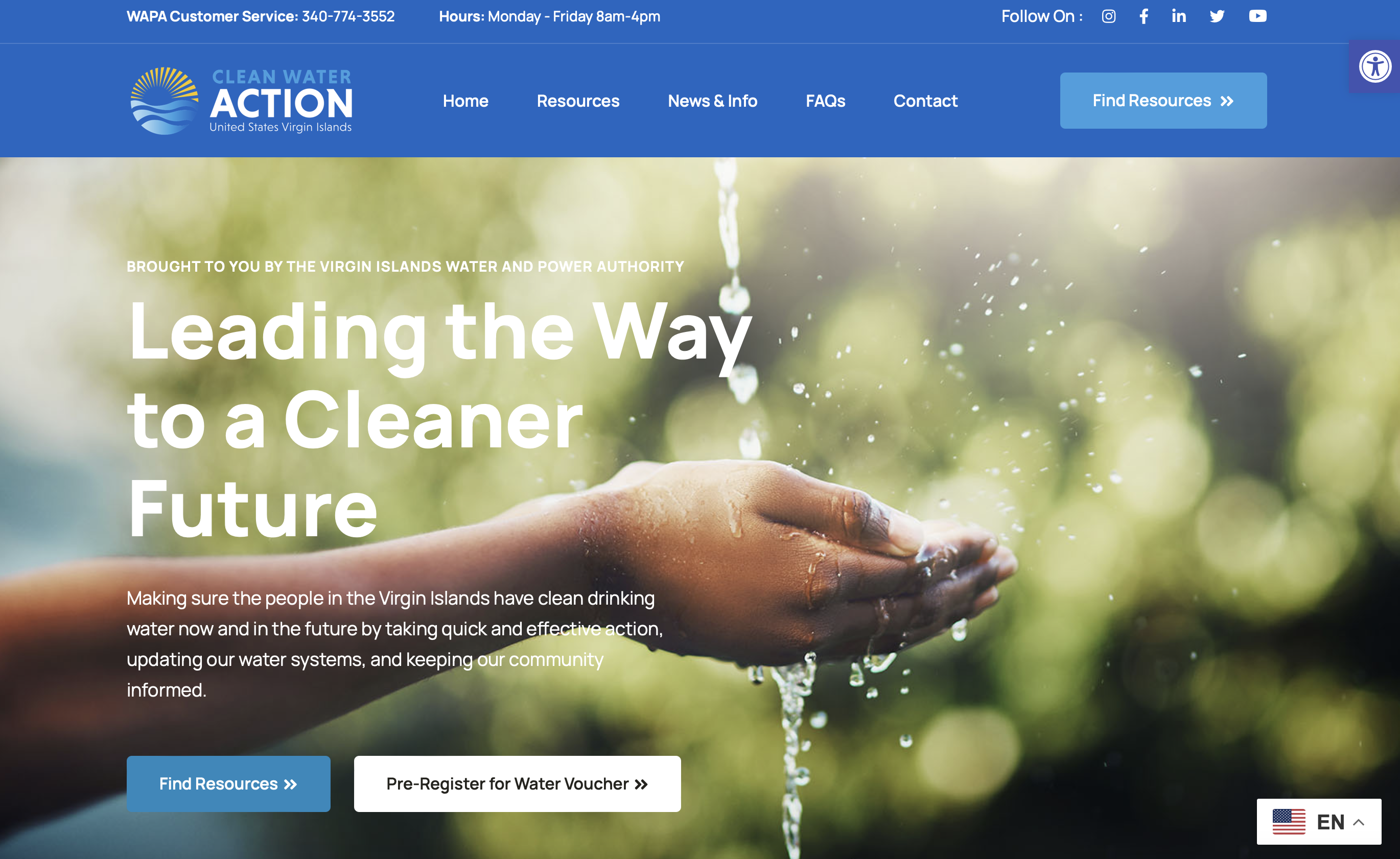
WAPA has established a “Clean Water Action” website, www.cleanwaterusvi.com, where St. Croix residents affected by lead in their water may register for $100 coupon books for bottled water that will be distributed starting Saturday. (Screenshot of website)
Starting Saturday, the V.I. Water and Power Authority will distribute water vouchers to St. Croix residents who live in the areas affected by lead and copper in their water supply, CEO Andrew Smith announced Wednesday.
The vouchers, which will be issued as coupons redeemable for bottled water at designated businesses over the next 90 days, will be distributed from Saturday through Monday, Nov. 18 to 20, from 9 a.m. to 5 p.m., Smith said.
Representatives from WAPA, VITEMA, the departments of Health, Planning and Natural Resources, and Human Services, the V.I. National Guard and VI Police Department are coordinating this effort to ensure an efficient process at the distribution stations, he said.
Officials estimate more than 8,500 people living on St. Croix lack safe municipal water because of lead and copper content that was discovered during testing at the end of September. While cistern water is generally free from these heavy metals, many of these people may rely on WAPA water alone.
Emergency response officials disclosed a plan Nov. 7 to issue vouchers for free bottled water to these 3,431 affected households.
The lead and copper contamination was discovered while looking for the source of red and brown water coming from people’s facets.
The water was not discolored because of lead and copper but because it had sat in old, corroding iron pipes. These same aged pipes were to blame for elevated lead and copper levels — however, it was entirely possible to have no metals in discolored water and dangerous levels of metals in clear water. One did not indicate the other.
Following is the voucher registration information:
Pre-registration: Eligible residents of the affected communities listed below are strongly urged to pre- register for the coupons at www.cleanwaterusvi.com to reduce line delays. The online portal will open on Thursday afternoon. Upon arrival at the distribution station, the recipient should present the approval code and personal identification.
Walk up registration: Eligible residents must present personal identification and the WAPA water account number (can be found on the most recent bill). Renters who may not have a WAPA bill in their name or a lease verifying residency, must present a picture ID, and will be required to sign an affidavit confirming eligibility.
Residents of communities managed by the Virgin Islands Housing Authority will be notified by their housing manager how to receive their coupons and will not need to visit the distribution centers this weekend. These communities are Aureo Diaz Heights, Candido Guadalupe, and Williams Delight.
Residents who participate in the Human Services Department’s “Meals on Wheels” program and those on the agency’s waiting list will be delivered water by the agency’s personnel.
All other water customers residing in the affected areas who are unable to visit the distribution centers from this Saturday through Monday should stay tuned to media outlets for further information about time and location for additional voucher distribution.
Distribution locations are as follows and signage will be posted at each site to assist residents through the process:
Distribution Station #1 — drive-thru only: Parking lot adjacent to the Midre Cummings Park, Frederiksted, Saturday and Sunday service for water customers residing in La Grange, Smithfield, Wheel of Fortune, Two Brothers, White Lady, Hannah’s Rest, Campo Rico, Whim, and Stoney Ground.
Distribution Station #2 — walk up only: Agricultural Fairgrounds, Estate Lower Love (eastern entrance), Saturday, Sunday and Monday service for water customers residing in Grove Place, St. Georges, Adventure Hill, Paradise, Mount Pleasant (South), Williams Delight, Profit, and Castle Burke. Customers from other affected neighborhoods listed may also walk up at this location on Monday as the other locations will be closed.
Distribution Station #3 — drive-thru only: John H. Woodson Junior High School, Saturday and Sunday service for WAPA water customers residing in Colquohoun, Mon Bijou, Barren Spot, Diamond (West), Strawberry Hill, Sion Farm, St. John, and Montpellier (East).
Redemption Centers for coupons:
Water coupons may be redeemed at these St. Croix locations: The Market, Plaza East, both Pueblo locations, and Blue Mountain Water.
Coupon books are valued at a total of $100. Each coupon is valued at $10 and must be fully redeemed when used. There will be no cash exchanges, refunds or rebates permitted. Coupons will expire within 90 days of receipt.
For more information about the water distribution program, visit www.cleanwaterusvi.com.
Smith reminds the public that the utility’s water remains safe for bathing, flushing, cleaning and laundering clothes, however a “no drink” advisory is still in effect for consuming and cooking. Health Department hotlines are available for residents with health concerns related to lead in potable water at 340-712-6299 or 340-776-1519.
The Department of Planning and Natural Resources also operates a hotline related to concerns on water sampling at 340-514-3666. All hotlines operate Monday through Friday, 8 a.m. to 5 p.m.
Virgin Islands Fire and Emergency Medical Services
The Virgin Islands Fire and Emergency Medical Services has lifted the territorial burn ban that has been in effect since April 11. This decision comes after careful consideration of current environmental conditions and safety measures in place to prevent brush fires.
As the territory transitions out of this burn ban, V.I. Fire and Emergency Medical Services reminds residents and visitors of the importance of adhering to safety precautions when engaging in vegetative debris burning. The following are some essential safety guidelines to follow:
Check Weather Forecasts: Always check the current weather conditions and forecasts before initiating any burning activities. Avoid burning on windy days, as strong winds can quickly spread fires.
Create a Clear Perimeter: Clear a safe area around the site and remove all non-vegetative debris and burn small piles of debris at a time to better control the fire. Maintain a safe distance from structures, power lines and vehicles.
Use Safe Equipment: Use approved fire containment equipment, such as hoses, shovels and fire extinguishers, to control and extinguish the fire if necessary.
Never Leave Unattended: Never leave a burning fire unattended. Always monitor the fire until it is completely extinguished.
Avoid Burning During Peak Fire Hours: Avoid burning during the peak fire hours, typically in the late morning to early afternoon when conditions are driest and winds are stronger.
Residents and visitors are urged to exercise extreme caution and responsibility when conducting controlled burns. Safety should always be the top priority to protect one’s self and the neighbors from potential risks.
If a fire poses a threat to life or property, immediately call 911.
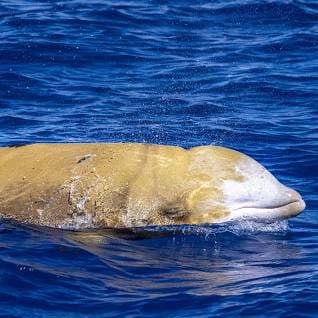
Dolphin name Cuvier’s beaked whale is very rare to see. (Submitted photo)
Early in the morning of Oct. 17, a 4.85m (15.9 ft) long Cuvier’s beaked whale (Ziphius cavirostris) was seen “thrashing” about in the water in Fish Bay, St. John. Construction workers who were near the site saw it swim out of the bay, but shortly afterward observed it drifting back. The construction team notified Lila Uzzell, a UVI Masters in Marine and Environmental Science student.
Uzzell reported the whale to the National Marine Mammal Stranding Network, which referred it back to the Virgin Islands Division of Fish and Wildlife within the V.I. Department of Planning and Natural Resources. Upon hearing the report, UVI Center for Marine and Environmental Studies (CMES) Director Paul Jobsis, Ph.D., requested that UVI perform the necropsy and use the skeleton as an educational display.
UVI Center for Marine and Environmental Studies employees, and UVI alumni Nicolas Durgadeen and Sam Gittens were conducting coral reef studies near Fish Bay that morning with Captain Kevin McCartney. Having received approval from local and national agencies, Jobsis requested McCartney tow the small whale to the UVI dock in Brewers Bay. Following four hours of towing, the whale reached the dock at 5 p.m. on Oct. 17, where a small crowd of UVI students and employees were waiting to photograph the whale and measure all body dimensions.
Jobsis assembled the team to begin the necropsy the next morning. “It is sad that this amazing animal died, but it is an incredible opportunity to learn more about them,” said Jobsis. “Beaked whales are rarely seen at the surface and are some of the deepest diving mammals in the world. They are known to dive down to 9,800 feet and hold their breath for nearly four hours. That’s incredible.”
According to the National Oceanic and Atmospheric Administration (NOAA) information webpage on Cuvier’s beaked whales, they are known to dive to 9,816 feet, and the longest recorded dive lasted 222 minutes. Typically, they dive to 3,300 feet for approximately an hour at a time. These whales live in small groups of two to seven animals and feed on deep-dwelling squid and octopus. The females have no teeth, and the males have two teeth jutting out of the lower jaw and two tiny teeth in the upper jaw. The animals suck in their prey and swallow them whole.
On the morning of the 18th, the necropsy team, Dr. Donna Nemeth, veterinarian; Dr. Heidi Stout; Moriah Bass, MSc; Amber Packard, MSc, and several UVI students started collecting samples to learn from this rare opportunity.
“Blubber (fat) samples taken from near the head, body and tail (flukes) will be sent to labs at the National Marine Fisheries Southeast Office to determine the health, possible cause of death and confirm the species identification,” said Jobsis.
Samples were also taken for analysis by beaked whale experts like Kristie West, Ph.D. The whale is a young adult male, and Jobsis hopes they will be able to confirm if it were sexually mature, as it is smaller than previously reported adult Cuvier’s beaked whales.
“We don’t know for sure what killed the animal; there were no obvious wounds that you would expect from a being hit by a ship. The animals are known to be sensitive to military mid- and low-frequency sonar. The sound damages their ears, and they swim too fast to the surface and get the bends. We didn’t find any food in its stomach but have taken stool samples of some parasites from its kidneys,” said Jobsis.
The necropsy was finished by Oct. 19. At that point, the team had removed most of the blubber and meat and towed it all far offshore to be released. The skeleton was sunk temporarily and will be recovered for use as an educational display.
“I know there are some people worried about the possibility of the carcass attracting sharks to Brewers Bay, but that is not likely because most of the meat is gone and the carcass is not near any swimming areas,” said Jobsis. “The flippers have already been removed and cleaned. When the skeleton is recovered, the long process of bleaching and reassembly begins. It is going to make an amazing display that hopefully inspires students to learn more about the oceans and the animals in it.”
Virgin Islands Department of Human Services
The V.I. Department of Human Services Division of Family Assistance, in partnership with Mission Project Inc., is glad to announce the launch of the Supplemental Nutrition Assistance Program (SNAP) — Employment and Training Program (E&T), which is aimed at providing individuals with the necessary skills and support to secure sustainable employment.
The program is set to begin on Nov. 20, and it promises to make a meaningful impact in the lives of participants.
SNAP E&T is a federally funded, state-administered program that assists program participants in gaining the skills, training or work experience needed to move towards and into employment. SNAP E&T also helps reduce barriers to work by providing individuals with support services, such as transportation and childcare as they prepare for and obtain employment and job retention services to help them maintain employment.
The program was created with the objective of empowering individuals receiving SNAP benefits by offering them training opportunities to gain employment skills and enhance their career prospects. By collaborating with Mission Project Inc., a well-regarded nonprofit organization with a history of community empowerment, the program aims to maximize its impact and effectiveness.
Participants will have access to a comprehensive range of resources and support offered through the SNAP E&T to include:
Job Readiness Training: Workshops and seminars designed to equip participants with essential job-seeking skills, such as resume writing, interview techniques and workplace etiquette
Career Counseling: One-on-one guidance and support to help individuals develop a personalized career plan, identify their strengths, and explore potential job opportunities
Skills Development: Training programs and courses tailored to meet the demands of the local job market, enabling participants to acquire new skills and enhance their employability
Job Placement Assistance: Assistance with job applications, job matching and referrals to local employers, ensuring participants have access to suitable employment opportunities
Supervised Job Search: Within the job search training and integrated job search components of SNAP E&T, most common activities include resume or cover letter assistance, mock interviews and individualized job search plan development.
The telephone numbers to call are:
St. Thomas/St. John Office – 774-0930, ext. 4309, 4377, 4477
St. Croix Office – 772-7100, ext. 7159, 7192
For more information, visit the Department o Human Services website at www.dhs.gov.vi or on
Facebook (https://www.facebook.com/usvidhs) at U.S. Virgin Islands Department of Human Services.
A beer industry political advocacy group has called for reforms to the rum cover-over tax deal. (Shutterstock image)
When it’s liquor before beer, the U.S. Virgin Islands is in the clear, to paraphrase an old limerick. Critics from the beer industry, however, have questioned the wisdom of that sophomoric anthem, saying the tax breaks for rum distillers in Puerto Rico and the USVI do a disservice to the territories while maximizing profits of international corporate conglomerates.
For 105 years, almost all federal taxes collected on rum from the U.S. territories have been reverted back to the islands. While the so-called rum cover-over has become an important tool in keeping Puerto Rico and the Virgin Islands financially solvent, it’s also long been the target of critics who view the plan as an unfair industry subsidy. That lobby was recently joined by the Beer Institute, which advocates federal policies for brewers, importers, and beer industry suppliers.
The argument is that, while well-intentioned, rum cover-over doesn’t actually go to build “schools, roads, and bridges,” according to the Beer Institute, but funds giant liquor companies like Diageo and Bacardi through heavy local tax breaks. This pits Puerto Rico and the Virgin Islands — the world’s largest rum producers — against each other in a lose-lose battle, long-time critics have said.
In 2008, the USVI lured Diageo — makers of Captain Morgan and other liquors — away from Puerto Rico with vast tax breaks and a new distillery.
St. John’s Sen. Angel Bolques Jr. worried challenges to the rum cover-over would undermine an important part of Virgin Islands finances. The rum cover-over is used to bolster the Government Employees’ Retirement System, which was forecast to collapse by October 2024 before rum money was used to back bonds, saving the system.
“I cannot stress enough the urgency with which Congress must address the current impasse over tax extenders and benefits. The prolonged delay in reaching a decision has profound and far-reaching implications, not just for the Virgin Islands, but for all U.S. territories relying on such critical funding,” Bolques said in a written statement on Wednesday.
“Every day of inaction exacerbates the challenges we face, hindering our ability to effectively support our healthcare, education, and other vital sectors. It is imperative that Congress acts swiftly and decisively to resolve this issue, demonstrating a commitment to the well-being and prosperity of all territories under the U.S. flag. The future of our communities hangs in the balance,” he said.
Every few years, Congress must consider whether to reenact the rum cover-over, which returns between $10.50 and $13.25 of the $13.50 tax per proof gallon to the territories. While a new bill would make the tax returns permanent, a push by the Beer Institute and other tax hawks seeks to limit how the territories can spend the money. It’s not a new idea. A 2009 House bill would have curtailed Puerto Rico and the USVI’s ability to finance economic development projects with this revenue source. It did not become law.
Senate President Novelle Francis presided over Tuesday’s hastily called, busy legislative session. (Photo by Jamal Potter, Legislature of the Virgin Islands)
Tuesday, in a legislative session that was not on the calendar at the beginning of the week, senators approved four appointments and passed three measures honoring residents.
The nominations by Gov. Albert Bryan Jr. and approved by the Senate included Sandra L. Setorie as executive director of the Public Services Commission and Clement “Cain” Magras and Laura Nichols-Samms to the Public Services Commission. Nichols-Samms was approved despite an unfavorable recommendation from the Rules and Judiciary Committee. Senators have expressed concern that some appointees don’t have specific expertise in the areas they oversee. Sen. Angel Bolques Jr. said Nichol-Samms was “a very dedicated individual” who could make “balanced decisions.”
Sen. Kenneth Gittens said he appreciated Nichol-Samm’s willingness to serve but could not support her because of a lack of technical expertise. He was one of the four senators voting against her appointment.
Kasima I. Knight-Hodge was also approved as a member of the V.I. Real Estate Commission, District of St. Thomas.
The bills that only need approval from the governor now would honor Wayne “Facts Man” Adams, Aliyah Boston, and former Senator Almando “Rocky” Liburd.
Adams is credited in his bill for “articulating and bringing events of historical significance to the people of the Virgin Islands.” The bill also says that the bridge at the Nadir intersection on the island of St. Thomas should be named after Adams.
The bill honoring Liburd for his service to the people of the Virgin Islands also calls for a renaming. If the governor approves, the North Shore Road on St. John will be named the Almando “Rocky” Liburd Drive.
The resolution concerning Aliyah Boston recognizes her for her “accomplishments in girl’s and women’s basketball, her contribution as an ambassador for the territory.”
During the long day, the largest appropriation was $17 million to the Port Authority to dredge the Charlotte Amalie Harbor.
Sen. Dwayne DeGraff, noting tourism’s contribution to the territory, said, “The dredging must be done.”
Sen. Ray Fonseca said yes, the dredging must be done, but added that a conversation must be started about the cruise lines paying for some of the future dredgings.
Sen. Marise James was the only senator not attending the session.
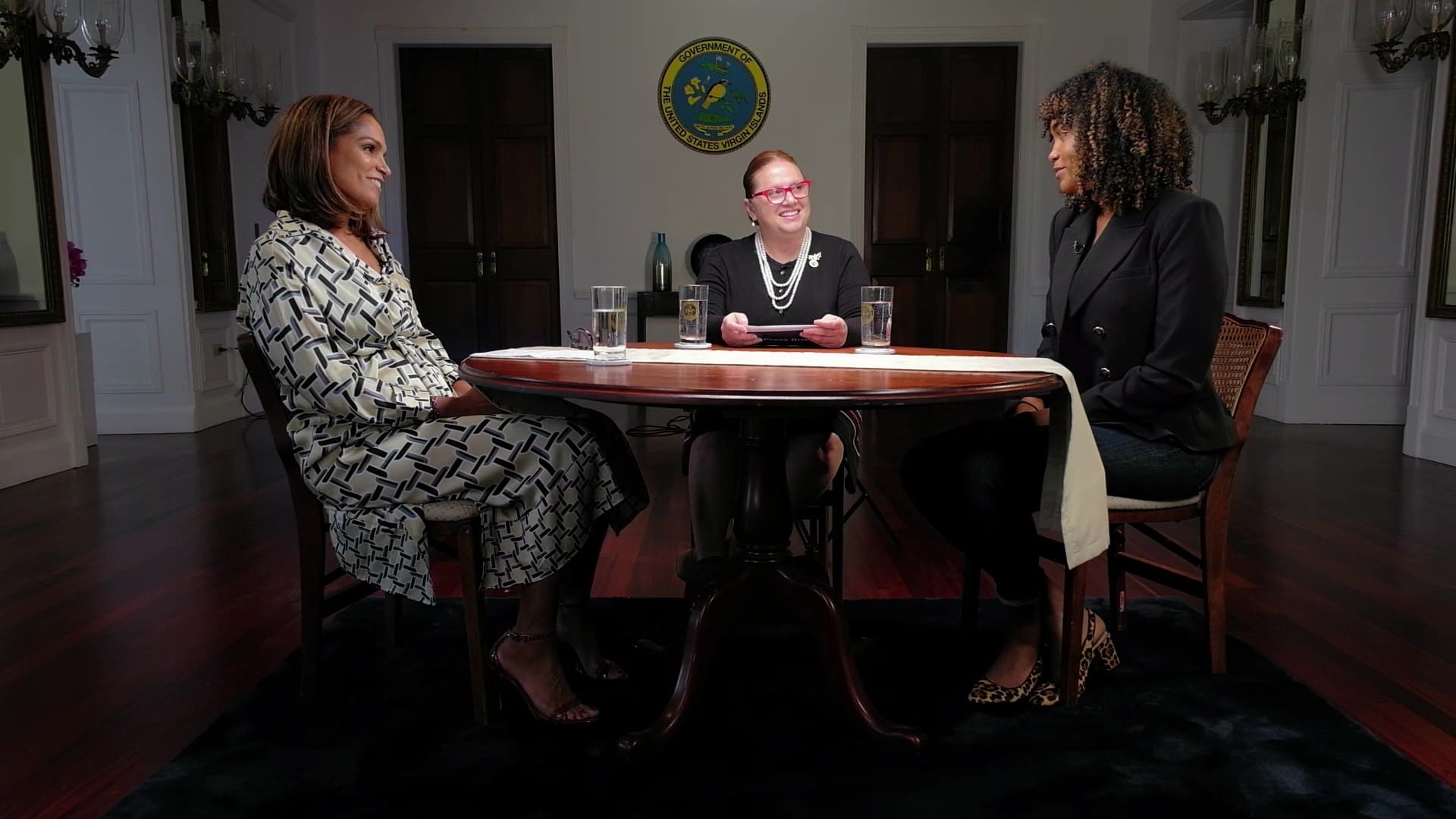
First lady Yolanda Bryan, Health Commissioner Justa Encarnacion, and Aliyah Bryan discuss life with diabetes during an episode of the Press Box in 2021. (Government House photo)
Over 14 years ago my life changed forever. The lab results were in, the doctor entered the hospital room and said the dreaded words that I will never forget, “She has Diabetes Type 1” (DT1).
Yolanda Bryan (Photo by Andre Ettienne)
The doctor spoke about next steps forward of managing the chronic disease in terminology that can only be described as sounding like Charlie Brown’s teacher talking. Anyone that remembers Charlie Brown’s teacher speak it sounded exactly like: “Bwa ba bwa bwa bwa.” I recall it crushing to hear, but even worse, looking into my daughter’s fearful eyes.
I was determined that she would live as normally as possible, and she did just that! She danced ballet, received her diving certification, played club and was on her school’s varsity volleyball team — she even represented the USVI on the Junior National Volleyball and Basketball Teams — and excelled in school. Today, despite episodes of neuropathy, she is a thriving 26-year-old woman who continues to make me proud every single day!
As a mother with a child living with DT1, I know all too well the psychological upheaval that takes place in a household when faced with the many challenges of this chronic disease. Stress in the areas of social, medical resource availability, emotional and financial strain among many others take effect when the unpredictable symptoms of this diabetes strike. Not to mention the psychological distress and compounding stronghold that diabetes has on children afflicted by this illness. Whether you live with DT-1 or DT-2, it is important to have open conversations and raise awareness about diabetes.
Living with diabetes does not have to be a death sentence, however, it can be challenging, both physically and mentally, but know that you are not alone in this fight. Seek out support from local medical providers, online support groups, and counseling for individuals and families. It is also important learn how to incorporate nutritional food, the glycemic index for learning how to control sugar spikes, in addition to healthy plate portion control practices and regular exercise routines — and of course monitor your glucose levels regularly.
As the holidays are upon us, let us be reminded to be mindful of portion control and the quantity of carbohydrates that we consume. I know the Thanksgiving feast looks delicious; however, you may want to choose between seasoned rice and stuffing.
During National Diabetes Month we remind ourselves that education is key when it comes to addressing diabetes. Let us break down barriers and foster empathy as we discuss one of the most prevalent health conditions worldwide — diabetes. As a caretaker, I share my personal journey with diabetes with the hope that it will be of some encouragement to those in our community who it may inspire to take action. Together with awareness, education, and all our resources both nationally and locally we will win this battle. Until a cure is found.
For more information on diabetes support services visit: