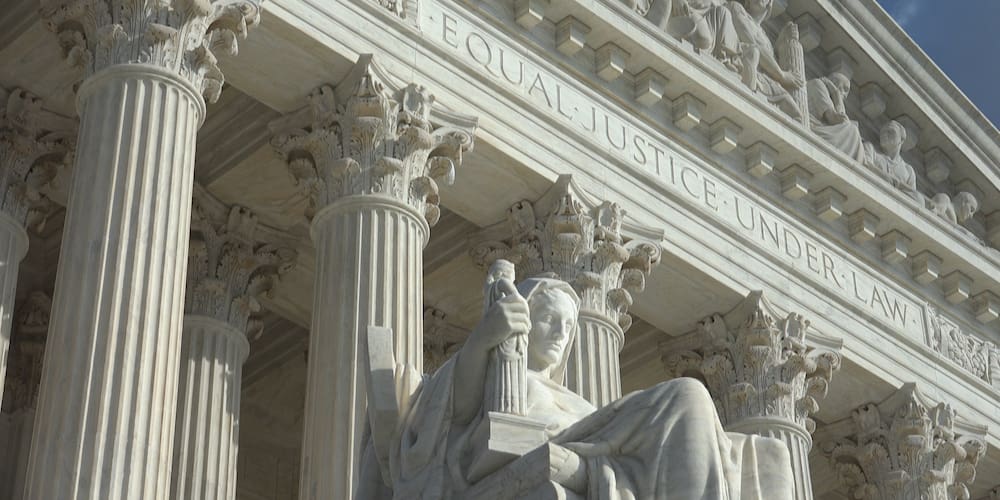
The U.S. Supreme Court heard oral arguments Wednesday in President Donald Trump’s challenge to birthright citizenship in a case that could have far-reaching implications for people born in U.S. territories.
“For the people of the U.S. Territories, including the U.S. Virgin Islands, this fight is deeply personal,” Delegate to Congress Stacey Plaskett said in a statement afterward. “For generations, we have struggled to have our citizenship and our rights fully recognized. The Supreme Court’s long avoidance of the birthright citizenship question in the territories has left our residents in an unacceptable state of legal limbo — and now we are watching that same dangerous logic weaponized to strip citizenship from children born on American soil.”
Wednesday’s arguments came more than a year after Trump signed an executive order seeking to end birthright citizenship for children whose parents are unauthorized immigrants or temporary residents. States and organizations quickly challenged the order, which was blocked by multiple lower courts. Trump petitioned the U.S. Supreme Court for a review of the case after a federal judge in New Hampshire granted an injunction to the American Civil Liberties Union and other organizations.
In an amicus brief submitted to the court, 21 current and former officials and judges from the U.S. Virgin Islands, Puerto Rico, Guam, American Samoa and the Northern Mariana Islands rejected the idea that a president or Congress can deny citizenship to people born in the United States, whose citizenship is enshrined by the 14th Amendment. The group included Plaskett, Gov. Albert Bryan Jr., Lt. Gov. Tregenza Roach, former Gov. Kenneth Mapp, former Delegate Donna Christian-Christensen, and former V.I. Superior Court judges Adam Christian and Soraya Diase Coffelt.

“It’s really important to not have the question of citizenship turn on the political whims of Congress or the president,” Neil Weare, co-director of Right to Democracy and the brief’s counsel of record, said in a call with the Source Wednesday. “And so the understanding in Congress and the Department of Justice that the federal government can turn citizenship on and off in the Virgin Islands and other territories is a very dangerous idea — and one that is contradicted by the text and history of the Citizenship Clause.”
Weare said in a statement earlier this week that the court has avoided answering whether people born in United States jurisdictions have a right to be recognized as citizens under the 14th Amendment for more than a century.
“As a result, presidents and congresses from both parties have claimed the power to unilaterally deny people born in U.S. territories recognition as citizens — even people who have been recognized as U.S. citizens their entire lives,” he stated. “This troubling experience offers a stark object lesson for the Justices as they consider whether to allow the Trump Administration to alter the long-settled meaning of the Citizenship Clause.”
Right to Democracy co-director Adi Martinez Roman said the case raised questions about presidential and congressional power, like whether they can “simply decide to exclude groups of people they do not want to be considered U.S. citizens.”
“The U.S. Constitution regulates the power of government and protects its subjects from abuse. Therefore, the Supreme Court can and should answer that question in the negative,” she stated, adding that the court’s “consistent avoidance of this issue in U.S. territories has created uncertainty and confusion when it comes to our own questions of self-determination and decolonization.”
Many of the arguments presented Wednesday by U.S. Solicitor General D. John Sauer and ACLU Legal Director Cecillia Wang referenced a precedent the court set in 1898 when it ruled that Wong Kim Ark, a child born to Chinese parents in San Francisco, was a U.S. citizen. Sauer said the Trump administration was not attempting to overturn the precedent but seized on mentions that, in that case, the child’s parents were “domiciled” residents — a designation he said doesn’t apply to many people in the United States illegally today.
Wang argued that the justices were merely reciting the facts of the case when they used the term and that under “common law” — laws based on court decisions rather than statutes — “‘domicile’ was not relevant, and the children born to temporary visitors … were always considered birthright citizens.”
“It really was a big day at the Supreme Court for the question of what citizenship means in the United States,” Weare said. “And what really came across from justices on kind of both sides of the ideological divide was a recognition of the continuing validity of the Supreme Court’s prior decision in Wong Kim Ark and its adoption of a common law understanding of what birthright citizenship means in the United States.”
Weare said that’s significant for people in the territories because under a common law understanding of birthright citizenship, constitutionalized by the 14th Amendment, people born in United States jurisdictions have a right to citizenship in states and territories alike.
“It was understood to apply through the ‘dominion’ of the United States, which, again, included both states and territories,” he said. “So while the issue of U.S. territories did not come up with the argument — we’re unlikely to see much about it in the Supreme Court’s decision — if what was previewed in the Supreme Court’s argument today holds, it could provide a very strong precedent moving forward for constitutional citizenship in U.S. territories.”
Weare noted that legal experts had an opportunity to discuss the territories’ issues at a V.I. Bar Association conference attended by Justice Neil Gorsuch, and he encouraged people who want to learn more to review a recent panel discussion. Right to Democracy is also planning to host events in the U.S. Virgin Islands and Washington, D.C., for the 250th anniversary of the Declaration of Independence and the 125th anniversary of the Insular Cases.