


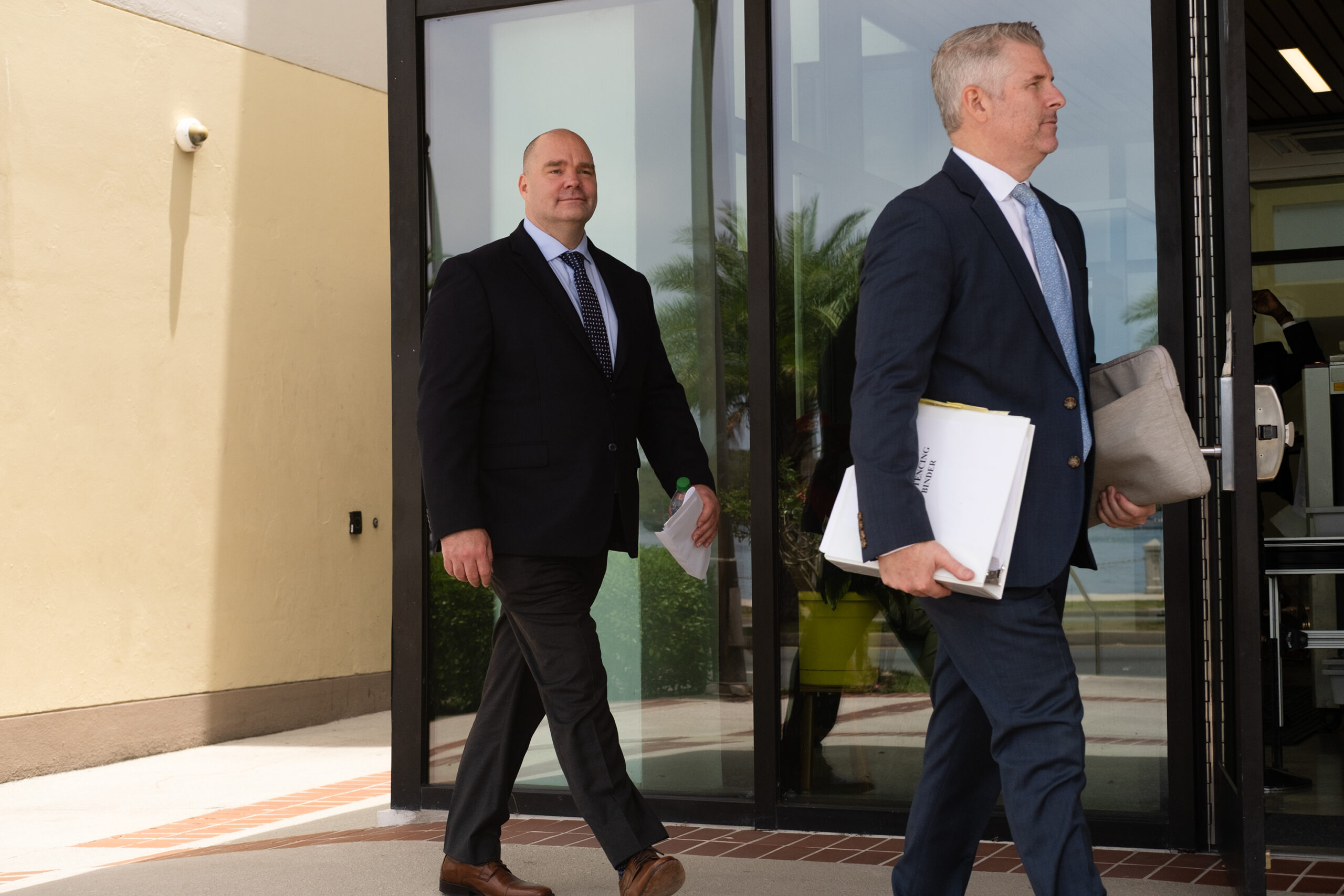
A federal judge Wednesday sentenced convicted felon, cybersecurity contractor and star witness David Whitaker to 22 months in prison for his role in a bribery scheme that roiled the territory and led to multiple high-profile resignations and convictions.
Whitaker pleaded guilty to two counts of wire fraud and one count of bribery in September 2024, roughly one year after he began cooperating with federal investigators. The first wire fraud count stems from a more than $130,000 bill Whitaker sent to VIPD after his company, Mon Ethos Pro Support, was hired to sweep government offices for listening devices or “bugs.” Whitaker has admitted to planting most of the devices himself. The second wire fraud charge came from false statements Whitaker made to the U.S. Small Business Administration in order to secure a federal Paycheck Protection Program loan in February 2021.
The bribery charge stemmed from payments Whitaker began making to former V.I. Police Commissioner Ray Martinez “so that he would stop working on his restaurant during work hours and pay my invoices,” according to his testimony during Martinez and former Management and Budget Director Jenifer O’Neal’s trial in December.
Wednesday’s sentencing hearing began with a lengthy sidebar during which Alexandre Dempsey, a trial attorney with the U.S. Justice Department’s Public Integrity Section, and David Cattie, Whitaker’s attorney, apparently conveyed to U.S. District Court Judge Mark Kearney that it was Martinez who roped Whitaker into the scheme and not the other way around. When introducing the government’s 22-month sentencing recommendation, Dempsey said that it had been suggested both in court and in public that it was Whitaker who came to the U.S. Virgin Islands to instigate fraud.
“The United States does not believe that to be the case,” Dempsey said, adding that it was also a matter of record that Martinez was aware of a separate kickback arrangement between Whitaker, businessman Benjamin Hendricks and former Sports, Parks and Recreation Commissioner Calvert White. Whitaker, Dempsey said, heard Martinez’s “veiled request for a bribe and took him up on it.”
Kearney later apologized to Whitaker directly.
“I read you as being the solicitor,” he said, adding that he now understood that it was Martinez who saw and exploited an opportunity to use Whitaker.
The admission came less than a day after Kearney sentenced Martinez to 10 years in prison and expressed bewilderment that Martinez — once the territory’s highest ranking law enforcement officer — hadn’t looked into Whitaker’s well-documented criminal history before taking bribes and colluding with him to skim from inflated invoices submitted under a federally funded contract. Whitaker said Wednesday that people in the Virgin Islands, including Martinez, were well aware of his criminal past because he told them about it.
Dempsey acknowledged Whitaker’s history but noted that Whitaker quickly confessed when confronted and said that Whitaker had performed every action asked of him after he agreed to work with federal investigators.
“He is as cooperative as a cooperator can be,” Dempsey said.
Cattie, who asked Kearney for a sentence of home confinement because of Whitaker’s cooperation and health issues, also noted that Martinez, O’Neal, White and Hendricks chose to deny and fight the charges against them. In a sentencing memorandum filed last week, Cattie also pointed out that Whitaker was only charged with “corrupt conduct” related to Martinez. His interactions with O’Neal, White and Hendricks all happened after he began cooperating with the Federal Bureau of Investigation. Without that cooperation, it’s unlikely that the three former cabinet members and Hendricks would have been convicted.
“Suffice it to say, I do find that your assistance was substantial,” Kearney told Whitaker at one point.
Cattie argued that the benefit of Whitaker’s cooperation went beyond the four convictions because it acts as a deterrent for the next government official who may be thinking about taking a bribe in a territory where public corruption is widely perceived as pervasive and difficult to prove.
“It’s the whisper. It’s the wink,” he said, but Whitaker “brought that to light.”
Addressing the court, Whitaker once again admitted to the false invoices, the PPP fraud and the bribes. People were already worried about whether their government is working for them, he said, “and I added to it.”
“I knew better and I did it anyway,” he said. “The hard question is why I did it again.”
Whitaker, who was free on $250,000 bail and has been living in Georgia while he awaited sentencing, told the court that when he arrived in the territory, he left behind the people in his life who held him accountable and that he let Martinez’s position as police commissioner “carry too much weight.”
“I did wrong. I know better. I failed. I’m sorry,” he said, adding that he was ready to face the consequences.
The court also heard from Anthony Thomas, a former V.I. Property and Procurement commissioner who later took a position at Mon Ethos and who was appointed chief administrative officer of the V.I. Water and Power Authority in late 2024. Thomas asked for leniency and spoke more broadly about the need for accountability and institutional guardrails.
“No one should be above accountability. Public trust is a sacred responsibility,” he said. Kearney said later that it would be unfair for anyone to compare Whitaker’s sentence with those imposed on Martinez, O’Neal and White.
“They took an oath to serve,” he said. “They were trusted.”
Following his incarceration, Whitaker faces three years of supervised release, including six months of home confinement. He was ordered to pay $600,000 in restitution and given until Jan. 2, 2027 to surrender so that he can make arrangements for a person for whom Whitaker is a caretaker.
O’Neal’s sentencing is set for 9 a.m. Thursday at the federal court on St. Thomas.
Editor’s Note: Reporter Grayton Goldsmith contributed to this reporting.