


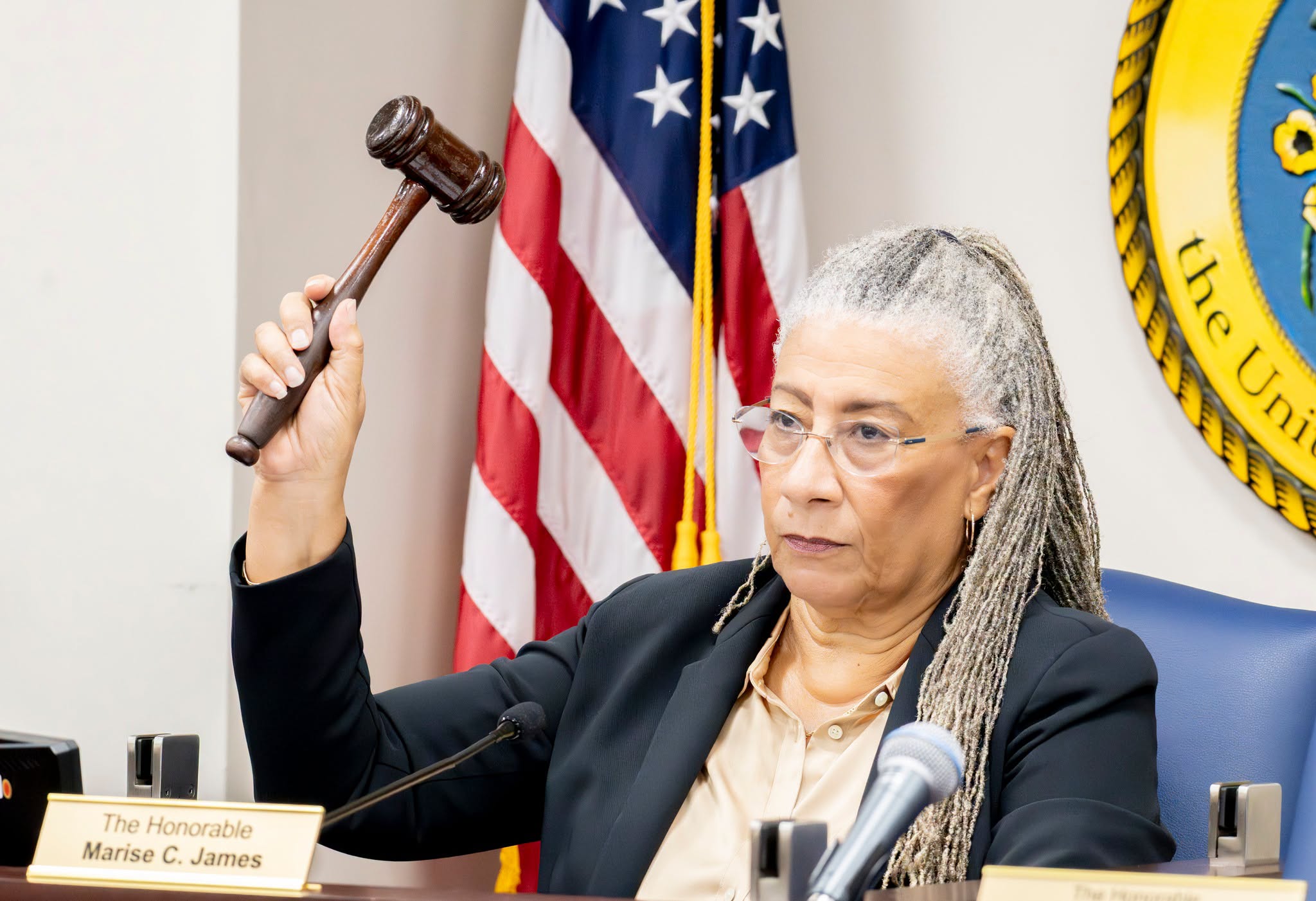
On Tuesday, the Senate Disaster Recovery, Infrastructure and Planning Committee reviewed territorial emergency preparedness, including emergency operations planning, agency coordination and hurricane readiness.
Emergency management, health, utility and law enforcement officials outlined improvements in hurricane planning and operations for the 2026 Atlantic season but also acknowledged continuing vulnerabilities in shelter staffing, hospital infrastructure and the electric grid.
Virgin Islands Territorial Emergency Management Agency Director Daryl Jaschen said the government recently completed a five-day hurricane exercise with federal partners, simulating a Category 3 storm striking St. John, with moderate damage on St. Thomas and minor damage on St. Croix.
A draft after-action report cited improvements in planning with federal partners and emergency operations coordination but also identified recurring issues, including underuse of the WebEOC incident management system, operational gaps on St. John, shelter staffing shortages, confusion at food and water distribution sites and communications problems.

“Before I saw my after-action review, I’d give us definitely a B-plus, but right now I’d give us a B-minus,” Jaschen said of the territory’s hurricane readiness entering the 2026 season. He said several findings in the draft after-action report “parallel gaps identified in past events, proving that priority recommendations from other reports have not yet been fully implemented.”
Jaschen said emergency operations centers are prepared, with contingency plans in place while the St. Thomas facility undergoes repairs. He urged residents to stock enough food, water and other basics to be self-sufficient for 10 days on St. John and about seven days on St. Thomas and St. Croix until supply chains recover after a hurricane.
Several senators questioned whether long-standing weaknesses identified after hurricanes Irma and Maria have been fully resolved, particularly involving shelter staffing, hospitals and emergency operations.
Assistant Human Services Commissioner Carla Benjamin said the territory can accommodate 2,209 people in shelters before a storm, but capacity drops to 1,136 after landfall because fire and health standards require about twice as much space per person for longer stays. She said about half as many people can be housed safely if shelters remain open for longer-term stays.
She also said shelter operations are coordinated through a 72-hour planning matrix with FEMA, the American Red Cross and the Education Department, and that water is pre-staged at shelter sites ahead of storms. Federal agencies have pre-positioned roughly 250,000 meals and about 500,000 liters of water in the territory, and pet sheltering options have been expanded at colocated shelters on St. Thomas and St. Croix.
Jaschen and Health Commissioner Justa Encarnacion said staffing remains a major constraint. Jaschen testified that a shortage of nurses could limit the government to opening only one shelter per island during a significant hurricane. Encarnacion said the Health Department has 23 nurses territorywide, with 18 available for medical special-needs shelters, and that officials are working with federal partners to secure additional clinical personnel if needed.
Benjamin also reported that 954 residents are enrolled in the territory’s elder and disabled disaster registry, a program created by law to track seniors and people with disabilities living alone. She said it is used to prioritize welfare checks and identify medically fragile residents who may need backup power if outages persist.
Hospital Chief Executive Officer Darlene Baptiste told lawmakers both Gov. Juan F. Luis Hospital on St. Croix and Schneider Regional Medical Center on St. Thomas continue operating from temporary hospital facilities established after the 2017 hurricanes.
She said JFL North was not designed as a permanent hospital and that, if a stronger storm threatens, inpatient care would be relocated into the Virgin Islands Cardiac Center, while outpatient dialysis currently provided in a temporary trailer remains a top clinical priority. Health officials also testified that the territory’s medical oxygen supply is one of its most significant vulnerabilities.
Encarnacion said SRMC can now generate medical oxygen on site, but JFL still depends on vendor deliveries that can be disrupted “when sea and airports close.” Baptiste added that an oxygen generator intended for St. Croix has not yet been installed and is still undergoing design and siting work.
Director of Water Distribution Don Gregoire told senators the utility has replaced 10,213 wooden poles with composite poles designed to withstand wind speeds up to 200 miles per hour and converted about 40% of critical portions of its electrical distribution system underground, reducing exposure to high winds and falling vegetation.
He said the authority’s financial position is its “most significant concern,” with limited cash reserves constraining WAPA’s ability to build emergency inventory to desired levels, purchase additional fuel reserves, accelerate fleet repairs, and maintain the financial flexibility needed to respond to multiple storms.
Adjutant General Maj. Gen. Kodjo S. Knox‑Limbacker told senators that a worst-case Category 4 or 5 hurricane would likely require about 989 additional Guard personnel from other states through the Emergency Management Assistance Compact.
He said deployment plans have been revised since 2017 to preposition Guard teams with vehicles and communications equipment at local police and fire stations across the islands rather than concentrating forces at armories, and that Guard personnel would work alongside the Virgin Islands Police Department on security, traffic control and support at distribution sites.
Several senators said the exercise findings underscored how much work remains since hurricanes Irma and Maria, pointing to recurring problems with shelter staffing, temporary hospital facilities, St. John logistics, communications, debris clearance and the power grid.