

The story about Gov. Albert Bryan Jr.’s Executive Order allowing for gender marker changes on government documents in the U.S. Virgin Islands is being picked up by several national LGBTQ+ news sites, garnering responses of both praise and, predictably, bigotry. While I believe there is room for optimism at this step, I am also feeling it is increasingly necessary to provide additional context gained through the answers provided by Government House to follow up questions, as there also appears to be a great deal of misunderstanding about what the EO actually does.
First, the ability to present a letter from a medical provider as justification for changes is only available to intersex people the way the EO is written — it does not apply to transgender or nonbinary people. This is great news for intersex people who can access and are receiving treatments. It is unclear, however, whether this was the intention of the EO or a result of misunderstanding about the differences between intersex, transgender, and nonbinary identities.
Second, the option to provide a judicial order as justification for changes does apply to trans and nonbinary people as well as intersex people, however, there is no local process for obtaining a judicial order — the expectation being that this would need to come from the Legislature enacting a bill specifying a process to follow. This option then is only available to people who have left the Virgin Islands and are living somewhere that does provide a process for obtaining a judicial order, which they can then use in the Virgin Islands.
While I applaud the administration for taking steps to support intersex, trans, and nonbinary people from or in the U.S. Virgin Islands, I find it frustrating that there is no process for trans and nonbinary people currently living in the USVI since they can use neither the provider option nor actually get a judicial order locally. I also think it’s important to note that not all trans, nonbinary, or intersex people need, want, or can access medical intervention (or access in the Virgin Islands), which means even the provider letter option applies to only some intersex people.

Gov. Bryan first tried to get gender marker changes addressed through the Legislature with Bill 35-0395. As I noted in my testimony to the Legislature in November 2024 when the Governor’s bill was heard, 21 states and Washington, D.C. do not require a medical provider’s certification, nor do they require a judicial order. It is an administrative process, not a medical or judicial one.
The governor even notes in his press release that administrative processes exist in 25 states, Puerto Rico, and D.C. for birth certificate changes and 30 states, Puerto Rico, and D.C. for driver’s license changes. Only the minority of these require a provider statement. So why wait for the Legislature to create more complicated procedures that create additional barriers rather than just adopt purely administrative processes?
So again, while I find it encouraging that the administration has taken these steps, I believe it is important to clarify the significant limitations in what the EO actually does. I also suggest the process could be easily simplified and made far more inclusive, particularly for trans and nonbinary people currently living in the territory.
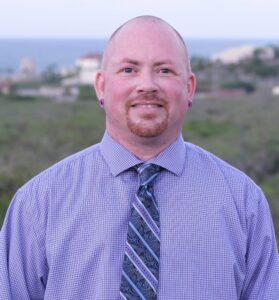
— Andrew Seeber, Ph.D., is an openly trans- and nonbinary-identified scholar and author of “Trans* Lives in the United States: Challenges of Transition and Beyond.” Dr. Seeber earned their doctorate in Sociology with a doctoral emphasis in Feminist Studies at the University of California, Santa Barbara. They have taught a variety of courses across Sociology, Social Work, Social Psychology, Gender, and Trans Studies. Their research focuses on the experiences of trans people throughout the life course, LGBTQ+ people from the Caribbean, and uses an intersectional approach to analyze areas such as family relationships, employment, health care, and strategies for managing difficult social contexts. Dr. Seeber is an Assistant Professor of Sociology at the University of the Virgin Islands and serves on the Board of Trustees for St. Croix Pride.