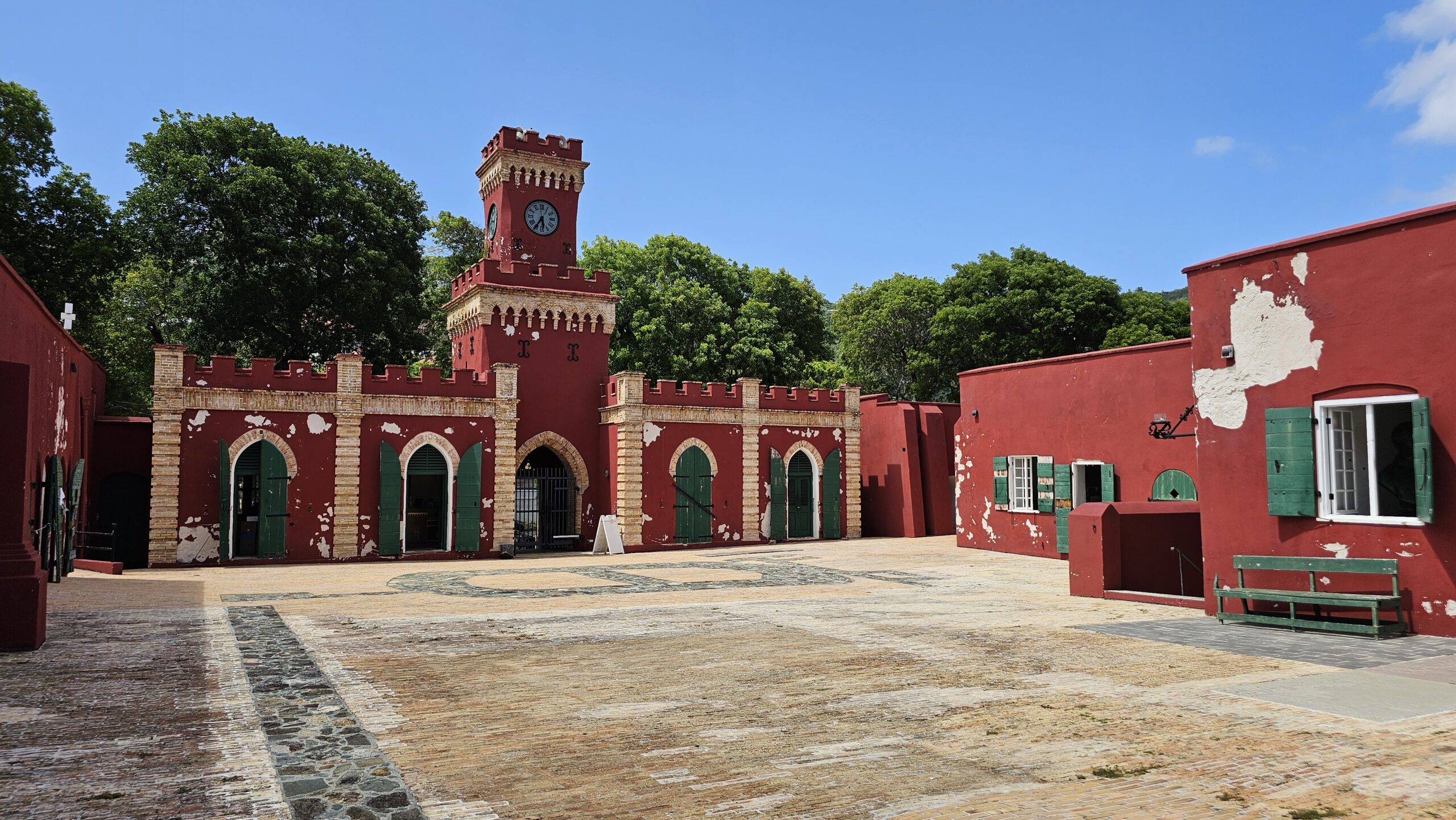
On Tuesday evening, the Virgin Islands Department of Planning and Natural Resources’ Division of Libraries, Archives, and Museums hosted a Microsoft Teams virtual town hall to gather community input on the design for the future of exhibits and visitor experiences at Fort Christian Museum on St. Thomas, marking an early step in a larger effort to reimagine the historic site. About 15 people were present.
Officials emphasized that the project is still in its conceptual phase and no date is set for the redesign. The department is hoping to gather feedback that upholds the perspectives and experiences of the people of the territory, dating back, of course, to colonial times.
Sean L. Krigger, director and Deputy State Historic Preservation Officer, said “that orientation is going to be critical,” highlighting the trans-Atlantic Slave Trade. “So we have a story to tell in terms of that history and those connections.”
“As you know, Fort Christian’s a historic treasure. It’s the oldest standing structure in the U.S. Virgin Islands, and it’s an icon that draws many people every year,” said main presenter, Monica Marin, Libraries, Archives and Museums chief curator.
The clock tower, chapel, and rooftop remain some of its unique architectural features. However, officials want solutions to challenges with the current design.
“The fort is mostly unconditioned in a salt sprayed, hot, and humid environment. Not all areas of the fort are accessible to those with mobility challenges. It’s also subject to storms. All these factors need to be considered when thinking about the visitor experience,” added Marin.
DPNR secured $500,000 in federal funding for the current planning phase, with additional grants needed to support future exhibit fabrication and installation. The funding is from the United States Department of Commerce, Economic Development Administration, under the Public Works & Economic Development Act of 1965 Award No. F2163. The funding will be shared with Fort Frederik. The department also contracted museum design firm Howard + Revis to assist with exhibit planning and development. Community feedback collected during the evening’s meeting and in surveys will help guide the ideas for seeking additional funding for the design and implementation. The survey will be open until Monday, July 6, for community input and feedback, but organizers are pushing to get responses by Wednesday, June 17.
Throughout the town hall, participants were introduced to a series of proposed exhibit themes that reflect the rich and complex history of the Virgin Islands. These topics include indigenous histories, migration and movement throughout the Caribbean, colonialism, resistance, emancipation, labor struggles, cultural creativity, environmental stewardship, and the transfer of the Virgin Islands from Danish to American control.
“Our three core groups of people are educational purposes, so students, visitors, and local residents,” said Marin.
Project planners also stressed the importance of centering local voices and perspectives. They questioned participants for their feedback on implementing 3D site models, mahogany furniture and artifact displays, tactile and touchstone props, special art shows or changing exhibits, and reinstating gift shops.
“Many areas of the fort will not be accessible by wheelchair users or those with physical limitations,” said Marin, so improvements in this area are welcomed, with suggestions for a phone or tablet-based digital tour. Audio stations, rotating exhibitions, and immersive projections were among the ideas discussed, as was an interest in commissioning local artists to create original, live-action works that help interpret Virgin Islands history and culture.
One participant, Edney Freeman, asked if and how St. John’s influence will be included and also questioned the “maroon community’s” inclusion. Marin responded that the 1733 uprising and the battery at Fortsberg will be highlighted at Fort Christian, along with the territorial marooning experiences.
“We want to emphasize that this is not by any means a final plan, but rather a starting place to better understand what you like, what you don’t like, and what you hope to see at the forts and as part of the larger interpretive narrative,” added Marin.
The meeting also explored a variety of potential exhibit strategies designed to create a more immersive and accessible visitor experience. Proposed features include augmented-reality tours, virtual access to areas inaccessible to visitors with mobility challenges, interactive touch exhibits, digital archives, oral-history recording stations, and immersive projections that bring historical events to life.
Throughout the discussion, DPNR leaders emphasized that community involvement is essential to the project’s success. Feedback gathered from residents, historians, educators, cultural bearers, and stakeholders will help determine which stories are prioritized and how they are presented.
A document of the virtual presentation can be found here.