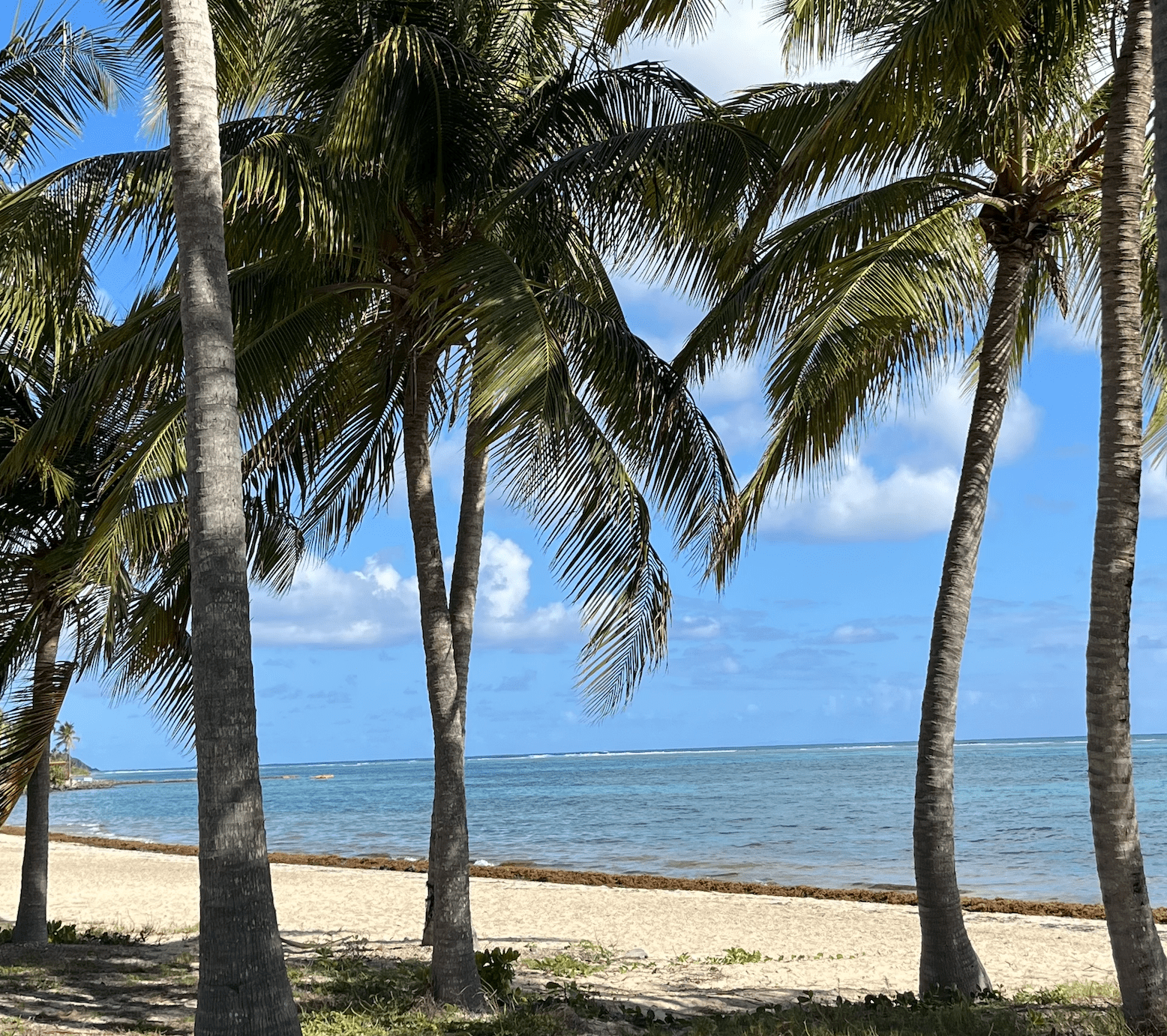
Sargassum levels across the eastern Caribbean and western Atlantic reached record highs in April 2025, with continued growth and coastal impacts expected into May. The increase raises the likelihood of beaching events across the region, including the U.S. Virgin Islands.
The record amount of sargassum detected was included in a sargassum outlook report released on April 30 from the University of South Florida Optical Oceanography Lab. The OOL at USF, which uses satellite imagery to monitor the presence of sargassum across the tropical Atlantic, Caribbean Sea, and Gulf of Mexico via satellite, has recently measured the gigantic increase in the amount of seaweed.
“As predicted the sargassum amount in each region (apart from) the east Atlantic increased in April,” the USF update said. “The increases in the Gulf and western Caribbean Sea were typical as in most previous years, but total amounts in the eastern Caribbean Sea and west Atlantic reached surprisingly high levels: they were both 200 percent higher than their historical records in April,” USF explained. “Similarly, the total amount of sargassum in all regions combined was 150 percent higher than the historical record in April.”
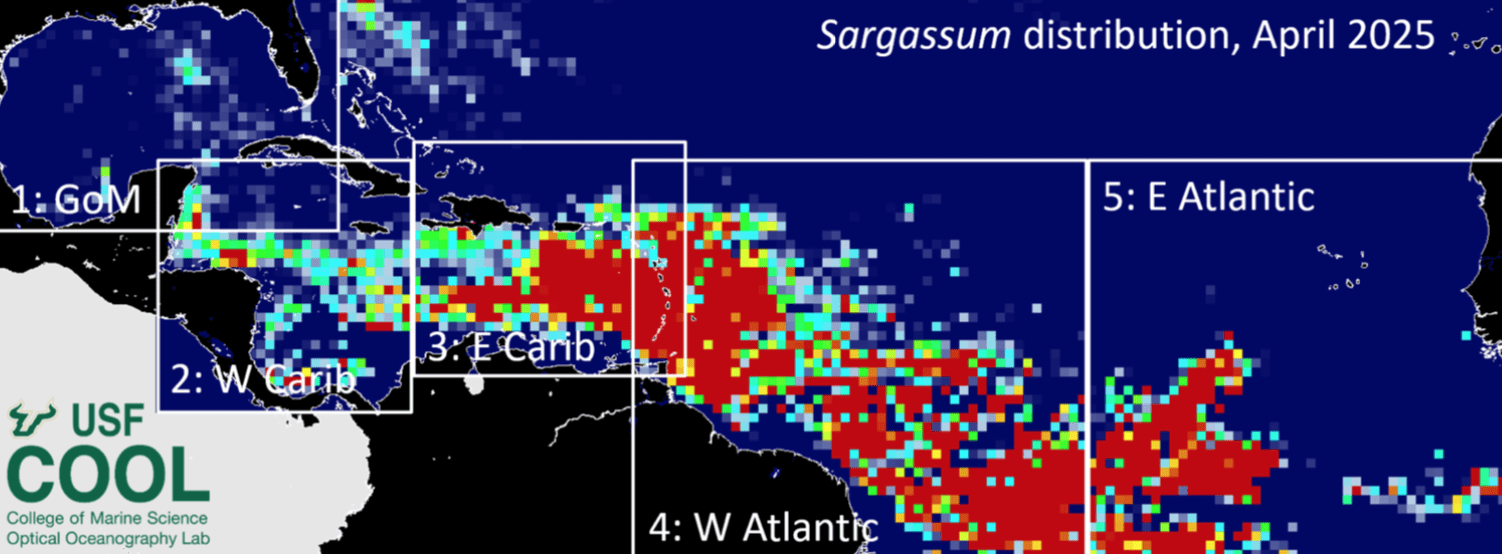
“Furthermore, this total amount was 40 percent higher than the all-time high in June 2022, which makes 2025 a record year,” USF noted. “Most of these increases are due to local growth and physical transport, but the exact reasons behind these new historical records need to be investigated,” USF continued.
Enormous Increase of Sargassum
Brian Barnes, Ph.D., an assistant research professor at the University of South Florida, provided the Source with more information about the large amount of sargassum and its potential effects on the U.S. Virgin Islands. Barnes emphasizes that more research is needed to understand the cause of the increase.
“Unfortunately, we do not have a good explanation for the significant increase of sargassum as the (report) states; this is an active area of investigation,” Barnes acknowledged. “In a broad sense, whenever a seed population meets appropriate conditions for growth, (such as the) temperature, nutrients, light regime, etc., there can be rapid biomass expansion,” Barnes explained. “This appears to be happening now in the eastern Caribbean, but the exact confluence of environmental factors is unknown,” he said.
Barnes noted that another area of ongoing research is the potential connection between cyclone development and the abundance of sargassum, including how factors such as ocean conditions and atmospheric changes might influence the amount of sargassum in the ocean.
“This is an active topic of research,” Barnes said. “Following previous hurricanes, we’ve seen both increases and decreases in sargassum abundance,” he added.
Although there has been a significant surge in sargassum, Barnes stated that much of the seaweed is currently not having a substantial impact on the U.S. Virgin Islands. However, that may change soon.
“While USVI has seen some sargassum aggregations reach shores, the vast majority of the biomass is further south (and west) in the Caribbean. We have reports from St. Croix and St. Thomas that sargassum inundations are picking up, and I’d expect this to continue into May and beyond. Water quality may certainly be impacted if/when larger aggregations begin to pile up and decay in nearshore environments, with follow-on impacts to marine life,” Barnes indicated.
The USF report noted that a NOAA-funded project to help detect sargassum is currently underway in areas of Florida, with plans to eventually expand to the local region.
“A NOAA-funded effort led to the development of higher-resolution sargassum maps for the lower Florida Keys and upper Florida Keys,” the USF report stated. “These new maps will be combined with circulation models to have a short-term forecast of sargassum transport, and such a capacity will be expanded to other regions in the near future.”
Barnes said that the NOAA sargassum detection system may ultimately be available across the U.S. Virgin Islands and Puerto Rico.
“We expect some of the high-resolution sargassum detection products we’re creating (with NOAA support) to be available very soon for the USVI,” Barnes explained. “The forecast model integration for Puerto Rico and the USVI will likely not happen until at least 2026,” Barnes admitted. “However, there are some coarser-resolution forecast products currently available from our partners, including these from the Caribbean Coastal Ocean Observing System and NOAA’s Atlantic Oceanographic and Meteorological Laboratory.”
More Sargassum Expected Across the USVI
According to the April 2025 sargassum update, residents and visitors across the USVI can anticipate more seaweed during the month of May.
“As in most previous years, May will likely see continued increases in most regions. More sargassum is expected to be transported to the west Caribbean Sea and then to the Gulf through the Yucatan,” the USF report predicted. “Sargassum inundation will continue to occur in most of the Caribbean nations and islands as well as along the southeast coast of Florida,” USF added.
Sargassum Explained
A previous Source article included additional information about sargassum through an interview with Yuyuan Xie, Ph.D., a research scientist at USF. Xie is involved with the university’s OOL.
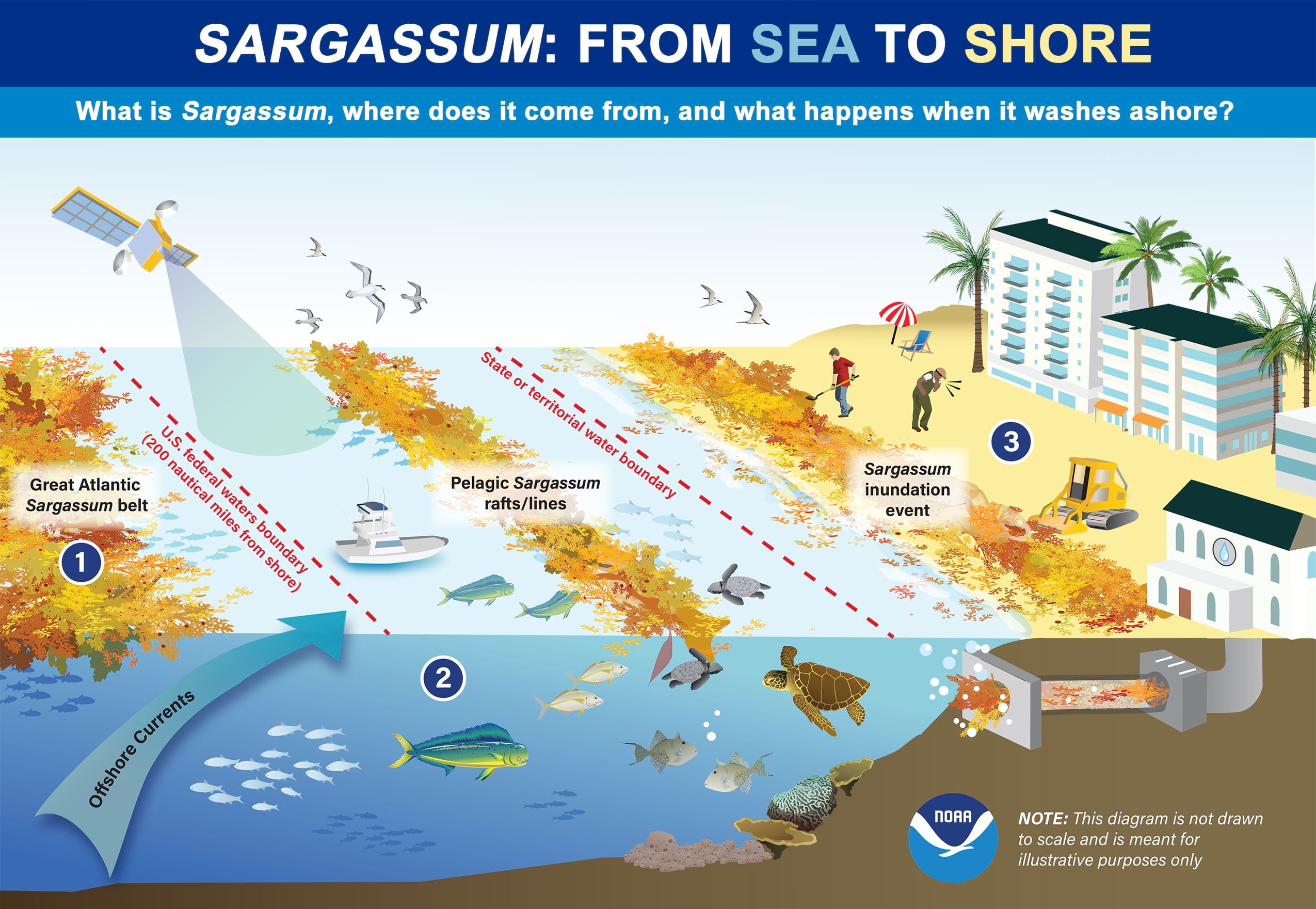
“Pelagic sargassum seaweed is a brown macroalgae floating on the ocean surface,” Xie said. “It was first reported in the 15th century by Christopher Columbus, and a regional sea in the North Atlantic Ocean, the Sargasso Sea, was named after this plant. Sargassum serves as a habitat for many marine animals, such as turtles, fish, shrimp, crabs, and so on. These macroalgae can grow to a length of several meters and form floating mats on the ocean surface,” Xie continued.
Health Impacts
Sargassum has positive and negative benefits for the environment. Fortunately, the arrival of the algae is not extremely dangerous to people. However, there are some significant health risks.
“Most of the time, moderate amounts on beaches would not represent a risk factor for humans. However, there are exceptions,” cautioned Xie. “After a couple of days onshore, sargassum starts to decompose and release noxious and stinking gases such as ammonia and hydrogen sulfide. The bad smell can cause respiratory problems. There are reports that in some of the Caribbean Islands, the hospitalization rate has gone up during the sargassum season,” he said.
“Sargassum can be both good and bad for the environment. In the ocean it is a critical habitat for many animals, so they should like to see increased sargassum. Sargassum on beaches can also stabilize sand dunes, thus helping to avoid beach erosion. But too much of a good thing can also make it bad — excessive amounts of sargassum can also cause environmental and economic problems,” Xie added.
“There is no scientific consensus on exactly what caused the sargassum increases in the past decade in the Atlantic Ocean, but climate change may be part of the reason, as it affects precipitation, ocean circulation, and dust events, among others. This is still a research topic,” according to Xie. The current predictions for a busy year of sargassum are based on statistical models rather than the exact causes of why the amount of seaweed is expected to increase.
Monthly Sargassum Updates
Individuals can follow the progression of the current mat of seaweed and stay up to date each month on where sargassum may be headed.
“For the general audience, we’re generating a Sargassum Outlook Bulletin on a monthly basis, which can be downloaded via accessing our Sargassum Watch System (SaWS) page,” Xie told the Source. “This bulletin provides a general picture of the current bloom conditions and future bloom probability for the regions under watch. The SaWS system also provides satellite imagery every day for the current sargassum situation, where a user can download the images and surface currents,” Xie concluded.