Sargassum levels rose again across the Atlantic and Caribbean in March, and researchers say more growth is likely in April. The latest bulletin from the University of South Florida’s Optical Oceanography Lab says the broader eastern Caribbean could continue seeing beaching events in the coming month.
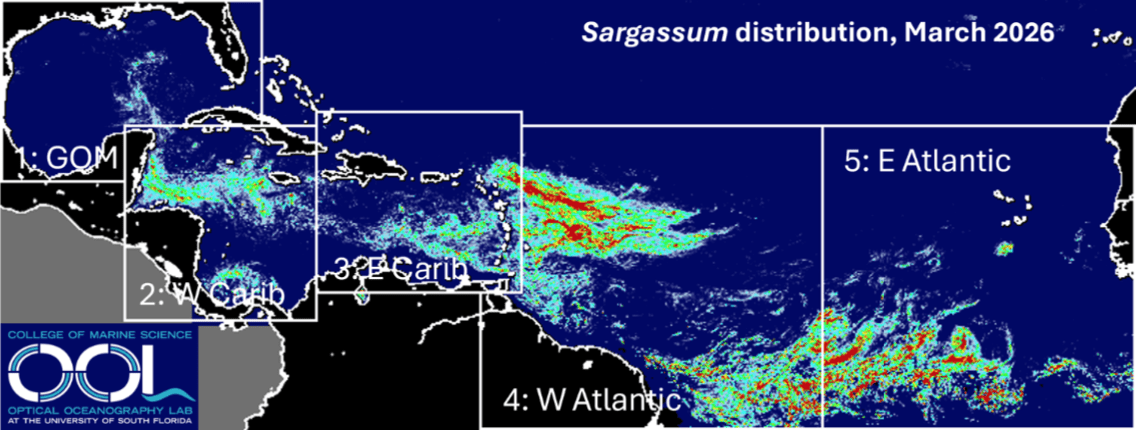
The OOL at USF monitors the presence of sargassum across the Atlantic, Caribbean, and Gulf regions using satellite imagery.
The Sargassum Bulletin released on March 31 by USF said that the seaweed continued to build across the region during March.
“As predicted in the February 2026 USF report, sargassum continued to grow and move to the west, resulting in increased sargassum amounts in every region shown in the map of monitored areas across the Atlantic and Caribbean,” USF explained. “Except for the eastern Atlantic region, every region continued to see record high sargassum amounts for the month of March,” the bulletin added.
USF also explained that “the distribution map continued to show three separated large masses in the Eastern Atlantic, Western Atlantic, and Western Caribbean, including the Gulf.”
Indeed, on the map included in the bulletin, a broad swath of seaweed was visible east of the Caribbean islands, with patches near Puerto Rico and the Virgin Islands. The report also stated that beaching events appeared to have occurred.
“Major beaching events appear to have occurred in the Western Caribbean, including Belize, Honduras, and the Mexican Caribbean coast, and around Lesser Antilles islands,” stated USF.
What is Sargassum?
According to the National Oceanic and Atmospheric Administration, sargassum plays an important role offshore as habitat for marine life, but it can also create problems when winds and currents carry large mats ashore.
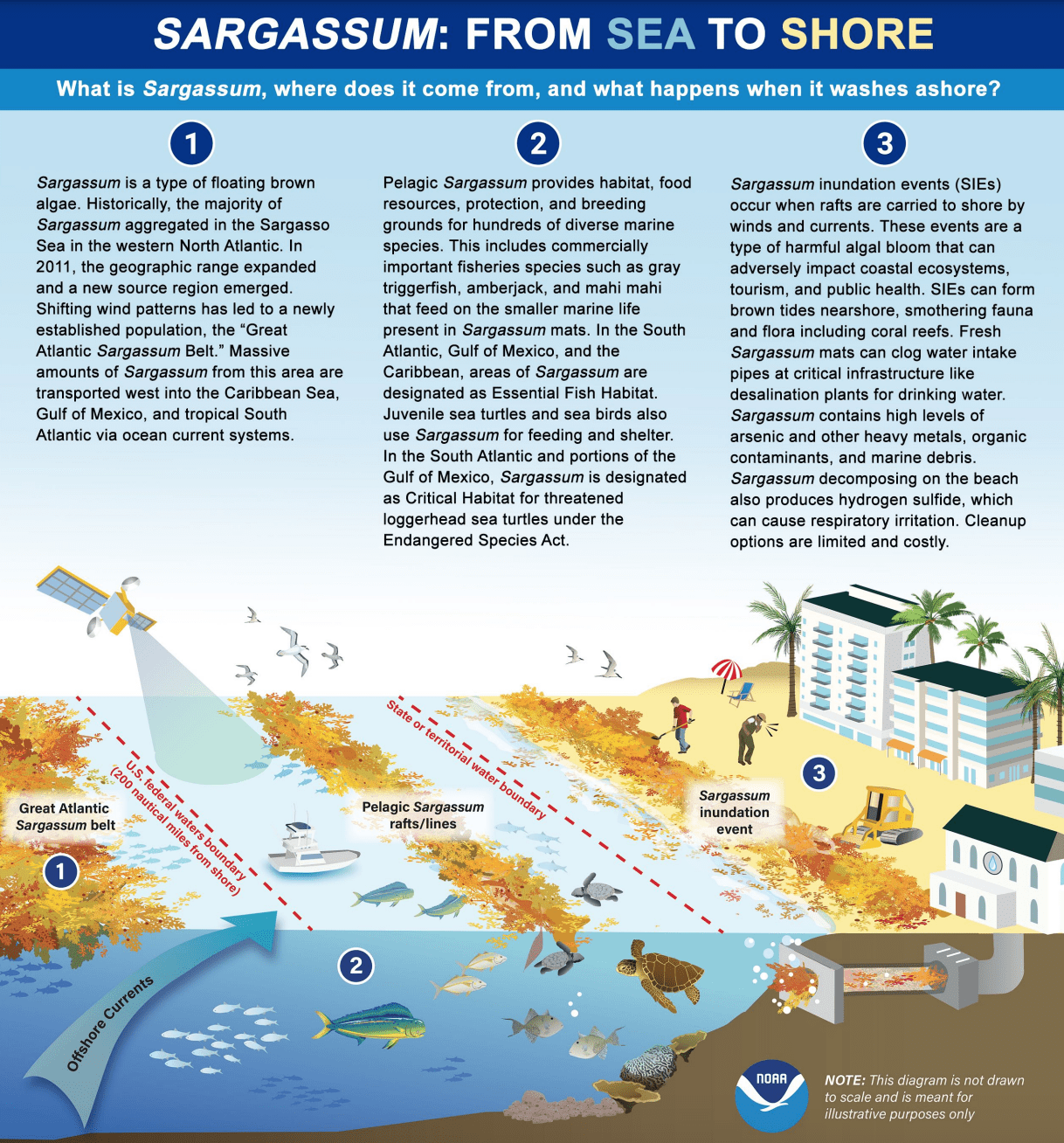
“Sargassum is a type of floating brown algae that provides food, protection, and habitat for many marine species. While sargassum plays an important role in the health and biodiversity of open ocean ecosystems, it can also be harmful in certain situations when rafts of this brown algae are carried to shore by winds and currents,” NOAA said.
Sargassum Across the USVI
The Source connected with Brian Barnes, Ph.D., an assistant research professor at USF, who provided additional insight about the increase in the algae, and what it might mean for the USVI.
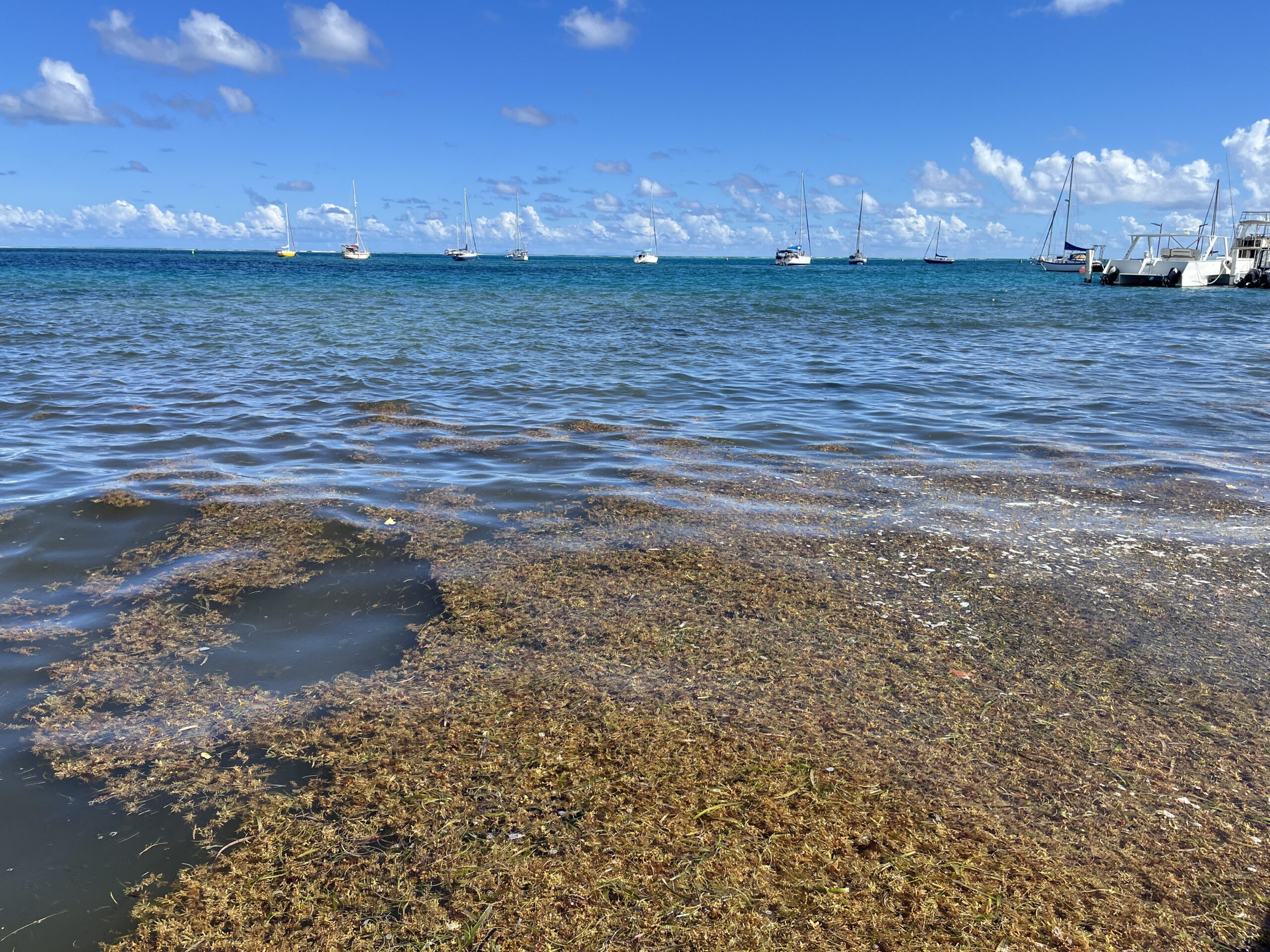
Barnes said the U.S. Virgin Islands do not appear to be in the worst location in the region right now in terms of receiving inundations of sargassum, although the eastern Caribbean outlook predicting more seaweed could still apply to the local islands.
“Given the current sargassum footprint, the U.S. Virgin Islands is in a better place compared to some of the eastern and Western Caribbean,” Barnes explained. “In a broader sense, the bulletin statements about the Eastern Caribbean can also apply to USVI specifically,” he continued.
Barnes also noted that larger climate patterns like El Niño, which is expected to develop and potentially become strong later this year, may have an influence on the transport and biomass of sargassum. However, he also said that localized factors such as winds, currents, and nearshore conditions are likely to play a bigger role in determining beaching risk in the territory.
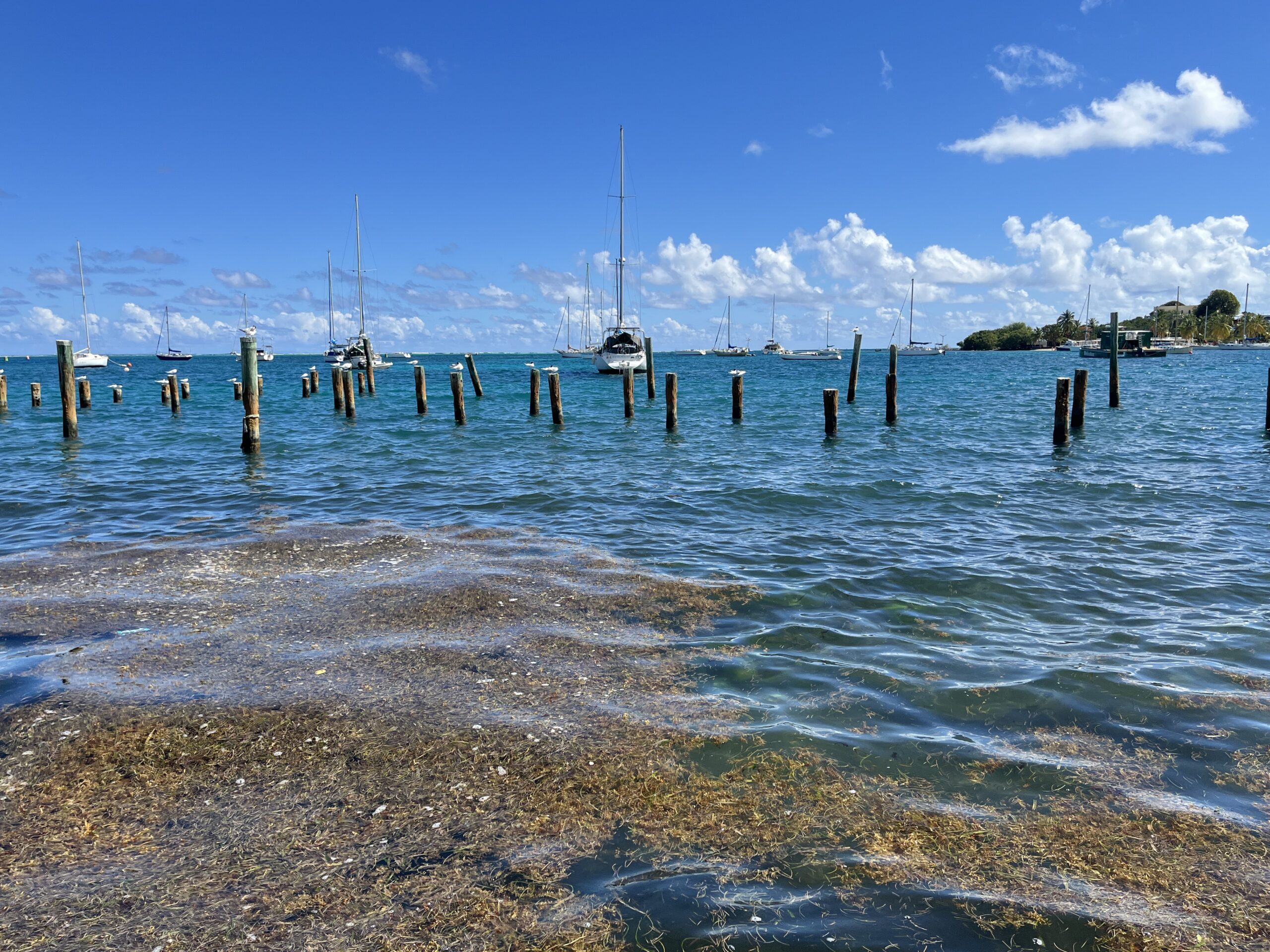
As reported in a previous Source interview with Amy Dempsey, a marine biologist and founder of the consulting firm Bioimpact Inc., officials in the territory have begun using floating barriers to divert incoming mats of sargassum before they reach the shoreline. The booms have shown promise in keeping beaches clearer, but they require constant upkeep due to strong currents and storm damage and must be removed ahead of approaching cyclones.
What’s Next
In its “Looking Ahead” section of the bulletin, researchers at USF emphasized that more seaweed should be anticipated across the Atlantic and Caribbean.
“Sargassum amount in most regions will continue to increase in the coming month,” USF warned. “Beaching events in both the Western Caribbean and the Eastern Caribbean will continue. The Florida Keys and southeast coast of Florida will likely see moderate beaching events in the coming month as sargassum in the Gulf will continue to be transported to these locations.”
“The year of 2026 is set to be another major sargassum year, meaning that total sargassum amount exceeds 75% of the historical values and likely to be a record year by summer 2026,” USF concluded.
Sargassum Updates
Individuals can follow the progression of the current mat of seaweed and stay up to date each month on where the algae may be headed.
Finally, in addition to monitoring sargassum, residents and visitors across the U.S. Virgin Islands are encouraged to follow the local weather forecast. Weather information is available from the NWS and NOAA. The local weather forecast for the U.S. Virgin Islands is regularly updated on the Source Weather Page, and individuals can also find helpful weather information and alerts from the Virgin Islands Territorial Emergency Management Agency.