


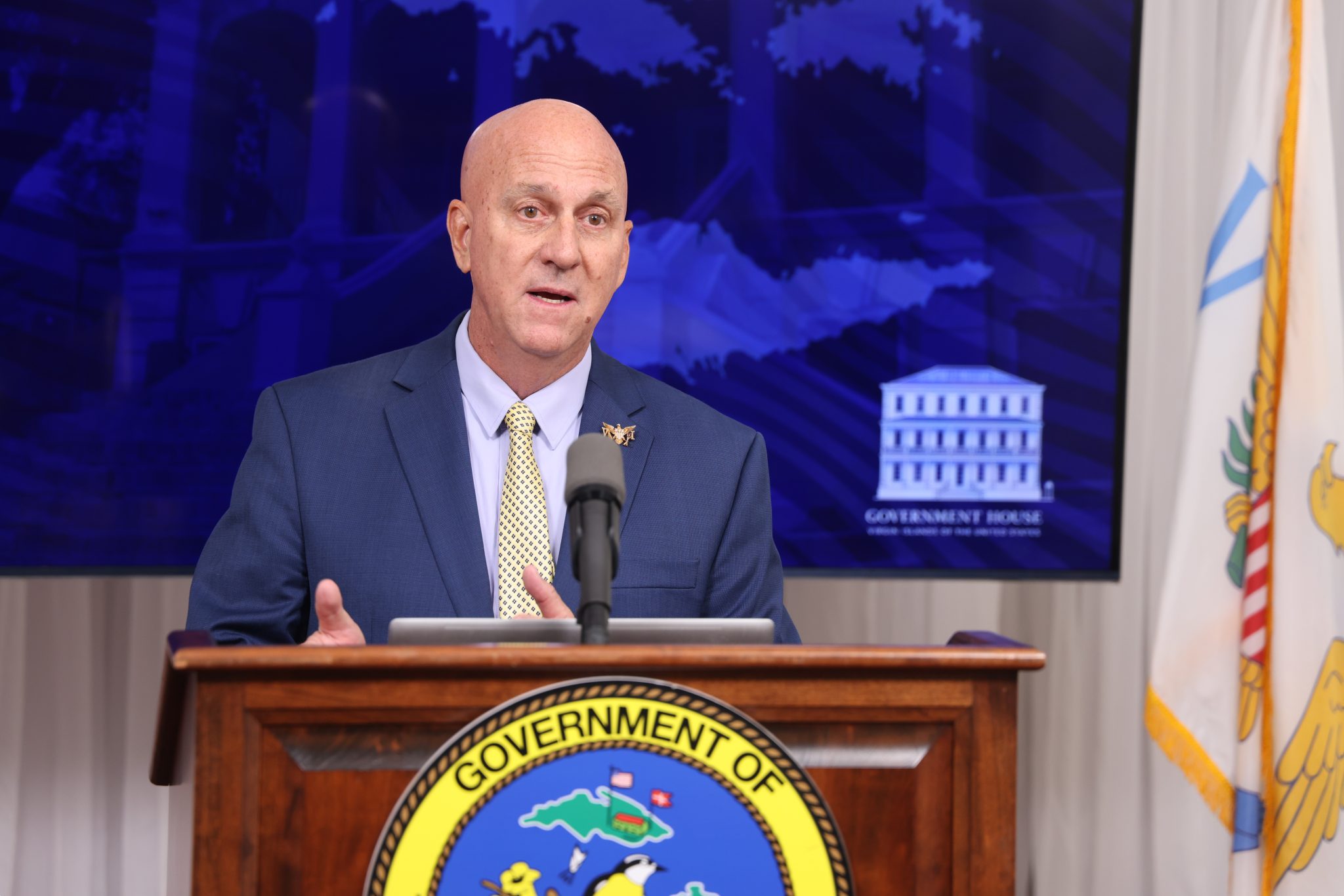
The 2026 Atlantic Hurricane season began last week, and officials Monday urged Virgin Islanders to make preparations ahead of what is forecast to be a summer with less-than-average storm activity.
V.I. Territorial Emergency Management Agency Director Daryl Jaschen said during a Government House briefing that the National Oceanic and Atmospheric Administration is predicting 8-14 named storms in the 2026 season. Between three and six of those could develop into hurricanes, and there could be up to three major hurricanes. Most of that activity is likely to occur in August, September and October, Jaschen said.
“First of all — and no surprise — we want you to reinforce and protect your home,” Jaschen said. “We want you to start now. Inspect your roof, your shutters and your windows. Make repairs before the storm develops, not after a storm is assigned. So please, take the initiative now.”
Jaschen also told residents to secure loose items around their property and make a plan if they intend to stay in a public shelter. Preparedness kits should include, at minimum, three to five days of water, nonperishable food, medications, cash, important documents, flashlights and batteries. For category three storms and above, Jaschen said Virgin Islanders should prepare to be self-sufficient for seven days and St. Johnians should have enough supplies for 10 days.
Shelters will open during major hurricanes at the Lockhart K-8 School on St. Thomas, at the Adrian Senior Center and V.I. Human Services Department Community Hub on St. John and at the D.C. Canegata Recreational Center and St. Croix Educational Complex on St. Croix.
This year’s hurricane season comes amid concerns about the federal government’s willingness to respond to natural disasters. Prior to resuming office, President Donald Trump expressed an interest in dismantling the Federal Emergency Management Agency in favor of state-level responders.
“I say you don’t need FEMA,” he said during a January 2025 press conference. “You need a good state government, and when you have a problem in Los Angeles or when you have a problem even in the state of California, you have your own — essentially — FEMA. You fix it yourself.”
Asked about the federal government’s posture Monday, Jaschen said the territory always takes the lead during emergencies and that its federal partners are “always here to support us … based upon our exhausting of our local resources.”
“The change has not happened at all,” he said. “The Stafford Act’s always been in place for that. As far as a local cost-share — that may change down the road, but that’s not my concern so much. My concern is making sure that the resources in front of us support the territory when emergencies do come.”
Monday’s briefing also fell on the same day the V.I. Port Authority responded to a recent letter signed by multiple major airlines that called the territory’s billion-dollar plan to overhaul its airports expensive and unsustainable. Interim VIPA Executive Director Ava Penn said in a statement that the Port Authority is “still in the active procurement process to finalize related agreements” with developer SkyCity and that “coordination and consultation with the airlines serving the U.S. Virgin Islands, who are key stakeholders in this process, are ongoing.”
“VIPA has long been in communication with the airlines regarding terminal modernization in the Territory, dating back to the 2018 planning and design charrettes for the Cyril E. King Airport and the Phase 1 Expansion of the hold room at Henry E. Rohlsen Airport, completed in December 2021,” according to the Port Authority’s statement. “Since December 2022, VIPA has engaged in numerous ongoing discussions with the airlines regarding the Authority’s P3 initiative, and we highly value their participation and input. We encourage all parties involved in the process to take part in the final stages of planning and the delivery of this transformative project.”
Asked about the dispute, Government House spokesperson Richard Motta Jr. said that “there are conversations being had” and “some alternative plans that are being floated” but that he was not able to discuss details.
Motta also had little to say about a separate letter from the St. Thomas Humane Society in which its president, Randolph Knight, excoriated the Virgin Islands government and Agriculture Department for failing to disburse more than $156,000 to cover animal services. Knight wrote that while the government allocation accounts for less than nine percent of the Humane Society’s budget, “this pittance still provides some needed relief.”
Animal shelters, according to the letter, “have been maligned, mistreated and taken advantage of for far too long. Most regrettably, all of the territory’s nonprofits are inadequately and inconsistently funded and disrespected while they still somehow find a way to provide the services abysmally neglected by the VI Government.”
Asked about funding bottlenecks Monday, Motta said nonprofits that provide services have to meet a number of requirements in order to receive their allotments.
“And so I don’t know if there’s a discrepancy on either side that’s preventing that or creating that bottleneck, but I know that the government is well-intentioned in providing that support — and hopefully can work out whatever discrepancies that there are to make sure that those necessary functions are funded appropriately,” he said.